
True Summer Celebrities and Why
 Reviewed by Alexandra Gilmore
Celebrity photos can illustrate True Summer coloring, but styling, lighting, and editing make them unreliable proof of anyone's season. Learn which cool, softened, medium-contrast patterns are worth noticing, then translate dusty rose, soft navy, berry, and silver-gray references into tests on your own face.

True Summer celebrities can be useful when you want to understand what cool, softened, medium-contrast coloring looks like in real life. The important caveat is simple: public figures are visual references, not proof. A celebrity can show you how soft navy, dusty rose, cool berry, and silvered gray behave on a similar feature pattern, but your own season still has to be checked on your face.
True Summer and Cool Summer are often used for the same palette. Some systems call this season True Summer because it is the central Summer type. Other systems call it Cool Summer because cool undertone is the dominant trait. In both cases, the practical profile is the same: cool undertone, softened chroma, and low-to-medium or medium contrast.
This guide uses celebrity inspiration carefully. It explains the naming overlap, gives visual profiles you can verify in photos, compares True Summer with Soft Summer and Light Summer, and shows what to do next if a famous example feels close but not exact.
Key Takeaways
- True Summer and Cool Summer usually describe the same season. The label changes by framework, but the palette is cool, soft, and moderate in contrast.
- Celebrity inspiration is a reference point, not a diagnosis. Lighting, makeup, hair color, retouching, and styling can all change how a public figure reads.
- Look for repeatable feature behavior. True Summer coloring usually looks clearer in cool gray, soft navy, powder blue, dusty rose, mauve, and blue-based berry.
- Compare neighboring Summers before deciding. Soft Summer is more muted and blended. Light Summer is lighter and more delicate. True Summer is the coolest and slightly more defined of the three.
- Use a season quiz or controlled draping for your own result. A celebrity reference can sharpen your eye, but it cannot replace a test that reads your undertone, value, and contrast together.
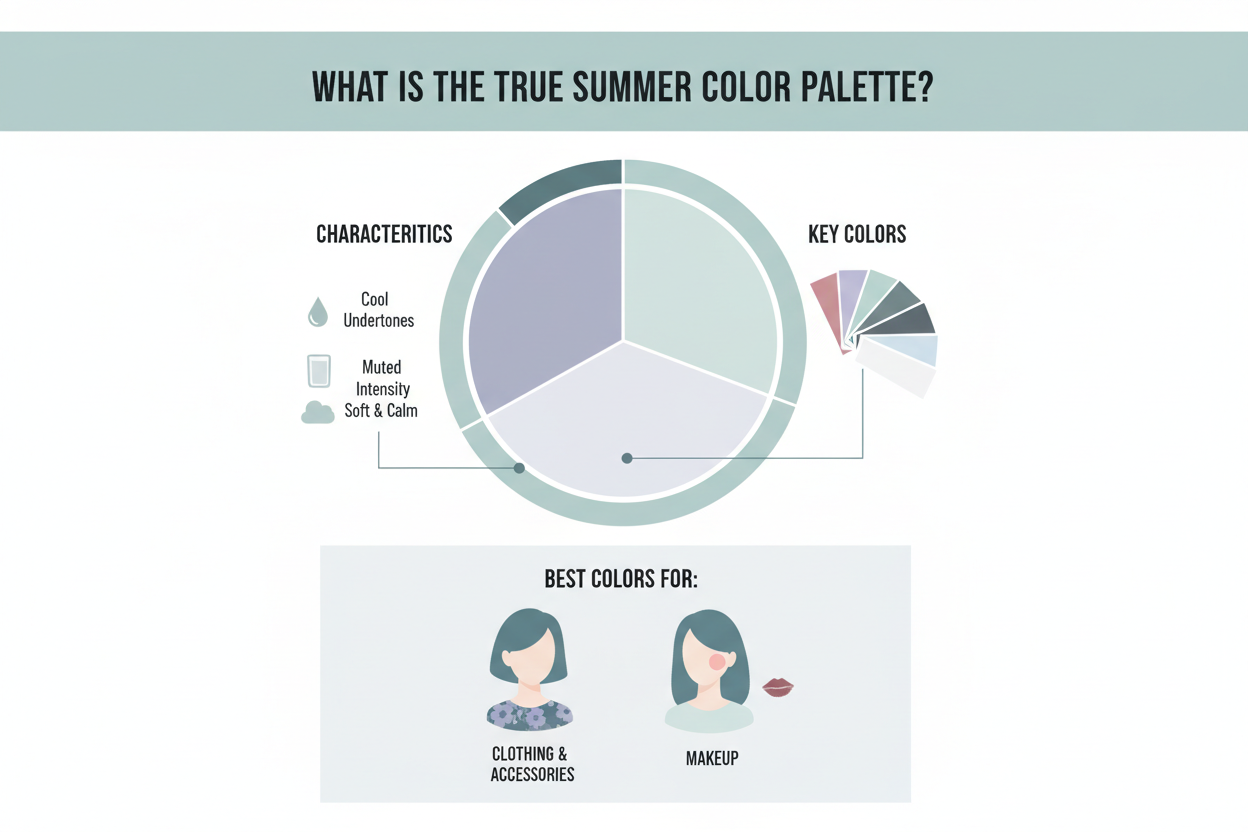
True Summer and Cool Summer: When the Names Mean the Same Thing
The name confusion is real. In many 12-season systems, the middle Summer subtype is called True Summer. In many 16-season systems, the same idea appears as Cool Summer. The word True points to the central version of the season family. The word Cool points to the strongest visible trait.
That means a page about Cool Summer celebrities can overlap heavily with True Summer examples. The difference is usually language, not a different body of color advice. Both labels describe people whose coloring is cooler than Light Summer, clearer than Soft Summer, and softer than Winter.
The easiest way to keep the labels straight is to focus on the three variables below.
| Variable | True Summer Signal | What It Rules Out |
|---|---|---|
| Temperature | Clearly cool or neutral-cool, with a blue, rose, or gray cast rather than peach or gold. | Warm Spring and Autumn directions. |
| Chroma | Softened, not icy, neon, earthy, or muddy. | Bright Winter, Bright Spring, and very dusty Soft Summer extremes. |
| Contrast | Low-to-medium or medium contrast between skin, hair, and eyes. | High-contrast Winter and very delicate Light Summer results. |
How to Use Celebrity Inspiration Without Misdiagnosing Yourself
Celebrity examples are tempting because they make the season feel concrete. They are also easy to misuse. A red-carpet photo may include professional lighting, bronzer, a temporary tan, dyed hair, colored contacts, or a dress chosen for brand impact rather than personal color harmony. None of that makes the example worthless. It just means you should study patterns, not single images.
Use a celebrity as a visual vocabulary tool. Ask what happens when the person wears cool blue instead of orange, soft gray instead of camel, muted berry instead of tomato red, or silver jewelry instead of heavy yellow gold. If the cooler and softened choices repeatedly make the face look calmer and more even, the image is useful for understanding True Summer behavior.
Do not ask whether your face looks like theirs. Ask whether your colors react in the same way. That shift keeps the comparison practical and kinder.
💫 Discover Your Complete Color Palette
Celebrity examples can narrow the field, but your best result comes from your own undertone, contrast, and feature pattern.
Take the Season QuizVisual Profiles That Often Point Toward True Summer
The most reliable True Summer clues are not a single hair color or eye color. They are combinations. A True Summer might have ash brown hair and blue-gray eyes, but another person might have cool dark blonde hair, muted green eyes, and rose-beige skin. The common thread is not one feature. It is the way every feature stays cool and gently softened.
| Visual Profile | What to Look For | Best Test Colors |
|---|---|---|
| Ash brunette with cool eyes | Medium ash brown hair, blue-gray or cool green eyes, and rose or neutral-cool skin. | Soft navy, smoky blue, slate, dusty rose. |
| Cool dark blonde with soft contrast | Hair reads beige-ash or mushroom rather than golden, and facial contrast stays moderate. | Powder blue, cool taupe, mauve, rose-gray. |
| Muted cool brunette with brown eyes | Brown eyes can fit when they read soft and cool, without amber or golden warmth. | Blue-based berry, lavender gray, charcoal navy. |
| Cool olive or rose-beige complexion | Skin may not look pink, but warm camel and orange still make it look heavier or flatter. | Cool gray, muted teal, soft white, plum. |
If a public figure or your own features match one profile, do not stop there. Test the colors. True Summer is visible when cool softened colors make the face look balanced and warm or very bright colors create distraction.
True Summer Celebrity Inspiration by Feature Pattern
Because celebrity color analysis is not an official public record, the safest wording is inspiration, not certification. Names such as Kate Middleton, Emily Blunt, Emily DiDonato, and Olivia Wilde are often discussed in the True Summer or Cool Summer space because their public images frequently show cool-toned, softly defined coloring. Treat those names as study prompts, not verdicts.
A useful exercise is to search for the same person in several types of styling: a cool navy outfit, a dusty rose or mauve look, a black look, a warm orange or camel look, and a soft gray look. You are not looking for one flattering photograph. You are looking for repeated color behavior.
| Inspiration Type | Useful Celebrity Reference | What to Study |
|---|---|---|
| Classic cool brunette | Kate Middleton is frequently cited in Cool Summer discussions. | How soft navy, cool blue, berry, and gray look calmer than orange, camel, or heavy black. |
| Soft cool brunette model look | Emily DiDonato is a useful reference for cool, muted, medium contrast styling. | How cool makeup and muted clothing support the face without creating hard contrast. |
| Cool dark blonde or light brown | Emily Blunt is often used as a cool, softened reference, depending on hair color era. | Whether ashier hair and cool rose makeup look more natural than warm gold styling. |
| Cool eyes with moderate contrast | Olivia Wilde is sometimes discussed near Summer because of cool eyes and softer color response. | Whether the best looks stay cool and softened or need more Winter-level contrast. |
Those examples are intentionally cautious. A public figure may be styled across many palettes for work. The point is to train your eye on temperature, softness, and contrast, then move back to your own drapes.
True Summer vs Soft Summer and Light Summer
Most True Summer confusion happens inside the Summer family. If the palette is clearly cool but something still feels off, compare True Summer with Soft Summer and Light Summer. You can also use the dedicated Soft Summer vs True Summer and True Summer vs Light Summer comparisons for a tighter check.
| Season | Dominant Quality | Celebrity-Inspiration Clue | Best Color Test |
|---|---|---|---|
| True Summer | Coolness first, softness second. | Cool colors look settled and medium-depth colors still work. | Soft navy vs slate blue vs dusty rose. |
| Soft Summer | Muted softness first, coolness second. | Too much clarity or blue coolness can look slightly sharp. | Rose taupe vs mushroom vs muted sage. |
| Light Summer | Lightness first, coolness second. | Medium navy or plum can feel heavy, even when cool. | Powder blue vs misty aqua vs light rose. |
When you compare celebrity examples, do the same thing. A Soft Summer reference may look more hazy and neutral, while a Light Summer reference may look airier and more delicate. True Summer sits in the middle, with the strongest cool signal.
Hair, Makeup, and Wardrobe Takeaways
True Summer style works when every choice respects coolness and softness. Hair looks most believable when it stays ash, mushroom, beige-cool, or cool brown rather than gold, copper, or heavy espresso. Highlights should be fine and cool, not chunky or caramel.
Makeup usually works best in rose, mauve, muted berry, cool pink, taupe, soft charcoal, and blue-gray. A True Summer red should be blue-based and softened. Tomato red, orange coral, bronze shadow, and warm terracotta usually pull attention away from the face.
In clothing, the strongest anchors are soft navy, blue-gray, cool taupe, rose-brown, slate, soft white, dusty rose, lavender, muted teal, and blue-based berry. Black can be useful away from the face, but it often looks harder than the person wearing it. Camel, mustard, pumpkin, and warm olive usually create the wrong kind of warmth.
When a Celebrity Reference Is Not Enough
A celebrity reference is not enough when your own results change by lighting, makeup, tan, hair dye, or camera settings. It is also not enough when two neighboring seasons both seem plausible. That is a sign to move from browsing to controlled testing.
Try a short sequence in indirect daylight: soft navy, cool gray, dusty rose, muted teal, warm camel, orange, black, and icy white. The better colors should make the skin look more even, keep the eyes connected to the face, and reduce shadows around the mouth and nose. The weaker colors may make the face look separate from the outfit, flatter in tone, or unnecessarily tired.
Do the test with hair pulled back if your hair is dyed warmer or darker than your natural base. True Summer can be hidden by caramel highlights, bronzer, self-tanner, or a very black top because those choices add temperature or contrast that the natural coloring may not have. If you are comparing yourself with a famous person, use makeup-free or low-makeup references for your own test first, then look at styled images only after you know what your face does with fabric.
It also helps to separate admiration from evidence. You may love the wardrobe of a celebrity who is much brighter, warmer, or higher contrast than you. That does not mean the colors are wrong for your taste. It only means they may not be the easiest colors near your face. Keep the style idea, then translate the shade: black becomes soft navy, orange-red becomes muted raspberry, camel becomes cool taupe, and bright white becomes soft white.
Write down the result instead of trusting memory. A simple note such as "soft navy reduced shadows, camel made skin yellow, black separated from face" is more useful than a folder of saved celebrity looks. After three or four notes, the pattern usually becomes obvious and much easier to repeat when shopping for clothes.
If the cool softened group wins but you still cannot choose between True, Soft, and Light Summer, take a structured season quiz. It can sort the same variables in a consistent order instead of relying on whichever celebrity image you saw last.
People Also Ask
Is True Summer the same as Cool Summer?
In most practical color analysis content, yes. True Summer and Cool Summer are often used for the same palette: cool undertone, softened colors, and moderate contrast. The name depends on the framework.
Who are common True Summer celebrity examples?
Kate Middleton, Emily DiDonato, Emily Blunt, and Olivia Wilde are often used as True Summer or Cool Summer inspiration in online color analysis discussions. Use them as visual references, not as confirmed personal analyses.
Can a True Summer have brown eyes?
Yes. Brown eyes can fit True Summer when they read soft and cool rather than amber, golden, or high-contrast. The overall feature relationship matters more than eye color alone.
What colors should I test if I think I am True Summer?
Start with soft navy, smoky blue, cool gray, dusty rose, mauve, muted teal, lavender, and blue-based berry. Compare them against camel, orange, mustard, tomato red, crisp white, and heavy black.
📚 Recent Articles
Common Questions: The Ultimate Color FAQ
How do I know if a celebrity is really a True Summer?
You usually cannot know with certainty unless the person has shared a credible professional result. What you can do is study visible color behavior across many images and ask whether cool, softened, medium-depth colors repeatedly look more harmonious than warm, bright, or stark colors.
What is the strongest True Summer feature?
Cool undertone is the strongest signal. Softness and moderate contrast matter too, but if coolness is not visible in the skin, hair, eyes, and best clothing colors, another season is more likely.
How is True Summer different from Winter?
Winter is cooler but clearer and higher contrast. True Summer is cool too, but its colors are softened with gray and its facial contrast usually looks moderate rather than sharp.
Should I copy a True Summer celebrity wardrobe?
Use it as a color study, not a shopping list. Your lifestyle, contrast level, skin depth, and personal style still matter. Copy the color logic, then choose pieces that fit your own wardrobe.
What should I do if I look close to several Summer celebrities?
Move from inspiration to testing. Compare True Summer, Soft Summer, and Light Summer drapes in the same light, with the same makeup level, and note which group makes the face look most even and connected.