
True Summer vs Light Summer
 Reviewed by Alexandra Gilmore
True Summer and Light Summer share cool softness, yet Light Summer needs more brightness and less depth near the face. Compare medium cool blues and roses with their lighter, airier versions, then watch whether your features gain definition or disappear before choosing clothes, makeup, and hair.

Both True Summer and Light Summer belong to the same cool, soft family—yet wearing the wrong one can leave your complexion looking washed out or unexpectedly harsh. If you've taken a seasonal color quiz and landed somewhere between the two, you're not alone. The boundary between these subtypes is genuinely subtle, and even experienced analysts pause over it.
💫 Explore Seasonal Color Analysis
Use the distinctions in this article to narrow the possibilities, then compare the seasonal system as a whole. Seeing the neighboring palettes together makes the result easier to test in real clothing and daylight.
Learn Seasonal Analysis →This guide cuts through the confusion. Here's what you'll walk away knowing:
- The defining traits of each season—skin, hair, eyes, and overall contrast level
- The core palette difference and why it matters for everyday dressing
- The most common mistyping traps and how to sidestep them
- Practical next steps to confirm which Summer subtype is actually yours
The Summer family as a whole shares three hallmarks: cool undertones, low-to-medium depth, and muted, softened color. True Summer sits at the center of that family, balancing all three qualities equally. Light Summer leans into the light dimension—its coloring is softer and lower in contrast than True Summer's, with a nudge toward neutral-cool rather than purely cool undertones.
Understanding that single distinction—depth and intensity—is the thread that runs through every comparison on this page.
What True Summer and Light Summer Have in Common
True Summer and Light Summer are easy to mix up because they share the same foundation. Both sit inside the Summer family, which means both are cool, light, and soft. Neither type suits warm or earthy tones. Both look best in colors that call to mind a midsummer landscape bleached by heat haze—nothing sharp, vivid, or heavy.
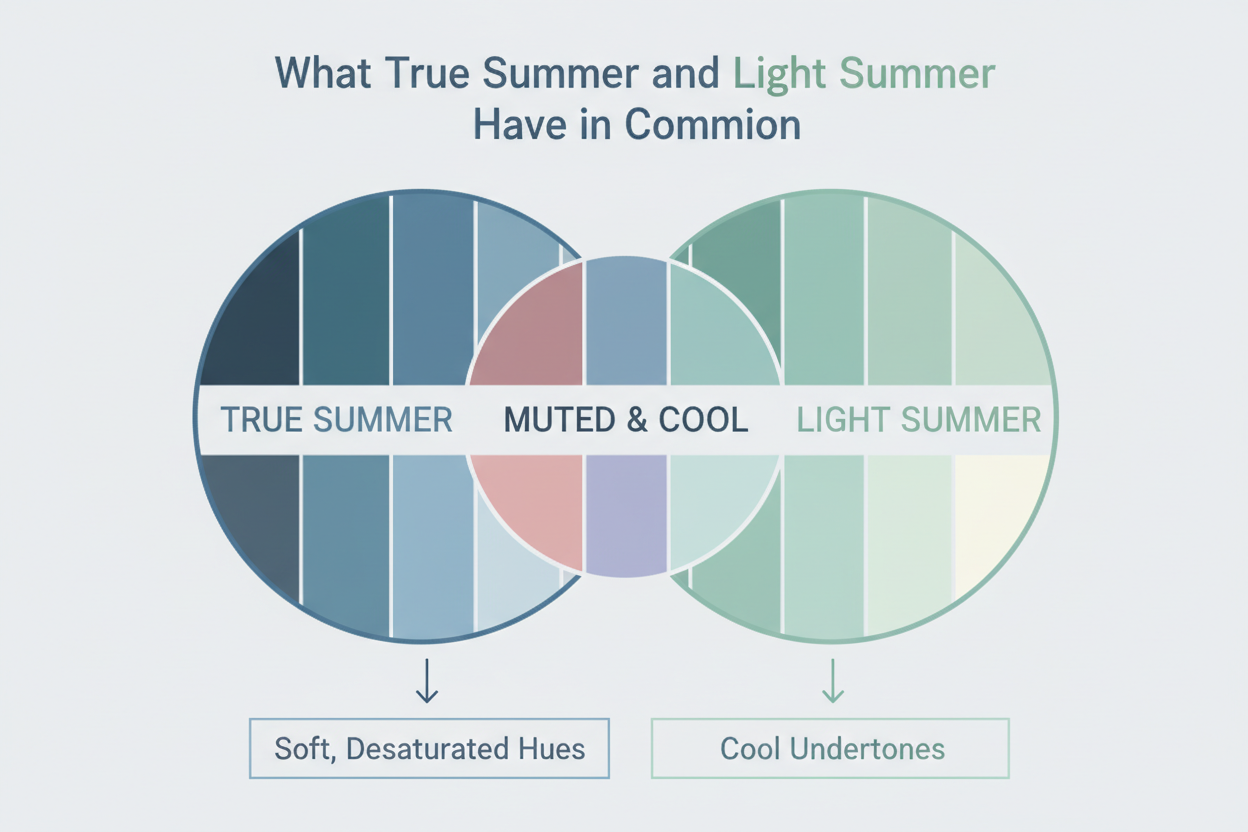
That's exactly what makes the distinction tricky. If you've confirmed that cool tones suit you, that lighter shades work better than dark ones, and that anything warm or earthy looks off on you, you've placed yourself in the Summer family. The harder question—which Summer?—is what this guide works through.
Both types also share a low-to-medium contrast level between skin, hair, and eyes. There's none of the dramatic dark-hair-and-pale-skin contrast you'd see in a True Winter, and none of Autumn's warm richness. The coloring tends to look blended and harmonious rather than defined and striking.
The Core Difference: Undertone Depth and Color Intensity
What separates True Summer from Light Summer comes down to one axis: undertone purity and color intensity.
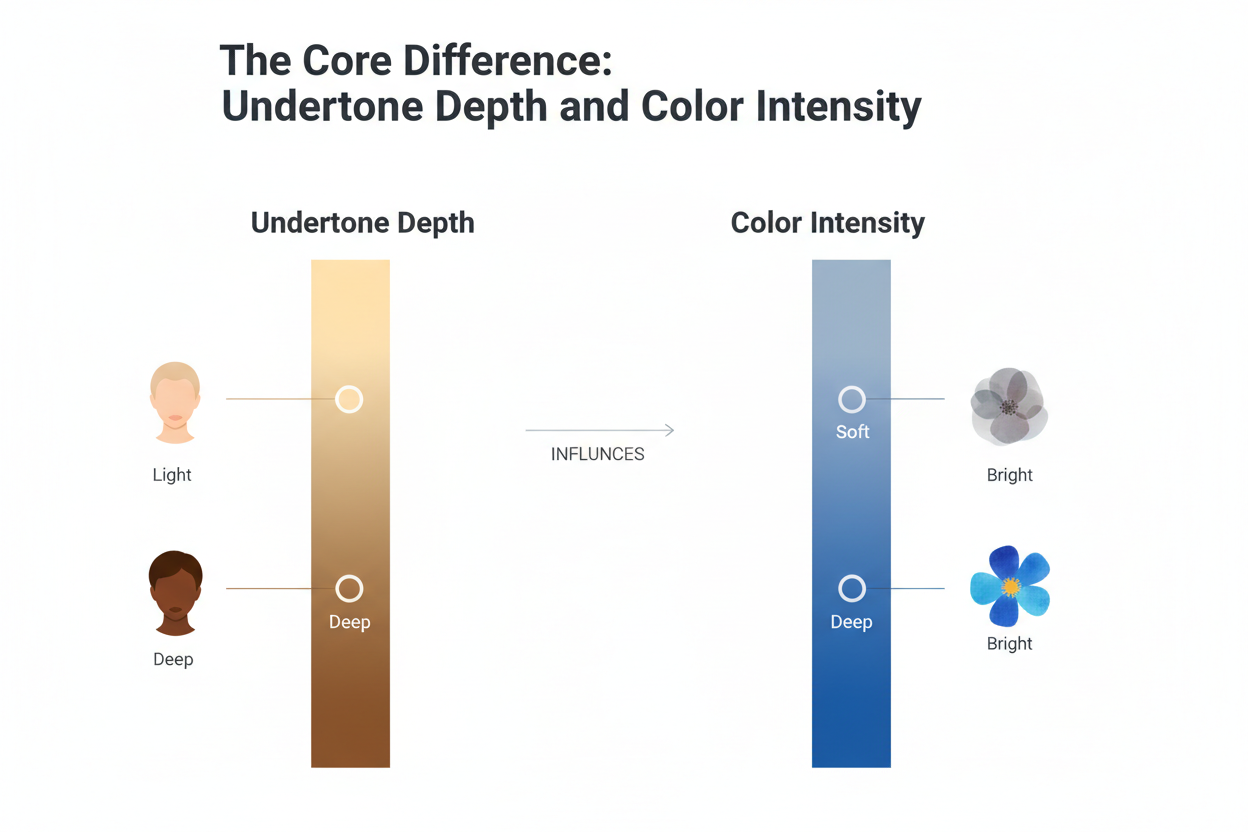
True Summer has a purely cool undertone with no warm or neutral inflection. Because that coolness runs all the way through, True Summer can carry slightly deeper and more saturated muted shades without looking overwhelmed.
Light Summer blends cool with a neutral undertone. The cool quality is still present and primary, but there's a gentle neutral softness woven in. More importantly, lightness is the dominant characteristic — Light Summer coloring sits at a lower depth and lower contrast level than True Summer's.
Think of it this way: True Summer's palette is muted but can go a little deeper. Light Summer's palette is muted and must stay lighter and lower in contrast. Put a Light Summer in True Summer's medium-depth dusty rose or slate blue and the color can overpower the complexion. Put a True Summer in Light Summer's palest lavender blush and the color may wash them out.
That single distinction — pure cool and medium-light versus neutral-cool and light — is the lens to apply to every comparison that follows.
True Summer at a Glance: Coloring Traits and Best Colors
Physical characteristics
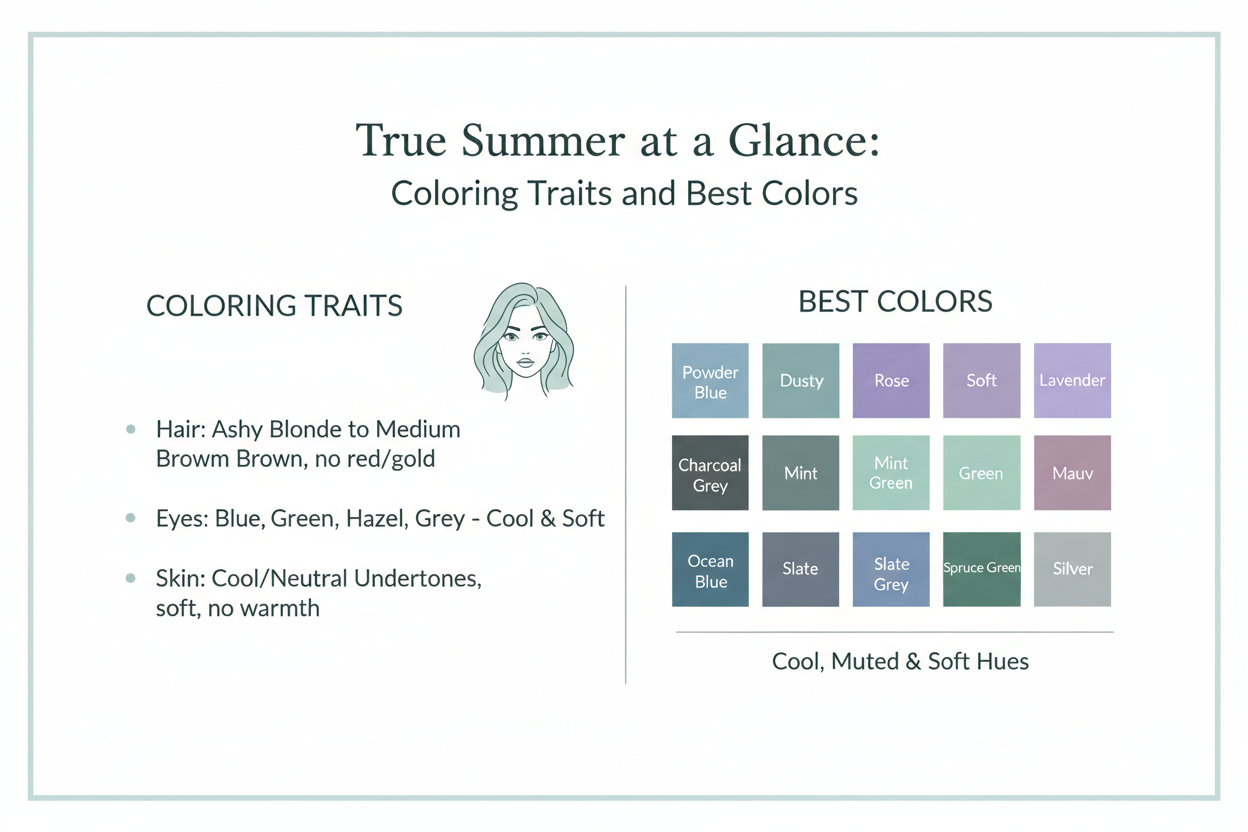
True Summer sits at the heart of the Summer family, combining the full set of Summer qualities in balance: coolness, softness, and mutedness. The overall effect is harmonious and understated.
- Skin: Cool-toned, often with a pink or rosy undertone; may read slightly ruddy or grayish in some lights; medium-fair to medium depth
- Hair: Ash brown, ash blonde, or mousy brown with no golden or red warmth; tends to look cool and flat in color
- Eyes: Blue, gray-blue, gray-green, or soft hazel with a gray quality; soft rather than bright or piercing
- Overall contrast: Low to medium — hair and skin sit close in value; nothing stands out sharply
Best colors
True Summer's palette comes from the faded, blended tones of a late-summer landscape: softened, muted, and cool. Colors are hushed but not washed out — present enough to register without any vibrance.
- Dusty rose, muted raspberry, and soft berry
- Slate blue, powder blue, and cool gray-blue
- Lavender and soft purple
- Soft teal and muted seafoam
- Cool gray and blue-gray neutrals
- Soft white with a cool, slightly gray cast (not bright white or cream)
Colors That Drain a True Summer
True Summer's palette depends on cool, muted harmony. These qualities work against it:
- Warm or earthy tones: Camel, rust, olive, and golden yellow pull warmth into the face and create a yellow or sallow cast
- High-chroma or neon colors: Vivid orange, electric blue, or hot pink break the muted quality and make the complexion look blotchy or harsh
- Very deep, dark shades: Black, dark chocolate, and deep navy create too much contrast against a medium-light complexion, making the face look tired
- Bright, crisp white: Stark white overwhelms the rosy softness of True Summer skin; cool off-white works far better
- Yellow-based neutrals: Cream, tan, and beige carry warmth that clashes with a purely cool undertone
Light Summer at a Glance: Coloring Traits and Best Colors
Physical characteristics
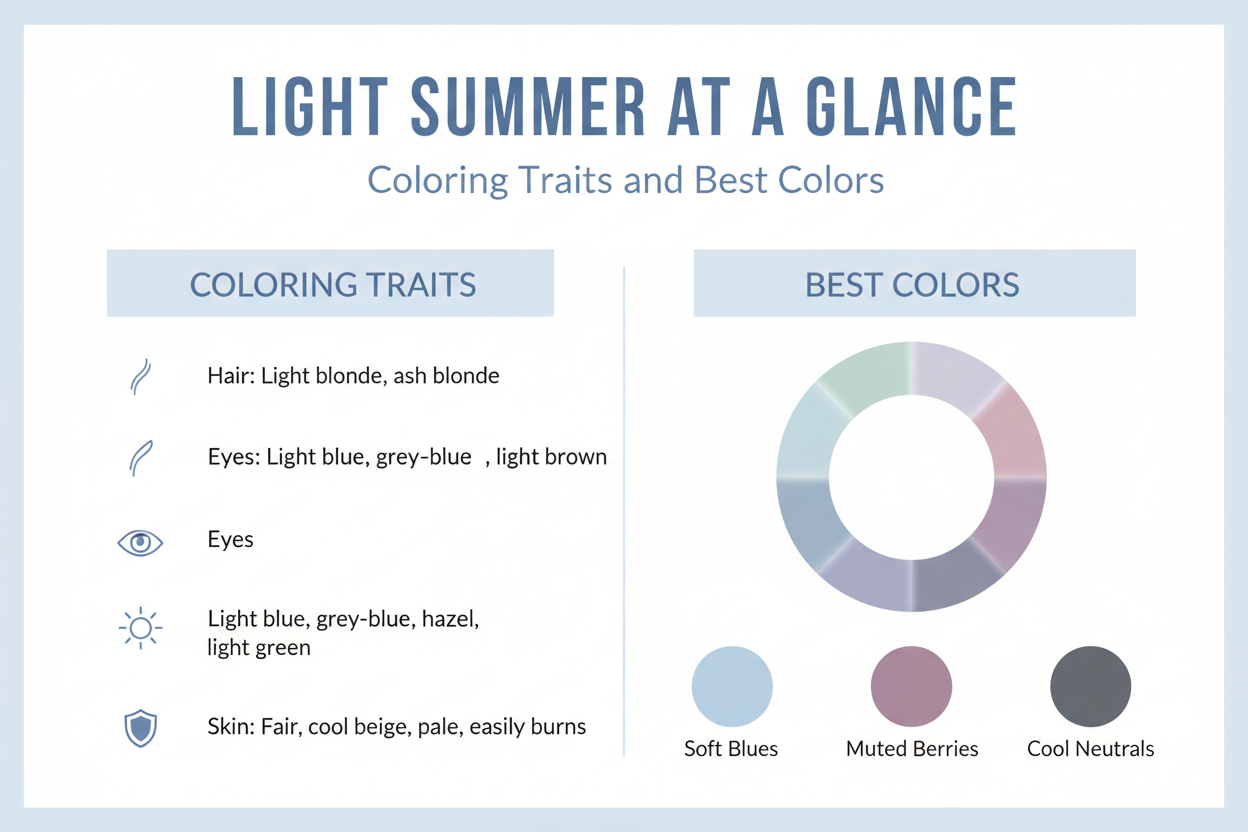
Light Summer sits within the Summer family but leads with lightness rather than coolness. The overall impression is soft and low-contrast—delicate without being washed out.
- Skin: Light to fair, with a cool-neutral undertone that can read slightly peachy or pinkish; typically lighter in value than True Summer skin
- Hair: Ash blonde, light ash brown, or cool medium blonde—no golden or red warmth, and lighter on average than True Summer hair
- Eyes: Light blue, soft gray, pale green, or light hazel; gentle rather than intense
- Overall contrast: Very low—hair, skin, and eyes are all close in value; the look is soft and harmoniously blended
Best colors
Light Summer works best in colors that are soft and airy—not too bright, not too muted. The palette is genuinely colorful, just carried at a very light, quiet value. Think the palest end of the Summer range.
- Pale lavender and soft lilac
- Blush pink and light rose
- Powder blue and pale sky blue
- Soft mint and cool aqua
- Light periwinkle
- Soft white and cool pale gray
Because Light Summer's undertone runs slightly warmer than True Summer's, a few barely-warm pastel tones can work—but only at very light, low-saturation values.
Colors That Drain a Light Summer
- Deep or heavy shades: Dark navy, black, or deep burgundy create too much contrast against a light complexion, overwhelming the coloring
- High-saturation colors: Vivid jewel tones—bright emerald, cobalt, or magenta—make the skin look flat or pallid by comparison
- Warm or earthy tones: Orange, camel, olive, and golden tones clash with the cool-neutral undertone and can push the complexion toward sallow or ruddy
- Highly muted, dark dusty tones: Colors that are both dark and muted (deep mauve, charcoal) sit too heavy for the light value range Light Summer needs
- Stark or bright white: Like True Summer, Light Summer does better in soft, cool off-white than in crisp, high-contrast white
Side-by-Side Comparison: Key Differences in Palette, Contrast, and Styling
| Dimension | True Summer | Light Summer |
|---|---|---|
| Undertone | Purely cool | Neutral-cool blend |
| Primary quality | Coolness + mutedness | Lightness + softness |
| Value range | Medium-light to medium | Light to very light |
| Saturation tolerance | Low-to-medium muted | Low—must stay delicate |
| Contrast level | Low to medium | Very low |
| Depth of colors | Can handle slightly deeper muted tones | Needs to stay in lighter values |
| Warm tones | Draining | Draining |
| Very dark shades | Creates excess contrast | Overwhelms |
| Bright/vivid colors | Breaks muted quality | Far too intense |
| Ideal neutrals | Cool gray, blue-gray, soft white | Pale gray, cool off-white, lightest blush |
| Signature palette feel | Hushed, muted, cool | Ethereal, airy, soft |
A quick self-test: hold a medium-depth dusty rose next to a pale blush pink near your face in natural light. If the deeper tone makes your skin look alive and the pale one washes you out, you're probably True Summer. If the deeper tone reads heavy while the pale blush makes your complexion glow, Light Summer is the better fit.
Common Mistyping: Why True Summer and Light Summer Get Confused—and How to Avoid It
Even experienced analysts regularly debate which Summer subtype fits a given person. That uncertainty isn't a failure—it reflects how close these types actually sit on the color spectrum.
Why the confusion happens
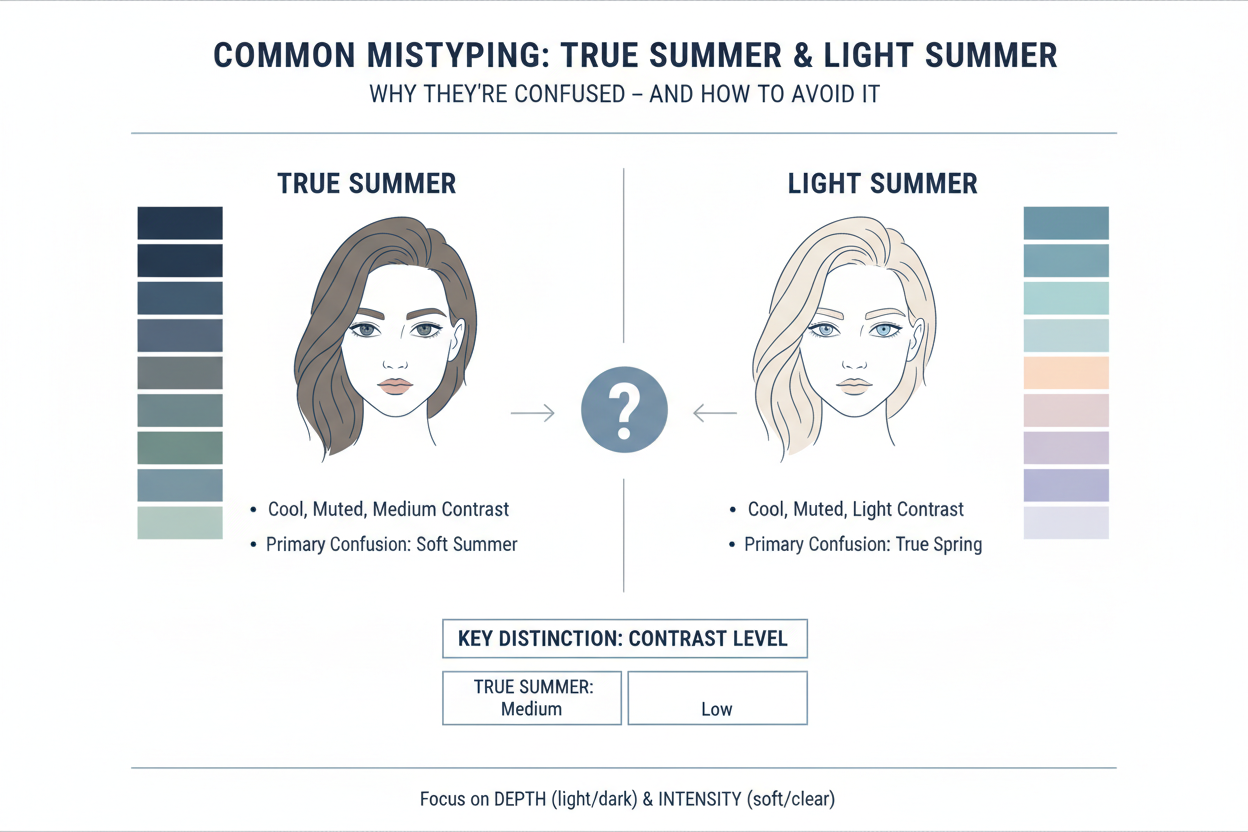
Shared family traits dominate. Both types are cool, muted, and light, so a first-pass analysis often stops at "Summer" without pushing further. The subtype difference only shows up when you compare how light and how pure the undertone is.
Undertone ambiguity is real. Light Summer's neutral-cool blend can read as simply cool depending on the light or the skin tone. Without a direct side-by-side palette test, that neutral nudge is easy to miss.
Self-analysis is unreliable. Looking at yourself in a mirror is not the same as draping colors directly against your face. Even people with professional help find these distinctions difficult to see.
Light Summer is also confused with Light Spring. The key question is undertone. Light Spring runs warm-neutral and suits warmer pastels. Light Summer needs to stay cool-neutral. Golden tones that make a Light Spring look radiant will drain a Light Summer.
True Summer is also confused with Soft Summer. Soft Summer is more muted and slightly warmer. If heavily grayed-down shades seem to suit you better than cleaner cool tones, it's worth looking at Soft Summer.
How to avoid the mistyping
- Test your reaction to warm tones: a clear warm drain confirms you're in the Summer family, but it doesn't tell you which subtype
- Test your reaction to depth: does a medium-depth dusty blue-purple feel right, or slightly heavy? True Summer can carry it; Light Summer usually can't
- Pay attention to contrast: very pale, barely-there colors should make you look radiant if you're Light Summer—if they wash you out instead, lean True Summer
- Look at your overall coloring value: if hair, skin, and eyes are all light with almost no contrast between them, Light Summer is the more likely fit
How to Confirm Your Season: Next Steps
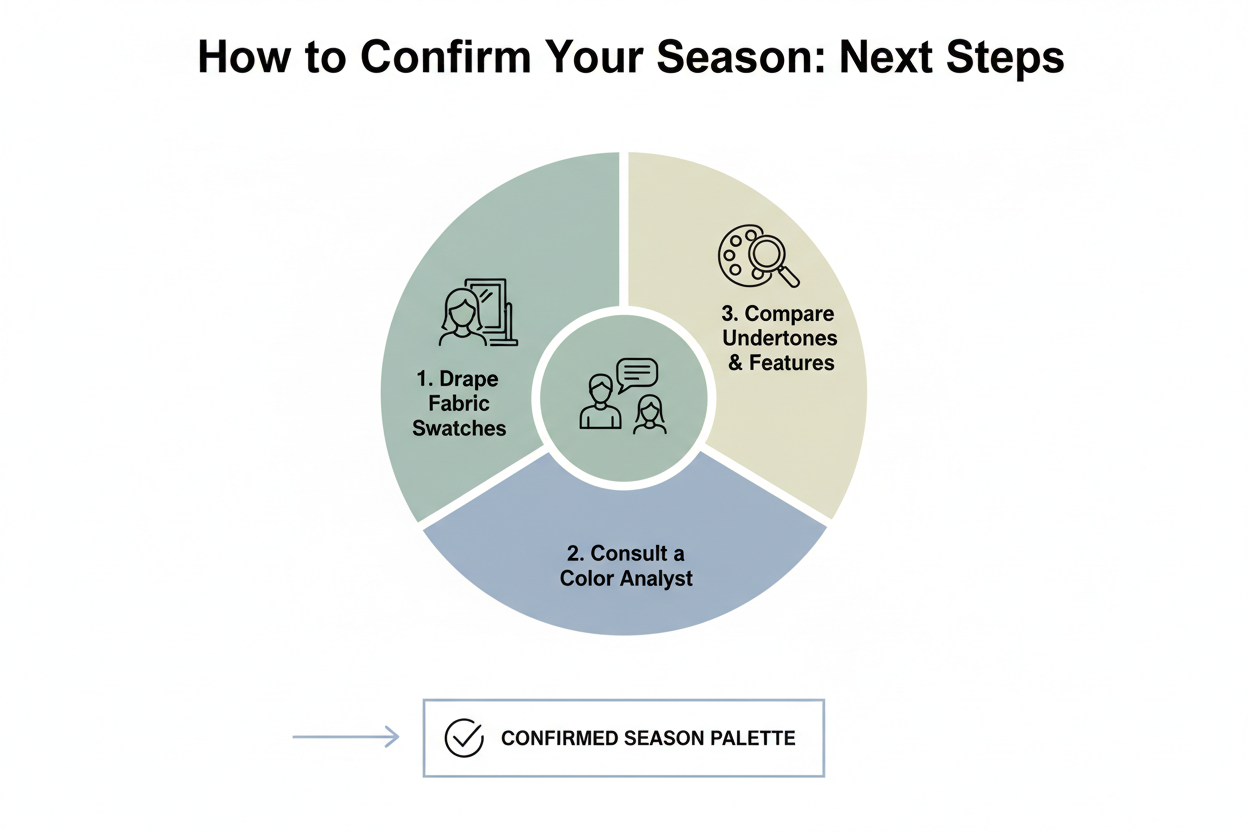
Self-analysis is hard, partly because the differences between True Summer and Light Summer are genuinely subtle. The clearest signals from this guide:
- Undertone purity: A cool undertone that reads clean and consistent points to True Summer. Any hint of neutral blending points to Light Summer.
- Depth response: Medium-light muted tones working well on you suggests True Summer. If those same shades feel heavy and only very light colors work, that's Light Summer.
- Contrast check: Very low contrast across hair, skin, and eyes leans Light Summer. Low-to-medium contrast sits more comfortably with True Summer.
The most reliable confirmation is draping—holding color swatches directly against your face in natural light and watching what happens to your skin. If you can do that with swatches from both palettes at the same time, the difference becomes much easier to see than any written description will get you.
People Also Ask
What is the difference between True Summer and Light Summer?
Both types belong to the Summer family, so both need cool, soft, and light colors—but they diverge on two points: undertone purity and color depth.
- True Summer has a purely cool undertone and sits at a medium-light depth. It can handle slightly deeper muted tones—dusty rose, slate blue, soft berry—without the complexion looking overwhelmed.
- Light Summer blends cool with a gentle neutral undertone, and its defining quality is lightness. Coloring sits at a lower depth and lower contrast level, so even medium-depth shades from the True Summer palette can feel heavy. Only very light, airy tones bring out a Light Summer complexion.
Both types need cool and muted colors, but Light Summer needs them at a noticeably lighter, more delicate value.
Can you be between True Summer and Light Summer?
Seasonal color analysis places people into defined categories, but coloring exists on a spectrum, and landing near the border between two types is common. Someone close to the edge of True Summer and Light Summer will likely find that:
- Colors from both palettes work reasonably well, but neither set feels quite right across the board
- The lightest shades in the True Summer palette and the slightly deeper shades in the Light Summer palette are where the most overlap sits
- Natural lighting can make the distinction appear to shift
If you feel pulled between the two, pay attention to how medium-depth muted tones land on your skin. If they feel flattering, True Summer is the stronger call. If they consistently feel a touch heavy, Light Summer fits better. A professional draping session is the most reliable way to settle it.
What colors should a Light Summer avoid?
Light Summer coloring is delicate and easily overpowered. These tend to drain or flatten it:
- Deep, heavy shades — black, dark navy, deep burgundy, and charcoal create too much contrast against a light complexion
- High-saturation jewel tones — cobalt, vivid emerald, bright magenta, and electric blue are far too intense
- Warm and earthy tones — orange, camel, olive, rust, and golden yellow clash with a cool-neutral undertone and can make skin look sallow
- Dark muted shades — colors that are both dusty and deep (deep mauve, charcoal gray) sit too heavily for Light Summer's value range
- Stark or bright white — creates too much contrast; a soft, cool off-white works much better
The rule of thumb: if a color is warm, very dark, or highly saturated, it probably works against Light Summer's low-contrast, ethereal quality.
Is True Summer cool or neutral?
True Summer is purely cool. Of the three Summer subtypes—True Summer, Light Summer, and Soft Summer—True Summer sits at the cool extreme, with no warm or neutral inflection.
This is what sets True Summer apart from Light Summer, which blends cool with a slight neutral quality. True Summer is most flattered by the cleanest, most unambiguously cool shades in the muted range—dusty pinks with no warmth, blue-based purples, cool grays, and soft teal—rather than anything edging toward warmth or neutrality.
How do I know if I am a True Summer or Light Summer?
A few practical checkpoints help narrow it down:
Assess your overall coloring depth. If your hair, skin, and eyes are all in a very light, near-matched range with almost no contrast between them, Light Summer is more likely. A slightly deeper or more medium hair tone relative to skin points toward True Summer.
Test medium-depth muted tones. Hold a dusty blue-purple or soft slate close to your face in natural light. If it looks flattering and balanced, lean True Summer. If it reads as heavy or overpowering, lean Light Summer.
Test very pale, barely-there shades. Pale lavender or blush-white tones will make a Light Summer glow. If those same shades wash you out, True Summer is the stronger fit.
Check your reaction to warm tones. Both types look drained in warm, earthy colors—so a warm drain confirms Summer family membership but does not distinguish the two subtypes.
Consider draping. Physically placing swatches from each palette against your face at the same time, in natural daylight, makes the difference far easier to read than any mirror check alone.
FAQ
What is the main difference between True Summer and Light Summer?
Both seasons share the Summer family's cool, soft, and light foundation. The split comes down to undertone purity and color depth. True Summer carries a purely cool undertone at a medium-light depth, so it can handle slightly deeper muted shades without the complexion looking strained. Light Summer introduces a gentle neutral quality alongside the cool undertone, and its defining characteristic is an even lower depth and contrast level - only very light, airy colors truly flatter it.
Do True Summer and Light Summer wear the same colors?
They overlap considerably, but not entirely. Both palettes draw from cool, muted, low-saturation shades - dusty pinks, soft blues, quiet lavenders. The difference shows up at the edges of the palette. True Summer can reach into medium-depth muted tones like soft berry, dusty plum, and slate blue, which would feel heavy on a Light Summer. Light Summer does best with the palest end of those same hues: blush, powder blue, barely-there lilac.
Can a Light Summer wear the same depth of color as a True Summer?
Generally, no. Light Summer coloring sits at a lower overall depth, so medium-depth shades - even muted, cool ones - tend to overpower the complexion rather than harmonize with it. Colors that look balanced on a True Summer can make a Light Summer look washed out or heavy. Staying in a lighter value range matters a lot here.
Is Light Summer cool or neutral-cool?
Light Summer is neutral-cool. It blends a cool undertone with a subtle neutral inflection, with an emphasis on lightness and softness throughout. This sets it apart from True Summer, which is purely cool with no neutral lean. The neutral element is slight - Light Summer still firmly belongs to the cool Summer family - but it means Light Summer can occasionally tolerate very soft warm-neutral tones that a True Summer cannot.
What colors drain both True Summer and Light Summer?
Both seasons share the same cool, muted, light foundation, so similar categories of color work against both:
- High-saturation brights - cobalt, vivid magenta, electric green, and bold orange overwhelm both types
- Warm, earthy tones - orange, camel, rust, and olive clash with cool undertones across the entire Summer family
- Very dark, heavy shades - black, deep charcoal, and dark espresso create too much contrast against naturally light coloring
- Stark white - generates a harsh contrast that neither type's delicate coloring can balance; a soft cool off-white works far better
The shared rule: anything warm, very dark, or highly saturated tends to drain both seasons.
Which Summer subtype is rarer: True Summer or Light Summer?
There's no reliable population data on which subtype is actually less common. In practice, True Summer is often described as the anchor or "pure" Summer type — it sits at the center of the Summer family and combines qualities of all three subtypes. Light Summer and Soft Summer each lean toward a neighboring season (Spring and Autumn, respectively). Anecdotally, many color analysts say True Summer and Soft Summer come up more often in conversation, which may reflect their status as better-defined boundary types. That doesn't confirm rarity either way.
How does True Summer differ from Soft Summer?
While this article focuses on True Summer versus Light Summer, the True Summer–Soft Summer distinction trips people up often enough to be worth addressing. The dividing line is muting and warmth:
- True Summer is cool and moderately muted. The palette is quiet but not as dulled as Soft Summer, and there's no warm influence at all.
- Soft Summer edges toward the Autumn family. It shares the Summer coolness but blends in more warmth and noticeably more muting — colors run grayer, smokier, less distinctly cool. Kristen Stewart is often cited as a Soft Summer example because her coloring carries that warmer, more blended quality that sets her apart from the cleaner cool tones of a True Summer like Emily Blunt.
If you're not sure whether you're True Summer or Soft Summer, take our color analysis quiz to get a clearer starting point.