
Cool Summer Color Palette (True Summer) Guide
 Reviewed by Alexandra Gilmore
Cool Summer, also called True Summer, is the coolest and most balanced Summer subtype. Build around dusty rose, lavender, blue-gray, muted berry, soft navy, and cool teal, then compare Light and Soft Summer with controlled draping.

Cool Summer and True Summer are two names for the same central Summer palette in most 12-season systems. This is the canonical guide to its cool temperature, muted chroma, medium value, wardrobe colors, makeup, hair, metals, and at-home draping checks. If you are looking for public styling references, use the separate Cool Summer celebrities guide as inspiration—not as proof of your season.
💫 Discover Your Complete Color Palette
Ready to discover all the colors that make you look radiant? Our comprehensive color analysis will reveal your complete personal palette - perfect for hair, makeup, and wardrobe decisions.
Find My Season →📚 Recent Articles
People who belong to the true summer color palette look their absolute best in colors that are cool in temperature and low in saturation. Bright, warm, or high-contrast shades tend to overpower their naturally blended, understated coloring — while the right dusty rose, soft lavender, or cool blue-gray makes their skin appear clearer, their eyes brighter, and their overall appearance more harmonious.
This guide covers everything you need to build a wardrobe around the true summer color palette:
- What defines the season and how it sits within the broader Summer family
- Physical characteristics commonly associated with True Summer
- Your best colors — and the ones to leave on the rack
- Practical outfit formulas using five proven color combinations
- How to confirm whether True Summer is genuinely your season
Whether you already suspect you're a True Summer or you're comparing it against the Soft or Light Summer subtypes, you'll find clear, actionable guidance in every section ahead.
What Is the True Summer Color Palette?
True Summer is one of twelve seasons in modern seasonal color analysis — a system that groups human coloring by the temperature, value, and saturation of the colors that harmonize best with it. Every season belongs to a broader family (Spring, Summer, Autumn, Winter), and every family has three subtypes.
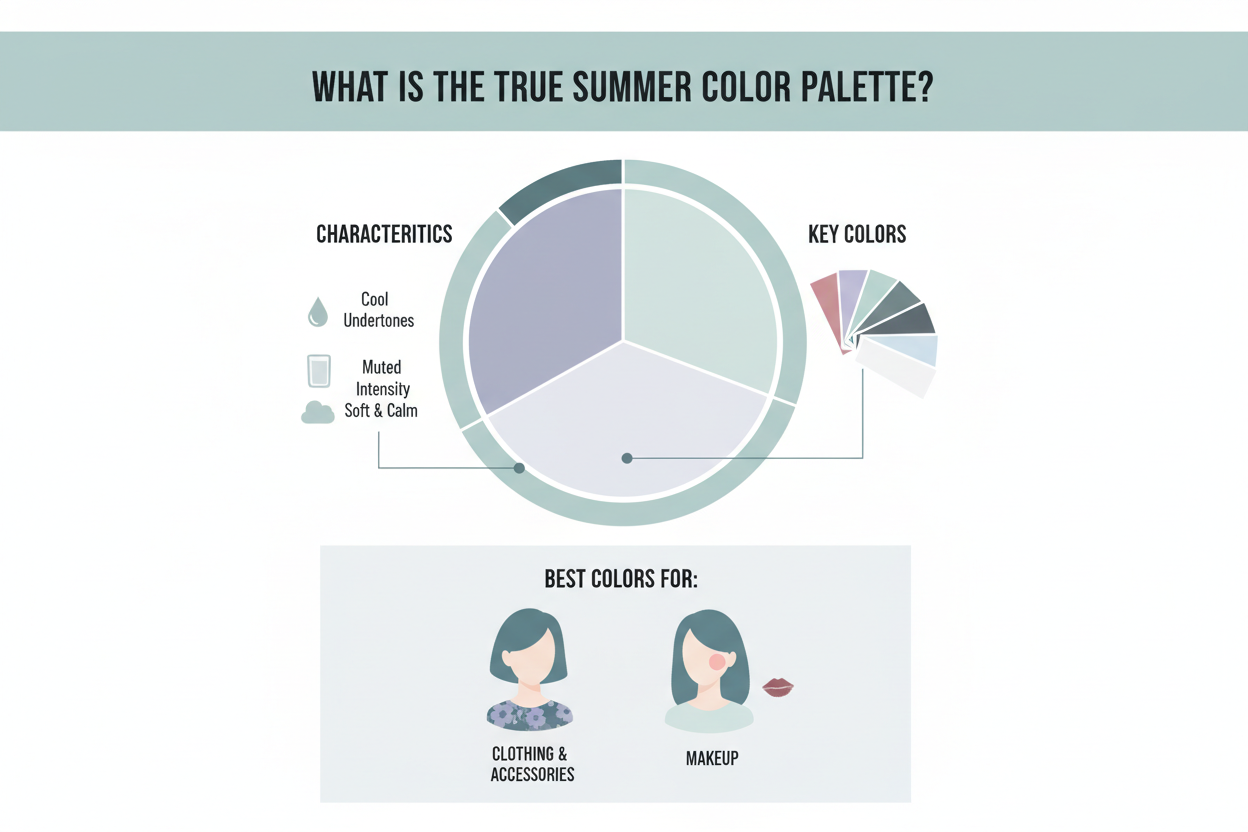
True Summer is the anchor of the Summer family: the purest, most straightforward expression of what Summer coloring means. People in this season look their best in colors that are cool in undertone and muted in saturation — think the palette of a quiet, overcast beach rather than a tropical resort.
The logic is simple. True Summer drapes are cool rather than orange-based, and softly muted rather than highly saturated. In color terminology, that means controlling hue and chroma while staying mostly in a medium value range. Colors that share those qualities tend to look harmonious beside the face; warmer, brighter, or much higher-contrast comparisons help reveal whether another season is more accurate.
If you're unsure whether True Summer describes your coloring, take the color analysis quiz to pinpoint your season before reading further.
True Summer vs. the Other Summer Subtypes
The three Summer subtypes — Light Summer, True Summer, and Soft Summer — all share the cool-and-muted foundation of the family, but they differ in lightness and secondary influences.
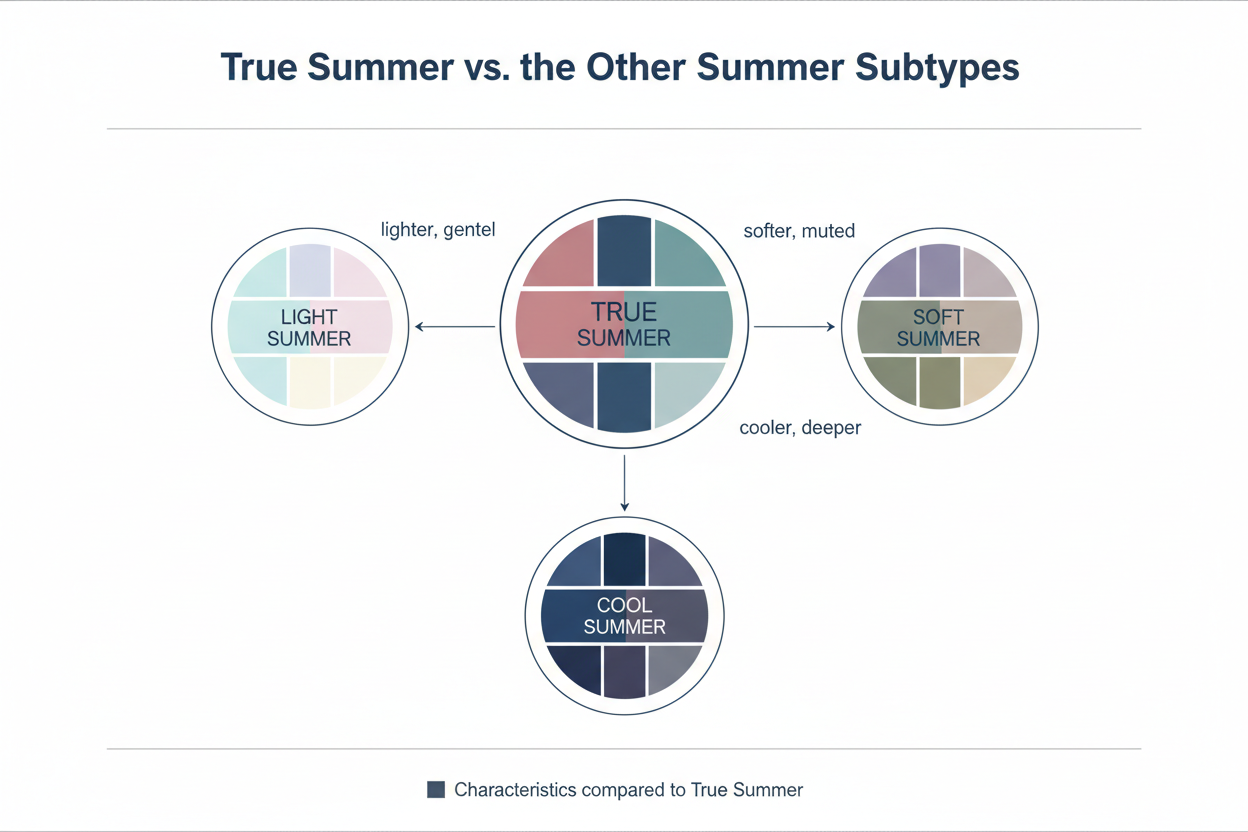
| Subtype | Core quality | Secondary influence | Contrast level |
|---|---|---|---|
| Light Summer | Cool + light | Spring (adds brightness) | Low |
| True Summer | Cool + muted | None — purest Summer | Low to medium |
| Soft Summer | Cool + muted | Autumn (adds subtle warmth) | Low |
True Summer is the coolest of the three. No Autumn warmth, no Spring brightness. Light Summer trends toward softer, almost washed-out pastels. True Summer uses mid-depth, clearly muted hues. Soft Summer allows a hint of earthy warmth in its neutrals. True Summer doesn't.
This matters when you're shopping. If you try Soft Summer's dusty browns or warm taupes and find they make you look slightly sallow, you're probably a True Summer. If Light Summer pastels feel too faded and thin on you, True Summer's deeper, cooler mid-tones will feel more solid.
Physical Characteristics of True Summer
No single physical trait locks you into a season — coloring appears across many ethnicities and backgrounds — but True Summer does have recognizable patterns worth knowing.
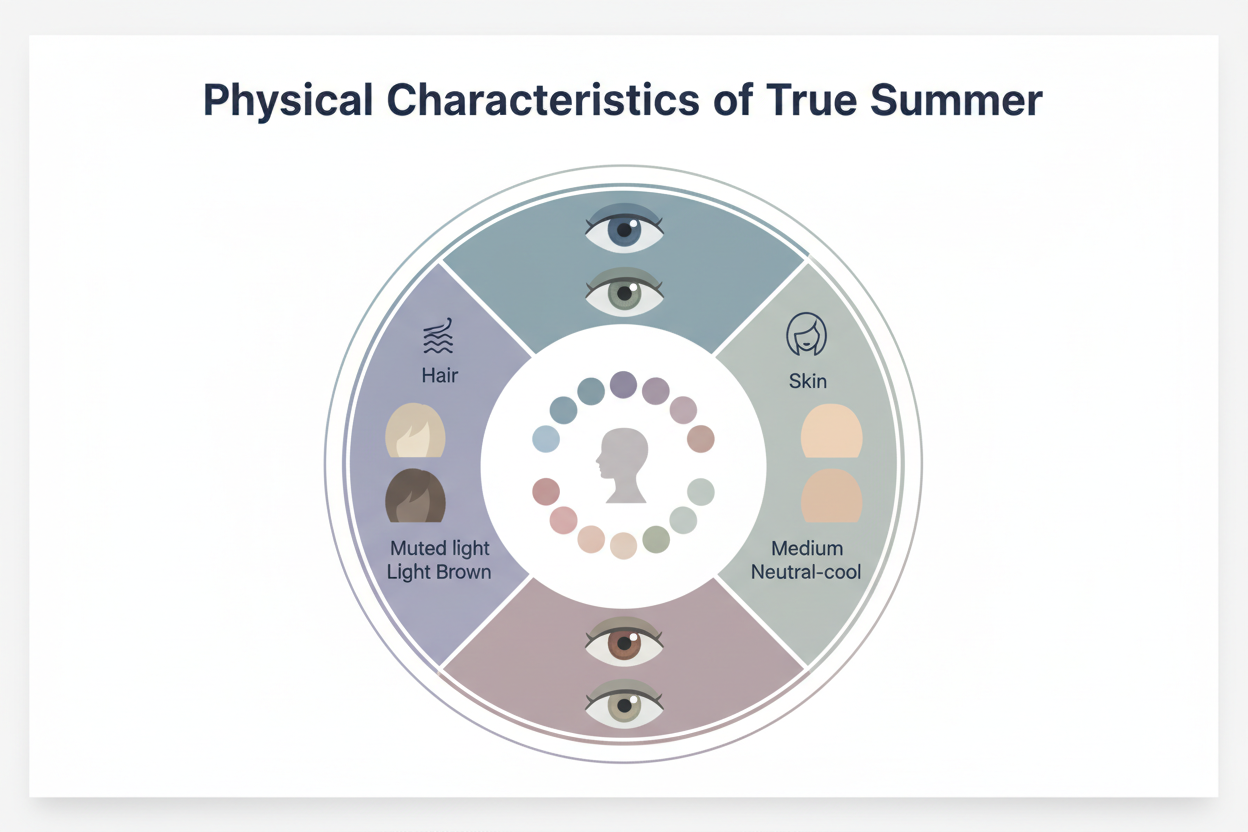
Skin
- A cool or neutral-cool response to draping; surface redness and skin depth do not determine the result
- Cool pink, blue, and gray fabrics tend to make the complexion look more even than orange, camel, or mustard
- Tanning behavior is not a reliable season test and should not be used as a requirement
- Vein color is affected by skin depth, lighting, and anatomy, so treat it only as a weak clue
Eyes
- Eye color can be any shade; what matters is how the face responds to cool, muted drapes
- A softly blended effect can support the diagnosis, but iris pattern alone cannot establish it
Hair
- Natural hair can occur at many depths; dyed hair should be covered during a controlled test
- Ashiness may support the palette, but warm highlights or natural warmth do not automatically rule it out
Contrast level True Summers generally fall at low to medium contrast. The difference between hair, skin, and eye color is noticeable but not dramatic — which is why high-contrast combinations like black and bright white can look harsh against this coloring.
The True Summer Color Palette: Your Best Colors
True summer coloring comes down to two things: cool temperature and muted saturation. Every color in the palette has had its warmth dialed back and its intensity softened, landing somewhere that feels harmonious and quietly sophisticated without trying hard.
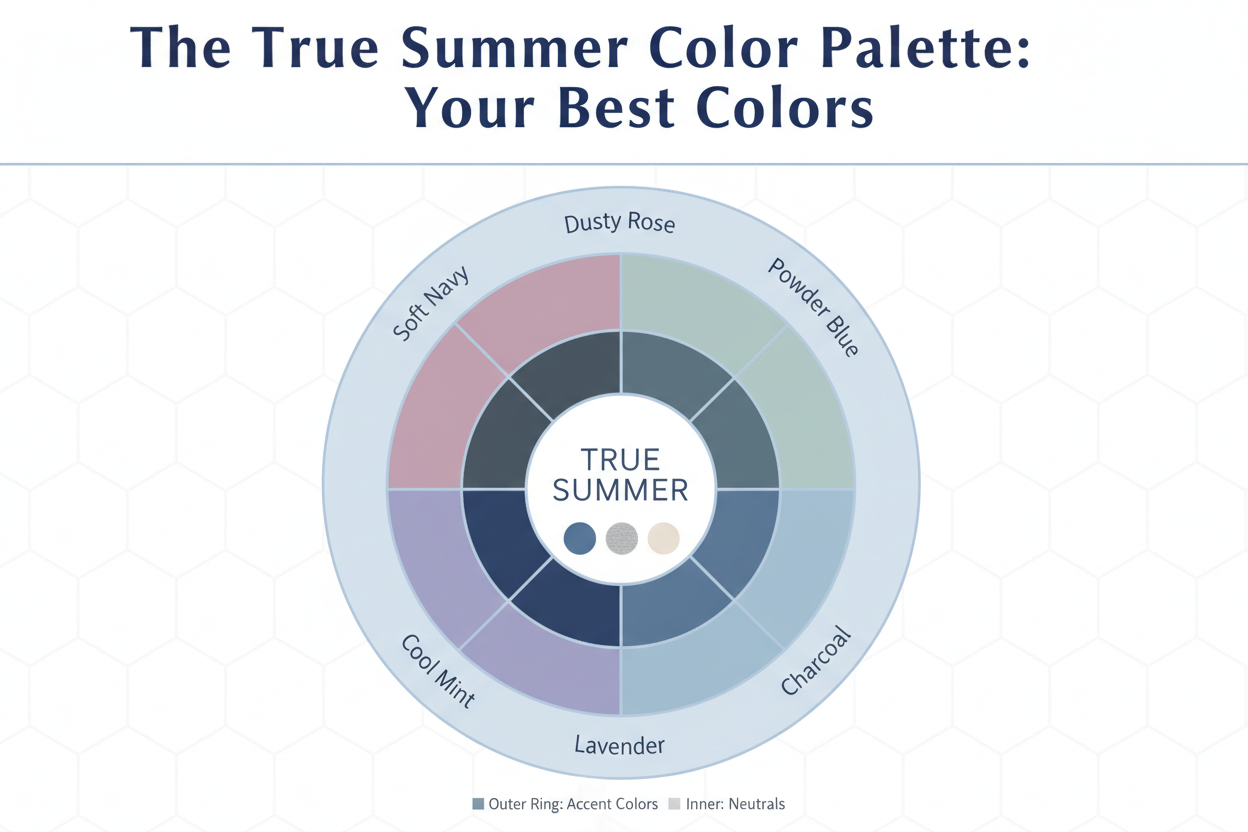
Core hues to reach for:
- Dusty rose and muted berry — warm-sounding names, but these shades stay cool at their base, making them a true summer staple
- Soft lavender and lilac — a direct expression of the season's cool-muted nature
- Powder blue and periwinkle — cool blues with no green warmth; particularly flattering near the face
- Blue-gray and slate — versatile neutrals that ground an outfit without adding warmth
- Rose-mauve and plum — deeper accent colors that stay firmly on the cool side
- Soft teal and dusty aqua — cool greens with a blue lean; avoid anything yellow-green
- Cool heathered gray — from light silver-gray to deeper charcoal with a cool cast
What these colors share is what they don't contain: yellow undertones, orange depth, or concentrated brightness. Held near a true summer face, they let the skin's natural rosy or ashy tones come forward rather than competing with them.
Not sure if these colors describe you? Discover your season with our free quiz and then verify the result with repeat draping in consistent daylight.
True Summer Neutrals and How to Use Them as a Wardrobe Base
Neutrals are the foundation of any capsule wardrobe, and true summer's neutrals are specific enough that getting them wrong undermines the whole palette.
True Summer neutrals:
- Soft blue-gray — the closest thing to a true summer "black"; works as a dark neutral in any outfit
- Rose-brown and mauve-taupe — warm-sounding but cool at their base; replace beige with these
- Cool stone and dusty greige — lighter neutrals that pair with almost anything in the palette
- Soft white with a cool or slightly pink tint — avoid cream, ivory, or any white with yellow warmth
What to avoid as neutrals: warm beige, camel, tan, true ivory, and black. These belong to seasons with warm or high-contrast coloring. Warm beige pulls yellow tones forward against true summer skin; black creates more contrast than the season's coloring is built to carry.
The practical approach: build your wardrobe base in blue-gray, cool taupe, and rose-brown. Any true summer accent color will sit naturally from there.
Colors True Summer Should Avoid
Knowing what to avoid is just as useful as knowing what works — and for True Summer, the logic is consistent throughout.
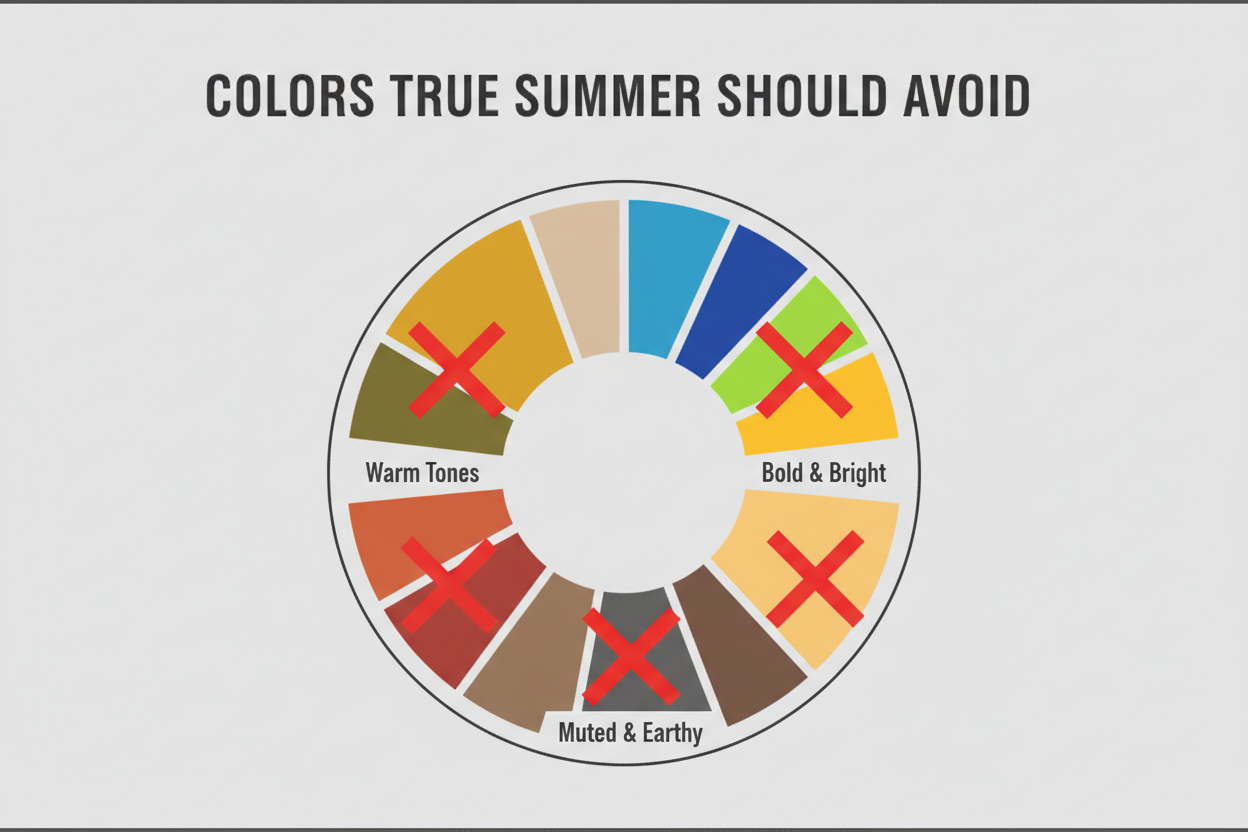
Avoid warm colors:
- Warm orange, rust, and terracotta — these bring yellow-orange undertones that clash with cool skin, making the complexion look sallow or dull
- Golden yellow and mustard — warm and saturated, which are both the wrong direction for this season
- Camel and warm tan — as neutrals, these pull the wrong undertone forward; cool taupe is the swap to make
Avoid high-chroma brights:
- Neon or electric versions of any color — True Summer's naturally muted coloring gets overwhelmed by intense saturation rather than lifted by it; the color ends up wearing you
- Bright coral and hot pink — too warm and too vivid; the muted rose or cool berry version of either shade is a better fit
Avoid high-contrast darks:
- True black — the contrast level can make True Summer skin look ashy or drawn; blue-gray or soft charcoal does the same job without the harshness
- Stark bright white — similarly high-contrast; a soft cool white or icy lavender-white works better
In every case the problem is the same: colors that are too warm clash with cool undertones, and colors that are too bright or too dark overwhelm the low-to-medium contrast that defines True Summer coloring.
How to Build True Summer Outfits with Color Combinations
True summer rewards tonal dressing — outfits that stay within the same cool-muted family — and soft contrast pairings where colors are clearly distinct but never jarring.
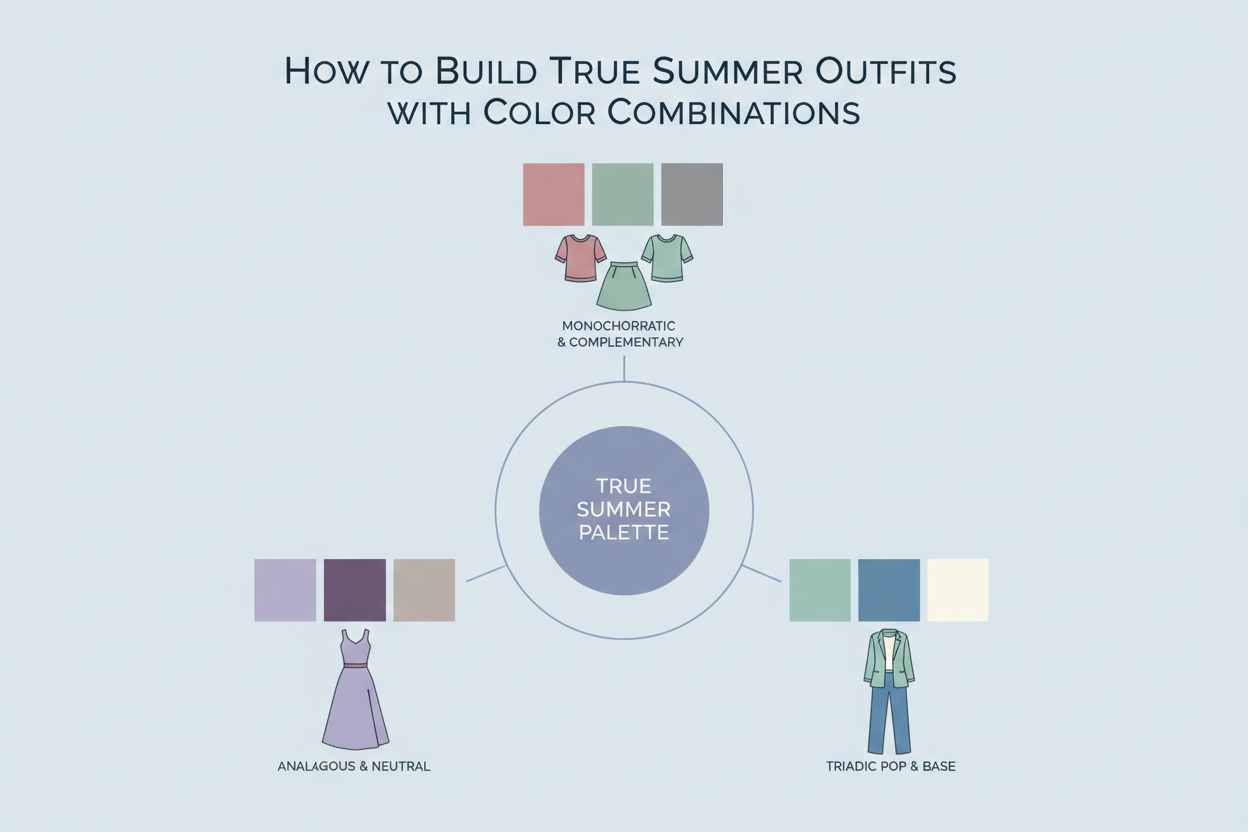
The basic approach: anchor the outfit with a True Summer neutral, then bring in one or two palette colors. Skip the high-contrast statement piece. The result is polished and cohesive, which fits naturally with what this season's coloring does.
General principles:
- Keep everything — top, bottom, shoes, bag — within the cool-muted family
- Use depth variation (light and medium, not light and very dark) to create interest without hard contrast
- Treat prints as a chance to use palette colors, not a reason to sneak in warm or bright shades
Five Color Combination Formulas for True Summer
These work because every element shares the same cool-muted DNA. Swap in a warmer or brighter version of any shade and the whole thing falls apart.
Dusty rose + soft blue-gray A classic True Summer pairing. The rose stays cool — no orange warmth — and the blue-gray acts as a grounded neutral. Put the gray in trousers or a blazer, the rose in a top or knit.
Lavender + cool taupe Tonal without being matchy. Both colors are muted and cool; the lavender reads as color, the taupe keeps it grounded. This works especially well as a monochromatic look with lavender appearing in a few different shades.
Powder blue + rose-mauve A bit more contrast than the first two, but both colors sit firmly in the cool family. Works best when one shade carries a larger piece and the other shows up as an accent — a powder blue dress with a mauve bag, for instance.
Soft teal + dusty pink The teal is the deepest note; the pink softens it. Avoid teals that pull yellow-green — look for versions with a clear blue base.
Blue-gray + heathered lavender-gray + soft white A three-tone outfit built entirely from True Summer's neutral-to-accent range. Layering gray tones with a hint of lavender creates depth without pushing the palette anywhere it shouldn't go.
Each formula scales across seasons — heavier fabrics in winter, lighter ones in summer — but the color logic holds whether you're building a sundress outfit or a winter coat look.
How to Confirm You Are a True Summer
The most reliable way to identify your season is the draping test: hold fabric in different colors up to your face in natural light, without makeup, and watch what happens to your complexion.
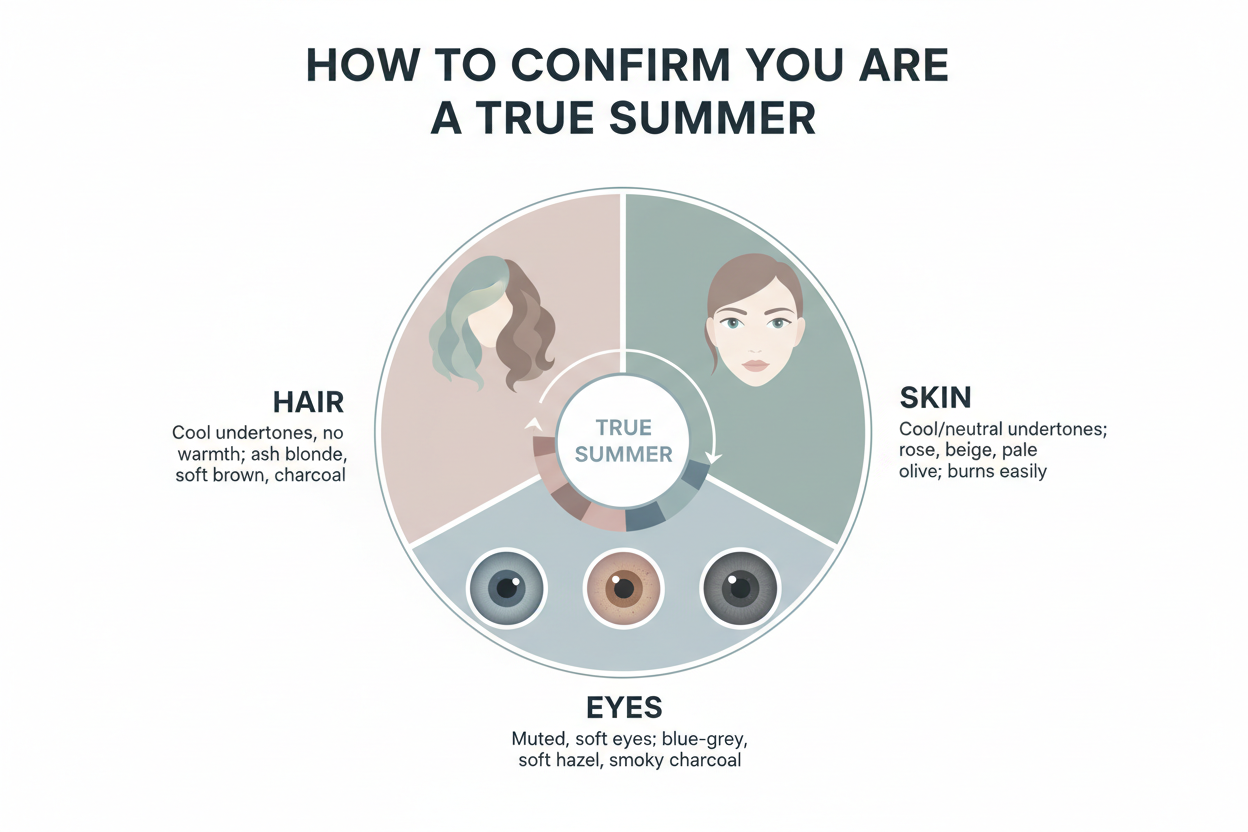
What to look for:
When you hold a warm color (orange-based peach, camel, golden yellow) near your face:
- Does your skin look yellowish or sallow?
- Do shadows appear under your eyes?
- Does your complexion look dull or tired? If yes, warm colors are working against you.
When you hold a cool muted color (dusty rose, powder blue, soft blue-gray) near your face:
- Does your skin look clearer and more even?
- Do your eyes look more defined without any makeup change?
- Does the area under your eyes look less shadowed? If yes, you respond well to the cool-muted palette.
When you hold a bright, high-saturation color (electric blue, neon coral) near your face:
- Does the color overpower your face — drawing attention to itself rather than to you? If yes, you need muted rather than bright versions of your palette colors.
Comparing True Summer against Soft Summer: If dusty, slightly warm shades — like warm mushroom or muted gold — look fine rather than actively good, you may sit between True and Soft Summer. True Summer faces tend to look clearest in colors that stay cool rather than neutral-warm, even within the muted range.
Professional analysis and digital tools: In-person color analysis with trained draping is the gold standard. A structured digital quiz — built around your actual responses to colors rather than self-reported hair color — can narrow your season and confirm whether True Summer fits.
If you've recognized your coloring here, continue with our free color analysis quiz, then compare the result against your own repeat draping observations before you shop.
People Also Ask
What colors does a True Summer look best in?
True Summer works best in colors that are cool-toned and muted — not warm, not bright. The strongest choices:
- Dusty rose and cool berry — pink-based with no orange warmth
- Soft lavender and lilac — a direct match for the season's cool, quiet quality
- Powder blue and periwinkle — especially good near the face
- Blue-gray and slate — the most versatile neutrals in the palette
- Soft teal — as long as it reads blue rather than yellow-green
- Rose-mauve and muted plum — deeper options that stay firmly cool
What ties these together is what they don't have: yellow undertones, orange depth, or heavy pigment. Held near a True Summer complexion, they let the natural rosiness or ashiness come through instead of pulling the wrong tones forward.
What is the difference between True Summer and Soft Summer?
Both seasons are cool and muted, which is why they get confused — but there's a real, practical difference between them.
True Summer is the purest, coolest version of the Summer family. No secondary influence, no warmth, no added brightness. Colors sit clearly on the cool side, even within the muted range.
Soft Summer has a secondary Autumn influence. That introduces a subtle warmth into the palette, which is why dusty browns, warm taupes, and earthy neutrals work here in a way they don't for True Summer.
A useful self-test: hold warm, muted shades like mushroom, warm greige, or dusty camel near your face in natural light. If they look fine — neutrally fine — Soft Summer might be the closer fit. If they make your complexion look sallow or flat, while cool shades like blue-gray or dusty rose immediately look cleaner, you're probably True Summer.
The short version: True Summer needs cool muted colors. Soft Summer can handle neutrally warm muted ones, and often looks better in them.
How do I know if I am a True Summer color season?
The most reliable method is a draping test — holding fabric in different colors up to your bare face in natural daylight and watching what your complexion does in response.
Signs you may be a True Summer:
- Cool, muted colors (dusty rose, powder blue, soft blue-gray) make your skin look clearer and more even, and reduce the appearance of shadows under the eyes
- Warm colors (peach, camel, golden yellow) make your skin appear yellowish, sallow, or tired
- Bright, high-saturation colors (electric blue, neon coral) overpower your face rather than lifting it — the color becomes the focal point, not you
- Your natural coloring is cool or neutral-cool: no visible golden or olive warmth in the skin, hair that reads ashy rather than golden, and eyes that are blue, gray, or soft gray-green
True Summer also tends toward low to medium contrast — the difference between your hair, skin, and eye color is noticeable but not dramatic. If high-contrast pairings like black and white look harsh against your coloring rather than striking, that's a good sign you're in this season.
A color analysis quiz built around your responses to actual colors — rather than just hair or eye descriptions — can be a useful starting point for narrowing down your season.
What colors should True Summer avoid?
True Summer has three problem zones:
Warm tones
- Orange, rust, and terracotta bring yellow-orange undertones that fight against cool skin
- Golden yellow and mustard are both too warm and too saturated
- Warm beige, camel, and tan pull sallow undertones forward when worn near the face
High-saturation brights
- Neon or electric versions of any color overwhelm True Summer's naturally muted coloring
- Bright coral and hot pink are too warm and too vivid — reach for the muted, cool versions instead
High-contrast darks and stark lights
- True black creates enough contrast to make True Summer skin look ashy or drawn; soft charcoal or blue-gray works better
- Stark white has a similar effect; a cool soft white or icy lavender-white is more flattering
The pattern is consistent: warm colors clash with cool undertones, and anything too bright or contrasty overpowers the low-to-medium contrast that defines True Summer coloring.
Can True Summer wear black?
Technically, yes — but it's not a great choice for most True Summers, and it's not part of the palette for good reason.
True Summer coloring runs at low to medium contrast. Black is about as extreme as darks get, and next to a True Summer complexion it tends to create more contrast than the coloring can carry. The result: skin that looks ashy or washed out, especially when black is worn near the face.
The practical swap is a soft blue-gray or deep charcoal with a cool cast. These do everything black does in an outfit — ground a look, anchor a neutral palette, work in formal settings — without the harsh contrast that makes True Summer coloring recede.
If black is unavoidable (dress code, specific garment), keep it away from the face. Wear it as trousers or shoes rather than at the neckline, and bring a True Summer color in closer to the face to soften the effect. But as a regular wardrobe choice, blue-gray just works better.
FAQ
What makes True Summer different from the other Summer subtypes?
All three Summer subtypes — True Summer, Soft Summer, and Light Summer — share a cool, muted foundation. What separates them is where each sits relative to that core.
True Summer is the purest expression of the family: fully cool, fully muted, with no secondary influence pulling the palette toward warmth, lightness, or darkness. Soft Summer leans toward Autumn — a secondary warm influence means it handles dusty, earthy neutrals that would look slightly off on a True Summer. Light Summer leans toward Spring, still cool and muted but lifted toward higher value, making lighter, airier shades more harmonious than the medium-depth tones that suit True Summer best.
In practice, True Summer needs colors that stay consistently cool and never introduce warmth or high saturation. The other subtypes allow some flexibility in one direction or another. True Summer does not.
Can True Summer wear warm colors at all?
Warm colors are consistently the hardest category for this season. True Summer coloring is cool-based — no yellow or golden warmth in the skin, hair, or eyes — so warm shades like rust, camel, peach, or mustard tend to make the complexion look sallow or dull rather than healthy.
That said, degree matters. A color with a slight warm nudge that's still firmly muted and cool (a dusty rose with barely any peach, for instance) may be wearable, especially away from the face. But moving toward warm colors moves a True Summer away from their most flattering range — not just slightly off, but noticeably so.
The safer rule: if a color reads warm at a glance, it's almost certainly not a True Summer color.
What hair colors are typical for True Summer?
True Summer hair reads cool and ashy rather than golden or warm. Common natural hair colors include:
- Ash brown in light to medium shades, with no reddish or caramel warmth
- Mousy or cool medium brown, often described as neither clearly blond nor brunette
- Cool dark blond with no golden highlights
- Ash gray as the hair transitions naturally, which tends to stay harmonious because the cool tone holds
True Summer hair doesn't typically carry warm undertones like copper, auburn, or golden highlights. Those belong to the Autumn or warm-leaning Spring families. If your natural hair looks distinctly ashy, cool, or slightly blue-tinged in certain light, that supports the True Summer season.
Is True Summer the same as cool summer in older color systems?
Yes, largely. Older four-season frameworks — which divided everyone into Spring, Summer, Autumn, or Winter — used "Summer" for cool, muted coloring. True Summer in the modern twelve-season system is the direct continuation of that original type.
When the system expanded to twelve seasons, Summer was subdivided into three to account for variation among people who shared cool, muted coloring but differed in warmth and value. True Summer is the central archetype — the one that most closely matches what the classic framework described as "Summer." Soft Summer and Light Summer are adjacent variations.
If you were typed as a Summer under an older system with no further detail, True Summer is the most likely match, though it's worth comparing yourself against all three subtypes to be sure.
What jewelry metals suit the True Summer palette?
True Summer's cool, muted coloring pairs best with metals that share those qualities:
- Silver is the go-to — its cool tone works naturally with True Summer's blue-based undertones
- White gold works for the same reason: cool, no warmth
- Rose gold can work if it's muted and dusty, but only when it reads more pink than orange-copper
- Yellow gold tends to clash — the warmth fights the season's cool undertones, so it's worth avoiding near the face especially
Finish matters too. High-polish metals can push contrast higher than the palette needs. Brushed or satin silver keeps things harmonious without looking dull.
How does True Summer differ from Cool Winter if both are cool seasons?
Both seasons are cool, but they sit at opposite ends of the value and saturation spectrum.
| Quality | True Summer | Cool Winter |
|---|---|---|
| Saturation | Muted, low-chroma | Clear, high-chroma |
| Value | Medium | Deep to high-contrast |
| Contrast level | Low to medium | High |
| Overall effect | Soft, hazy, blended | Crisp, sharp, defined |
Colors that work on True Summer — dusty lavender, powder blue, soft rose — look washed out on Cool Winter. The jewel tones and icy brights that suit Cool Winter (sapphire, true red, pure white) tend to overpower a True Summer complexion rather than lift it.
Both seasons avoid warm colors, but True Summer needs that coolness delivered softly. Cool Winter carries it at full intensity.
What are the best True Summer color combinations for everyday outfits?
For everyday wear, True Summer combinations work best when you stay in the cool, muted range throughout — neutrals as a base, soft accents built on top.
Five combinations that actually hold up:
- Blue-gray + dusty rose — a natural pairing that keeps both colors comfortable; works as a top-and-bottom or in a print
- Soft lavender + cool white — fresh without feeling stark; swap in icy lavender-white if regular white feels too sharp
- Periwinkle + soft mauve — both cool, both mid-depth; sits together without creating obvious contrast
- Slate blue + rose-taupe — leans neutral, which makes it easy to wear in professional or casual settings
- Dusty teal + muted plum — a deeper option for evenings or when you want more color, still cool and muted throughout
The one rule that holds across all of them: every color in the outfit should share the same cool, muted character. One warm or bright element is enough to throw the whole thing off.
Not sure which combinations work for your specific coloring? Take the color analysis quiz, then test the suggested combinations beside your face in the same neutral daylight.
To compare this result with another established color-analysis guide, continue with the companion article “Neutral Skin Tone Colors: What to Wear and How to Test Them”, which keeps the two closely related questions distinct.