Cool Summer Celebrities and Why
 Reviewed by Alexandra Gilmore
Cool Summer celebrities offer concrete styling examples, yet photos and professional color work can disguise their natural palette. Study the shared cool undertone, muted contrast, and response to dusty blues, berries, and silver, then use those observations as draping ideas rather than proof of your type.

If you've ever scrolled through color analysis content and wondered whether your coloring matches a recognizable face, you're already thinking the right way. Comparing your features to well-documented cool summer color palette celebrities is one of the most practical shortcuts in personal color analysis—and this article makes that comparison concrete.
💫 Explore Seasonal Color Analysis
Use the distinctions in this article to narrow the possibilities, then compare the seasonal system as a whole. Seeing the neighboring palettes together makes the result easier to test in real clothing and daylight.
Learn Seasonal Analysis →Cool Summer (also called True Summer) is one of three Summer sub-seasons in a 16-season color analysis framework. It sits between Soft Summer and Light Summer, defined by coloring that reads as cool in undertone and soft in contrast. Celebrities like Kate Middleton and Emily DiDonato are among the most frequently cited examples of this season—and studying what their skin, hair, and eye tones share tells you far more than a checklist ever could.
This page is an examples article, not the palette authority. For the complete color list, neighboring-season comparison, outfit formulas, makeup, hair, metals, and draping checks, use the canonical Cool Summer color palette (True Summer) guide.
Here's what this article covers:
- The precise traits that place someone in the Cool Summer season
- Why specific celebrities are analyzed as Cool Summers—and what features lead analysts to that conclusion
- The color palette that flatters this season, and the shades that visibly drain it
- A side-by-side comparison of Cool Summer versus the adjacent Summer sub-seasons
- Practical feature checks you can use to see whether your own coloring reflects theirs
Whether you're early in your color season journey or revisiting a past analysis, grounding the theory in real faces makes the whole system click. Start with the features, match them to the palette, and by the end you'll have a clear picture of what Cool Summer coloring actually looks like—and whether it might be yours.
What Makes Someone a Cool (True) Summer?
Cool (True) Summer comes down to two qualities working together: cool and soft. Every feature—skin, hair, eyes—reads blue or grey rather than warm and golden, and the contrast between those features stays in a low-to-medium range rather than sharp or dramatic.
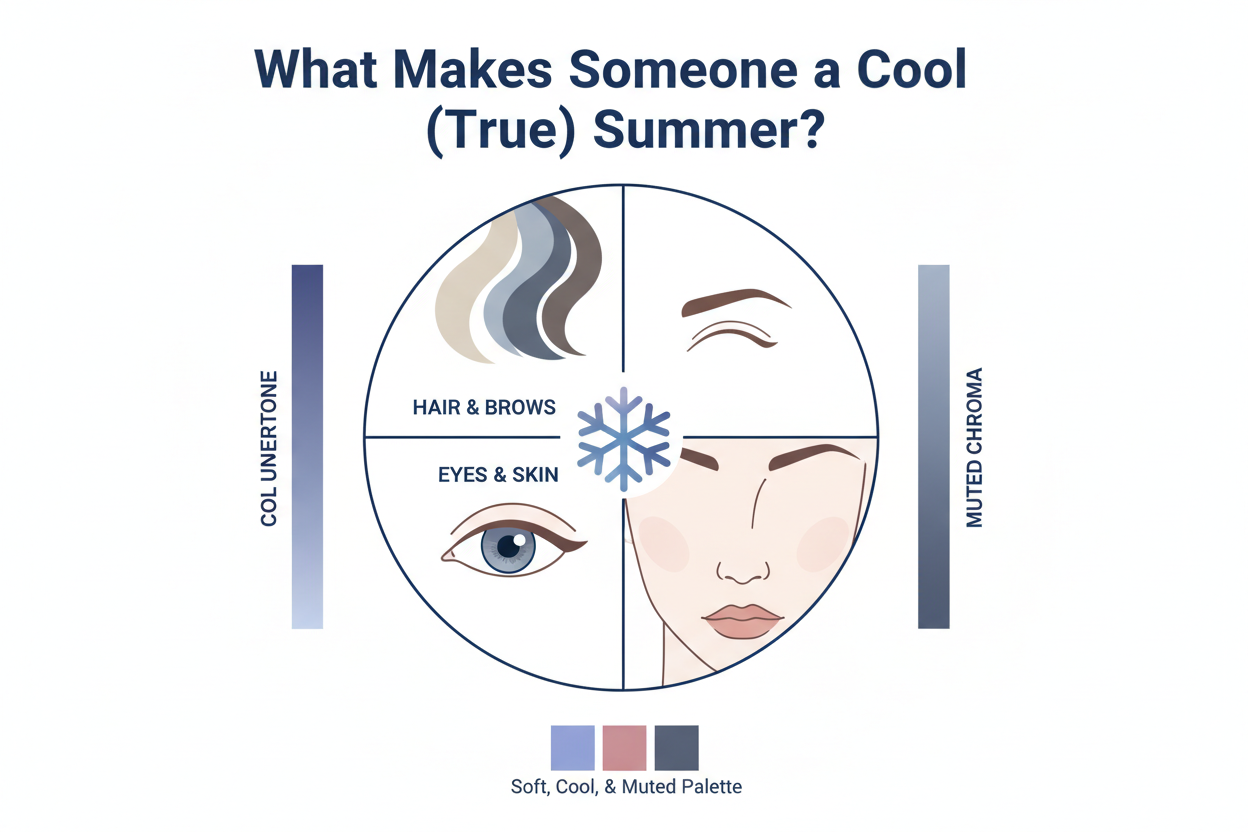
In a 16-season system, Cool Summer sits between Soft Summer and Light Summer. That position matters: it shares softness with Soft Summer and lightness with Light Summer, but cool undertone is the defining, non-negotiable quality of this particular sub-season.
What to look for:
- Skin: Cool or neutral-cool undertone—pink, rosy, or bluish-beige rather than peach or golden. The complexion tends toward porcelain, rose-beige, or cool-toned olive.
- Hair: Ash brown, cool dark blonde, or naturally muted, with no golden, red, or warm highlights. Depth ranges from light to medium-dark, never dramatically dark.
- Eyes: Blue, grey, cool green, or soft grey-hazel. The iris pattern reads soft rather than intensely saturated.
- Overall contrast: Features blend into each other gently. There's no stark dark-hair-against-pale-skin drama the way you'd see in a True Winter.
If all three categories trend cool and the overall impression is harmonious and gentle rather than striking, Cool Summer is a strong candidate.
Think you might be a Cool Summer? Take the color season quiz →
Why Celebrity Comparisons Actually Help You Identify Your Season
Color season theory is abstract until you see it on a face you already know. When an analyst says "cool, soft, medium contrast," those words mean different things to different people—but when they say "think Kate Middleton's complexion," the description suddenly has shape.
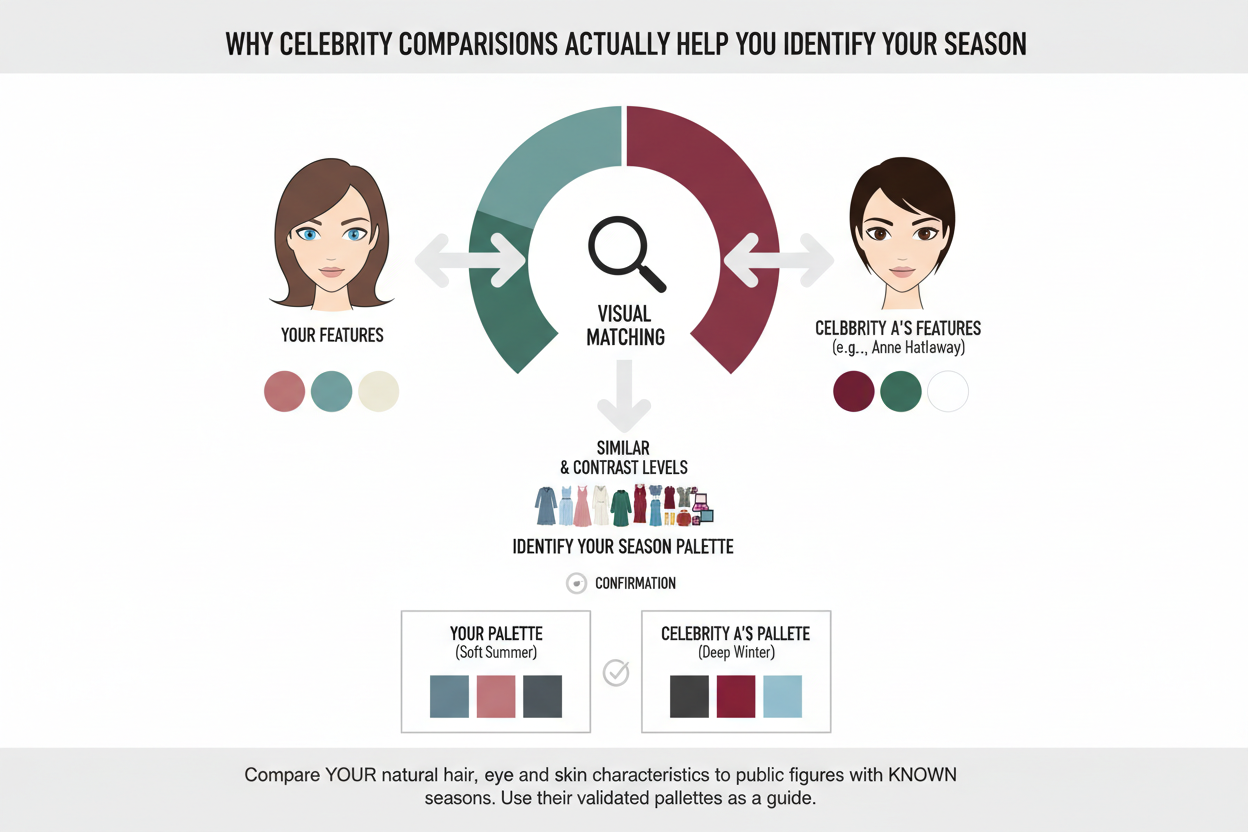
Celebrity comparisons serve a specific analytical function: they give you a reference point for undertone and contrast reading, not an aspirational beauty standard. The goal is never "do I look like Kate Middleton?" It's "do my features share the same type of coolness and softness her features do?"
That distinction matters for a few reasons.
Undertone reads differently across skin depths. Cool Summer spans a wide range of skin tones, so fixating on one celebrity's exact shade can send you in the wrong direction. What transfers across the group is feature type—the presence of cool undertone, not a specific complexion.
Contrast level is also easier to observe on a familiar face. When you've seen someone photographed thousands of times, you have an intuitive sense of whether their features clash dramatically or blend softly. That's genuinely useful data.
And hair and eye tone are easier to evaluate on someone else first. Noticing that Emily DiDonato's hair reads ashy rather than warm helps you understand what "ashy" actually means before you look in your own mirror.
One caveat worth keeping in mind: celebrity examples are illustrative, not exhaustive. The range of human coloring within any season is broad, and no single person represents all of Cool Summer. In-person analysis with a trained analyst is still the most accurate method. The celebrities here are starting points, not gatekeepers.
Kate Middleton: The Archetypal Cool Summer
Kate Middleton—Princess of Wales—is the most frequently cited Cool Summer reference point in color analysis, and the reasons come down to observable features, not cultural status.
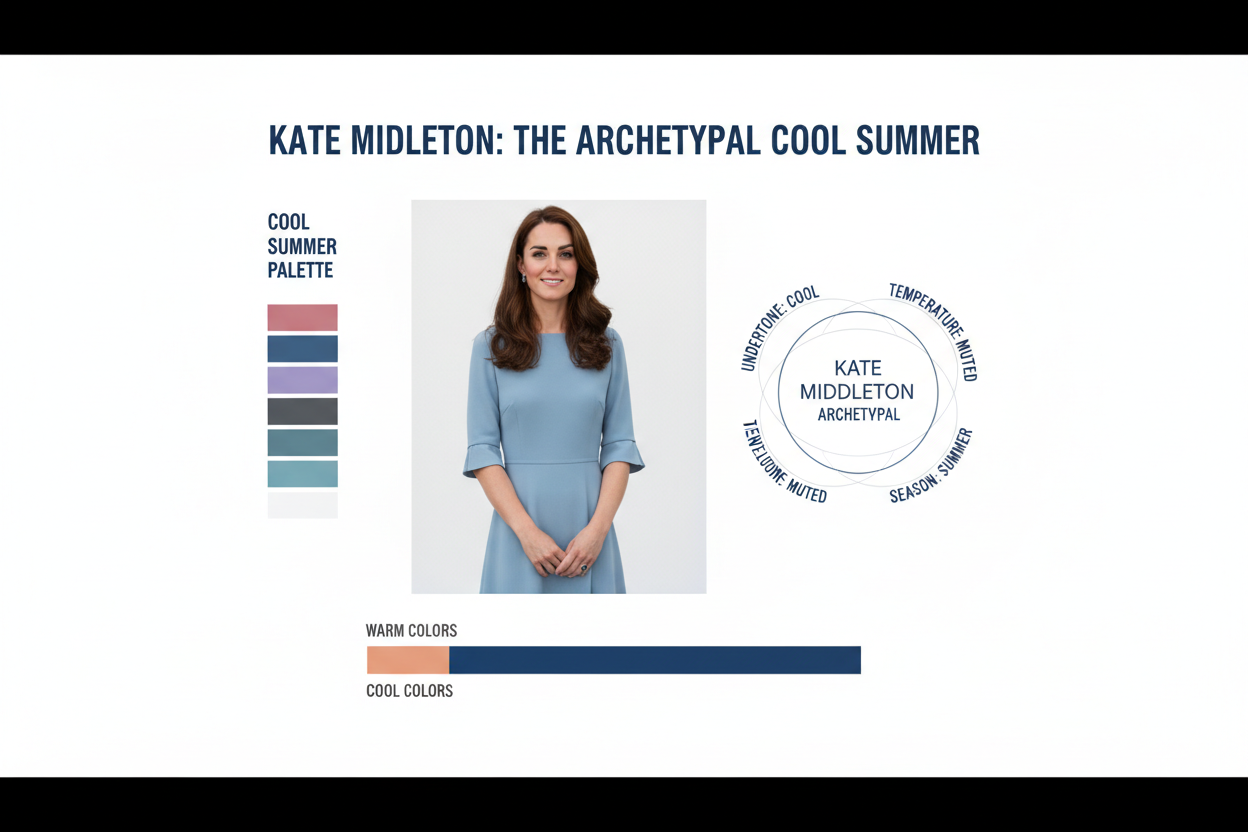
Her skin is cool-toned with a rosy, porcelain quality. There's no warmth or goldenness in her complexion even under varying lighting, which is one of the clearest signs of a genuine cool undertone.
Her natural hair is a medium cool-to-neutral brown. She's worn highlights over the years, but her base color reads as ash-inflected brunette without the red or golden warmth that would push toward Autumn or Warm Spring territory.
Her eyes are grey-green—soft in saturation, cool in tone, consistent with what you see across Cool Summer examples.
Overall contrast: her skin, hair, and eyes sit in a harmonious medium-contrast relationship. Her features don't create sharp visual drama. They blend in the gentle, unified way characteristic of Cool and Soft Summer coloring.
Her Signature Palette Choices in Public Appearances
What makes Kate Middleton useful as a reference is the sheer volume of documented public appearances—enough to identify consistent color patterns rather than one-off styling choices.
Her recurring wardrobe colors map almost directly onto the Cool Summer palette:
- Navy blue appears repeatedly across formal engagements, suits, and coats. Navy is one of the palette's anchor neutrals—deep enough to convey authority, cool enough not to overpower her complexion.
- Dusty rose and soft blush show up in more relaxed daytime looks. These muted pinks complement her rosy skin without reading as brash or warm-toned fuchsia.
- Soft grey features in tailored pieces. Cool grey sits naturally against cool skin in a way that warm camel or tan doesn't.
- Powder blue and icy periwinkle work because they echo the cool tones already present in her eyes and skin.
- Muted berry and soft mauve appear in occasion dressing—cool-toned alternatives to bright red, which reads too warm and sharp against her complexion.
Analysts often describe her overall aesthetic as carrying an aristocratic elegance, a quality that maps naturally onto the Cool Summer palette's soft, refined character. Worth noting: that effect isn't a personality trait. It's what happens when someone consistently chooses colors within their natural tonal range. The palette does the work.
Emily DiDonato and the Cool Summer Model Aesthetic
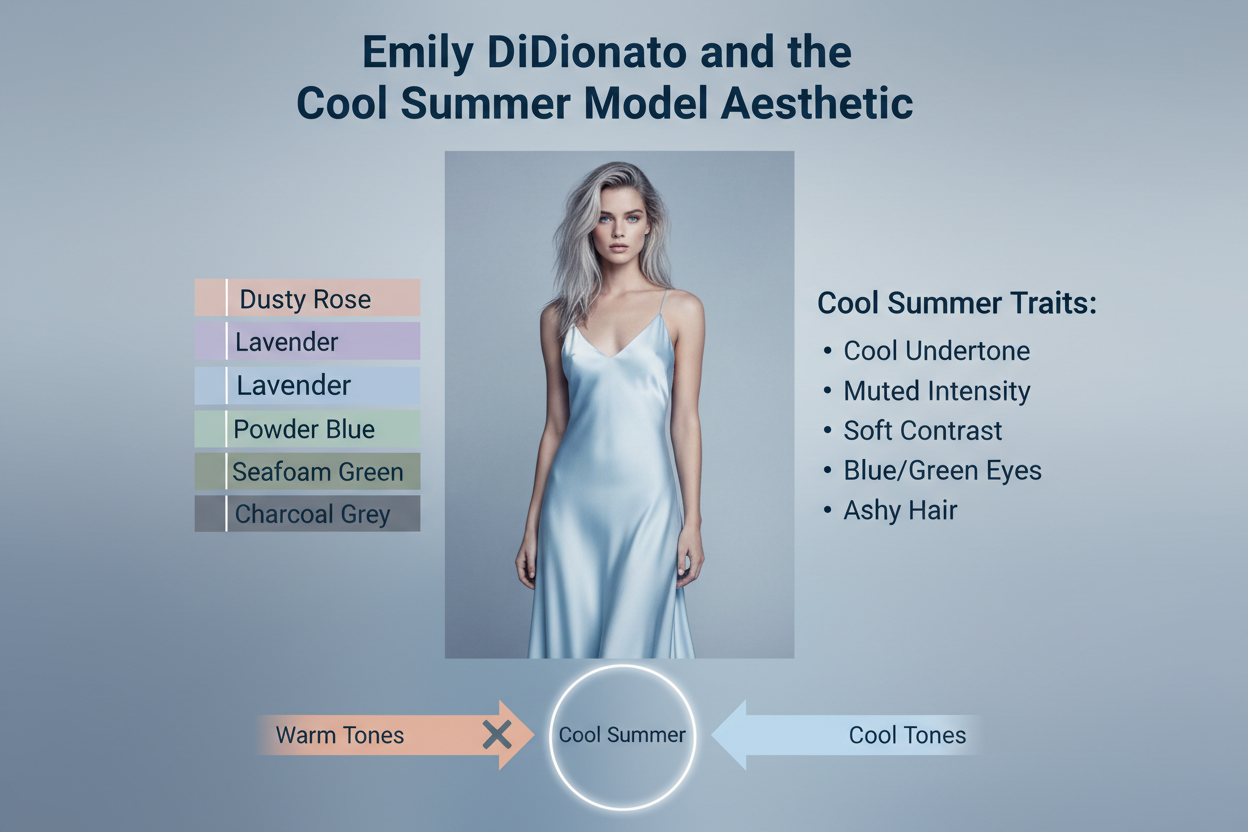
Emily DiDonato and the cool summer model aesthetic
Emily DiDonato is an American model known for Sports Illustrated Swimsuit and various beauty campaigns. She's a useful Cool Summer reference because color in editorial work gets managed deliberately, which makes undertone characteristics easier to spot.
Her skin has a cool, neutral undertone that reads rosy-fair in natural light. Stylists consistently work with it rather than against it—choosing color environments that complement her complexion instead of fighting it.
Her hair is a cool-to-neutral medium brown, similar in depth to Kate Middleton's but photographed across a wider range of styling conditions. Even when styled to look richer or deeper, the base tone reads muted and ash-influenced rather than warm or golden.
Her eyes are a soft, cool-toned brown, which is worth noting for anyone who assumes Cool Summers must have blue or grey eyes. Brown eyes absolutely fit the season—as long as they read cooler and softer rather than warm amber or golden.
Contrast level: like Middleton, DiDonato's features relate to each other gently. The overall impression is harmonious rather than high-contrast, which fits the medium-contrast signature of the season.
If you're exploring this season through a makeup lens, DiDonato's editorial work is a good reference for how Cool Summer coloring responds to cool-toned cosmetics—the muted pink lipsticks, cool-based foundations, and soft berry eyeshadows that makeup artists consistently reach for when working with her.
Not sure your coloring matches either of these examples? Start the quiz to find your actual season →
The Colors That Flatter Cool Summers—and the Ones That Drain Them
The Cool Summer palette is built around colors that share two qualities with the season itself: cool undertone and soft intensity. When those qualities align between a person and their clothing, the result is visual harmony—skin looks even, eyes appear brighter, and the overall impression is clear rather than washed-out.
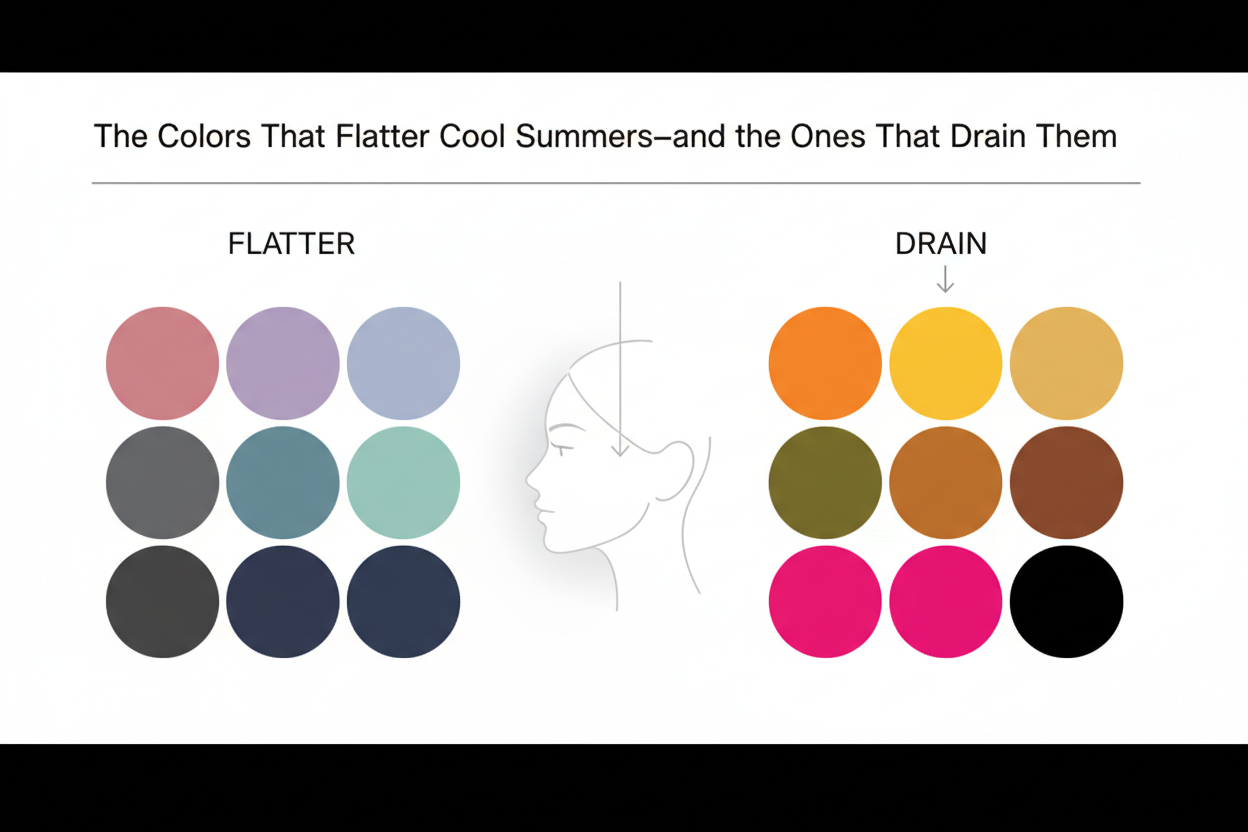
Colors that work with Cool Summer coloring:
| Category | Examples |
|---|---|
| Blues | Navy, powder blue, periwinkle, slate blue, icy blue |
| Pinks | Dusty rose, soft blush, cool pink, muted mauve |
| Purples | Lavender, soft plum, cool lilac |
| Greens | Soft sage, cool mint, dusty teal |
| Neutrals | Soft white, cool grey, rose-taupe, blue-navy |
| Berries | Soft raspberry, cool burgundy, muted berry |
These shades share the same cool, low-saturation quality as the season itself. They don't overpower; they amplify.
Colors that visibly drain Cool Summer coloring:
- Warm oranges and terracottas: These pull warm undertones forward that aren't there, making cool-toned skin look sallow or grey.
- Golden yellows and mustard: The warm, golden frequency clashes with cool undertones and tends to make the complexion look flat or tired.
- Earthy browns and camel: These warm neutrals work against the cool quality of skin and hair rather than echoing it.
- Bright, saturated warm reds: Too intense and too warm—they overpower the season's soft contrast.
- Crisp white: Often too stark for Cool Summer's soft contrast level. A soft white or rose-white works better.
- Black: Can work in smaller doses but tends to create more contrast than the season's coloring supports comfortably.
Kate Middleton's consistent avoidance of warm earth tones in public appearances—and her reliable return to navy, dusty rose, and soft grey—is about as clear a real-world demonstration of these principles as you're going to find.
How to Tell If You Share a Cool Summer's Coloring
Comparing your features to Cool Summer celebrities works best as a feature audit rather than a looks comparison. Here's how to approach it:
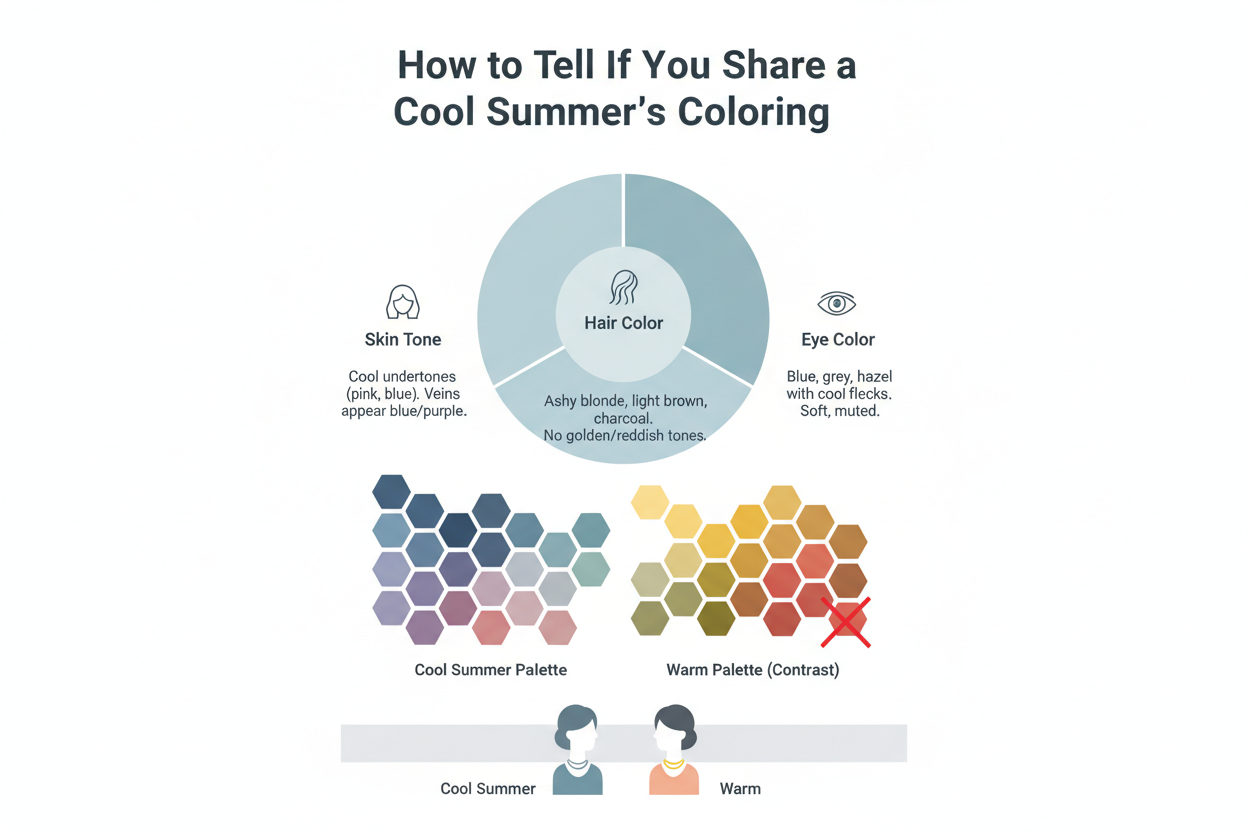
Start with skin undertone—it's the non-negotiable. Hold a cool-grey or soft white fabric near your face in natural light. If your skin looks clearer, more even, and healthier, you likely have a cool undertone. If warm gold or peach does that job instead, you're probably in a warmer season.
Check your hair tone honestly. Look at your natural hair (or roots if colored) and ask: does it lean ash, or does it lean gold/red? Cool Summers have naturally ashy, muted hair with no warm glint even in sunlight. Hold your hair next to Kate Middleton's natural color in photographs—does it read in the same cool-brown family?
Assess your overall contrast level. Step back and consider how dramatically your hair contrasts against your skin. Cool Summers sit in a medium zone—not the near-invisible contrast of very light blonde against fair skin, and not the sharp contrast of jet-black hair against porcelain. If your features blend harmoniously rather than creating strong visual tension, that's the Cool Summer contrast signature.
Look for cool tones in your eyes, whatever the color. Blue, grey, and cool green are common, but Emily DiDonato shows that cool brown eyes fit the season too. The question isn't the color category—it's whether the eye reads warm and golden or cool and soft.
If three or four of these checks land consistently in the cool, soft range, Cool Summer deserves serious consideration. If you're hitting a mix—some cool, some warm—an adjacent season like Soft Summer or Light Summer may be more accurate.
Three Feature Checks to Compare Yourself to Cool Summer Celebrities
Use this as a quick visual checklist before moving to a formal analysis:
① Skin undertone check Compare your complexion to Kate Middleton's in photographs taken in natural, unfiltered light. Does your skin share that cool, rosy-to-neutral quality? Or does yours read warmer—more peachy or golden?
② Hair depth and tone check Compare your natural hair to both Middleton's and DiDonato's. Is the depth (light to medium-dark) in a similar range? More importantly, does the tone read ash-cool rather than warm-gold? A quick test: does your hair look richer in shade or in sunlight? Cool hair tends to look more vibrant in shade; warm hair glints in sun.
③ Eye tone and clarity check Look at your eye color and ask whether it reads cool (blue, grey, cool green, soft cool brown) rather than warm (amber, golden brown, warm hazel). Also consider saturation: Cool Summer eyes tend to be softly saturated, not intensely vivid.
If all three checks point cool and soft, your coloring matches the season's signature. If one or two feel uncertain, an in-person or professional online analysis will give you a more reliable read than self-comparison alone.
Cool Summer vs. the Other Summer Sub-Seasons: Key Differences
Cool Summer sits between Soft Summer and Light Summer in the 16-season framework, which makes these the two most common mix-ups. The differences are real but subtle—and that subtlety is exactly what trips people up.
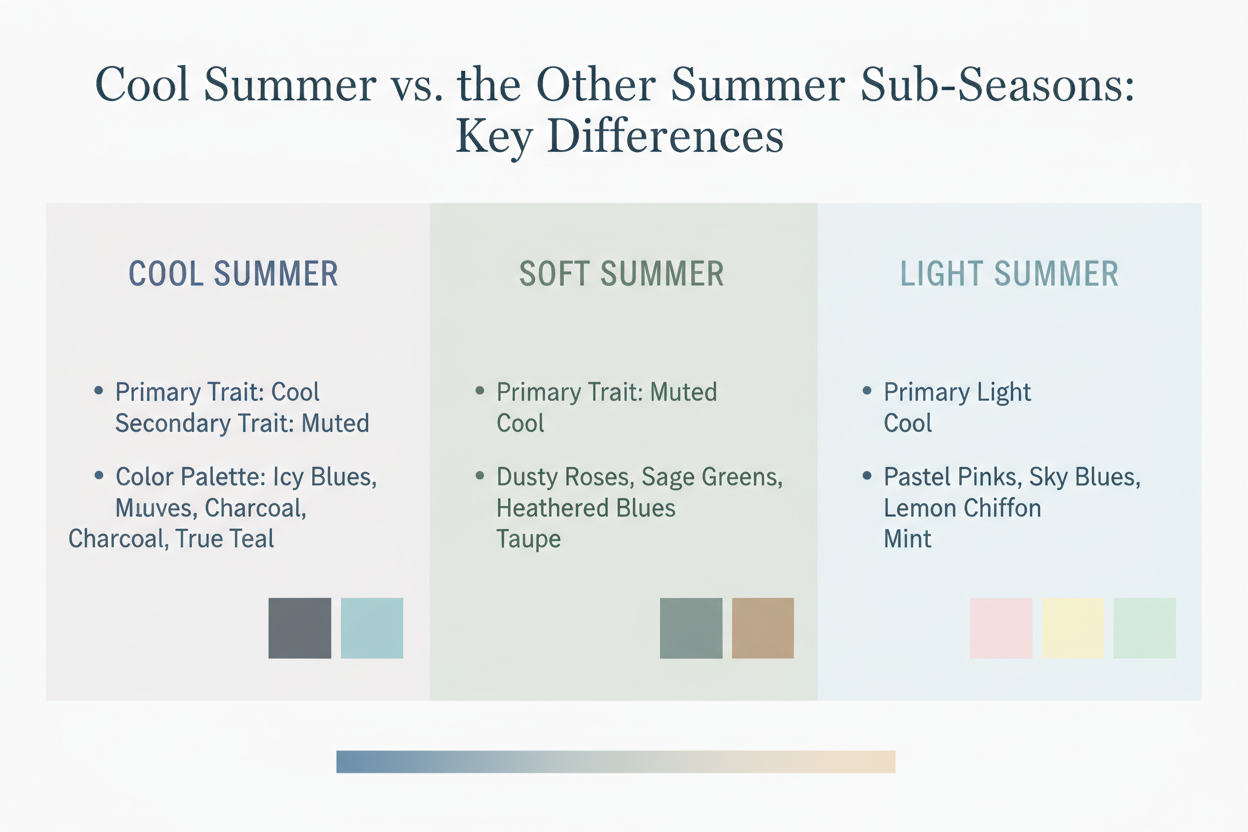
Cool (True) Summer vs. Soft Summer
| Trait | Cool Summer | Soft Summer |
|---|---|---|
| Dominant quality | Cool undertone | Soft/muted intensity |
| Undertone | Distinctly cool | Cool-to-neutral, more muted |
| Contrast | Low-to-medium | Very low |
| Hair | Cool ash brown, medium depth | Softer, more blended, greyer/taupe |
| Palette intensity | Slightly crisper | More muted and dusty throughout |
The key distinction: Cool Summer leads with coolness; Soft Summer leads with muted softness. A Soft Summer's coloring tends to look more blended and hazy overall—quieter in contrast than a Cool Summer's, even when the two seem close on paper.
Cool (True) Summer vs. Light Summer
| Trait | Cool Summer | Light Summer |
|---|---|---|
| Dominant quality | Cool undertone | Light/delicate |
| Hair depth | Light to medium-dark | Light to medium-light |
| Overall impression | Cool, refined | Airy, delicate |
| Palette weight | Can carry medium-depth colors | Needs lighter, more delicate tones |
The key distinction: Cool Summer handles more depth than Light Summer can. Medium-depth colors like navy or soft plum overwhelm a Light Summer; a Cool Summer wears them without issue.
If you're wavering between the three, ask yourself one question: what is the most dominant quality of your coloring—coolness, softness, or lightness? Whichever quality stands out most points toward the corresponding sub-season. If coolness clearly leads, Cool (True) Summer is the strongest candidate.
People Also Ask
Who are some famous Cool Summer celebrities?
Kate Middleton and Emily DiDonato are the two most consistently cited examples of Cool (True) Summer coloring. Both have the season's defining combination of cool undertone and soft, medium contrast across skin, hair, and eyes. Other names appear across color analysis sources, but Middleton and DiDonato come up most reliably because their features are well-documented and their undertone characteristics are easy to observe across a large number of photographs.
What colors should Cool Summers avoid?
Cool Summers generally want to stay away from colors with a warm, golden, or earthy quality. The most draining choices include:
- Warm oranges and terracottas — these clash with cool undertones and can make skin look grey or sallow
- Mustard and golden yellow — the warm frequency works against the cool base
- Camel and warm brown neutrals — these disconnect from the cool quality of skin and hair
- Bright warm reds — too saturated and too warm for the season's soft contrast level
- Black — often reads as too harsh against naturally medium-contrast features
- Crisp or bright white — typically too stark; soft or rose-white works better
The pattern is consistent: if a color reads as noticeably warm or highly saturated, it will likely fight rather than flatter Cool Summer coloring.
How is Cool Summer different from Soft Summer?
Both seasons share cool-to-neutral undertones and relatively low contrast, but the dominant quality differs. Cool Summer leads with coolness — it's the most distinctly cool of the three Summer sub-seasons, and its palette can carry slightly crisper, more defined tones. Soft Summer leads with muted softness — the overall coloring is quieter, more blended, and hazier in contrast.
In practice: a Cool Summer can comfortably wear navy or soft plum without being overwhelmed. Those same colors may read as too defined or heavy on a Soft Summer. If you're deciding between the two, the key question is whether coolness or softness is the more dominant quality in your coloring.
What does the Cool Summer color palette look like?
The Cool Summer palette is built from colors that are cool in undertone and soft to medium in intensity — nothing overly bright, saturated, or warm. It includes:
- Blues: navy, powder blue, periwinkle, slate, icy blue
- Pinks: dusty rose, soft blush, cool pink, muted mauve
- Purples: lavender, soft plum, cool lilac
- Greens: dusty sage, cool mint, muted teal
- Neutrals: soft white, cool grey, rose-taupe, blue-navy
- Berries: soft raspberry, cool burgundy, muted berry
The overall impression is refined and understated rather than bold or high-contrast. Kate Middleton's public wardrobe is a reliable visual reference for how these colors actually look together.
Can you be a Cool Summer with dark hair?
Yes, though "dark" needs some unpacking. Cool Summer covers light to medium-dark hair—ash brown, cool dark blonde, and muted brunette all fit. What matters isn't depth so much as tone: Cool Summer hair reads ash and muted rather than warm, golden, or red-tinged, whatever the depth.
What Cool Summer doesn't really include is dramatically dark hair—the near-black associated with high-contrast seasons like True Winter. If your hair is very dark and creates a sharp contrast against your skin, True Winter or Dark Autumn may be a better fit. If it reads cool and muted at medium depth, Cool Summer is still worth considering.
FAQ
What are the defining features of a Cool Summer color season?
Cool (True) Summer comes down to two qualities working together: cool undertone and soft intensity. In practice:
- Skin has a pink, rose, or neutral-cool cast with no warmth or golden quality
- Hair reads ashy—cool blonde, ash brown, or muted brunette, not warm, golden, or red-toned
- Eyes tend toward blue, grey, soft grey-green, or cool hazel, often with a muted quality
- Overall contrast sits at a medium level—features blend rather than creating sharp, high-contrast definition
Cool (True) Summer is one of three Summer sub-seasons, all sharing a cool-to-neutral base. What sets it apart from the other two is that coolness is the dominant descriptor, with softness as the secondary quality.
Why are Kate Middleton and Emily DiDonato considered Cool Summers?
Both come up consistently across color analysis sources as classic Cool (True) Summer examples because their features visibly demonstrate what the season actually looks like.
- Kate Middleton has ash-brown hair with no warm or golden tones, cool-toned skin with a pink-rose quality, and blue-grey eyes. Her public wardrobe — heavily featuring navy, dusty rose, soft plum, and muted blue — also lines up closely with what the Cool Summer palette recommends.
- Emily DiDonato has cool, muted coloring with soft contrast across skin, hair, and eyes, and the large volume of professional photos available makes those features easy to analyze.
Celebrity examples illustrate what a season looks like — they don't define its full range. Useful reference points, not rigid benchmarks.
What is the difference between Cool Summer, Soft Summer, and Light Summer?
All three are Summer sub-seasons and share a cool-to-neutral undertone. The differences come down to which quality dominates:
| Sub-Season | Dominant Quality | Secondary Quality |
|---|---|---|
| Cool (True) Summer | Cool | Soft |
| Soft Summer | Soft/Muted | Cool |
| Light Summer | Light | Cool |
- Cool Summer can handle slightly more defined, crisper tones within the Summer range—navy or soft plum sit comfortably here
- Soft Summer leads with muted, hazy softness; those same colors can read as too heavy or sharp
- Light Summer leads with delicacy; the palette skews toward the palest, most ethereal end of the Summer range
In a 16-season system, Cool Summer sits between Soft Summer and Light Summer. The deciding factor is which quality—coolness, softness, or lightness—most strongly defines your coloring.
What colors flatter the Cool Summer palette most?
Cool Summer draws from colors that are cool in undertone and soft to medium in intensity. Good choices:
- Blues: navy, powder blue, periwinkle, slate, icy blue
- Pinks: dusty rose, soft blush, muted mauve, cool pink
- Purples: lavender, soft plum, cool lilac
- Greens: dusty sage, muted teal, cool mint
- Neutrals: soft white, rose-taupe, cool grey, blue-navy
- Berries: soft raspberry, cool burgundy, muted berry
The palette sits in the middle ground — not stark and high-contrast, but not washed out either. Warm, golden, or earthy tones tend to clash, and so do saturated brights or hard black.
Can celebrity color season examples be used to identify my own season?
Yes, but with realistic expectations about what comparisons can and cannot do. Celebrity examples are genuinely useful for a few reasons:
- They give you a concrete visual anchor for abstract concepts like "cool undertone" or "medium contrast"
- A well-documented public figure comes with a large pool of images across different lighting and styling contexts
- Seeing how certain colors perform on a known Cool Summer can help you gauge whether similar colors work on you
The limitation is that celebrity examples cover only a slice of the season's full range of human coloring. Color analysis sources consistently note that cited examples don't capture every variation a season includes. Use celebrities as a starting reference point, not a pass/fail checklist, and be willing to look beyond a single face when you're assessing your own features.
Is Cool Summer the same as True Summer?
Yes. Cool Summer and True Summer are the same season—the name just depends on which color analysis framework you're using. "True Summer" shows up in systems that want to signal this is the central, most archetypal Summer type. "Cool Summer" is more common in 16-season frameworks, where the name flags coolness as the defining characteristic.
Either way, the underlying profile is identical: cool undertone, soft intensity, medium contrast. If you see one label or the other in color analysis content, they're describing the same seasonal type.
How accurate is comparing myself to Cool Summer celebrities without a professional analysis?
Helpful, but not definitive. Celebrity comparisons can meaningfully narrow your options and sharpen your intuition—especially when you study how specific colors perform on a known Cool Summer and compare that response to your own experience with those same colors. That kind of observational process has real value.
Where self-comparison tends to fall short is in details that photographs don't always capture: the exact undertone of your skin in person, how your features read under different light, and whether a borderline characteristic tips you toward Cool Summer or a neighboring season like Soft Summer or Light Summer.
If you want a reliable answer, a structured tool or professional analysis will get you there more accurately than visual comparison alone. A seasonal color quiz that considers your individual feature combination is a practical next step—one that can confirm what celebrity comparisons can only suggest.