
Soft Summer vs True Summer
 Reviewed by Alexandra Gilmore
Soft Summer and True Summer are both cool-leaning, but one needs dusty restraint while the other handles clearer, more classically cool color. Compare their blues, pinks, neutrals, metals, and makeup side by side to learn whether extra chroma defines your features or overwhelms them.

Both Soft Summer and True Summer sit inside the broader Summer season, which means they share cool-leaning undertones and a general preference for low-contrast, refined color. Yet the two sub-seasons can feel almost like opposites once you hold their palettes side by side. One is quiet and dusty; the other is crisp and classic. Choosing the wrong one can leave your complexion looking either washed out or strangely harsh—which is why getting the distinction right matters.
💫 Explore Seasonal Color Analysis
Use the distinctions in this article to narrow the possibilities, then compare the seasonal system as a whole. Seeing the neighboring palettes together makes the result easier to test in real clothing and daylight.
Learn Seasonal Analysis →This guide breaks down exactly where the two palettes diverge and what that means for your skin, hair, and eyes in practice. Here is what you will find inside:
- The shared DNA — what True Summer and Soft Summer genuinely have in common
- The defining split — how saturation and muting separate the two
- Feature profiles — how each type tends to look in person, with celebrity reference points like Kristen Stewart (Soft Summer) and Emily Blunt (True Summer)
- Palette breakdowns — the specific hues that flatter each type and the ones that drain both
- Common misidentification traps — and how to sidestep them
- A practical path forward — using a color analysis quiz to confirm your sub-season with confidence
If you have ever looked at a Soft Summer color card and thought it seemed too warm, or stared at a True Summer palette and wondered why the blue-pinks feel slightly off for you, you are in the right place. By the end, you will have a clear, evidence-based framework to tell the two apart and start building a wardrobe that genuinely works.
What Soft Summer and True Summer Actually Have in Common
It helps to understand why these two get confused before trying to separate them. Both belong to the Summer family, and that shared ancestry shapes how they respond to color in similar ways.
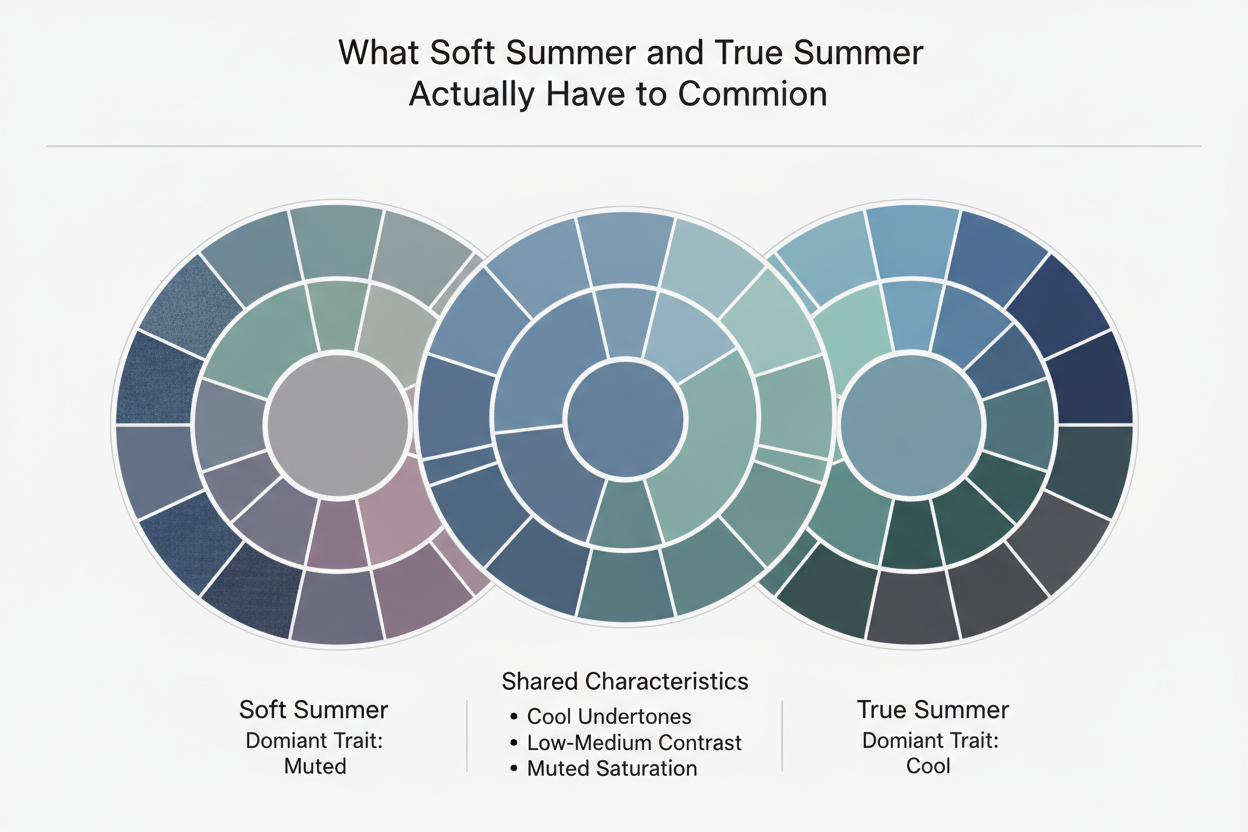
The common ground:
- Cool-leaning undertones. Neither type suits the warm amber, caramel, or orange-adjacent shades associated with Autumn or Spring. Both read as cool or cool-neutral at their core.
- Low overall contrast. Hair, skin, and eyes tend to blend softly rather than stand apart in sharp contrast. Bold color combinations can overwhelm the natural harmony in both.
- Sensitivity to brightness. Highly saturated colors tend to compete with the complexion rather than work with it. Both types do better in hues with some restraint built in.
- A preference for softness. Even where they diverge, neither sub-season suits harsh or heavily saturated palettes.
This is why the confusion persists. Someone who knows warm tones and bright colors drain her might reasonably land on either palette without being sure which one actually fits. The shared avoidance zone is real—but the reasons each type ends up there are slightly different, and that's what the rest of this guide gets into.
The Core Difference: Saturation and Softness
If there's one axis that separates Soft Summer from True Summer, it's how much muting the palette needs.
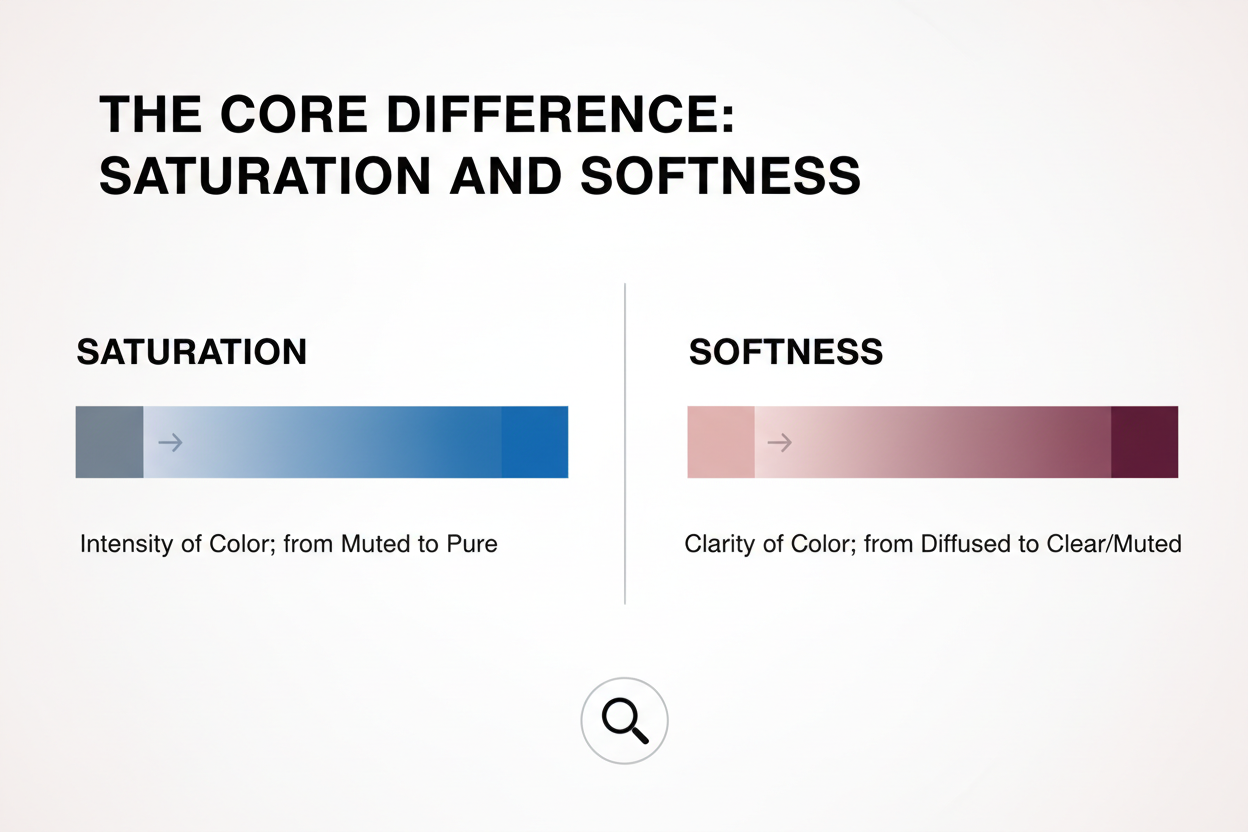
True Summer—also called Cool Summer—is the season's clearest expression. The palette is cool, medium in depth, and has a graceful, elegant quality. Colors can be relatively clear and clean while still sitting comfortably on a True Summer. Think the clear blue of a hazy summer sky, or a classic dusty rose: cool, but not aggressively blended or blurred.
Soft Summer sits somewhere different. It's still cool at its foundation, but noticeably softer and more blended than True Summer—and it borrows subtle warmth from the Autumn seasons. Every shade looks slightly diffused, as if seen through a thin layer of gauze. Where True Summer can wear a cool, medium-clear lavender, Soft Summer needs that same lavender to carry a dusty, almost grey undertone before it works.
The practical implication: a color that reads as clean and elegant on a True Summer can read as slightly harsh or too "blue" on a Soft Summer, because Soft Summer needs the warmth and muting dialed up one notch further.
Feature Profiles: How Each Type Looks in Person
Knowing what each sub-season actually looks like on a real face is one of the fastest ways to figure out which one you are.
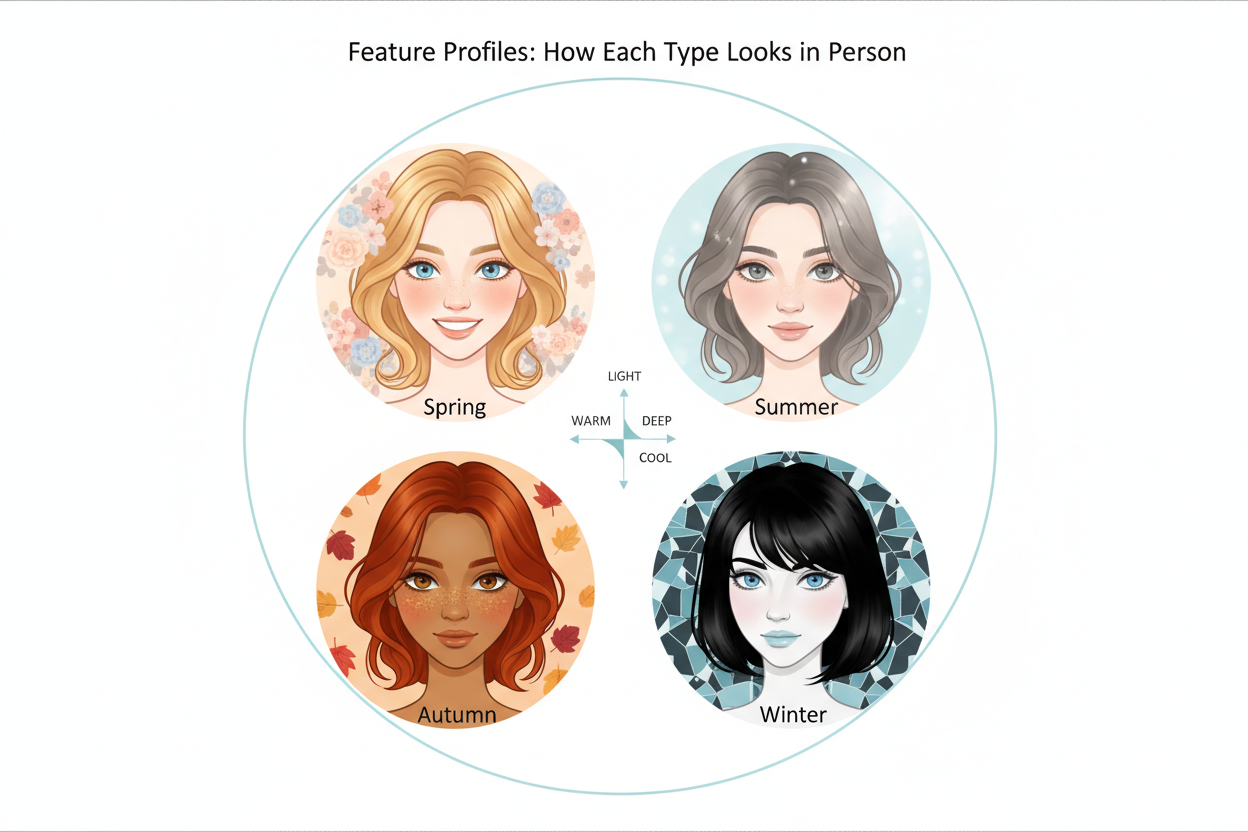
Soft Summer features have a gentle, dusty quality. In practice, that means:
- Skin that looks soft and slightly diffused—ashy, greyed, or peachy-muted rather than clearly pink
- Hair in muted, blended shades: ash brown, soft brunette, or greyed blonde rather than anything bright or richly saturated
- Eyes that look blended—grey-green, grey-blue, or soft hazel—rather than vivid or sharply defined
- An overall face that reads as softly low-contrast, with features that flow into one another
True Summer features are also low contrast, but cooler and more classically elegant. Here:
- Skin has a noticeably cool, rosy, or pink-toned cast
- Hair runs cool—cool browns, dark blondes, ash-toned shades that read clearly cool rather than hazy or blended
- Eyes tend toward cool blue, grey-blue, or clear grey
- The overall impression is refined and quiet, but with slightly more definition than Soft Summer
Celebrity Reference Points: Kristen Stewart vs Emily Blunt
These two make the distinction easy to see.
Kristen Stewart (Soft Summer): Her coloring has that characteristic blended, ashy quality. Skin and hair sit in a similar muted register, and her eyes carry a soft grey-green tone with no sharp definition. Nothing in her natural coloring reads as distinctly cool or vivid—everything is slightly diffused, which is exactly the Soft Summer signature.
Emily Blunt (True Summer): Her complexion reads clearly cool and rosy. Her hair sits in a cooler mid-range tone, and her eyes have a defined, cool quality. Overall contrast is still low, but the coolness is cleaner and more apparent—less blended, more classically cool. That's the thing that separates a True Summer from a Soft one: you can read the cool clarity at a glance.
Palette Breakdown: Colors That Work for Each Type
Knowing your sub-season only matters when it translates into actual color choices. Here's how the two palettes differ in practice.
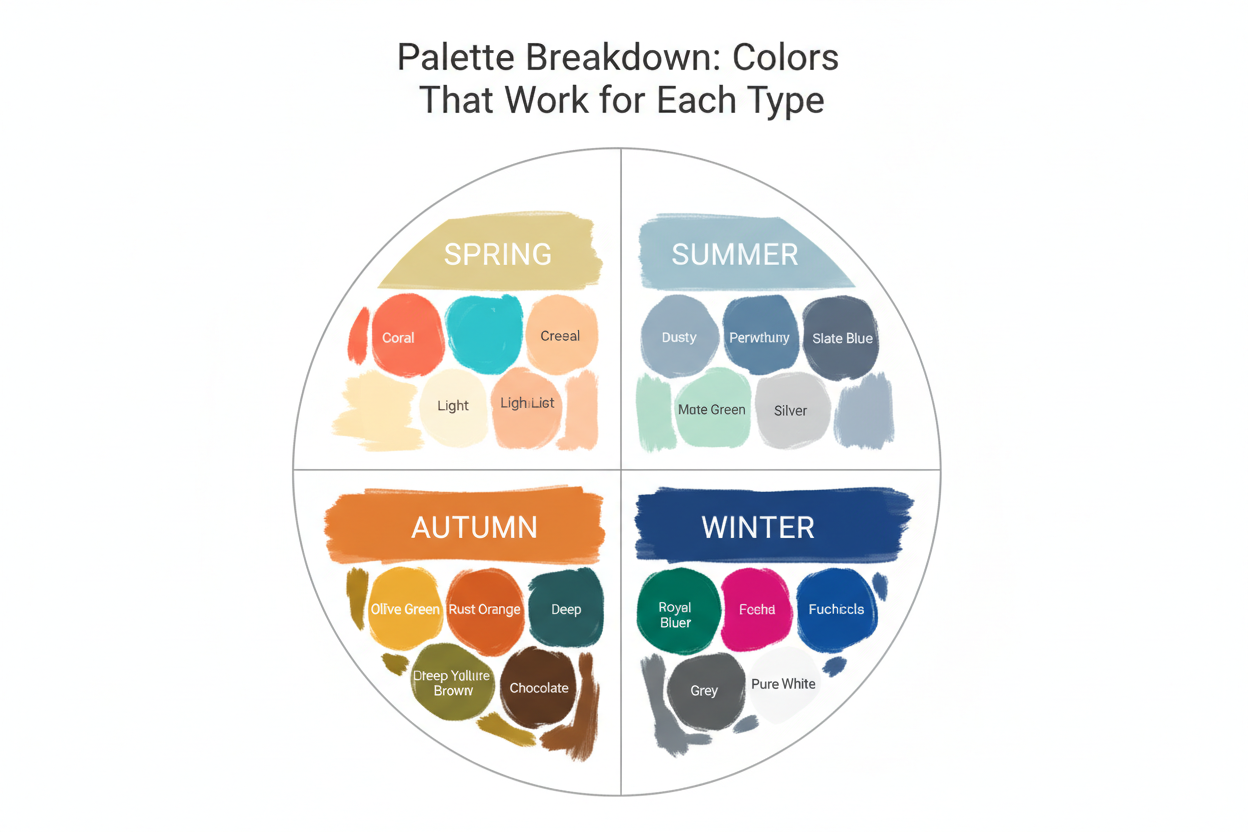
Soft Summer palette priorities:
- Muted, dusty, blended cool hues: soft mauve, blush with a grey undertone, muted sage, dusty periwinkle, warm-edged taupe
- Shades that look like they have a slight veil over them—never sharp or vivid
- Subtle warmth can be flattering, as long as it stays blended and muted rather than bright
- Neutrals in warm-toned greiges, soft camel (muted, not golden), and quiet off-whites rather than stark white or pure cool grey
True Summer palette priorities:
- Cool, medium-depth hues that are clear but not saturated: rose pink, lavender, soft cornflower blue, blue-toned red, cool berry
- Classic cool neutrals: soft charcoal, cool dove grey, blue-based navy, rose-toned beige
- These colors can carry a degree of clarity that would overwhelm a Soft Summer—the key is staying cool and medium in depth rather than vivid or dark
Colors That Drain Both Types—and Why Warm or Bright Shades Are the Culprit
Both sub-seasons have a well-defined avoidance zone. Understanding it helps rule out colors confidently regardless of which side of the line you fall on.
Colors to avoid for both Soft Summer and True Summer:
- Warm, golden, or orange-based shades — mustard, rust, warm terracotta, golden yellow. These add warmth that neither cool-undertone type can carry without looking sallow.
- Highly saturated, vivid brights — electric blue, hot pink, neon green, vivid red. The intensity overwhelms the naturally low-contrast, softly cool complexion both types share.
- Very dark, high-contrast shades — jet black, very dark brown. The contrast cuts against the soft, blended nature of both palettes.
- Pure, stark white — creates a harshness that cool-muted types struggle to balance.
One more note specifically for Soft Summer: cool-clear shades that lack muting can also drain this type. A bright, clean cobalt that works on a True Summer can read as cold and unflattering on a Soft Summer, because her coloring needs that extra blended quality. This is probably the most practical test: if a clearly cool shade still feels slightly stark or harsh, Soft Summer is the more likely fit.
The color you wear next to your face isn't just an aesthetic choice—it changes how your face reads. Colors that harmonize with your natural coloring make skin look healthy and the face look rested; colors that clash introduce shadows and dullness that have nothing to do with your actual features.
The Autumn Influence in Soft Summer—and Why It Matters
This is what most sets Soft Summer apart within the Summer family, and also what causes the most confusion.
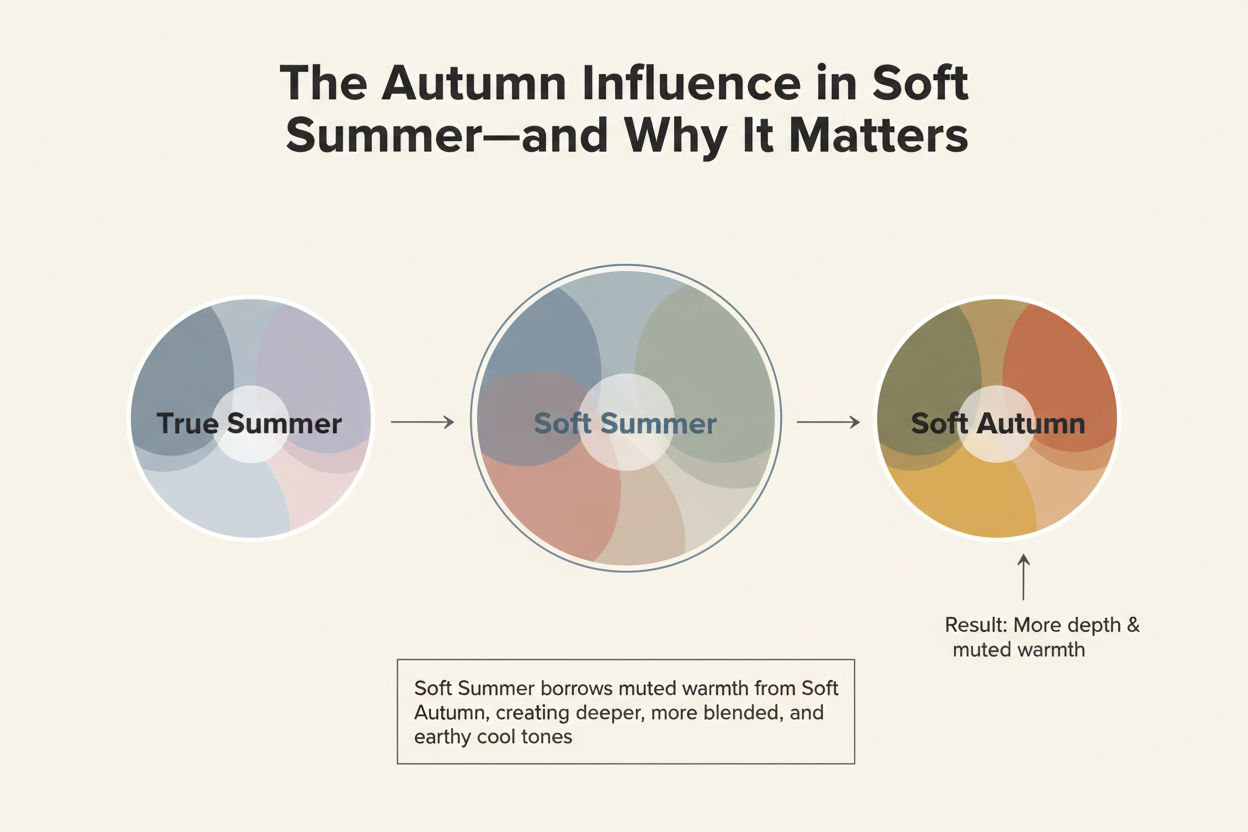
Soft Summer sits at the border between Summer and Autumn. Its palette inherits a subtle warmth and earthiness from the Autumn side—enough to soften its cool base, but not enough to push it into warm territory. The result is still a cool palette, just less purely cool than True Summer or Light Summer.
In practice, this looks like:
- Soft Summer can handle a slightly warm-edged grey or a brownish mauve where True Summer would look off
- Dusty rose works differently here than on True Summer—a rose with a faint peachy or brownish tinge may actually read better than a cool, clear pink
- Soft camel and muted warm beiges show up in this palette in a way they don't in True Summer
What this doesn't mean:
- Soft Summer is not warm-undertoned. The Autumn influence softens; it doesn't warm in the traditional sense.
- Soft Summer can't wear the full Autumn palette—rich, saturated, deeply warm shades are still unflattering.
- Any warmth that reads as vivid or saturated is still outside this type's range.
This is what makes the type genuinely hard to identify without careful analysis. The Autumn bleed makes Soft Summer feel less intuitive than True Summer, whose cool-clear palette is relatively straightforward to recognize.
Common Misidentification Mistakes and How to Avoid Them
These two sub-seasons are close enough that the same mistakes come up again and again. Knowing what to watch for makes the distinction easier.
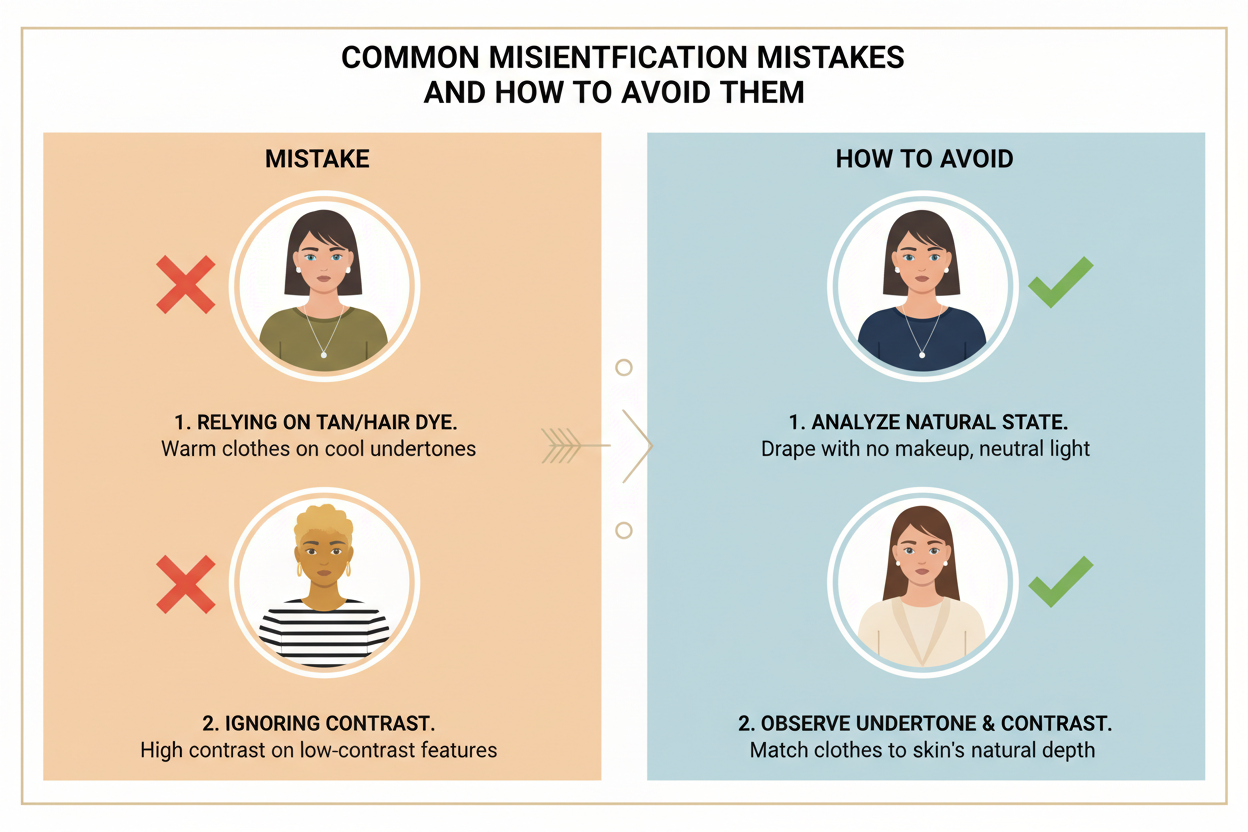
Mistake 1: Assuming all Summer types wear the same shades of pink and blue. True Summer's classic rose pink and soft cobalt don't automatically work for Soft Summer. If those cool-clear pinks feel slightly cold against your skin, that's a signal pointing toward Soft Summer.
Mistake 2: Confusing "soft" with "warm." Soft Summer's muted, blended quality sometimes leads people to mistake it for a warm season. The fact that burnt orange and golden mustard still drain a Soft Summer corrects this. The muting isn't warmth—it's a diffusing of both cool and warm energy.
Mistake 3: Over-relying on a single feature. Hair color alone or eye color alone won't distinguish these two types. What matters is the combination: undertone, contrast level, and whether your features read as blended or clear overall.
Mistake 4: Defaulting to True Summer because it is more commonly discussed. True Summer is often treated as the default. If you've tried clean cool palettes and found them slightly harsh or flat on you, that reaction is itself useful information.
Diagnostic checkpoints to use:
- Do cool-clear shades (bright lavender, crisp cool pink) feel slightly stark or cold on you, even though warm shades also drain you?
- Does your hair have an ashy, blended, or slightly hazy quality rather than a clearly cool tone?
- Do your features blend softly together rather than reading as distinctly cool and defined?
- Do you find that muted, dusty shades with subtle warmth feel more harmonious than pure cool shades?
If you answered yes to most of those, Soft Summer is the stronger fit.
How to Confirm Your Sub-Season with a Color Analysis Quiz
Self-analysis has a real limitation here: it's genuinely hard to assess your own coloring objectively, especially when the difference between two sub-seasons comes down to something as subtle as "muted vs. clear" or "blended vs. defined." The line between Soft Summer and True Summer is real, and even experienced analysts say there's a lot of room for uncertainty at the border.
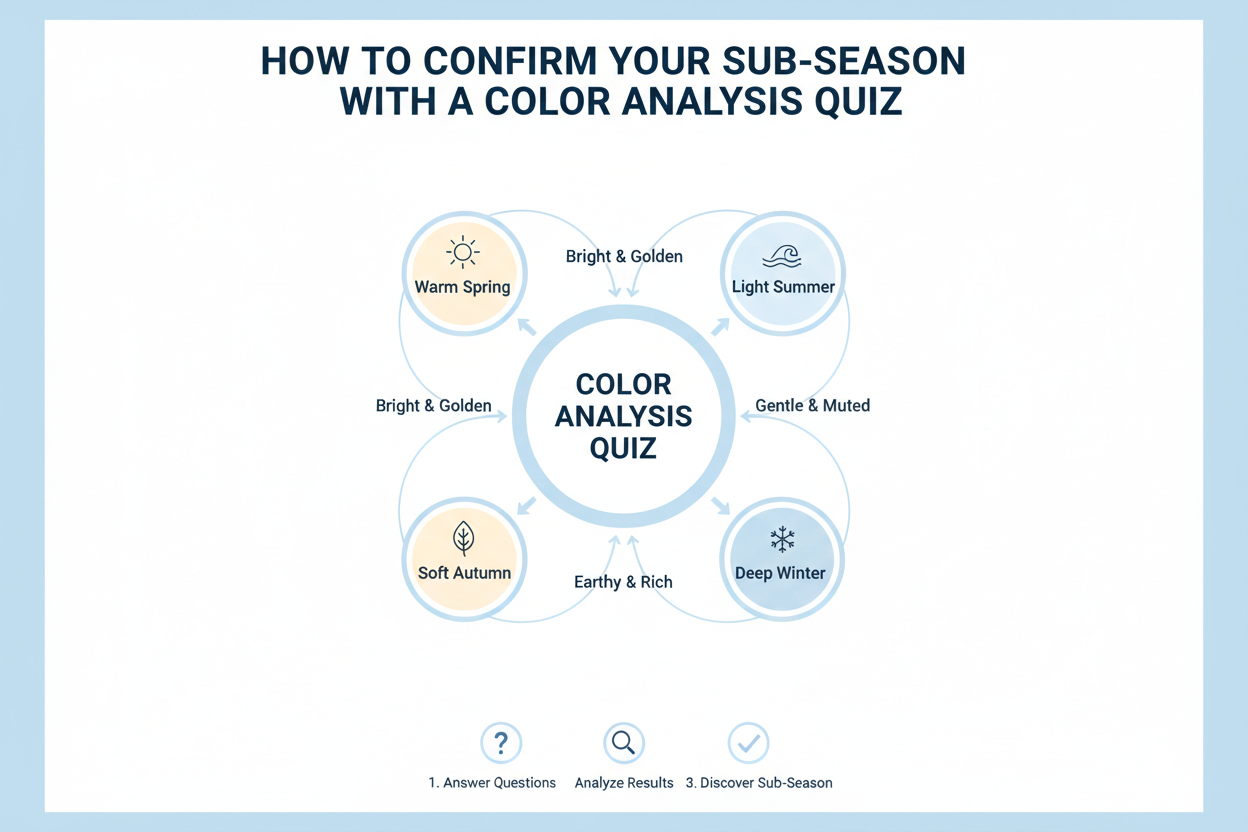
A structured quiz works through the relevant variables in order—undertone, contrast, feature quality, color response—so you're not left weighing competing signals on your own.
If the checkpoints above left you uncertain, or if you fit both profiles a little too well, a quiz is the most reliable next step short of an in-person draping session.
[Quiz CTA block]
People Also Ask
What is the difference between Soft Summer and True Summer color palettes?
Both palettes are cool-based and low-contrast, but they split on one thing: how much muting the colors need.
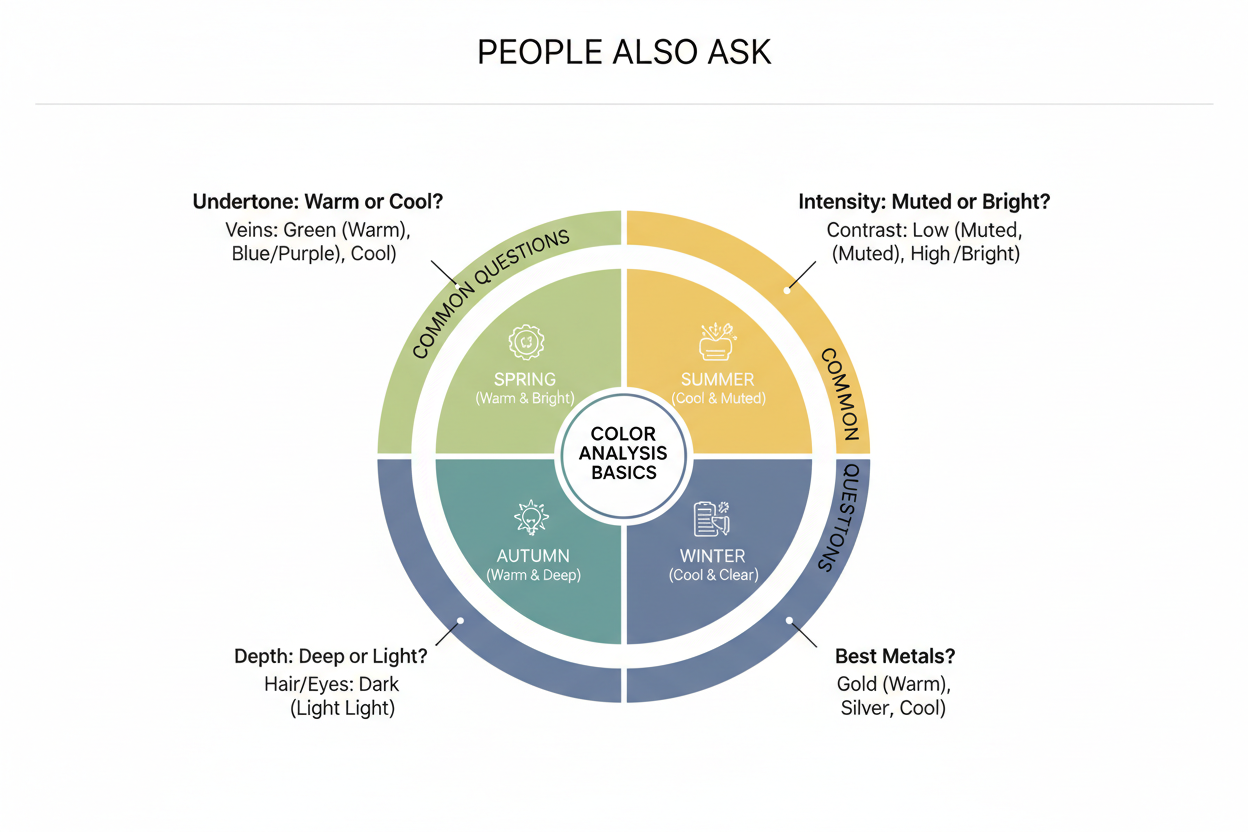
True Summer—also called Cool Summer—works with hues that are cool and medium in depth but still relatively clear. Think clean rose pink, soft lavender, or classic cool berry. Soft Summer, by contrast, needs every shade to carry an extra layer of diffusion. Its palette borrows a subtle blending quality from the neighboring Autumn seasons, which means even the cool tones look slightly veiled or dusty rather than crisp and defined.
True Summer = cool and clear. Soft Summer = cool and blended.
Can a Soft Summer wear True Summer colors?
Sometimes, but not always. Because both sub-seasons share a cool foundation and low contrast, there's overlap in the middle of each palette. Soft shades of rose or muted blue from the gentler end of True Summer can translate reasonably well.
The cleaner, crisper True Summer shades—cool clear lavender, bright cobalt, crisp cool pink—tend to read as slightly stark or cold on a Soft Summer. The practical test: if a color feels a little harsh even though it's undeniably cool, that points toward Soft Summer's need for more muting. When in doubt, go for the dustier, more diffused end of any shared color.
How do I know if I am a Soft Summer or True Summer?
Look at three things together rather than any single feature in isolation:
- Overall feature quality. Soft Summer features—skin, hair, eyes—tend to blend softly into one another with an ashy or hazy quality. True Summer features read as distinctly cool and lightly defined, like a clean rosy complexion paired with clearly cool-toned hair.
- Response to cool-clear colors. If crisp cool shades like lavender or bright rose still feel somewhat cold or stark despite warm shades also being unflattering, Soft Summer is the stronger fit. If those clean cool shades feel harmonious, True Summer is more likely.
- The subtle warmth test. Soft Summer can handle a slightly warm-edged mauve or soft camel in a way True Summer cannot. If those muted, faintly warm shades feel comfortable rather than wrong, that points toward Soft Summer.
Celebrity comparisons can help: Kristen Stewart (Soft Summer) has that blended, diffused quality throughout her coloring, while Emily Blunt (True Summer) reads as cleanly cool with more defined clarity.
What makes Soft Summer different from other Summer sub-seasons?
Within the Summer family—True Summer, Light Summer, and Soft Summer—each sub-season has a distinguishing characteristic:
- Light Summer is the lightest and most delicate of the three, built around soft, airy pastels on a cool base.
- True Summer is the balanced, quintessential version: cool, medium-depth, and quietly elegant.
- Soft Summer sits at the border between Summer and Autumn, which is what makes it different. That positioning gives it a subtle earthiness the other two sub-seasons don't have. The palette is still cool at its core, but every shade is more blended and muted than what Light or True Summer needs—and it can absorb faintly warm-edged neutrals that neither of the other Summer types can pull off.
That Autumn adjacency is what gives Soft Summer its characteristic dusty, diffused quality, and it's the main reason people confuse it with True Summer.
Is Soft Summer warm or cool undertone?
Soft Summer is cool-based, but with a catch. The foundational undertone is cool, which is why warm shades—golden yellow, rust, anything orange-based—still don't work for this type.
What sets Soft Summer apart is that the cool base is softened by a faint Autumn influence. The result is a palette that reads cool-muted rather than cool-clear. The borrowed warmth acts as a diffusing agent: it blends and softens the coolness without replacing it. Soft Summer can't carry the saturated warm shades a true Autumn type can, but it handles faintly warm-edged neutrals better than True Summer does.
The practical takeaway: if you're Soft Summer, you're cool-undertoned, but you sit closer to the cool-neutral zone than True Summer does.
FAQ
What is the main difference between Soft Summer and True Summer?
The single biggest distinction is saturation and softness. True Summer—also called Cool Summer—uses hues that are cool and medium in depth but relatively clear. Soft Summer needs every shade to carry an extra layer of diffusion, giving its palette a dusty, blended quality. Both types are cool-based and low-contrast, but Soft Summer sits closer to the boundary with Autumn, which introduces that characteristic veiled, muted look you won't find in True Summer's cleaner tones.
Do Soft Summer and True Summer share the same undertone?
Yes—both are cool-based. Neither type suits overly warm or bright colors, and both look best when warm golden, orange, or high-saturation shades are kept out of the picture. The difference is one of degree. True Summer's coolness reads as crisp and defined, while Soft Summer's cool base is softened by a subtle Autumn influence that nudges it toward the cool-neutral zone without ever making it genuinely warm.
Why does Soft Summer have hints of Autumn in its palette?
Soft Summer occupies the transition zone between the Summer and Autumn seasons. In the 12-season color analysis system, each sub-season borrows characteristics from its nearest neighbor. Because Soft Summer sits adjacent to Soft Autumn, a degree of Autumn's earthiness and blending quality seeps in. That influence doesn't add genuine warmth—it acts more like a diffusing filter, softening and muting every cool shade so colors appear blended rather than bold or clear. This is why Soft Summer can tolerate faintly warm-edged neutrals that True Summer cannot.
Can a True Summer wear muted, dusty colors without looking washed out?
It depends on the specific shade. True Summer is built for cool tones with moderate clarity, so some softer, muted hues—a gentle cool mauve or hazy blue, for instance—can still work if the coolness stays intact. But heavily diffused, dusty shades that sit at the core of Soft Summer's palette may read as slightly dull or flat on a True Summer, whose features carry more cool clarity. The cleanness of the color matters: True Summer tends to look most harmonious when a muted shade still has a defined cool edge rather than a blended, ashy quality.
What colors should both Soft Summer and True Summer avoid?
Both types are drained by the same broad categories:
- Warm, golden, or orange-based tones — rust, mustard, terracotta, warm camel
- Highly saturated or bright shades — vivid red, electric blue, neon anything
- Very dark, stark contrasts — jet black paired with the face, very deep charcoal
Cool colors suit both best, and overly warm or bright shades drain either type regardless of the muted-versus-clear distinction between them.
How does contrast level help distinguish Soft Summer from True Summer?
Both sub-seasons are low-contrast, meaning the difference between hair, skin, and eye color is gentle rather than dramatic. True Summer features tend to have a slightly more defined cool clarity—a noticeably cool-toned complexion alongside clearly cool-ash hair creates a clean, elegant impression. Soft Summer features blend into one another with a hazier, more diffused quality; the boundaries between feature tones are less distinct. If your overall look reads as "gracefully cool and defined," True Summer is more likely. If everything about your coloring seems to melt softly together with no sharp edges, Soft Summer is the stronger fit.
Is a color analysis quiz reliable for telling Soft Summer and True Summer apart?
A well-designed quiz can be a useful first step, particularly for narrowing the field from all twelve seasons down to the two most likely candidates. Because Soft Summer and True Summer share so much—cool undertone, low contrast, muted preference—distinguishing them comes down to subtle questions about how your features blend, how your skin responds to very clean cool shades versus diffused dusty ones, and whether faintly warm-edged neutrals feel comfortable or slightly off.
A quiz that probes those nuances can point you in the right direction. Take the color analysis quiz to see which Summer sub-season your features align with most closely—and use the result alongside the feature and palette guidance in this article for the most accurate outcome.