How to Build a Capsule Wardrobe for Your Color Season
 Reviewed by Alexandra Gilmore
Turn your color season into a 24-piece closet with a clear neutral base, wearable main colors, and a few accents.

Building a seasonal capsule wardrobe bridges the gap between knowing your color analysis results and getting dressed easily each morning. Instead of buying random trendy pieces, build around a practical color formula: about 60% season-specific base neutrals, 30% everyday palette colors, and 10% statement accents. In a 25- to 30-piece capsule, that means roughly 15 to 18 neutral pieces, seven to nine main-color pieces, and two or three accents. The proportions are a planning tool, not a rule for every outfit. When garments share a compatible color story and meet your real needs, more combinations become possible and closet clutter is easier to avoid.
For a business wardrobe example, see the men’s seasonal suit and shirt palette.
Start with what you own. Identify your season or the palette direction that looks best in daylight, then choose two anchor neutrals before picking colors. A capsule wardrobe color season guide works only when its pieces fit your climate, work, routines, and preferred silhouettes. If your season is uncertain, our beginner's guide to seasonal color analysis explains the system; the color analysis quiz can give you a starting point to test with fabric near your face.
The Core Formula: The 60-30-10 Rule for Wardrobes
The 60-30-10 rule clothing formula assigns the largest share to neutral base colors, a smaller share to recognizable palette colors, and the smallest share to bright or distinctive accents. Its purpose is color harmony: a neutral trouser can support several tops, while a small accent changes the mood without demanding a separate outfit. Treat the percentages as approximate counts across your capsule, not a requirement that every look contains three colors.
For a 24-piece starter capsule, try 14 neutral items, seven main-color items, and three accents. If you count 30 pieces, a simple version is 18, nine, and three. Some garments do two jobs: a muted olive trouser may act as a neutral in an Autumn wardrobe but as a main color in another palette. Assign its role according to how often it combines with the rest of your closet. Shoes and bags count if they materially change the combinations available.
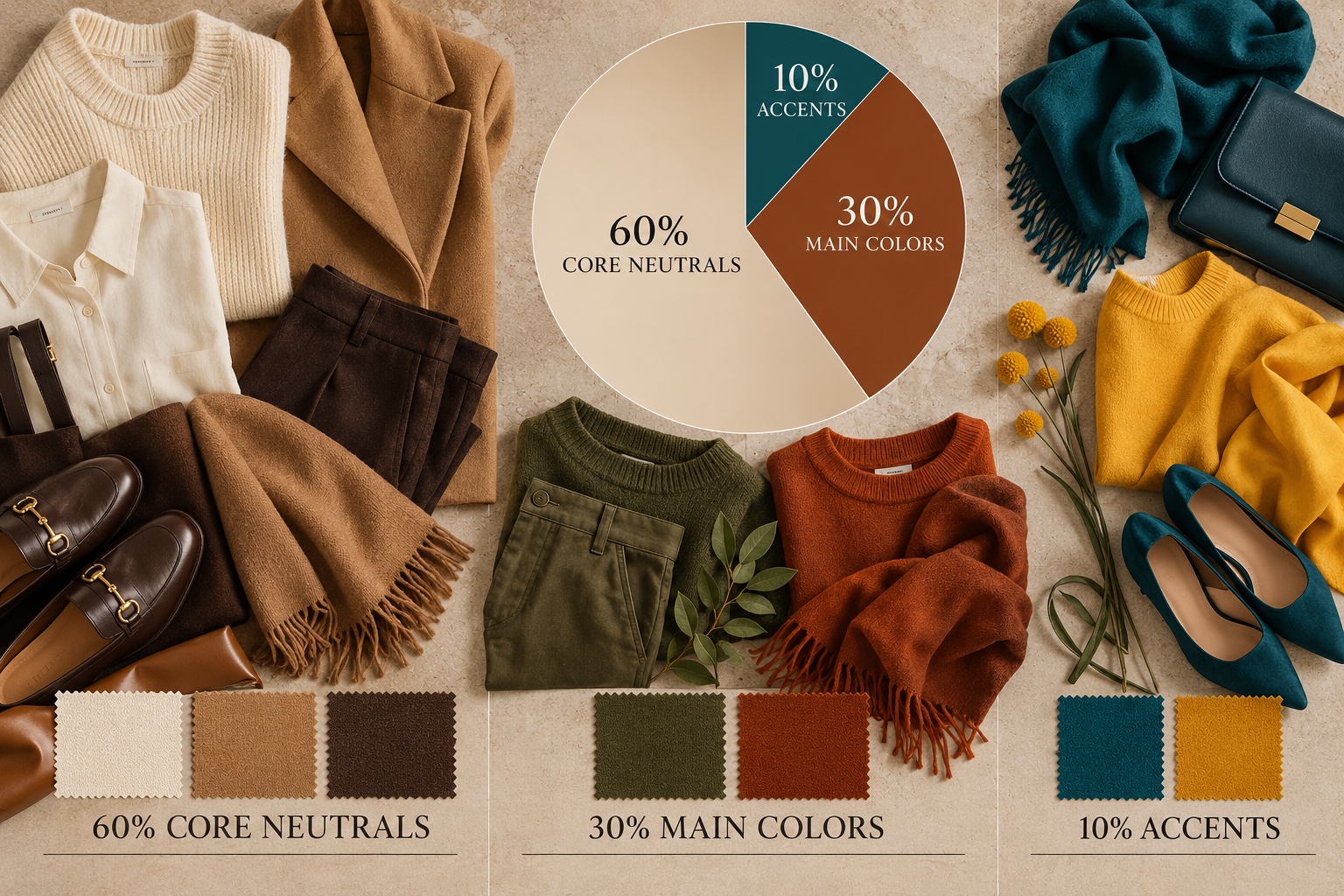
A capsule is more than a pleasing stack of swatches. It needs outfit combinations for actual days. Before adding a piece, ask whether it works with at least three items you already selected and whether you would wear the resulting outfits. One neutral jacket can connect an office shirt, weekend knit, and dinner top. Three isolated statement tops may be beautiful but do little to improve the wardrobe. This is why the best capsule is usually built around repeated pairings rather than a fixed shopping list.
What counts as a piece?
Our sample lists count clothing, outer layers, shoes, and a small number of accessories; underwear, activewear, sleepwear, and specialized uniforms are outside the count. Adjust that boundary for your life. A person who walks to work in cold weather may need two extra weatherproof items. Someone who dresses casually every day may trade a blazer for a second pair of jeans. Keep the color roles intact even when the garment categories change.
Step 1: Establish Your Core Seasonal Neutrals
Choose two principal neutrals: one darker anchor for trousers, skirts, jackets, or shoes, and one lighter partner for shirts and knits. A third supporting neutral can add depth. Put actual garments together in indirect daylight; names like beige and gray vary widely between brands. The closest neutral is the one that supports your chosen palette colors and looks comfortable near your face, not merely the color printed on a seasonal chart.
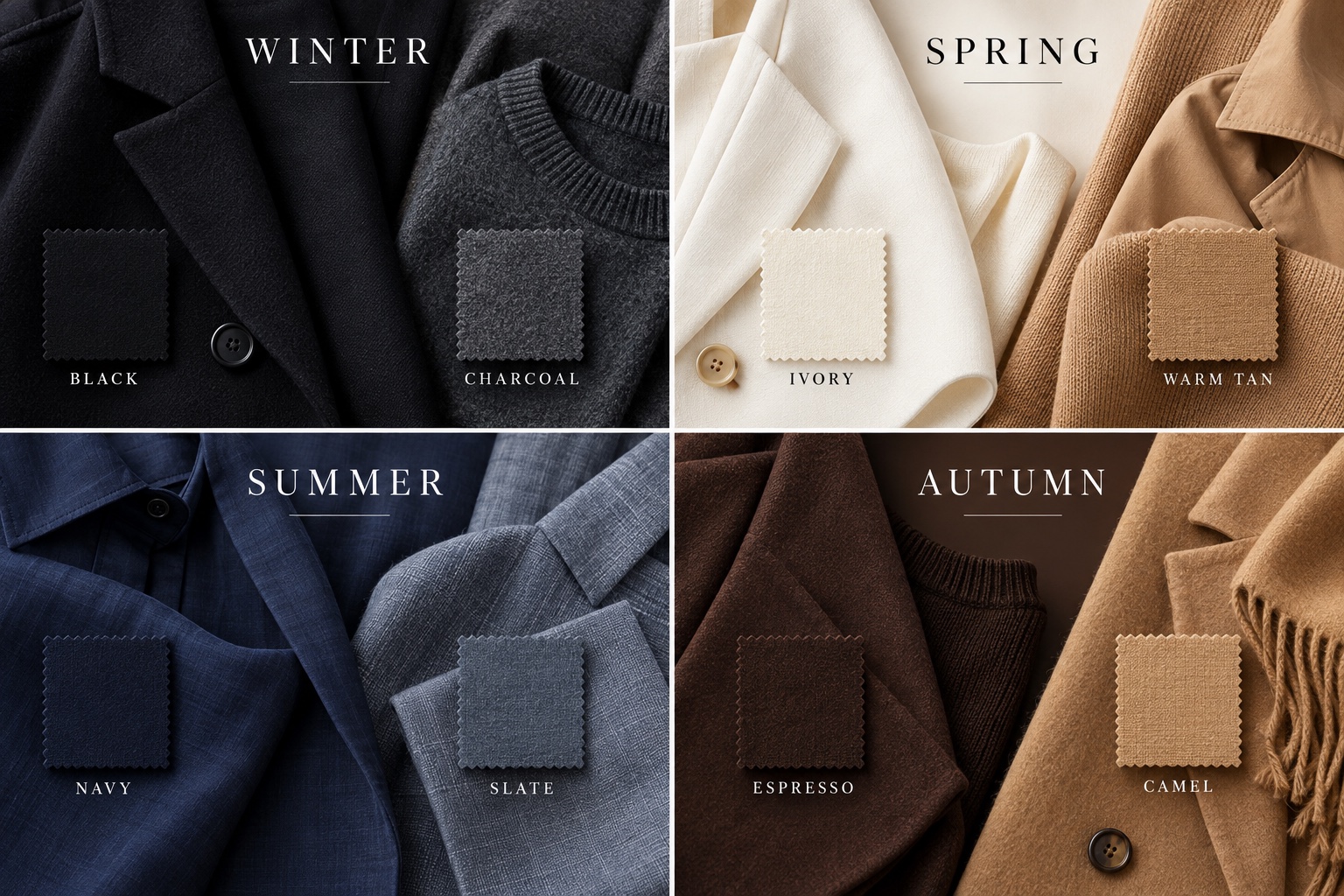
| Season | Core neutral pair | Supporting option | Near-face check |
|---|---|---|---|
| Winter | Black + charcoal | Crisp white or cool navy | Keep the contrast clean; avoid yellowed cream if it dulls your face. |
| Spring | Ivory + warm tan | Light camel or clear warm navy | Choose fresh, golden-leaning light neutrals rather than dusty gray. |
| Summer | Navy + slate | Soft white or dove gray | Look for a cooler, softer edge than stark black and optic white. |
| Autumn | Espresso + camel | Warm cream or olive | Choose earthy warmth; compare camel to your skin in natural light. |
These are broad four-season starting points. A Light Summer may prefer gentler navy than a deeper Summer, and a Deep Autumn may need darker espresso than a Soft Autumn. If you use the twelve-season system, keep the same method and refine the depth and saturation. Our 12-season comparison chart helps with that finer adjustment.
Step 2: Choose 3–4 Everyday Main Colors
Your main colors should be appealing enough to wear repeatedly and close enough in temperature, depth, and clarity that they mix without much effort. Pick three or four colors from your seasonal color analysis wardrobe palette, then assign each a job. One may be a frequent near-face color for shirts. Another may be a knit or dress color. A third can appear in a skirt, overshirt, or patterned item. A fourth is optional if it pairs with the first three.
For example, an Autumn capsule might use olive, rust, warm teal, and muted mustard with espresso and camel. A Winter version could use cobalt, blue-red, emerald, and icy pink with black and charcoal. Spring could use coral, clear turquoise, leaf green, and warm yellow with ivory and tan. Summer could use dusty blue, cool rose, lavender, and soft teal with navy and slate. These are examples, not prescriptions for every subseason. If one shade makes your other colors difficult to wear, replace it with a calmer neighbor.
Lay each candidate beside both anchor neutrals. If a main color works with only one, decide whether that limited role is worth a slot. A compatible patterned scarf or blouse can connect two colors, but it should repeat colors already in the palette rather than introduce several unrelated ones. For the basic mechanics of pairing hues, see our clothing color matching guide.
Use the three-outfit test
Before buying or keeping a main-color garment, build three complete outfits around it: one for your most common day, one slightly more relaxed, and one that uses a different layer or shoe. Photograph them in the same light. If you must buy several new pieces to make the garment work, it is probably not a useful capsule addition right now. This test links the palette to your actual outfit combinations rather than to an abstract color board.
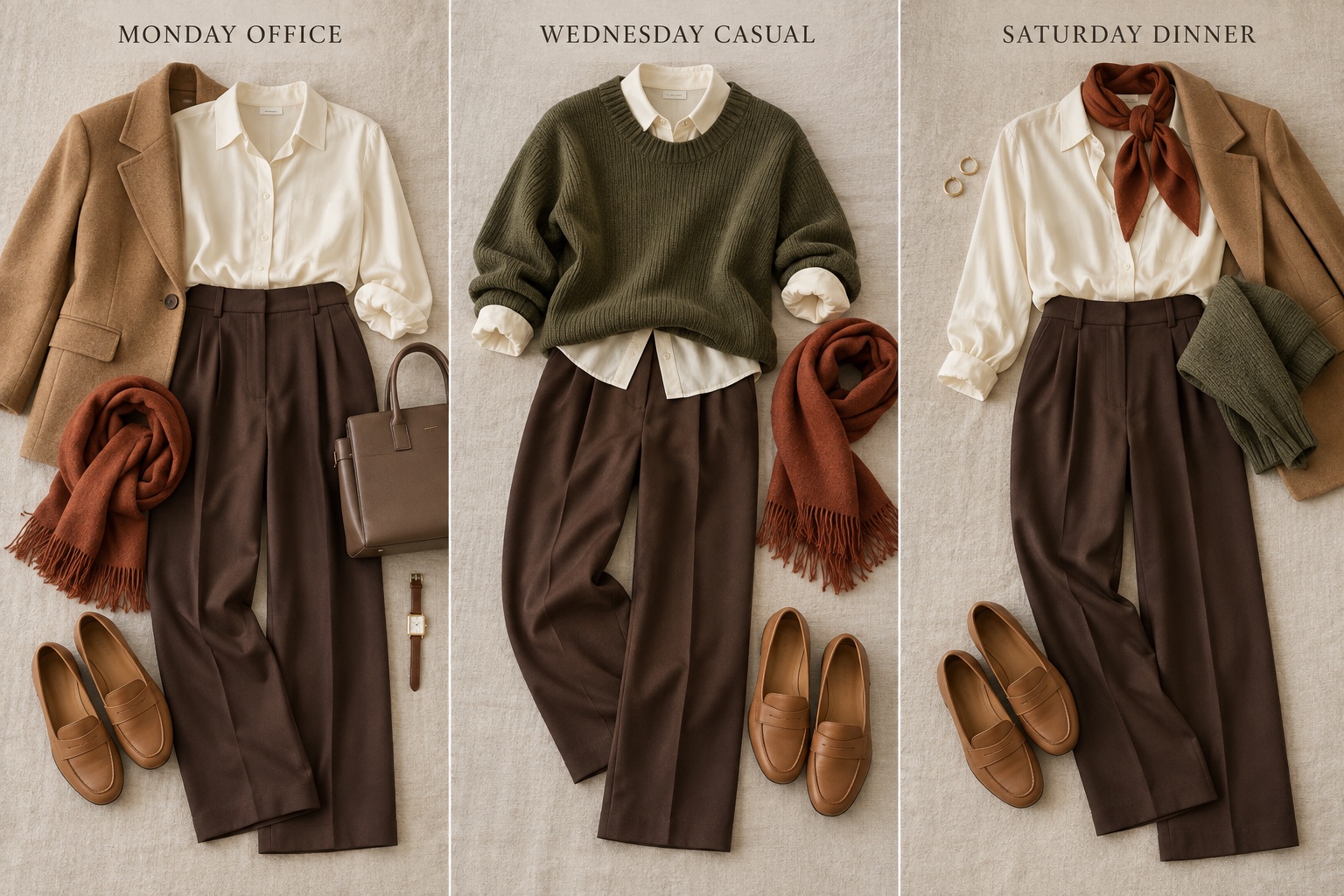
The illustration uses a compact Autumn color story, but the principle works in every season. Start with the same neutral trouser and shirt, change the layer, then move the accent near the face or remove it. Repeating a few reliable pieces is the point of a capsule, not a failure of creativity. If a garment feels too formal for Wednesday or too casual for Saturday, adapt the silhouette while keeping its color role.
Step 3: Add 2–3 Statement Accent Shades
Accent shades create energy in a smaller area: a scarf, bag, shoe, belt, jewelry detail, or one standout top. Pick two or three colors that complement your main palette. In Winter, this might be fuchsia and electric blue; in Spring, poppy and bright turquoise; in Summer, raspberry and periwinkle; in Autumn, saffron and peacock teal. Brightness is relative to the season: a Summer accent can be lively without becoming neon.
Do not force all accents into every outfit. A rust scarf against a camel coat may be enough. A vivid pair of shoes can animate a mostly neutral look. If the accent sits at the neckline, check it against your face in daylight; if you love a color that is less flattering there, use it lower on the body or as a bag. The 10% share is a closet-level reminder to keep these pieces selective. It does not mean measuring a scarf against the surface area of a coat.
Accessories are often a lower-cost way to test a color before purchasing a coat or dress. Bring the potential accent home if returns are possible, compare it with your anchors, and check whether it repeats across several outfits. If it only works with one special-occasion item, treat it as a separate occasion piece rather than claiming it expands the everyday capsule.
Capsule Checklists for the 4 Main Seasons
Each list below has 24 pieces. The counts are a starter structure: 14 neutral anchors, seven everyday main-color pieces, and three accents. They include shoes and accessories because these affect what you can actually wear. Substitute equivalent garments for your climate, dress code, and gender expression. A shirt can become a tunic, a skirt can become another trouser, and a coat can become a lightweight overshirt. Keep the role and compatibility of the piece while changing the shape.
Winter: crisp contrast and clear color
14 neutrals: two black trousers, charcoal trouser, black jeans, black skirt or second dress pant, crisp white shirt, white tee, charcoal knit, black knit, black blazer, charcoal coat, black everyday shoes, black dress shoes, and a black bag. Seven main colors: cobalt blouse, cobalt knit, emerald top, blue-red shirt, icy pink shirt, royal-blue dress or overshirt, and plum knit. Three accents: fuchsia scarf, silver-toned belt or jewelry piece, and electric-blue accessory. Swap the light neutral if your Winter subtype prefers a different level of contrast. The structure gives black a practical job while clear colors enliven the upper half.
Spring: light warmth and clear brightness
14 neutrals: two warm-tan trousers, ivory jeans, tan skirt or second trouser, ivory shirt, ivory tee, cream knit, tan knit, camel blazer, light-tan jacket, ivory layering top, tan everyday shoes, warm-neutral dress shoes, and a tan bag. Seven main colors: coral blouse, coral knit, leaf-green top, turquoise shirt, warm-yellow top, clear peach dress or overshirt, and fresh green knit. Three accents: poppy scarf, warm-gold accessory, and bright turquoise bag charm or belt. Keep colors clear rather than dusty; a lighter Spring may use gentler versions of these same ideas.
Summer: cool softness and easy layers
14 neutrals: two navy trousers, slate trouser, soft-gray jeans, navy skirt or second trouser, soft-white shirt, soft-white tee, dove-gray knit, slate knit, navy blazer, soft-gray coat, navy everyday shoes, cool-gray dress shoes, and a slate bag. Seven main colors: dusty-blue blouse, powder-blue knit, cool-rose top, muted lavender shirt, soft-teal top, periwinkle dress or overshirt, and mauve knit. Three accents: raspberry scarf, silver-toned accessory, and periwinkle bag detail. Keep the main pieces related in softness; very stark black can be shifted to shoes or away from the face if you already own it.
Autumn: earthy warmth and textured neutrals
14 neutrals: two espresso trousers, dark-brown jeans, camel trouser, chocolate skirt or second trouser, warm-cream shirt, cream tee, camel knit, brown knit, olive-neutral overshirt, camel coat, brown everyday shoes, tan dress shoes, and a chocolate bag. Seven main colors: rust blouse, olive knit, warm-teal shirt, ocher top, terracotta dress or overshirt, moss top, and muted mustard knit. Three accents: saffron scarf, warm-bronze accessory, and peacock-teal bag detail. An Autumn palette can vary from soft to deep; adjust intensity to the subtype that works best for you.
These lists are deliberately repetitive in garment roles so you can compare seasons fairly. A capsule wardrobe checklist should be edited after an honest wear audit. If you never wear skirts, replace that slot. If two shoes cannot handle your weather, change one. The goal is not to own precisely 24 objects; it is to make most pieces useful with several others. A 25th or 30th item can be valuable when it solves a recurring need rather than duplicating a color you already have.
How to Avoid Shopping Mistakes
A sale price does not create outfit combinations. Before buying, name the garment's role: core neutral, everyday main color, or accent. Then pair it with three items in your existing capsule, including one complete outfit you would wear next week. Compare its color in daylight if possible. Store images can shift cream toward yellow, navy toward purple, or olive toward gray. Check return terms and do not remove tags until the garment has passed the same real-world test as the rest of your closet.
| Shopping situation | Decision test | Best move |
|---|---|---|
| A beautiful color outside your season | Does it work away from your face and with three existing pieces? | Keep it as a lower-body or accessory choice if you love it; skip a near-face impulse buy. |
| A discounted neutral | Does its undertone match both anchors and at least two main colors? | Buy for a real wardrobe gap, not because it is labeled beige or gray. |
| A vivid statement piece | Can you make three outfits without buying companions? | Choose a smaller accent first if the full garment isolates itself. |
| A duplicate basic | Is the current one worn out, in the wash often, or missing a needed fit? | Replace or add only when use justifies the slot. |
| A pattern with many colors | Do two or more colors already appear in the capsule? | Use it as a bridge only when it connects existing pieces. |
Keep a short gap list on your phone: for example, “cool navy work pant” or “warm ivory layer.” A specific gap makes it easier to ignore attractive items from another palette. Try the garment with the shoes you really wear and under the outerwear you really need. Fit, fabric care, and comfort are as important as color. A perfectly seasonal piece that never leaves its hanger does not reduce closet clutter.
Seasonal Capsule FAQ
Can I keep a favorite black item if I am not a Winter?
Yes. Keep clothes you love and wear. If black feels harsh near your face, try it as pants, shoes, or a bag, or add a scarf or shirt in one of your best colors near the neckline. A warm tan jacket may soften a black trouser in a Spring capsule; a slate or dusty-blue layer may connect it in Summer. Do not discard a well-used item because a chart assigns it to another season. Replace it only when it no longer serves you.
Do I need a new capsule for every time of year?
No. Your personal color season is a palette family, not the calendar month. Keep the same core color relationships and swap fabric weights or weather-specific layers. A Summer palette can include a wool coat in winter; an Autumn palette can include linen in July. Store out-of-season pieces if space is limited, but keep the neutral anchors consistent so returning pieces still combine easily.
Must every outfit follow 60-30-10 exactly?
No. The formula helps distribute colors across a wardrobe. An outfit might be entirely neutral, or one saturated dress might dominate its visible area. Judge the whole look by balance and purpose. If the closet contains too many accents and too few anchors, outfit options narrow; that is the problem the formula helps diagnose.
What if I do not know my exact subseason?
Begin with the broader warm or cool direction and two neutral pieces that already look good on you. Compare candidate colors next to your face in indirect daylight, preferably with fabric rather than a phone screen. The interactive quiz can suggest a direction, and our 12-season visual chart can help refine it. Build slowly while you learn; you do not need a perfect label to improve your wardrobe.
How do I make this work on a budget?
Shop your closet first and write down missing roles. Repair, tailor, or re-style useful pieces before replacing them. Buy one compatible neutral only if it unlocks several outfits; add an accent later. Secondhand shopping can work especially well when you bring a small swatch or photo of your actual anchor garments and check the item in daylight. The Ellen MacArthur Foundation overview of circular fashion explains how repair and resale can keep clothing in use longer. A capsule saves money only if its planning prevents unnecessary purchases.
To make the next step concrete, choose one dark anchor, one light anchor, three everyday colors, and a small accent. Arrange your existing pieces into three complete outfits, then write a gap list for what is truly missing. If you want a starting palette before sorting your closet, take our color analysis quiz and test the result against real garments.
💫 Discover Your Complete Color Palette
Ready to discover all the colors that make you look radiant? Our comprehensive color analysis will reveal your complete personal palette - perfect for hair, makeup, and wardrobe decisions.
Take Color Analysis Quiz →📚 Recent Articles
Keep exploring practical ways to use your palette: match clothing colors, compare the 12 seasons, and revisit the seasonal analysis basics.