Seasonal Color Analysis Explained for Beginners
 Reviewed by Alexandra Gilmore
Seasonal color analysis is a practical way to group colors that support your combined skin, hair, and eye coloring. Start with temperature, depth, chroma, and contrast, then use the twelve palettes as shopping guidance rather than rigid permission about what you may wear.

You've probably heard someone say they're a "Summer" or an "Autumn" and wondered what that actually means. Seasonal color analysis is a practical framework that matches your natural coloring — skin, eyes, and hair combined — to one of twelve seasonal palettes, each filled with colors that work in harmony with what you were born with rather than against it.
💫 Discover Your Complete Color Palette
Ready to discover all the colors that make you look radiant? Our comprehensive color analysis will reveal your complete personal palette - perfect for hair, makeup, and wardrobe decisions.
Learn Seasonal Analysis →The goal isn't to restrict what you wear. It's to identify a personal color palette that lets your natural features take center stage, so the clothes and makeup you choose enhance your appearance instead of competing with it.
What makes this system beginner-friendly is its structure. Every palette is built on three measurable dimensions:
- Hue — whether your overall coloring reads as warm, cool, or neutral
- Value — how light or dark your coloring is on a spectrum
- Chroma — how vivid or muted your natural tones appear
Those three axes organize all human coloring into four base seasons — Spring, Summer, Autumn, Winter — and then expand into twelve distinct sub-seasons to capture the full range of variation people actually have.
If you've ever bought a piece of clothing in a color that looked great on the hanger but washed you out the moment you put it on, seasonal color analysis is designed to explain exactly why that happens — and help you stop repeating the mistake.
The sections ahead walk through each dimension, the full 12-season map, common beginner pitfalls, and how to put your result to practical use.
For the next diagnostic or service-choice step, continue with the companion article “Is Seasonal Color Analysis Worth It”, which keeps the two closely related questions distinct.
📚 Recent Articles
What Seasonal Color Analysis Actually Does
The system has one practical job: figure out which colors work with your natural coloring rather than against it. Wear colors from your matched palette and your skin looks clearer, your eyes more defined, your overall appearance more pulled-together. Wear colors outside it and even expensive, well-fitting clothes can leave you looking tired or washed out.
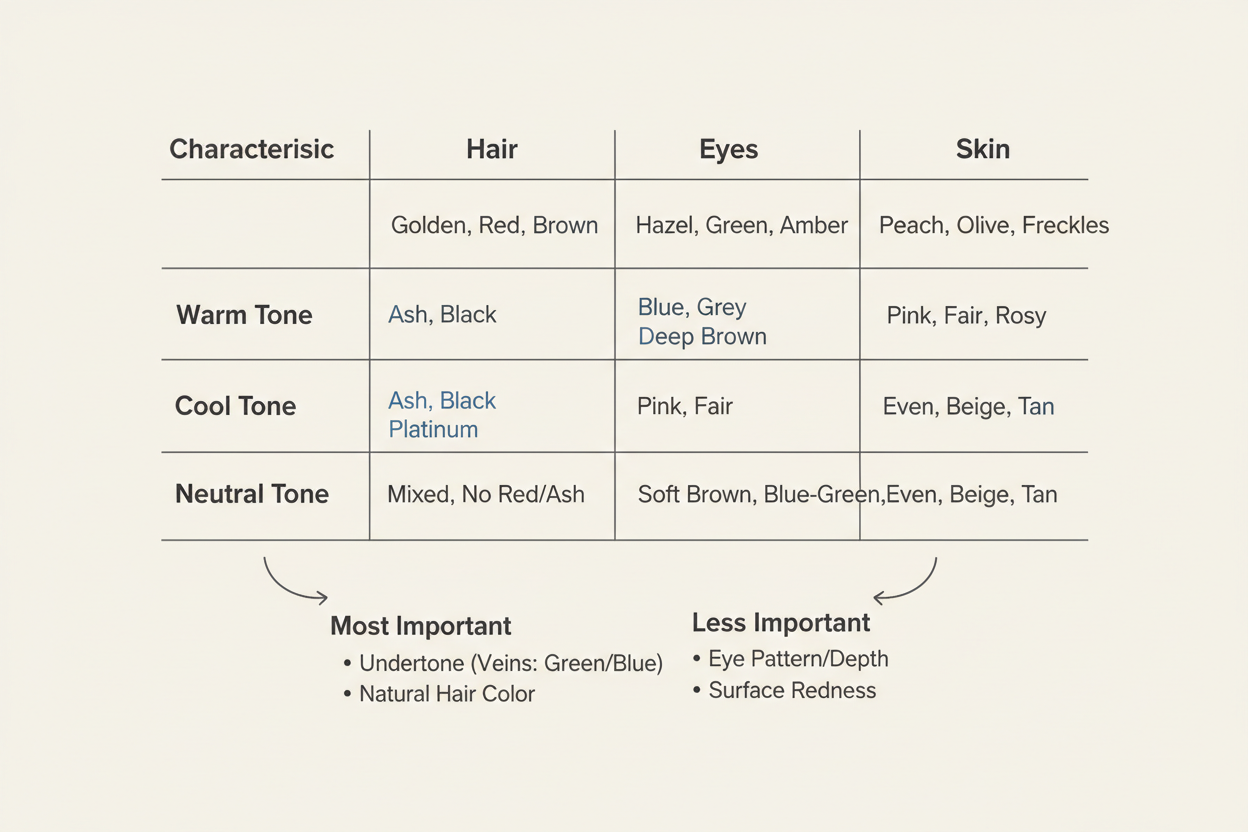
Seasonal color analysis builds that palette by placing you into one of twelve seasons, each defined by a specific mix of warmth, depth, and intensity. Your season becomes a shortcut — a shopping filter, a makeup guide, a way to edit your wardrobe — that cuts most of the guesswork out of color decisions.
→ Take the free color analysis quiz to find your season
The Three Dimensions Behind Every Season
Every seasonal palette comes down to three measurable qualities of color. Get these straight and the rest of the system starts to make sense.
| Dimension | The question it answers |
|---|---|
| Hue | Does warm, neutral, or cool color suit your coloring? |
| Value | Do light, medium, or dark shades harmonize best with your features? |
| Chroma | Are clear saturated colors or soft muted tones more flattering? |
Everyone falls somewhere on all three axes, but one usually matters most — it's the dimension with the strongest pull on which palette you end up in. Figuring out which one that is for you is what turns a vague result into a usable one.
Warm, Cool, and Neutral: Start With Undertone
Hue is almost always the first filter to apply because it has an outsized effect on how colors interact with skin.
Undertone is the underlying color beneath your surface skin tone. It doesn't change with tanning or the seasons, and it has nothing to do with how light or dark your skin is. There are three possibilities:
- Warm — golden, peachy, or yellow-based undertones
- Cool — pink, red, or blue-based undertones
- Neutral — a blend of both, with no single dominant cast
Colors that clash with your undertone tend to pull attention toward imperfections — shadows, redness, unevenness. Colors that work with it do the opposite: skin looks more even without any additional effort.
A quick starting point: the metal test. Hold a piece of gold jewelry near your face, then swap it for silver.
- Gold looks noticeably better → lean warm
- Silver looks noticeably better → lean cool
- Both look equally fine → likely neutral
It's not a final answer, but it gives you a reliable first signal before you go deeper.
Light vs Dark, Soft vs Bright: The Other Two Axes
Once hue is roughly established, value and chroma refine your placement considerably.
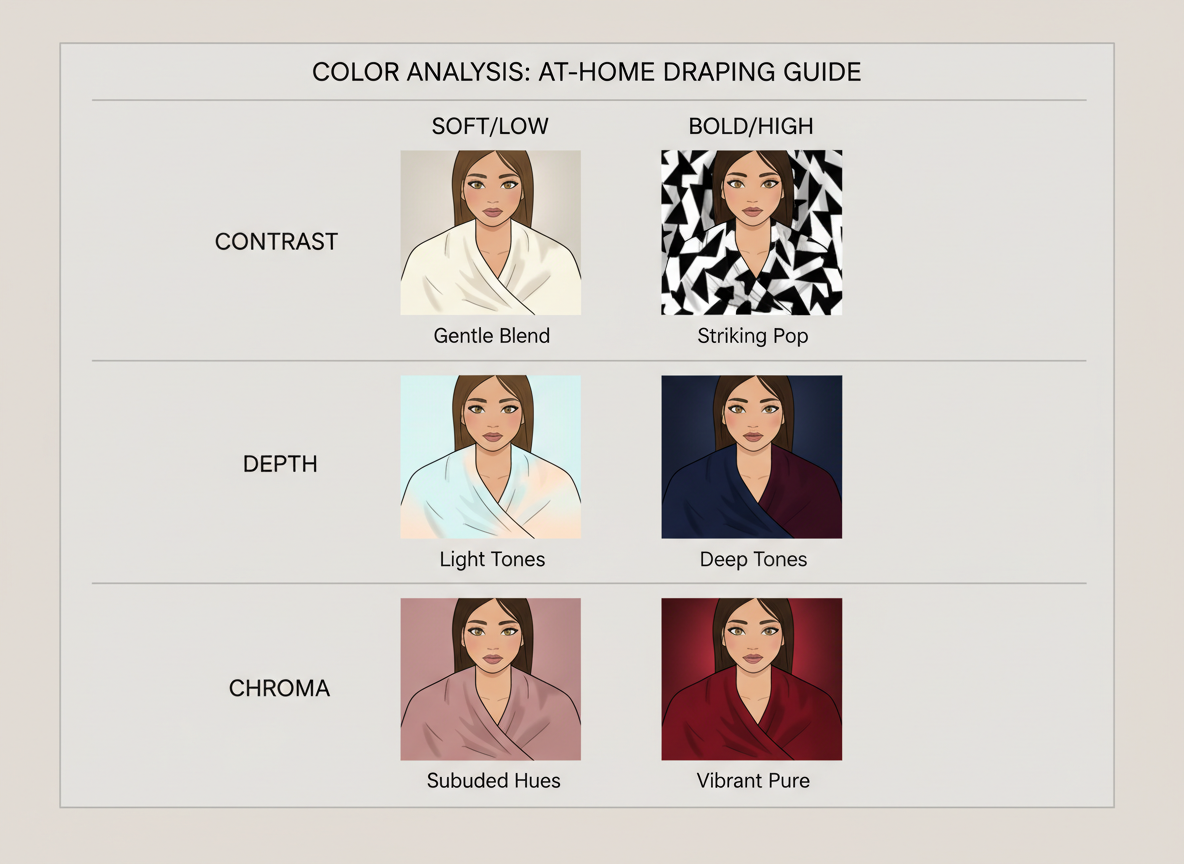
Value is how light or dark your overall coloring reads when you take hair, skin, and eyes together. Platinum hair, pale skin, and light eyes means low overall contrast — lighter palettes tend to work better. Deep hair and dark eyes means more natural depth, and richer, darker shades usually hold up against that.
The key thing to understand is that value isn't just about skin tone in isolation. It's the combination of your features and the contrast between them that matters.
Chroma is about saturation. Some people's coloring is naturally vivid — clear, bright, with sharp definition between features. Others have softer, more blended coloring with a slight grey or smoky quality. Highly saturated colors can look harsh against naturally muted coloring; dusty, greyed-down colors can look flat against bright coloring.
This is why a person can be:
- Cool and muted — like a soft summer palette
- Warm and bright — like a clear spring palette
- Cool and deep — like a winter palette
- Warm and soft — like an autumn palette
All four combinations are valid, and the 12-season system accounts for each one.
The Four Base Seasons and the 12-Season Expansion
The original system used four seasons. Each maps to a recognizable combination of the three dimensions:
| Season | Hue | Value | Chroma |
|---|---|---|---|
| Spring | Warm | Light to medium | Clear, bright |
| Summer | Cool | Light to medium | Soft, muted |
| Autumn | Warm | Medium to deep | Soft, muted |
| Winter | Cool | Medium to deep | Clear, bright |
Four seasons covers the major categories, but human coloring is more varied than four buckets allow. The 12-season expansion splits each base season into three sub-seasons, named by whichever dimension is most dominant:
- Spring → True Spring, Light Spring, Bright Spring
- Summer → True Summer, Light Summer, Soft Summer
- Autumn → True Autumn, Soft Autumn, Dark Autumn
- Winter → True Winter, Dark Winter, Bright Winter
The sub-seasons exist for edge cases — someone who is warm but also very muted, or cool but also very deep — where a base season fits, but only halfway.
→ Find your sub-season with the free quiz — takes about 3 minutes
Why Beginners Usually Get Stuck
Most beginners hit the same handful of problems.
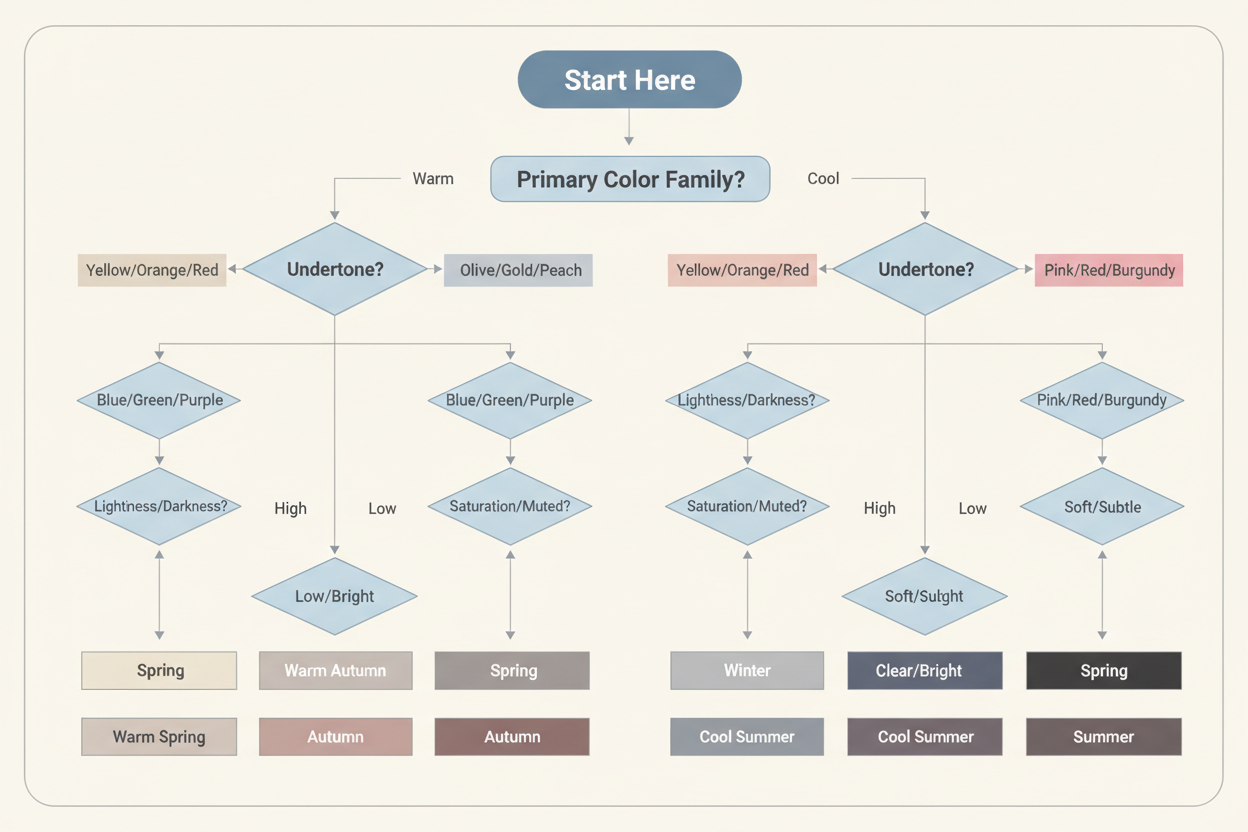
1. Confusing surface skin tone with undertone. Someone can have deep skin and a cool undertone, or fair skin and a warm undertone. Darkness and warmth aren't the same thing. Miss that distinction and the whole system seems broken.
2. Looking at one feature instead of all three. Hair color changes. Skin reads differently under different light. Eye color is usually more complicated than one word captures. You have to read all three together — picking only the most obvious one doesn't work.
3. Expecting everything to line up. Most people's coloring sends mixed signals. Warm skin, cool eyes. That's normal. The goal is finding the dominant pattern, not waiting for perfect agreement. One dimension leads; the others support it.
If you've taken a quiz and walked away unsure about the result, it's almost always one of these three.
How to Use Your Result in Real Life
A seasonal palette is most useful as a practical decision-making tool, not a rigid rulebook. Here's how it works in three areas:
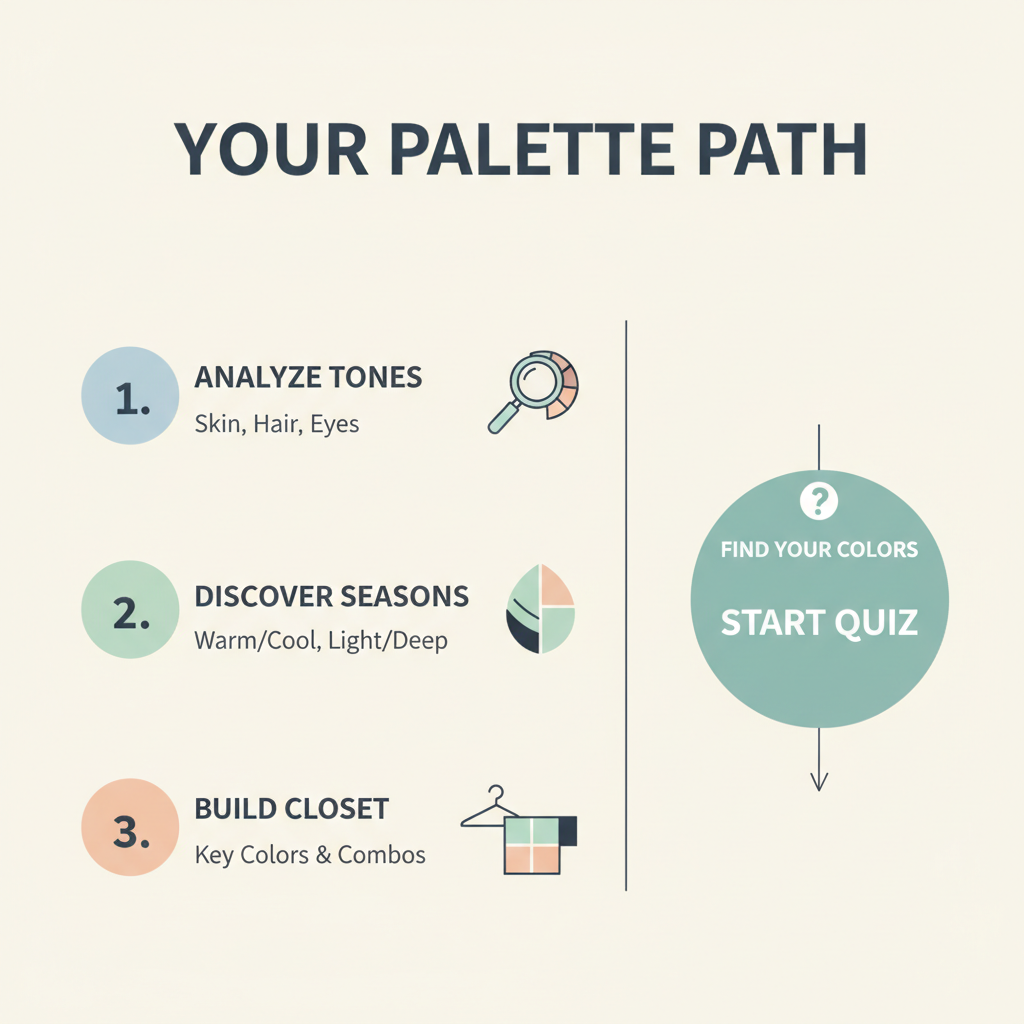
Clothing Your palette gives you a set of colors that work reliably as neutrals, accent colors, and statement pieces. Instead of deciding from scratch every time you shop, you filter first by palette, then by style, fit, and price. This cuts down on decision fatigue and reduces the number of items you buy and never wear.
Makeup Foundation undertone, blush shade, lip color, and eyeshadow all work better when they match your season. A cool-toned blush on a warm-season person, for example, can make the face look slightly grey or flat. Your palette tells you which undertones to look for on the label.
Wardrobe editing Your palette is also a sorting tool. Hold existing pieces up against your season's color swatches and you'll quickly see which items are pulling their weight and which ones keep getting skipped — usually because they subtly clash with your undertone or chroma.
The result isn't a guarantee that every palette color will be your favorite, and stepping outside it occasionally isn't a problem. What it gives you is a reliable baseline — a starting point that's grounded in how your specific coloring actually works, not what's trending.
→ Take the free color analysis quiz to explore your full seasonal palette
People Also Ask
What are the 12 seasons in color analysis?
The 12-season system starts with four base seasons — Spring, Summer, Autumn, and Winter — each defined by a combination of warmth, depth, and color intensity. Spring is warm and bright, Summer is cool and soft, Autumn is warm and muted, and Winter is cool and clear.
Each base season splits into three sub-seasons based on which quality dominates a person's coloring:
- Spring → True Spring, Light Spring, Bright Spring
- Summer → True Summer, Light Summer, Soft Summer
- Autumn → True Autumn, Soft Autumn, Dark Autumn
- Winter → True Winter, Dark Winter, Bright Winter
Real human coloring rarely fits neatly into four buckets. Someone warm-toned but soft and muted needs a different palette than someone warm and vivid — even though both fall somewhere in the Spring or Autumn family. The sub-seasons handle those distinctions without throwing out the whole framework.
How do I know if I am warm or cool toned?
Undertone — whether your coloring reads as warm, cool, or neutral — is the first filter in seasonal color analysis. It sits beneath your surface skin tone and doesn't change with a tan or the time of year.
A simple starting point: the metal test.
- Hold gold jewelry close to your face in natural light, then swap it for silver
- If gold looks better → you likely lean warm
- If silver looks better → you likely lean cool
- If both look fine → you may be neutral
The metal test gives you a direction, not a verdict. Lighting and jewelry finish both affect what you see, so treat it as a first clue and keep going.
A few other things worth checking:
- Vein color on your inner wrist: greenish veins suggest warm undertones; bluish or purple suggest cool
- How colors read near your face: if terracotta and gold make your skin look clearer, you probably lean warm; if soft blues and rose-pinks do the same, you likely lean cool
- What the wrong colors do: colors that clash with your undertone tend to pull attention toward shadows and unevenness rather than your features
Undertone has nothing to do with how light or dark your skin is — someone with deep skin can be cool-toned, someone fair can be warm. If you're not sure after the first test, looking at all three signals together usually clears it up.
FAQ
Is seasonal color analysis only about skin tone?
No — skin tone is just one input. The system looks at your overall natural coloring across three dimensions:
- Hue (warmth or coolness) — present in skin, hair, and eyes together
- Value (depth and contrast) — how light or dark your features are relative to each other
- Chroma (intensity) — whether clear, saturated colors or soft, muted ones sit more harmoniously against you
Skin undertone matters, but so does how deep your hair is, how bright your eyes are, and how much contrast exists between all three. Two people with nearly identical skin tone can land in very different seasons because their hair depth or feature contrast differs. One of these three dimensions usually has the strongest pull on your final palette — figuring out which one is what makes a result useful rather than generic.
The whole point is to find colors that work with your skin, eyes, and hair at the same time, not colors that flatter one feature while ignoring the others.
Can a quiz replace professional color analysis?
Not entirely — but it's a useful starting point, especially if you're new to this.
A quiz walks you through the key dimensions in a structured way, helps you notice things you may have overlooked (like how your features compare in depth and contrast), and narrows the field from 12 possible seasons to a realistic shortlist.
A trained analyst does something a quiz can't: they drape physical fabric swatches next to your face under controlled lighting, which removes the guesswork that comes from variable phone screens and indoor light. They can also identify which of the three dimensions is dominant for you — the detail that most affects which specific sub-season you land in. And because you're not self-reporting, common errors like misremembering your natural hair color or misreading your vein color don't factor in.
Think of a quiz as the fastest way to form a working hypothesis about your season. For most beginners, that's enough to start making better color choices. If the result feels off after testing it in your wardrobe, or if you're landing between two seasons, a professional consultation can sort it out.