Gold vs Silver Jewelry Test: Step-by-Step Undertone Guide (With Swatches)
 Reviewed by Alexandra Gilmore
Gold versus silver works best as a face comparison, not a wrist test or a rule that every neutral person must break. Hold pieces with similar size and shine in the same daylight, judge skin evenness and shadows, then consider finish and contrast if both metals look convincing.

Direct answer: To test gold vs silver jewelry, hold similarly sized pieces beside your bare face in indirect natural daylight against a neutral white background. Switch them in the same position and watch your skin, not the jewelry: the more harmonious metal makes your complexion look even and luminous without deepening under-eye shadows or adding a yellow cast. Yellow gold often gives a warmer effect; silver gives a cooler one. If both look equally good, record a close result rather than forcing an undertone label. The four-step protocol and metal swatches below help you repeat the comparison.
💫 Discover Your Complete Color Palette
Ready to discover all the colors that make you look radiant? Our comprehensive color analysis will reveal your complete personal palette - perfect for hair, makeup, and wardrobe decisions.
Find My Color Palette →📚 Recent Articles
Gold vs. Silver Test: Read the Result First
The jewelry test is a visual comparison, not a laboratory measurement of undertone. Its practical value is simple: it shows which metal produces the effect you prefer near your face. Start with the result you can see, then use undertone, skin depth, and color season as supporting context.
| What you see | What it may mean | What to check next |
|---|---|---|
| Gold looks more balanced | Warmer metal color or a softer gold finish may suit your coloring | Compare yellow gold with a quieter brushed or antique gold |
| Silver looks more balanced | Cooler, clearer metal color may sit more naturally beside your face | Compare polished silver with softer white gold or pewter tones |
| Both metals look good | Your coloring may be neutral, balanced, or flexible enough for both | Test rose gold and mixed metals, then choose by outfit and finish |
| The winner changes between tests | Lighting, camera processing, metal finish, makeup, or clothing may be affecting the result | Repeat the comparison with matched pieces in one controlled setup |
A result does not have to be dramatic. You are looking for the more consistent option, not a transformation. If you need to stare for several minutes to see a difference, record the test as close rather than forcing a winner.
Use the result beyond jewelry. A metal preference is one clue about the color temperature and contrast you may enjoy in clothing, makeup, and hair color.
Find your complete color palette →The Natural Daylight Protocol: 4 Steps to Test Metals Accurately at Home
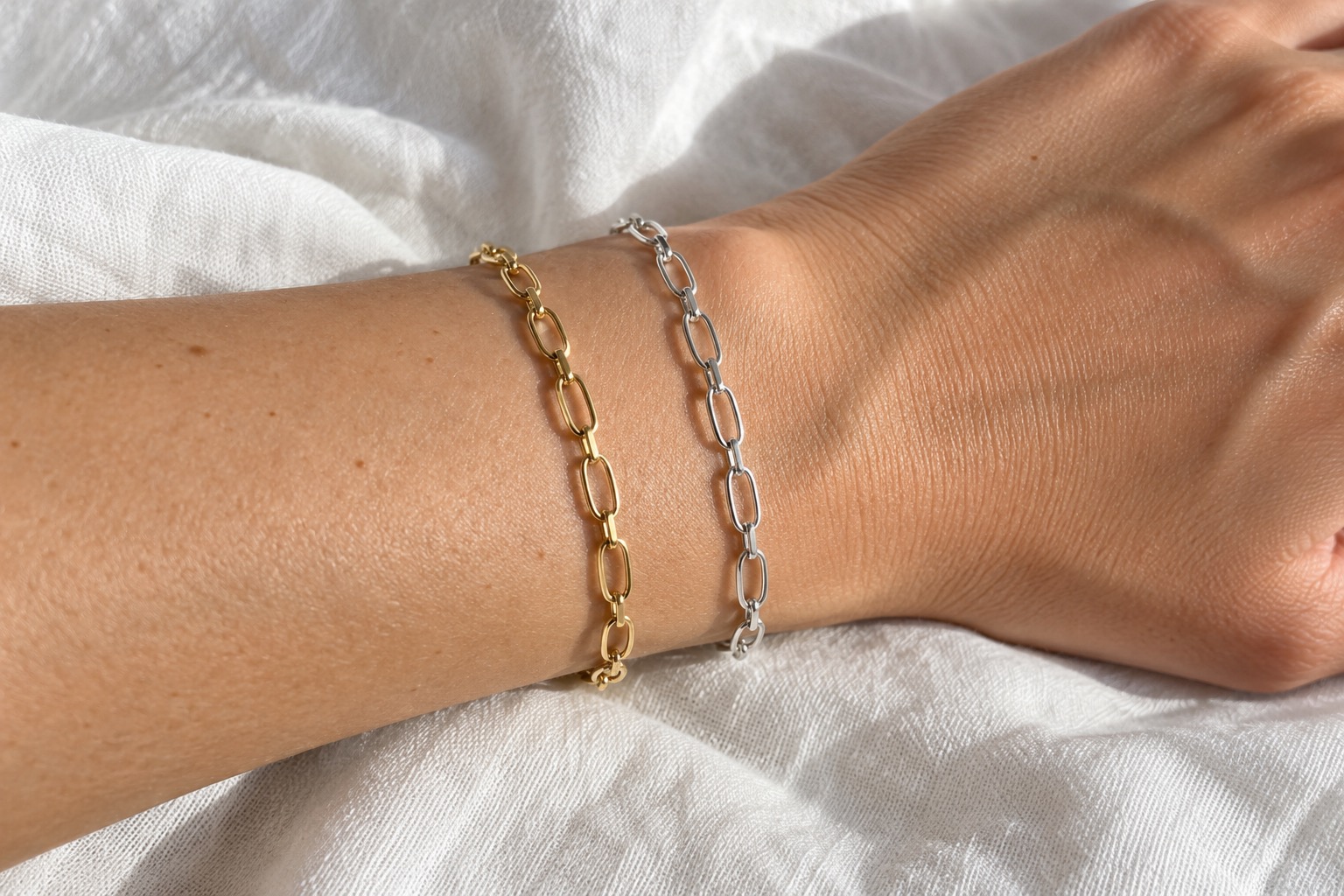
Prepare a mirror, a neutral white top or white linen behind your face, and yellow gold and sterling silver pieces with similar size and finish. Keep the background and the amount of visible metal consistent. The wrist image shows the two metal colors under one daylight source; make the final judgment beside your face, where shadows and skin evenness are easier to compare.
- Set neutral daylight. Face a window in bright indirect daylight, turn off indoor lamps, and avoid direct sun. Place a plain white background behind you and wear a neutral white top so nearby colors do not reflect onto your skin.
- Start with bare skin. Remove foundation, concealer, bronzer, and strongly colored lipstick; pull dyed hair away from your face. Notice your baseline skin tone and existing shadows under the eyes and around the mouth.
- Switch matched metals beside your face. Hold silver at the jaw, collarbone, or ear, then replace it immediately with yellow gold at the same distance and angle. Judge the whole face rather than which piece looks prettier. Keep shine and visible area as similar as possible.
- Repeat and record the result. Switch the order for a second pass. Write down gold, silver, or close based on skin evenness, facial shadows, and color cast. A close result is valid; try another finish before assigning an undertone.
A tiny matte silver stud and a large polished gold necklace are not a fair pair. If matched jewelry is unavailable, compare metallic fabric or clean color cards first. A wrist comparison can show reflected color, but the face comparison should decide the result.
How to Score What You See
Words such as glowing or washed out are easy to repeat but difficult to judge. Use the same four observations for each metal. Score one point when a metal clearly performs better and zero when there is no meaningful difference.
Signs of Harmony vs Discord
Harmony: skin looks luminous and smooth, the face reads as even, and natural under-eye shadows stay soft. Discord: shadows under the eyes deepen, the face takes on a yellow or sallow cast, or uneven areas become more prominent. Keep the metal at the same position when judging these signs; reflected light can otherwise change the result.
| Signal | Better result | Less useful result |
|---|---|---|
| Overall evenness | The face reads as one connected, balanced area | Red, gray, yellow, or uneven areas become the first thing you notice |
| Facial shadows | Existing shadows stay soft and proportional | Shadows around the eyes, nose, or mouth appear heavier |
| Color cast | The metal looks distinct while the skin still looks natural | The skin appears unusually gray, sallow, orange, or pink beside it |
| Feature harmony | You notice the eyes, lips, and face before the jewelry | The metal looks detached or overpowers the rest of the face |
A two-point difference is enough to choose a starting metal. A tie suggests flexibility, an imperfect comparison, or a stronger response to finish than temperature. Your preference still matters: a metal that supports your style and is worn with confidence can be a better purchase than the technically quieter option.
How to Do the Gold or Silver Test With a Photo
A photo can help because it freezes both versions and lets you compare them without relying on memory. It cannot measure your undertone, and automatic phone processing can change color and contrast between shots. Treat the camera as a comparison tool, not a scanner.
- Place the phone on a stable surface at eye level and use the same rear or front camera for both images.
- Stand in indirect daylight with a neutral wall behind you. Keep the window, phone, and your face in fixed positions.
- Turn off filters, portrait relighting, beauty mode, Night Shift, and any setting that changes skin smoothing or warmth.
- Tap and hold on the face to lock focus and exposure if your camera allows it. Do not let the phone brighten one metal and darken the other.
- Take one photo with silver and one with gold. Keep your expression, hair, neckline, camera distance, and jewelry position the same.
- Place the unedited images side by side. Review overall evenness and shadows before zooming in.
If the photo result contradicts the mirror, trust neither immediately. Check whether the camera shifted white balance or whether one piece reflected more light into the lens. Repeat the mirror test first, then use a second camera only if you want another view.
Beyond Yellow Gold: How Rose Gold, White Gold, and Platinum Fit Your Undertone
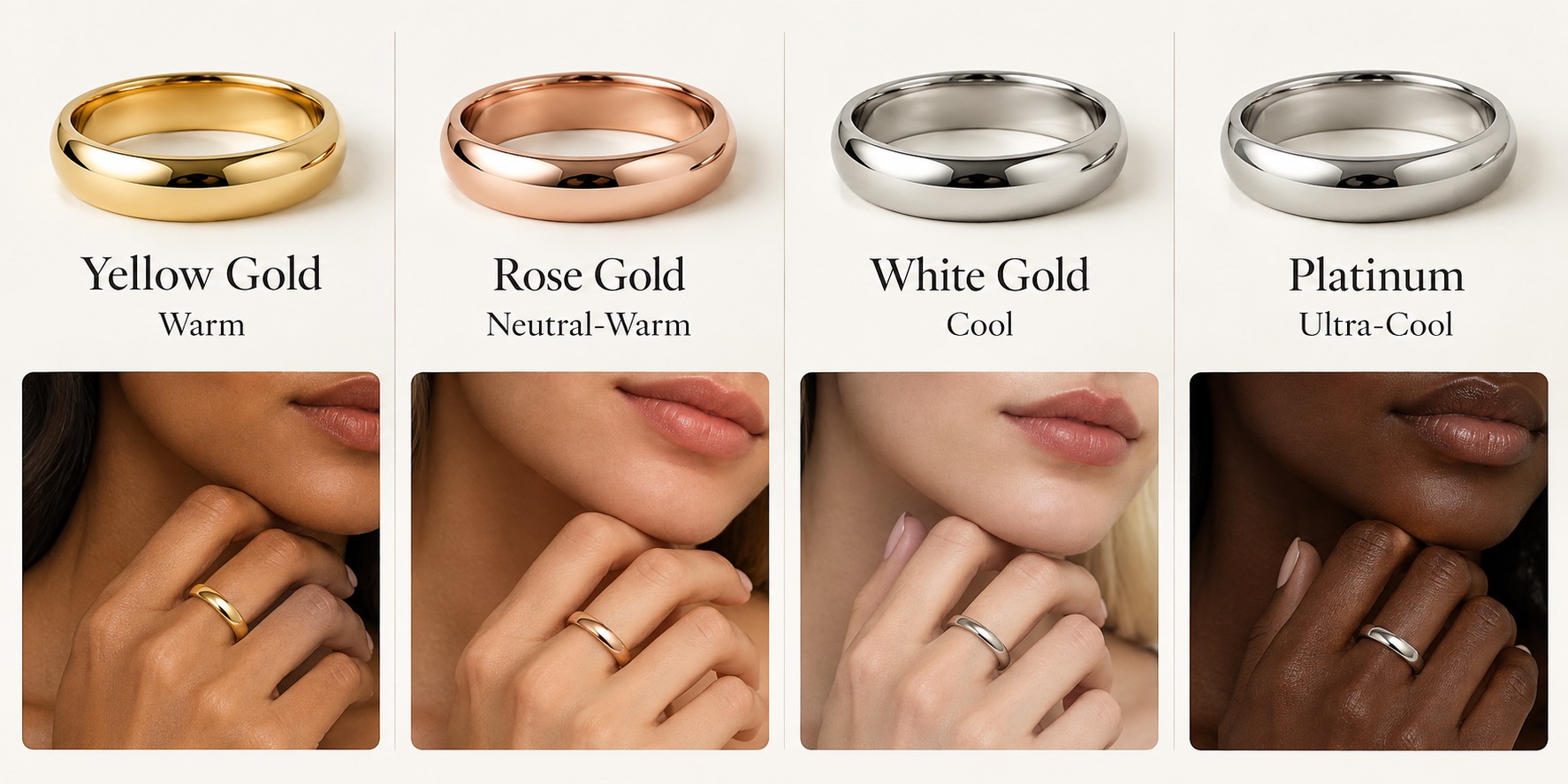
Use these swatches as a starting map of metal color, not a rule about who may wear each metal. Yellow gold usually reads warm, rose gold neutral-warm, white gold cool, and platinum ultra-cool in this visual comparison. Alloy composition, plating, and polish can change the exact look, so test the actual piece beside your face.
| Metal or finish | Possible visual effect | When to test an alternative |
|---|---|---|
| Bright yellow gold | Warm, saturated, and noticeable near the face | Try champagne, brushed, or antique gold if it feels too strong |
| Silver, platinum, or white gold | Cooler and often clearer, with intensity determined by polish | Try a satin or oxidized finish if polished silver looks stark |
| Rose gold | Warm metal with a pink or copper influence; the exact color varies | Compare it directly rather than assigning it automatically to neutral skin |
| Mixed metals | Repeats both temperatures and can connect jewelry to more outfit colors | Adjust the dominant metal if the combination feels visually busy |
| Antique or oxidized finishes | Lower shine and softer contrast than a polished surface | Useful when metal temperature works but brightness does not |
Rose gold is not a scientific midpoint between gold and silver. It is a family of alloys and finishes with visible pink, copper, and yellow variation. One rose-gold piece may look delicate and balanced while another reads strongly copper. The same direct comparison rule applies.
Why Gold and Silver Tests Give Conflicting Results
A contradiction usually tells you something about the test conditions or the specific objects. It does not automatically prove a neutral undertone. Work through the variables before changing your conclusion.
Lighting and camera processing
Warm household bulbs favor yellow and gold tones; cool LEDs can make silver appear cleaner. Mixed daylight and artificial light create different color casts across the face. Cameras may also apply a new white balance to each frame. Use one indirect daylight source and lock the camera settings when possible.
Shine, size, and contrast
A large polished piece reflects more light and attracts more attention than a small matte piece. Deep coloring may handle stronger metal contrast, while softer coloring may look more balanced with brushed or antique finishes. This is about visual intensity, not a rule that ties skin depth to one metal.
Olive skin and surface redness
Olive coloring can include a green-gray surface cast over warm, cool, or neutral-leaning undertones. Surface redness from sensitivity, temperature, or irritation can also obscure what you think you see. If common shortcuts keep failing, compare metals directly and read the detailed cool vs. warm olive skin guide before assigning a label.
Hair, makeup, and clothing
Dyed hair, a bright neckline, lipstick, and eye makeup all add color and contrast near the jewelry. They can change which complete look you prefer without revealing an underlying undertone. Test once in neutral conditions and again in the outfit you actually plan to wear. Both answers can be useful for different decisions.
Use the Vein Test as a Secondary Clue
Blue, purple, green, or mixed-looking veins are often used as an undertone shortcut, but vein color is not proof of a warm, cool, or neutral category. The visible color depends on surrounding skin color, tissue optics, vessel depth, and perception. Research on superficial veins has described the role of color contrast and the interaction between light and tissue rather than a simple one-color diagnosis (Journal of the American Academy of Dermatology; Journal of the Optical Society of America A).
If your vein reading and jewelry comparison agree, record that as supporting evidence. If they disagree, prioritize the direct jewelry comparison for the jewelry decision. You can review the limitations in the full vein test guide or compare several methods in the at-home skin undertone test.
Turn Your Metal Result Into a Personal Palette
Choosing gold or silver answers one narrow question. It does not determine every clothing color, makeup shade, or hair color that will work for you. A useful palette also considers value, contrast, chroma, and how colors behave together around the face.
Keep your test result as a clue: gold, silver, both, or finish-dependent. Then use it alongside fabric draping and other comparisons instead of building a wardrobe around a single shortcut.
Use Your Result in a Complete Color Palette
See how your metal preference fits with clothing, makeup, hair color, and your overall level of contrast.
Find My Color Palette →Common Questions: The Ultimate Color FAQ
How can I tell whether gold or silver looks better on me?
Compare similarly sized gold and silver pieces beside your face in the same indirect daylight. Switch them quickly and look for the metal that keeps the skin appearing more even, does not deepen facial shadows, and feels connected to your features rather than visually separate. Repeat the test in reverse order. If the difference remains small, call the result close and choose by finish, outfit, or preference.
Can I do the gold or silver test from a photo?
Yes, a controlled photo comparison can help, but it cannot measure undertone. Take two unedited images from the same camera position with identical daylight, exposure, white balance, expression, clothing, and jewelry placement. Turn off filters and beauty processing. If the phone changes brightness or warmth between frames, repeat the mirror test and treat the photos as inconclusive.
What does it mean if both metals look good?
It may mean your coloring is neutral or flexible, but it can also mean that the two pieces have equally suitable finishes and levels of contrast. There is no need to force a warm-or-cool label. Test rose gold, mixed metals, polished surfaces, and brushed finishes, then choose the version that works with your wardrobe and the effect you want.
What if the vein test and jewelry test disagree?
Use the jewelry comparison for the jewelry decision. Vein appearance is affected by skin color, tissue optics, vessel depth, lighting, and visual contrast, so it is only a secondary clue. Check the test conditions and repeat both metals in neutral daylight. A disagreement does not automatically mean neutral undertone, and it does not make either metal unavailable to you.
Does the test work for deep, fair, or olive skin?
The direct comparison can work at any skin depth because it asks which visible effect you prefer, not which metal a skin-tone category is supposed to wear. Use matched pieces and consistent lighting. With olive skin or visible surface redness, avoid relying on vein color alone; warm, cool, and neutral-leaning undertones can all occur beneath an olive surface cast.
Is rose gold warm or cool?
Rose gold is generally a warm metal because it combines gold with a visible copper or pink influence, but its color varies by alloy and finish. It is not automatically the best option for neutral undertones, nor is it limited to one color season. Compare the actual piece with yellow gold and silver under the same conditions and judge its brightness, pinkness, and contrast on you.