16 Season Color Analysis Explained
 Reviewed by Alexandra Gilmore
Four seasons can feel too broad, while sixteen can feel needlessly complex until their extra boundaries are clear. Learn how temperature, value, chroma, and contrast create the additional subtypes, then decide whether the added precision helps you test colors or merely gives the same palette a new label.

You already know that some colors make you look radiant while others drain the life from your face. Seasonal color analysis exists to explain exactly why — and to hand you a reliable framework for choosing colors that work with your natural coloring instead of against it.
💫 Discover Your Complete Color Palette
Ready to discover all the colors that make you look radiant? Our comprehensive color analysis will reveal your complete personal palette - perfect for hair, makeup, and wardrobe decisions.
Learn Seasonal Analysis →The original four-season model (Spring, Summer, Autumn, Winter) gave the world a useful shorthand. But a single label rarely captures the full picture. Two people can both test as "Winter" yet look completely different in the same palette. The 16-season color analysis system was built to close that gap.
Here is what this guide covers:
- Why the classic 4-season model is a starting point, not the finish line
- The three color dimensions — hue, intensity, and value — that separate one season from another
- How the 16-season system relates to the 12-season model, and where it goes further
- A plain-language tour of all 16 color types, their parent seasons, and their defining traits
- A practical method for identifying your own season based on your skin, eyes, and hair
- How your palette translates into clothing, makeup, and hair color choices
- The most common mistakes people make when applying this system, and how to sidestep them
Whether you are brand new to color analysis or already familiar with the 4- or 12-season frameworks, this guide gives you a clear, grounded path to finding your most precise color type.
📚 Recent Articles
Why the Classic 4-Season Model Is Only the Starting Point
The four-season framework — Spring, Summer, Autumn, Winter — gave color analysis its structure. Each season groups people whose natural coloring shares a common character: Springs tend toward warm, clear, light tones; Summers lean cool and muted; Autumns are warm and earthy; Winters are cool and high-contrast. For decades, this framework helped people make dramatically better color choices simply by knowing which quadrant they fell into.
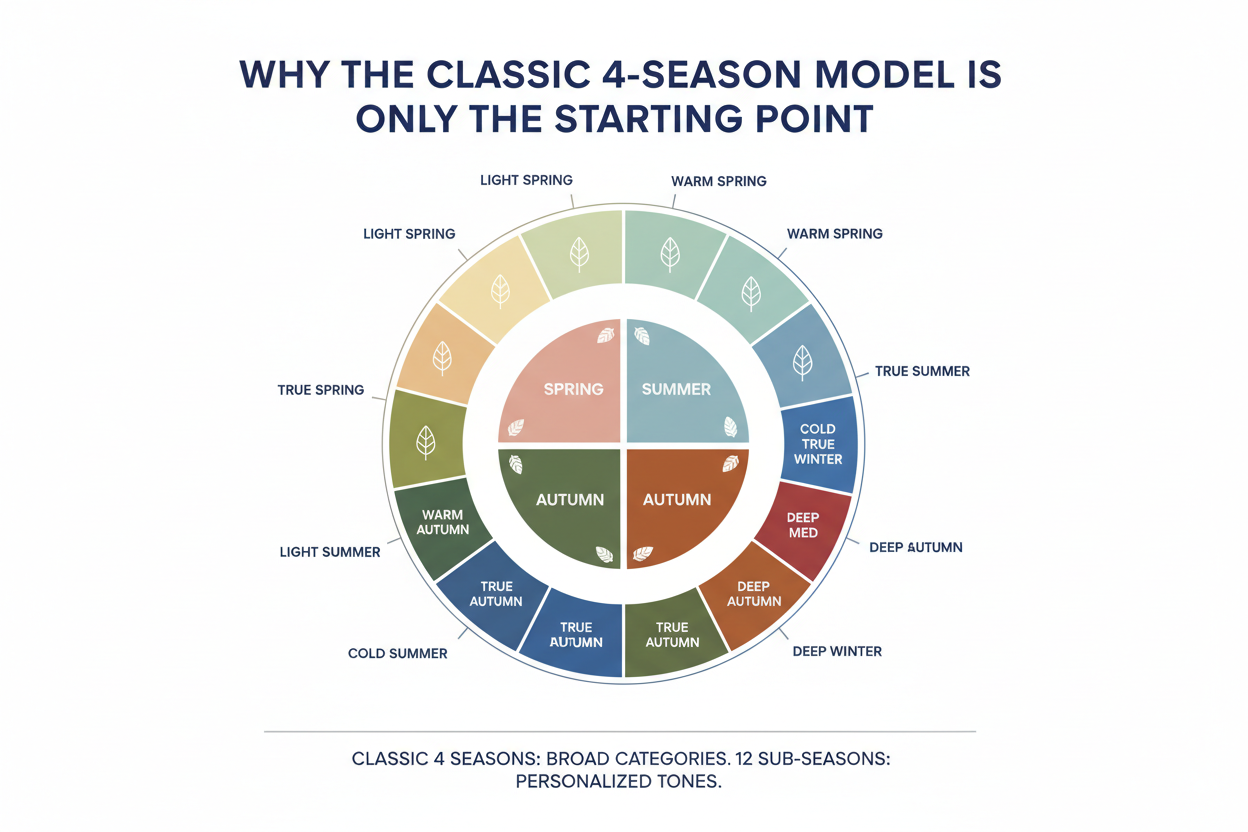
The problem is that each quadrant is wide. A woman with pale golden skin and soft strawberry-blonde hair and another with deeper peachy skin and vivid copper hair might both test as Autumn — but the palettes that actually flatter them look noticeably different. Forcing both into one label means at least one of them is working with colors that are slightly off.
That's the gap the 16-season system addresses. Instead of four broad categories, it uses sixteen more precisely defined types — each one a specific combination of hue, intensity, and value. The four parent seasons stay intact; the system just cuts each one into four sub-seasons rather than leaving it as a single block.
The practical result is a tighter palette. Fewer colors that are technically "your season" but don't quite work, and more that make you look healthy, rested, and put-together.
Not sure where you land in the 16-season system? Take the color analysis quiz →
How the 16-Season System Works: Hue, Intensity, and Value Explained
Every color — and every person's natural coloring — can be described along three dimensions. The 16-season system uses all three to place you somewhere specific within the color spectrum.
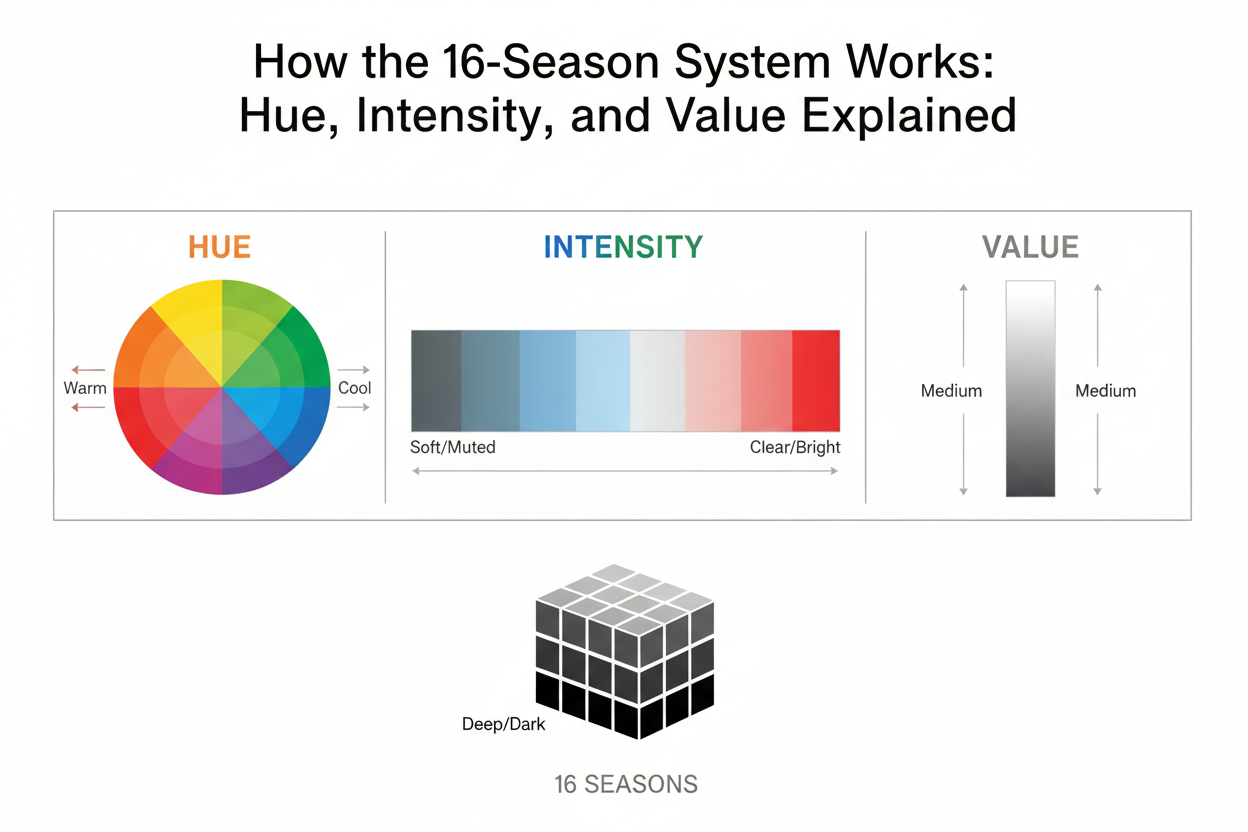
Hue (warm vs. cool) Hue describes whether a color, or a person's coloring, leans warm (golden, peachy, yellow-based undertones) or cool (pink, blue, or ashy undertones). This is the axis most people encounter first. It splits the four parent seasons at the broadest level: Spring and Autumn are warm; Summer and Winter are cool.
Intensity (muted vs. bright) Intensity — sometimes called chroma or saturation — describes how vivid or subdued the coloring is. A Soft Autumn and a True Autumn share the same warm hue, but the Soft Autumn's coloring is blended and low-contrast, while the True Autumn carries more richness and depth. Wearing colors that match your natural intensity is one of the fastest ways to look pulled-together rather than washed out or overdone.
Value (light vs. deep) Value describes lightness or darkness. A Light Spring and a Deep Autumn are both warm, but their value contrast is opposite. When your palette matches your value, clothes neither overwhelm your coloring nor disappear against it.
The 16-season system applies all three dimensions together to land on a category specific enough to actually be useful.
The Four Parent Seasons as Anchor Points
Spring, Summer, Autumn, and Winter aren't replaced by the 16-season model — they're still the organizing framework. Think of each parent season as a neighborhood and the sub-seasons as specific addresses within it. Which parent season you belong to is still the first question; the three axes above then narrow you down to your sub-season.
How Sub-Season Labels Are Constructed
Most 16-season labels follow a simple two-word formula: dominant trait + parent season. The first word names the most defining characteristic of that sub-season; the second names the parent season it belongs to.
For example:
- Warm Spring → belongs to Spring, defined primarily by its warm hue
- Soft Summer → belongs to Summer, defined primarily by its muted intensity
- Deep Autumn → belongs to Autumn, defined primarily by its dark value
- Bright Winter → belongs to Winter, defined primarily by its high intensity
Once you recognize the pattern, any 16-season label you come across — in articles, videos, or apps — is immediately readable.
16 Seasons vs. 12 Seasons: What Changes and Why It Matters
If you've used 12-season color analysis before, you might wonder what the extra four seasons actually add. The difference is simple once you see how the structure works.
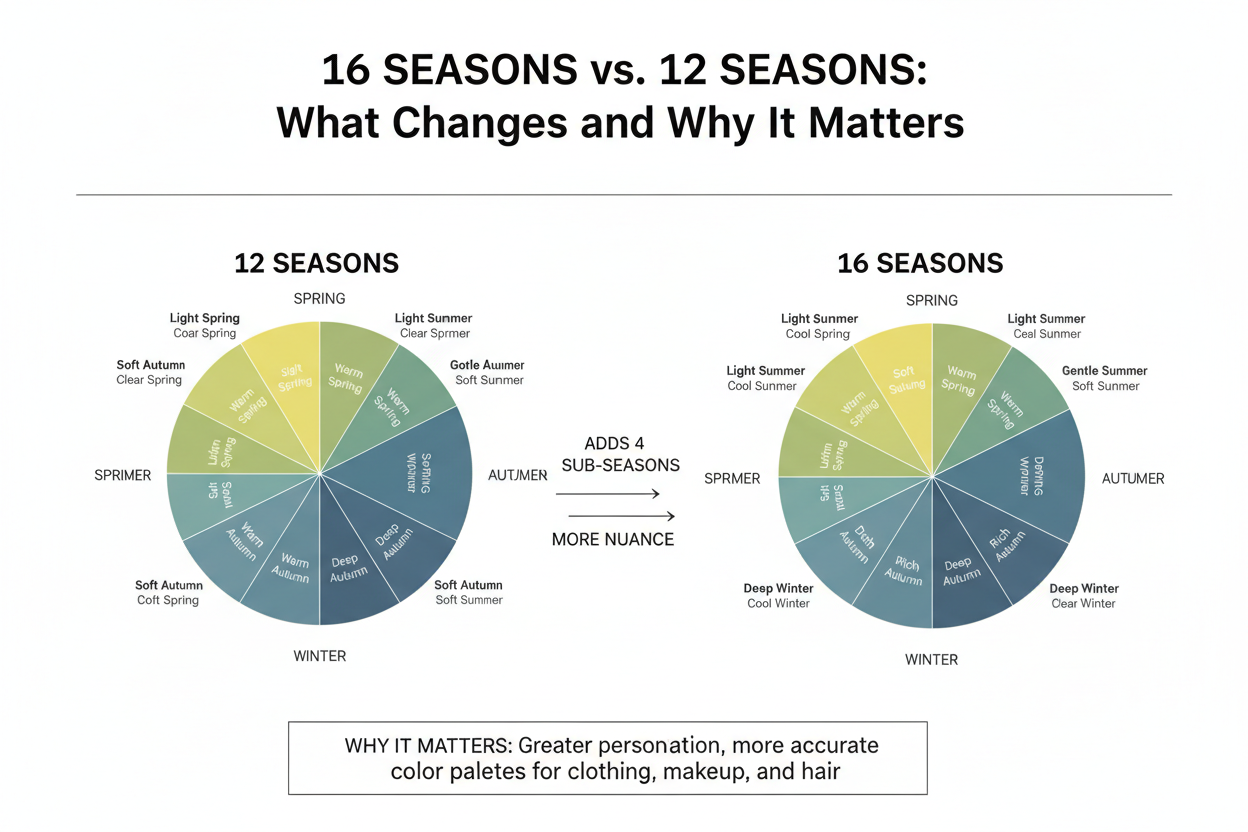
Both systems start with the same four parent seasons and split each one into sub-seasons. The 12-season system gives you three sub-seasons per parent (twelve total). The 16-season system gives you four sub-seasons per parent (sixteen total). Those four extra categories aren't invented from nothing — they cover the coloring profiles that sit right at the center of each parent season, often called the "True" or "Pure" version (True Spring, True Summer, True Autumn, True Winter).
In the 12-season framework, people whose coloring is most purely representative of their parent season can end up slightly underserved. The three sub-seasons sit to either side of center rather than at it. The 16-season system adds those center types explicitly, which makes it easier to place people whose coloring doesn't lean strongly in any direction away from the parent season's core.
If you already have a 12-season result, it almost certainly maps onto one of the 16 seasons — either as one of the eight shared sub-seasons, or if you landed near the center of your parent season, as one of the four "True" types the 16-season model names directly.
The Eight Sub-Seasons the 12-Season System Already Covers
The 12-season system includes two sub-seasons per parent that align closely with 16-season labels. These eight types show up — under the same or very similar names — in both frameworks:
| Parent Season | Shared Sub-Seasons (approx.) |
|---|---|
| Spring | Light Spring, Warm Spring |
| Summer | Light Summer, Soft Summer |
| Autumn | Soft Autumn, Deep Autumn |
| Winter | Deep Winter, Bright Winter |
If your 12-season result is one of these eight, your 16-season equivalent is the same type. The 16-season system adds four more types — roughly one "True" center type per parent season — and depending on the methodology, may shift the boundaries between neighboring sub-seasons.
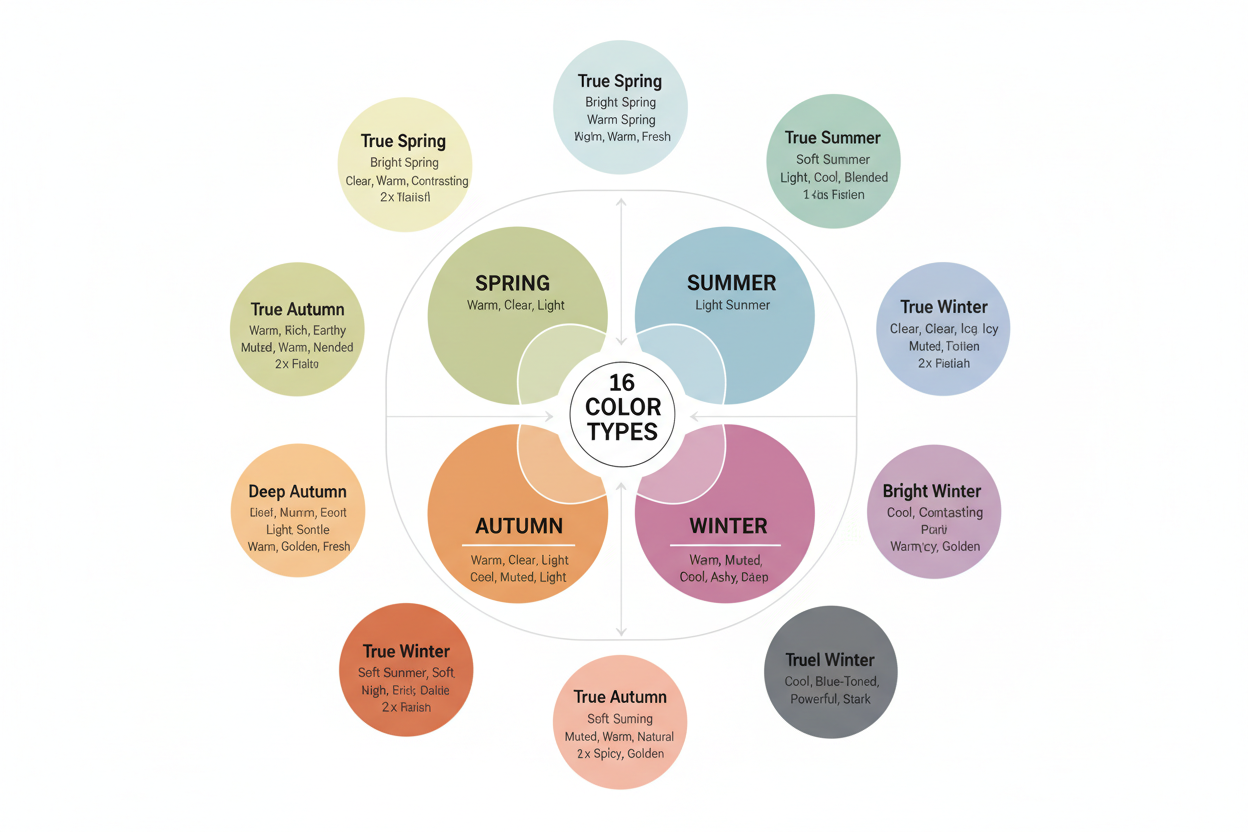
The 16 Color Types at a Glance: Names, Parent Seasons, and Key Traits
Quick reference for all 16 types. Each row names the season, its parent, and the one or two characteristics that most define it.
| # | Season Name | Parent | Defining Trait(s) |
|---|---|---|---|
| 1 | Light Spring | Spring | Warm undertone, light value, delicate contrast |
| 2 | Warm Spring | Spring | Most warm of all Springs, clear and golden |
| 3 | True Spring | Spring | Balanced warm brightness — neither light nor deep |
| 4 | Bright Spring | Spring | Clear, vivid — bridges Spring and Winter brightness |
| 5 | Light Summer | Summer | Cool undertone, light and soft, low contrast |
| 6 | Soft Summer | Summer | Cool-leaning muted — the most blended of all seasons |
| 7 | True Summer | Summer | Classic cool, rose-toned softness |
| 8 | Cool Summer | Summer | Most distinctly cool Summer, with ash tones |
| 9 | Soft Autumn | Autumn | Warm but muted — the gentlest Autumn |
| 10 | Warm Autumn | Autumn | Most warm and golden of all Autumns |
| 11 | True Autumn | Autumn | Rich, earthy warmth — the classic Autumn |
| 12 | Deep Autumn | Autumn | Warm with dark value — bridges Autumn and Winter depth |
| 13 | Deep Winter | Winter | Cool undertone, very dark value, high contrast |
| 14 | Cool Winter | Winter | Most distinctly cool Winter, with blue-ashy tones |
| 15 | True Winter | Winter | Classic high contrast — cool, clear, and vivid |
| 16 | Bright Winter | Winter | Highest intensity — bridges Winter and Spring clarity |
Ready to find your exact type? Start the free color analysis quiz →
How to Identify Your Season: The Attributes That Narrow It Down
Self-assessment works, though treat it as a starting point rather than a final answer. Four attributes will narrow things down:
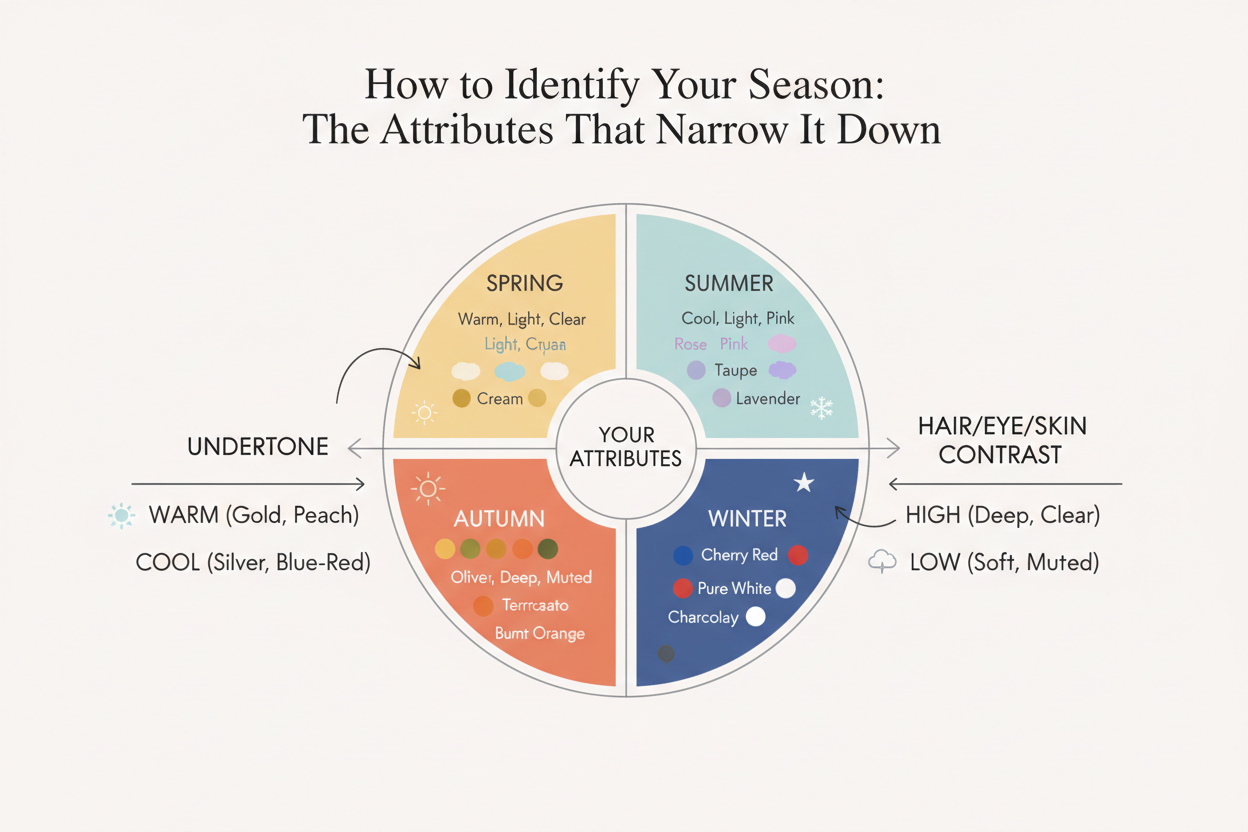
1. Skin undertone Look at the veins on your inner wrist in natural light. Blue or purple suggests cool; green suggests warm; a mix suggests neutral. This points you toward the warm side of the wheel (Spring, Autumn) or the cool side (Summer, Winter).
2. Natural hair color Golden, strawberry, or red-brown hair supports warm seasons. Ash brown, ash blonde, or blue-black supports cool seasons. Dyed hair will throw this off — use your natural color or roots.
3. Eye color and pattern Clear, bright eyes (vivid blue, bright green, clear hazel) tend toward high-intensity seasons. Soft, flecked, or muted eyes tend toward lower-intensity ones.
4. Overall contrast level Look at how much contrast there is between your hair, eyes, and skin. Very dark hair against pale skin points toward Winter. Hair, eyes, and skin all similarly light or muted points toward Summer or Light Spring. Medium contrast covers most of Spring and Autumn.
Going through these in order — undertone → hair → eyes → contrast — narrows 16 possibilities down to a few candidates. That said, undertone misreads and bad lighting can introduce errors, so a quiz or professional draping session is still the most reliable way to confirm.
What Your 16-Season Palette Tells You About Clothing, Makeup, and Hair
Knowing your 16-season type is useful only if it changes what you actually put on your body. Here is how the precision of the 16-season system translates into concrete decisions.
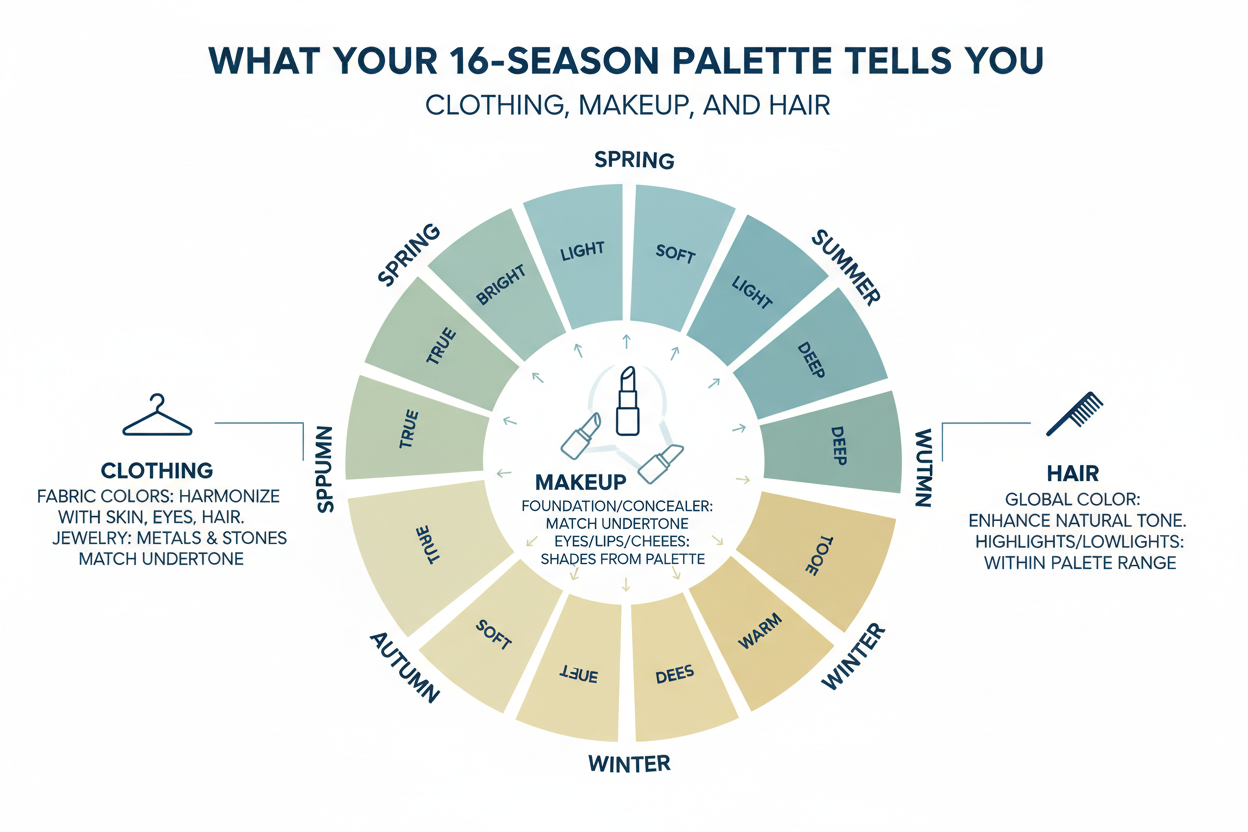
Clothing Your palette defines a specific range of colors — in specific levels of warmth, saturation, and lightness — that work with your natural coloring rather than against it. A Soft Summer's best neutrals are dusty rose-grays and muted blue-greens; those same neutrals look flat on a True Winter, who needs clearer, cooler tones with more contrast. The 16-season system is precise enough that even within a broad color family like blue, you can identify which blues work and which don't.
Makeup Foundation undertone, blush color, lip color, and eyeshadow all respond to your season. Warm seasons tend to look better in peachy-coral blushes and warm brown eyeshadows; cool seasons lean toward rose and mauve. Within the warm group, a Light Spring calls for sheer, soft corals, while a Deep Autumn can carry deeper terracotta and bronze. The 16-season framework makes these distinctions explicit instead of leaving you guessing within a vague "warm" category.
Hair color Your season can guide decisions about coloring, highlighting, or toning your hair. A Cool Summer tends to look most natural with ash or cool-blonde tones and risks looking brassy with golden highlights. A Warm Autumn, by contrast, looks vibrant with copper or caramel and flat with ash. These aren't rigid rules — personal preference always matters — but they explain why some color appointments leave you glowing and others leave you wondering what went wrong.
Common Mistakes When Using the 16-Season System (and How to Avoid Them)
The 16-season system adds precision, but it also adds more room for specific types of errors. Worth knowing the main ones before you start.
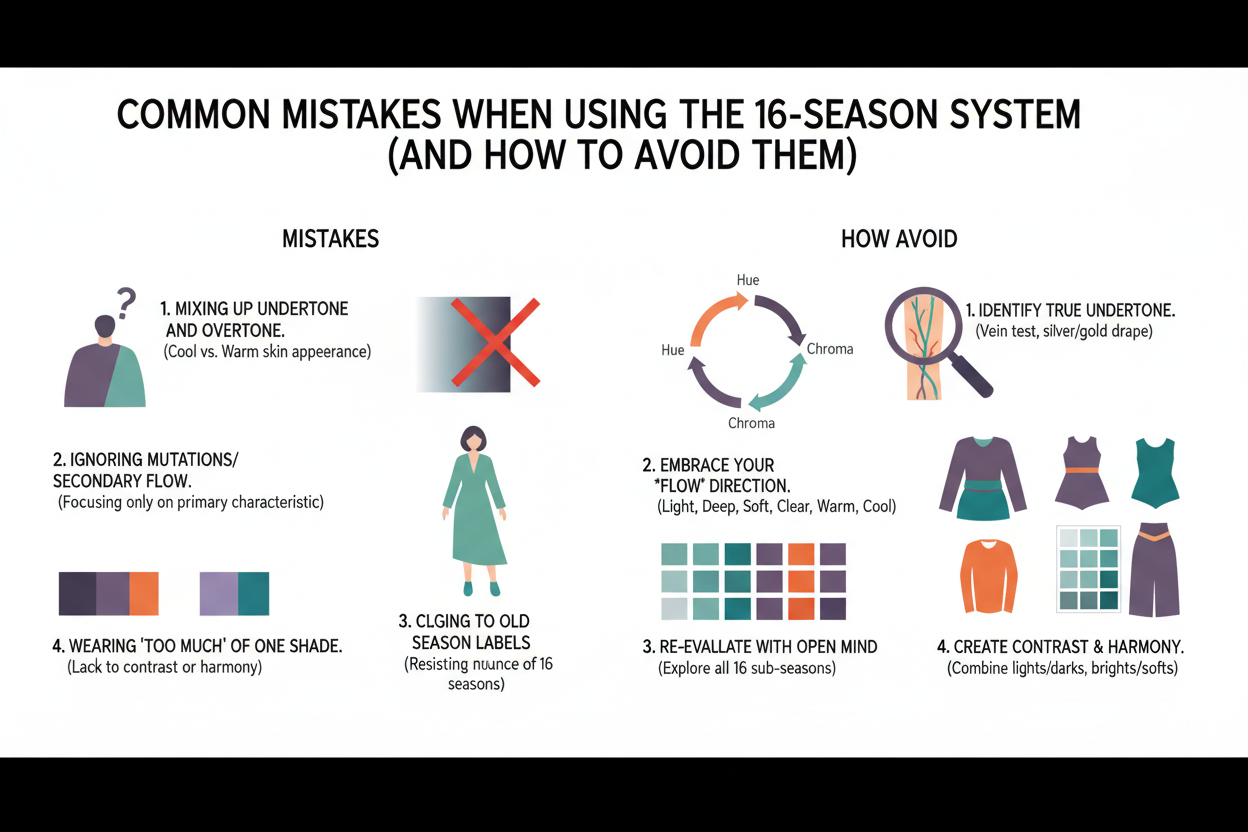
Misidentifying your undertone Undertone assessment is the most consequential step and the most commonly botched one. Artificial lighting, skin redness, and recently applied skincare can all skew the reading. Always assess in natural daylight, with a bare clean face, away from colored walls or clothing that might cast a reflection.
Conflating intensity with value These two dimensions are independent, and mixing them up produces wrong results. Someone can be cool and deep (Deep Winter), or cool and light (Light Summer). Assuming "light" means "muted" or "deep" means "bright" will send you to the wrong sub-season.
Using hair color alone Hair color is one data point, not the whole picture — and the one most likely to change. Relying on it without also considering skin undertone and contrast level will mislead you, especially if your hair has been colored, lightened, or has shifted with age.
Comparing yourself to a type description rather than a palette Written descriptions use approximations. Two people can match the same description but respond differently to the same colors. Whenever possible, test actual colors against your face — draped fabric swatches work well — rather than deciding by description alone.
Treating the system as all-or-nothing The 16 seasons are categories imposed on a continuous spectrum. If your coloring sits near the boundary between two sub-seasons, both palettes may work reasonably well. The goal is to find the range that serves you most often, not to land on a single label that explains every choice.
People Also Ask
What is the difference between 12 season and 16 season color analysis?
Both systems build on the same four parent seasons — Spring, Summer, Autumn, and Winter — and split each into sub-seasons. The difference is just how many sub-seasons each parent gets.
- 12-season system: Three sub-seasons per parent season, twelve types total. These sit to either side of the parent season's center, which makes it hard to place people whose coloring is a textbook example of their parent season.
- 16-season system: Four sub-seasons per parent season, sixteen types total. The four extra types are essentially the "True" or center versions of each parent — True Spring, True Summer, True Autumn, True Winter — filling the gap the 12-season model leaves.
Eight of the 16 sub-seasons appear in both systems under the same or nearly identical names. If you have a 12-season result, it almost certainly maps straight onto one of the 16 types. The 16-season system just gives you finer resolution, especially if your coloring sits close to the core of your parent season.
How do I find my season in the 16-season color analysis system?
You narrow it down through four attributes, in order:
- Skin undertone — Check in natural daylight with a bare face. Blue or purple veins at the wrist suggest cool; green veins suggest warm. That puts you on either the warm side (Spring, Autumn) or the cool side (Summer, Winter).
- Natural hair color — Golden, red-brown, or strawberry tones lean warm; ash blonde, ash brown, or blue-black lean cool. Go by your natural color or roots, not dyed hair.
- Eye color and clarity — Vivid, clear eyes point toward higher-intensity seasons; soft, flecked, or muted eyes point toward lower-intensity ones.
- Overall contrast level — High contrast between hair, eyes, and skin points toward Winter types; low contrast toward Summer or Light Spring; medium contrast covers much of the Spring and Autumn range.
Working through these four in order gets you from sixteen possibilities down to a small handful pretty quickly. That said, lighting conditions and self-assessment errors trip people up, so confirming with a quiz or a professional color draping tends to give a more reliable result.
What are the 16 seasons in color analysis?
The 16 seasons are organized into four groups of four, each anchored by a parent season:
Spring (warm, clear)
- Light Spring
- Warm Spring
- True Spring
- Bright Spring
Summer (cool, soft)
- Light Summer
- Soft Summer
- True Summer
- Cool Summer
Autumn (warm, muted or rich)
- Soft Autumn
- Warm Autumn
- True Autumn
- Deep Autumn
Winter (cool, deep or vivid)
- Deep Winter
- Cool Winter
- True Winter
- Bright Winter
Each name follows the same pattern: a descriptive word capturing the defining characteristic (light, warm, soft, bright, deep, cool, or true) paired with its parent season. Once you understand the three underlying dimensions — hue, value, and intensity — any 16-season label becomes readable on sight.
Is 16 season color analysis more accurate than 4 season color analysis?
For most people, yes — though "more useful" is probably a better framing than "more accurate."
The four-season system works well as a first pass. Knowing you're broadly an Autumn already rules out a huge chunk of the color spectrum and points you in the right direction. The problem is that each parent season covers a lot of ground. Two people who both test as Autumn can look noticeably different in the same palette — one has deeper, richer coloring, the other has a softer, more muted version of those same warm tones.
The 16-season system fixes that by getting more specific about hue, intensity, and value. The palette you end up with is tighter, which means fewer colors that are technically "correct" but still somehow a little off. The downside is complexity: more categories means more ways to misclassify yourself, especially if you're going it alone. But used carefully — with draping or a reliable quiz — the 16-season framework gives most people genuinely better guidance.
What does hue, intensity, and value mean in seasonal color analysis?
These three dimensions describe every color — and every person's natural coloring — along independent axes. The 16-season system uses all three together to assign a precise season.
Hue (warm vs. cool): Whether your coloring leans golden and yellow-based (warm) or pink, blue, and ashy (cool). Spring and Autumn sit on the warm side; Summer and Winter on the cool side. It's the broadest dividing line in the system.
Intensity (muted vs. bright): Also called chroma or saturation — how vivid or subdued your coloring is. A Soft Autumn and a True Autumn may share the same warm hue, but Soft Autumn's coloring is blended and low-contrast while True Autumn carries more richness. Matching your natural intensity is one of the fastest ways to look more put-together.
Value (light vs. deep): How light or dark your coloring is overall. A Light Spring and a Deep Autumn are both warm, but their value contrast runs in opposite directions. Get this wrong and colors either swallow your coloring or vanish against it.
The 16-season system applies all three dimensions at once. Hue gets you to the warm or cool side; intensity and value pin down your exact sub-season from there.
FAQ
What is 16 seasonal color analysis and how does it differ from the classic 4-season system?
Seasonal color analysis matches your natural coloring — skin undertone, hair, and eyes — to a palette of flattering colors. The classic model puts everyone into one of four seasons: Spring, Summer, Autumn, or Winter.
The 16-season system keeps those four seasons but splits each one into four sub-seasons, giving you sixteen distinct color types. If the four-season model tells you which neighborhood your coloring belongs to, the 16-season system gives you a street address. The result is a tighter palette — fewer colors that are technically "in season" but still slightly off for your specific mix of undertone, depth, and clarity.
How are the 16 color seasons named and organized?
The 16 types fall into four families, each built around a parent season:
- Spring: Light Spring, True Spring, Warm Spring, Bright Spring
- Summer: Light Summer, True Summer, Soft Summer, Cool Summer
- Autumn: Soft Autumn, True Autumn, Warm Autumn, Deep Autumn
- Winter: Deep Winter, True Winter, Cool Winter, Bright Winter
Each name has two parts: a descriptor (light, warm, soft, cool, bright, deep, or true) paired with the parent season. The descriptors map to the three underlying dimensions — hue, intensity, and value — so once you know that, any label in the system is self-explanatory.
Can I determine my 16-season type at home, or do I need a professional?
Self-assessment at home works, and it's how most people start. You need natural daylight, a bare face, and a mirror. Check the veins on your wrist (blue-purple tends toward cool; green tends toward warm), notice whether your natural hair pulls golden or ashy, and look at how much contrast exists between your hair, eyes, and skin. That gets you most of the way there.
The catch is that artificial lighting, dyed hair, and the general weirdness of analyzing your own face all introduce errors. A professional color analyst holds physical fabric drapes next to your face and watches in real time how different hues interact with your skin — which cuts through a lot of the guesswork. If you don't have access to an in-person analyst, a well-designed online quiz can help, especially one that asks about several attributes rather than just "warm or cool?"
What is the difference between the 12-season and 16-season color analysis systems?
Both systems divide the same four parent seasons into sub-seasons, so there's significant overlap. The difference comes down to how each parent season gets subdivided:
- 12-season system: Each parent season splits into three sub-seasons, positioned to the left and right of the season's center. People whose coloring is closest to the pure, archetypal form of their parent season don't have a dedicated type.
- 16-season system: Each parent season splits into four sub-seasons, adding a "True" version — True Spring, True Summer, True Autumn, True Winter — that fills exactly that gap.
Eight of the sixteen types appear in both frameworks under the same or very similar names. If you already have a 12-season result, it almost certainly maps directly to a 16-season equivalent. The 16-season system mainly adds precision for people whose coloring sits at the core of their parent season rather than leaning toward a neighboring one.
How do hue, intensity, and value determine which of the 16 seasons I belong to?
These three dimensions describe every color — and every person's natural coloring — along separate, independent axes:
- Hue (warm vs. cool): Whether your coloring has golden, peachy, or red-brown undertones (warm) versus pink, ashy, or blue-based undertones (cool). This is the first and broadest dividing line, placing you on either the Spring/Autumn side or the Summer/Winter side.
- Intensity (muted vs. vivid): How saturated or subdued your coloring appears overall. Soft Autumn and True Autumn share the same warm hue, but Soft Autumn's coloring is blended and low-contrast while True Autumn carries greater richness and depth.
- Value (light vs. deep): How light or dark your overall coloring is. Light Spring and Deep Autumn are both warm, but their value contrast is opposite — one is pale and delicate, the other deep and rich.
All three axes work together. Hue puts you on the warm or cool side; intensity and value narrow it down to your specific sub-season from there.
Will my 16-season color type change if I dye my hair or get a tan?
Your season is based on your natural coloring — the pigmentation you were born with, which stays fairly stable through adulthood. Dyeing your hair or getting a tan changes how you look day to day, but it doesn't change your actual season.
This matters most when you're trying to figure out your type in the first place. If you're assessing yourself, go by your natural hair color (or let your roots grow out a bit) and check your skin once any tan has faded. Using altered coloring as your starting point tends to throw off the result. Once you know your season, you can absolutely dye your hair or spend time in the sun — your palette reflects your natural coloring, not a set of rules about how you have to look.
What practical difference does knowing my 16-season type make to my wardrobe?
Knowing your four-season type already rules out a large chunk of the color spectrum. Your 16-season type narrows it further in three concrete ways:
- Clothing colors: Your palette identifies not just which hues work but the right level of saturation and depth. A Soft Summer needs dusty, low-contrast tones; a Bright Winter needs the same cool undertone but vivid and high-contrast. Both are "cool," but the wrong intensity will make either look washed out or harsh.
- Makeup shades: Foundation undertones, blush, and lip color all respond to the same precision. A warm-palette person reaching for a cool-toned foundation will consistently look slightly off, no matter how good the match looks in the tube.
- Hair color: Your palette shows which tones harmonize with your natural coloring rather than compete with it — useful whether you color your hair or not, and especially useful for avoiding highlights that look disconnected from your skin.
Ready to find your precise type? Take the color analysis quiz to get your 16-season result.