White Paper Undertone Test: Does It Work
 Reviewed by Alexandra Gilmore
White paper may make warm or cool tendencies easier to notice, but reflected light and surface redness can also create a convincing false result. Run the test under controlled daylight, understand what it can and cannot show, then cross-check with fabrics and foundation before acting.

You've probably been there: a foundation shade matches your skin color perfectly in the store, but the moment you get home it looks oddly gray, orange, or just off. The culprit is almost never your surface skin tone — it's your undertone, the subtle hue sitting beneath the skin's surface that doesn't change regardless of a tan or a pale winter complexion.
💫 Discover Your Complete Color Palette
Ready to discover all the colors that make you look radiant? Our comprehensive color analysis will reveal your complete personal palette - perfect for hair, makeup, and wardrobe decisions.
Find My Color Palette →The white paper test for undertone is one of the most widely circulated DIY methods for figuring out that hidden hue. The premise is simple: hold a plain white sheet of paper next to your bare face, observe how your skin looks by comparison, and use the contrast to determine whether your undertone runs warm, cool, or neutral. No special tools, no cost, no appointment required.
That simplicity is exactly why it spread. And it does get some things right:
- It forces you to look at your skin relative to a neutral reference point rather than in isolation.
- It can produce a clear result for people whose undertone is pronounced.
- It's a useful first step when you have nothing else to go on.
But the test also has real, documented limitations — limitations that explain why many people complete it and still end up buying the wrong foundation. Lighting conditions, the paper's own optical properties, and the way human perception adapts to color all create room for error. For deeper and fairer complexions especially, the contrast the test relies on can be subtle enough to misread entirely.
This article examines the white paper test honestly: the logic behind it, the specific conditions under which it works, the situations where it misleads, and how to pair it with other at-home methods to get a result you can actually rely on when choosing makeup, clothing, and hair color.
For the next diagnostic or service-choice step, continue with the companion article “Undertone Test: Vein Test vs Jewelry Test”, which keeps the two closely related questions distinct.
📚 Recent Articles
What Undertone Actually Is (And Why It's Hard to See)
Skin tone and undertone get used interchangeably, but they describe two completely different things — and mixing them up is why most DIY tests give inconsistent results.
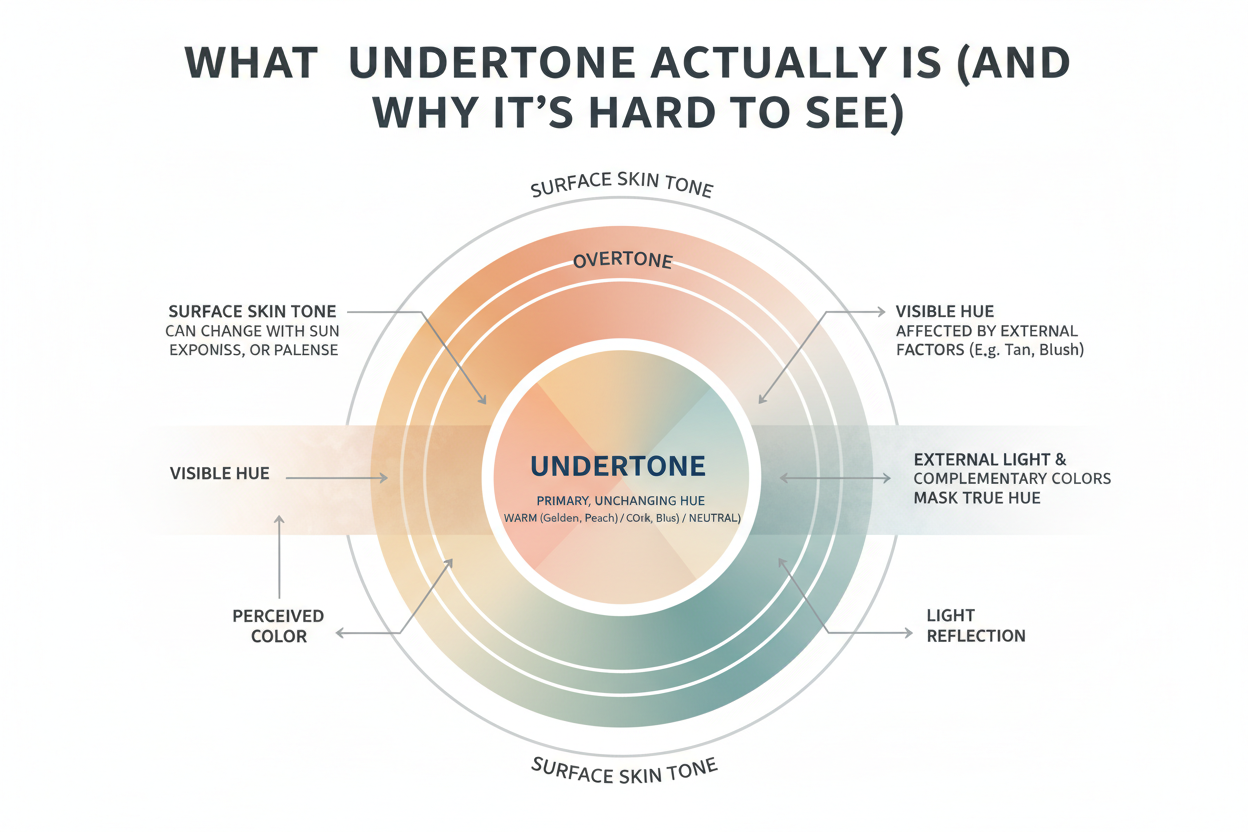
Skin tone is the color you see on the surface: fair, light, medium, tan, deep. It shifts with sun exposure, seasons, and age. Undertone is a subtler, more stable hue that lives beneath the surface layers — think of it as a tint coming through from underneath, the way a base coat affects every color painted on top of it, even after it's no longer visible.
Skin is made up of multiple layers, and those layers carry different warm or cool pigments. Melanin, hemoglobin, and carotene each contribute color at different depths. What your eye actually sees is the combined result of all those layers at once. The undertone — warm (yellow/golden), cool (pink/blue/red), or neutral (a balance of both) — is just one signal buried inside that mix.
This is why undertone is genuinely hard to see on its own. You're not perceiving a single color. You're perceiving a complex blend, and your brain is constantly adjusting that perception based on surrounding colors, light sources, and contrast. Any test that asks you to visually isolate undertone from surface tone is asking your visual system to do something it isn't built for — which is why even simple-sounding tests need very specific conditions to work reliably.
Two people with the same surface skin tone can have completely opposite undertones. One might find cool-toned clothing flattering while the other finds the same shades draining. The surface color looks identical; the undertone is the variable. That gap is exactly what makes self-assessment tricky — and why a single test rarely tells the whole story.
Want to skip the guesswork? Take the color analysis quiz →
How the White Paper Test Is Supposed to Work
The method is simple. Hold a plain, uncoated white sheet of paper next to your bare face — no foundation, no bronzer, no color-correcting moisturizer — and look at how your skin reads by comparison.
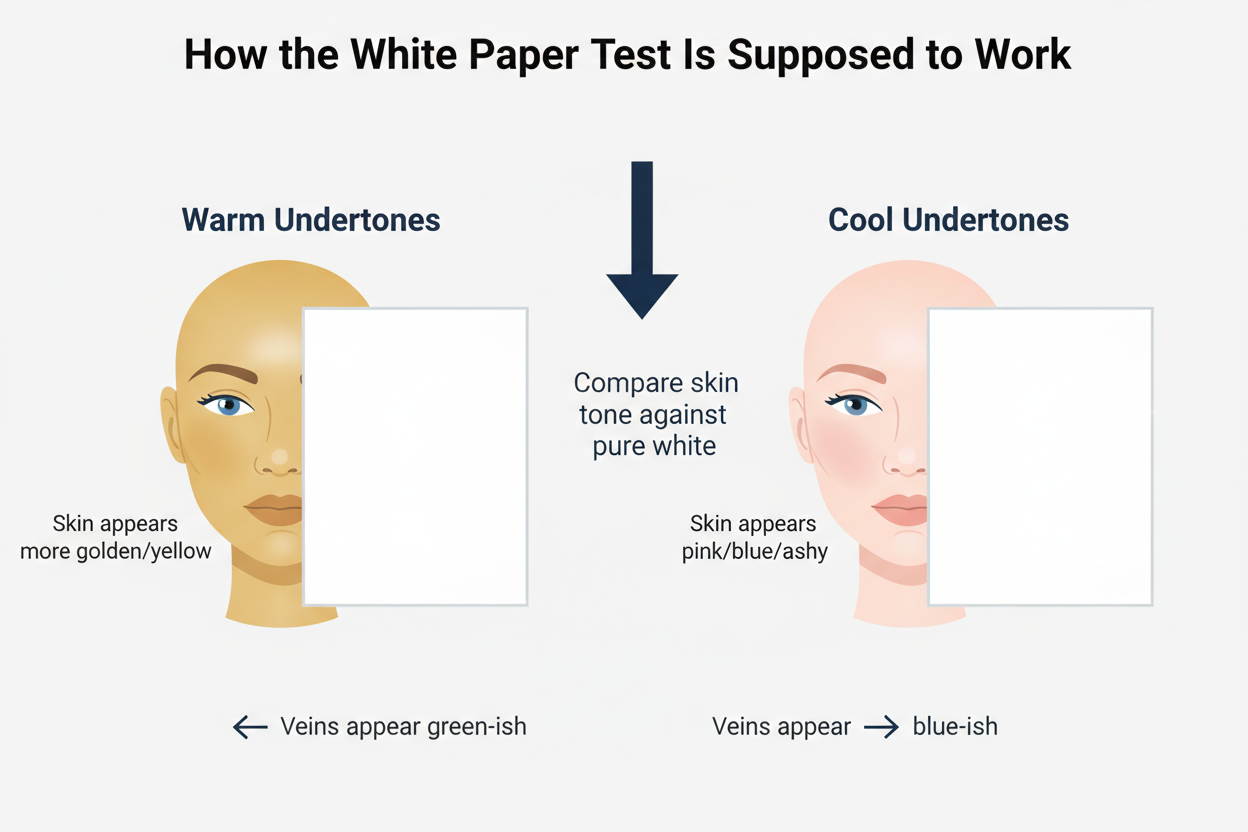
The idea is that white is the most neutral reference point you have. Against it, the residual hue in your skin gets easier to see:
- Warm undertone: Your skin looks yellow, golden, or peachy next to the white.
- Cool undertone: Your skin reads pink, rosy, or slightly bluish against the white.
- Neutral undertone: No single hue dominates. Your skin looks balanced, sometimes olive.
White works as the baseline because it has no undertone of its own. It's supposed to strip away the visual noise of your surroundings and let only your skin's hue come through.
Two conditions matter more than anything else: bare skin, and natural daylight. Warm bulbs and fluorescent office lighting will skew what you see. It also helps to look at your inner wrist, neck, or jawline rather than areas that get a lot of sun, since sun-exposed skin carries extra surface pigment that can muddy the signal.
When everything lines up and the undertone is pronounced, you get a clear, immediate read. The problem is that ideal conditions are harder to pull off than the instructions let on.
Where the White Paper Test Actually Breaks Down
The white paper test fails in predictable ways. Understanding those failure modes tells you exactly when not to trust the result.
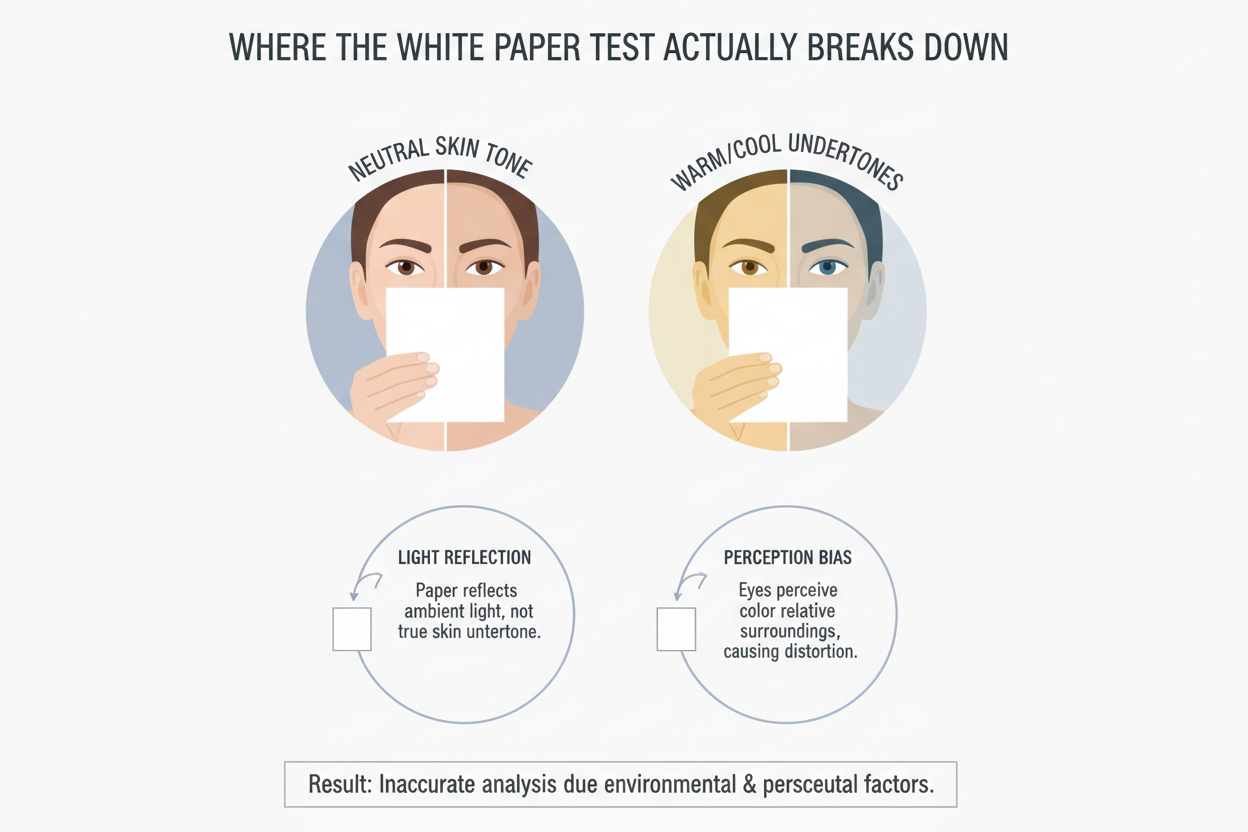
Undertone is layered, not surface-level. Undertone sits beneath multiple skin layers, each with their own tint, so the signal you're trying to detect is already faint before it reaches the surface. Holding your wrist next to a sheet of paper is trying to pick up a subtle hue filtered through several translucent layers. For anyone with deeper skin or a neutral undertone, the contrast may simply be too small to read.
Two people with the same skin tone can read the test differently. Undertone is independent of surface skin tone, so someone with medium skin could have a strongly warm or strongly cool undertone, or something in between. The test doesn't account for this. It assumes the skin's overall appearance will shift noticeably against white, but for neutral undertones there's often nothing distinctive to see.
Observer bias compounds the problem. Humans are bad at judging subtle color differences, especially when we already have an expectation. If you think you have warm undertones, you'll probably interpret a slight yellow cast as confirmation. There's no objective measure here, just your interpretation of a comparison that's already hard to read.
Paper quality varies. Standard printer paper is not one consistent white. Optical brighteners in some papers push the sheet toward blue-white; others lean cream. The reference point shifts depending on which sheet you grab.
The Lighting Problem: Why Indoor Light Ruins the Test
Lighting is the single biggest variable that can invalidate the white paper test, and it's the condition most people overlook.
Warm incandescent bulbs cast a yellow-orange light that makes every skin tone look warmer than it is. Cool fluorescent lighting pushes everything toward blue-gray. Both shifts affect the paper and your skin simultaneously, but not proportionally. The comparison ends up reflecting the light source more than your actual undertone.
Natural daylight, specifically indirect sunlight near a window on an overcast day, is the only light that doesn't systematically skew the result. Direct sun introduces its own warm cast. Bathroom lighting is almost universally unreliable.
Here's the practical problem: if the signal you're trying to detect is already subtle, artificial lighting doesn't just add noise. It can erase the signal entirely. You end up reading the room, not your skin.
If you can't get natural daylight, wait. Doing the test under artificial light and acting on the result is more likely to mislead you than to help.
Other At-Home Undertone Tests and How They Compare
No single at-home method is definitive. Running two or three tests and looking for agreement gives you a much more reliable result than any one test alone. Here's how the most common alternatives compare:
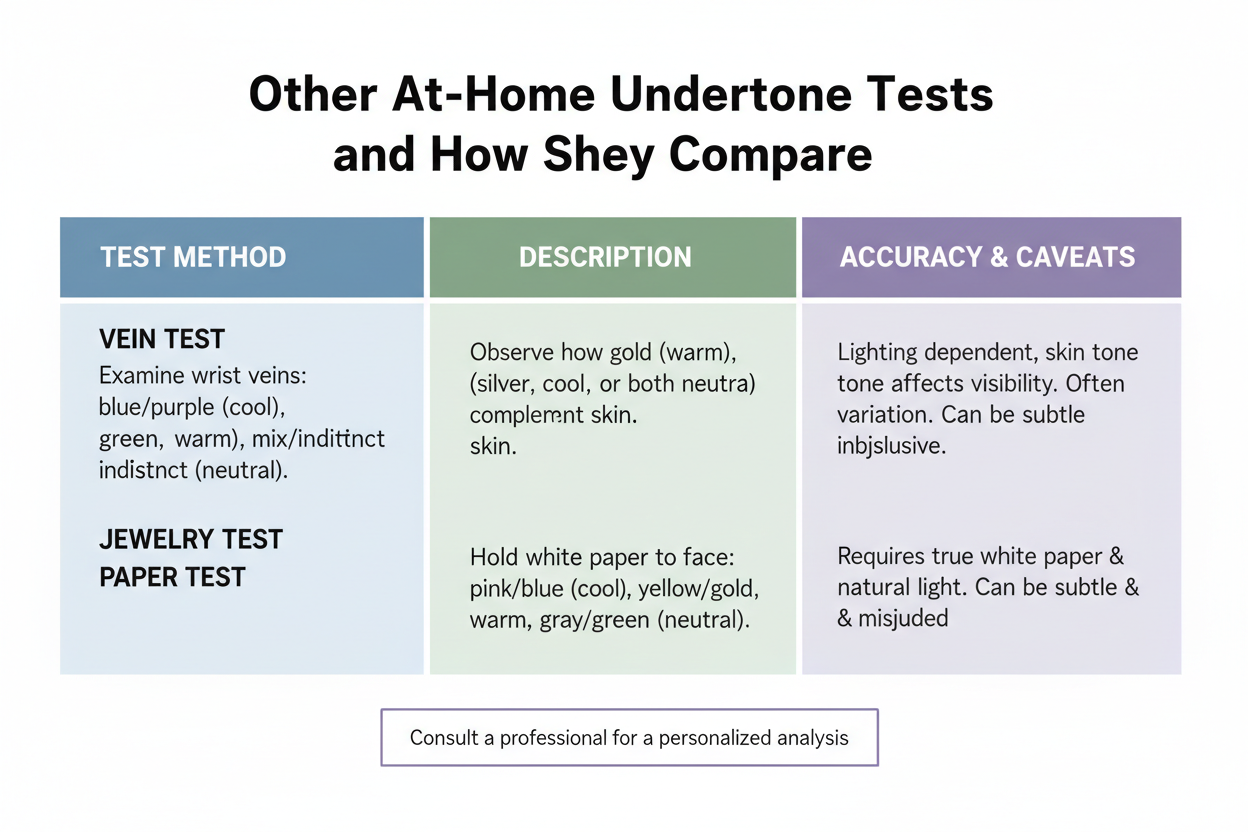
The Vein Test Look at the veins on your inner wrist in natural light:
- Blue-purple veins → cool undertone
- Green veins → warm undertone
- Blue-green veins → neutral undertone
The vein test has one real advantage over the white paper test: veins are beneath the skin, so the color you're seeing is closer to where undertone actually lives. You're less reliant on surface perception. It's also less prone to observer bias because blue versus green is a more distinct call than the warm-versus-cool shift you're hunting for in the paper test. (More on that comparison below.)
The Jewelry Test Hold a piece of gold jewelry against your skin, then a piece of silver:
- Gold looks better → warm undertone
- Silver looks better → cool undertone
- Both look equally good → neutral
This one is practical and doesn't require natural light, but "looks better" is an aesthetic judgment that varies by personal preference and the style of the piece. Take it with a grain of salt.
The Sun Reaction Test How does your skin respond to sun exposure?
- Burns easily, rarely tans → likely cool undertone
- Tans quickly, rarely burns → likely warm undertone
- Burns first, then tans → often neutral or olive
This method captures something the visual tests can't: how your skin's pigment actually behaves. The downside is that it's less useful for product matching and requires you to remember a pattern over time rather than observe something right now.
The White Clothing Test Hold a pure white garment next to your face, then a cream or off-white one:
- Pure white looks better → cool undertone
- Cream or ivory looks better → warm undertone
A useful complement to the paper test because it gives you a second white reference in a context that's easier to read.
Not sure which results to trust? Start the structured color analysis quiz → to get a result grounded in multiple signals, not just one.
Why Getting Your Undertone Wrong Has Real Consequences
Undertone errors aren't just about foundation mismatches — they affect every color decision that touches your face.
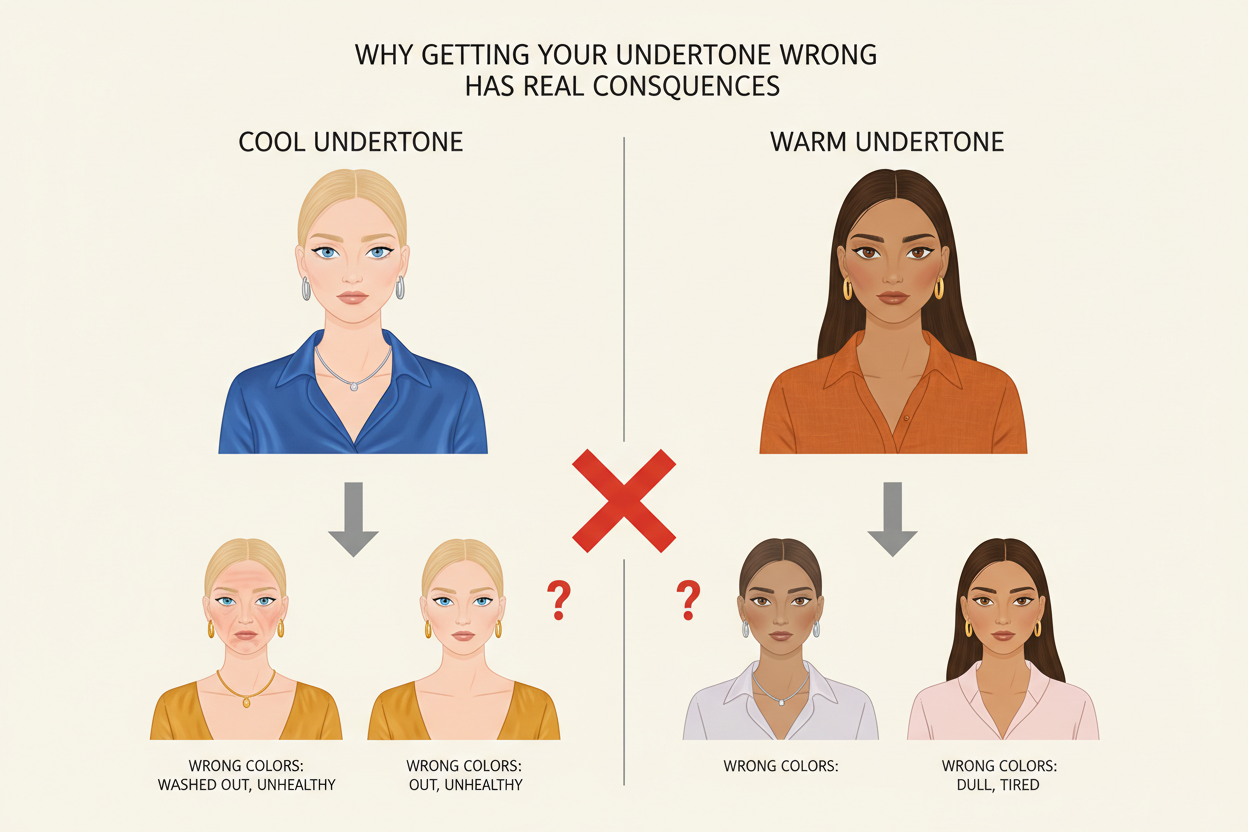
The most immediate problem is foundation that looks wrong even when you've matched the depth correctly. A cool-toned foundation on warm-undertoned skin reads ashy or grayish. A warm-toned foundation on cool skin tends to go orange or muddy. You can nail the value and still walk out looking off.
Beyond foundation, undertone shapes how clothing colors interact with your face. Two people with identical surface skin tones can have opposite reactions to the same color. Someone with a warm undertone might find that a sharp black makes them look drawn and tired, while the same black on cool-undertoned skin creates contrast that reads as polished. Same garment, different result.
Eyeshadow, blush, lip color, and hair dye all follow the same logic. Shades that work with your undertone make skin look luminous. Shades that fight it flatten your complexion and make you look tired, no matter how good the product is.
Getting the undertone wrong means buying things that look promising and then disappoint — a cycle that costs both money and confidence.
How to Use the White Paper Test as a Starting Point, Not a Final Answer
The white paper test isn't worthless — it's just not built to carry more weight than a first impression. Here's how to use it without over-relying on it:
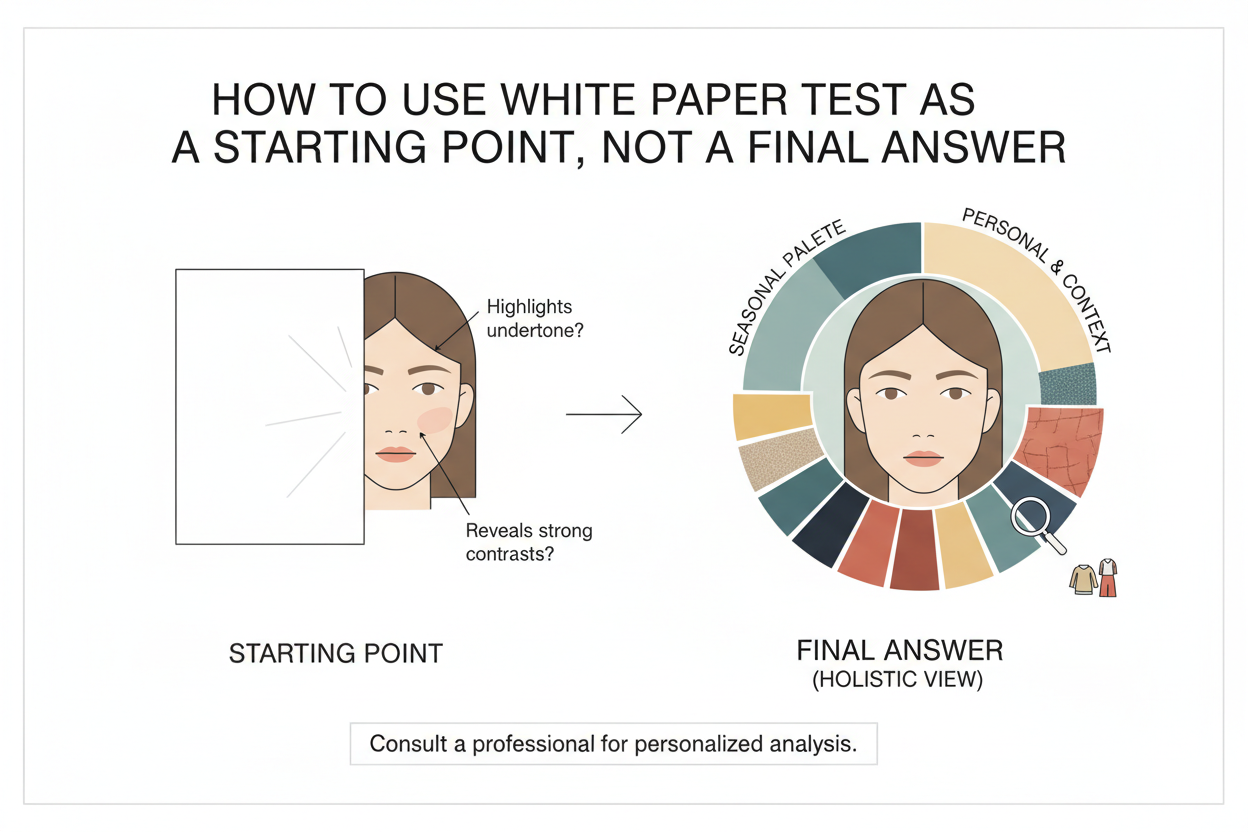
Step 1: Run the test under natural light. Do it at a window, with bare skin, using standard printer paper. Note your initial read: warm, cool, or genuinely uncertain.
Step 2: Cross-check with the vein test. Look at your inner wrist right after. If both tests agree, that's a meaningful signal. If they don't, treat yourself as potentially neutral — or at least hold the result loosely.
Step 3: Add a third data point. Try the jewelry test or the white-vs-cream clothing test. You're looking for agreement across methods, not a single conclusive answer.
Step 4: Use a structured quiz to confirm. At-home visual tests share the same core weakness: they depend on your ability to read subtle color differences under imperfect conditions. A structured quiz asks about multiple signals — vein color, sun reaction, which metals suit you, which colors make you look drained — and builds a profile from several independent inputs instead of one ambiguous comparison.
Once you have a clear undertone, product choices stop being guesswork. Picking a foundation, a blush, or a clothing palette becomes a matching process rather than a hoping process. That shift is worth the extra step.
The Vein Test vs. the White Paper Test: Which Is More Reliable?
Head-to-head, the vein test has a structural advantage for one reason: it's measuring something closer to the source.
Undertone is a hue that exists beneath the skin's surface layers. The white paper test asks you to detect that hue after it's been filtered through those layers and blended with surface pigment — a process that softens and obscures it. The vein test shows you a color that originates from beneath the skin. Blood doesn't have undertone in the makeup sense, but the way that color reads through your specific skin layers does reveal something about those layers' tints. Cool-toned skin filters vein color differently than warm-toned skin — which is why the same blue blood looks green through warm-toned skin and blue-purple through cool-toned skin.
The vein test is also less sensitive to lighting. The distinction between blue-purple and green is a categorical difference, not the subtle warm-vs-cool shift you're trying to read in the paper test. It's harder to misread.
The limitation: veins vary in prominence, and some people find the color genuinely ambiguous — especially those with neutral undertones, where a blue-green result is accurate but easy to call either way.
Use the vein test as your main cross-check when the white paper test gives you an unclear result. When both tests agree, that agreement actually means something. When they disagree, treat yourself as neutral or olive for now and test both warm and cool shades directly on your skin before buying anything.
People Also Ask
Does the white paper test actually work for finding skin undertone?
It works well enough to give you a starting direction — but only under the right conditions. The test can pick up a pronounced warm or cool undertone in natural daylight with bare skin. Where it falls apart is with neutral undertones, deeper complexions where surface signals are harder to read, and any lighting that isn't truly neutral. Treat it as a first filter, not a final answer. If the result is clear and a second test like the vein check confirms it, you can trust it. If it's ambiguous, that's actually useful information too: you might be neutral, or the conditions just weren't right.
How do you do the white paper test for undertone correctly?
Here are the steps for a reliable result:
- Remove all makeup — foundation, tinted moisturizer, bronzer, and concealer all interfere with the reading.
- Go to a window with natural daylight. Indirect light on an overcast day works best. Skip direct sunlight, incandescent bulbs, and fluorescent lighting — they all shift how you see color.
- Hold a plain, uncoated white sheet of paper next to your inner wrist or jawline.
- Look at the contrast. If your skin looks yellow, peachy, or golden against the white, your undertone is probably warm. If it reads pink, rosy, or slightly bluish, it's probably cool. If neither stands out, you may be neutral.
- Check against the vein test right away — inner wrist veins that look green suggest warm, blue-purple suggests cool — to see if both results line up.
What is the most accurate way to determine your skin undertone at home?
No single at-home test is definitive. Running several tests and looking for consistent results across them is far more reliable than relying on one method.
A useful combination:
- White paper test in natural daylight as a starting point
- Vein test on the inner wrist as a cross-check (green = warm, blue-purple = cool, blue-green = neutral)
- Jewelry test — gold tends to flatter warm undertones, silver cool, and both work for neutral
- Sun reaction — skin that tans easily tends toward warm; skin that burns first often skews cool
When three or more point the same direction, you can act on it. When they conflict, a quiz that pulls together multiple signals will give you a more grounded answer than any single visual test.
Can you have a different undertone than what the white paper test shows?
Yes, and it happens more often than people expect. The white paper test gives you a visual estimate based on subtle surface color — but several things can throw it off:
- Artificial lighting can push any skin tone warmer or cooler than it actually is
- Tanned or sun-exposed skin adds surface pigment that masks what's underneath
- Observer bias is real: if you're expecting a warm result, you're more likely to see one
- Paper quality varies — some printer paper has optical brighteners that shift it toward blue-white, which changes the reference point entirely
Your undertone lives in the pigment layers beneath the surface. One visual comparison can't always reach that deep, which is why it's worth cross-checking with other methods before deciding anything.
What is the difference between skin tone and undertone?
They describe two different aspects of the same surface.
Skin tone is the color you see on the surface of your skin — the fair, medium, tan, or deep classification that shifts with sun exposure, seasons, and age. It's what you notice immediately.
Undertone is a subtler hue that sits beneath those surface layers. It doesn't change with a tan or fade in winter. Think of skin as a layered painting: the top layers carry your visible skin tone, but the base coat — the undertone — shapes how every shade on top reads. That base hue falls into one of three categories: warm (yellow, golden, peachy), cool (pink, red, bluish), or neutral (a mix of both).
The key point is that skin tone and undertone are independent of each other. Two people with medium skin tone can have completely opposite undertones. That independence is exactly why matching surface color alone — picking a foundation that looks right in the bottle — so often fails in practice.
Why does my foundation look wrong even though I matched my skin color?
Foundation matching is actually two separate matches, not one. Most people nail the depth — how light or dark the shade is — and stop there. But if the undertone is off, the shade doesn't matter. It'll still look wrong.
A cool-toned foundation on warm skin reads ashy or gray. A warm-toned one on cool skin goes orange or muddy. The depth can be perfect and the color still clashes. This is also why the same foundation looks great on one person and strange on someone with nearly identical skin — undertone is the variable that's different.
Once you know yours, you can filter foundations before you even try them. Cool undertones: look for "pink," "rosy," or "porcelain." Warm undertones: "golden," "warm," or "honey." Neutral formulas are usually labeled that way. That one extra step cuts out most of the guesswork.
Frequently Asked Questions About the White Paper Undertone Test
Does the white paper test work for all skin tones, including deep and fair complexions?
It depends. For medium skin tones with a clear warm or cool lean, the test usually gives you something readable in decent light. For very fair skin, the difference between warm and cool can be subtle enough to miss if you're not sure what to look for. For deeper complexions, surface color tends to dominate visually, which can drown out the undertone signal the test is trying to pick up. At either extreme, combining the white paper test with the vein test and the jewelry test gives you a more reliable read than any one method on its own.
What type of lighting should I use when doing the white paper test?
Natural daylight is your only reliable option. Position yourself near a window on an overcast day — indirect daylight gives you a neutral light source that doesn't push your skin color in any particular direction. Avoid:
- Incandescent bulbs, which add warm, yellow-orange tones that make almost every skin look warmer than it is
- Fluorescent tubes, which cast a cool, greenish tint that skews readings the other way
- Direct sunlight, which bleaches out subtle color differences and varies too much to be consistent
If natural daylight isn't available, delay the test rather than accept a result taken under artificial light. A misread in bad lighting can send your foundation selection in entirely the wrong direction.
Can my undertone change over time or with sun exposure?
Your core undertone doesn't change — it's set by permanent pigment layers beneath the skin's surface and stays consistent regardless of season, age, or how much sun you've gotten over the years. What does change is your surface skin tone, which can temporarily mask your undertone after heavy tanning or sun damage.
This matters for testing: if you do the white paper test on heavily tanned skin, the extra surface pigment can make a cool or neutral undertone read as warm. For the most accurate result, test on skin that hasn't seen much recent sun. The inner wrist works well because it's usually less exposed than most other areas.
What if the white paper test and the vein test give me different results?
Conflicting results are actually useful information, not a sign you did something wrong. This usually comes down to one of two things:
- You may be neutral. Neutral undertones sit between warm and cool, so different tests can tip in opposite directions without either being wrong.
- One test was done in poor conditions. The white paper test is sensitive to lighting. If you ran it under artificial light, trust the vein test result instead.
When the two tests disagree, bring in a third: the jewelry test (does gold or silver look better against your skin?) or your sun history (do you tan easily, or burn first?). If most tests point the same direction, go with that. If they stay evenly split, neutral is a safe working assumption until you can test again in better conditions.
Is neutral undertone rare, and how do I know if I have it?
Neutral undertone isn't rare — it's just harder to spot because there's no strong pull in either direction. Signs you might be neutral:
- Both gold and silver jewelry look equally good on your skin
- Your veins look blue-green rather than clearly blue-purple or green
- The white paper test shows no obvious yellow or pink cast — your skin just looks like skin next to the paper
- Warm and cool foundation shades both work okay, but neither is quite right
Because neutral undertones don't announce themselves the way warm or cool ones do, people with neutral skin often go through a lot of foundation shades before finding one that works. If undertone tests keep giving you ambiguous results rather than wrong ones, that's probably neutrality — not a testing problem.
Why do some makeup shades make my skin look dull even when the color seems right?
Color and undertone are two separate things, and matching only one is exactly what creates this problem. A blush, bronzer, or lipstick can be the right depth for your skin and still have an undertone that clashes with yours underneath.
When undertones conflict — a cool-leaning product on warm skin, or the reverse — your skin reads as dull or muddy even though the shade looked fine in the package. This is the same thing that causes foundation mismatches, and it shows up across every product category. Once you know your undertone, use it to filter: warm undertones tend to work with peachy, golden, and terracotta shades; cool undertones with rose, berry, and taupe; neutral undertones have room to go either way.
How many undertone tests should I do before I trust the result?
Run at least three different tests before acting on a conclusion. One test — including the white paper test — has too many variables to be reliable on its own. A practical minimum:
- White paper test in natural daylight
- Vein test on the inner wrist in the same natural light
- Jewelry test — observe gold vs. silver against bare skin without makeup
If all three point to the same category, trust the result. If two align and one conflicts, go with the majority. If all three disagree or come back ambiguous, a structured quiz that combines multiple signals into a single profile will sort it out more reliably than repeating visual tests under the same imperfect conditions.