Undertone Test: Vein Test vs Jewelry Test
 Reviewed by Alexandra Gilmore
Veins and jewelry can disagree because one reflects anatomy and lighting while the other reflects color response, finish, and personal taste. Learn what each test actually measures, run both under better conditions, and settle conflicting results with controlled fabric or foundation comparisons near the face.

You've probably heard the advice before: flip your wrist over, look at your veins, and you'll know your undertone in seconds. Or maybe you've been told to hold a gold necklace next to your face, then swap it for silver, and see which one makes your complexion glow. Both pieces of advice are common, both are legitimate — and both can point in opposite directions on the same person.
💫 Discover Your Complete Color Palette
Ready to discover all the colors that make you look radiant? Our comprehensive color analysis will reveal your complete personal palette - perfect for hair, makeup, and wardrobe decisions.
Find My Color Palette →That disagreement isn't a flaw. It's actually useful information.
This article breaks down exactly how the undertone veins test works, how the jewelry test works, what each one is actually measuring, and — most importantly — what to do when the two results don't match. Along the way, you'll learn:
- Why skin undertone is a separate concept from surface skin tone
- How to read vein color accurately in natural light
- How to run a fair jewelry comparison
- Which test tends to give a cleaner signal first
- How to resolve a conflict between the two methods
- What a neutral undertone really looks like
- How to translate your result into practical choices for makeup, clothing, and accessories
Whether you're new to color analysis or you've tested yourself three times and still aren't sure, this guide gives you a clear, repeatable framework for landing on an answer you can actually use.
For the next diagnostic or service-choice step, continue with the companion article “A Guide to Eye Colors: What Makes Eyes Warm or Cool?”, which keeps the two closely related questions distinct.
📚 Recent Articles
What Skin Undertone Means and Why People Mix It Up With Skin Tone
Your skin has two layers of color happening at once. The surface tone — the shade you'd describe as fair, medium, or deep — changes when you tan, flush, or spend a winter indoors. Undertone is different. It's the subtle hue sitting beneath that surface, and it stays relatively constant no matter how your skin looks from season to season.
That distinction matters because undertone, not surface tone, is what determines whether certain colors make you look vibrant or washed out. Two people can share the same surface shade and have completely opposite undertones — one warm, one cool — which is why the same foundation or shirt can look entirely different on each of them.
Most people work with three categories:
- Warm — a golden, peachy, or yellow-leaning base
- Cool — a pink, red, or bluish base
- Neutral — a mix of both, without a strong pull in either direction
Confusing surface tone with undertone is the main reason people reach for colors that technically match their skin but still feel slightly off. Getting your undertone right is what makes a color choice look like it was meant to be there.
How the Vein Test Works
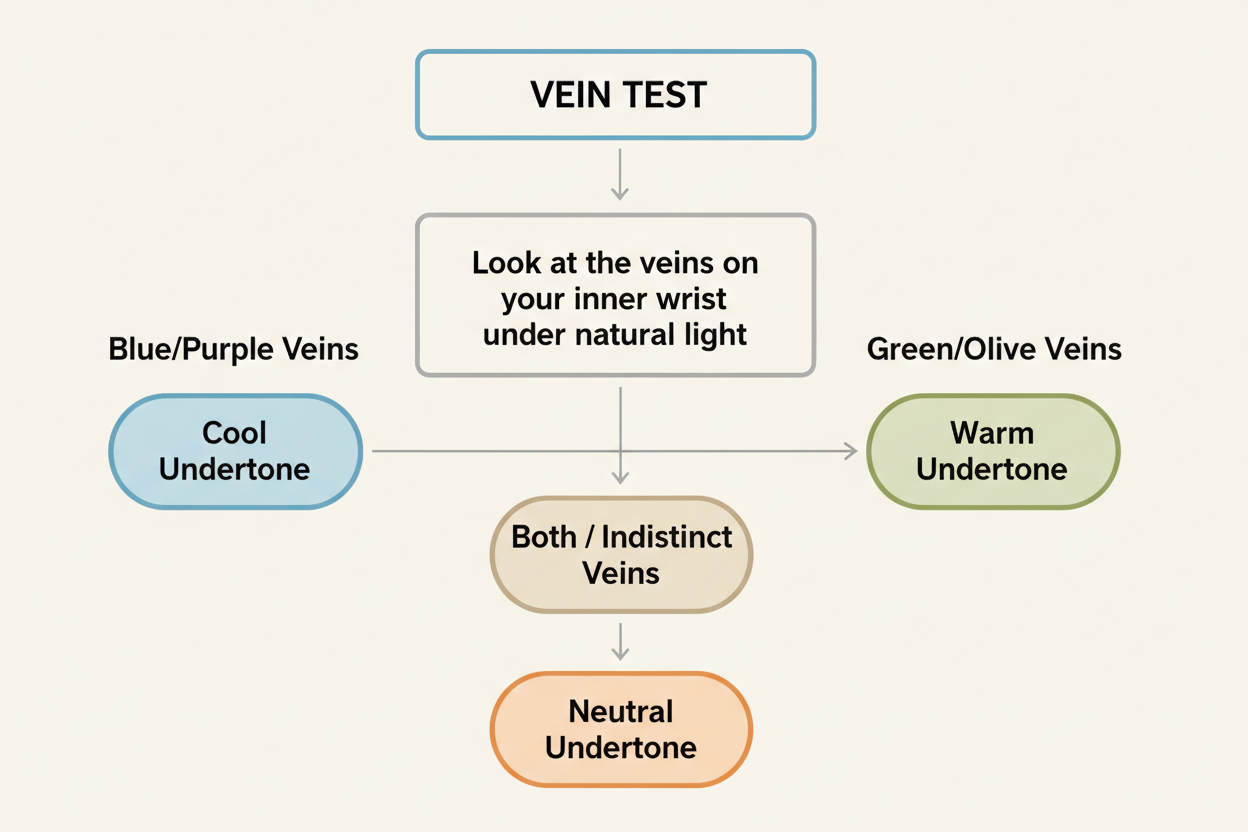
The vein test is one of the most common starting points, and the setup is simple. In natural daylight — not warm indoor lighting, which distorts what you see — look at the veins on the inside of your wrist against bare, makeup-free skin.
What you're looking for:
- Bluish or purple veins tend to indicate a cooler undertone
- Greenish veins tend to indicate a warmer undertone
- A mix of both, or difficulty distinguishing often points toward neutral
Your veins aren't actually different colors in different people. What you're seeing is how your skin's underlying pigment filters the light reflected back from the blood vessels beneath. That's also why the test has limits — if the light source is off, or your skin has a heavy surface tan, the result can shift.
Run this test near a window during the day on a clean face, and give it a few seconds rather than glancing once and moving on.
How the Jewelry Test Works
Hold a piece of silver metal and a piece of gold metal against your skin — the jawline or inner wrist works well — and see which one makes your complexion look more alive.
The general pattern:
- Silver tends to flatter cooler undertones — the cool metal harmonizes with pink or bluish undertones in the skin
- Gold tends to flatter warmer undertones — the warm metal complements yellow or peachy undertones
Most people find this easier than interpreting vein color because the reaction is immediate and visual. That said, it's not foolproof. Lighting, the specific shade of the metal, what you're wearing, and personal taste can all skew what you see. It's also worth noting that the test shows what looks harmonious, not what you prefer — those aren't the same thing.
For a clean read: use plain metal without gemstones, hold it directly against bare skin, and check in natural light rather than under warm bathroom bulbs.
Vein Test vs Jewelry Test: Which Gives Better Signal First
Neither test is clearly better — they just work differently.
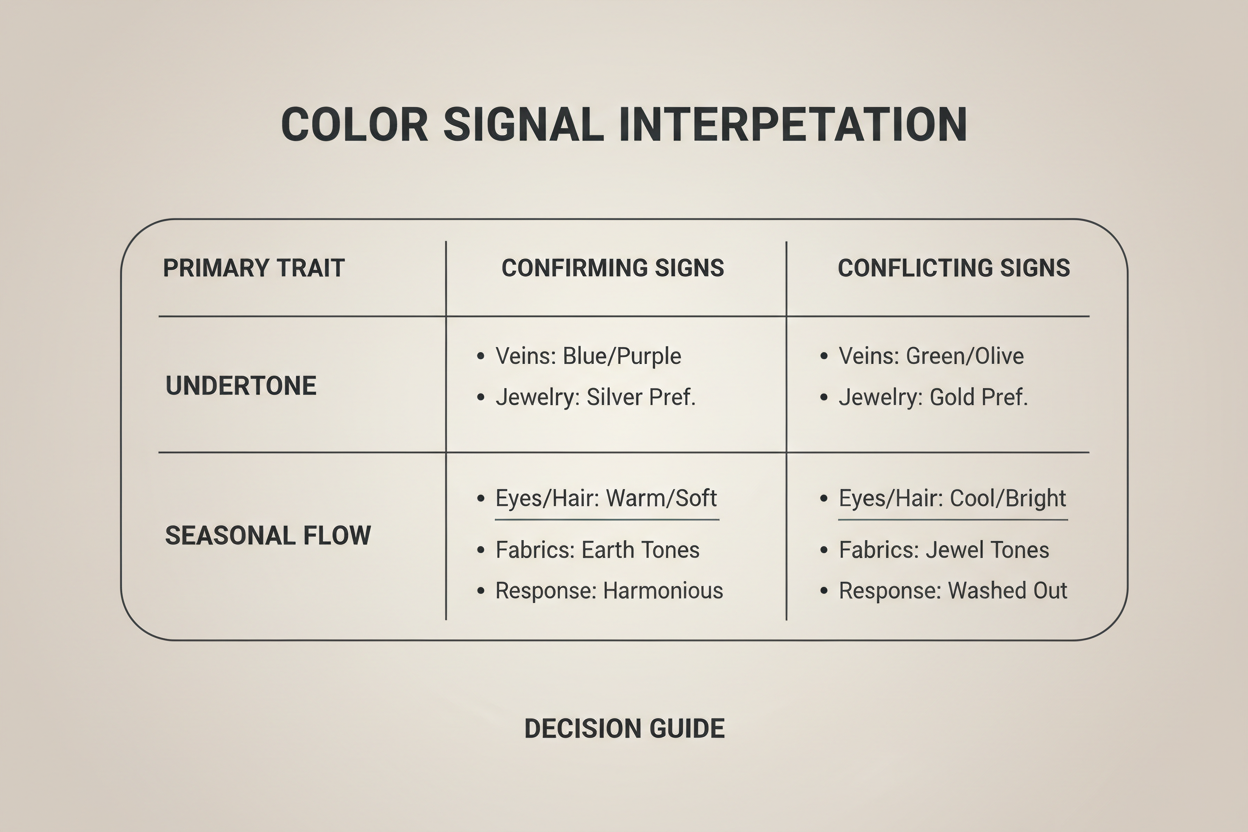
The vein test is a reasonable starting point because it requires nothing and gives you something fairly objective to look at. You're observing a physical characteristic, not making a judgment call about what looks good.
The jewelry test works well as a follow-up because it's immediate and visual. Holding warm versus cool metal next to your skin can make an abstract idea — "I'm warm-toned" — click into place.
In practice:
| Test | Strength | Weakness |
|---|---|---|
| Vein test | Quick, no materials needed | Lighting and skin tone can obscure results |
| Jewelry test | Visual and intuitive | Subjective; affected by lighting and metal quality |
If both tests point the same way, you have a reasonably confident read. Greenish veins plus warm metals looking better on your skin is a consistent warm signal. You can move forward with that.
Still not sure? A color analysis quiz that reads your actual complexion can cut through the guesswork fast. [Try the color analysis quiz →]
What to Check Next if the Two Tests Disagree
Disagreement between the vein test and the jewelry test is common. It doesn't mean you did something wrong. It usually means you need a couple more reference points before landing on an answer.
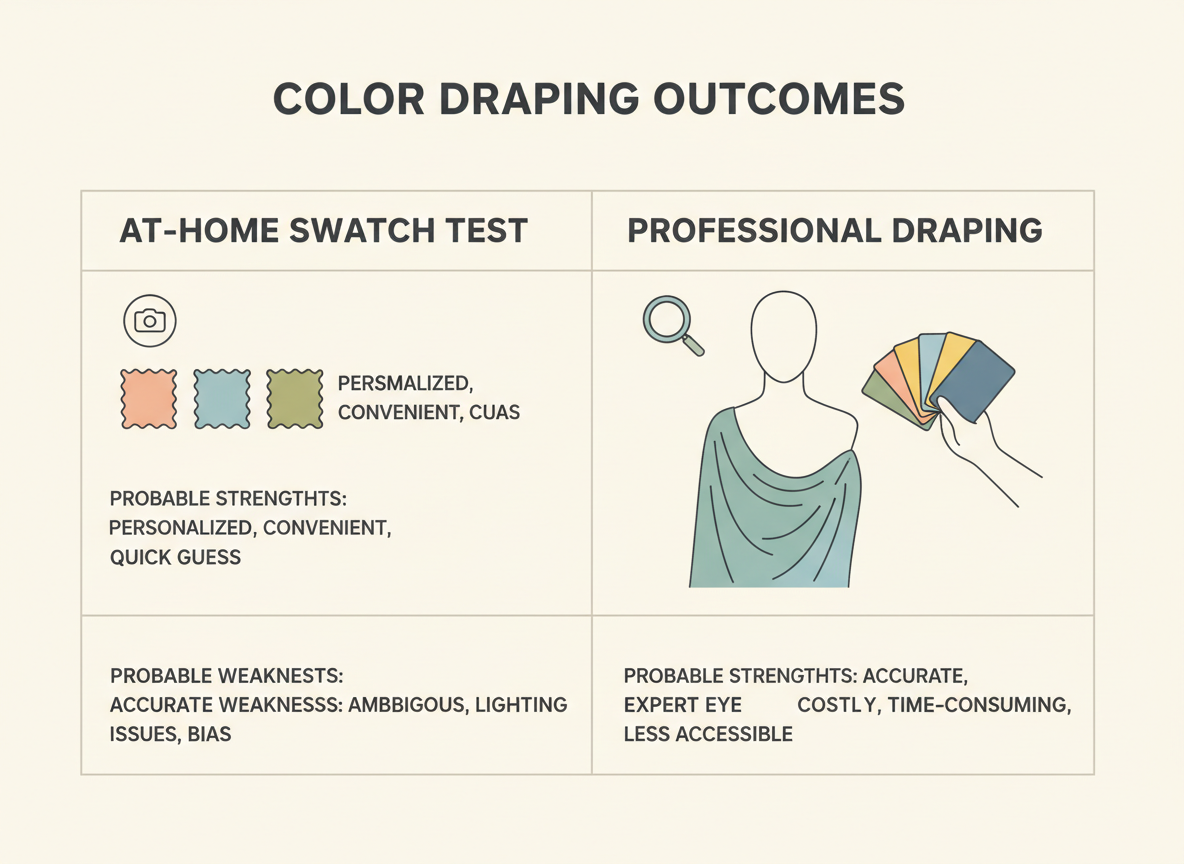
The white-paper test is the easiest next step. Hold a plain white sheet next to your bare face in natural light and look at the contrast. If your skin looks yellower or more golden against the white, that leans warm. If it reads more pink or rosy, that leans cool. If you genuinely can't tell — if your skin just looks like skin — neutral is a real option, not a cop-out.
Your sun response can help when visual tests still feel murky. People who tend to burn before they tan often run cooler; people who tan without much trouble often run warmer. It's not precise, but as one more data point it can break a tie.
The basic idea: no single test settles it. Using several signals together is what makes the result worth anything.
If you've done three or four checks and they're still pointing in different directions, a guided color analysis can help — it looks at combinations of features rather than asking you to isolate one thing at a time. [Start your color analysis →]
Signs You Might Be Neutral Rather Than Clearly Warm or Cool
Neutral is a real result, not a sign you couldn't figure it out. Some people genuinely sit between warm and cool, and the tests tend to reflect that ambiguity rather than resolve it.
A few things that point toward neutral:
- Your veins look blue-green rather than clearly one or the other
- Both gold and silver jewelry look fine on you, with neither creating a strong contrast
- The white-paper test doesn't pull noticeably in either direction
- You can wear colors from both warm and cool palettes without either looking obviously off
If your undertone is neutral, you'll probably have more flexibility than most — a broader range of shades tends to work without obvious clashes. The downside is that the tests designed to give you a clear answer often feel inconclusive. If that matches your experience, neutral is probably the right call rather than forcing a warm or cool label that doesn't quite fit.
How to Use the Result in Makeup, Clothing, and Jewelry Choices
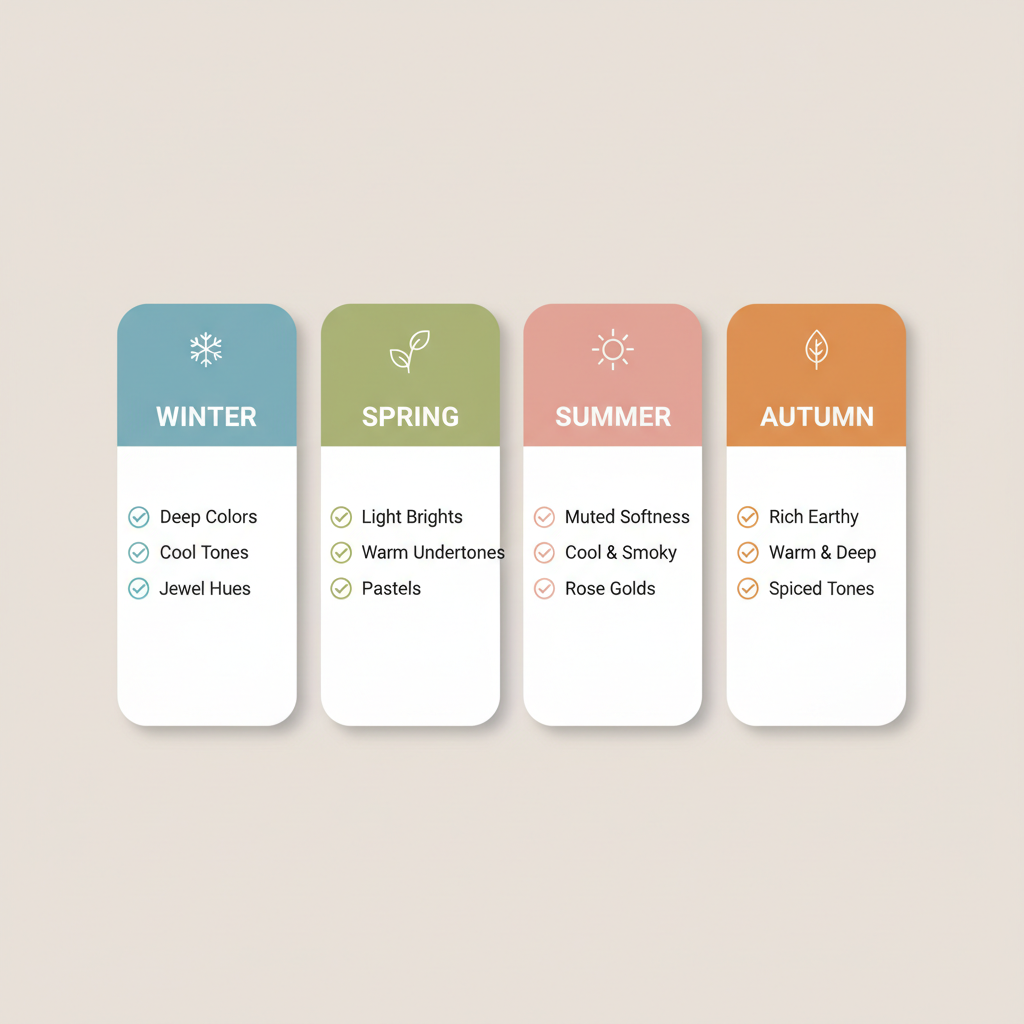
Knowing your undertone changes how you shop — not by narrowing your options, but by giving you a filter for what consistently works.
Makeup:
- Warm undertones tend to work with yellow or golden-base foundations, bronzers, and peachy blushes
- Cool undertones usually do better with pink-base foundations, berry tones, and rosy blushes
- Neutral undertones can pull from both
Clothing:
- Warm undertones are generally flattered by earthy tones: terracotta, olive, mustard, warm browns
- Cool undertones tend to look sharper in jewel tones, navy, cool grays, and true whites
- Neutral undertones often work across both palettes, though individual preferences still vary
Jewelry:
- Warm undertones tend to look most natural with gold, brass, and copper
- Cool undertones tend to suit silver, white gold, and platinum
- Neutral undertones can wear either
Undertone findings don't restrict what you can wear. They just explain why some choices feel effortless and others need more work to land right. Once you know yours, you're making informed choices instead of guessing.
Ready to go further? A full color analysis gives you a complete picture — not just warm, cool, or neutral, but the specific palette that works with your coloring. [Start your full color analysis →]
People Also Ask
Are blue veins always a cool undertone?
Not always. Blue veins are a strong signal toward cool undertones, but they aren't a guarantee on their own.
The vein test works by observing how your skin's underlying pigment filters light reflected from blood vessels beneath the surface. When that filter runs pink or bluish, veins tend to appear more blue or purple. So the logic holds most of the time.
Where it gets complicated:
- Lighting conditions can shift the apparent color of your veins significantly. Warm indoor bulbs can make blue veins read more purple; harsh white light can do the opposite.
- Surface tan or deeper skin tones can make vein color harder to read, sometimes making blue veins appear closer to blue-green.
- Blue-green veins — where you can see both colors depending on the angle — often point toward neutral rather than a definitive cool.
The safest approach is to treat blue veins as one data point rather than the final answer. If other tests — the jewelry test, the white-paper test — also point cool, your confidence goes up. If the jewelry test sends a different signal, you probably need another reference point before settling.
What if silver and gold both look good on me?
That's actually useful information rather than a failed test. It suggests you may have a neutral undertone.
People with strongly warm undertones tend to find that gold adds warmth and life to their complexion, while silver can make them look slightly washed out. For strongly cool undertones, the pattern flips: silver harmonizes easily while gold can clash. When both metals look balanced against your skin without either pulling clearly ahead, that even response is a characteristic pattern for neutral undertones.
A few things to check if you're in this situation:
- Look at degree, not just direction. Even if both metals work, one might still look slightly more natural. A subtle edge counts.
- Cross-reference with your veins. If your veins read blue-green rather than clearly one color, that's another neutral indicator pointing the same direction.
- Consider your palette flexibility. Neutral undertones typically tolerate both warm and cool clothing colors without either looking obviously wrong — a broader pattern that tends to confirm what the jewelry test showed.
If the signals from multiple tests consistently land somewhere in the middle, neutral is a valid and complete answer, not a sign that the tests failed to work.
FAQ
Should I do undertone tests in daylight or indoor light?
Natural daylight is strongly preferred. Artificial lighting — especially warm incandescent bulbs or cool fluorescent strips — shifts how colors read on your skin, and can make your vein color, or how a metal sits against your wrist, look noticeably different from what it actually is.
A few practical things to keep in mind:
- Sit near a window during the day, ideally when the sun isn't casting a strong directional shadow across your arm or face.
- Remove makeup first. Foundation and concealer change the surface color your eye is reading, which can throw off both the vein test and any skin-against-paper comparison.
- Skip golden-hour light. Late afternoon sun warms everything up and can push readings in the warm direction even on clearly cool skin.
If natural light isn't available, a neutral daylight-balanced bulb works as a fallback — just treat the result with a bit more skepticism and cross-reference with a second test before landing on a conclusion.
Can one undertone test settle the answer on its own?
Sometimes, but not reliably. A single test can point you in a useful direction, and if your undertones are clearly warm or clearly cool, one strong signal is often enough to feel confident. For everyone else — especially those who land near neutral — one method is more likely to leave you uncertain or nudge you the wrong way.
The more practical approach:
- Use the vein test as a starting point, then confirm with the jewelry test or a white-paper comparison.
- Look for agreement across tests. When two or three methods point the same direction, you can trust the result a lot more.
- Treat disagreement as information. If the vein test says warm and the jewelry test says cool, that tension probably means neutral or near-neutral — not that the tests failed.
No single test is perfectly reliable. Lighting, skin depth, and individual variation all introduce noise. Running a few methods together gives you a more honest picture than any one signal can.