Seasonal Color Analysis Quiz: How Accurate Is It
 Reviewed by Alexandra Gilmore
A seasonal quiz is only as reliable as its questions, your lighting, and the clues you can judge accurately about yourself. Learn which quiz designs deserve more trust, how photo and self-report errors enter the result, and how to verify a proposed palette before spending.

A seasonal color analysis quiz promises something genuinely useful: a fast, free shortcut to the palette of colors that make your skin glow, your eyes pop, and your wardrobe finally feel coherent. Millions of people take one every year. But how much should you actually trust the result?
💫 Discover Your Complete Color Palette
Ready to discover all the colors that make you look radiant? Our comprehensive color analysis will reveal your complete personal palette - perfect for hair, makeup, and wardrobe decisions.
Take Color Analysis Quiz →The honest answer is: it depends on the quiz and how you use it.
Seasonal color analysis itself is not a new idea. Its modern roots trace back to 19th-century color theory, and the framework has been refined ever since—most recently into a 12-season system that maps your natural coloring across three dimensions: hue (warm vs. cool), value (light vs. deep), and chroma (muted vs. bright). A well-designed quiz tries to compress that three-axis assessment into a handful of questions about your skin, hair, and eyes.
The result can be surprisingly good—or confidently wrong. Here is what shapes that gap:
- Quiz design matters more than quiz length. A short quiz built on sound undertone logic can outperform a longer one that asks vague or visually dependent questions.
- Self-reported data introduces noise. Figuring out your own seasonal color palette is genuinely difficult without training, which means the answers you type in are only as accurate as your self-perception.
- Borderline seasons are the quiz's weakest point. When your coloring sits between two adjacent seasons, a single-question difference can flip the result entirely.
This article breaks down exactly how a seasonal color analysis quiz works, where the methodology holds up, where it struggles, and what you can do right now to get a more reliable answer—whether that means refining your quiz approach or knowing when a professional consultation is worth the investment.
For the next diagnostic or service-choice step, continue with the companion article “Color Season Quiz With a Photo: How Reliable Is It?”, which keeps the two closely related questions distinct.
📚 Recent Articles
What a Seasonal Color Analysis Quiz Actually Does
A seasonal color analysis quiz is a structured substitute for physical color draping. In a real consultation, an analyst holds fabric swatches against your face and watches how your skin, eyes, and shadows respond. A quiz replaces that with self-reported descriptions of the same three inputs: skin tone, hair shade, and eye color.
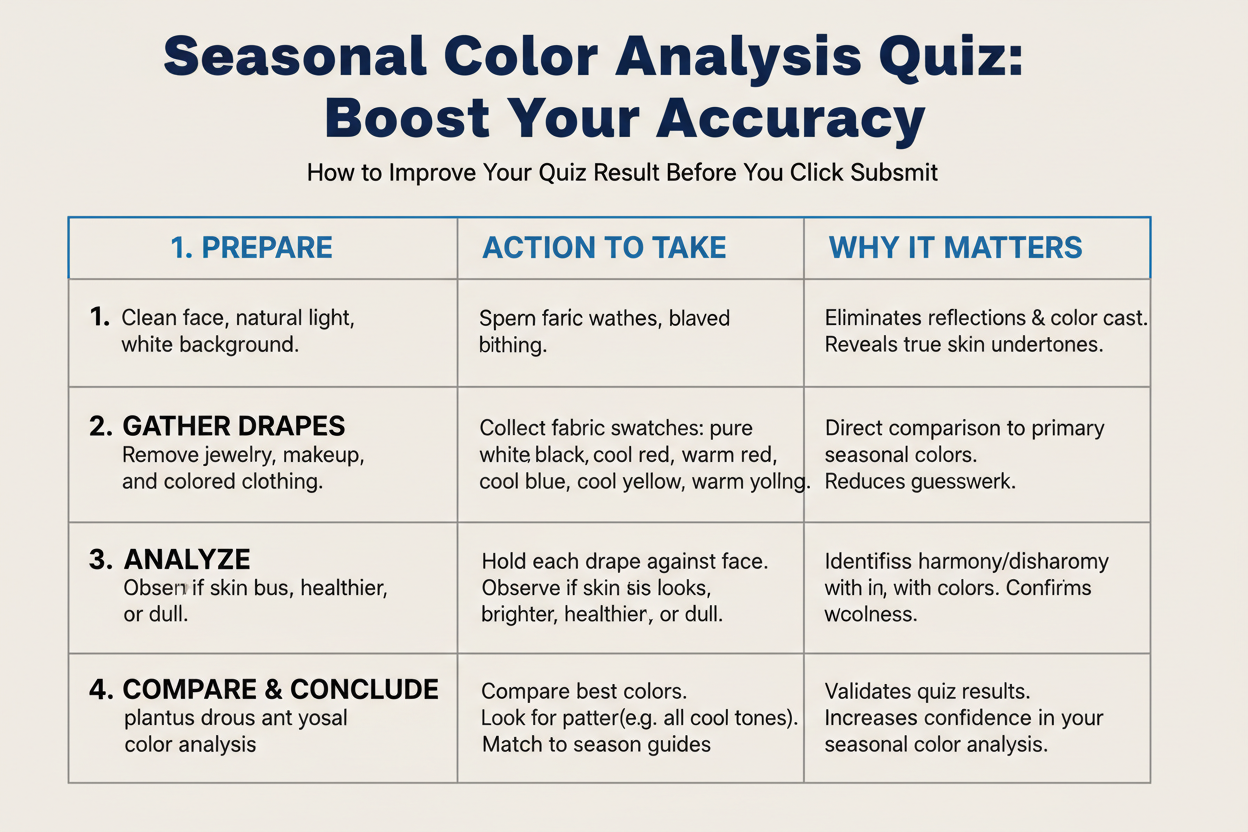
Your answers get mapped against a decision tree that routes you toward one of the seasonal palettes. No drapes, no controlled lighting. The logic is the same as an in-person session; the data quality depends entirely on how accurately you describe yourself.
That's worth keeping in mind when you read your result. For most people it's enough to get useful guidance, but knowing how the mechanism works helps you judge whether your result deserves confidence or a second look.
The 12-Season System the Quiz Is Built On
Color analysis isn't a recent lifestyle trend. The modern understanding of how colors work with human coloring goes back to 19th-century color theory, and practitioners have been refising the system ever since. Today's most complete version organizes human coloring into 12 distinct seasonal types rather than the original four.
The four base seasons—Spring, Summer, Autumn, Winter—each split into three sub-seasons, giving you 12 types total. Each type is defined by a specific combination of three characteristics:
- Hue: whether your overall coloring reads as warm, cool, or neutral
- Value: whether your coloring is relatively light or deep
- Chroma: whether your coloring is clear and high-contrast or soft and muted
A quiz that covers all three axes has a much stronger theoretical foundation than one that only asks about skin tone or lumps everyone into four broad buckets.
Cool, Warm, and Neutral: The Three Undertone Roots
Every one of the 12 seasons branches from a single first-level split: undertone. Your coloring is primarily cool, primarily warm, or neutral—sitting somewhere between the two poles. That three-way division is what the entire seasonal map is built on.
Cool seasons (True Summer, Soft Summer, Light Summer; True Winter, Bright Winter, Dark Winter) are anchored by blue, pink, and ashy undertones. Warm seasons (True Spring, Light Spring, Bright Spring; True Autumn, Soft Autumn, Dark Autumn) are anchored by yellow, peach, and golden undertones. Neutral seasons borrow from both sides without committing fully to either.
Getting this first-level call right is, by far, the most important step in any color analysis—quiz or professional.
How Undertone Sequencing Determines Quiz Accuracy
Professional color analysts tackle undertone first, and for good reason: the draping evidence on that one question eliminates half the seasonal map immediately. One viewer who attended a professional draping session described the moment a warm drape touched the client's skin—the reaction was immediate and unmistakable, the unflattering result confirming a cool undertone by contrast alone.
Quizzes that mirror this logic—leading with undertone questions before asking about value or chroma—follow the same filtering sequence a trained analyst uses. That ordering is why undertone identification is the single biggest accuracy lever in any quiz.
Quizzes that skip undertone, bury it mid-survey, or phrase it badly introduce the most error. If a quiz asks you to pick your "skin color" from a generic palette of five squares without first establishing whether you read as cool or warm, whatever season it assigns you is built on a shaky foundation.
Before you answer a single quiz question, you should already have a working hypothesis about your undertone. The section below on natural-light assessment explains how to build that hypothesis in under five minutes.
Where Quizzes Get It Right
If your coloring falls clearly within one season rather than on the border between two, a well-designed quiz is genuinely useful. A few things quizzes do well:
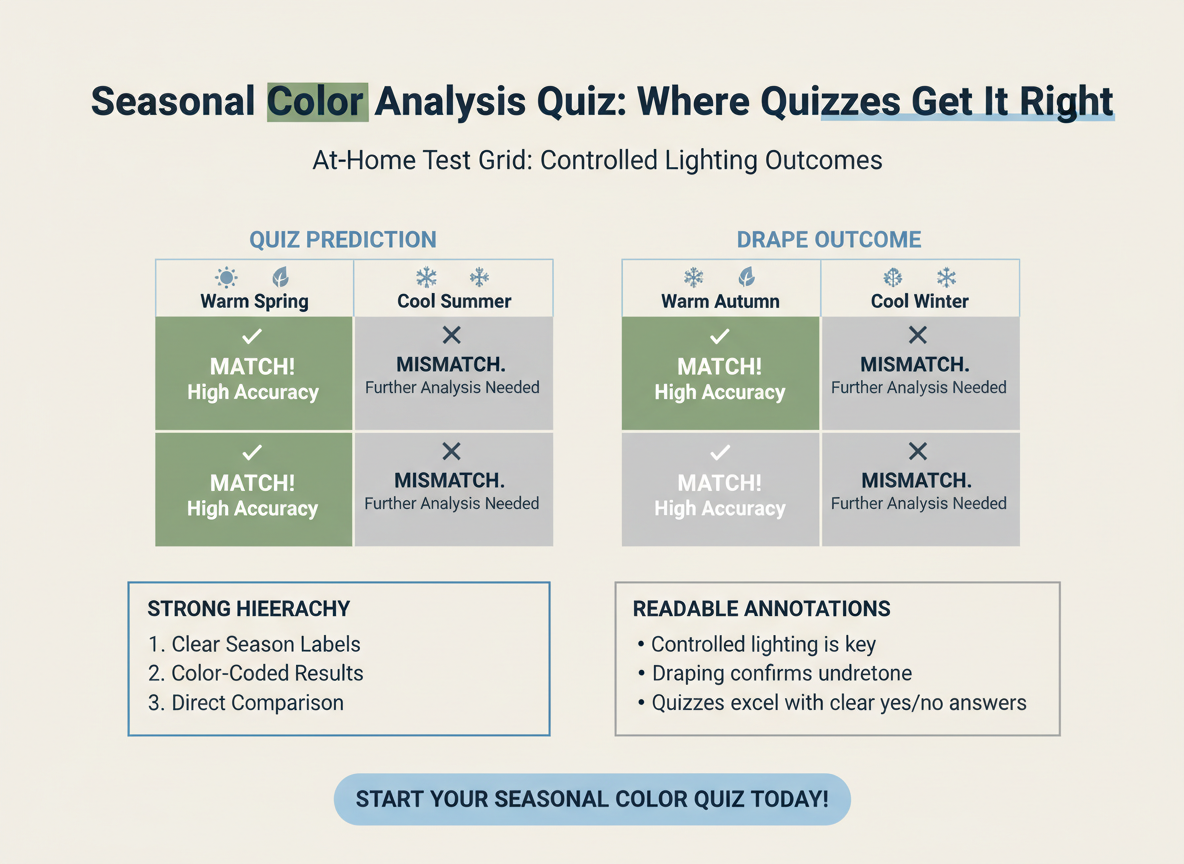
- Speed. A good quiz can sort your coloring in minutes—far faster than scheduling a professional appointment.
- Palette specificity. Rather than returning a vague "you look good in blues," a 12-season quiz maps your result to a curated set of flattering hues based on your skin tone, hair shade, and eye color together, not any single feature in isolation.
- Accessibility. A quiz makes color analysis available to anyone regardless of geography or budget.
- Stability. Seasonal color results are grounded in the fixed characteristics of your natural coloring, not trend cycles, so the output stays relevant year after year.
If your undertone, value, and chroma all point in the same direction without much ambiguity, a quiz result is often accurate enough to use directly for wardrobe and makeup decisions.
Where Quizzes Fall Short: The Borderline-Season Problem
Here's a telling scenario: a trained color analyst, trying to determine a friend's season, got stuck between two adjacent seasons and didn't have her physical drapes with her. She turned to a quiz as a tiebreaker.
That moment reveals the ceiling. Even someone with professional training and years of experience couldn't resolve a borderline case through observation alone. A quiz has the same problem—it also lacks draping data.
Adjacent seasons like Soft Autumn and Soft Summer, or Bright Spring and Bright Winter, share a lot of surface characteristics. Similar undertones, similar value ranges. The difference is usually subtle enough that only side-by-side draping makes it visible.
In borderline cases, a quiz isn't so much wrong as it is a coin flip between two plausible answers. If both seasons produce flattering results for you, the quiz did its job. If one palette consistently feels slightly off, that's the borderline telling you something.
How to Improve Your Quiz Result Before You Click Submit
The most impactful thing you can do before taking a seasonal color analysis quiz is improve the quality of the data you are about to enter. Quiz accuracy is directly proportional to the accuracy of your self-description.
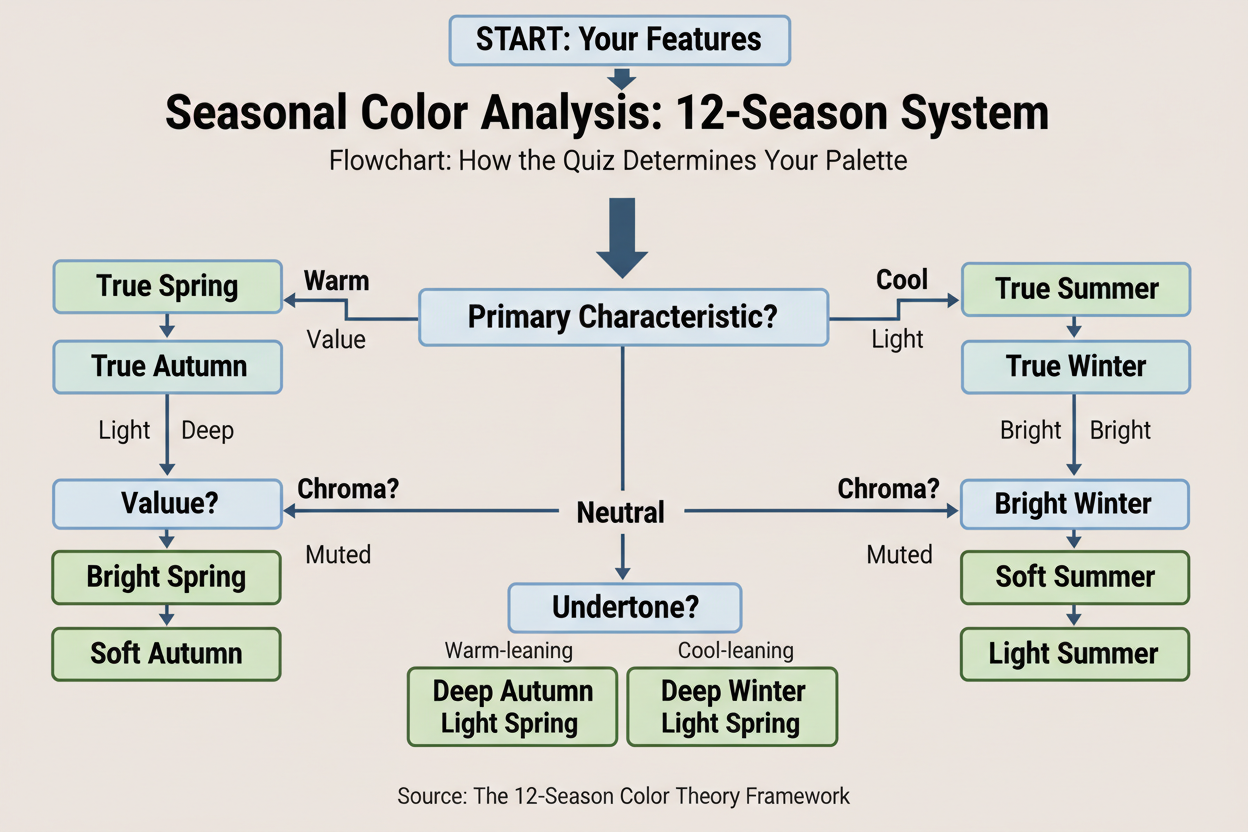
Three preparation steps make a measurable difference:
- Identify your undertone independently first. Figure out whether you lean cool, warm, or neutral before the quiz asks. The natural-light method below is the most reliable way to do this on your own.
- Describe your natural coloring, not your current coloring. If your hair is dyed, try to recall or reference your natural shade. Color analysis is calibrated to your unaltered coloring.
- Look at your features together, not in isolation. Your season comes from how your skin tone, hair shade, and eye color interact as a system. Avoid fixating on one feature—a lot of people over-index on skin tone and underweight hair and eye color.
The Natural-Light Rule for Self-Assessment
Artificial lighting distorts color perception in ways that are easy to miss. Incandescent bulbs push everything warm. Fluorescent tubes can add a green or cool cast. Indoor LEDs vary all over the place. A feature you assess under artificial light may look like it has a completely different undertone than it actually does.
The fix is simple: assess your skin, hair, and eyes near a window in diffused natural daylight before you take the quiz. Not direct sunlight—that creates harsh shadows and blows out color—but indirect outdoor light. Check the vein color on the inside of your wrist, the tone of your jawline against a white background, the true color of your hair roots at the scalp. Note what you see, then bring those observations into your answers.
This one step removes the most common source of self-reported error and meaningfully raises the chance your result reflects your actual seasonal coloring.
Quiz vs. Professional Color Analysis: Which Do You Need?
For most people, a seasonal color analysis quiz is the right starting point—not a consolation prize. It's fast, costs nothing, and gets close enough to guide real decisions for anyone whose coloring clearly falls within one season.
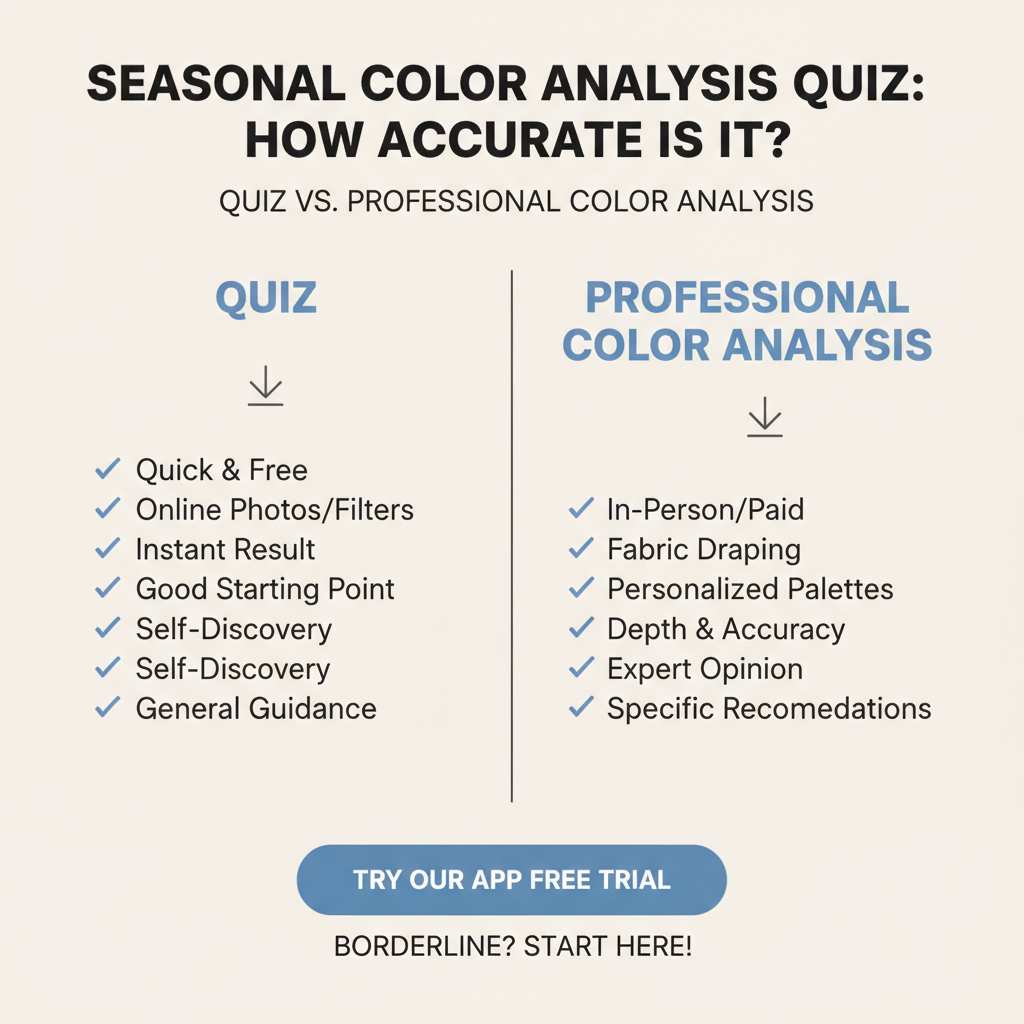
The case for professional analysis gets more compelling in specific situations:
| Situation | Quiz likely sufficient | Professional analysis worth considering |
|---|---|---|
| Coloring feels clearly warm or clearly cool | ✓ | |
| Quiz result feels immediately "right" when you test it | ✓ | |
| Two or three different quizzes return the same season | ✓ | |
| Quizzes consistently split between two adjacent seasons | ✓ | |
| Quiz result feels flattering in theory but wrong in practice | ✓ | |
| You want a verified, permanent reference palette | ✓ |
Think of the quiz as the right first move: it narrows 12 possibilities down to one or two and gives you something to test against. If testing confirms it, you're done. If it doesn't—especially if you keep gravitating toward colors from a neighboring season—that's the sign that physical draping would sort out what a self-reported quiz can't.
People Also Ask
How accurate is a seasonal color analysis quiz compared to a professional?
For most people, a well-designed quiz is meaningfully accurate—but it has a ceiling.
When your coloring falls clearly within one season, a quiz that sequences undertone questions first will usually land on the same result a professional analyst would. The underlying logic is the same: assess hue, value, and chroma, then map the combination to a seasonal palette.
The gap shows up at the edges. A professional uses physical draping—holding fabric swatches against your face under controlled lighting—to catch subtle differences that self-reported answers miss. If your coloring sits between two adjacent seasons, that physical evidence is often what resolves it. A quiz can't replicate that.
A rough benchmark: if two or three different quizzes keep returning the same season, that's a reasonable sign they're right. If they split across adjacent seasons, a professional draping session is probably worth it.
Can a color analysis quiz work for men?
Yes. Seasonal color analysis works from physical traits—skin undertone, hair depth, eye color—that have nothing to do with gender. The seasonal map is the same for everyone.
There's at least one account of a quiz being used this way: an experienced color analyst described using one to help pin down a male friend's season when physical drapes weren't available. It came down to two candidate seasons, and the quiz broke the tie.
The main challenge for men is the same as for anyone: honest self-assessment. If you've never thought about your skin undertone or natural hair shade before, some of the terminology might feel unfamiliar. But the questions are answerable—just find a window with decent natural light and take a few minutes with it.
What is the difference between the 4-season and 12-season color analysis systems?
The original system grouped all human coloring into four broad categories named after the seasons—Spring, Summer, Autumn, and Winter. Each category captured a general combination of warmth and lightness but left a lot of variation inside each bucket.
The 12-season system refines this by splitting each base season into three sub-seasons, giving you 12 distinct types total. The split runs along two additional axes:
- Value: whether your coloring is lighter or deeper within its season
- Chroma: whether your coloring is clear and high-contrast or soft and muted
So a 12-season quiz can tell the difference between, say, a Soft Summer (cool, muted, medium depth) and a True Summer (cool, slightly more saturated, lighter), rather than lumping both into a single "Summer" bucket.
In practice, the 12-season result is more useful. A 4-season result points you in a general direction; a 12-season result tells you which specific shades within that direction actually work for you.
How do I find my undertone before taking a seasonal color quiz?
Undertone is the most important input in any seasonal color analysis quiz, so knowing it before you start will improve your result. A few methods work well when you do them in diffused natural light near a window:
- Vein check: Look at the veins on the inside of your wrist. Blue or purple suggests cool; green suggests warm; a mix suggests neutral.
- White paper test: Hold a plain white sheet next to your bare jawline. Skin that looks pinkish or rosy against it tends cool. Skin that looks yellowish or peachy tends warm. If neither reads clearly, you may be neutral.
- Jewelry test: Think about whether gold or silver jewelry tends to make your skin look better. Gold = warm lean; silver = cool lean; both work equally = neutral.
Do this before you open the quiz and note what you see. Going in with a clear undertone hypothesis cuts down on the most common source of error.
What happens if my quiz result puts me between two seasons?
A split result—where two adjacent seasons score nearly the same, or where both palettes feel equally right—isn't a failure. It's useful information.
Adjacent seasons share real characteristics. Soft Autumn and Soft Summer, for instance, are both muted and medium in depth. The difference is undertone warmth, and for people with neutral or borderline coloring that distinction can be genuinely hard to see. The quiz is picking up on something real.
When this happens:
- Test both palettes in practice. Hold fabric in each season's key colors against your face in natural light. See which one makes your skin look clearer and more even.
- Take the undertone question seriously. Cool vs. warm is the variable most likely to separate two adjacent seasons. Go back to your undertone assessment and look at it with fresh eyes.
- Consider a professional draping session. Physical drapes side-by-side are designed exactly for cases that self-reported answers can't resolve. If you want a definitive answer rather than a working hypothesis, that's the right next step.
In practice, adjacent palettes overlap enough that both usually produce flattering results. A borderline result is rarely a real problem.
FAQ
How accurate is a seasonal color analysis quiz?
Pretty accurate for most people, especially if your coloring falls clearly into one season. Quizzes that ask about undertone first, then depth and contrast, tend to get it right more often because they follow the same logic a professional analyst uses.
Accuracy gets shakier in two situations:
- Borderline coloring: If your features sit between two adjacent seasons, self-reported descriptions often lack the detail needed to tell them apart reliably.
- Inconsistent self-assessment: Answering under artificial lighting or based on dyed rather than natural hair color introduces errors the quiz can't fix.
A quick confidence check: if two or three different quizzes return the same season independently, that's a good sign the result is accurate.
Can I use a seasonal color analysis quiz if I have neutral undertones?
Yes, but expect some uncertainty. Neutral undertones put your skin close to the warm/cool boundary—which is exactly where many adjacent seasons split—so quizzes will sometimes land you on one side when you might fit equally well on the other.
Most well-designed quizzes include a neutral undertone option and route those answers toward seasons that handle mixed undertones well, like True Summer or True Autumn. If your quiz forces a binary warm/cool choice with no middle ground, don't weight that answer too heavily. Pull up the palette for a neighboring season and compare the two before you settle on one.
What is the difference between a 4-season and a 12-season color analysis quiz?
The original 4-season system places everyone into one of four broad categories—Spring, Summer, Autumn, or Winter—each capturing a general mix of warmth and depth. It's a useful starting point, but there's a lot of variation within each group that it doesn't account for.
The 12-season system splits each base season into three sub-types, distinguished by:
- Value: lighter or deeper coloring within the season
- Chroma: clearer and more saturated versus softer and more muted
That extra precision matters. A 4-season quiz might tell you "Summer." A 12-season quiz tells you whether you're a Soft Summer, True Summer, or Light Summer—three genuinely different palettes with different optimal shades. When you're actually shopping or building a wardrobe, that distinction is what makes the result usable.
Why do different quizzes give me different seasonal color results?
A few things cause this:
- Different question frameworks: Some quizzes weight undertone most heavily; others prioritize contrast level or value. How questions are sequenced and weighted changes the output.
- System differences: A quiz built on the 4-season model returns broader categories than one built on the 12-season model, and the two don't map cleanly onto each other.
- Subjective input variation: Self-descriptions of hair, eye, and skin color are imprecise. Small differences in how you answer the same question on two different days can push a borderline result either way.
If your results are genuinely inconsistent rather than just toggling between two adjacent seasons, check your undertone assessment under natural daylight—that's the most common culprit.
Is a seasonal color analysis quiz reliable enough to use for shopping decisions?
For most people, yes—with reasonable expectations. A quiz gives you a directional palette: a set of hue families, value ranges, and chroma levels that tend to be flattering. That's enough to avoid obvious mismatches and narrow your options when shopping.
Where it falls short:
- Specific shade decisions within a palette still benefit from trying things on in person.
- If your result lands at a seasonal boundary, the palette guidance still holds but may need cross-referencing with the adjacent season.
Think of it as a well-informed starting point, not a final answer. Most people find it noticeably improves their shopping decisions even without professional follow-up.
How long does a seasonal color analysis quiz take?
Most online quizzes take three to ten minutes. Four-season versions tend to be shorter, usually five to ten questions about undertone, hair, and eye color. Twelve-season quizzes add questions about contrast and chroma, which takes a bit longer.
The preparation often takes more time than the quiz itself. Checking your undertone and natural coloring in daylight before you start adds a few minutes, but it makes a real difference in how accurate your answers are.
When should I see a professional color analyst instead of relying on a quiz?
A professional draping session is worth it in three situations:
- Consistent borderline results: Multiple quizzes keep splitting between two adjacent seasons and testing palettes yourself hasn't settled it. Physical drapes under controlled lighting will.
- High-stakes wardrobe investment: Building a capsule wardrobe, buying formalwear, or making other significant clothing purchases. A professional result reduces costly mistakes.
- Unusual or complex coloring: High-contrast features, significant warm-cool mixing, or coloring that doesn't fit standard descriptions cleanly. These are exactly the cases where self-reported quiz answers fall short and a trained analyst can observe what you can't.
For everyday guidance, a carefully taken quiz is a solid starting point. Professional analysis is the step for what a quiz, by design, can't resolve.