
Undertone Test for Fair Skin
 Reviewed by Alexandra Gilmore
Fair skin makes veins and redness highly visible, but that visibility can produce a false undertone answer under changing light. Use a controlled daylight protocol to separate stable warm, cool, neutral, or olive direction from flushing, freckles, translucency, and the color cast of your surroundings.

Fair skin can make undertone tests look obvious and confusing at the same time. Veins are often easier to see, redness shows quickly, and a small change in light can make the same face look pink, yellow, gray, or almost transparent. That is why the best undertone test for fair skin is not one shortcut. It is a controlled daylight protocol that separates stable undertone from temporary surface color.
The goal is simple: read how your skin responds when the conditions stay consistent. You are not trying to diagnose your skin, choose a base product, or build a full wardrobe in one sitting. You are testing whether your fair skin leans cool, warm, neutral, or olive when redness, freckles, translucency, makeup, and indoor light are not allowed to take over the result.
💫 Discover Your Complete Color Palette
Ready to discover all the colors that make you look radiant? Our comprehensive color analysis will reveal your complete personal palette - perfect for hair, makeup, and wardrobe decisions.
Find My Color Palette →Key Takeaways
- Fair skin often shows veins, redness, and freckles clearly, but those surface signals do not always equal undertone.
- Test in indirect daylight near a window, with no makeup, no self-tanner, and no strong colored walls reflecting onto your face.
- Use at least three checks: white vs cream, silver vs gold, pink vs peach, and a jaw-to-neck comparison.
- Redness is surface color, not undertone. Freckles can sit on top of any undertone. Translucency makes veins easier to see, but vein color still needs confirmation.
- After you find a likely undertone, confirm it with pale/fair terminology and clothing guides instead of turning this page into a generic palette list.
📚 Recent Articles
What Makes Fair-Skin Undertone Tests Tricky
Fair skin usually sits in the lightest visible skin-depth range, but skin depth and undertone are different. Depth tells you how light or deep the skin appears. Undertone tells you the stable color direction underneath the surface: cool pink-blue, warm peach-yellow, balanced neutral, or sometimes a muted olive cast.
The tricky part is that fair skin has less visual depth to buffer surface changes. A warm bathroom bulb can make you look yellow. A cold phone screen can make you look blue. Flushing, rosacea-prone redness, recent sun exposure, or a new skincare active can make cool undertones look stronger than they really are. Freckles can add warmth even when the skin underneath is cool or neutral.
For terminology, it helps to separate this page from broader pale-skin guides. If you are not sure whether your issue is fair depth, temporary paleness, or undertone, start with Pale vs Fair Skin: What's the Difference?. For color choices after the test, use Best Colors for Pale Skin or Best Colors for Pale Skin: Undertones, Contrast, and Outfits.
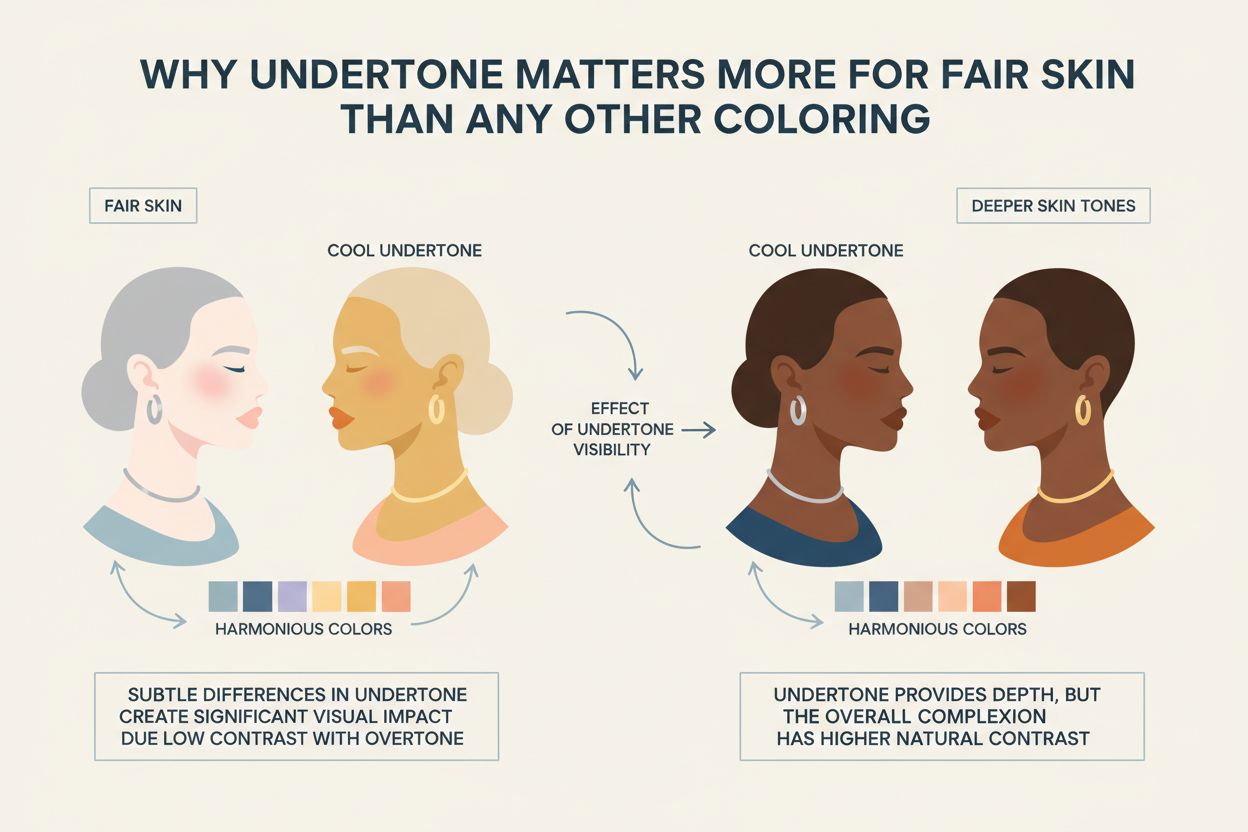
Medical skin classifications are not the same as color-analysis undertone. DermNet's Fitzpatrick skin phototype describes how skin responds to sun exposure, and it places pale and fair skin in the lighter phototypes. That can explain why fair skin burns easily, but it does not tell you whether your wardrobe should lean cool, warm, neutral, or olive.
Controlled Daylight Protocol for Fair Skin
Before judging any test, set up the room. Stand near a window in indirect daylight, not direct sun. Direct sun creates glare, sharp shadows, and heat-related redness. Indoor bulbs are worse because warm bulbs add yellow and cool bulbs add blue. If the light changes during the test, pause and repeat it another day.
Remove makeup from the jaw, neck, and collarbone. Wait at least twenty minutes after washing your face so cleanser, exfoliation, or rubbing does not leave temporary redness. Pull hair away from your face, cover bright clothing with a neutral towel, and keep colored curtains or walls out of the reflection. Fair skin is reflective enough that a red sweater or green bathroom wall can shift what you see.
| Control | Why it matters on fair skin | What to do |
|---|---|---|
| Indirect daylight | Prevents yellow bulbs and blue screens from changing the read | Face a window with the sun not hitting your skin directly |
| Bare jaw and neck | Foundation and concealer hide the most useful comparison area | Test after skincare has settled and before makeup |
| Neutral surroundings | Fair skin picks up reflected color easily | Use a white, gray, or oatmeal towel over bright clothes |
| Same timing | Flushing and sun exposure can change surface tone | Repeat at the same time of day if results are mixed |
Take one neutral reference photo only if your camera does not auto-correct the colors heavily. The mirror matters more than the photo. Phone cameras often cool down redness or warm up shadows, so use photos as notes, not proof.
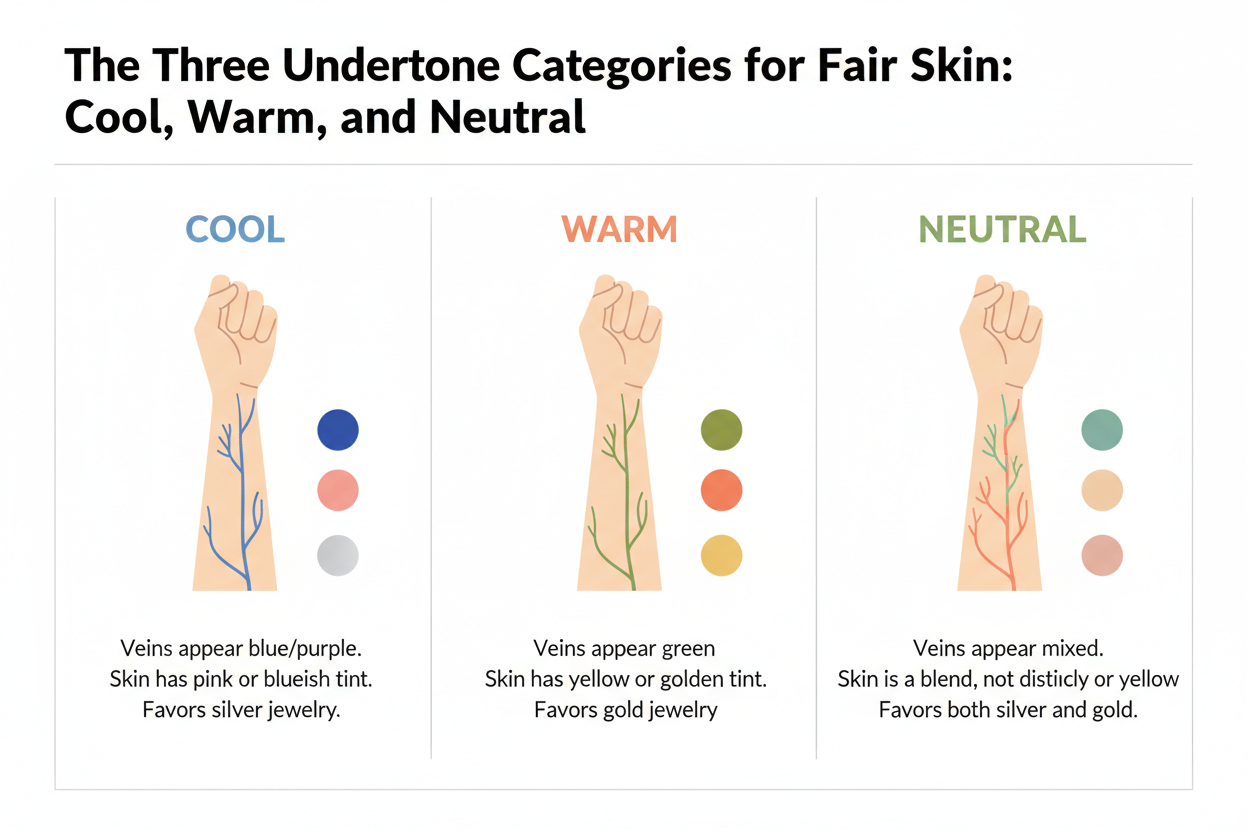
How to Read Cool, Warm, Neutral, and Olive Signals
A cool fair undertone usually looks clearer next to blue-based white, soft gray, cool pink, berry, silver, and blue-red. The face tends to look more even, and shadows around the mouth or eyes look less yellow. Cool does not mean the skin is always visibly pink. It means cool colors make the skin look calmer and more defined.
A warm fair undertone usually looks easier next to ivory, cream, peach, camel, soft coral, gold, and yellow-red. The face looks less gray and less stark. Warm does not mean orange, tan, or deeply golden. On fair skin, warmth can be very quiet: more ivory-peach than bronze.
A neutral fair undertone sits between the two. Pure white and cream may both work, silver and gold may both be acceptable, and the best colors are often softened rather than strongly cool or warm. The sign is not that everything works. It is that extreme coolness or extreme warmth both start to look separate from the face.
Olive fair skin is more muted and can look beige, green-gray, or slightly shadowed even when the skin is light. If your cool tests and warm tests both feel wrong, compare with Pale Skin Warm vs Cool Undertone before deciding you are simply neutral.
Redness, Freckles, and Translucency: What to Ignore
Redness is surface color, not undertone. It may come from flushing, sensitivity, irritation, exercise, temperature, or skin conditions. A fair face can look pink across the cheeks and still have warm or neutral undertones at the neck. That is why the jaw-to-neck check matters. If your cheeks are red but your neck looks ivory, peach, or olive, do not let the cheeks decide the whole test.
Freckles can sit on top of any undertone. Golden freckles may make fair skin look warm from a distance, but the skin between the freckles may still respond better to cool colors. The opposite can happen too: a cool-looking fair face with strawberry or copper freckles may still need warmth in cream, peach, or soft coral. Look at the background skin, not only the freckle color.
Translucency makes veins easier to see. That is useful, but it can also make the vein test too loud. Blue veins through very thin fair skin do not automatically prove a cool undertone. Greenish veins can appear when blue veins sit under yellowish surface tone. Treat veins as one clue, then check fabrics and metals.
Sun response is also separate from undertone. The FDA notes that fair-skinned people may absorb more solar energy under the same conditions, and the American Academy of Dermatology keeps a separate sun-safety and sunscreen education resource. That matters for skin care and burn risk. It does not decide whether cream or pure white flatters you more.
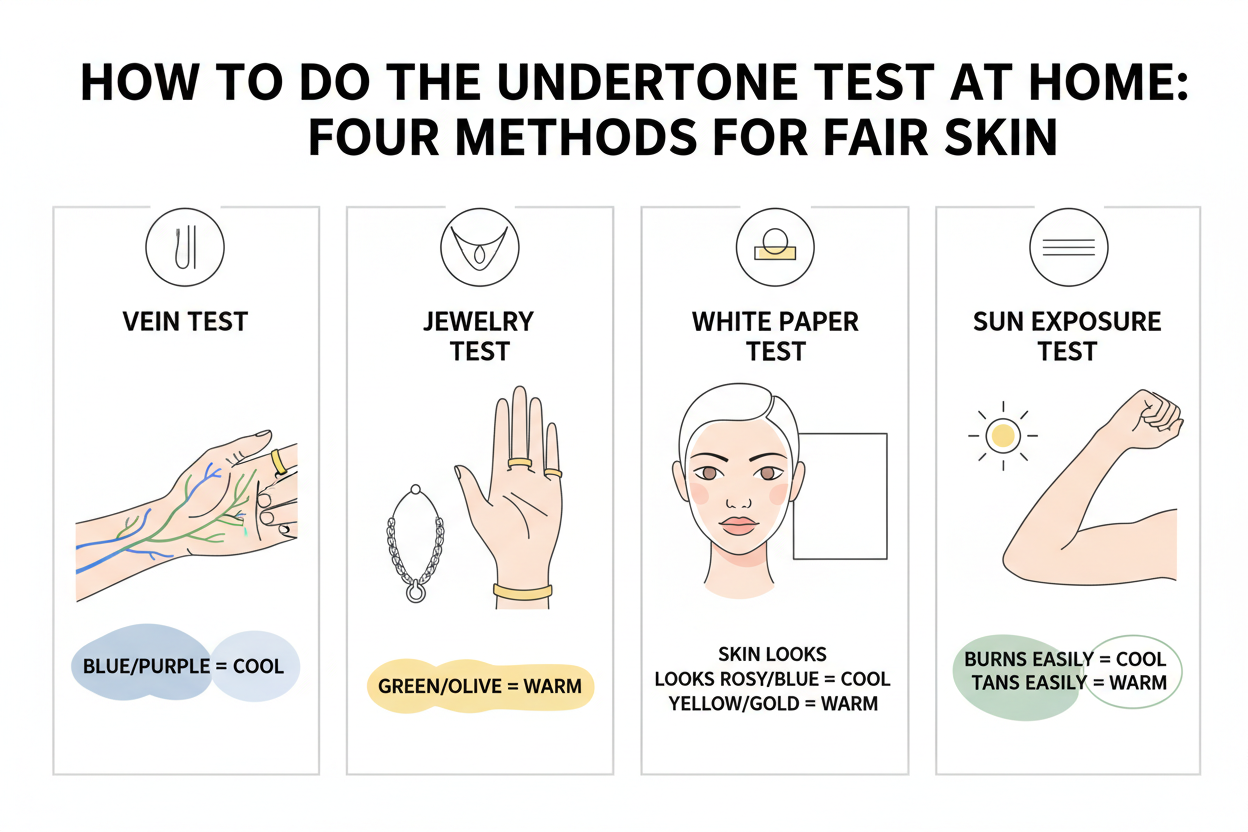
Four Tests That Work Better on Fair Skin
Run these tests in one session, then repeat any confusing result another day. You are looking for repeated patterns, not a dramatic reveal.
1. White vs cream drape
Hold clean white fabric under your chin, then replace it with cream or ivory. If white makes your skin look even and awake while cream adds yellow or heaviness, you likely lean cool. If cream softens the face while white looks chalky, gray, or severe, you likely lean warm. If both are wearable but neither is excellent, keep neutral or olive in the running.
2. Silver vs gold metal check
Hold silver and yellow gold near the collarbone, not only on the wrist. Cool fair skin usually looks smoother with silver. Warm fair skin usually looks healthier with gold. Neutral fair skin may handle both. If both metals look too bright, test brushed metal rather than shiny metal, because high shine can overpower fair coloring.
3. Pink vs peach fabric check
Compare a cool pink with a soft peach. Do not use neon pink or orange, because saturation can confuse the result. Cool fair undertones usually look clearer next to cool pink. Warm fair undertones usually look easier next to peach. Neutral undertones may prefer dusty rose, muted coral, or another middle shade.
4. Jaw-to-neck check
Look at the jaw, neck, and collarbone together. The face may have redness, freckles, or sun exposure, but the neck often shows the more stable undertone. If the face says pink and the neck says yellow, test again after redness settles. If the jaw and neck both lean the same way, the result is more dependable.
| Result pattern | Likely direction | Next confirmation |
|---|---|---|
| White, silver, and cool pink all calm the skin | Cool fair undertone | Try soft gray, berry, navy, and blue-red near the face |
| Cream, gold, and peach all make the face look less stark | Warm fair undertone | Try ivory, camel, soft coral, and warm rose |
| Both sides work, but strong extremes look separate | Neutral fair undertone | Try softened neutrals, rose beige, taupe, and balanced blues |
| Cool and warm both look slightly off or too bright | Possible fair olive | Try muted teal, mushroom, soft khaki, and complex neutrals |
How to Check Your Result Against Clothes and Foundation
Once you have a likely undertone, test it with real choices. For clothing, stay close to the face. A scarf, T-shirt, or open shirt tells you more than trousers. Cool fair skin should usually look clearer in pure white, blue-red, soft gray, and cool rose than in cream, orange, or yellow beige. Warm fair skin should usually look softer in ivory, peach, camel, and warm coral than in icy white or blue-pink.
Use clothing guides for the next step rather than expanding this test into a full palette page. Start with pale-skin clothing color guide if you want a quick wardrobe filter, or the more detailed pale-skin color guide if you need contrast and outfit examples.
For makeup or base products, check the jaw and neck. A foundation undertone can look right on the cheek and wrong at the neck because redness is stronger on the face. If your concern is specifically fair skin with redness, use Foundation for Fair Skin with Red Undertones. This article only gives the undertone-testing logic; it is not a product catalog.
When Your Undertone Result Still Looks Mixed
Mixed results are normal on fair skin. If veins look blue, cream looks good, and silver looks harsh, the problem may be surface redness, freckles, muted olive coloring, or contrast level rather than undertone alone. Repeat the protocol on a calm-skin day and compare the jaw, neck, and collarbone before changing your conclusion.
If you are between cool and neutral, avoid the extremes first: icy white, harsh black, orange, and yellow beige. If you are between warm and neutral, avoid overly blue pinks, cold grays, neon shades, and stark white until you have a clearer pattern. If olive is possible, muted and complex colors will usually beat both pastel cools and bright warms.
The useful result is not a label for its own sake. It is a filter that makes shopping and makeup choices less random. A fair-skin undertone test should leave you with two or three reliable comparisons you can repeat: white versus cream, silver versus gold, and pink versus peach. If those comparisons keep pointing the same way, you have enough information to move on to a seasonal analysis or personal palette.
People Also Ask
What is the best undertone test for fair skin?
The best test is a controlled daylight comparison, not one shortcut. Use indirect daylight, bare skin, neutral surroundings, and compare white vs cream, silver vs gold, and cool pink vs peach. Fair skin changes quickly under colored light, so stable conditions matter more than the specific object you hold up first.
Why does my fair skin look pink even if warm colors suit me?
Your cheeks may be showing surface redness. Redness is surface color, not undertone. Check the jaw, neck, and collarbone after your skin has settled. If cream, gold, and peach make those areas look more even, you may have a warm or neutral undertone even with pink cheeks.
Do freckles mean I have warm undertones?
No. Freckles can sit on top of any undertone. They may make the skin look warmer from a distance, but the background skin may still be cool, neutral, warm, or olive. Test fabric response, not only freckle color.
Are visible blue veins proof of cool undertones?
No. Translucency makes veins easier to see on fair skin, so blue veins can look stronger than they would on deeper skin. Use the vein test as one clue, then confirm with fabric and metal tests.
Common Questions: The Ultimate Color FAQ
Can fair skin have olive undertones?
Yes. Fair olive skin can look muted, beige-gray, or slightly green around the mouth and neck. It is often mistaken for neutral because neither cool pink nor warm peach feels fully right. If both white and cream seem a little wrong, test muted teal, mushroom, soft khaki, and complex taupe before settling on neutral.
Should I test my undertone on my face or wrist?
Use both, but trust the jaw-to-neck area more. The wrist is useful for veins, while the face shows how colors affect your overall appearance. The neck and collarbone help balance the two because they usually have less redness and less makeup than the face.
Can my undertone change?
Your underlying undertone is usually stable, but surface tone changes with sun exposure, irritation, tanning products, health, and skincare. If your result seems different from month to month, repeat the test in the same daylight setup and compare areas with less surface change.
What should I do after I find my undertone?
Use the result as a starting filter. Cool fair skin can begin with pure white, soft gray, cool pink, berry, and navy. Warm fair skin can begin with ivory, peach, camel, warm rose, and soft coral. Neutral and olive fair skin need more testing around muted, balanced, or complex colors. For a broader next step, take the color analysis quiz and compare the result with your at-home observations.