Undertone Test for Dark Skin
 Reviewed by Alexandra Gilmore
Standard undertone advice often relies on signals that are hard to read or misleading on deep complexions. Compare equal-depth foundation bases, fabrics, and metals under stable light to identify warm, cool, or neutral direction, then use the result for makeup and clothing rather than skin depth alone.

Two women with identical skin tones can wear the same shade of black and get completely opposite results — one looks radiant, the other washed out. The difference almost always comes down to undertone, that subtle layer of warm, cool, or neutral hue sitting beneath the surface of your complexion.
💫 Discover Your Complete Color Palette
Ready to discover all the colors that make you look radiant? Our comprehensive color analysis will reveal your complete personal palette - perfect for hair, makeup, and wardrobe decisions.
Find My Color Palette →Knowing your undertone is the foundation for choosing everything from foundation and concealer to the colors you wear closest to your face. But here is the problem: the most popular shortcut — checking the color of your wrist veins — was largely developed with lighter complexions in mind, and it loses accuracy on deeper skin tones.
What you will find in this guide:
- A plain-language explanation of why the vein test is harder to read on dark skin
- A step-by-step method for doing it as accurately as possible
- Three backup tests that cross-check your result
- A practical breakdown of what warm, cool, and neutral undertones look like on deeper complexions
- Guidance on when a digital color analysis tool is the smarter choice
The core premise here is simple: no single test gives you a definitive answer on dark skin. Relying on veins alone is the fastest route to a misread result and a wardrobe or makeup bag full of shades that fight your natural coloring rather than enhance it. Running two or three short tests and comparing the outcomes is the approach that consistently works — and every method in this guide can be done at home in under ten minutes.
📚 Recent Articles
What Undertone Actually Means for Dark Skin
Surface skin tone and undertone are two different things, and mixing them up is the root cause of most color-matching mistakes.
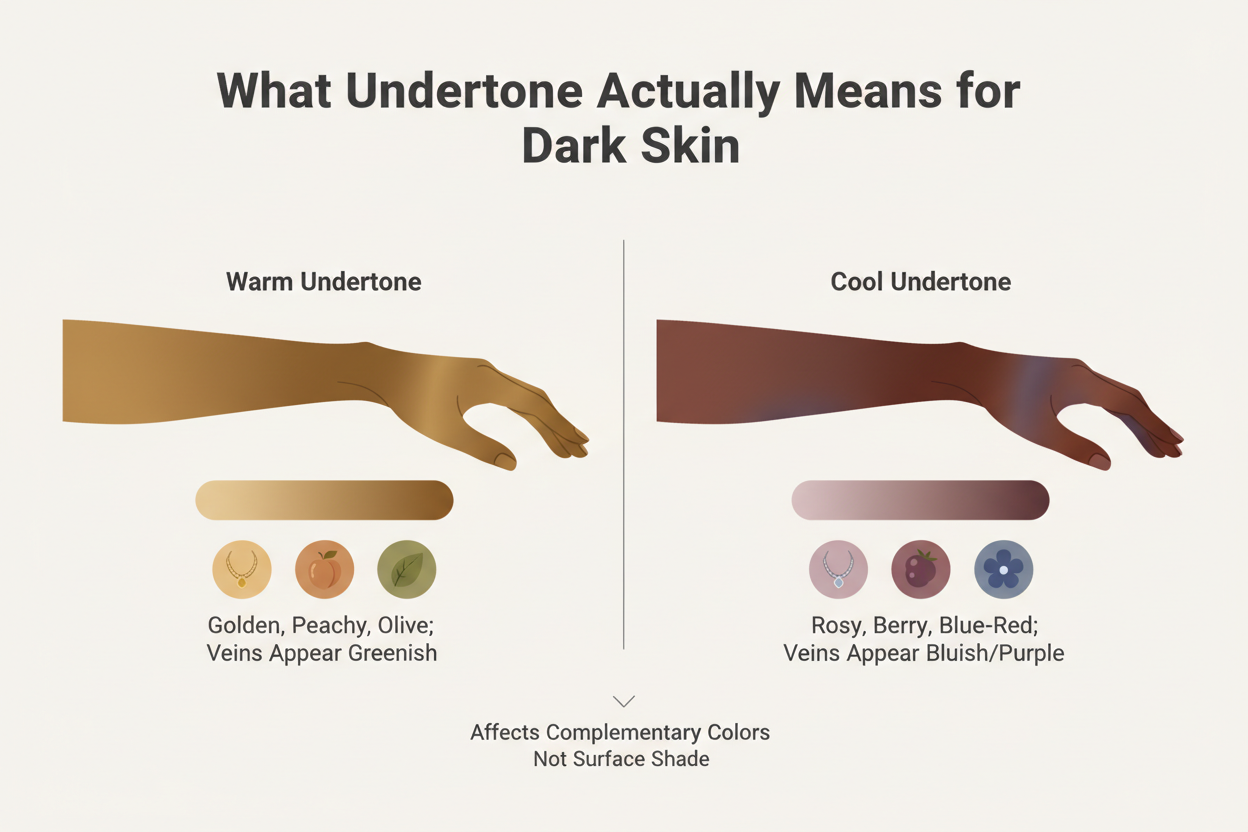
Surface tone is what you see directly — the depth and richness of your complexion. Undertone is the subtle hue sitting beneath that surface, quietly shaping how every color you wear reads against your face.
Three categories:
- Warm — yellow, golden, or peachy undertones
- Cool — pink, red, or bluish undertones
- Neutral — a balance of both, with no single hue dominating
The key point for anyone with a deep or dark complexion: undertone has nothing to do with how dark your skin is. A rich, deep complexion can carry warm, cool, or neutral undertones just as easily as a fair one. Your surface tone can be very deep while your undertone runs definitively cool. Or your complexion can be medium-deep with a strong warm pull. The two dimensions don't affect each other.
This is why two people with nearly identical skin tones can respond completely differently to the same color. One finds black sharp and flattering; the other finds it draining. Same surface tone, different undertone — and that difference is the whole story.
Once you know your undertone, the rest follows: you can build your clothing, makeup, and accessory choices around colors that work with your personal coloring instead of against it.
Why the Standard Vein Test Is Harder to Read on Deeper Skin
The vein test works on one basic premise: the color of your veins through the skin reflects your undertone. Blue-purple means cool, green means warm, and a mix means neutral.
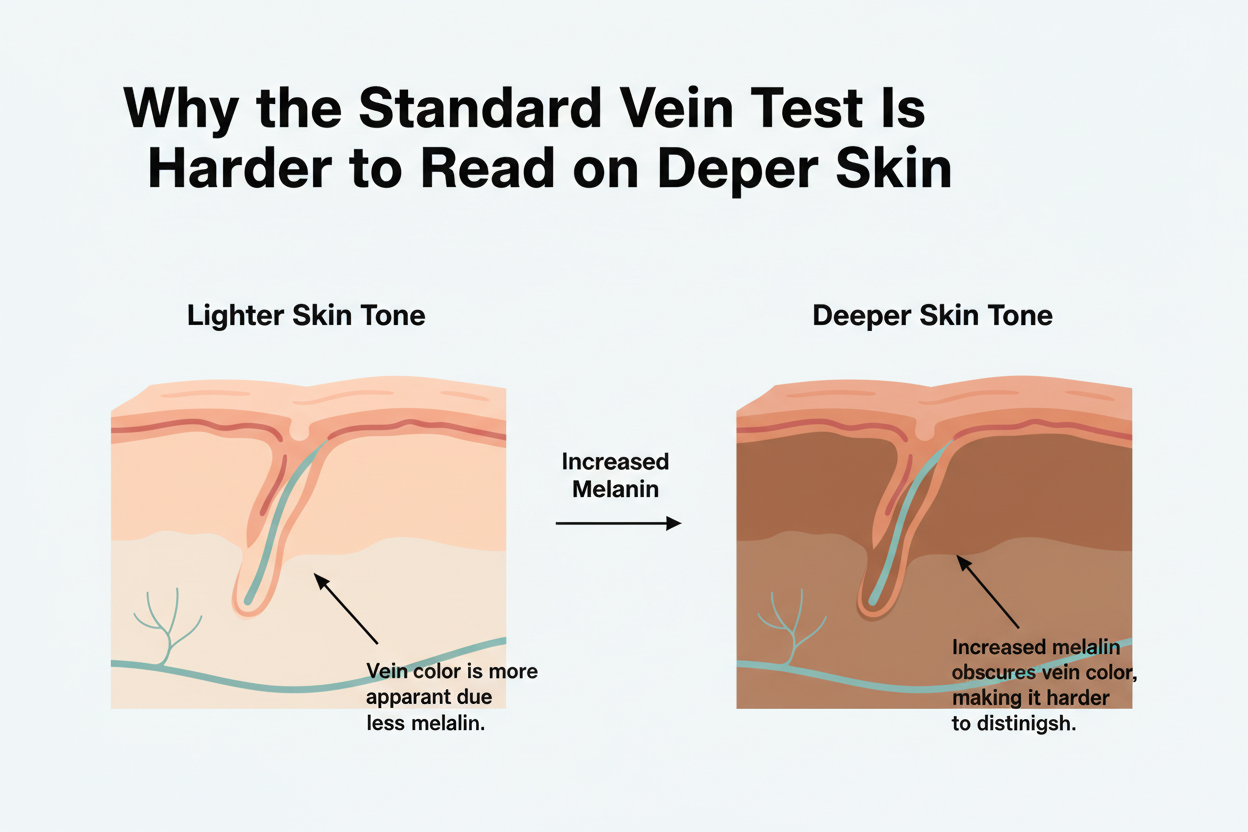
The catch is that this only works when the skin is relatively translucent. On deeper complexions, higher concentrations of melanin absorb and scatter light differently, acting like a much denser filter. The result is that veins on dark skin often read as green no matter what your actual undertone is, because the melanin layer pulls the perceived color toward the warm end of the spectrum.
That one limitation creates a real problem. Someone with a genuinely cool undertone can look at green-tinged veins, decide they run warm, and spend months picking the wrong foundation shades and clothing colors.
The vein test isn't useless on deep skin tones — but it can't be read on its own. It's one data point, not the deciding factor.
How to Perform the Vein Test Correctly on Dark Skin
With the right setup, the vein test still gives you useful information. Most mistakes come from bad lighting or checking the wrong part of the arm. Here's how to get a reliable read.
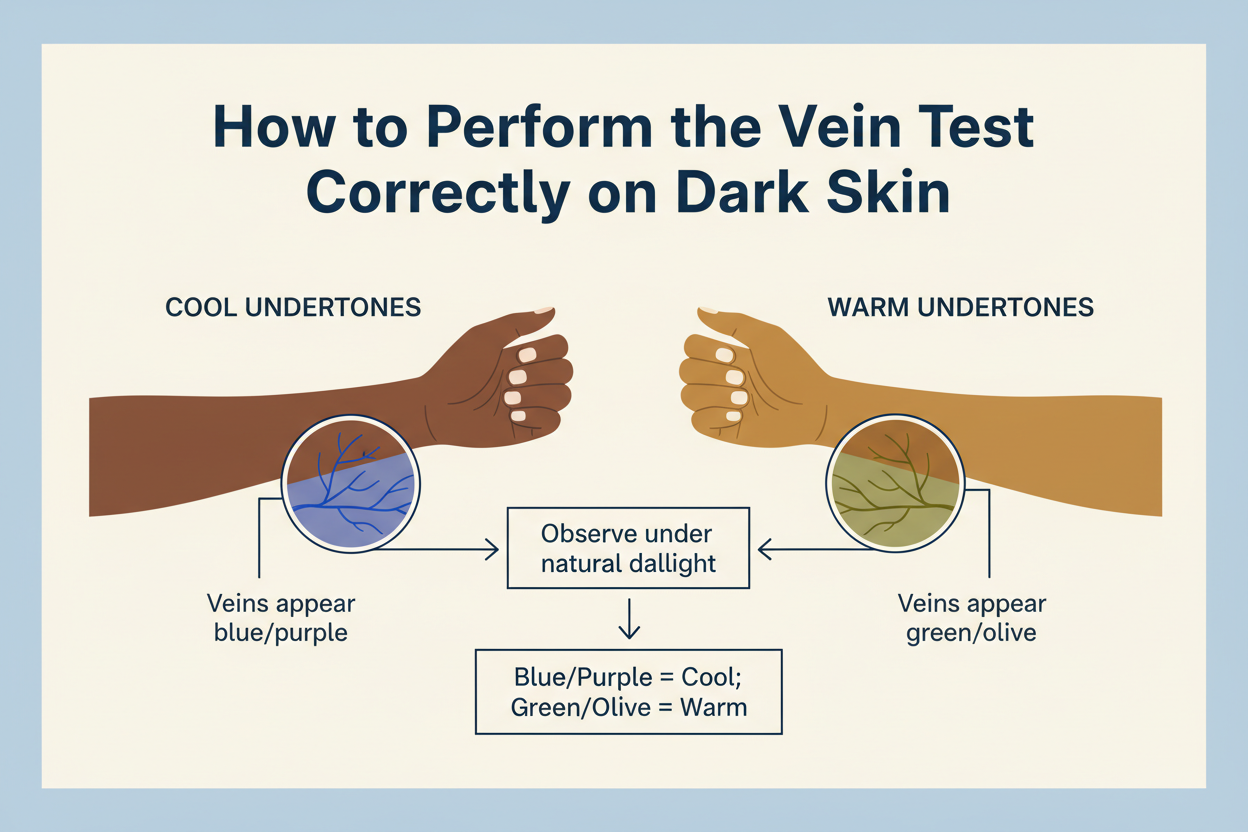
Step 1 — Set up the right lighting Move near a window during daylight hours and sit in indirect natural light — bright, but not in direct sun. This matters more than any other step. Skip it and the test gets unreliable for anyone; on dark skin, the error gets worse.
Step 2 — Choose the right location Check the inner wrist and, if you can, the inner upper arm. The skin there is thinner than on the back of the hand or the outer forearm, so you get a clearer view of the veins.
Step 3 — Read without makeup Remove any foundation, concealer, or self-tanner from the area first. Product pigments change how the color underneath reads.
Step 4 — Observe the dominant hue
- Blue or blue-purple veins → likely a cool undertone
- Green or olive-green veins → likely a warm undertone
- A mix of blue and green → likely a neutral undertone
On deeper complexions, be skeptical if all your veins look green. That's a common result regardless of actual undertone, so treat it as possibly warm rather than confirmed warm, and check against the backup tests below.
Choosing the Right Light: Why Artificial Light Invalidates the Test
Fluorescent office lighting pulls colors toward a cool, flat blue. Warm incandescent or LED bulbs push them toward yellow and orange. Either shift distorts what you see, so a result taken under artificial light is basically noise.
Natural indirect daylight — the kind you get sitting a meter or two from a window on a bright day — is the only condition that shows vein color without a noticeable color cast. If natural light isn't available, wait rather than guess under artificial conditions. A wrong result is worse than no result.
Three Backup Tests That Confirm Your Undertone
Each of these tests works on its own, but their real value is in combination. If three out of four (including the vein test) point the same direction, you have a reliable answer.
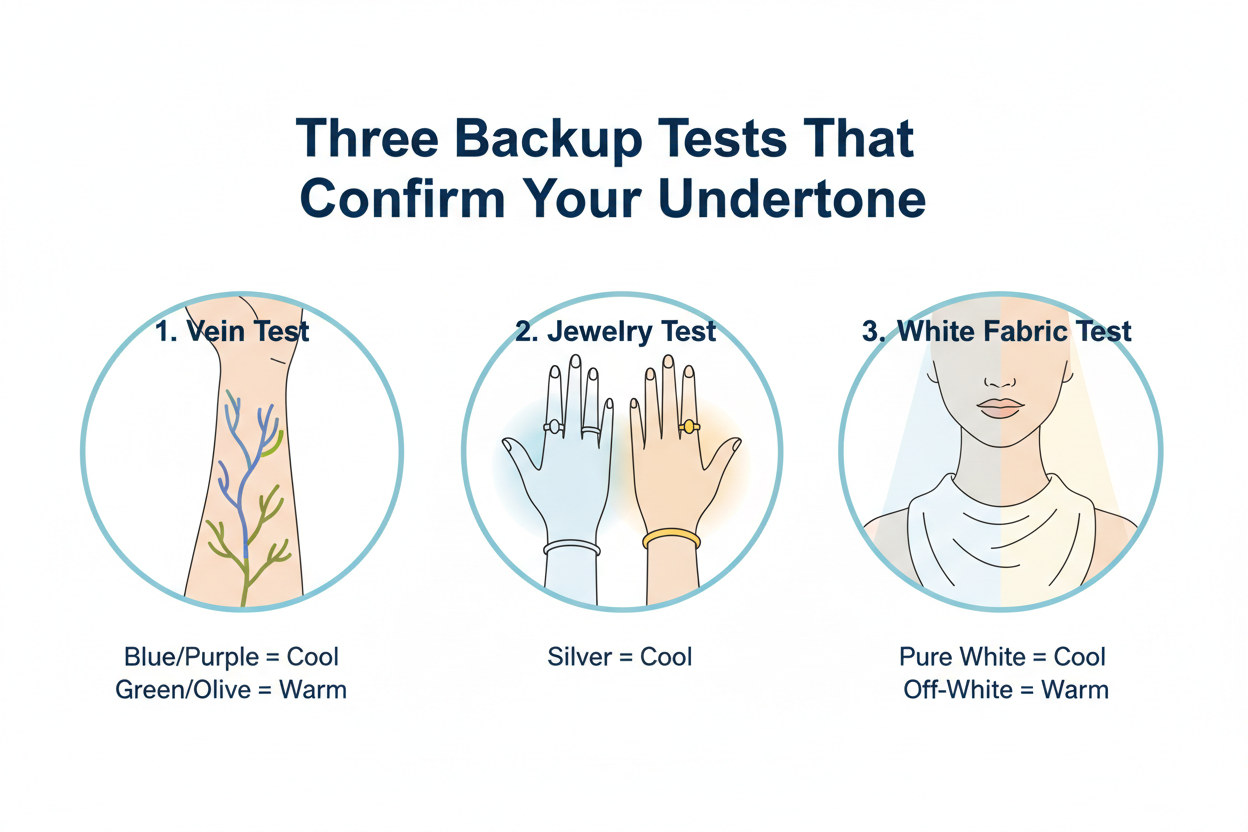
The White-Fabric Drape: Warm White vs. Cool White
This test is often more visually decisive than the vein test for people with dark skin because the contrast between fabric and face is immediate and easy to read.
What you need: Two pieces of fabric or paper — one bright, stark white; one warm white (ivory or cream). If you don't have fabric, a stark white sheet of paper and an ivory or off-white piece work fine.
How to do it:
- Remove all makeup and move to a natural light source.
- Hold the bright white fabric under your chin and against your jawline. Look at your face, not the fabric.
- Swap to the warm white (ivory or cream) and repeat.
What to look for:
| Fabric | What it does to your face | Undertone signal |
|---|---|---|
| Stark/bright white | Face looks vibrant, even-toned, and clear | Cool undertone |
| Ivory or cream | Face looks healthy, warm, and luminous | Warm undertone |
| Both look similar | No strong difference either way | Neutral undertone |
If stark white makes your complexion look slightly ashy or pulls out shadows under your eyes, warm white is probably the better match — a warm undertone signal. If ivory makes your face look muddy or yellowed, bright white is working better — a cool undertone signal.
The jewelry test
Hold a piece of silver jewelry against your face or wrist, then swap it for gold. In natural light, notice which metal makes your skin look cleaner and more alive.
- Gold flatters more → warm undertone
- Silver flatters more → cool undertone
- Both look roughly equal → neutral undertone
Most people find this one surprisingly clear-cut, even on very deep complexions.
The sun-reaction test
Think about what happens to your skin in strong sun without protection:
- You tan quickly with minimal burning → warm or neutral undertone
- You burn or go pink-red before tanning, or tan very slowly → cool undertone
- You tan moderately with occasional burning → neutral undertone
This is a retrospective test rather than a hands-on observation, but it adds a useful data point that doesn't depend on current lighting conditions.
Confirm your result: If three or more tests point the same direction, treat that as your undertone. If results split two-two, run the fabric drape test again in the best available natural light — it tends to be the most visually conclusive for dark complexions.
Reading Your Results: Warm, Cool, and Neutral Undertones in Dark Complexions
Knowing how undertone shows up on deep skin makes it easier to trust what you're seeing instead of talking yourself out of it.
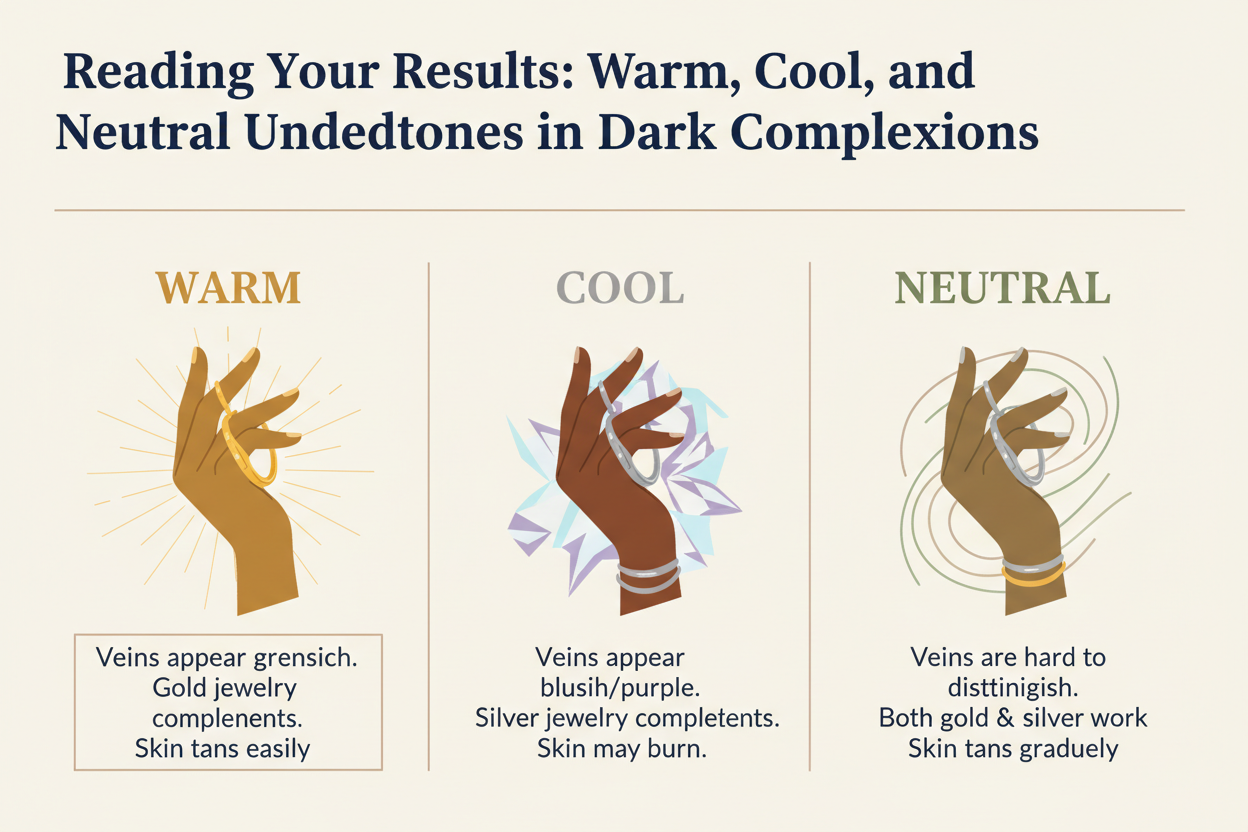
Warm undertone on dark skin Skin tends to read golden, bronze, or amber. Earthy tones, rusts, terracottas, and warm browns look like they belong on you. Ivory and cream whites sit more comfortably next to your face than stark white does.
Cool undertone on dark skin Skin often has a jewel-like depth: ebony, blue-black, or rich espresso without any golden cast. Sapphire, emerald, and magenta tend to look vivid and sharp. Bright white usually feels cleaner than cream.
Neutral undertone on dark skin Neither warm nor cool colors clash in any obvious way. You can pull from a wide palette, and both gold and silver jewelry work reasonably well. Neutral is a real undertone category, not a placeholder for results that came back ambiguous.
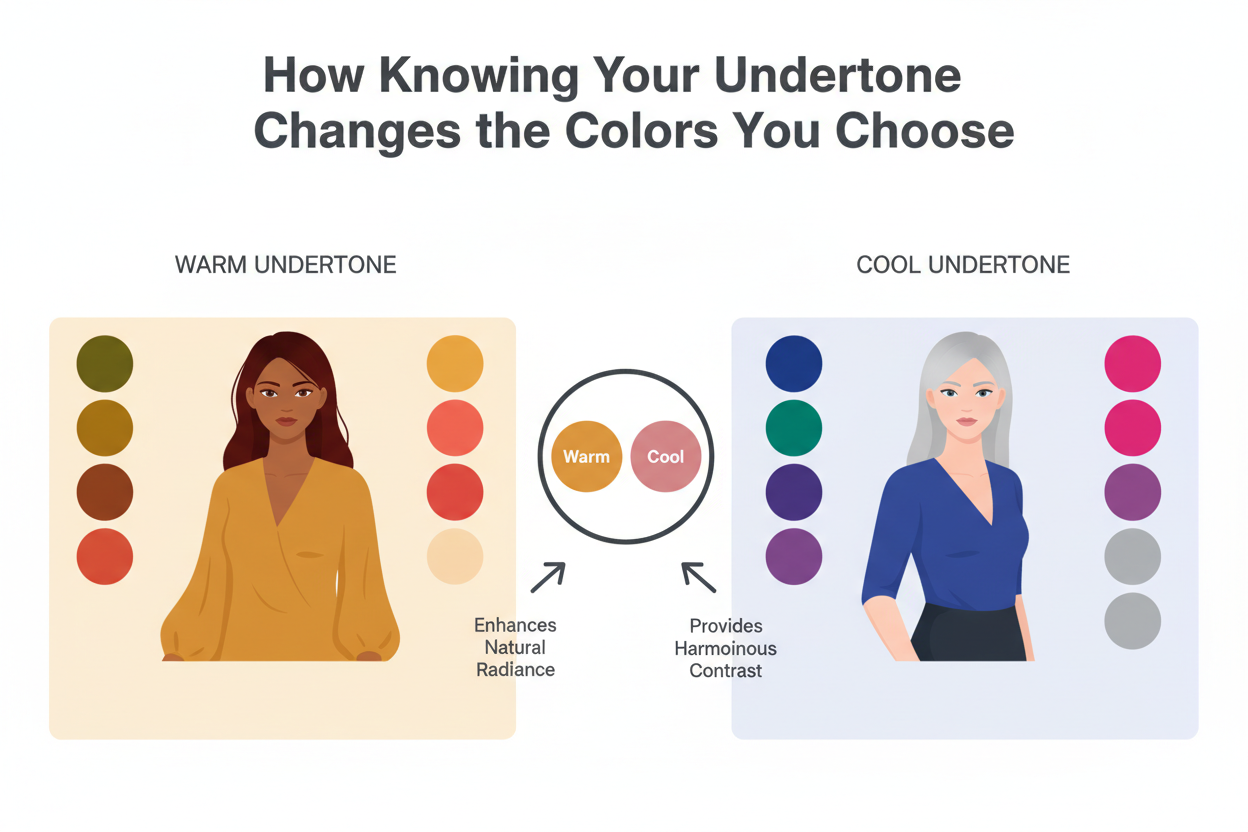
How Knowing Your Undertone Changes the Colors You Choose
Undertone knowledge isn't abstract — it shows up in decisions you make every day.
Clothing and accessories
- Warm undertone: Earthy oranges, warm reds, olive greens, mustard yellows, and bronze metallics work with your natural coloring. Stark icy blues or cool lavenders can create a subtle clash.
- Cool undertone: Jewel tones, cool pinks, true reds, navy, emerald, and silver metallics work with your undertone. Very warm, orange-based hues may feel slightly off.
- Neutral undertone: You can pull from both palettes. Focus on saturation and contrast rather than warm-versus-cool when making choices.
Foundation and concealer
This is where undertone knowledge pays off most. Foundation shades are typically labeled W (warm), C (cool), or N (neutral) for exactly this reason. Choosing a shade with the wrong undertone label — even if the depth is right — produces the grayish or orangey cast that makes foundation look unblended. Knowing your undertone lets you filter correctly before you even swatch.
Colors worn close to the face
Scarves, necklines, earrings, and collars sit close enough to your skin that their undertone interacts with yours. A cool-undertoned person wearing a heavily warm-toned scarf near the face may notice it pulls yellow out of the skin rather than enhancing the complexion's natural depth.
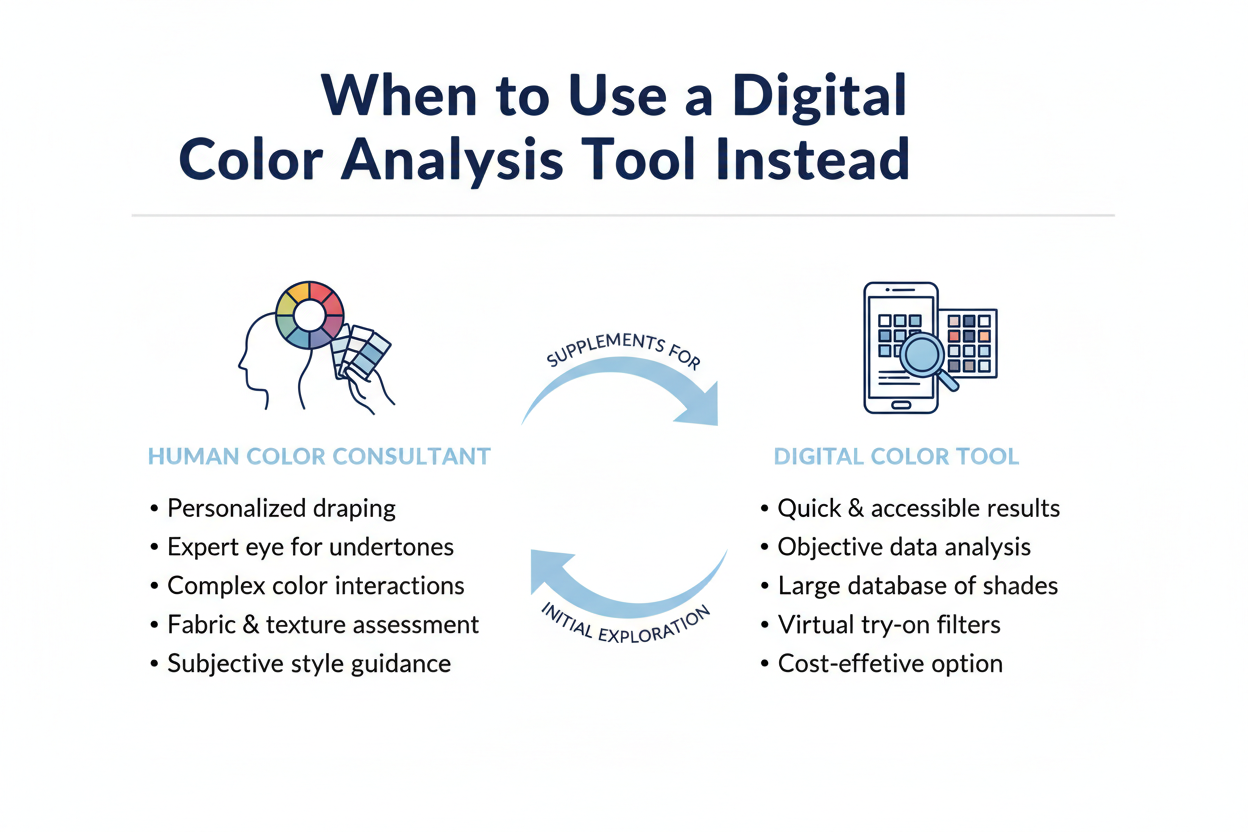
When to Use a Digital Color Analysis Tool Instead
The DIY methods above work well when your results line up. But some complexions give genuinely mixed signals — veins that don't point clearly either way, fabric tests that feel like a guess, jewelry that looks fine in both metals.
Mixed signals don't mean your undertone is unknowable. They mean the informal tests have gone as far as they can.
A digital color analysis tool looks at your coloring more systematically — skin tone depth, undertone, and how those interact with specific colors. For darker complexions, that matters: it sidesteps the vein test's main weakness, which is trying to read color through a melanin-dense layer.
If your results have been split or just confusing, a structured quiz is the next logical step. Running the same manual tests again won't get you somewhere different.
People Also Ask
How do you find your undertone if you have dark skin?
No single test gives a definitive answer on deeper complexions, so the most reliable approach is to run multiple tests and look for a pattern.
Start with the vein test on your inner wrist in natural indirect daylight — but treat it as one data point, not a verdict. Follow it with the fabric drape test: hold stark white, then ivory or cream, beneath your chin and notice which makes your skin look cleaner and more alive. Then run the jewelry test, comparing gold against silver in the same light. Finally, think about how your skin reacts to sun exposure over time.
If three or more tests point the same direction — warm, cool, or neutral — that's your undertone. If results are split, the fabric drape test tends to be the most decisive for dark skin, so repeat it under the best light you have before settling on an answer.
Can the vein test work on brown or Black skin?
Yes, but don't use it alone.
The vein test reads color through the skin. On deeper complexions, higher melanin concentrations filter light more heavily, so veins frequently look green regardless of your actual undertone. Someone with a genuinely cool undertone can still see green-tinged veins and walk away with the wrong answer.
That doesn't make the test useless. A clearly blue-purple result on dark skin is still a real cool signal. The problem is that green is ambiguous — it's not confirmation of warm, it's just a possibility. Treat it that way, and cross-check with the fabric drape and jewelry tests before you decide anything.
What does it mean if your veins look green on dark skin?
Green veins get cited as a sign of warm undertone, but on dark skin that reading needs more scrutiny than usual.
Melanin in deeper complexions absorbs and scatters light in ways that push perceived vein color toward green. So green veins might reflect your actual undertone — or they might just be an artifact of how light moves through a melanin-rich layer. Both causes look identical, which is the problem.
If your veins read green, treat it as a possible warm signal, not a confirmed one. Run the backup tests. If the fabric drape and jewelry tests also lean warm, you're on solid ground. If those point cool or neutral, the vein color was probably the melanin talking, not your undertone.
Is warm or cool undertone more common in dark skin tones?
No universal rule exists. Dark and deep complexions span all three undertone categories — warm, cool, and neutral — and none dominates.
Warm undertones are statistically common in many darker complexions, which probably explains the misconception that all dark skin is warm-toned. But a deep, rich complexion can carry a cool undertone — often showing up as a blue-black or jewel-like quality with no golden cast. Neutral undertones are just as possible and genuinely common, not a catch-all for ambiguous results.
This matters practically: two people with nearly identical surface tones can respond completely differently to the same clothing or foundation shade. Surface depth and undertone are independent of each other.
What is the most accurate undertone test for deep complexions?
No single test wins here, but the fabric drape test tends to be the clearest for dark complexions because it works on immediate contrast rather than trying to read color through layers of melanin.
Hold stark white versus ivory fabric beneath your chin and watch what happens to your face in real time. That response isn't filtered through melanin the way a vein reading is. Most people with deep complexions find the answer obvious once they see the right fabric: one choice makes the face look even and alive, the other just looks a little off.
For the most reliable result, combine the fabric drape with the jewelry test and the sun-reaction check. If all three point the same direction, that's about as accurate as informal testing gets. If they keep contradicting each other, a structured digital color analysis tool is worth trying since it evaluates undertone systematically and doesn't depend on vein visibility at all.
FAQ
Why do my veins look green even though I think I have a cool undertone?
Green veins don't mean warm undertone. It's mostly physics.
Veins carry mixed oxygenated and deoxygenated blood, but what you see isn't really the blood — it's light scattering through the skin layers above. That scattering pushes the perceived color toward green regardless of undertone. On deeper complexions with more melanin, the effect is even stronger, so green veins can show up on genuinely cool skin just as easily as warm.
If the fabric drape and jewelry tests consistently point cool, trust those. The veins are telling you about optics, not undertone.
Can I have a neutral undertone if I have very dark skin?
Yes. Undertone and skin depth are separate things — one has nothing to do with the other.
A neutral undertone means your skin carries roughly balanced warm and cool hues beneath the surface, with neither dominant. This happens across the full range of skin depths, including very deep complexions. Neutral also isn't a consolation prize for inconclusive results. It's a real undertone with clear signs: both warm-white and cool-white fabrics look decent on you, both gold and silver jewelry work, and your veins tend to read blue-green rather than clearly one or the other.
If your tests keep producing mixed but consistent results, neutral is the right call — and it gives you a wide range to work with in clothing and foundation.
Does undertone change as skin darkens in summer?
No. Undertone is fixed — it describes the hues beneath your skin's surface, and tanning doesn't touch it.
What changes in summer is your surface tone. More UV exposure means more melanin, which makes your complexion look deeper or darker. The underlying hue stays put. That's the whole reason undertone and skin tone are treated as separate things: one shifts with the seasons, the other doesn't.
In practice, your undertone-based choices — foundation shades, clothing colors, jewelry metals — stay the same year-round. You might need a slightly deeper foundation in August, but it should still carry the same warm, cool, or neutral base as your winter shade.
How many tests should I do before I trust my undertone result?
Run at least three tests and look for a majority pattern before treating any result as confirmed.
A useful minimum set:
- Vein test (natural daylight, inner wrist)
- Fabric drape (stark white vs. ivory or warm cream beneath the chin)
- Jewelry test (gold vs. silver in natural light)
If two of three point the same direction, that's a reasonable working conclusion. If all three agree, you can be confident. When results split evenly across all three, add a fourth data point — your sun-reaction history, or a structured digital tool — before deciding.
On dark skin specifically, weight the fabric drape more heavily than the vein test when the two conflict. The drape reads contrast in real time rather than filtering color through melanin layers.
What colors should I avoid if I have a warm undertone and dark skin?
You rarely need to avoid a color entirely, but some shades tend to clash with warm undertones and are worth a second look before buying.
Colors that often create tension with warm-undertoned dark skin:
- Stark, icy pastels — icy pink, baby blue, and lavender can look washed out or ashy against golden or bronze undertones
- Cool-based neutrals — true taupe, slate grey, and blue-based beige tend to dull the warmth in your skin rather than work with it
- Cool-leaning reds — burgundy and blue-red tones usually sit less naturally than tomato, brick, or terracotta reds
Warm undertones on deep skin tend to thrive with earthy oranges, rich yellows, olive greens, warm browns, and coral pinks. The real goal isn't to cut out cool colors — it's to notice which specific shades make your skin look vibrant and which ones flatten it, then dress accordingly.
Is the vein test reliable for Black skin specifically?
It can offer a signal, but don't rely on it alone.
The issue is melanin. Higher melanin concentrations absorb and scatter light differently than lighter skin, which often makes veins look green regardless of actual undertone. A clearly blue-purple result on Black skin is still a meaningful cool indicator. But green is ambiguous — it might reflect a genuine warm undertone, or it might just be how light behaves moving through a melanin-rich dermis.
That doesn't make the test useless. It means you need to check it against something else. Run the fabric drape and jewelry tests and compare. If all three point warm, the green reading was probably accurate. If the other tests suggest cool or neutral, the vein result was likely skewed by melanin rather than your actual undertone.
How does knowing my undertone help me pick foundation for dark skin?
Undertone determines whether a foundation looks like skin or like a mask — and it matters as much as finding the right depth, maybe more.
Foundation shades work on two axes: depth (how light or dark) and undertone (warm, cool, or neutral). Getting the depth right but the undertone wrong produces something that just looks off — too orange, too ashy, too pink — even if the coverage and finish are technically fine. On deeper complexions this tends to be more visible, because the contrast between your skin and a mismatched cast is harder to ignore.
In practical terms:
- Warm undertone — look for foundations labeled golden, bronze, caramel, or with a yellow-orange base
- Cool undertone — look for foundations labeled with a pink, red, or blue-neutral base
- Neutral undertone — foundations labeled neutral or balanced tend to work well; avoid anything with a strong warm or cool pull
Once you know your undertone, you can cut through the options quickly instead of testing everything. If you're still not sure after trying the physical tests, a digital color analysis tool can map your undertone more systematically — useful before you spend money on products.