Neutral Undertone Test: Signs, Results, and Mistakes
 Reviewed by Alexandra Gilmore
A neutral undertone is best identified by a repeated pattern across controlled foundation, fabric, and metal comparisons—not by one ambiguous vein or jewelry test. Use this step-by-step protocol to recognize the signs, avoid common mistakes, and refine a neutral-warm or neutral-cool result.

Neutral Undertone Test: Key Takeaways
- A neutral undertone is a balanced warm-cool direction, not the absence of an undertone and not a fallback for confusing results.
- The strongest signs are repeated middle-ground results across controlled fabric, foundation, and metal comparisons.
- Vein color, jewelry preference, tanning history, and one photograph are clues—not stand-alone tests.
- Test bare skin in indirect daylight, keep the background and camera exposure stable, and compare matched options one pair at a time.
- After a neutral result, refine toward neutral-warm or neutral-cool, then test depth, chroma, and contrast separately.
The most reliable neutral undertone test is a pattern, not a single trick. Neutral is a useful working result when neither warm nor cool options consistently dominate across several fair comparisons. Your skin may still lean slightly warm or slightly cool, and that small lean can matter more for foundation than for jewelry or clothing.
Use the protocol below to collect comparable evidence, recognize the signs of a neutral undertone, and avoid the mistakes that make almost anyone look “neutral.” The goal is not to force a label. It is to narrow your next decisions—foundation direction, clothing comparisons, and seasonal color testing—with less guesswork.
💫 Discover Your Complete Color Palette
Ready to discover all the colors that make you look radiant? Our comprehensive color analysis will reveal your complete personal palette - perfect for hair, makeup, and wardrobe decisions.
Find My Color Palette →📚 Recent Articles
What a Neutral Undertone Actually Means
Skin depth and undertone answer different questions. Depth describes how light or deep the complexion appears. Undertone is the warm-cool direction used by beauty and color systems to organize shades. A person can have a neutral undertone at any skin depth, and no ethnicity automatically predicts one undertone.
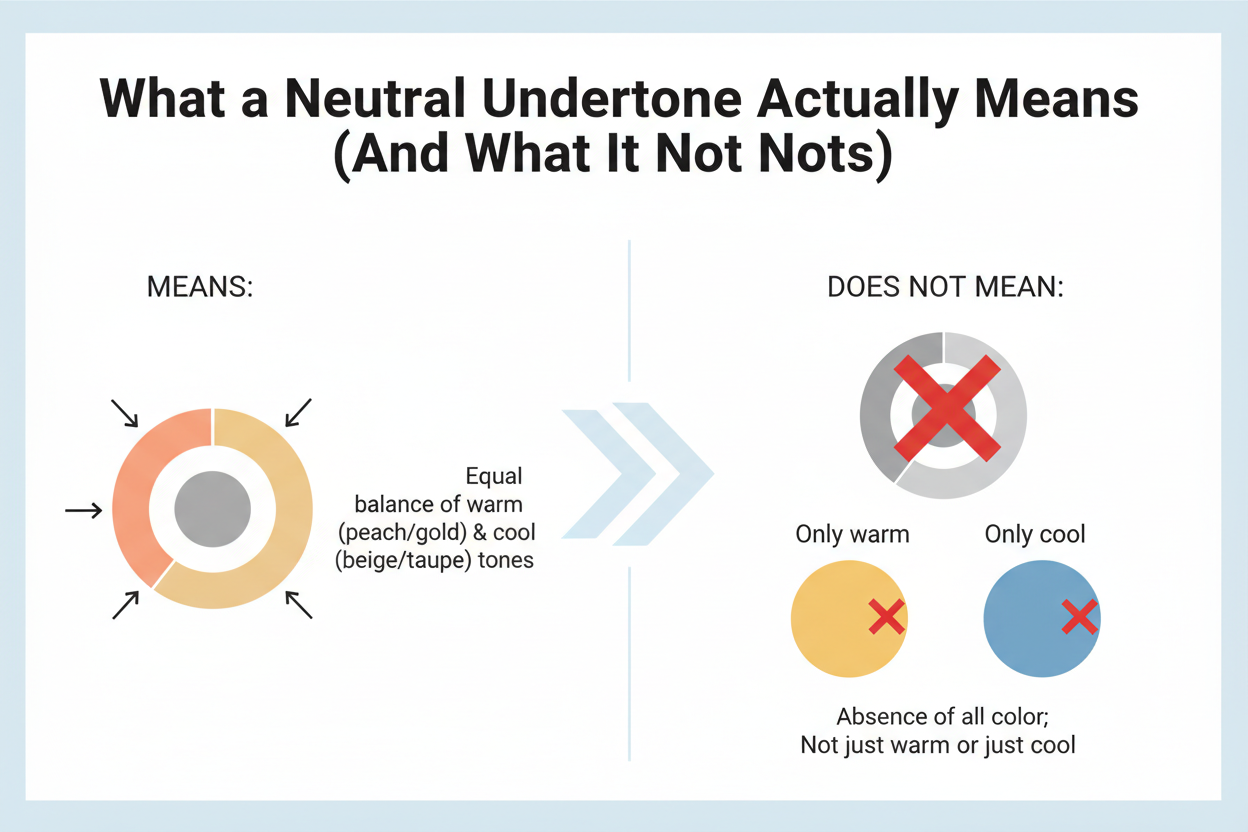
“Neutral” also does not mean perfectly equal pigment or universal compatibility with every color. In practice, many neutral foundation families include neutral-warm and neutral-cool options. That is useful: the category describes a middle range, while your best match may sit slightly to one side. The current Maybelline skin tint shade guide, for example, separates neutral, neutral-warm, and neutral-cool descriptions within one range.
Neutral undertone is not the same as a neutral color season. A seasonal palette also considers value, chroma, and contrast. You can confirm a neutral or near-neutral skin direction and still need separate comparisons to find the colors that suit your overall coloring. For the wider framework, use the complete guide to neutral skin tones after this test.
Set Up the Test Before You Read Any Sign
Subtle color differences become unreliable when the environment keeps changing. Standardized color evaluation depends on controlled illumination; the same principle applies at home, even though your setup will not be laboratory-grade. X-Rite’s guide to lighting for color evaluation explains why the light source changes color appearance.
- Stand near a window in indirect daylight. Avoid direct sun, which creates glare and deep shadows.
- Turn off warm lamps and move away from a bright monitor or colored wall.
- Use bare skin when practical, or keep the same minimal makeup throughout. Pull dyed hair away from the face.
- Wear a gray, soft white, or similarly quiet top. A bright shirt can reflect color onto the jaw and neck.
- If you take photos, lock the position and exposure. Do not compare images made by different cameras or automatic filters.
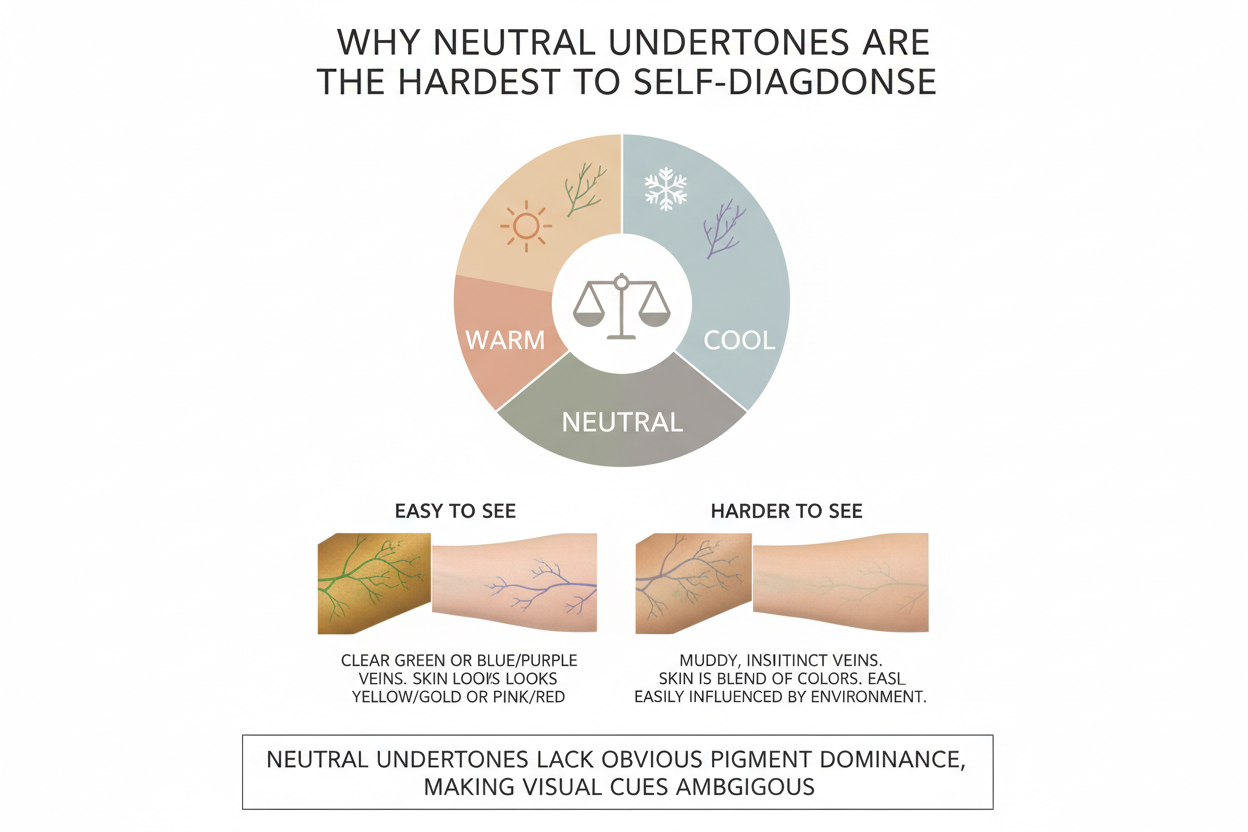
Wait a few minutes if you have just exercised, washed your face with hot water, or come in from extreme weather. Temporary redness is surface information, not a reliable undertone signal. Then run the comparisons in one session and repeat the strongest pair on another day.
Four Neutral Undertone Tests—and How Much to Trust Them
No at-home method proves an undertone by itself. Give the most weight to direct product and fabric comparisons, where the decision resembles the real choice you need to make. Use veins and jewelry as supporting observations.
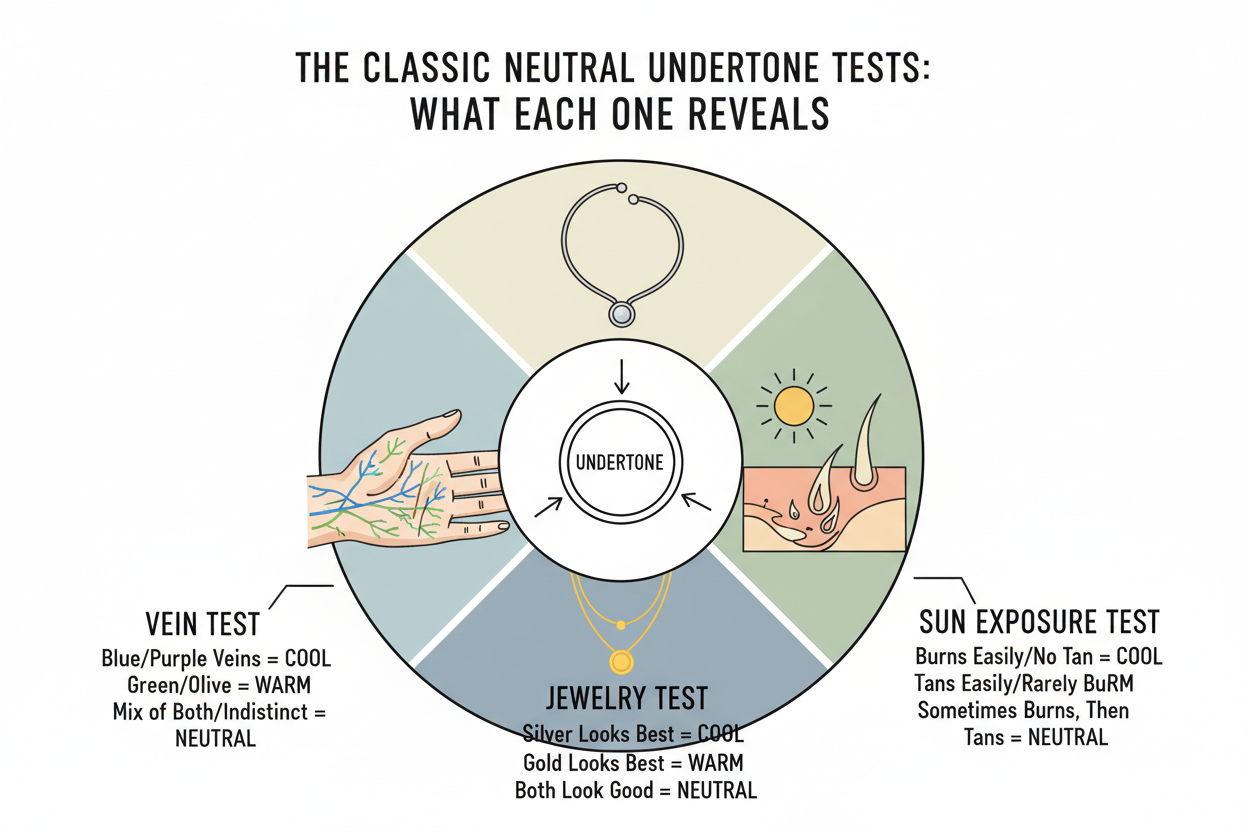
| Test | Neutral-leaning result | Main limitation |
|---|---|---|
| Foundation swatches | A neutral shade disappears more cleanly than equal-depth pink or golden alternatives. | Brand labels are not standardized, and the wrong depth can hide the undertone comparison. |
| Fabric pairs | Balanced or slightly muted options repeatedly outperform strongly warm and cool versions. | Changing depth or brightness at the same time makes the pair unfair. |
| Gold vs. silver | Both metals integrate similarly, or the winner changes with finish and brightness. | Preference, patina, size, and shine can matter more than metal color. |
| Vein color | Veins look blue-green, teal, mixed, or simply difficult to classify. | Visibility varies with skin depth, anatomy, and illumination. |
1. Foundation Swatch Test
Select three foundations at the same apparent depth: one described as neutral, one warm or golden, and one cool or pink. Apply narrow stripes from the lower cheek across the jaw, allow them to settle as directed, and view them near a window. The useful match is the one whose edge is least obvious across both face and neck—not the one whose bottle looks closest.
Maybelline’s foundation shade guidance recommends comparing undertone families along the jaw and checking swatches in more than one light. Treat the brand name on the label as a shortlist, not as evidence about your skin.
2. Matched Fabric Pair Test
Compare white with soft ivory, cool gray with balanced taupe, dusty rose with warm coral, and muted teal with clear turquoise. Keep each pair close in lightness and saturation. Watch the face: does one side exaggerate redness, yellow reflection, grayness, or under-eye shadow? If the balanced choices win repeatedly while neither temperature extreme dominates, neutral is a reasonable working result.
3. Metal Test
Use pieces of similar size and finish—brushed gold versus brushed silver, for example. Compare them near the face rather than only on the wrist. If both work, repeat with brighter versions. A neutral result often shows flexibility, but “I own more gold” is personal preference, not test data. The dedicated gold or silver undertone test covers this comparison in more detail.
4. Vein Test
Look at more than one area in daylight. Mixed blue and green impressions can support a neutral hypothesis, but unclear veins are not proof. Deeper skin may make vein color difficult to see, while thin skin and visible surface redness can alter the impression. Record the observation and move on; do not let it overrule foundation or matched fabric results.
Signs You May Have a Neutral Undertone
The best sign is convergence: several independent comparisons point toward the middle. Use this checklist as a record of repeated observations, not a points-based diagnosis.
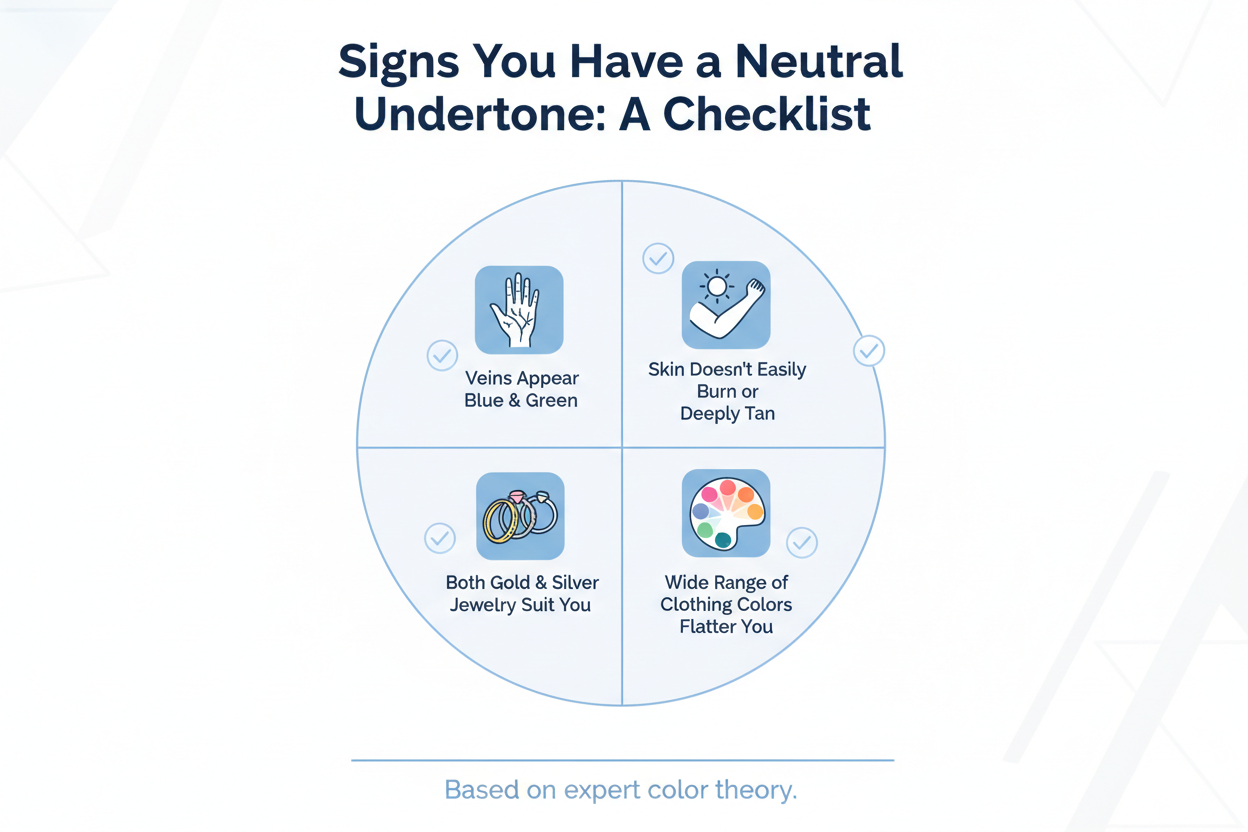
- A neutral foundation family blends better than equal-depth shades with a strong pink, peach, yellow, or golden cast.
- You can wear comparable gold and silver pieces without one consistently making the skin look gray or overly yellow.
- White and ivory are both plausible, while their most icy and most yellow versions are less reliable.
- Balanced taupe, mushroom, muted rose, teal, navy, and soft white are easier starting points than extreme temperature colors.
- Your vein color looks mixed or changes between blue-green impressions in the same neutral light.
- Results remain near-neutral when repeated on different days, even if you detect a small warm or cool lean.
One contradiction is normal. Foundation may favor neutral-cool while antique gold jewelry still looks excellent. Products, fabrics, and metals differ in depth, reflectivity, and chroma, so not every comparison isolates temperature perfectly. Classify the repeated pattern, then keep the exceptions as useful style information.
Keep a short comparison log: name the pair, light source, winner, and visible change around the jaw, eyes, or lips. Specific observations are easier to verify than broad impressions such as “healthy” or “washed out.”
The Most Common Neutral Undertone Testing Mistakes
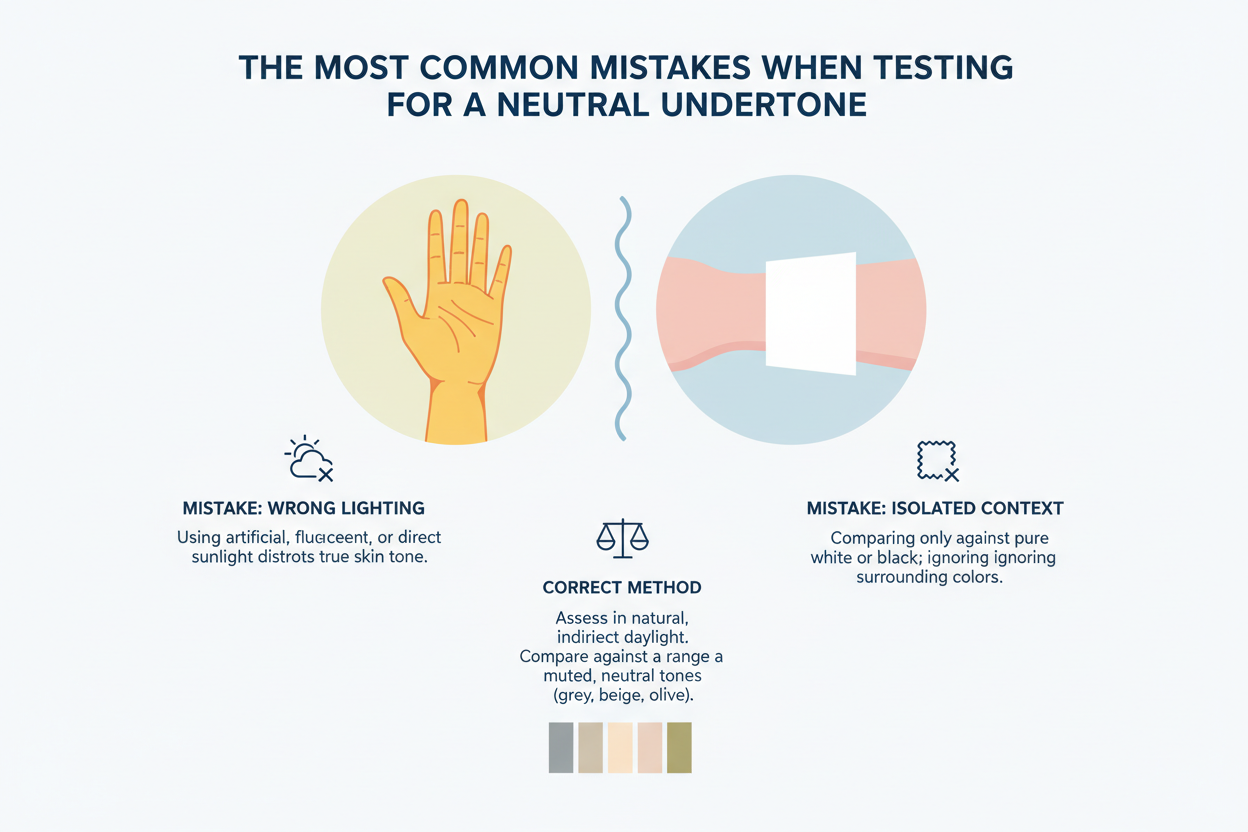
- Calling any inconclusive result neutral. Confusion can come from poor light, mismatched samples, or the wrong foundation depth. Neutral requires repeated middle-range results under controlled conditions.
- Using one test as the verdict. Veins may be hard to see; jewelry may reflect personal taste; sun response involves many variables. Cross-check.
- Comparing unequal options. A shiny large gold earring against a tiny matte silver stud tests scale and finish. A pale dusty pink against dark orange tests value and chroma as well as temperature.
- Testing over makeup or self-tanner. Added pigment changes the surface you are trying to observe. If you regularly wear self-tanner, you may need a separate practical foundation match for that state.
- Reading redness as cool undertone. Irritation, blemishes, rosacea, heat, and recent exercise can add visible redness without defining the underlying shade direction.
- Reading a tan as warm undertone. Surface depth and color can change with sun exposure while your most workable undertone family may remain neutral or cool-leaning.
- Trusting a filtered selfie. Automatic white balance, portrait modes, screen tint, and surrounding colors can shift the image. Use a camera result only as one controlled comparison.
- Assuming neutral means every color works. Undertone is only one color dimension. A shade can be balanced in temperature and still be too bright, muted, light, dark, or high-contrast for your coloring.
Neutral Undertone vs. Olive Undertone
Neutral describes a warm-cool balance. Olive describes a green, gray-green, or muted cast that can occur with a warm, cool, or relatively neutral temperature direction. The categories can overlap: “neutral olive” is a useful description when both the balanced temperature and olive cast affect matching.
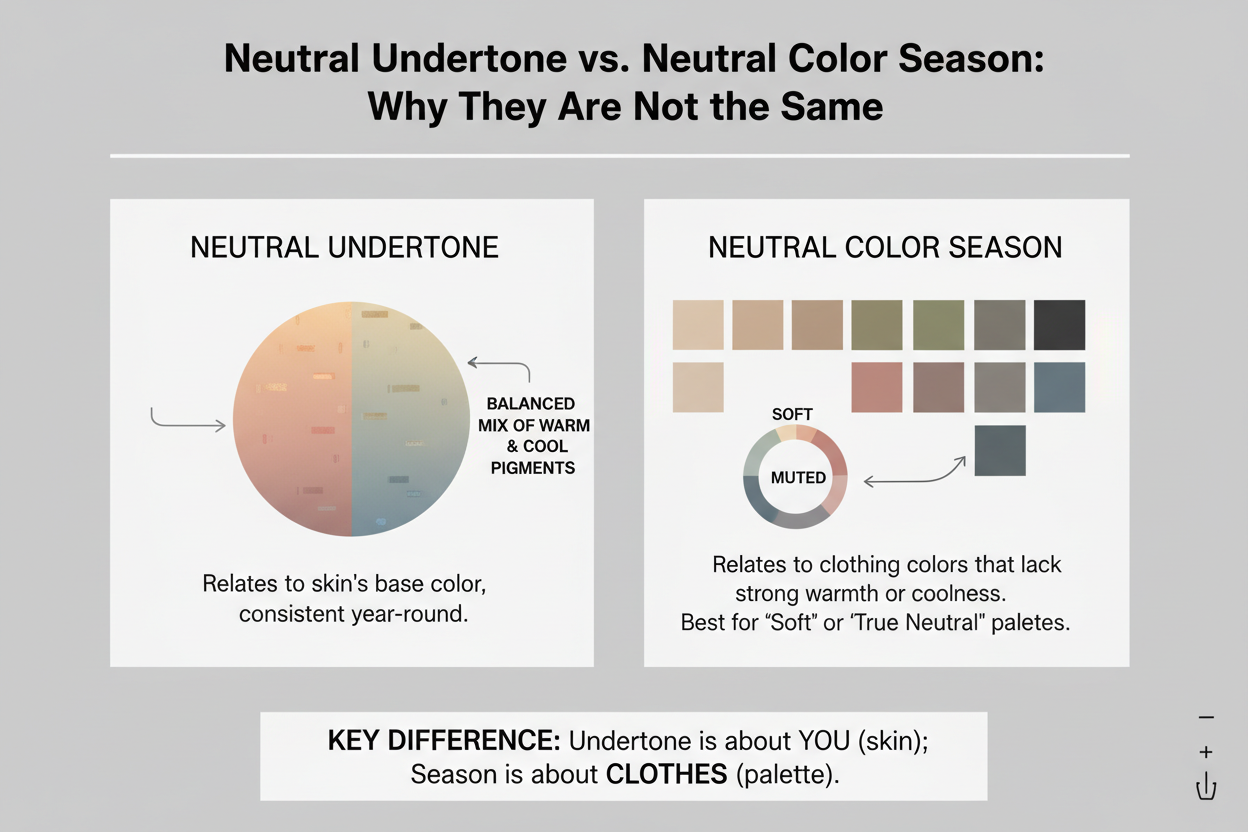
If neutral foundation is close but repeatedly turns peach, orange, or overly pink, compare an olive-labeled option at the same depth. Watch the jaw and neck rather than trying to see “green skin.” If both neutral and olive options vary by brand, keep notes on the actual successful shades. The full neutral vs. olive undertone guide provides a controlled decision path.
How to Choose Foundation After a Neutral Result
- Choose two or three candidates at the closest depth. If depth is wrong, undertone is difficult to judge.
- Include a neutral, a neutral-warm, and a neutral-cool or olive option when the range provides them.
- Swatch from lower cheek to jaw and let the formula settle. Check the product instructions for timing.
- View the swatches in indirect daylight and in the lighting where you will usually wear the product.
- Select the shade that connects face and neck with the least visible edge. Do not use hand color as the final match.
Finish and coverage can change how forgiving a shade appears. A sheer skin tint may span a wider range than a full-coverage foundation. Oxidation and wear also vary by formula, so test a sample when possible. The foundation label decoding guide helps translate a neutral result across brand labeling systems.
What to Do After You Identify a Neutral Undertone
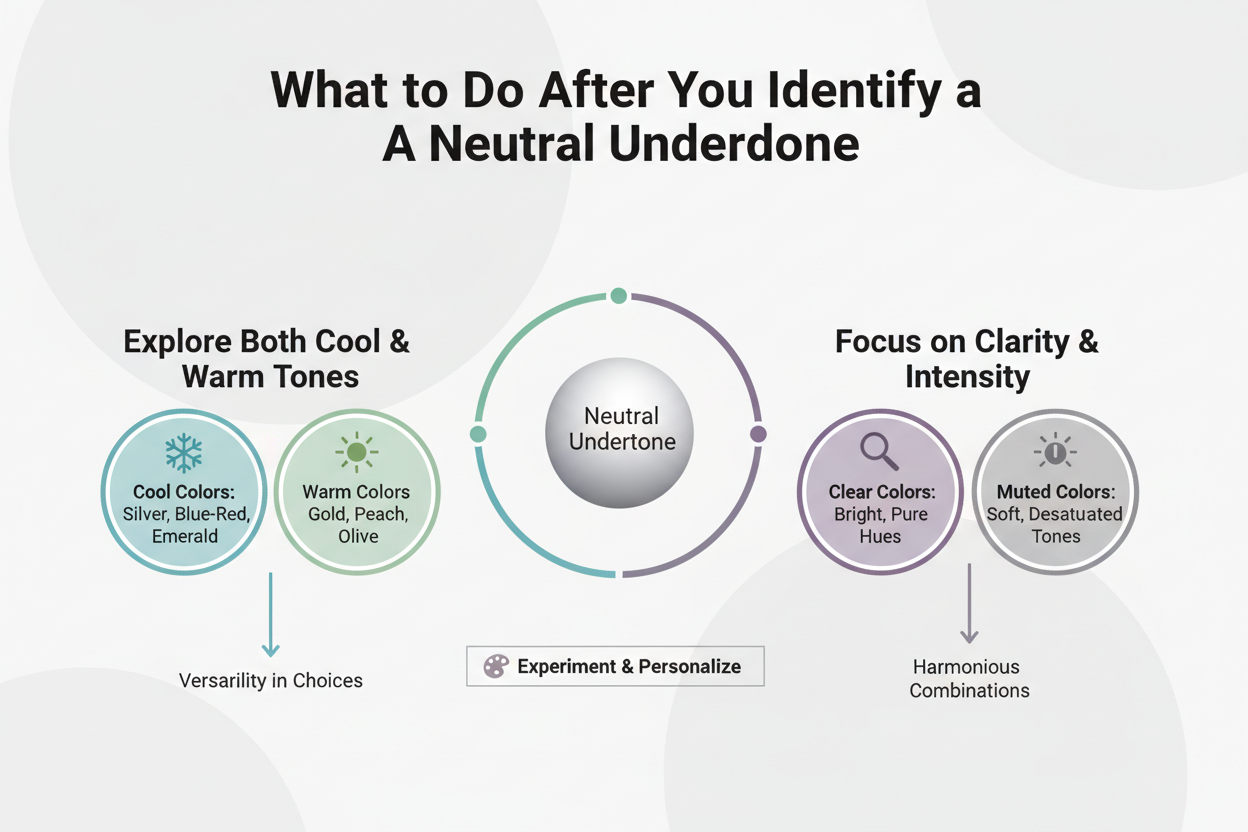
Keep neutral as a starting hypothesis and refine one variable at a time. First compare neutral-warm with neutral-cool. Then test lighter versus deeper colors, muted versus clear colors, and low versus high contrast. This sequence prevents undertone from absorbing every styling question.
- For clothing: start with mushroom, balanced taupe, soft white, navy, muted teal, and rosewood. Then compare warmer and cooler neighbors at the same depth.
- For jewelry: use both metals if you like them. Adjust brightness and finish before excluding a metal color.
- For makeup: begin with neutral complexion shades, then test neutral-peach and neutral-rose cheek and lip colors.
- For seasonal analysis: test value, chroma, and contrast rather than assigning yourself a “neutral season.” The contrast-level guide is a useful next step.
Record exact product names and photograph fabric winners under the same setup. A useful result should make future comparisons faster, not create a rulebook that overrides what you can observe.
Knowing your lean matters because it can sharpen makeup shade selection and give color analysis more to work with. If you want a more precise read, a dedicated undertone quiz or professional color analysis can distinguish between neutral, neutral-warm, and neutral-cool—take the quiz at color-analysis.app to get a personalized starting point.
People Also Ask
How do I know if I have a neutral undertone?
You may have a neutral undertone when neutral foundation shades blend better than equally deep warm and cool options, both gold and silver are plausible, and matched fabric pairs produce balanced or split results. Confirm the pattern across several tests in stable daylight rather than relying on one clue.
What color are veins with a neutral undertone?
They may look blue-green, teal, mixed, or hard to classify. Vein appearance is affected by lighting, visibility, and the skin above them, so it can support a neutral hypothesis but cannot confirm it.
Is a neutral undertone warm or cool?
It sits near the middle of the warm-cool range. Many people lean slightly neutral-warm or neutral-cool, which explains why one neutral foundation or metal may work better than another.
What colors look best on neutral undertones?
Balanced colors such as mushroom, taupe, soft white, navy, muted teal, rosewood, and softened berry are practical starting points. Your best lightness, saturation, and contrast still depend on the rest of your coloring.
Common Questions: The Ultimate Color FAQ
Can neutral undertones wear both gold and silver?
Often, yes. Compare pieces with similar scale, shine, and finish. If one bright metal looks harsh, a brushed or antique version may work even when the metal color itself is suitable.
Can your undertone change?
Your practical shade match can shift when surface color changes because of tanning, irritation, medication, or other factors. Retest foundation depth and undertone when the old match no longer connects face and neck instead of assuming the label must remain identical.
Is neutral undertone the same as not knowing?
No. “I cannot tell” is only the start of the test. Neutral becomes a useful result when controlled foundation, fabric, and metal comparisons repeatedly land near the middle.
Can deep skin have a neutral undertone?
Yes. Skin depth and undertone are independent dimensions. Use equal-depth foundation swatches and fabric comparisons; do not depend on vein visibility or ethnicity-based assumptions.