Cool vs Warm Undertone Test
 Reviewed by Alexandra Gilmore
A foundation can match surface depth and still turn orange or gray because its undertone points the wrong way. Compare warm and cool fabrics plus equal-depth base products in consistent daylight, then cross-check the result instead of allowing wrist veins to make the entire decision.

Walk into any beauty store without knowing your undertone and you're essentially shopping blindfolded. Pick the wrong foundation shade and it either pulls orange on your skin or leaves you looking washed out — even when the surface color looks like a match on the back of your hand.
💫 Discover Your Complete Color Palette
Ready to discover all the colors that make you look radiant? Our comprehensive color analysis will reveal your complete personal palette - perfect for hair, makeup, and wardrobe decisions.
Find My Color Palette →Here's the problem most people run into: undertone is regularly confused with skin tone, and the go-to shortcut — checking the color of your wrist veins — is far less reliable than beauty influencers suggest. In fact, makeup educators trained across multiple markets actively caution against relying on the vein test alone.
There's also a persistent myth that skin tone and undertone travel together. They don't. A person with deep brown skin can absolutely carry a cool undertone, just as someone with a fair complexion can run warm. Assuming otherwise leads to the wrong product choices every time.
This guide gives you a complete, at-home cool and warm undertone test you can do right now — no special tools required. You'll find:
- Five practical at-home methods that cross-check each other for a more reliable result
- Clear guidance on reading your results — cool, warm, or neutral
- Direct applications to foundation, concealer, clothing, and color choices
- A breakdown of the most common mistakes that skew self-tests
- A pointer to a digital quiz option if you want a faster, camera-based answer
By the end, you'll have a confident, evidence-based answer — not just a guess — and the practical knowledge to use it every time you shop for base makeup or plan an outfit.
📚 Recent Articles
What Undertone Actually Means (And Why It's Not Your Skin Tone)
Your skin tone is what you see on the surface — the observable depth of color ranging from fair to deep. Your undertone is different. It's the secondary hue sitting beneath that surface layer, and it doesn't change with a tan, a breakout, or the season.
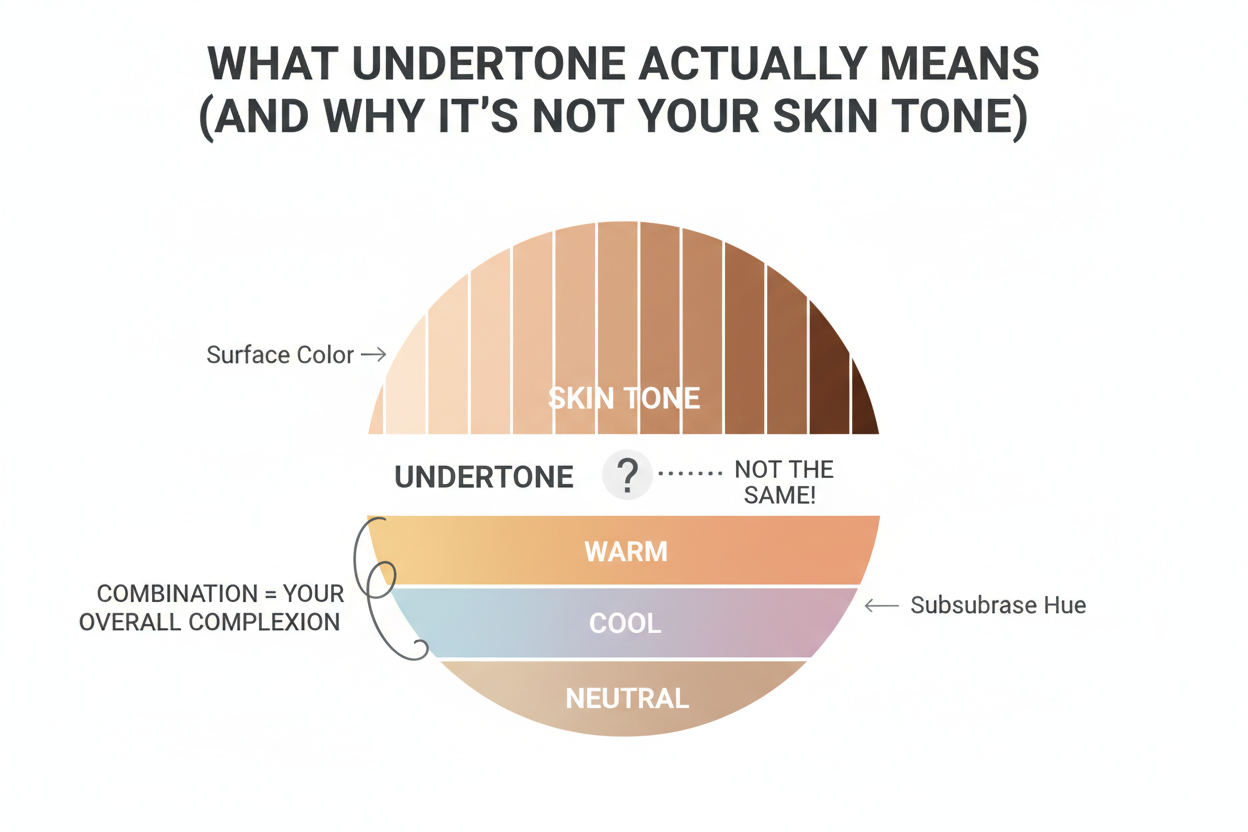
That underlying hue falls into one of three categories:
- Warm — yellow or golden cast beneath the skin
- Cool — pink or blue cast beneath the skin
- Neutral — a balanced mix of both, with neither clearly dominant
Tone and undertone move independently. Someone with deep brown skin can have a cool undertone. Someone with fair, pale skin can run warm. Assuming the two are linked is one of the most common and costly mistakes in makeup selection — people with darker complexions are routinely told they must be warm simply because of their skin depth. That assumption is wrong, and it leads directly to mismatched products.
This distinction matters before you start any cool and warm undertone test. If you go in thinking "I have medium skin, so I'm probably warm," you'll unconsciously skew every result you look for.
Why Getting Your Undertone Wrong Costs You at the Makeup Counter
Undertone determines whether a foundation looks natural on your skin or fights it. Matching your surface shade is only half the job. Get the depth right but miss the undertone, and your base will read grey, orange, or flat depending on which direction you've gone wrong.
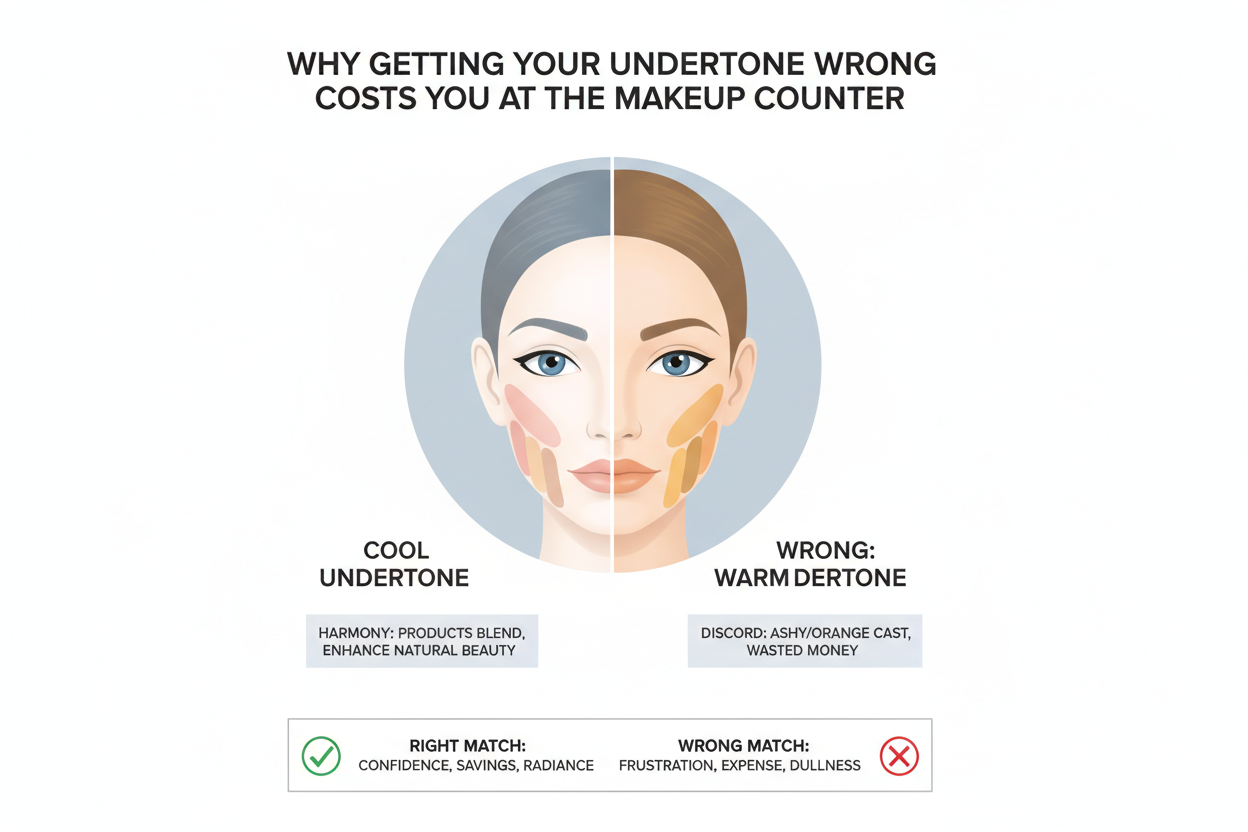
Two people can have identical surface tones and react completely differently to the same clothing color. One looks sharp in black. The other looks washed out. Neither is wrong — they just have different undertones, and the color is doing opposite things to each of them.
The same thing happens at the makeup counter. When your undertone is right, the base disappears into your skin. When it's off, you can tell something's wrong even if you can't name why.
The 5 At-Home Methods for the Cool vs Warm Undertone Test
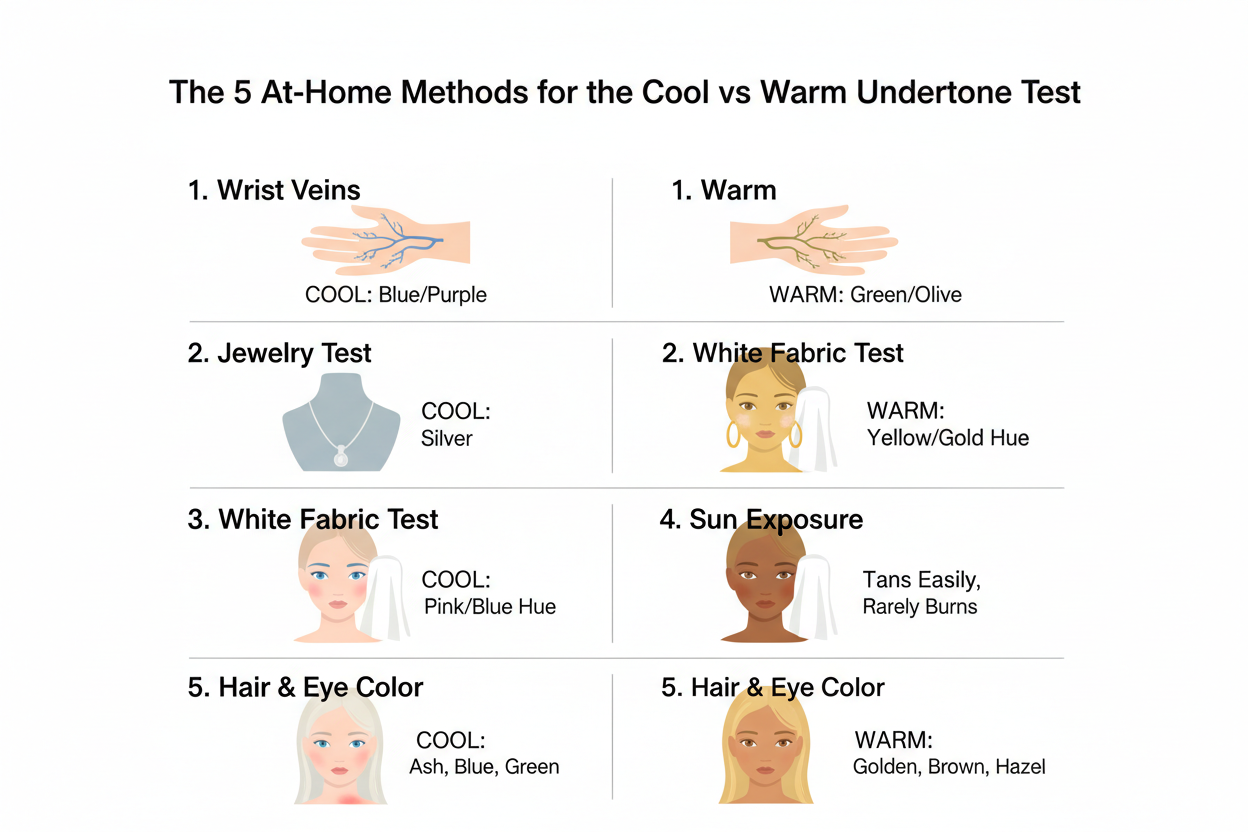
No single method is fully reliable on its own. The most accurate read comes from running multiple tests and looking for a consistent pattern across results. Use all five, then tally your answers.
Method 1 — Jewelry Test
Hold a piece of silver jewelry against your bare inner wrist. Then switch to gold. Observe which metal makes your skin look brighter and healthier.
- Silver looks better → cool undertone
- Gold looks better → warm undertone
- Both look equally good → neutral undertone
Method 2 — Sun Reaction Test
Think about what happens to your skin after extended sun exposure.
- Burns easily, rarely tans → typically cool undertone
- Tans quickly with little burning → typically warm undertone
- Burns first, then develops a tan → often neutral
This isn't a hard rule, but how your skin responds to UV light loosely tracks with undertone.
Method 3 — Clothing and Color Draping
Hold a pure white fabric and a cream or off-white fabric next to your bare face, one at a time, in natural light.
- Bright white makes your skin look cleaner and more awake → cool undertone
- Cream or off-white looks more harmonious → warm undertone
- Both work reasonably well → neutral undertone
The Vein Test: What to Look For and When to Ignore It
Look at the veins on the inside of your wrist in natural daylight — not under artificial lighting, which distorts the color read significantly.
- Blue or purple veins → cool undertone
- Green veins → warm undertone (the veins aren't actually green; you're seeing yellow skin filtering blue-purple through to look green)
- Blue-green mix → neutral undertone
This test gets more attention than it deserves. A makeup educator trained across multiple markets explicitly advises against using it as your sole reference. The read shifts depending on how deep your veins sit, the quality of your light source, and whether your skin has any redness from a recent reaction. One data point, not a verdict.
The White Paper and Natural Light Test
Take a plain white sheet of paper. Hold it directly next to your bare face — cheek or jaw — in natural daylight, away from direct sunlight and away from artificial bulbs. Then look at your skin against the white.
- Your skin looks pink, rosy, or slightly bluish next to the white paper → cool undertone
- Your skin looks yellow, golden, or peachy → warm undertone
- You can't clearly distinguish either cast → neutral undertone
This one is particularly useful for deeper skin tones, where the vein test is notoriously unreliable. The white paper gives you a neutral reference that strips out ambient color bias, and natural light keeps the comparison honest. A warm-toned bulb will make everyone look warm. A blue-tinted LED pulls cool. Step outside or stand by a window with indirect daylight for a clean read.
How to Read Your Results: Cool, Warm, or Neutral
Once you've finished all five methods, count how many pointed in each direction.
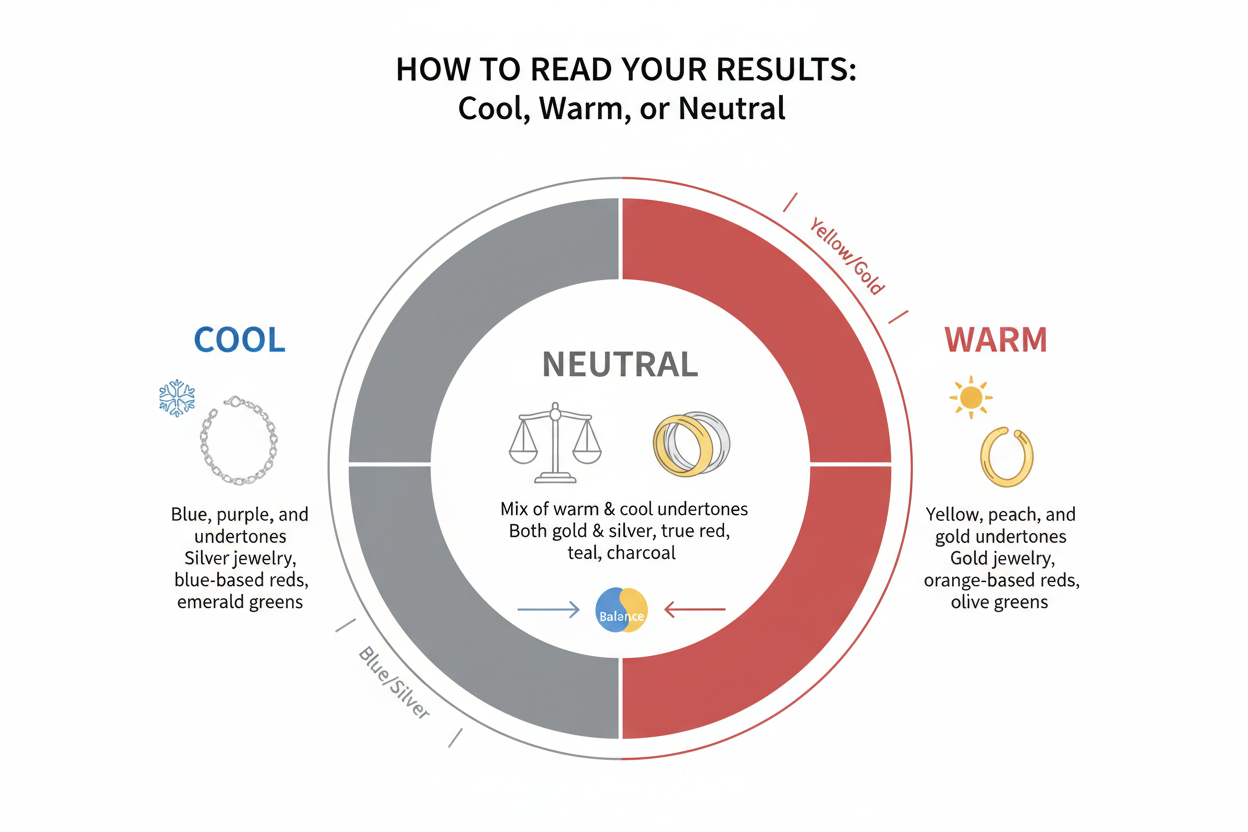
If four or five results point the same way — your undertone is clear. Trust it.
If three point one way and two point another — you likely have a dominant undertone with a slight lean. Products labeled for that dominant category will probably work best, though some neutral-leaning options may suit you just as well.
If results are evenly split — you're probably neutral. Neutral doesn't mean you have no undertone; it means neither cool nor warm dominates. That's actually an advantage: you have more flexibility with foundation shades and clothing colors than people at either end of the spectrum.
A quick summary of each category:
| Result | Underlying hue | Foundation label to look for |
|---|---|---|
| Cool | Pink, red, blue | Cool or "C" or "N" with pink cast |
| Warm | Yellow, golden, peachy | Warm or "W" or "N" with yellow cast |
| Neutral | Even mix | Neutral or "N" — works across ranges |
One thing worth knowing: your result doesn't change based on how dark or light your skin is. A cool undertone is a cool undertone whether your surface depth is fair or deep. If a result feels wrong because it doesn't match what you expected, run the tests again rather than dismissing it.
Ready to confirm your result with a faster method? Take the digital undertone quiz →
Common Mistakes That Skew Your Undertone Test Results
Even well-designed self-tests produce unreliable answers when the conditions aren't right. These are the most common errors — and how to avoid them.
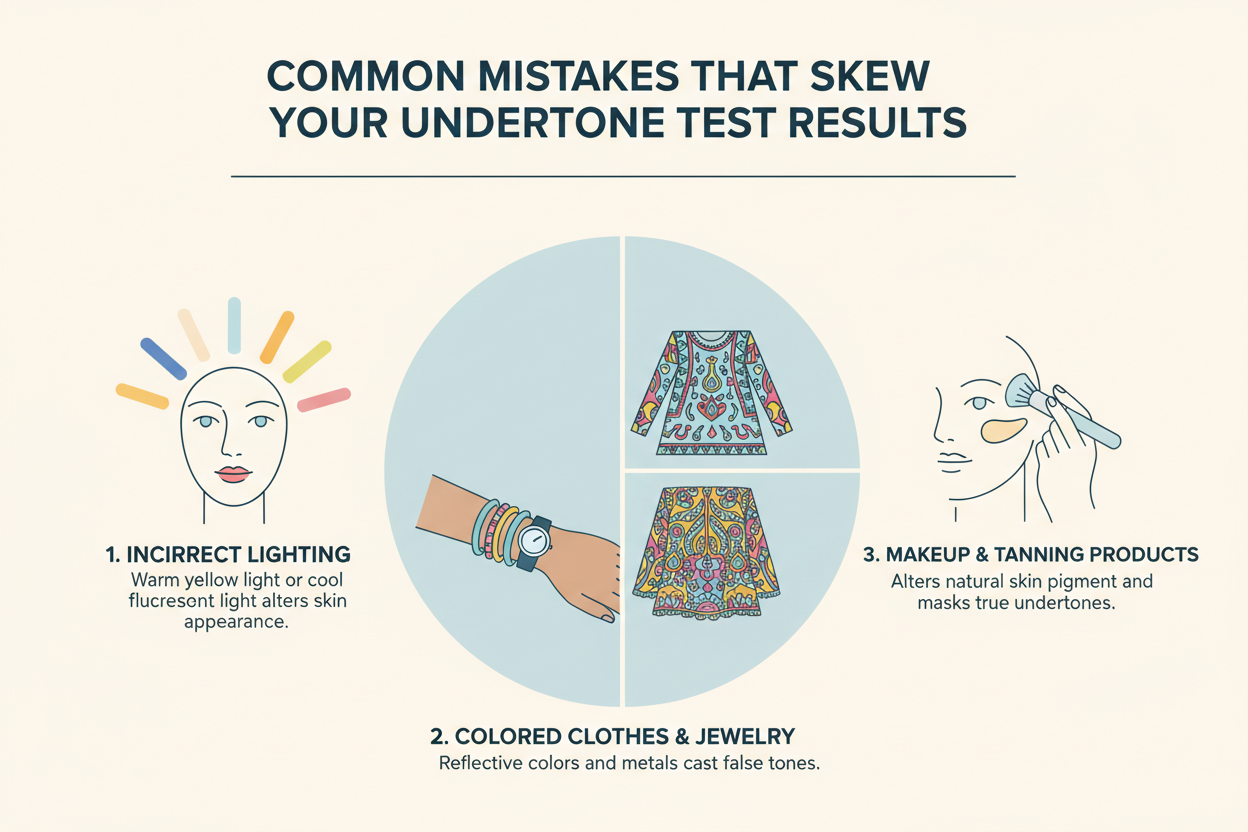
Testing under artificial lighting. Warm-toned bulbs make every undertone read warm. Cool blue LEDs pull everything toward cool. The vein test and the white paper test both need natural daylight. Do them near a window or outside.
Using the vein test as the only method. The vein test gets cited constantly and misapplied just as often. Skin depth, lighting, and surface redness all interfere with what you see. Treat it as one signal among several, not the final answer.
Testing with a tan or self-tanner on. A tan lays a warm, yellow-brown cast over your actual undertone. Self-tanner does the same thing, only more so. Wait until the tan has faded, or test on a spot that hasn't seen recent sun.
Assuming undertone based on skin depth. This one shows up in beauty advice constantly and it's just wrong. People with brown or deep skin tones get assigned warm undertones by default, often without any actual testing. When they report a cool undertone, it sometimes gets dismissed. Run the tests without a predetermined answer.
Testing with product on your skin. Foundation, tinted moisturizer, or leftover bronzer will all mask what you're trying to see. Test on completely bare, clean skin.
Testing in front of a colored wall. Surrounding colors reflect onto your skin and shift what you see. Use a white or neutral background.
Applying Your Undertone: Foundation, Clothing, and Color Choices
Knowing your undertone only matters if you do something with it. Here's how it plays out in practice.
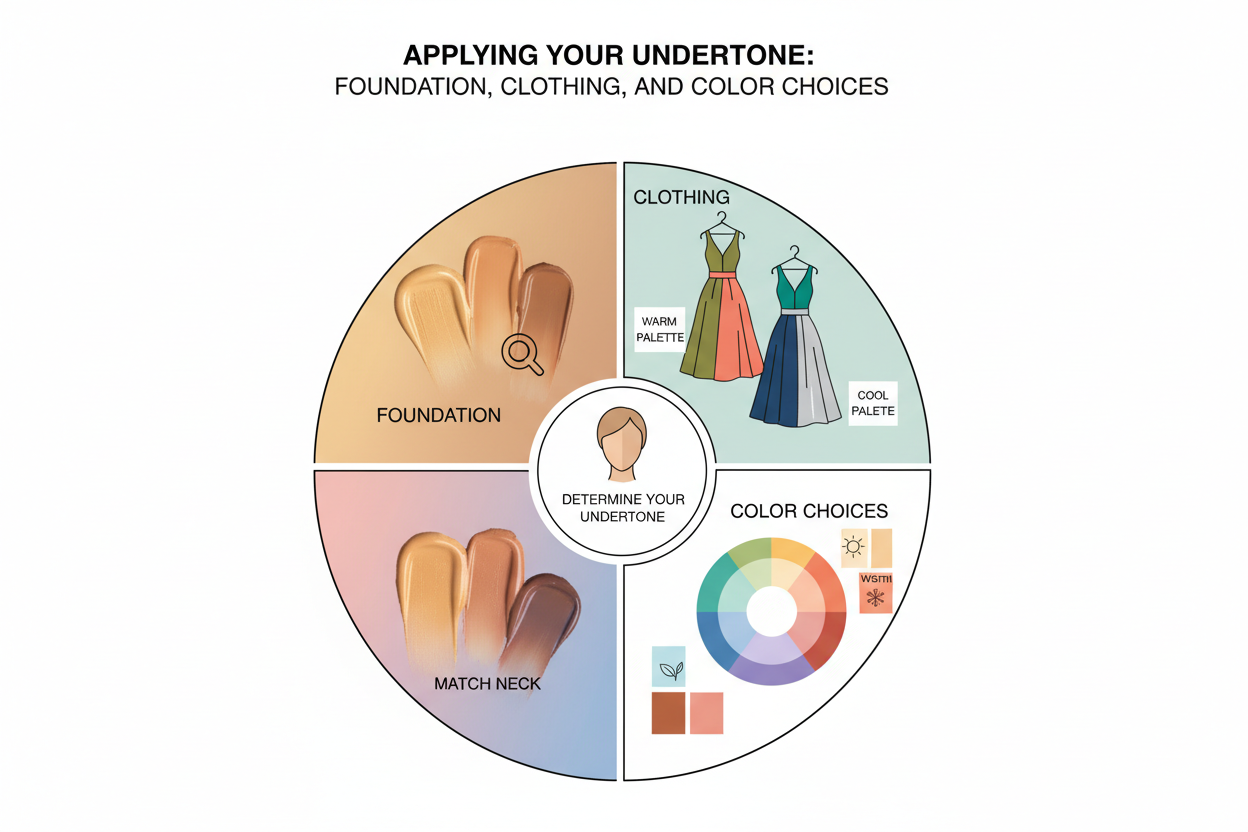
Foundation and base makeup:
Undertone is why foundations have letters like "W," "C," or "N" after the number. A shade that matches your depth but fights your undertone will look off no matter how close the surface color is. To test foundation, apply it to your jaw in natural light and wait a few minutes — that's when undertone clashes become obvious.
- Cool undertone: Look for pink, rose, or neutral-cool shades. Skip anything labeled "golden" or "honey."
- Warm undertone: Golden, peach, and yellow-leaning formulas work best. Avoid anything described as "rosy" or "pink-toned."
- Neutral undertone: You have the most flexibility. True neutral shades work well, and you can often pull off both cool and warm foundations depending on the season.
Concealer:
Same logic. A cool-toned concealer on warm skin looks ashy over dark circles. A warm concealer on cool skin can turn orange against your jaw. Get the undertone right first, then match the depth.
Clothing colors:
That glow you get from a well-chosen outfit comes from color harmony with your undertone, not just your skin tone.
- Cool undertone: Blues, purples, emerald greens, soft pinks, and true whites tend to work well. Bright white usually reads better than cream.
- Warm undertone: Earthy tones — terracotta, olive, mustard, warm browns, ivory — work naturally with a golden undertone. Cream usually beats stark white.
- Neutral undertone: Most color families work. Focus on saturation and how colors contrast with your overall coloring rather than worrying about undertone compatibility.
Hair color:
Ash tones complement cool undertones. Warm golden or copper tones suit warm undertones. Useful to know when you're deciding between two similar dye options.
Take the Digital Undertone Quiz for a Faster Answer
The five at-home methods work, but they depend on your lighting, your ability to read your own skin without bias, and having the right materials nearby. A camera-based quiz cuts most of that out.
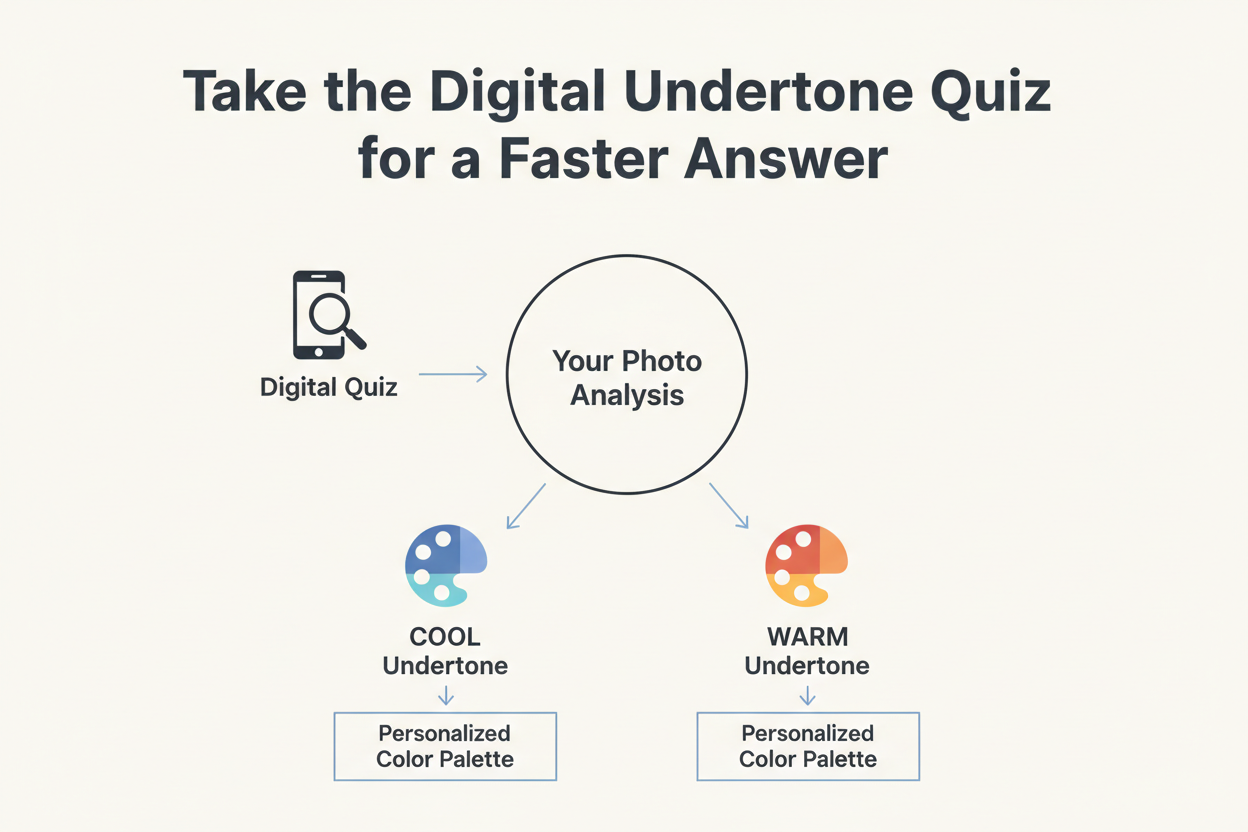
Selfie-based tools analyze your skin against a calibrated reference and return an undertone reading faster than running five manual tests. They also sidestep the self-assessment problem — the tendency to confirm what you expected rather than what your skin is actually showing.
If your at-home results were split, or you just aren't sure, a digital quiz is a reasonable tiebreaker.
Take the undertone quiz at color-analysis.app →
People Also Ask
How do I know if I have a cool or warm undertone?
Run at least three of the five at-home methods — the jewelry test, the white paper test, the vein test, the sun reaction test, and the color draping test — then look for a consistent pattern. Cool undertones show up as silver jewelry looking more flattering, blue or purple veins, and a pink or rosy cast against white paper. Warm undertones show up as gold jewelry looking better, greenish veins, and a yellow or peachy cast against white paper. One test is rarely enough. A pattern across multiple methods gives you a reliable answer.
Can you have a warm skin tone but cool undertone?
Yes, and this combination is more common than most beauty advice lets on. Surface skin tone and undertone are independent — one describes observable depth, the other describes the hue beneath it. People with deep brown or tan skin are frequently and incorrectly assumed to be warm just because of their depth. That assumption is a bias, not a fact. A person with rich brown skin can have a distinctly cool undertone, and testing — rather than assuming — is the only way to know.
What is the most accurate way to test your undertone at home?
No single method is fully reliable on its own. The most accurate approach is combining multiple tests and looking for convergence:
- The white paper test in natural daylight is one of the most consistent starting points, especially for deeper skin tones
- The jewelry test (silver vs. gold) gives a clear visual contrast that most people can read easily
- Color draping (white vs. cream fabric) adds a second layer of visual confirmation
The vein test gets the most attention but is among the least reliable when used alone — lighting, skin depth, and surface redness all affect the read. Use it as supporting evidence, not a standalone verdict. If your results are still split, a digital selfie-based quiz can serve as a useful tiebreaker.
Does undertone change with age or sun exposure?
Your undertone doesn't change — it's a fixed characteristic of your skin. What can change is how easy it is to read. A deep tan layers a warm cast over your actual undertone, which can make a cool-undertoned person appear temporarily warmer. Self-tanner does the same thing more dramatically. Surface redness from sun, heat, or irritation can also throw off the vein test and the paper test.
As skin ages, texture and tone shifts can make undertone slightly harder to detect visually, but the underlying hue stays stable. For the most accurate results, check bare skin that hasn't had significant recent sun exposure.
What undertone do most people have?
Neutral is probably the most common undertone in the general population, mostly because it covers a wide middle range rather than being a single distinct type. People with neutral undertones have a roughly even mix of cool and warm, with neither pulling ahead. True cool and true warm undertones are just as real and just as common — the difference is only that one direction clearly wins out over the other. No undertone is a default for any ethnicity, skin depth, or region, even though that idea keeps showing up in makeup advice.
FAQ
What is the difference between skin tone and undertone?
Skin tone is the observable surface color of your skin — fair, light, medium, tan, deep. Undertone is the secondary hue underneath that surface. It doesn't change with sun exposure the way surface color does.
The difference matters when you're shopping for foundation or concealer. You can match the surface color exactly and still look off if the undertone is wrong. Skin tone tells you how light or dark a shade needs to be. Undertone tells you which direction the hue should lean.
Can dark or deep skin tones have a cool undertone?
Yes. Undertone and skin depth are separate characteristics. Assuming someone has a warm undertone because they have brown or deep skin is a common bias that leads to bad product matches. Deep skin can carry cool (pink, blue, or ashy) undertones just as easily as fair skin can. The white paper method, the jewelry test, and color draping will show the actual undertone regardless of how deep the surface tone is. Test; don't assume.
Why does the vein test not always work for undertone identification?
The vein test gets taught constantly but doesn't hold up well on its own. Artificial lighting shifts how vein color reads, deeper skin tones make veins hard to see clearly, surface redness wipes out the blue-green contrast, and vein depth varies from person to person. Makeup educators with training in both Western and Korean techniques have said directly that vein color alone isn't a reliable way to determine undertone. It's useful as one data point alongside at least two other methods—not as a final answer on its own.
What colors should I wear if I have a cool undertone?
Cool undertones tend to look best in blues, purples, pinks, and jewel tones. Some specific shades that work well:
- Blues and teals — navy, cobalt, slate
- Purples and lavenders — soft lilac through deep plum
- True pinks and berries — rose, fuchsia, raspberry
- Cool neutrals — charcoal, pure white, cool taupe, soft grey
Colors with strong yellow, orange, or golden-brown bases — mustard, rust, camel, warm olive — can make cool undertones look dull or washed out. The same goes for makeup: blush with a pink or berry base, lip colors in rose or plum, and highlighters with a silver or pearl finish tend to sit more naturally than warm-toned versions.
What foundation undertone should I choose if I test as neutral?
Neutral formulas — labeled "N" on most shade ranges — are the obvious starting point, but you're not locked into them. Because you carry both warm and cool characteristics, you have more flexibility than someone at either end of the spectrum.
In practice: start with "N" shades in your depth range, then adjust. If your skin reads slightly warm-neutral, a "W" or "Y" (yellow) formula often blends better. If it reads slightly cool-neutral, try "C" or "P" (pink). Either way, swatch at least two adjacent formulas in natural light before committing.
One upside to neutral undertones: you're less likely to deal with dramatic oxidation shifts, which makes cross-brand matching a bit more forgiving.
How does knowing my undertone help me pick the right concealer?
Undertone mismatches are one of the most common reasons under-eye coverage looks grey, chalky, or orange instead of natural. Matching your undertone lets you choose a concealer that cancels discoloration rather than clashing with it:
- Cool undertone — look for concealers with a pink or peach-pink base, which neutralize blue-grey circles without turning ashy
- Warm undertone — peach or golden concealers correct dark circles without leaving an orange cast
- Neutral undertone — peachy-pink formulas tend to work well
The same logic applies to spot concealing. A concealer that matches your undertone blends into the skin and disappears; one that mismatches sits on top and draws more attention to the area you're trying to cover. Undertone is usually the single biggest factor in whether a concealer looks natural or not.
Is there a quick digital test I can take instead of doing the at-home methods?
Yes. If the at-home tests feel inconsistent, or you just want a faster starting point, a digital quiz or selfie-based tool can help. Some platforms analyze a submitted photo to match your skin tone and undertone without requiring props or good lighting. Others ask a short series of questions covering the same ground as the physical tests — how your skin reacts to sun, which metals look better against it, whether certain colors make you look tired or alive.
For the fastest result, take the free undertone quiz at color-analysis.app → — it returns a cool, warm, or neutral read with color and product guidance you can use right away.