Types of Skin Tones: Depth, Undertone, and Classification
 Reviewed by Alexandra Gilmore
Skin tone, undertone, Fitzpatrick phototype, and cosmetic skin type answer four different questions, even though people often mix their names together. Separate visible depth, color direction, sun response, and oil or dryness so you can use the right classification for foundation, styling, or clinical context.

"What type of skin tone do I have?" can mean four different questions. Someone may be asking about visible depth, undertone, sun reaction, or whether their facial skin is dry or oily. Those systems are not interchangeable. A person can have medium-depth olive skin, Fitzpatrick phototype IV, and dry facial skin at the same time.
This guide separates the classifications so you can choose the one that fits the task. Depth and undertone help with foundation and personal color analysis. Fitzpatrick phototype belongs to a sun-response and clinical context. Cosmetic skin type describes oil, dryness, and sensitivity rather than color.
If you need a visual depth-and-undertone reference, use the skin color chart. If you want to compare words such as ivory, honey, caramel, and cocoa, use the skin color names with pictures guide.
Key Takeaways
There is no single list of skin-tone types that works for every purpose. Record each answer separately: visible depth, likely undertone, Fitzpatrick phototype when medically relevant, and cosmetic skin type for skincare. Race and ethnicity are not skin-tone categories, and a photograph cannot reliably assign every classification.
💫 Discover Your Complete Color Palette
One feature rarely explains every color that works for you. Compare your undertone, depth, clarity, and contrast as a complete palette, then use the results to test clothing, makeup, and hair colors more consistently.
Find My Color Palette →📚 Recent Articles
Four Different Meanings of "Skin Type"
Every classification starts with a purpose. A makeup shade system needs enough color detail to separate products. A dermatologist may need information about sun sensitivity. A cleanser guide cares about oil and dryness. Trouble starts when a result from one system gets copied into another.
| Classification | Question it answers | Typical categories | Main use |
|---|---|---|---|
| Visible depth | How light or deep does the skin appear? | Fair, light, medium, tan, deep | Makeup, art, visual description |
| Undertone | Which color direction sits beneath the surface? | Warm, cool, neutral, olive | Foundation and personal color analysis |
| Fitzpatrick phototype | How does the skin tend to react to UV exposure? | I through VI | Sun-response and clinical context |
| Cosmetic skin type | How oily, dry, or reactive is facial skin? | Normal, dry, oily, combination, sensitive | Skincare choices |
A label from one row does not predict the others. Deep skin can be dry or oily. Fair skin can have a warm, cool, neutral, or olive undertone. A neutral undertone does not imply a particular Fitzpatrick phototype. Keep the answers in separate fields.

Classification 1: Visible Skin Depth
Visible depth describes how light or deep the skin appears under stated conditions. Consumer charts often use fair, light, light-medium, medium, tan, deep, and very deep. The boundaries overlap. A product range with forty foundation shades will divide the continuum more finely than a five-swatch illustration palette.
Melanin is the main pigment behind lasting human skin-color variation. According to the NCBI overview of melanin biochemistry, melanocytes produce pigment in melanosomes and transfer it to keratinocytes. The type, amount, and distribution of pigment contribute to visible color. Blood flow, carotenoids, skin thickness, and surface conditions also affect what the eye sees.
Depth can look different after tanning, flushing, inflammation, or a change in lighting. It also varies across the body. For foundation, compare the lower cheek, jaw, neck, and upper chest in indirect daylight. For a general description, record the body area and whether the skin was recently exposed to sun.
Depth is not race or ethnicity. People within any broad population group have a range of visible colors, and a depth label cannot identify ancestry or nationality.
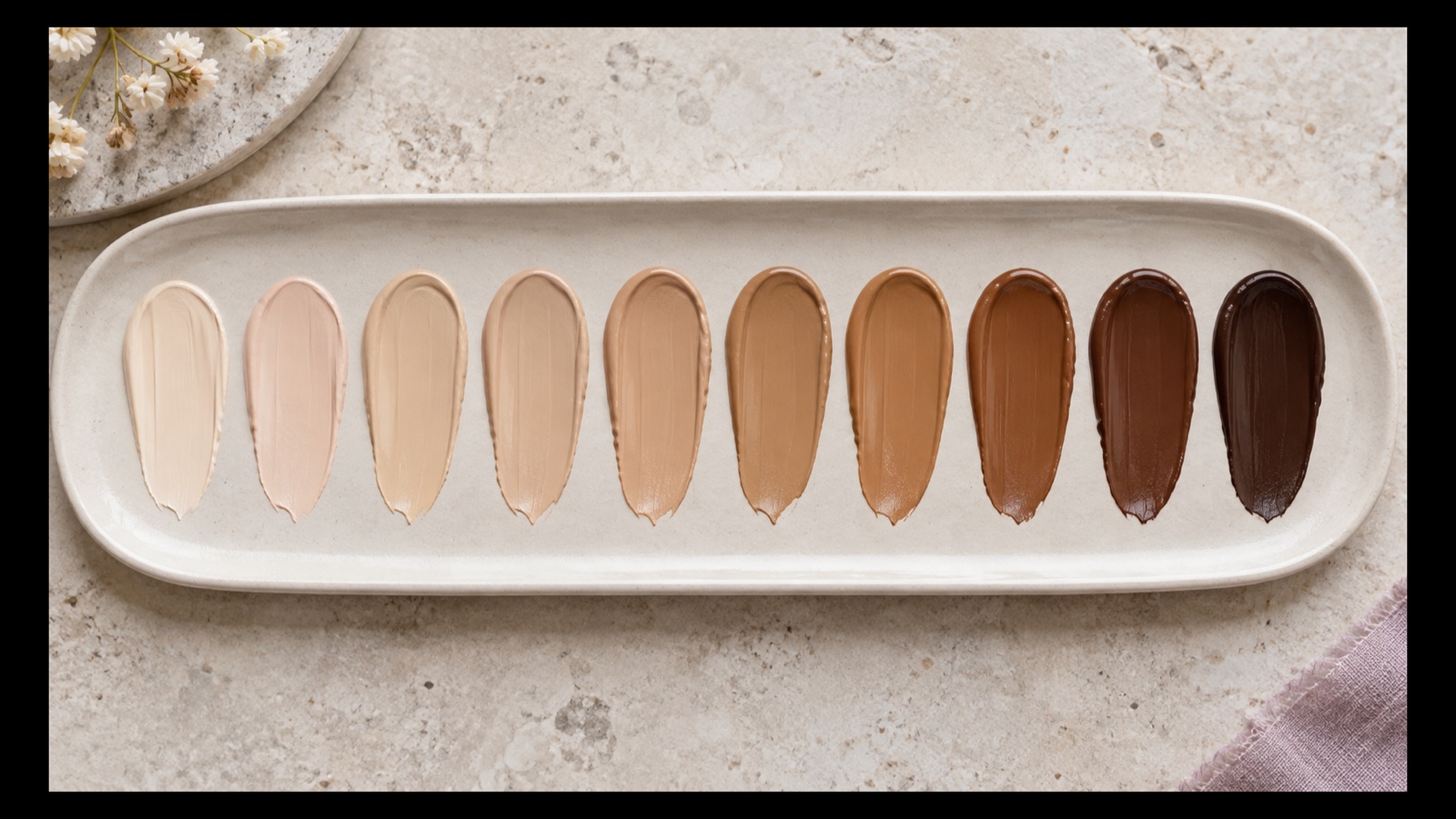
Common depth categories
- Fair: the shallowest part of many consumer ranges.
- Light: deeper than fair, with several possible undertones.
- Light-medium: a transition group often omitted from short charts.
- Medium: the center of many ranges, not a universal numerical midpoint.
- Tan: a deeper visible family; the word may also describe sun-induced change.
- Deep and very deep: broad groups that require the same undertone detail as lighter depths.
Names such as porcelain, sand, honey, caramel, and espresso are not extra scientific types. They are variable descriptions placed within these depth families.
Classification 2: Undertone
Undertone is the warmer, cooler, neutral, or olive direction perceived beneath the current surface color. It helps explain why two foundations with the same depth may look yellow, pink, orange, or gray on different people.
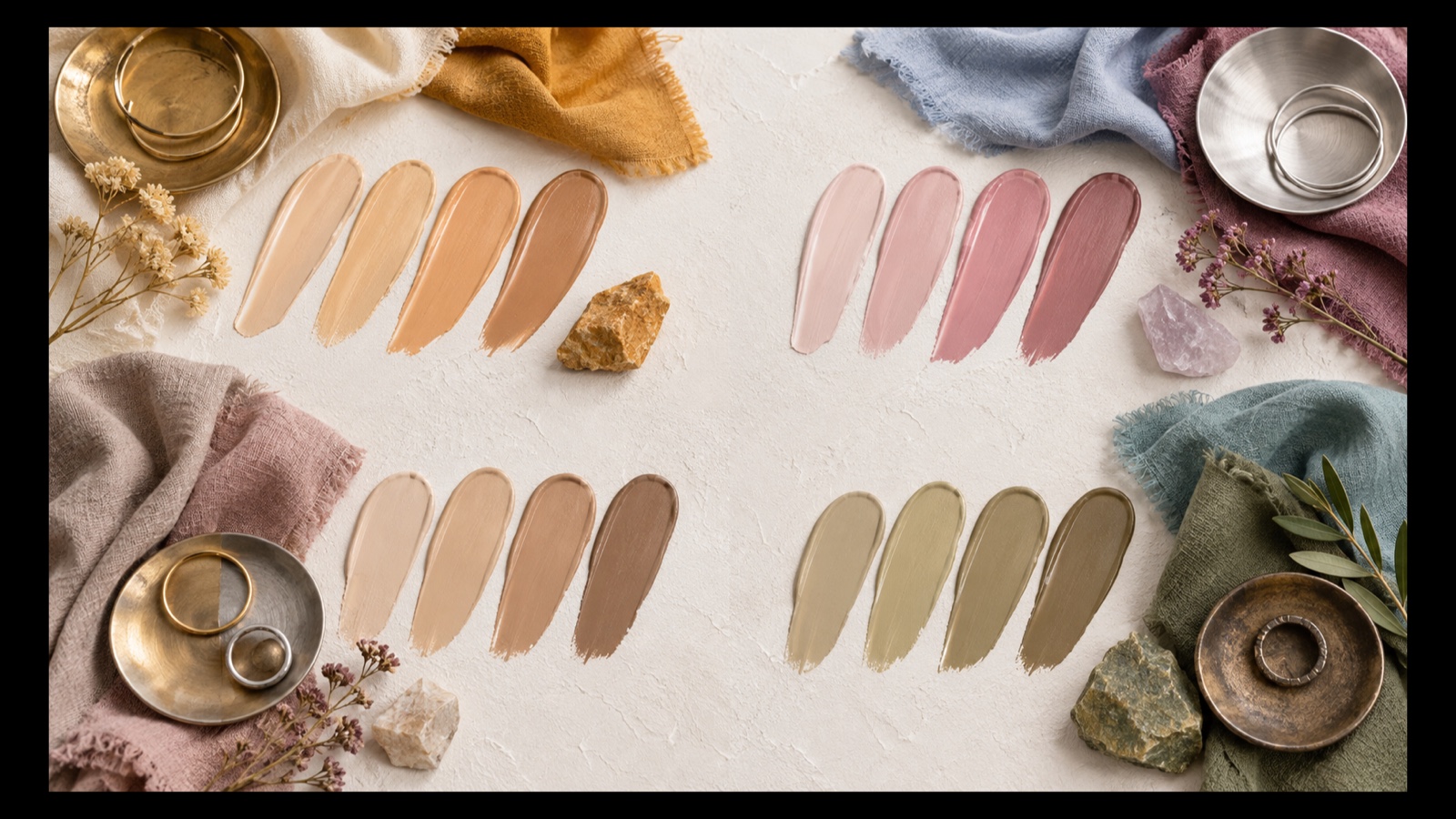
Warm undertone
Warm undertones may read golden, yellow, or peach. Warm does not mean that the surface never looks red, and it does not determine a seasonal color result without contrast and chroma.
Cool undertone
Cool undertones may read pink, rosy, red, or slightly blue. Surface flushing can imitate coolness, so compare calmer areas of the jaw and neck too.
Neutral undertone
Neutral undertones do not lean strongly warm or cool. Neutral does not mean colorless. A neutral complexion can still have depth, saturation, and local surface variation.
Olive undertone
Olive often shows a muted green or gray-green cast. It can appear at light, medium, tan, or deep depth and may lean warm, neutral, or cool. Olive should not be treated as a fifth depth between medium and tan.
Home tests provide clues rather than proof. Veins are seen through skin, jewelry preferences are subjective, and white paper can exaggerate surrounding color. Use several comparisons or follow the skin undertone test at home, which includes daylight and fabric checks.
Classification 3: Fitzpatrick Phototype
The Fitzpatrick scale contains six phototypes based mainly on reported burning and tanning after UV exposure. DermNet's phototype guide describes types I through VI by sun response and constitutional pigmentation.
| Phototype | Typical sun response | Common misuse |
|---|---|---|
| I | Always burns, does not tan | Treating it as the name of one visible pale color |
| II | Burns easily, tans poorly | Assigning it from hair or eye color alone |
| III | May burn initially, then tans | Assuming everyone in the group looks alike |
| IV | Burns minimally, tans readily | Using it as a synonym for one ethnicity |
| V | Rarely burns, tans deeply | Ignoring undertone and color variation |
| VI | Very rarely burns, deeply pigmented | Treating it as one foundation shade |
Phototype is not an exact visual color scale. A 2024 review of clinical skin-color assessments, available through PubMed, identified limitations in existing systems and specifically warned about conflating Fitzpatrick classification with race, ethnicity, and skin color.
Do not choose a phototype by matching a selfie to six pictures. Sun reaction, medical history, medications, and photosensitivity can complicate the answer. A clinician can use the appropriate assessment when phototype affects a procedure or treatment decision.
Classification 4: Cosmetic Skin Type
Cosmetic skin type describes how the face behaves, not what color it is. Common categories include normal, dry, oily, combination, and sensitive. They can change with climate, age, hormones, products, and skin conditions.
DermNet's guide to soaps and cleansers describes a simple observation after washing: oily skin shows shine and oil on a tissue, dry skin may feel tight or flaky, and combination skin often has an oily T-zone with drier cheeks. Sensitive skin may sting or react and can overlap with dryness or an underlying condition.
Normal, dry, oily, and combination
"Normal" means a comfortable balance of oil and moisture in this context, not a superior type. Dry skin lacks oil or moisture and may feel tight. Oily skin produces visible shine or residue. Combination skin behaves differently across areas of the face.
Sensitive is not a color category
Sensitivity may appear as stinging, flushing, itching, or easy irritation. Redness can be more difficult to see on deeper skin, so color alone should not determine whether a product feels irritating. Persistent symptoms deserve professional assessment.
Cosmetic skin type does not predict undertone. A person with cool, warm, neutral, or olive coloring can have any of these skincare profiles.
Other Skin Tone Scales
Representation and measurement systems serve additional purposes. The Monk Skin Tone Scale uses ten tones for work in technology, photography, and inclusion. Instrumental colorimetry can record coordinates under controlled conditions. Foundation ranges may contain dozens of product-specific shades.
These systems are not competing answers to one question. A representation scale checks whether images cover a useful range. A colorimeter records a sample. A foundation range helps select a product. None replaces the four classifications above in every context.
Which Classification Should You Use?
| Goal | Start with | Add next |
|---|---|---|
| Choose foundation | Visible depth | Undertone, formula, jaw-to-neck swatch |
| Build a personal color palette | Undertone clues | Contrast, chroma, and fabric comparisons |
| Discuss sun response | Fitzpatrick phototype | Clinical history and professional guidance when needed |
| Choose cleanser or moisturizer | Cosmetic skin type | Sensitivity and any diagnosed condition |
| Describe a complexion | Visible depth | Undertone and an image reference |
If a quiz gives one result for all of these tasks, read its definitions. A result called "type IV," "medium," or "combination" belongs to a specific system. The label is incomplete without the question it answered.
Worked Examples: One Person, Several Classifications
Consider someone whose current visible depth is light-medium and whose foundation matches tend to look best in neutral-olive shades. They report burning occasionally and developing a gradual tan. Their cheeks feel dry, while the forehead becomes shiny by midday. The useful record is not "olive skin type." It is light-medium depth, neutral-olive undertone, a phototype that must be assessed from sun history, and combination facial skin.
Now consider a person with deep visible skin and a cool red undertone. Their face feels tight after cleansing. None of those observations predicts the others. Deep describes depth, cool red describes undertone, and dry describes cosmetic skin type. Their phototype should not be guessed from the depth label or a photograph.
A third person may have fair skin with a warm peach undertone and oily facial skin. The combination is ordinary even though many simplified charts pair fair only with cool pink and warm only with deeper color. Chart design can create stereotypes when it shows too few undertone options at each depth.
Seasonal changes provide another example. Someone may move from medium to tan depth after summer sun while continuing to use neutral foundation undertones. Their cleanser needs may change in humid weather, but neither change automatically assigns a new color season or phototype. Update the line that changed and leave the others alone.
These examples show why the classification name belongs next to every result. "Type III" means something different from "skin type: dry," and "medium" means something different from "neutral." A form that stores all answers in one field will create confusion later.
How to Record Your Own Result
Use a short four-line note instead of one crowded label:
- Visible depth: medium today, checked at jaw and neck in indirect daylight.
- Undertone: neutral-to-olive; warm and cool fabric comparison still mixed.
- Phototype: leave unassigned unless the sun-response history is needed.
- Cosmetic skin type: combination, with an oily T-zone and comfortable cheeks.
Add the date if tanning or seasonal change affects the visible depth. For a product match, record the exact formula and shade that worked. For skincare, note any products or weather conditions that changed dryness or sensitivity.
This format also makes uncertainty useful. "Neutral-to-olive" is a better working note than a forced warm result that changes under every light. You can update one line without rebuilding the whole profile.
When to check again
Repeat the visible-depth comparison when a current foundation stops matching or after a clear seasonal change. Recheck cosmetic skin type when climate, medication, hormones, or a new routine changes how the face feels. Undertone does not need a monthly test; repeat it only when the original result was uncertain or was taken under poor lighting.
Phototype is different. Do not stage sun exposure to test it. Use remembered burn and tan history, and ask a qualified clinician when the answer affects a procedure, medication, or medical risk. Save the clinician's wording with the date and reason for the assessment for future reference. A beauty quiz should not replace that assessment.
Common Classification Errors
The most common error is using "skin type" without defining the system. Another is turning depth into undertone, as if every fair complexion were cool or every deep complexion were warm. Both assumptions fail.
Do not assign Fitzpatrick phototype from visible color alone, and do not use it as a racial label. Do not use oiliness or sensitivity to infer undertone. Do not transfer poetic foundation names between brands as if they were standardized measurements.
Finally, avoid treating one category as healthier or more attractive. These classifications describe different physical properties. They do not rank people.
People Also Ask
What are the main types of skin tones?
For visible color, broad depth families are fair, light, light-medium, medium, tan, deep, and very deep. Each can have warm, cool, neutral, or olive undertones. Other systems, such as Fitzpatrick phototype and cosmetic skin type, classify different properties.
What is the difference between skin tone and skin type?
Skin tone usually means visible depth and sometimes undertone. Cosmetic skin type describes oiliness, dryness, combination behavior, or sensitivity. Fitzpatrick "skin type" is a phototype based on sun response. The shared word "type" does not make them the same system.
Can my skin tone type change?
Visible depth can shift with tanning and surface conditions. Cosmetic skin type can change with climate, products, hormones, and age. Undertone is generally treated as more stable, though it may be difficult to see under redness or a tan.
Is olive a skin tone type?
Olive is usually an undertone or muted color cast, not one depth. It can occur across several visible depth families and may lean warm, neutral, or cool.
Does Fitzpatrick type tell me my foundation shade?
No. Fitzpatrick phototype groups sun reaction and does not provide enough color detail for a foundation match. Foundation selection needs current visible depth, undertone, and an on-skin comparison in the chosen formula.
Are dry, oily, and combination skin related to skin color?
They describe facial oil and moisture behavior, not pigmentation. Any visible depth or undertone can be dry, oily, normal, combination, or sensitive.
The simplest way to avoid confusion is to name the system before the result. Say "medium depth," "olive undertone," "phototype IV," or "combination facial skin." Each phrase answers one clear question and leaves the others open.