Skin Color Names With Pictures: A Descriptive Guide
 Reviewed by Alexandra Gilmore
Ivory, honey, caramel, cocoa, and espresso are useful shorthand only when a picture shows the intended shade. Compare common names by visible depth and undertone, then treat each example as flexible vocabulary rather than a scientific category or a universal label shared by every brand.

Skin color names such as ivory, beige, honey, caramel, cocoa, and espresso are descriptive shortcuts. They help people discuss visible depth and color direction, especially in makeup, illustration, and personal color analysis. They are not scientific categories, and the same word can point to a different shade in another brand or chart.
That inconsistency is why a picture matters. A name alone tells you very little; a labeled image shows the speaker's intended depth and undertone. Even then, lighting and screen settings can shift the example. Use the names below as a shared vocabulary, not as fixed boxes that every complexion must fit.
This page concentrates on the words people use. For a visual grid organized by depth and undertone, open the skin color chart. For the difference between color depth, undertone, phototype, and cosmetic skin type, read types of skin tones and classification.
Key Takeaways
There is no official master list of skin color names. Most labels describe a rough depth, sometimes with a warm, cool, neutral, or olive cast. A precise description combines both dimensions, such as "light with a cool undertone" or "deep with a neutral-to-warm undertone." These color words do not describe race or ethnicity, health, or how someone will react to the sun.
💫 Discover Your Complete Color Palette
One feature rarely explains every color that works for you. Compare your undertone, depth, clarity, and contrast as a complete palette, then use the results to test clothing, makeup, and hair colors more consistently.
Find My Color Palette →📚 Recent Articles
Names Are Descriptions, Not Official Categories
Human skin pigmentation varies continuously. The NCBI overview of melanin biochemistry explains how melanocytes produce pigment in melanosomes and transfer it to surrounding skin cells. The amount, type, and distribution of pigment contribute to visible variation, but a consumer word such as "sand" or "cocoa" is not a biological measurement.
Beauty brands create names for their own product ranges. Writers and artists use other vocabularies. A word can suggest a family, but there is no central body deciding exactly where beige ends and tan begins. Even basic depth labels such as fair, light, medium, tan, deep, and very deep have soft boundaries.
Names can also carry social meanings that differ across languages and places. A neutral description should focus on visible color without assigning personality, value, ancestry, or attractiveness. When accuracy matters, pair the word with a picture, a depth label, an undertone, and the lighting conditions.
| Weak description | More useful description | What improved |
|---|---|---|
| Ivory | Fair-light ivory with a neutral undertone | Adds depth and color direction |
| Beige | Light-medium beige with a muted warm undertone | Separates warmth from depth |
| Caramel | Medium-tan caramel with a golden undertone | Shows which version of caramel is meant |
| Cocoa | Deep cocoa with a neutral-red undertone | Avoids treating all deep browns as identical |
How to Describe Skin Color More Precisely
Start with visible depth. Compare the lower cheek, jaw, neck, and upper chest in indirect daylight. Choose a broad family: fair, light, light-medium, medium, tan, deep, or very deep. This is the part most everyday names try to describe.
Next add undertone. Warm skin may read golden, yellow, or peach. Cool skin may read rosy, pink, red, or slightly blue. Neutral sits between those directions. Olive often has a muted green or gray-green cast and can occur at more than one depth.
Surface effects come last. Redness, a tan, freckles, hyperpigmentation, and shadows can change the current view without defining the whole complexion. If the cheeks are flushed, look at the jaw and neck too. If the face and chest differ, record the difference instead of forcing one name.
For example, "medium olive" is clearer than "olive," because olive does not tell you the depth. "Deep cool brown" is clearer than "dark," because it adds a color direction. A description can remain approximate. The goal is to help another person picture the range, not to produce a permanent identity label.
Fair and Light Skin Color Names
Fair and light labels sit at the shallow end of the visible depth range. Their differences are often small, so undertone and lighting have a large effect on the name someone chooses.
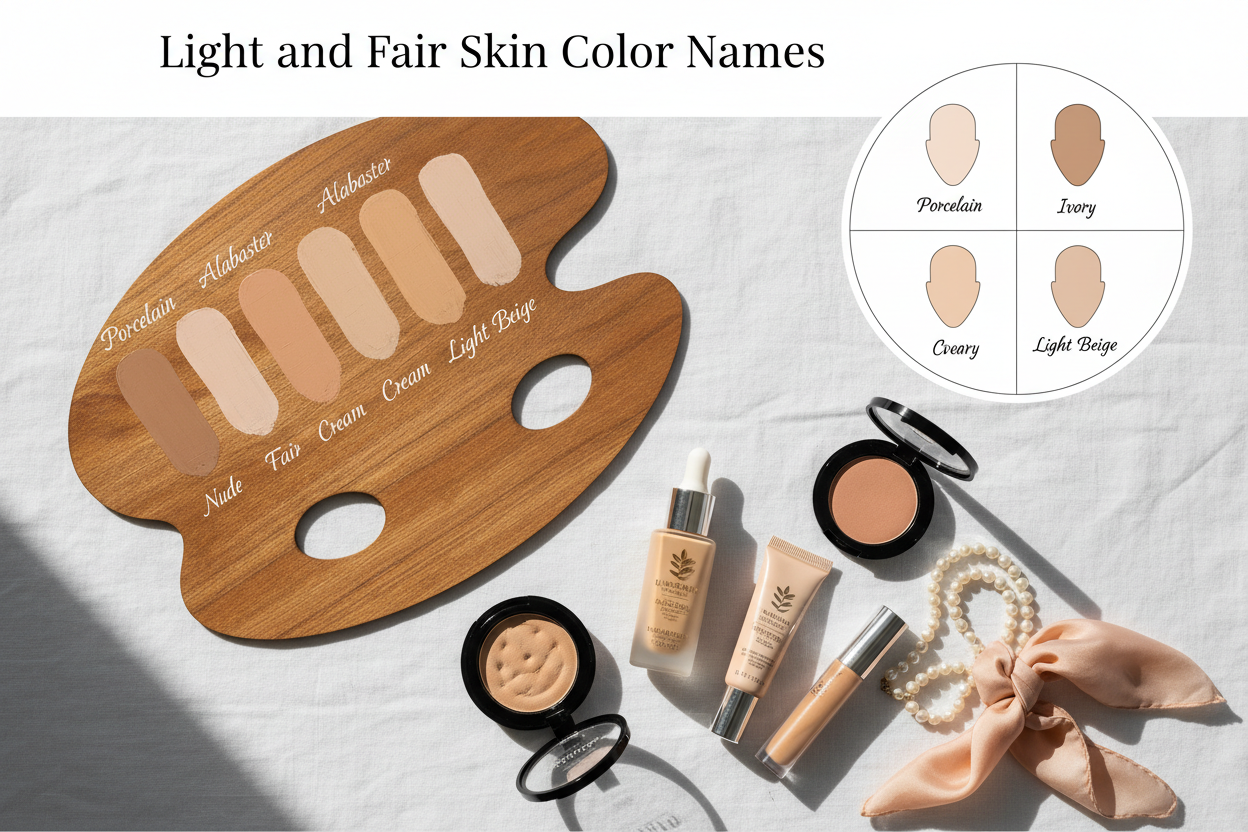
Porcelain
Porcelain usually means very fair skin with a clear or delicate appearance. Some charts use it for cool pink complexions, while others offer warm and neutral porcelain shades. The word does not guarantee a cool undertone.
Alabaster
Alabaster often describes very fair to fair skin that appears soft or low in saturation. It may be used for neutral, cool, or slightly warm complexions. In product names it can overlap almost completely with porcelain.
Ivory
Ivory usually covers fair to light skin. Warm ivory leans creamy or yellow; cool ivory may look pinker; neutral ivory sits between them. Because the label is common across beauty brands, it is one of the least consistent without an undertone description.
Fair and light
Fair and light are broad depth terms rather than shade names. Fair is generally shallower than light, but the boundary changes by chart. They are useful precisely because they make fewer claims than a poetic product name.
Light beige
Light beige is deeper than many ivory labels and more muted than peach. It can be warm, cool, neutral, or olive. A brand may place several different undertones under the same light-beige depth family.
Medium and Tan Skin Color Names
The middle of the range contains the greatest naming overlap. Beige, sand, honey, almond, tan, caramel, amber, and bronze may all appear here, but their order is not stable across charts.
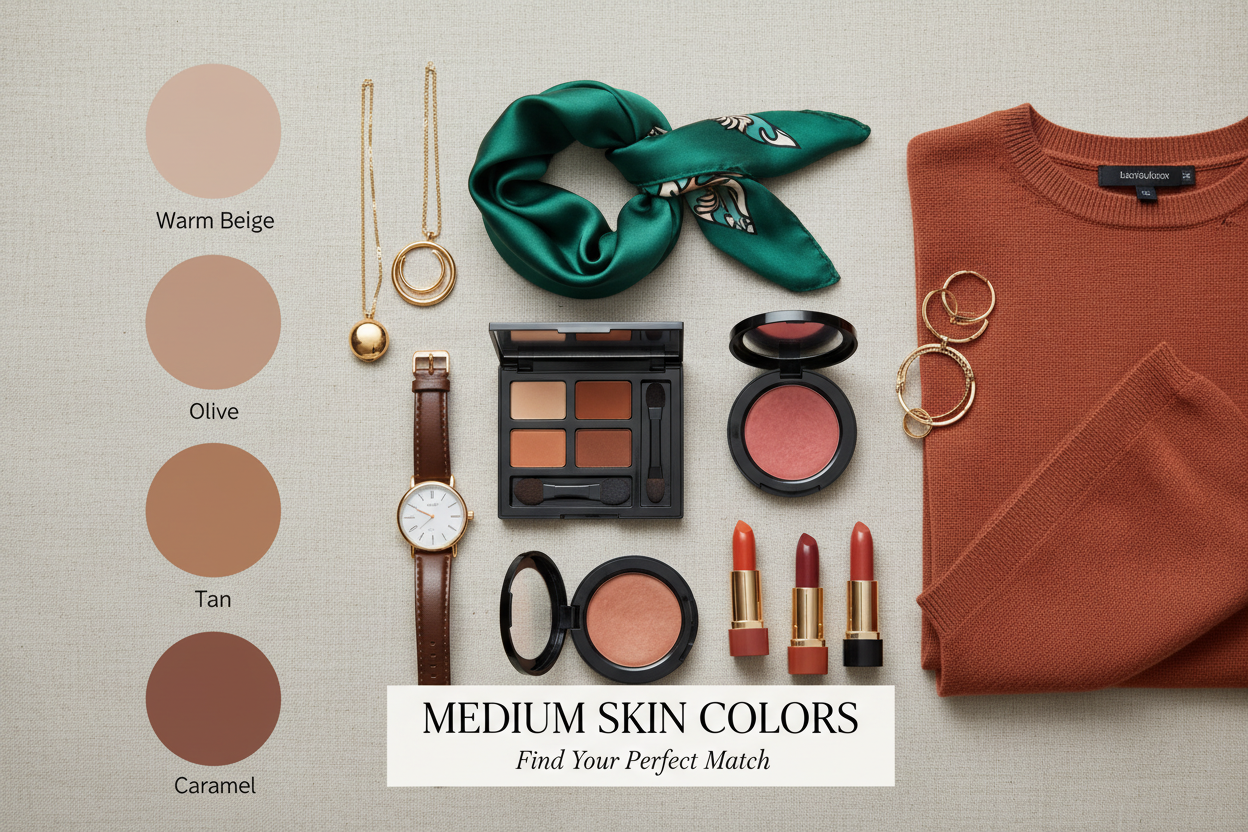
Beige
Beige can cover light, light-medium, or medium depth. It often suggests a balanced, slightly muted color, though names such as golden beige, rose beige, and olive beige show how broad the family is.
Sand
Sand usually sits near light-medium or medium. It often implies a neutral-to-warm beige, but some ranges use "cool sand." The neighboring shades on the same chart are more informative than the word by itself.
Honey
Honey commonly describes a medium color with a golden or warm undertone. Depending on the range, it may sit close to warm beige or extend into tan. It should not be used as a synonym for every warm medium complexion.
Almond
Almond is often medium or medium-tan with a neutral, golden, or muted undertone. Some brands use it much deeper. Pair it with a swatch or a depth family before relying on the name.
Tan
Tan can mean a naturally medium-deep visible tone or a temporary deepening after sun exposure. In a product range, it usually marks depth rather than the cause of the color. A person may move into a deeper foundation family after tanning while keeping a similar undertone.
Caramel, amber, and bronze
Caramel often describes medium-tan to deep warm brown. Amber suggests a golden or orange-brown direction. Bronze usually implies a warm or metallic golden-brown cast. All three are expressive names with wide boundaries, so they work best beside an image.
Deep and Dark Skin Color Names
Deep and very deep complexions contain as much undertone variation as lighter complexions. A short list of brown names often compresses that variation. Neutral, golden, red, cool, and olive directions all occur across deeper depths.
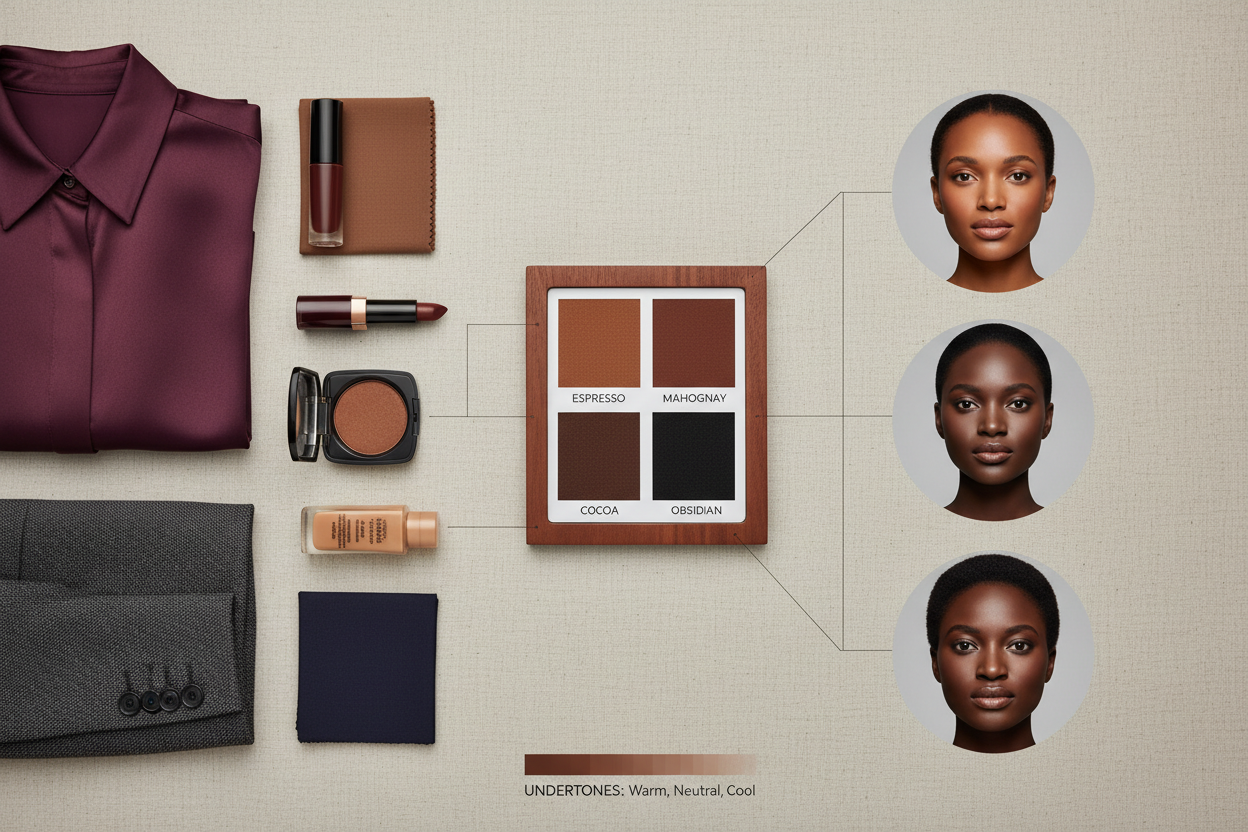
Brown and deep brown
Brown is a broad visible-color term. "Medium-deep neutral brown" or "deep warm brown" gives far more information. Deep brown should not be assumed to have one undertone.
Chestnut and mahogany
Chestnut usually suggests a warm or red-brown color at tan-to-deep depth. Mahogany often implies a deeper red or burgundy-brown direction. Product ranges sometimes reverse their order, so neither word is a measurement.
Cocoa and mocha
Cocoa and mocha usually describe deep brown shades. Cocoa may lean neutral or warm; mocha is sometimes used for a softer or cooler brown. The food comparison gives a rough impression, not an exact hue.
Espresso
Espresso often sits in the deep or very deep part of a range. It may be neutral, cool, or red-brown. A label such as "deep neutral espresso" is more helpful than espresso alone.
Ebony
Ebony is commonly used for very deep skin colors, often with a neutral or cool direction. Some people find the term useful; others prefer plain depth-and-undertone language. Use the wording a person chooses for themselves when describing an individual.
Where Olive Fits
Olive is best understood as a color direction rather than one point on the depth ladder. It can appear light, medium, tan, or deep. The muted green or gray-green cast may be easier to notice beside a clearly pink or golden comparison.
Olive skin can lean warm, neutral, or cool. This is why "olive equals medium tan" and "olive equals warm" both fail. A useful phrase includes depth, such as light cool olive, medium neutral olive, or deep warm olive.
Veins and jewelry can offer clues, but they do not settle the result. The at-home undertone guide combines several comparisons and explains why surface redness can hide olive tones.
How Names Change Across Brands and Images
Foundation names belong to a specific formula and shade system. One brand's honey may be another brand's golden beige. A converter can point to a nearby range, but the final product still needs a jaw-to-neck test because coverage, finish, and dry-down affect the result.
Images add another layer of uncertainty. Camera exposure, white balance, editing, screen brightness, and nearby colors change how a complexion appears. A labeled picture is more useful than text alone, but it is still a reference.
Formal scales also serve different purposes. A 2024 dermatology review available through PubMed warns against conflating Fitzpatrick phototype with skin color, race, or ethnicity. Google Research's study of skin tone representation scales compares systems designed for technology and inclusion. Neither source creates an official list of beauty shade names.
| Context | What the name is doing | What to check |
|---|---|---|
| Foundation range | Locating one shade within one product | Depth, undertone, formula, and dry-down |
| Color analysis | Describing visible coloring | Undertone, contrast, and chroma beside fabrics |
| Illustration | Naming a palette swatch | Lighting, highlights, shadows, and neighboring values |
| Personal description | Communicating how someone sees their own complexion | The person's preferred wording |
Choosing Words for a Real Person
When you describe yourself, use the language that helps you shop, draw, or communicate. When you describe someone else, plain color language is usually safer than a creative comparison. "Medium-deep with a warm undertone" is specific and neutral. It does not assume that the person likes a product-style name.
Context matters. A makeup artist may need a working shade description. A photographer may need a reference tone for exposure and color grading. A doctor may need a clinical classification that has nothing to do with foundation names. The same person can receive different labels in those settings because the systems are answering different questions.
Avoid turning color words into racial or ethnic labels. People within every broad population group have substantial variation in visible pigmentation and undertone. A skin color name cannot identify ancestry, nationality, or culture. If those details matter to the conversation, ask directly and use the person's own description.
Also watch for value judgments hidden in the vocabulary. Light is not more "pure," and deep is not more "exotic." Warm is not friendlier than cool. These are color directions. Remove adjectives that describe a personality or social status rather than something visible.
For accessibility, do not rely on the picture alone. Add alt text that states the depth and undertone being compared. In a chart, keep the labels next to the swatches and use enough contrast for the text. A reader should still understand the comparison if the image does not load or if color perception differs.
People Also Ask
What are the main skin color names?
Common names include porcelain, alabaster, ivory, beige, sand, honey, almond, tan, caramel, amber, bronze, brown, chestnut, cocoa, mocha, espresso, and ebony. They overlap and do not form an official ordered scale.
How do I find the name of my skin color?
First choose a broad depth in indirect daylight. Then add the undertone direction. Compare your result with labeled pictures and use a two-part description such as "light neutral beige" or "deep warm brown." If two names fit, keep the plain depth-and-undertone description.
Are skin tone names the same in every makeup brand?
No. Each brand names and spaces its own range. The same word may refer to a different depth or undertone in another formula. Compare the brand's swatches and shade descriptions rather than transferring the name alone.
Can two people with the same skin color name have different undertones?
Yes. Two medium-beige complexions may be warm and cool, or neutral and olive. The shared name describes only a rough visible neighborhood.
Does my skin color name change after tanning?
The closest depth label may change after tanning, while the broader undertone direction often remains similar. Record the current visible depth rather than treating an old shade name as permanent.
Is there an official skin color naming system?
No single naming system controls beauty, art, technology, and medicine. Those fields use different charts and scales for different tasks. Use descriptive names for communication and the appropriate formal system when a clinical or measured classification is needed.
A good skin color description is specific without pretending to be exact. Start with depth, add undertone, include a picture or swatch when possible, and state the context carefully. Repeat the comparison in neutral daylight if the label changes under warm or cool room lighting. That small amount of detail prevents most of the confusion created by one-word names.