Color Season Quiz for Men
 Reviewed by Alexandra Gilmore
A men's season quiz becomes manageable when it focuses on undertone, depth, and natural contrast instead of stereotypes about hair or eye color. Use the result to narrow shirts, suits, jackets, and casual wear, then check the palette against your face before rebuilding anything.

Figuring out which colors actually work for you doesn't have to take an afternoon in front of a mirror or a costly appointment with a style consultant. A targeted seasonal color analysis quiz for men cuts through the noise by focusing on the three physical traits that genuinely drive your best palette: skin tone, undertone, and natural contrast level.
💫 Discover Your Complete Color Palette
Ready to discover all the colors that make you look radiant? Our comprehensive color analysis will reveal your complete personal palette - perfect for hair, makeup, and wardrobe decisions.
Find My Season →Most men report that finding their color season feels overwhelming at first—there are seemingly endless variables to weigh, and generic advice rarely accounts for how men's coloring differs from the frameworks originally built around women's fashion. The good news is that the core logic is straightforward once it's framed correctly, and a well-built quiz can surface a reliable result in minutes rather than hours.
Here's what a focused men's color season quiz delivers:
- Speed. Some structured quizzes return an instant result after as few as three questions, making it easy to get a working answer before your next shopping trip.
- Accuracy grounded in expertise. The best versions of these quizzes are developed with input from color analysts and fashion stylists, applying the same seasonal framework professionals use in paid consultations.
- A practical starting point. Even if you later refine your result with in-person draping, a quiz gives you an actionable palette to work with right now—so you stop buying colors that wash you out and start choosing shades that make your natural features look sharper.
Work through the questions in the next section with your natural, unaltered coloring in mind—no tan, no hair dye if possible—and you'll walk away with a clear season to build on.
📚 Recent Articles
Why Seasonal Color Analysis Works Differently for Men
Color analysis has a reputation for being a women's thing—and that's mostly a marketing problem, not a scientific one. The seasonal framework maps your natural coloring to a set of harmonious shades regardless of gender. What changes for men is how those palettes translate into actual wardrobe choices: suits, casualwear, outerwear, and the neutrals that hold everything together.
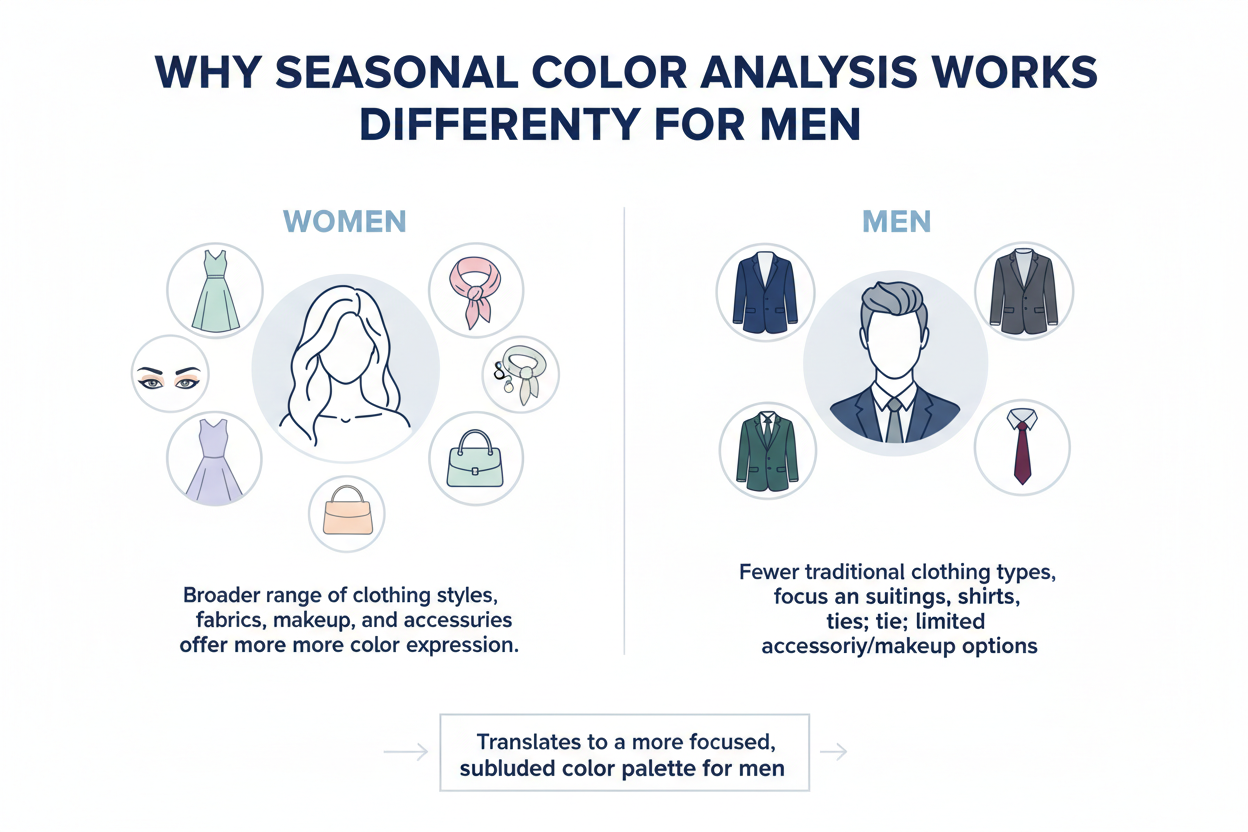
The stakes are also a bit different in practice. Men's wardrobes tend toward fewer, more expensive pieces worn on repeat, so a bad color choice compounds. A suit in the wrong undertone doesn't just look off in photos—it affects how you come across in every room you walk into. A good seasonal quiz applies the same framework professionals use, adapted for a context where getting it wrong costs real money.
The payoff is straightforward: colors that work with your natural features make you look sharper and more put-together. Stylists who do this work with men regularly say it also tends to make people look more confident and younger. That's not vanity. That's just dressing on purpose.
[→ Find your color season now — takes under two minutes]
What the Quiz Actually Measures: Skin Tone, Undertone, and Natural Contrast
It helps to know what the quiz is actually assessing before you start. Three things go in, and knowing what they are reduces the chance you'll answer a question based on the wrong feature.
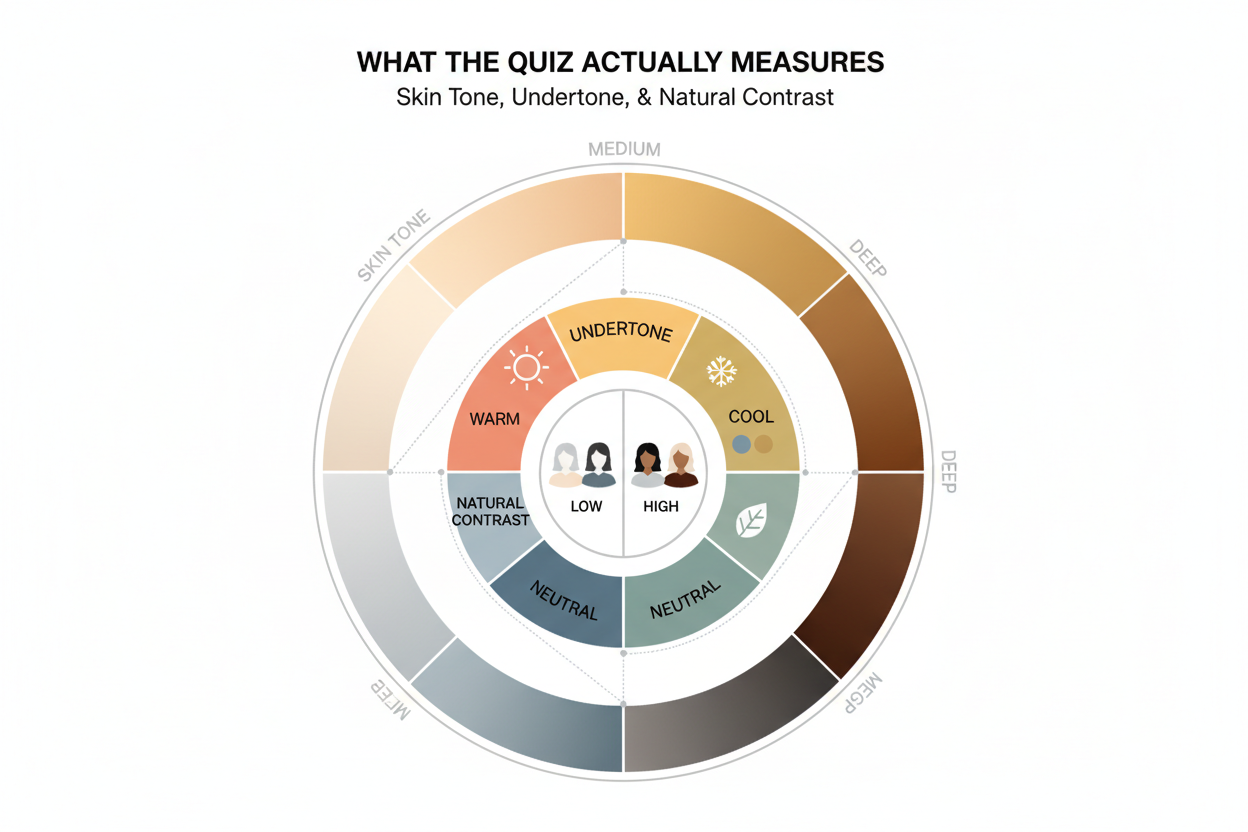
1. Skin tone (depth) This is how light or deep your complexion looks on a spectrum from very fair to very dark. It's the most visible characteristic and the easiest to observe, but it doesn't determine your season on its own.
2. Undertone Undertone is the underlying hue beneath your skin's surface—warm (yellow, golden, or peachy), cool (pink, red, or bluish), or neutral (a mix of both). This is where most men go wrong when self-assessing, because undertone is easily distorted by lighting, tan lines, or redness. Check the inside of your wrist in natural daylight: greenish veins tend warm, bluish-purple veins tend cool.
3. Natural contrast level Contrast is the visual difference between your skin tone, hair color, and eye color. Pale skin with very dark hair is high contrast. Medium skin with medium-brown hair and eyes is low contrast. This variable determines whether you fall into a higher-contrast season (Winter, Spring) or a softer one (Summer, Autumn).
Depth, undertone, and contrast are the three levers the quiz uses to narrow you to one of four seasons. Nothing else factors in.
The 4 Color Seasons Explained for Men's Wardrobes
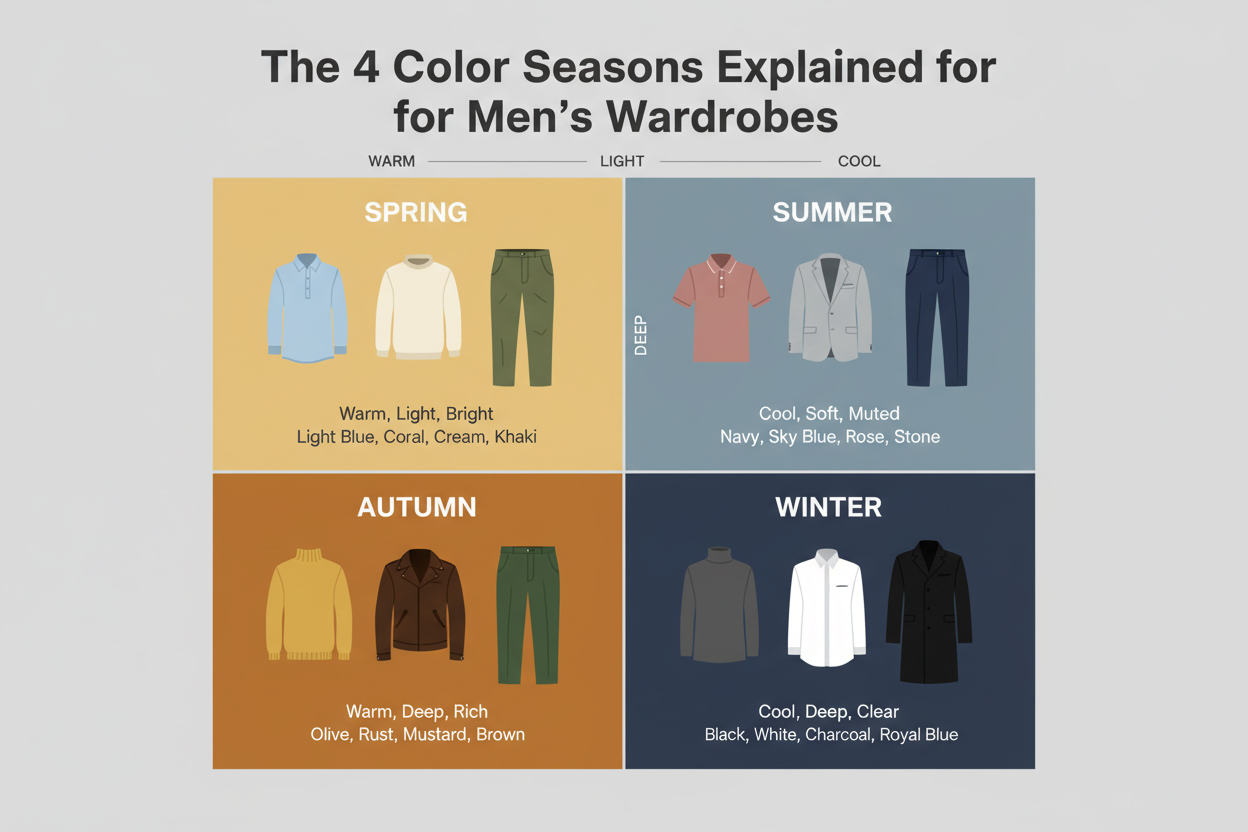
Every man's natural coloring maps to one of four seasons. Each season represents a family of colors that work with your specific combination of depth, undertone, and contrast. Here's how each one translates into practical wardrobe terms.
Cool Seasons: Summer and Winter for Men
Summer and Winter men both have cool undertones—their best colors run toward blue, gray, and rosy tones rather than yellow or orange. What separates them is contrast level.
Summer Summer men have low-to-medium contrast coloring: ash-blond or light-to-medium brown hair, light or medium cool-toned skin, soft eye colors. The Summer palette is muted and quiet—colors grayed down rather than vivid.
- Best neutrals: Soft navy, medium gray, slate blue, rose-taupe
- Best accent colors: Dusty rose, powder blue, lavender, soft teal
- Wardrobe note: A medium gray suit in a slightly cool tone is a Summer man's workhorse. Stark black-and-white combinations create more contrast than the palette can handle.
Winter Winter men have high natural contrast: dark hair against fair or deep skin, clear sharp eye colors. The Winter palette is bold and saturated—no muddiness.
- Best neutrals: True black, bright white, charcoal, pure navy
- Best accent colors: Icy pastels, jewel tones (sapphire, emerald, magenta), true red
- Wardrobe note: A black suit with a white or icy-blue shirt is a natural Winter combination. Earthy, muted tones like camel or olive tend to flatten a Winter man's features.
Warm Seasons: Spring and Autumn for Men
Spring and Autumn men both have warm undertones—their coloring leans golden, peachy, or bronze rather than pink or ashy. The difference comes down to depth and saturation.
Spring Spring men tend toward lighter, clearer coloring: golden-blond or light warm-brown hair, a peachy or ivory complexion, bright eye colors. The Spring palette is warm and clear—fresh rather than heavy.
- Best neutrals: Warm ivory, camel, light tan, warm khaki
- Best accent colors: Coral, turquoise, warm peach, bright warm greens, golden yellow
- Wardrobe note: A camel chore coat or tan chino suit reads naturally on a Spring man. Heavy, dark earth tones—deep burgundy, dark chocolate—tend to overwhelm a lighter Spring palette.
Autumn Autumn men have deeper, richer warm coloring: auburn, dark copper, or warm brown hair, an olive or golden-bronze complexion, warm hazel or dark brown eyes. The Autumn palette is warm and muted—complex and earthy rather than bright.
- Best neutrals: Chocolate brown, rust, dark olive, warm camel
- Best accent colors: Burnt orange, forest green, mustard, deep teal, terracotta
- Wardrobe note: An olive field jacket, a rust-toned henley, or a dark brown leather piece all sit naturally within an Autumn palette. Cool-toned grays and stark whites create an undertone mismatch that reads as slightly off, even if you can't immediately explain why.
Take the Seasonal Color Analysis Quiz for Men
You have enough context to answer the quiz questions with confidence. It looks at the three variables covered above—skin tone depth, undertone, and contrast—and gives you an instant result tied to one of the four seasons.
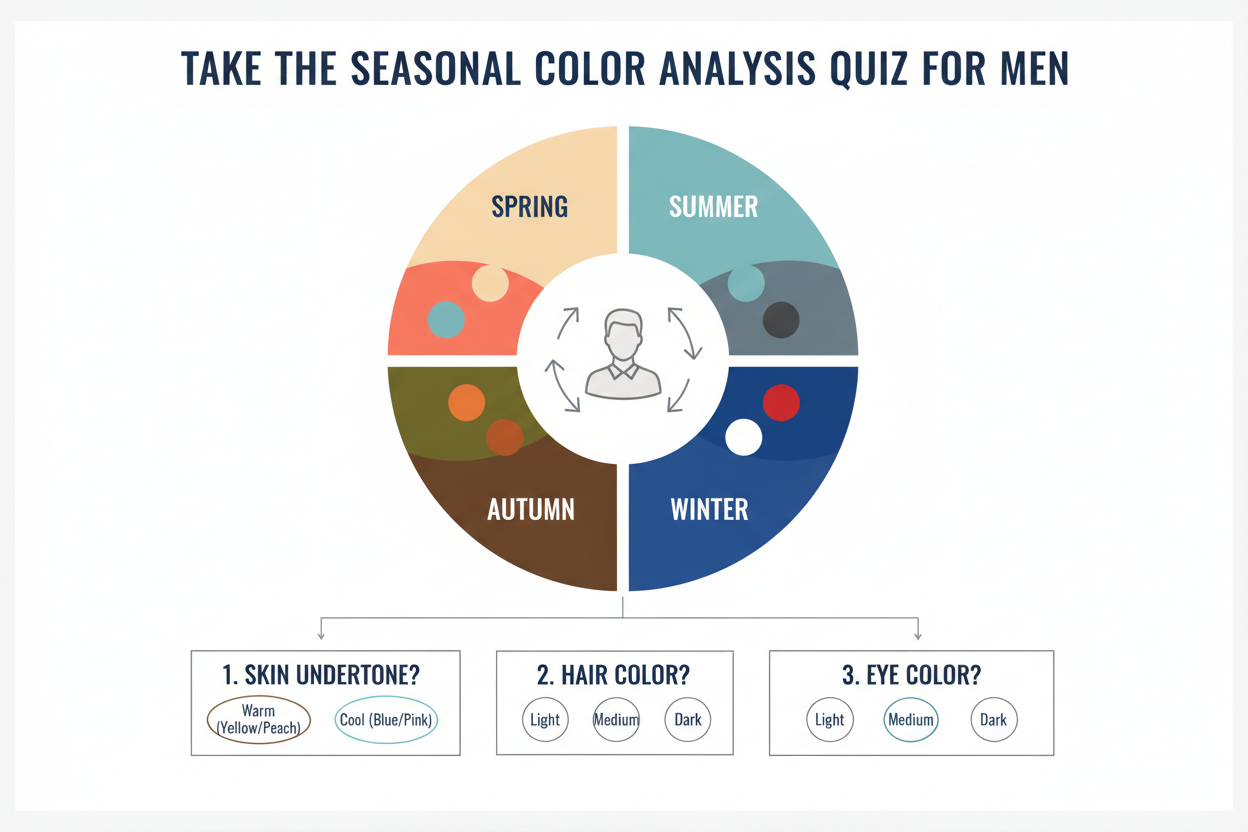
A few reminders before you start:
- Use your natural coloring. If your hair is dyed, think back to your natural shade or look at your roots. If you have a recent tan, assess your baseline skin tone, not the tanned version.
- Use natural light. Artificial lighting—especially warm incandescent bulbs—throws off undertone readings.
- Answer quickly. Your first instinct is usually more accurate than an overanalyzed one.
[→ Start the seasonal color analysis quiz for men]
How to Use Your Color Season Results to Build a Wardrobe
A season result is most useful as a filtering tool, not a rigid rule. The goal is faster, better decisions—not a weekend wardrobe overhaul.
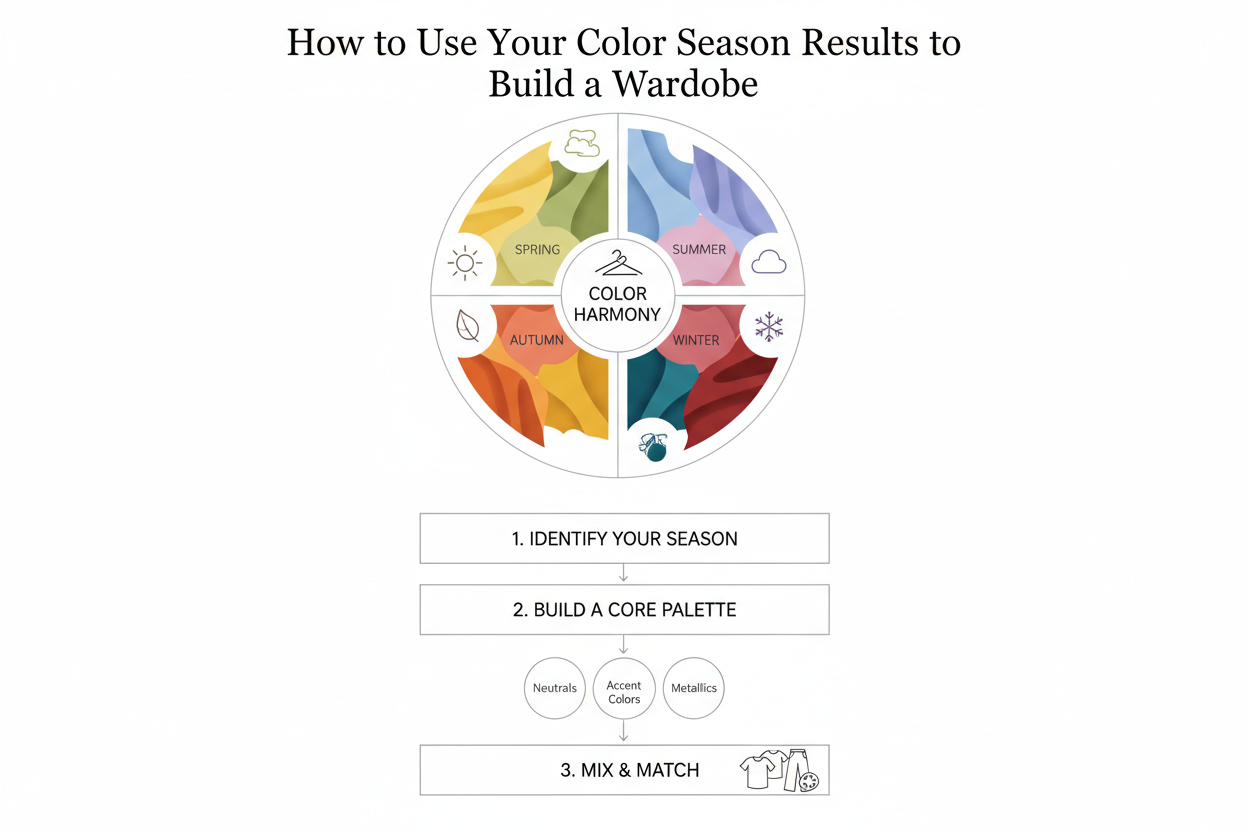
Start with neutrals. Every season has neutral tones that form the backbone of a wardrobe: trousers, outerwear, suits. Anchor there first. These are the pieces you wear most often, so getting the undertone right pays off more than anywhere else.
Add accent colors deliberately. Once your neutrals are solid, bring your season's accent colors into shirts, knitwear, and lighter pieces. They create visual interest without requiring a full outfit rebuild.
Know your avoid list. Understanding which colors drain your complexion is as useful as knowing which ones flatter it. If you're a Summer man, that means stepping back from warm oranges and muddy earthy tones. If you're a Winter, it means skipping camel and muted beiges.
Use the palette when shopping. The practical promise of color analysis is saving time and money. Before buying something new, check whether the color falls within your season's range. That one habit prevents the familiar experience of buying something that looked fine in the store and feels slightly off everywhere else.
Your season result won't decide every purchase—personal preference and context still matter—but it gives you a reliable default when you're not sure.
Common Mistakes Men Make When Trying to Find Their Color Season Alone
Self-analysis is harder than it looks. Even experienced color professionals sometimes get stuck without proper tools. One analyst described trying to determine a male friend's season without her draping kit and finding herself caught between two plausible results — unable to confirm which was right without holding actual fabric swatches near his face. If that happens to someone with professional training, it's not surprising that self-assessment trips up most men.
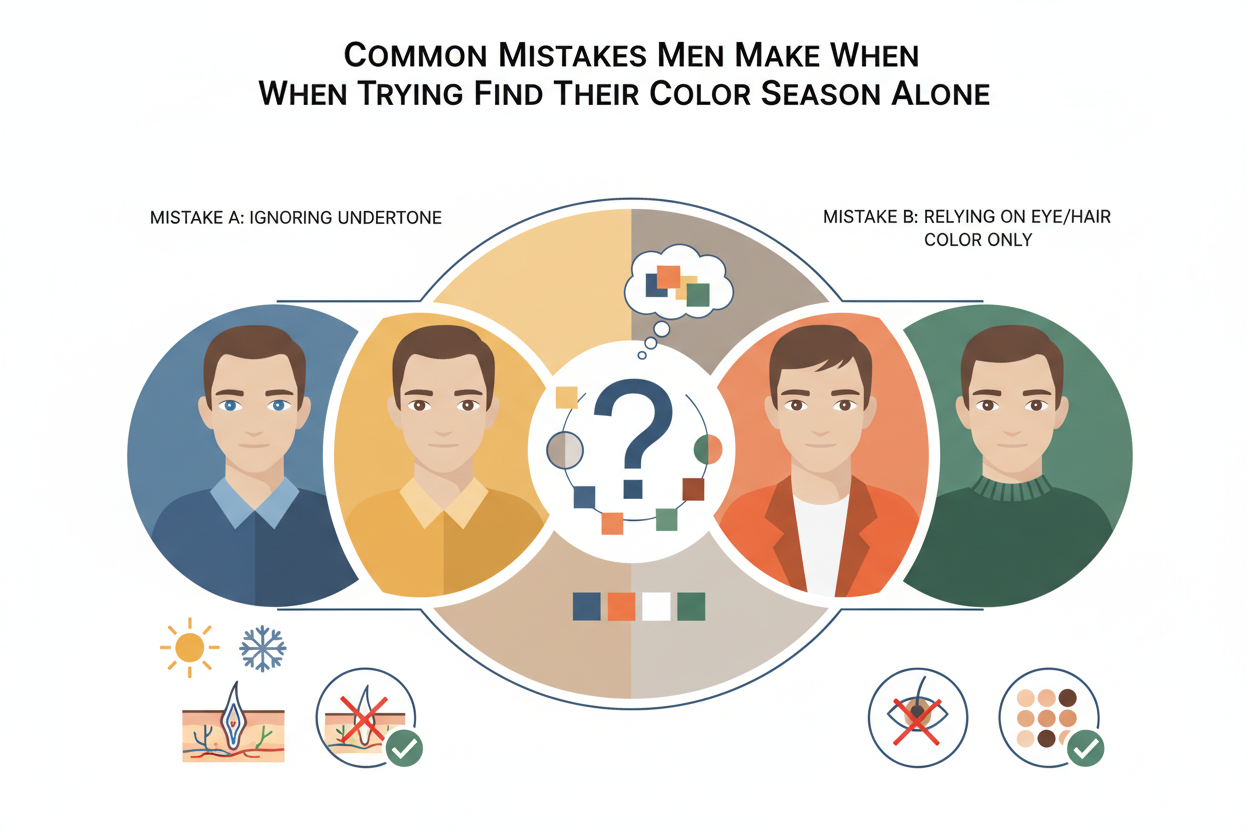
Here are the specific errors that lead to wrong conclusions:
Assessing undertone under artificial light Warm indoor lighting makes almost everyone look more golden than they are. Cool fluorescent light pushes skin toward an ashy tone. Neither is accurate. Undertone assessment needs neutral natural daylight — near a window, not under overhead fixtures.
Confusing skin tone depth with undertone These are two separate variables. A man can have a deep complexion and a cool undertone (Winter or Dark Summer), or a light complexion and a warm undertone (Spring or Light Autumn). Mixing them up leads to misidentification almost every time.
Ignoring hair and eye color when assessing contrast A lot of men focus entirely on skin tone and miss the contrast calculation. Fair skin with very dark brown eyes and hair means high contrast — and that matters as much as undertone when narrowing down your season.
Relying on what "looks good" in clothes you already own If your wardrobe defaults to black, navy, and gray, it's hard to draw conclusions about what your coloring actually responds to. What you already wear reflects years of habit and marketing more than what flatters your natural features.
Overcomplicating the process There are only four seasons. The variables are real but finite. Feeling overwhelmed usually comes from reading too many conflicting sources at once, not from the system itself being genuinely complex. A structured quiz cuts through that by asking one question at a time.
People Also Ask
How do I find my color season as a man?
Look at three things: how light or dark your complexion is, whether your skin reads warm, cool, or neutral underneath, and how much visual contrast there is between your skin, hair, and eyes. Once you have a sense of those, a seasonal color quiz can map you to Spring, Summer, Autumn, or Winter. For the most accurate read, check your coloring in natural daylight and use your unaltered hair color rather than a dyed shade.
What are the 4 color seasons for men?
Each season combines an undertone with a contrast level:
- Spring – Warm undertone, lighter or clearer coloring. Think camel, coral, warm ivory, and bright warm greens.
- Summer – Cool undertone, lower contrast. Think soft navy, slate blue, dusty rose, and muted pastels.
- Autumn – Warm undertone, deeper or more muted coloring. Think rust, olive, chocolate brown, and burnt orange.
- Winter – Cool undertone, high contrast. Think true black, bright white, pure navy, and jewel tones.
Each season has a palette of neutrals and accent colors that work with your natural features rather than against them.
Can men do seasonal color analysis?
Yes. Skin undertone, depth, and contrast work the same way regardless of gender. What changes is how the palettes translate to actual clothes: suits, outerwear, casualwear, the neutral pieces that anchor most men's wardrobes. Quizzes built specifically for men account for that context instead of pulling examples from makeup or women's fashion.
How accurate is a color season quiz?
It depends on how the quiz was built and how carefully you answer. Quizzes developed with professional color analysts tend to isolate the variables that actually matter—undertone, depth, contrast—and produce more reliable results than general lifestyle tools. That said, no quiz matches the precision of in-person draping with physical fabric swatches. Even experienced professionals sometimes can't call a season without them. A well-built quiz gets most people close enough to make genuinely better wardrobe decisions. If your result feels uncertain, read about both candidate seasons side by side—usually one description fits your coloring more cleanly than the other.
What colors should a Winter man wear?
Winter men have cool undertones and high natural contrast—typically dark hair against fair or deep skin, with clear, defined eye colors. Their palette runs bold and clean rather than muted or earthy.
- Best neutrals: True black, bright white, charcoal, pure navy
- Best accent colors: Jewel tones (sapphire, emerald, magenta), icy pastels, true red
- Colors to avoid: Warm earth tones like camel, rust, and muted olive. These clash with cool undertones and can flatten a Winter man's natural coloring.
A black suit with a white or icy-blue shirt is a reliable Winter combination that holds up across most formal and business contexts.
Does skin undertone determine your color season?
Undertone matters most, but it doesn't decide your season on its own. It tells you whether you belong to a warm season (Spring or Autumn) or a cool one (Summer or Winter). From there, your natural contrast level—the visual difference between your skin, hair, and eyes—determines which of the two warm or cool seasons actually fits. Depth (how light or dark your complexion is) helps refine the result. You need all three to land on a season. Undertone alone gets you to the right half of the framework, but you'll still have two options left.
Frequently Asked Questions About the Men's Color Season Quiz
How long does the seasonal color analysis quiz for men take?
Most take under five minutes. Some quizzes built specifically for men return a result after just three questions covering skin undertone, depth, and natural contrast. That brevity is intentional—the core variables needed to assign a season are limited, and adding more questions rarely improves accuracy if the right ones are already covered.
Do I need professional drapes or tools to take the quiz?
No. The quiz exists precisely because most people don't have draping fabric lying around. Even color professionals use quizzes sometimes—to get a rough read on a client's coloring before confirming it in person. What you actually need is decent natural daylight, a mirror, and an honest look at your unaltered hair and skin tone. Avoid artificial lighting, self-tanner, or recently dyed hair. Any of those can throw off your answers.
What if I get results that seem between two seasons?
This happens a lot, and it doesn't mean something went wrong. Even experienced analysts sometimes can't confirm a season without physical fabric swatches held up to someone's face. If your result feels split—say, between Autumn and Winter, or Spring and Summer—read the palette descriptions for both and notice which color recommendations feel right based on what you already know works on you. Pay particular attention to the neutrals. Those are the colors most men wear in the highest volume, so they're usually the clearest signal.
Can my color season change as I age or if I tan?
Your underlying undertone stays fixed throughout your life. That said, depth and contrast can shift. Hair that darkens, lightens, or goes gray changes your contrast level enough that a neighboring season can start to fit better. This happens most often when dark hair turns gray or white, which raises contrast and can move a result from Summer toward Winter, or from Autumn toward Spring. If your coloring has changed a lot since you last took the quiz, it's worth taking another look.
Is seasonal color analysis only useful for formal or business clothing?
No. The principles show up most clearly in suiting and outerwear—expensive pieces where the wrong color is an expensive mistake—but they apply just as well to jeans, t-shirts, knitwear, and accessories. Knowing your season tells you which neutrals to build around and which accent colors actually work on you. That's useful whether you're putting together a capsule wardrobe or just trying to figure out why things look fine in the store and off somehow at home.
How is a men's color season quiz different from one designed for women?
The underlying color science is identical. The difference is in how results get applied. Quizzes and palette guides built for men translate season results into men's wardrobe contexts—suits, chinos, outerwear, casual layers—rather than defaulting to makeup shades or women's fashion examples, which dominate most color analysis content. A men's-specific quiz also tends to frame contrast and depth questions around hair and beard combinations that are more relevant to men's natural coloring, making it easier to answer without having to mentally translate from examples that weren't written with you in mind.
What should I do after I find out my color season?
Start with your neutrals. Most men's wardrobes are built around a handful of shades—suits, trousers, coats, base layers. Match those against your season's recommended neutrals first. Getting that foundation right makes the biggest visible difference, and quickly. From there, use your palette's accent colors to guide what you buy next: shirts, ties, knitwear, accessories. Over time, shopping within your palette means fewer bad purchases and less time standing in a store wondering if something works. If you haven't figured out your season yet, take the seasonal color analysis quiz for men and start from something concrete.