What Is My Color Season Quiz (Step-by-Step)
 Reviewed by Alexandra Gilmore
Guessing a season from one favorite color skips the relationships among skin, hair, eyes, and contrast that make a palette useful. Work through those clues in sequence, reach a four-season direction, and test the result with real colors before moving to a narrower subtype.

Knowing which colors make you look vibrant—and which ones wash you out—can transform the way you shop, get dressed, and feel in photos. That knowledge starts with one question: what is my color season?
💫 Discover Your Complete Color Palette
Ready to discover all the colors that make you look radiant? Our comprehensive color analysis will reveal your complete personal palette - perfect for hair, makeup, and wardrobe decisions.
Find My Season →A color season quiz is the fastest self-guided way to answer it. By working through a short set of questions about your natural coloring—skin tone, hair, and eyes—the quiz maps your features onto one of the four seasonal palettes (Spring, Summer, Autumn, or Winter) and points you toward the specific tonal range that suits you best.
What you'll get from this guide:
- A plain-language explanation of what the quiz actually measures and why it works
- A step-by-step walkthrough of what happens during the quiz
- Practical guidance on preparing for the most accurate result
- A full breakdown of all four seasons and their sub-seasons
- Real-life ways to apply your result to clothing, makeup, and accessories
Color analysis isn't reserved for professional consultations. Free quizzes let you dip your toe into the system on your own, though getting a reliable result does require a little preparation and honest self-observation. This guide covers both—so by the end, you'll have your season and know exactly what to do with it.
For the next diagnostic or service-choice step, continue with the companion article “Free Seasonal Color Analysis Quiz”, which keeps the two closely related questions distinct.
📚 Recent Articles
Why Figuring Out Your Color Season Is Harder Than It Looks
Most people expect color analysis to be simple: look in the mirror, decide if you're warm or cool, pick a season. It rarely works out that way.
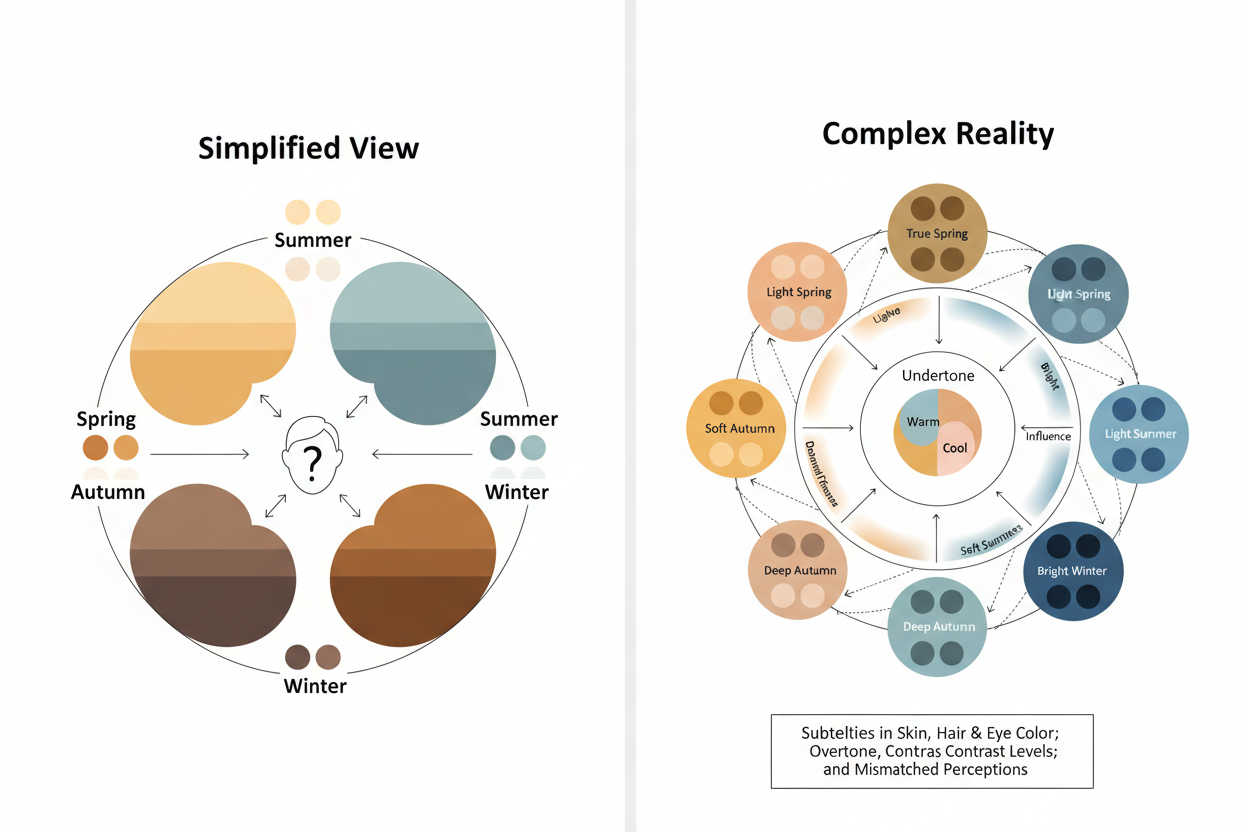
The real problem is that professional color analysts use fabric drapes—large swatches held close to your face under controlled lighting—to watch how your skin responds in real time. Without them, even experienced analysts get stuck. One analyst described trying to type a friend and landing between two plausible options simply because she didn't have her drapes with her. If a professional hits that wall, it's no surprise self-analysis trips most people up.
A few things make it genuinely difficult:
- Mixed signals. Your eyes might read cool while your hair reads warm, putting you between seasons rather than squarely in one.
- Artificial lighting. Indoor bulbs distort skin undertones—a neutral complexion can look yellow or pink depending on the room.
- Makeup. Foundation, bronzer, and brow products mask your natural coloring, sometimes dramatically.
- The vocabulary gap. Words like "muted," "clear," "tonal range," and "value contrast" mean specific things in color analysis. Without those definitions, quiz answers slide toward guessing.
A guided quiz doesn't fix all of this, but it breaks the observation process into one focused question at a time instead of asking you to weigh everything at once. That's why a structured quiz gets you closer to an accurate result than reading a general season description and hoping you recognize yourself in it.
[→ Take the Color Season Quiz now and get your result in minutes]
What the Color Season Quiz Actually Measures
A well-built color season quiz isn't asking about your favorite colors or style preferences. It's collecting data on your natural coloring—the features present before any product touches your face.
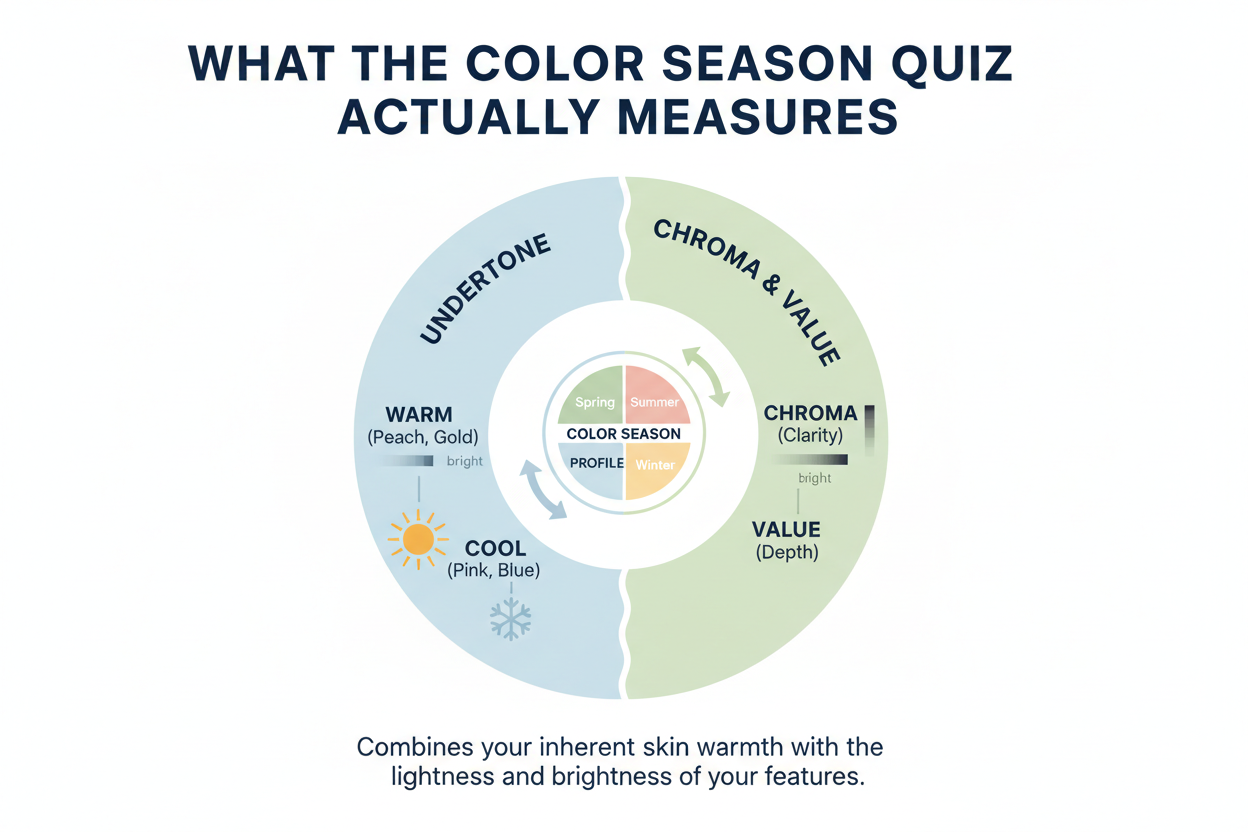
The quiz focuses on three observable categories:
- Skin tone and undertone – whether your complexion reads warm, cool, or neutral, and whether it's fair, medium, or deep
- Eye color and clarity – the hue (blue, green, hazel, brown, gray) and whether the iris appears bright and sharp or soft and blended
- Hair color and depth – the natural shade ranging from platinum to near-black, and whether it reads golden, ashy, or somewhere between
Six illustrated questions target these facial traits specifically. The illustrations help you tell apart options that are close together—for instance, distinguishing "ash brown" hair from "warm brown" when your own hair falls somewhere in that middle zone.
Your answers go into a mapping process that weighs all three trait categories together and produces two things: a color season (Spring, Summer, Autumn, or Winter, often narrowed to a sub-season) and a tonal range describing where you sit within that season's palette.
The Six Facial Trait Questions the Quiz Uses
The six questions in a standard color season quiz each target one identifiable dimension of your natural coloring. Exact wording varies by quiz, but the trait categories follow a consistent pattern:
| Question focus | What it's assessing |
|---|---|
| Skin tone depth | How fair, medium, or deep your complexion is |
| Skin undertone | Whether warmth, coolness, or neutrality dominates |
| Eye hue | The base color family of your iris |
| Eye clarity | Whether your eye color appears vivid or muted/blended |
| Hair color | Your natural shade and its position on the warm-to-cool spectrum |
| Hair depth | How light or dark your hair is from root to tip |
Illustrations accompany each question because written descriptions alone can't convey the difference between "light warm brown" and "medium neutral brown" precisely enough for reliable self-assessment. The visual anchors cut down the most common error in self-analysis: placing yourself at one extreme when you actually sit somewhere in the middle.
The Four Seasons and Their Tonal Ranges Explained
The color season system sorts everyone's natural coloring into one of four seasonal families. Each family is defined by two things: temperature (warm or cool) and depth/clarity (how muted or vivid, how light or dark).
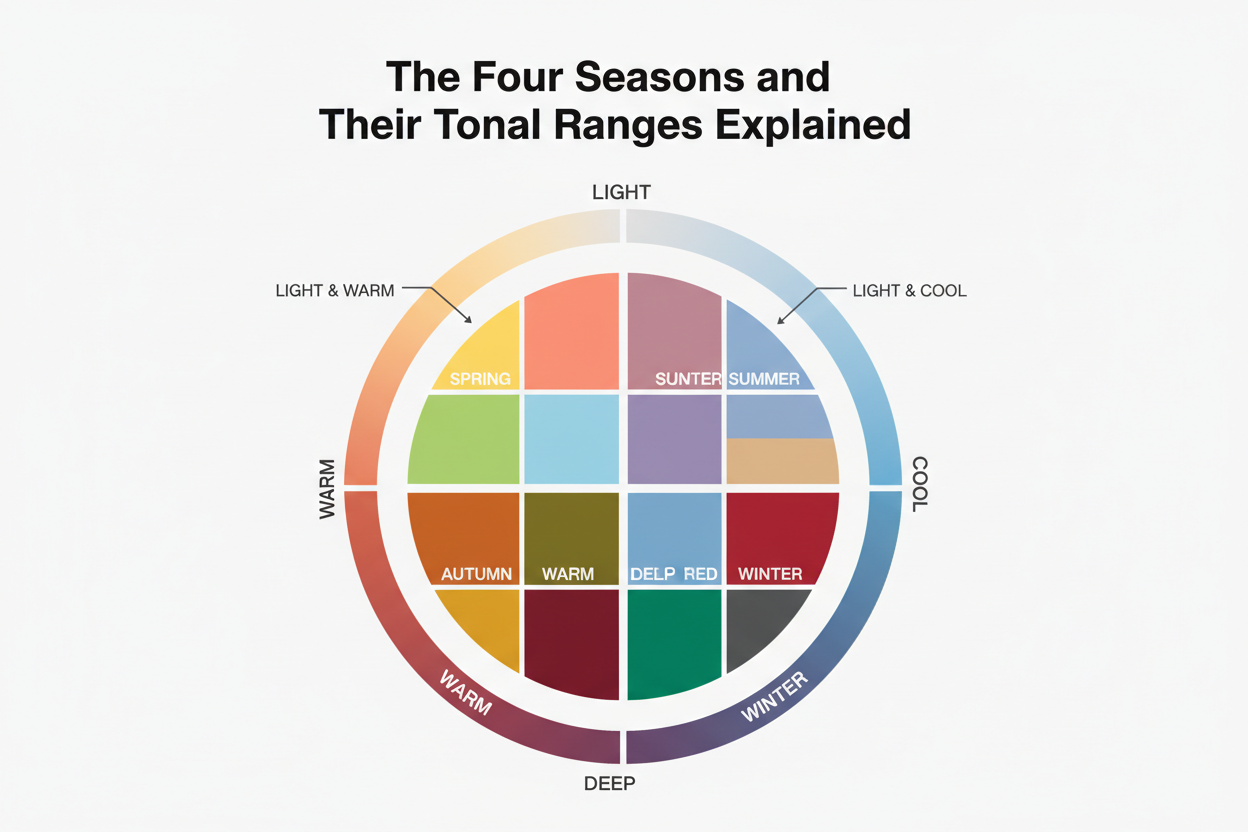
Spring – warm and bright. Springs have clear, warm skin with golden or peachy undertones, bright eyes (blue, green, warm hazel, or light brown), and naturally light to medium hair with golden or strawberry tones. Colors that work: coral, golden yellow, warm turquoise, clear warm tones generally.
Summer – cool and muted. Summers have cool or neutral-cool undertones, soft eyes in blue, gray-blue, or grayish-green, and hair that runs ash—blonde, brown, or silvery. Colors that work: dusty rose, lavender, soft blue, cool mauve.
Autumn – warm and muted. Autumns have warm, earthy undertones—golden, peachy, or bronze—with hazel, olive green, warm brown, or teal eyes, and hair anywhere from auburn to deep warm brown. Colors that work: terracotta, olive, burnt orange, warm camel.
Winter – cool and deep (or vivid). Winters have high contrast between features: dark hair against fair or deep skin, cool or neutral undertones, and sharp eyes—dark brown, black-brown, icy blue, or vivid green. Colors that work: true red, royal blue, stark white, black.
Each seasonal family breaks down into sub-seasons—usually three—for people who fit the broad family but sit closer to a border. That's the point of tonal ranges: your result doesn't just say "Autumn." It tells you whether you're a True Autumn, a Soft Autumn, or a Dark Autumn, because each has a distinct palette.
Soft Autumn: The Season That Sits Between Two Worlds
Soft Autumn is a good example of how sub-seasons work, partly because it sits at a boundary that trips a lot of people up.
Soft Autumn is warm and soft—meaning its palette is muted rather than saturated, and the warmth is gentle rather than intense. On the seasonal chart it falls between True Autumn and Soft Summer, so someone with Soft Autumn coloring might genuinely wonder whether they're an Autumn at all, or whether they've drifted into Summer territory.
The distinguishing features:
- Eyes: blue, green, hazel, or medium brown—Soft Autumns can have eyes that look cool in isolation, which is exactly why skin and hair context matters
- Hair: strawberry blonde through warm medium brown; natural highlights tend golden or coppery rather than ashy
- Skin: typically peachy or softly golden, though it can read more neutral than a True Autumn
The Soft Autumn palette runs toward dusty, earthy tones—warm taupe, terracotta muted with gray, sage green, muted coral—rather than the vivid oranges and deep rusts that suit True Autumn. Next to Soft Summer, Soft Autumn reads warmer and earthier where Summer goes cool and rosy.
This is why the quiz looks at multiple trait categories at once. A quiz that only asked about eye color could easily place a Soft Autumn with blue-green eyes into Summer. Skin undertone and hair depth have to come into the picture to get the result right.
How to Prepare for the Most Accurate Quiz Result
A few minutes of prep can meaningfully improve your result. The biggest source of error in self-analysis is assessing features that have been altered—by makeup, hair dye, artificial light, or a recent tan.
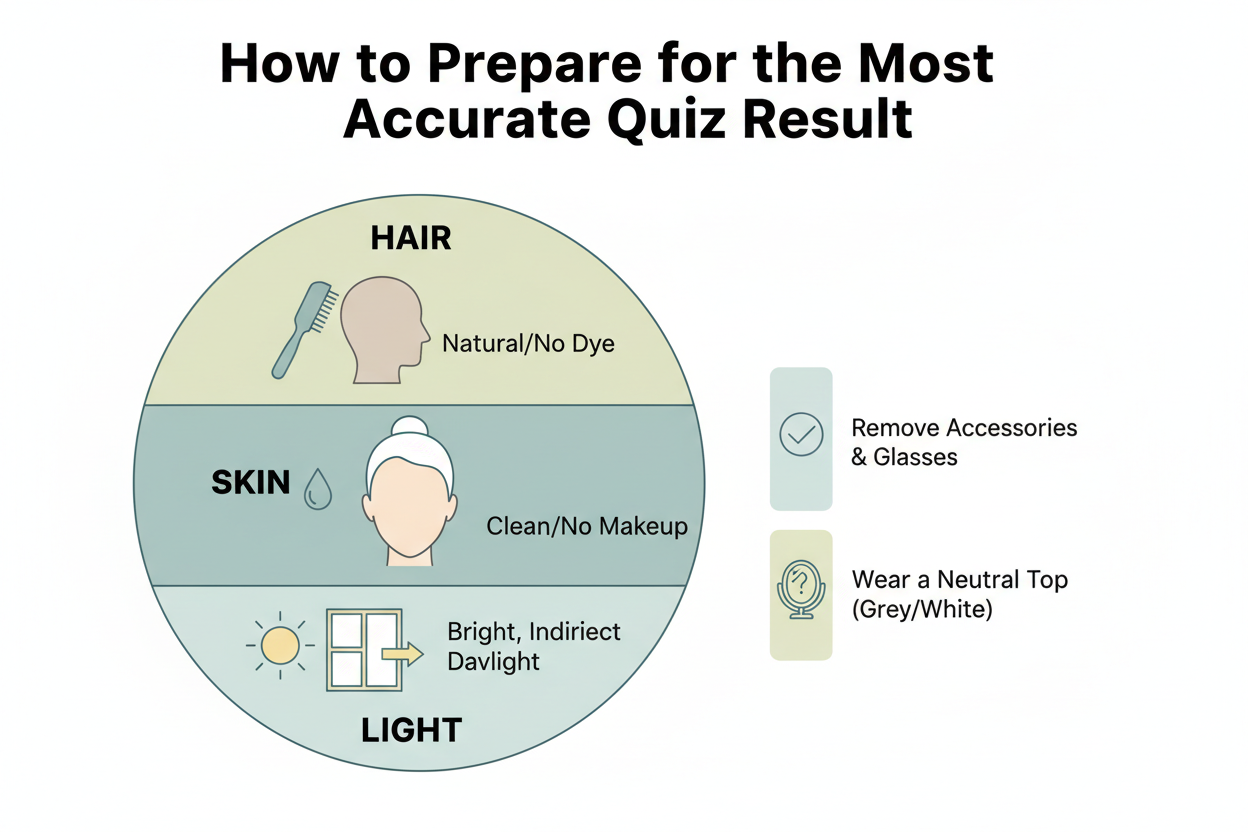
Before you open the quiz:
- Remove all makeup, including foundation, bronzer, tinted moisturizer, and brow products. These mask your natural skin undertone and shift how your features read.
- Go to a window with natural daylight, ideally on a cloudy day. Direct sun creates glare, and artificial light—especially warm-toned bulbs—distorts undertones.
- Assess your natural hair color, not your current dye. If your hair is colored, look at your roots or recall your pre-coloring shade. If you genuinely don't know your natural color, think back to whether your childhood hair read warm or ashy.
- Look at the features you were born with, not choices you've made. Color analysis maps your natural coloring, not your current aesthetic.
- Hold a white piece of paper near your face. Against true neutral white, warm undertones look golden or peachy and cool undertones read pink or blue-gray. It's one of the simplest checks you can do before the quiz.
Once you've done those steps, open the quiz with your face in natural light and answer based on what you see right now—not what you remember from years ago or what you wish your coloring was.
[→ Ready? Start the quiz here and find your color season in minutes]
Step-by-Step: What Happens When You Take the Quiz
Knowing the structure in advance makes it easier to just start. Here's what the experience looks like from first question to result.
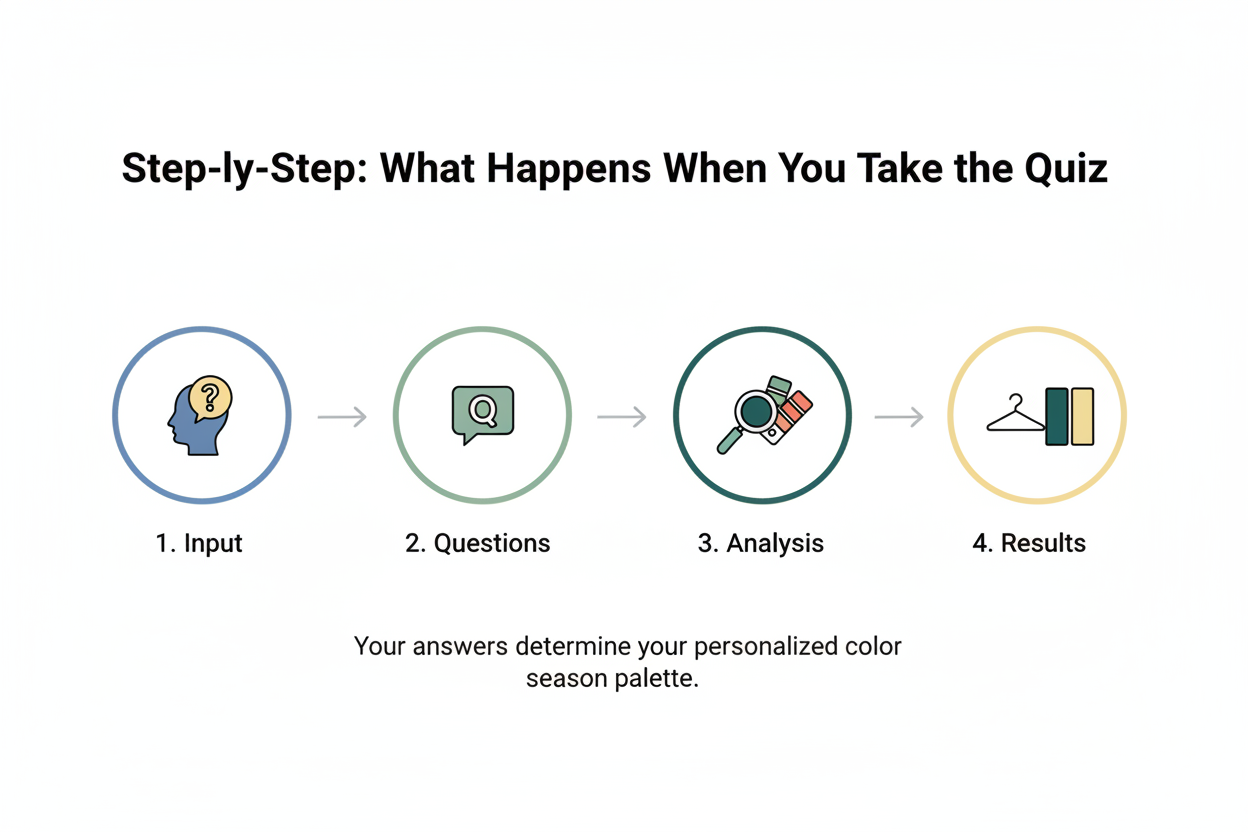
Step 1: Skin tone depth The first question anchors your overall depth—fair, medium, or deep. This establishes the baseline before undertone comes into play.
Step 2: Skin undertone You'll be asked whether your skin reads warm, cool, or neutral. Most people feel uncertain here. The white paper test helps: look at the inside of your wrist under natural light. Greenish veins lean warm; blue or purple lean cool; a mix suggests neutral.
Step 3: Eye color A set of illustrated swatches shows eye color families and you pick the closest match. The illustrations help distinguish between warm hazel and cool hazel—two options that sound similar but point to different seasons.
Step 4: Eye clarity This question asks whether your eye color looks vivid and defined, or soft and blended into the iris. High-clarity eyes tend toward Spring or Winter; softer, more diffused color tends toward Summer or Autumn.
Step 5: Hair color You select your natural hair shade from illustrated options spanning platinum through black, with warm and cool variations shown side by side at each depth level.
Step 6: Hair depth A final confirmation of how light or dark your hair sits overall. This helps the quiz distinguish between sub-seasons within the same family.
Result page After step six, the quiz outputs your color season (including sub-season) and your tonal range—where within that season's spectrum your coloring falls. Some quizzes also list the core colors in your palette and the ones to use more sparingly.
The whole thing takes a few minutes. Treat the result as a well-informed starting point, not a final verdict—especially if you feel genuinely torn between two options.
How to Use Your Color Season Result in Real Life
The result only matters if you do something with it. Your color season maps to three practical areas: clothing, makeup, and accessories.
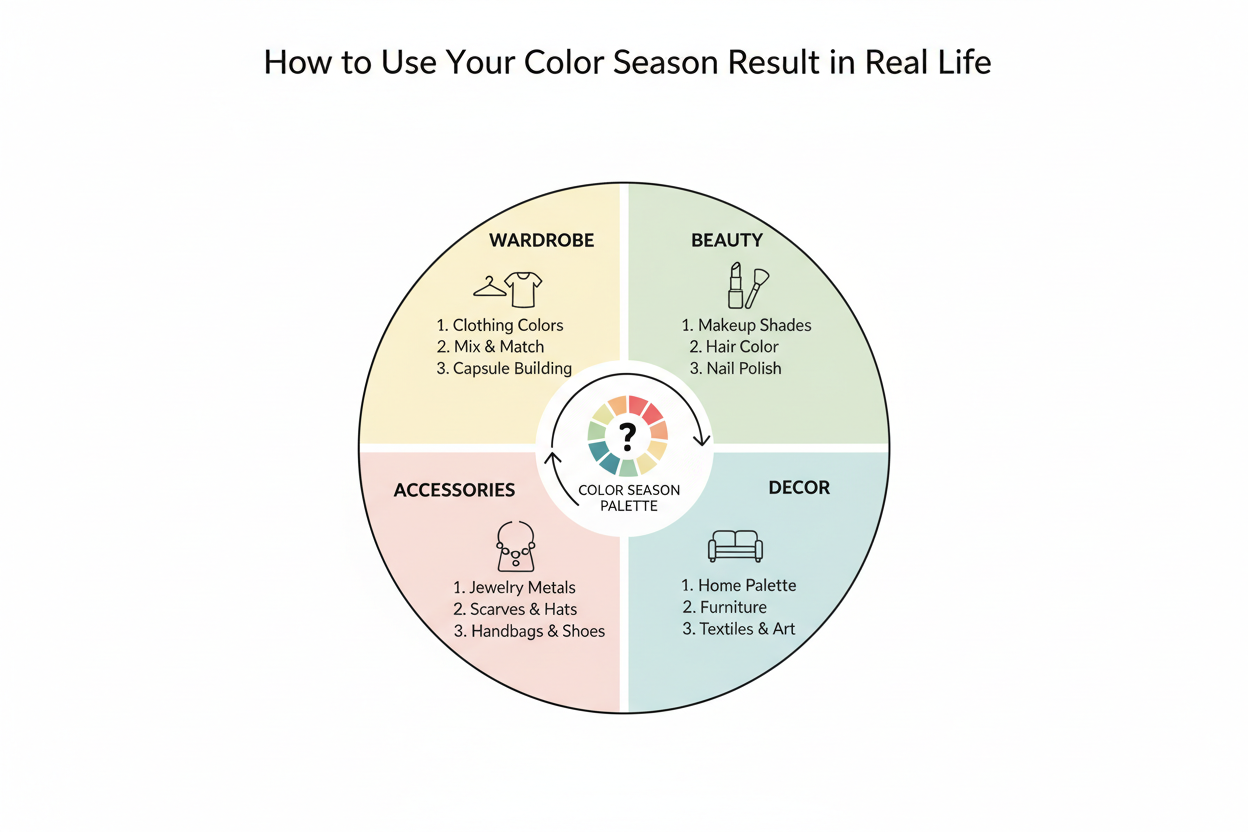
Clothing Your seasonal palette is a list of colors that work with your natural coloring instead of fighting it. In practice:
- Prioritize palette colors for tops and anything near your face—they have the most impact on how you look in person and in photos
- Use neutral-zone colors (colors every season can wear, just in different shades) for bottoms and outerwear
- If you love a color that falls outside your palette, wear it away from your face—in a bag, shoes, or a lower-body garment—rather than avoiding it entirely
Makeup Your tonal range points to the temperature and saturation level that flatters your skin:
- Warm seasons (Spring, Autumn) tend to do better with peachy-to-coral blushes and warm bronzers; cool shades can go gray or ashy
- Cool seasons (Summer, Winter) suit rosy, pink-based, or berry blushes; warm bronzers often look muddy against cool undertones
- Muted seasons (Soft Summer, Soft Autumn) usually look better with blended, diffused application than sharp, high-contrast looks
Accessories Metal tone follows the same warm-cool logic: warm seasons generally look better in gold and rose gold, cool seasons in silver and white gold. Neutral seasons can mix, though usually one reads slightly more flattering.
Shopping filter Your season is also a useful shopping shortcut. Standing in front of a rack or browsing online, your palette acts as a pre-filter—not to eliminate options arbitrarily, but to surface the ones most likely to work. Fewer bad purchases, less time second-guessing.
Your result isn't a rule. It's a framework that explains why certain colors consistently make you look healthy and energized, and gives you enough vocabulary to trust your own eye.
People Also Ask
How do I find out my color season without a professional?
The most accessible starting point is a structured online quiz that walks through your natural features—skin undertone, eye color, eye clarity, hair color and depth. Working through illustrated questions one trait at a time cuts down the guesswork that makes unguided self-analysis so unreliable.
A few things worth doing before you start:
- Take off all makeup and look at your features in natural daylight near a window
- Hold a white sheet of paper next to your face to get a clearer read on your undertone
- Go by your natural hair color, not a dyed shade
If you still feel stuck between two seasons after the quiz, hold actual palette swatches against your bare skin instead of trying to sort it out from written descriptions. A free quiz won't match the precision of in-person draping, but it gives you a solid starting point—better than guessing from a paragraph of general guidance.
What are the 12 color seasons in color analysis?
The classic system uses four seasons—Spring, Summer, Autumn, and Winter—each divided into three sub-seasons, giving 12 total. Each sub-season sits at a slightly different position within its family's temperature and depth range:
| Season family | Sub-seasons |
|---|---|
| Spring | True Spring, Light Spring, Bright Spring |
| Summer | True Summer, Light Summer, Soft Summer |
| Autumn | True Autumn, Soft Autumn, Dark Autumn |
| Winter | True Winter, Bright Winter, Dark Winter |
The sub-seasons exist for people whose coloring fits a broad family but leans toward a neighboring one. Soft Autumn sits close to Soft Summer on the seasonal flow chart. Bright Spring shares traits with Bright Winter. These border zones are where quizzes, and even professional analysts, have to weigh several traits together rather than hinging on any single feature.
Can a quiz accurately determine my color season?
For most people, a well-designed quiz gives a reliable result—with some caveats. Color analysts use quizzes as a supplementary tool. One analyst mentioned using a quiz to narrow down a season when she didn't have her draping fabric on hand, which suggests they carry real diagnostic value even for professionals.
Quizzes tend to be most accurate for people whose features clearly fall within one seasonal family, and for anyone who takes it with no makeup, in natural daylight, using their actual hair color.
Accuracy drops when your features send mixed signals—cool eyes, warm skin, neutral hair—or when your coloring has been significantly altered by dye, tanning, or heavy skincare.
Treat the result as a strong informed estimate, not a final verdict. If it feels wrong, check your features against the specific palette it suggested, or try a second quiz that uses illustrated options. Those tend to reduce interpretation errors by removing some of the guesswork.
What is the difference between a color season and a tonal range?
Your color season is the broad category your natural coloring falls into—Spring, Summer, Autumn, or Winter, usually narrowed to a sub-season like Soft Autumn or Light Summer. It tells you which family of colors generally harmonizes with your features.
Your tonal range describes where within that season your coloring sits: how warm or cool, how muted or vivid, how light or dark. Two people can share the same color season but have slightly different tonal ranges, so the exact shades that flatter them most will differ even within the same palette.
In practical terms:
- Your color season tells you the overall palette to focus on
- Your tonal range tells you which shades within that palette to prioritize and which to use more sparingly
Many quizzes output both pieces of information together because one without the other leaves you with an incomplete picture. Knowing you're an Autumn is useful. Knowing you're a Soft Autumn with a muted tonal range tells you to reach for dusty terracotta rather than vivid burnt orange.
How do I know if I am a Soft Autumn or Soft Summer?
These two sit right next to each other on the seasonal flow chart, which is why they get confused more than almost any other pairing. Both have muted, low-saturation coloring—neither is vivid or high-contrast. The difference is temperature.
Soft Autumn leans warm:
- Hair has golden, coppery, or strawberry-blonde tones
- Skin undertone reads peachy, golden, or softly warm
- Eyes may be blue, green, hazel, or medium brown, but the overall impression is warm and earthy
- Best palette: dusty warm tones—muted terracotta, warm taupe, sage green, soft camel
Soft Summer leans cool:
- Hair tends toward ash—cool brown, ash blonde, or muted taupe tones
- Skin undertone reads cool or neutral-cool, often with a rosy or grayish cast
- Eyes are typically soft blue, gray-blue, or grayish-green
- Best palette: dusty cool tones—mauve, lavender, cool rose, soft blue-gray
The simplest test: hold a warm golden-beige fabric and a cool ash-rose fabric near your bare face in natural light. One will make your skin look even and healthy. The other might make you look a little sallow or washed out. That reaction is your answer.
Frequently Asked Questions About Color Season Quizzes
Is a free color season quiz as accurate as a professional color analysis?
Not quite—but it's more useful than most people expect. A professional color analysis involves draping actual fabric samples against your bare skin in controlled lighting, which removes nearly all guesswork. A quiz works from your descriptions or selections of your features, which introduces some room for interpretation error.
That said, the gap is smaller than it sounds for most people. Color analysts use quiz-style tools as a diagnostic aid when draping isn't practical, so quizzes aren't just guesswork. If your features are clearly defined—distinct undertone, obvious eye clarity, consistent hair depth—a well-designed quiz will usually land on the right season.
Treat the result as a well-informed starting point, not a final verdict. You'll get the most accurate read by taking it with no makeup, in natural daylight, using your unaltered hair color.
What information do I need before taking a color season quiz?
You'll need four things before you start:
- Skin undertone – whether your veins look blue-purple (cool), green (warm), or somewhere in between (neutral), and whether you tend to tan or burn
- Eye color and clarity – the specific color (blue, green, hazel, brown, gray) and whether your iris looks vivid and clear or soft and muted
- Natural hair color and depth – light, medium, or dark, and whether it reads warm (golden, coppery, red) or cool (ashy, neutral brown)
- Overall contrast level – how much difference there is between your skin, eyes, and hair tones sitting next to each other
Remove all makeup before you look at any of these. Sit near a window in natural daylight - indoor lighting shifts perceived undertones more than most people expect.
What does my tonal range mean after I get my quiz result?
Your color season tells you which broad palette suits you—your tonal range tells you where within that palette to focus. Two people can both be Soft Autumn but have different levels of warmth or mutedness in their coloring, which changes which specific shades actually look good on them.
In practical terms:
- Color season = the overall palette family (e.g., Autumn)
- Tonal range = the temperature, saturation, and depth emphasis within that family (e.g., muted and warm rather than vivid and warm)
Many quizzes give you both because knowing only your season leaves the picture incomplete. If you're Soft Autumn with a particularly muted tonal range, you'll reach for dusty terracotta and warm taupe over saturated burnt orange—even though all three technically fall within the Autumn family.
Can men use a color season quiz to find their palette?
Yes. Seasonal color analysis works the same way regardless of gender. It's based on the relationship between skin undertone, eye color, and hair depth—none of which are gender-specific.
One analyst documented using a quiz to figure out the season of a male friend when she didn't have draping fabric available. It worked the same way it would for anyone else: working through visible facial traits to land on the most likely seasonal match.
The same prep applies: no artificial tan, natural hair color, natural daylight.
What should I do if I get a result I disagree with?
First, check whether you took the quiz under the right conditions: no makeup, natural light, natural hair color. If any of those were off, fix them and retake it before doing anything else.
If the result still doesn't feel right:
- Hold swatches (or color samples on screen) near your bare face in daylight and watch how your skin actually responds—that physical reaction is more reliable than which season "sounds like you"
- Figure out which features you think the quiz misread, then check whether they genuinely point to a different season or just to a neighboring sub-season within the same family
- The result might be correct even if the description surprised you—read the actual color list for that palette rather than going off its name or general vibe
If two seasons still seem equally plausible, you may be in a border zone between them (Soft Autumn and Soft Summer, for example). In that case, warm versus cool is usually what settles it.
How many color seasons are there and how does the quiz choose between them?
Most detailed quizzes use an expanded system with 12 color seasons: four main families (Spring, Summer, Autumn, Winter), each split into three sub-seasons. Rather than relying on any single feature, the quiz narrows things down by asking about several facial traits at once.
The six questions most structured quizzes ask about:
- Skin undertone and how your skin responds to sun
- Natural hair color (hue and depth)
- Eye color
- Eye clarity (vivid vs. muted)
- Overall contrast between features
- How your skin looks in warm versus cool colors
Each answer rules out certain seasons and makes others more likely. By the last question, most people are down to one or two plausible results, and the quiz picks the best fit from there.
Can my color season change over time?
Your core seasonal palette comes from the relationship between your natural skin undertone, eye color, and hair pigmentation. These traits stay broadly stable through adulthood, so your true color season generally doesn't change.
That said, a few things can shift:
- Hair naturally deepens or lightens with age, which can nudge someone toward a lighter or darker sub-season within the same family
- Skin can change in depth and clarity with age, hormonal shifts, or prolonged sun exposure
- Eye color shifts subtly for some people, though rarely enough to land in a different seasonal family
If your coloring has changed noticeably—especially hair going significantly lighter or skin becoming more muted—it's worth retaking a color season quiz to see whether you've moved within your seasonal family. Crossing from one main season to a completely different one (Spring to Winter, say) is unusual and would take pretty dramatic natural change.
Ready to find out where you land? Take the color season quiz now →