
Cool Summer Color Palette Guide
 Reviewed by Alexandra Gilmore
Burnt orange and chocolate can feel inexplicably heavy on Cool Summer because the season needs blue-based color and muted softness. Build around misty blues, cool rose, lavender, sage, charcoal, and soft navy, then use draping to separate this palette from lighter or more muted Summer neighbors.

If you have ever stepped into a store, reached for a rich burnt orange or a deep chocolate brown, and walked away wondering why none of it felt quite right on you, the answer may lie in your season. The cool summer color palette is built around a specific set of qualities — cool undertones, muted saturation, and a gentle, almost misty softness — that work in harmony with a particular kind of natural coloring rather than against it.
💫 Discover Your Complete Color Palette
Ready to discover all the colors that make you look radiant? Our comprehensive color analysis will reveal your complete personal palette - perfect for hair, makeup, and wardrobe decisions.
Find My Season →Cool Summer is widely considered one of the most quietly beautiful of the twelve seasonal palettes. Its hues evoke the feeling of an overcast afternoon in late summer: think lavender fields, dusty rose, soft slate, and the blue-grey of a calm sea. Nothing shouts. Everything harmonizes.
This guide covers everything you need to understand about the cool summer palette, including:
- What defines a cool summer palette and why those qualities matter
- The specific hues that make up the palette, from neutrals to statement colors
- How to recognize whether you are a cool summer type
- What to avoid and why certain colors visually clash with cool summer coloring
- How cool summer compares to its closest neighbors — cool winter and light summer
- Practical wardrobe combinations you can start building today
Whether you are new to seasonal color analysis or revisiting your season with fresh eyes, this guide gives you a complete, grounded picture of the cool summer palette so you can dress with confidence and intention.
📚 Recent Articles
What Makes a Color Palette 'Cool Summer'?
Every seasonal palette is defined by three qualities working together: undertone, saturation, and depth. For the cool summer color palette, those three qualities resolve into something very specific — cool, muted, and medium in depth.
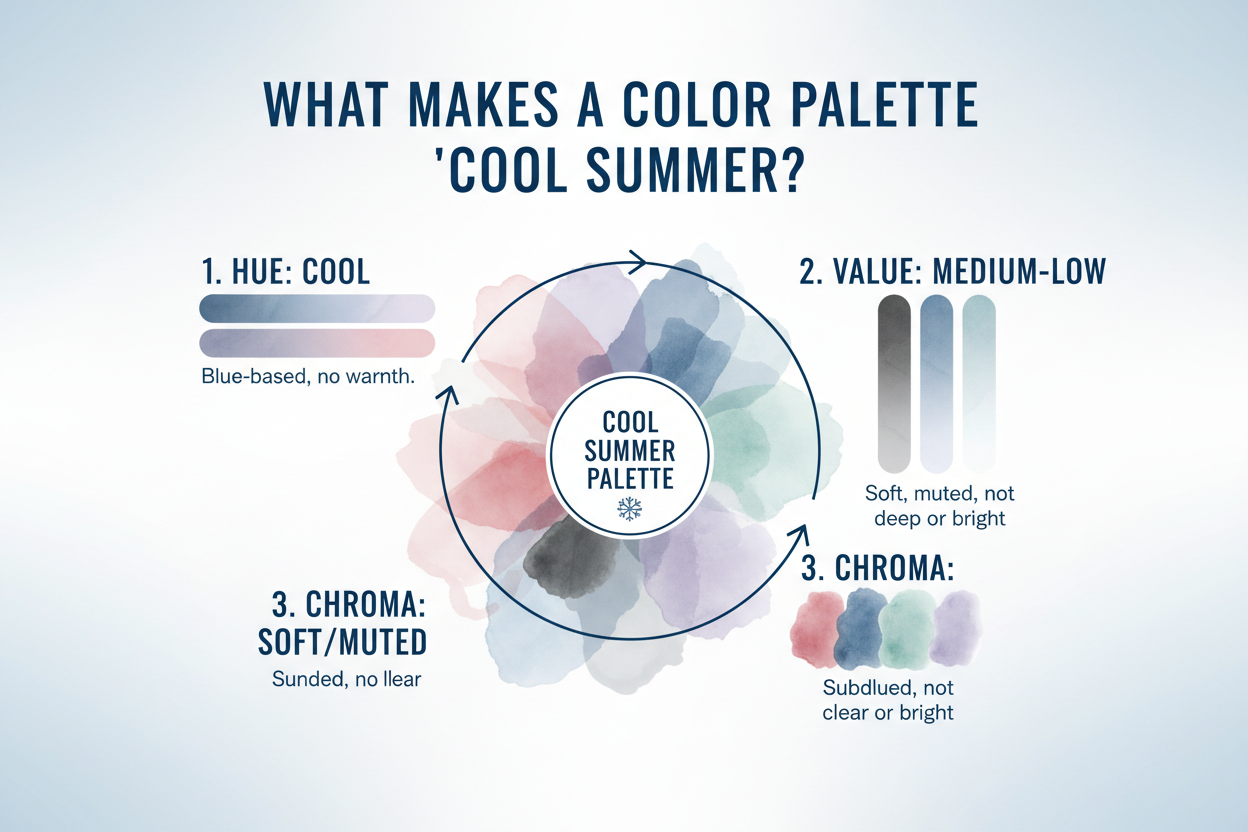
Cool means the palette draws on blue-based hues rather than yellow-based ones. No warmth pulling toward orange, gold, or caramel. Every color leans toward the blue, pink, or grey end of the spectrum.
Muted means the colors aren't vivid or saturated. They've been softened — think of a color with a small amount of grey mixed in. That greyish veil gives the cool summer palette its characteristic softness, and it's what separates it from cool winter, which shares the cool undertone but carries far more intensity and contrast.
Medium depth means the palette sits between the extremes. Cool summer is neither the lightest season nor the darkest. Its lightest hues are soft rather than icy, and its darkest shades are deep but not stark.
These three qualities together — not any one of them alone — are what make a color palette authentically cool summer. A pale blue can belong to cool summer, cool winter, or light summer depending on how saturated and deep it is. The full combination is what places a hue within this specific season.
Not sure whether you're a cool summer? Take the free color analysis quiz →
The Mood and Visual Story of the Cool Summer Palette
Before looking at specific hues, it helps to build an intuitive sense of what the cool summer palette actually looks like as a whole.
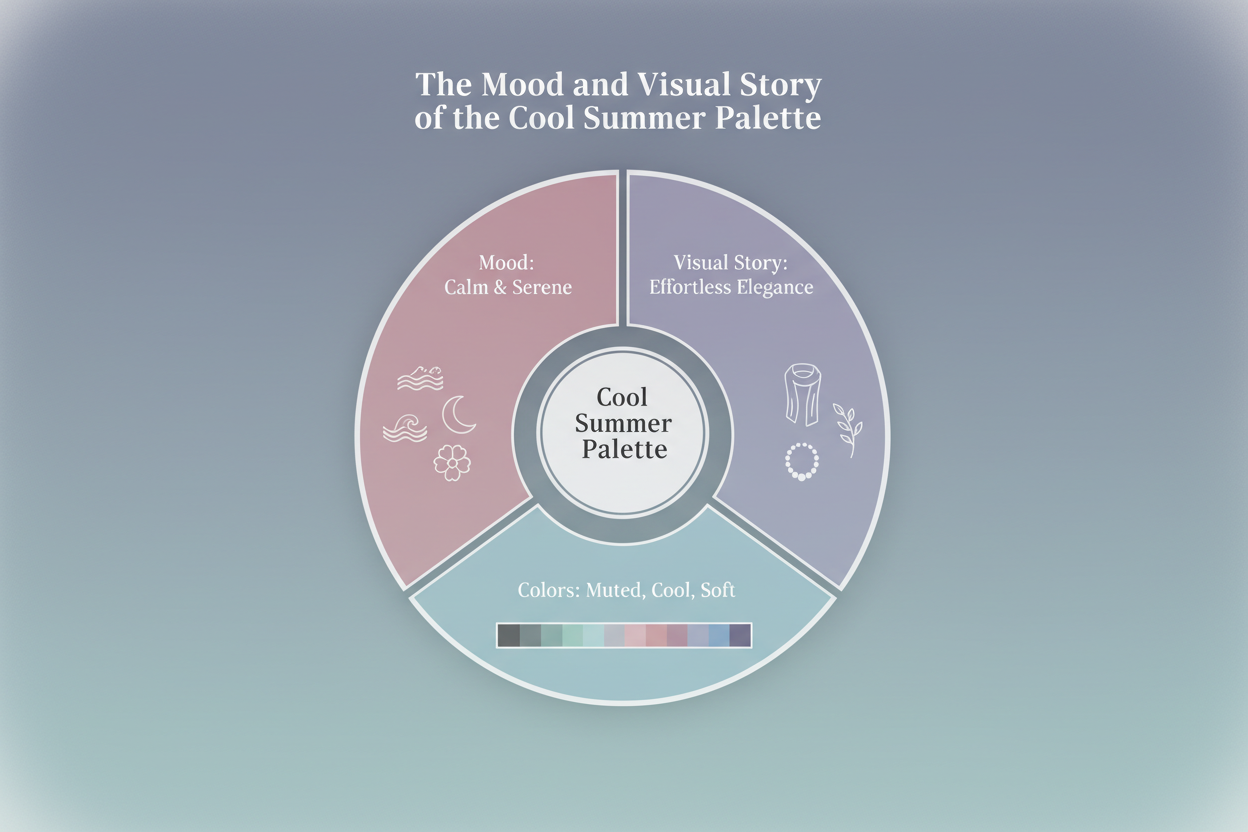
Picture an English country garden in the weeks just before autumn. The light is softer than it was in July. The flowers — lavender, sweet pea, veronica, dusty rose — aren't the bold, saturated blooms of a tropical garden. They blend into the landscape, their colors shifting gently into each other without hard edges. The greens aren't electric; they're quiet and slightly grey. The whites aren't crisp; they're creamy, or tinged with pink or blue.
That's the visual logic of the cool summer palette. Everything is soft and blended — delicate washes of color rather than clean, solid blocks. Nothing in the palette creates sharp contrast with anything else. Hues transition into one another the way watercolor spreads on wet paper: present, but never harsh.
This blended quality isn't just an aesthetic observation. It has a practical meaning for how you wear color:
- High-contrast combinations — a near-white top with a deep navy skirt, say — sit at the edge of what works for cool summer. The palette favors tone-on-tone and analogous pairings, where hues stay close in depth and saturation.
- Solid colors in cool summer tend to look better in their muted versions than their vivid ones. Dusty rose rather than hot pink. Soft slate rather than cobalt. Lavender rather than purple.
- The overall impression is quiet elegance — harmonious, composed, never overpowering.
Core Hues: The Cool Summer Color Wheel Broken Down
Every color family in the cool summer palette shares the same underlying qualities: cool-leaning, grey-tinged, and moderate in depth. The table below organizes the palette by family so you can see how those properties apply consistently.
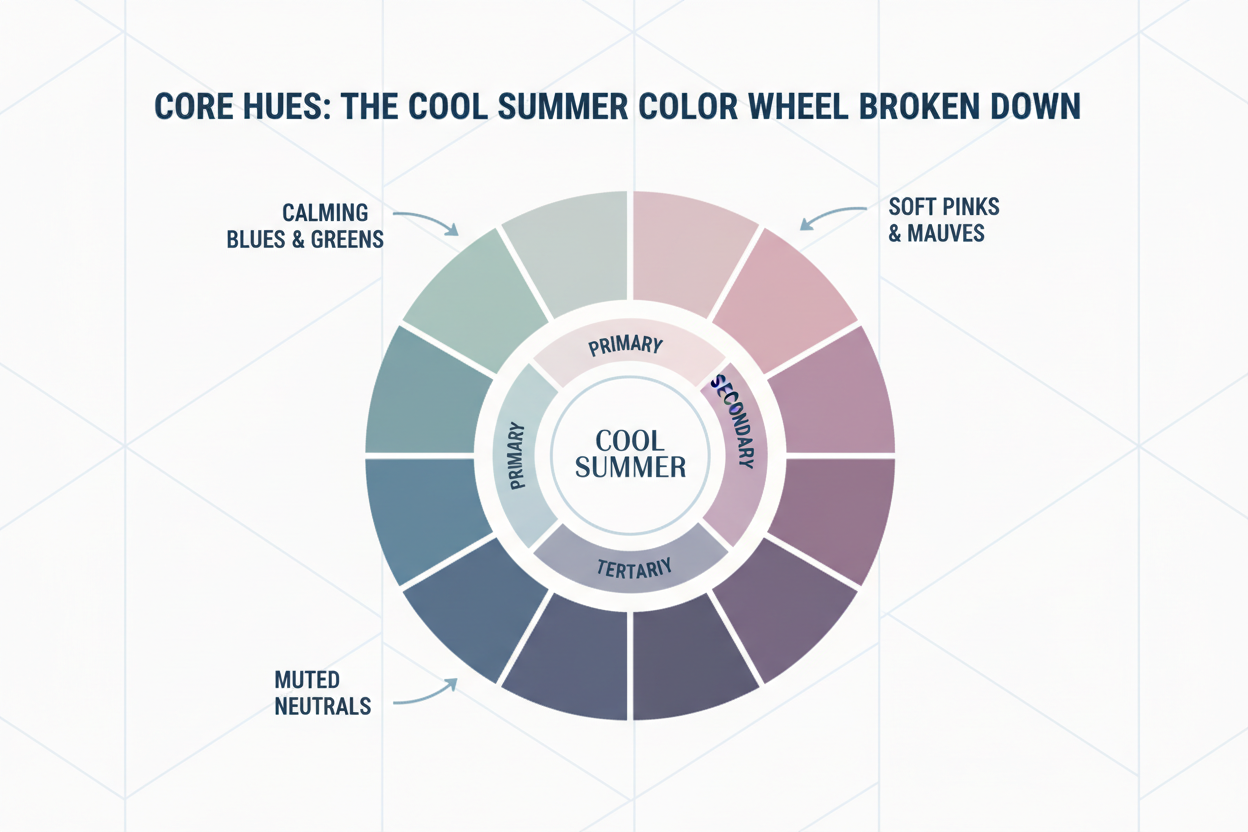
| Color Family | Cool Summer Versions | What Makes Them 'Cool Summer' |
|---|---|---|
| Blues | Soft periwinkle, dusty cornflower, muted steel blue, grey-blue | Greyish cast; neither icy pale nor deep navy |
| Pinks & Roses | Dusty rose, mauve, rose-pink, soft raspberry | Blue-based pinks; no orange or coral warmth |
| Purples & Lavenders | Soft lavender, muted lilac, dusty violet, plum (muted) | Leaning grey-blue rather than red-purple |
| Greens | Sage, soft spruce, grey-green, muted teal | Cool and dusty; no yellow-green brightness |
| Reds | Rose-red, soft burgundy, cool raspberry | Leaning towards pink-red rather than orange-red |
| Blues-Greens | Soft teal, dusty turquoise | Muted, with grey softening the vibrancy |
A note on saturation across all families: Picture turning a color's brightness down by about thirty percent and nudging its temperature toward blue or grey. That's cool summer territory. The hues should never read as vivid or electric, and they should never feel warm.
Cool Summer Neutrals: The Quiet Foundation of the Palette
Cool summer neutrals are the backbone of a functional wardrobe. They sit comfortably next to every accent hue in the palette without creating unwanted contrast.
The key cool summer neutrals:
- Soft white — not stark optical white, but a white with a slightly pink or cool grey cast
- Rose-brown — a warm-sounding name for a hue that is actually quite cool and muted; a mid-tone that bridges pink and taupe
- Cool greige — a grey-beige that leans toward grey, with no golden or yellow warmth
- Dusty navy — a navy that has been softened and slightly faded; not the crisp, saturated navy of a business suit
- Soft charcoal — a dark grey that works as cool summer's version of black, and is far more flattering than true black on this coloring
- Stone and pale grey — quiet mid-tones that anchor outfits without competing with the accent hues
These neutrals share the same muted, cool quality as the rest of the palette. They are not afterthoughts. They are what you layer the dusty roses, periwinkles, and sages on top of.
How to Identify If You Are a Cool Summer
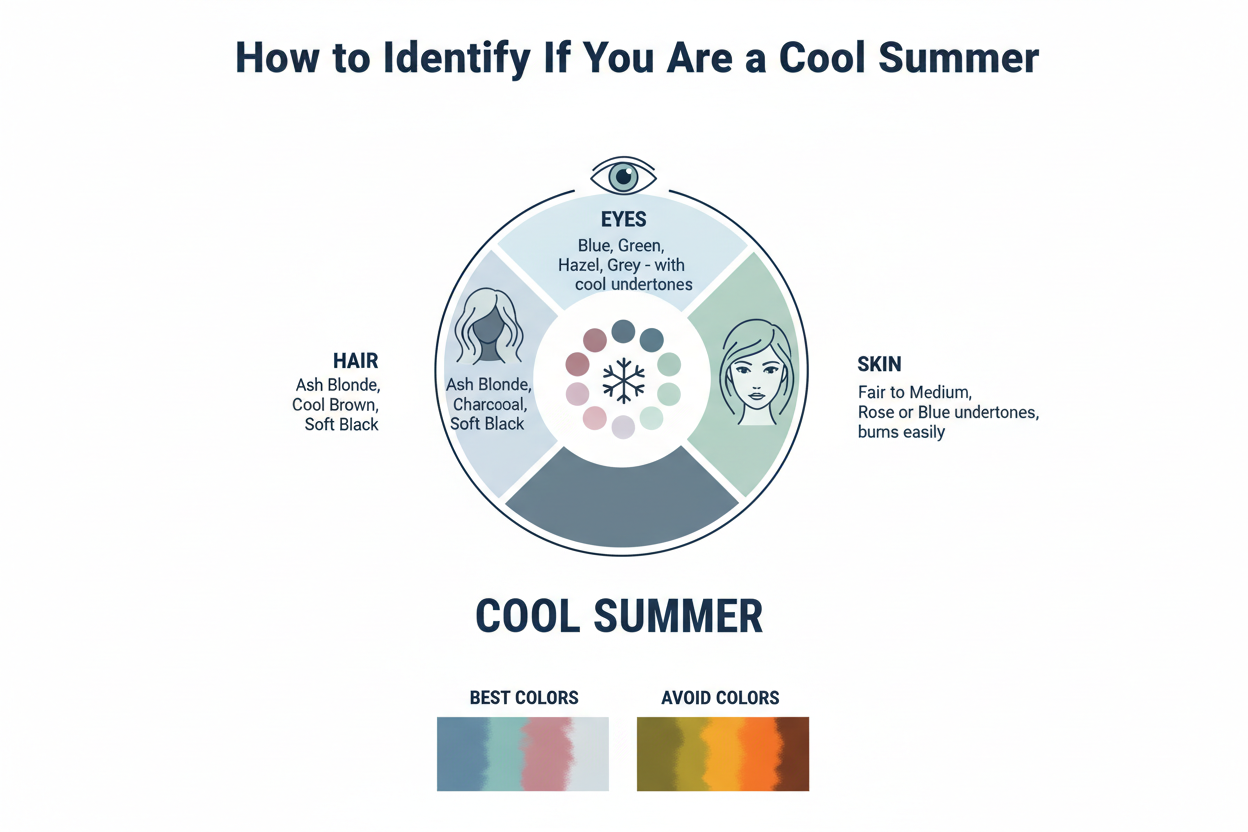
Seasonal color analysis works through a layered process of filters. The first filter is undertone — whether your natural coloring reads as cool, warm, or neutral. Cool summers sit firmly within the cool category, meaning their skin, hair, and eyes carry blue or pink-based tones rather than golden or yellow-based ones.
A striking demonstration of how powerful undertone is: when someone with cool coloring holds a warm-toned drape near their face — a rich orange or golden yellow — the reaction is often immediately visceral. The skin looks sallow, shadows deepen, and the overall effect is draining rather than enhancing. Conversely, a cool-toned drape creates clarity, brightens the eye area, and gives the skin a cleaner appearance. That contrast in reaction is the undertone filter working in real time.
Once you have established cool undertone, two secondary filters narrow the season further:
- Depth: Cool summers are medium in depth — neither very fair nor very deep in their overall coloring. This places them between light summer (lighter overall) and cool winter (deeper and more contrasted).
- Contrast: Cool summers have low to medium contrast between their hair, skin, and eye color. The difference between these elements is gentle rather than dramatic.
Common physical characteristics of a cool summer:
- Skin: Light to medium, with pink, rosy, or neutral-cool undertones. The veins on the wrist tend to look blue or blue-green rather than purple or olive.
- Hair: Ash brown, ash blonde, medium brown with cool tones, or naturally greying hair. Warm golden or red-toned hair is rare.
- Eyes: Blue-grey, grey-green, soft hazel with grey flecks, or cool medium brown.
- Overall impression: The features look harmonious and softly blended, without strong obvious contrast between them.
Worth noting: cool summer is not exclusively a northern European coloring. People across a range of skin tones can have cool undertones and low contrast. What matters is the relationship between the elements, not any single feature in isolation.
Cool Summer vs. Cool Winter vs. Light Summer: Telling the Seasons Apart
Because the word "cool" appears in both cool summer and cool winter, and because cool summer and light summer are both sub-seasons of the summer family, these three are the most commonly confused types. Here is how to distinguish them:
| Quality | Cool Summer | Cool Winter | Light Summer |
|---|---|---|---|
| Undertone | Cool | Cool | Cool to neutral-cool |
| Depth | Medium | Deep | Light |
| Contrast | Low–medium | High | Low |
| Saturation | Muted | Clear and vivid | Muted and delicate |
| Best colors | Dusty rose, soft lavender, muted navy | Stark white, deep burgundy, true red, black | Pale blush, soft sky blue, lightest lavender |
| Where it goes wrong | Too vivid, too warm, too dark | Too soft, too muted, too light | Too deep, too saturated |
The clearest practical test: a cool winter can wear stark black next to ice-white and look striking. Put a cool summer in the same combination and it tips into harsh — all that contrast fights the natural softness of their coloring. The reverse problem shows up with light summer pastels. Those very pale shades can read slightly washed-out on a cool summer, who carries just enough depth to need something with a little more presence.
Colors to Avoid as a Cool Summer
Knowing what to avoid is just as useful as knowing what works, and the reasons certain colors clash come from the same undertone and saturation logic covered above.
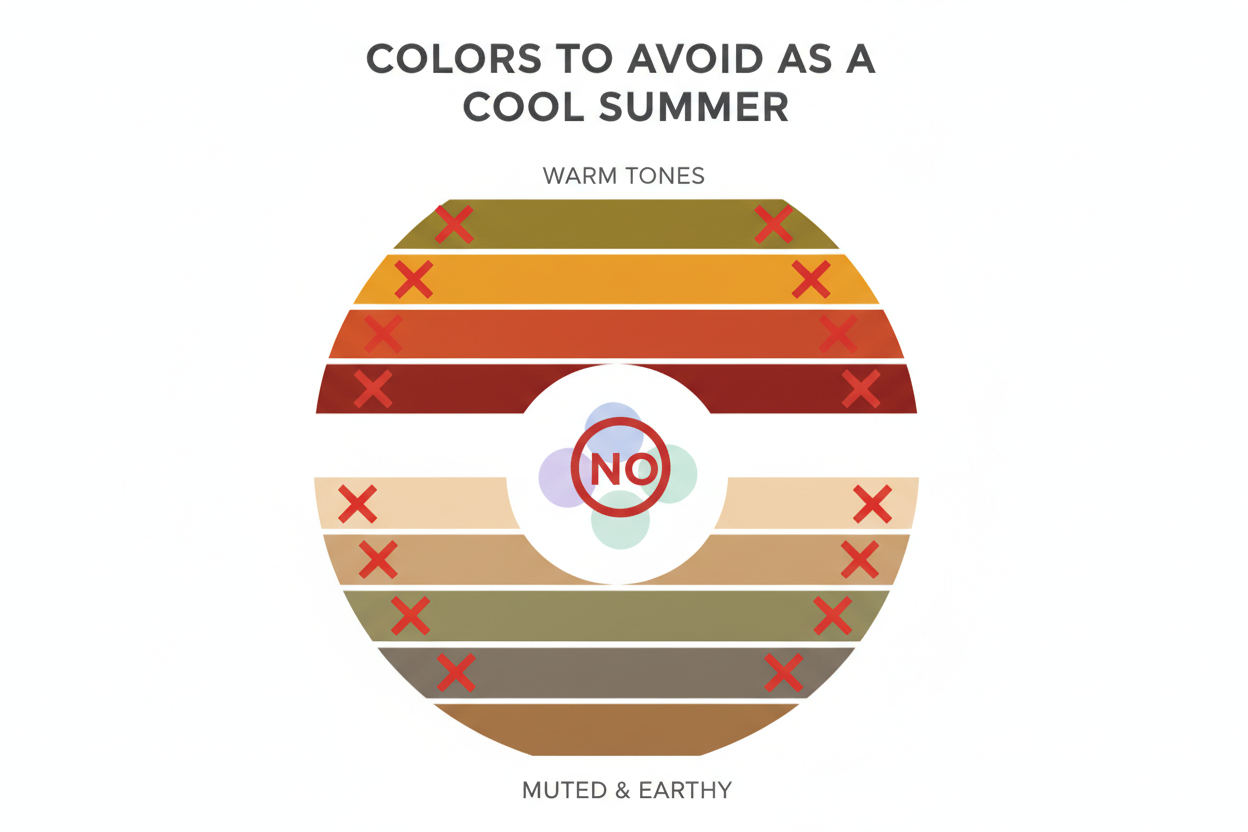
Warm-toned colors are the main category to steer clear of. Oranges, corals, terracottas, warm browns, golden yellows, and warm reds all carry yellow-based undertones that conflict with cool summer coloring. Held near the skin, these hues tend to make the complexion look sallow or tired and pull attention away from the face rather than toward it.
Highly saturated, vivid colors — even cool ones — tend to overpower the palette. A saturated cobalt blue, vivid emerald, or electric fuchsia will sit at odds with the quieter harmony of cool summer coloring. The intensity reads as too sharp and creates an imbalance between the clothing and the person wearing it.
Stark, pure black deserves particular attention. Black is not a safe neutral for cool summers — it is actually one of the harder colors for this type to wear, especially near the face. Its extreme depth creates a high-contrast jump that can make skin look flat and features less defined. The cool summer equivalent is soft charcoal or darkest navy, both of which carry some blue undertone and stop well short of true black.
Warm neutrals — camel, tan, warm beige, brown — belong to warm seasons and sit just as uncomfortably against cool summer skin as warm accent colors do.
A quick reference for what to avoid:
- Orange and all orange-adjacent colors (burnt sienna, rust, terracotta, coral)
- Warm red (tomato red, brick red)
- Golden yellow and mustard
- Warm brown and camel
- Stark, pure white (optical white)
- True black
- Vivid, highly saturated hues in any color family
Building a Cool Summer Wardrobe: Practical Color Combinations
Knowing individual hues is useful, but combining them well is what makes a wardrobe actually work. The guiding principle for cool summer combinations mirrors the palette itself: blended, not contrasted.
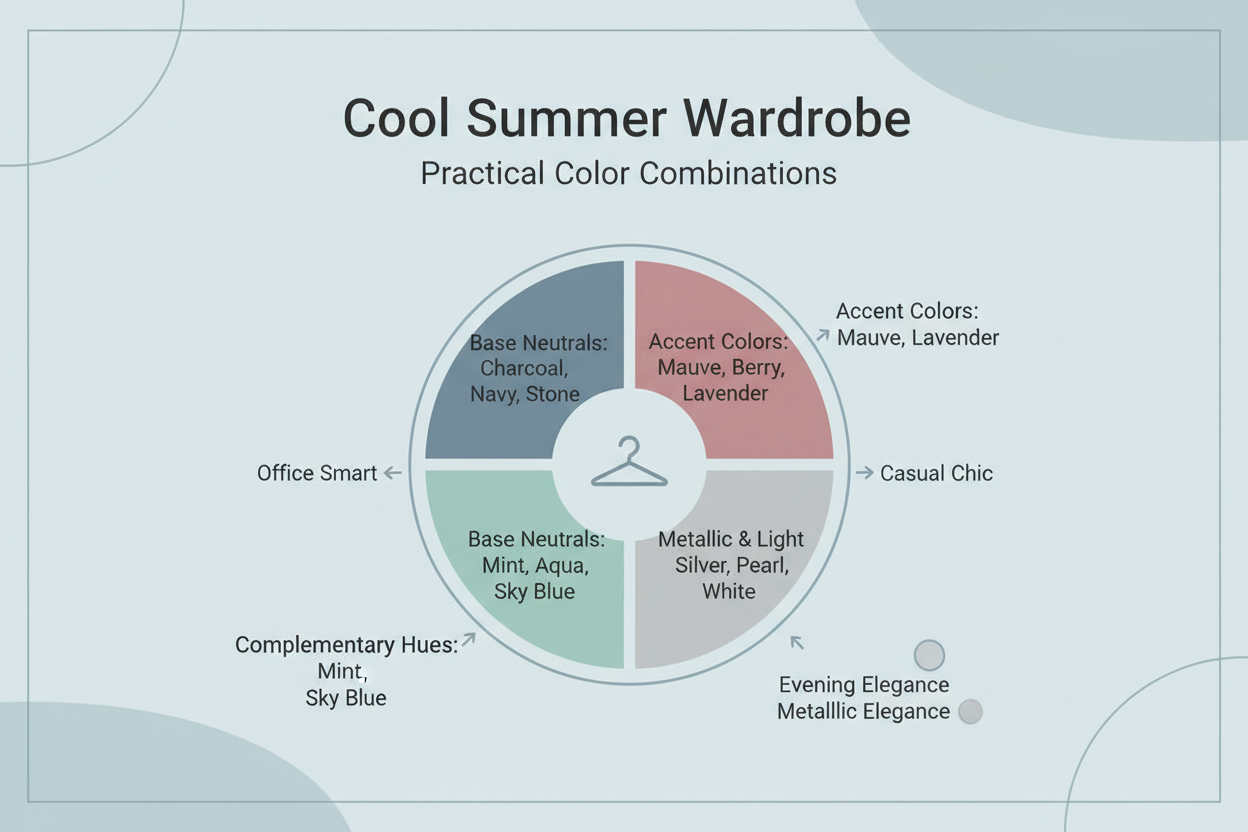
The core strategy: neutrals as anchors
Start every outfit with a cool summer neutral — soft white, cool greige, dusty navy, or soft charcoal — as either the top or bottom. These neutrals don't compete with anything, and they sit easily alongside every accent hue in the palette.
Tone-on-tone combinations
One of the most flattering approaches for cool summer is pairing hues from the same color family at slightly different depths:
- Soft lavender blouse + muted dusty violet trousers
- Pale grey-blue shirt + deeper slate-blue jacket
- Rose-brown coat + dusty rose knit underneath
The result is cohesive without creating the kind of contrast that draws attention away from your face.
Analogous combinations
Pairing neighboring hues from the cool summer wheel creates the same soft, blended quality as the palette itself:
- Lavender + soft blue + cool greige
- Sage green + dusty teal + soft white
- Mauve + rose-brown + pale grey
Accent color pairings
When you want a more defined pop of color, keep it calm by surrounding the accent with neutrals:
- Dusty rose top + cool greige trousers + soft white shoes
- Periwinkle blouse + dusty navy trousers
- Soft raspberry knit + stone grey coat
What to avoid in combinations
- Pairing two vivid hues together — even if both technically belong in the cool summer palette, the combination can read as too loud
- High-contrast pairings (very light against very dark) that push into cool winter territory
- Mixing a cool summer color with a warm neutral, like lavender with camel — the undertones fight each other
Discover Your Season: Take the Color Analysis Quiz
If you've read this far and found yourself thinking this sounds like me — or most of this fits, but I'm not sure — that's normal. Seasonal color analysis is a nuanced system, and reading about it only gets you so far.
The color analysis quiz at color-analysis.app walks you through your natural coloring step by step, using the same undertone-first framework from this guide. Whether you're stuck between cool summer and its neighbors, or starting from scratch, the quiz gives you a clear starting point.
People Also Ask
What colors are in the cool summer color palette?
Cool summer is built around hues that are cool-toned, muted, and medium in depth. Across every color family, the palette favors blue-based, grey-softened versions rather than vivid or warm ones.

Key colors include:
- Blues and periwinkles: Dusty cornflower, soft steel blue, grey-blue, muted periwinkle
- Pinks and roses: Dusty rose, mauve, rose-pink, soft raspberry
- Purples and lavenders: Soft lavender, muted lilac, dusty violet
- Greens: Sage, grey-green, soft spruce, muted teal
- Reds: Rose-red, cool raspberry, soft burgundy
- Neutrals: Soft white with a cool or pinkish cast, cool greige, dusty navy, rose-brown, soft charcoal
Every hue has a gentle grey cast — nothing vivid, nothing warm, nothing extreme in depth.
How do I know if I am a cool summer color type?
Cool summer comes down to three things working together: cool undertone, medium depth, and low-to-medium contrast.
Signs you may be a cool summer:
- Your skin has pink, rosy, or neutral-cool undertones — no golden or yellow warmth
- The veins on your inner wrist look blue or blue-green rather than green or purple
- Your hair is ash brown, ash blonde, or a cool medium brown — not golden, red, or warm-toned
- Your eyes are grey-blue, grey-green, soft hazel with grey flecks, or cool medium brown
- Your overall coloring looks softly blended — there is no high contrast between your hair, skin, and eyes
- Warm-toned clothing (orange, caramel, warm red) near your face tends to make you look sallow or tired, while cool, muted hues bring clarity and brightness
The most reliable test is comparing warm-toned versus cool-toned drapes against your skin in natural light. The difference is usually immediate and obvious.
What is the difference between cool summer and cool winter?
Both seasons share a cool undertone, which is why they get confused so often. The real difference is depth and saturation.
| Cool Summer | Cool Winter | |
|---|---|---|
| Depth | Medium | Deep |
| Saturation | Muted, softened | Clear, vivid |
| Contrast | Low to medium | High |
| Best colors | Dusty rose, soft lavender, muted navy | True red, stark white, deep burgundy, black |
A cool winter can wear black and pure white together and look sharp. A cool summer in the same combination looks overdone — the contrast fights their softer coloring. Cool summer needs colors that match its quiet, blended quality. Cool winter runs on intensity and clarity that would wash a cool summer out.
What colors should cool summers avoid?
Cool summers generally look best avoiding three broad categories:
Warm-toned colors: Orange, coral, terracotta, rust, warm red, golden yellow, mustard, camel, warm brown — these carry yellow-based undertones that clash with cool summer skin, often making the complexion look sallow or tired.
Highly saturated, vivid colors: Even technically cool hues become a problem at full saturation. Vivid cobalt, electric fuchsia, and bright emerald all read as too sharp against the soft, blended quality of cool summer coloring.
Stark, pure black and optical white: True black is too heavy for most cool summers, especially near the face. Optical white — the crisp, bright white of fresh copy paper — lacks the softness the palette needs. The better alternatives are soft charcoal and soft white with a cool or slightly pink cast.
Can cool summers wear black?
The short answer is: with caution, and rarely near the face.
True black is one of the harder colors for cool summers to pull off. Its extreme depth creates a high-contrast jump that can flatten skin tone and make features look less defined — the opposite of what a flattering color does. Cool winter can carry black effortlessly because of its deep, high-contrast coloring. Cool summer's softer, medium-depth palette tends to get overwhelmed by it.
That said, black worn away from the face — as trousers, shoes, or a bag — is far less problematic than black at the neckline.
The better alternative: Swap true black for soft charcoal or darkest dusty navy. Both read cool and provide depth without the stark, draining quality of pure black.
FAQ
What are the defining characteristics of the cool summer color palette?
Three qualities work together: a cool (blue-based) undertone, low-to-medium saturation, and medium depth. Nothing in the palette is vivid, warm, or especially dark.
The overall effect is soft and blended — like every hue has been quietly dusted with grey or lavender. Dusty rose, muted periwinkle, soft lavender, sage green, cool raspberry, gentle charcoal, rose-brown. It's one of the more harmonious seasonal groups because everything shares that same subdued, hazy quality.
Is cool summer the same as light summer?
No. They're related but distinct sub-seasons within the broader summer family.
| Cool Summer | Light Summer | |
|---|---|---|
| Defining quality | Cool undertone, primary | Lightness, primary |
| Depth | Medium | Light to very light |
| Saturation | Muted | Muted to delicate |
| Overlap | Leans toward cool winter | Leans toward spring |
Light summer coloring is notably fair and delicate — the palette skews toward very soft, airy hues. Cool summer carries more depth and a stronger cool emphasis. Both share muted saturation, but cool summer can handle slightly deeper shades without being overwhelmed. The two get confused often, especially for people with fair skin, which is why undertone and contrast level both need to be assessed together.
What neutrals work best for a cool summer color type?
Cool summer neutrals share the same three qualities as the rest of the palette — cool, soft, and medium in depth. The most versatile options are:
- Soft white with a cool or faintly pink cast (not optical blue-white)
- Cool greige — a grey-beige with no warmth or golden tone
- Dusty navy — a muted, grey-tinged navy rather than a rich or vivid one
- Soft charcoal — the practical replacement for true black
- Rose-brown — a warm-sounding name for what is, in practice, a cool, grey-toned neutral
- Lavender grey — soft enough to read as a neutral, versatile enough to anchor most outfits
These are the workhorses of a cool summer wardrobe. They sit quietly behind the palette's softer hues without creating harsh contrast or pulling warm — which is the one thing this season can't absorb.
Why do warm colors look unflattering on cool summers?
The issue is undertone mismatch. Cool summer skin has pink, rosy, or neutral-cool undertones — no yellow or golden warmth in the complexion. When warm-toned colors (orange, terracotta, camel, mustard, warm red) sit near the face, they reflect warm-yellow light back onto the skin. On a cool complexion, that reflected warmth reads as sallowness, tiredness, or uneven tone.
Color analysis works partly on reflected light — the right color bounces light back onto the face in a way that creates clarity, while the wrong color does the opposite. On a cool summer, warm hues tend to deepen shadows, dull the eyes, and flatten the overall appearance. A cool, muted alternative often produces an immediate improvement in how the skin reads.
Can cool summers wear pastels, or are they too light?
Yes — but the type of pastel matters more than the lightness.
Cool, muted pastels are actually among the most flattering options for cool summer coloring. The operative word is muted. Dusty rose, soft lavender, pale grey-blue, muted mint — these work because they carry a cool undertone and low saturation that harmonizes with the palette.
Bright, candy pastels are a different story. Those are spring colors: warm or clear in quality, and they tend to look too vivid or slightly off against cool summer skin.
So the real question isn't whether pastels are too light — it's whether they're the right kind of light. The dusty, grey-softened versions tend to look particularly good on cool summers because they mirror the soft, blended quality of the coloring itself.
What makeup colors suit a cool summer palette?
Makeup for cool summers follows the same logic as the clothing palette — cool undertones, soft saturation.
Foundation and base: Look for formulas with pink or neutral-cool undertones. Yellow or golden finishes introduce warmth that tends to clash with the complexion.
Lips: Dusty rose, mauve, cool berry, soft raspberry, and rose-pink are the most natural fits. Warm corals, peachy nudes, and orange-based reds tend to fight the skin tone.
Cheeks: Cool-toned rose and soft pink blushes work well. Warm peach or bronze shades are worth avoiding.
Eyes: Soft lavender, muted plum, dusty mauve, grey-blue, and cool taupe all complement the palette. Warm brown, bronze, and golden eyeshadows can pull the undertone off near the eyes.
Mascara and liner: Soft black or dark grey-brown tends to read better than pure jet black, which can look stark against the face.
How does cool summer differ from the other summer sub-seasons?
All three summer sub-seasons — cool summer, light summer, and soft summer — share a muted saturation quality. What separates them is which secondary characteristic dominates alongside that softness.
| Sub-season | Primary quality | Secondary quality | Leans toward |
|---|---|---|---|
| Cool Summer | Cool undertone | Medium depth | Cool Winter |
| Light Summer | Lightness | Cool/muted | Light Spring |
| Soft Summer | Muted saturation | Neutral-warm | Soft Autumn |
Cool summer is the most strongly cool of the three, sitting closest to the winter side of the seasonal spectrum. Its palette handles slightly deeper and more distinctly cool shades than the other two. Light summer is the fairest and most delicate, needing very soft, airy hues. Soft summer is the most neutral in undertone, sitting at the boundary with autumn and carrying a warmer edge than cool summer.
In practical terms: if you're a cool summer, the most clearly blue-based, cool-leaning colors in the broader summer family will serve you best. You'll also need to be more careful with anything neutral or warm-adjacent than either light or soft summer would.
Not sure which summer season fits your coloring? Take the color analysis quiz to find out.