Free Seasonal Color Analysis Quiz
 Reviewed by Alexandra Gilmore
A free quiz can translate undertone, depth, and contrast into a useful starting palette without a consultation. Prepare your answers and lighting carefully, then treat the result as a shortlist of colors to test rather than a final identity determined in a few minutes.

Figuring out your seasonal color palette without professional help can feel genuinely difficult. The good news: a well-designed seasonal color analysis free quiz cuts through the guesswork by translating the same foundational principles color analysts use — undertone, depth, and contrast — into a handful of targeted questions you can answer in minutes.
💫 Discover Your Complete Color Palette
Ready to discover all the colors that make you look radiant? Our comprehensive color analysis will reveal your complete personal palette - perfect for hair, makeup, and wardrobe decisions.
Take Color Analysis Quiz →Whether you're a complete beginner or you've taken a rough stab at your season before and landed somewhere uncertain, this quiz-based approach gives you a structured starting point grounded in real color theory rather than vibes.
Here's what you can expect from this guide:
- A clear explanation of what the quiz actually measures and why each question matters
- A breakdown of the 4-season and 12-season frameworks so you know which result to trust
- A walkthrough of what your seasonal palette means for your wardrobe, makeup, and accessories
- Honest answers to the most common questions people have before and after taking the quiz
Thousands of people have already used free color analysis quizzes to identify whether they belong in the Spring, Summer, Autumn, or Winter family — and to narrow that down further into a specific sub-season if the quiz uses the expanded 12-season model.
The quiz itself takes less than ten minutes. The clarity it gives you about which colors make your complexion look healthy and vibrant — and which ones quietly drain it — can inform your shopping and styling choices for years.
For the next diagnostic or service-choice step, continue with the companion article “What Is My Color Season? Free 16-Season Color Analysis Quiz”, which keeps the two closely related questions distinct.
📚 Recent Articles
What a Seasonal Color Analysis Quiz Actually Measures
A seasonal color analysis quiz isn't a personality test or a style preference survey. It's a diagnostic tool that maps three observable physical traits — undertone, skin depth, and contrast level — to one of the recognized seasonal palettes. When all three line up, the quiz can predict with reasonable accuracy which color family will make your complexion look its clearest and most balanced.
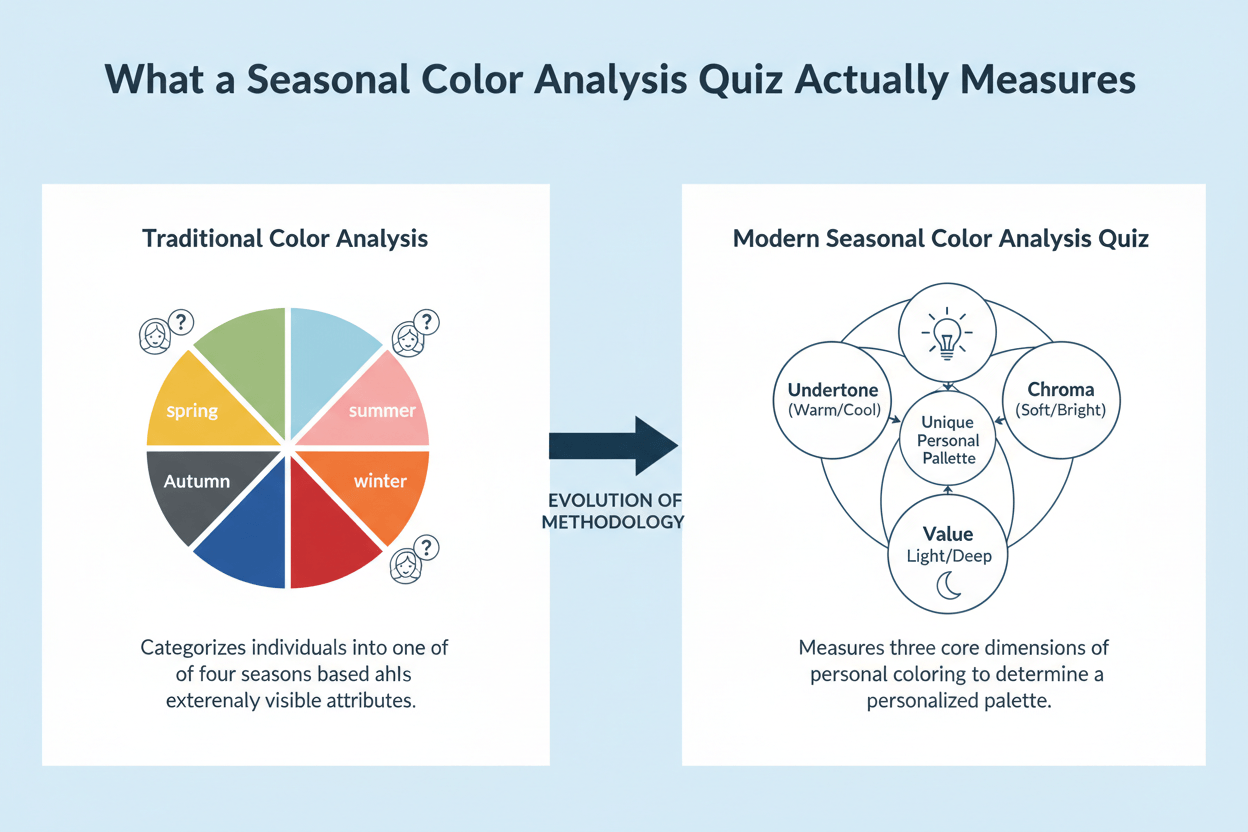
Knowing what the quiz measures before you take it has one practical benefit: the questions will make more sense, and you'll answer them more accurately. Here's what each input captures:
- Undertone — whether the underlying hue of your skin reads as cool (pink, bluish, or rosy), warm (golden, peachy, or yellow), or neutral (a blend of both). This is the primary fork in every seasonal system.
- Depth — how light or dark your overall coloring appears, considering skin, hair, and eyes together rather than any single feature in isolation.
- Contrast level — the degree of visual difference between your skin tone, hair color, and eye color. High-contrast coloring looks dramatically different across those three features; low-contrast coloring reads as more similar in value.
Because those three traits interact, the palette that suits you is specific in a way that generic advice about "warm tones" or "neutrals" can't capture. A structured quiz accounts for the combination all at once.
→ Take the Free Seasonal Color Analysis Quiz and find your palette in minutes.
12-Season vs. 4-Season: Which System Does This Quiz Use?
The original seasonal color analysis framework divides everyone into four broad groups — Spring, Summer, Autumn, and Winter — each named for the season whose natural palette it resembles. The 12-season model keeps those four anchors but subdivides each one into three variants, producing categories like Soft Summer, Bright Spring, or Deep Autumn. A 16-season model exists as well, extending the subdivisions further.
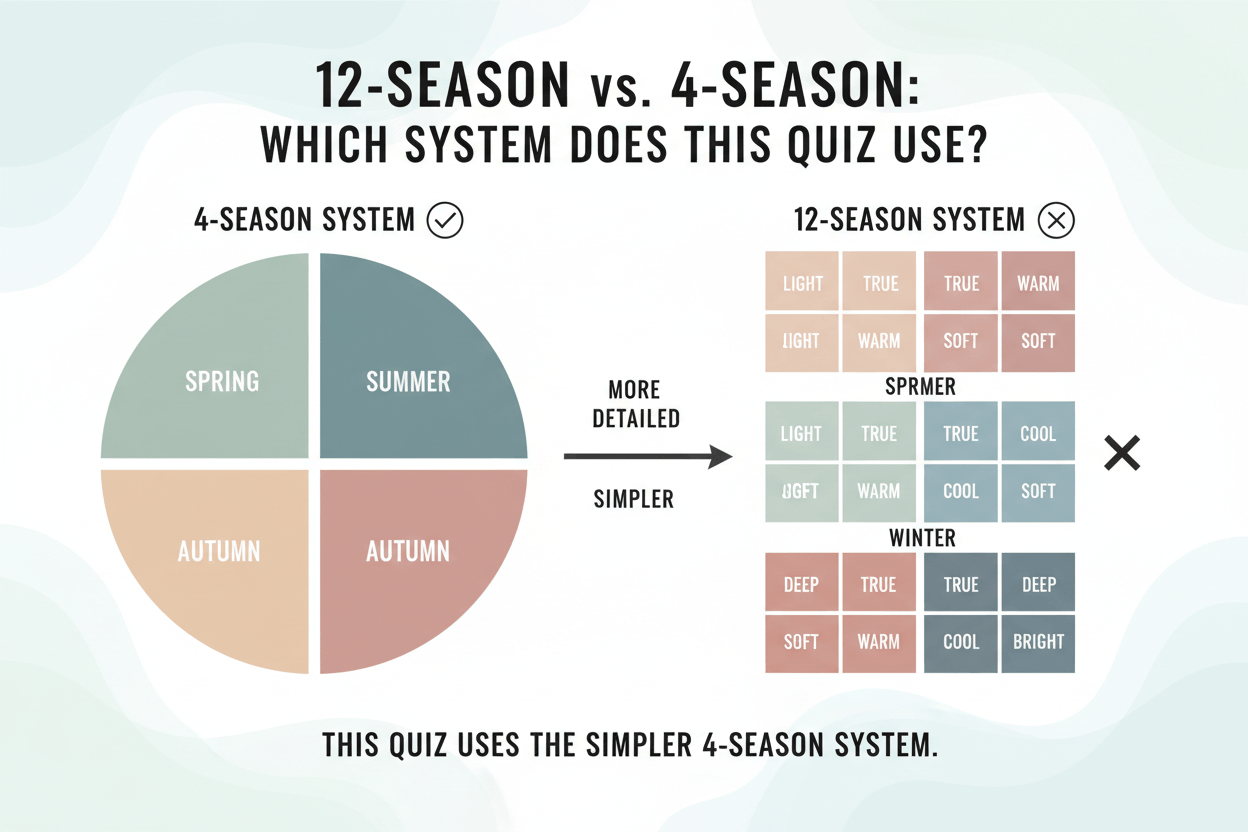
There is genuine debate in the color analysis community about which system is most useful. The distinction between 12-season and 16-season analysis, for instance, comes down to how finely you want to classify edge cases — people whose features sit at the boundary between adjacent palettes.
This quiz uses the 12-season model for a few specific reasons:
- It captures enough nuance to be useful, especially for shopping and wardrobe decisions
- The 16-season model tends to produce results that feel too narrow to act on with confidence
- It maps onto the three core variables the quiz measures: undertone, depth, and contrast
The 16-season approach isn't wrong. It just requires a level of in-person observation that's hard to replicate in a self-reported quiz. If your result leaves you feeling like you're between two palettes, you probably are — a professional analyst can help you narrow it down.
Why Undertone Is the First Fork in Every Seasonal System
Every system — 4, 12, or 16 seasons — starts in the same place: cool, warm, or neutral undertone. This isn't arbitrary. It's where the most visible difference in flattery shows up.
When a warm-toned drape is held against someone with cool undertones, the result is immediately unflattering. The face can look sallow, tired, or uneven. Switch to a cool drape and the same person's complexion reads cleaner and more alive. The difference is usually obvious even to an untrained eye.
Undertone is the first thing the quiz resolves because getting it wrong at this stage would make the rest of the result inaccurate, no matter how well everything else was measured.
How the Quiz Questions Identify Your Facial Traits
Rather than asking you to describe your coloring in abstract terms, a well-structured color analysis quiz uses illustrated questions that direct your attention to specific, observable features. This cuts down on guesswork and makes it easier to distinguish between, say, a warm olive complexion and a neutral medium complexion that only reads as olive in certain lighting.
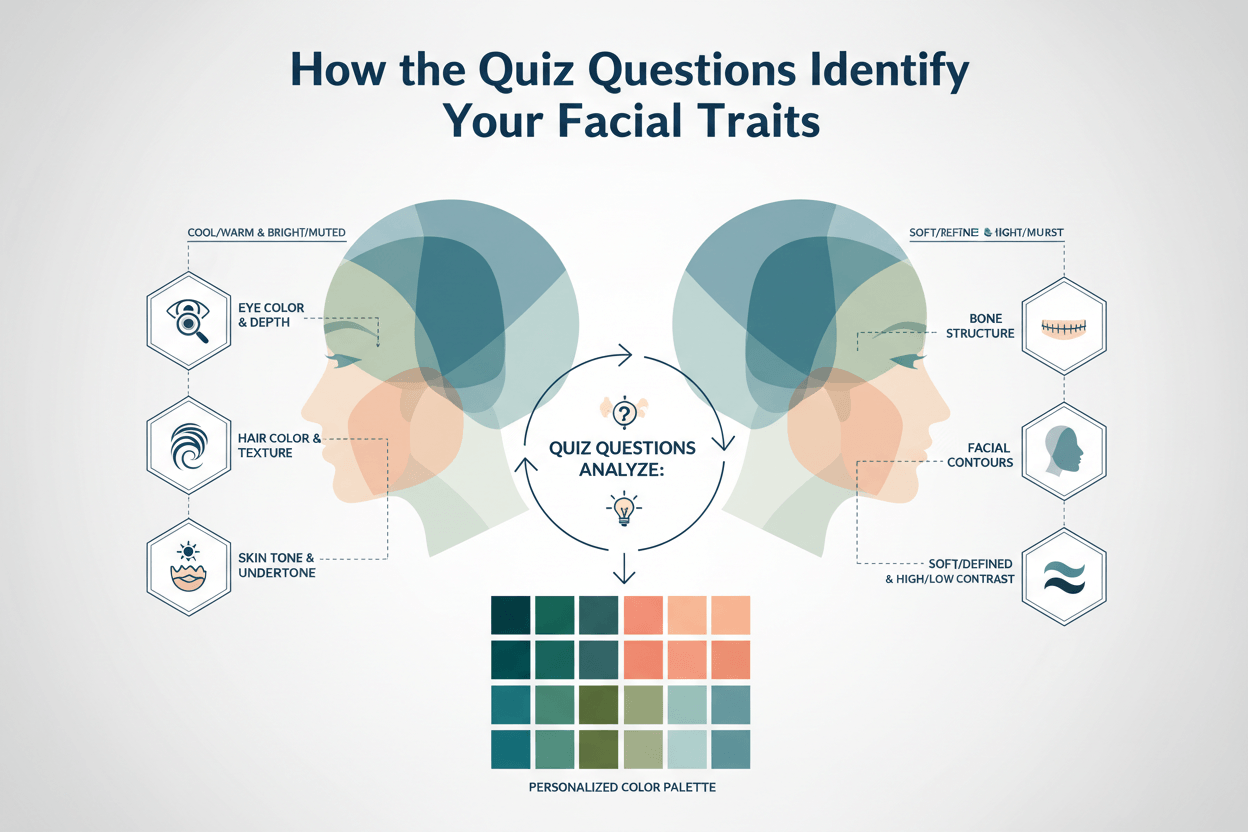
Most quiz questions are looking for the following:
- Skin undertone signals — vein color on the wrist, how your skin reacts to sun exposure, whether silver or gold jewelry looks more natural on you
- Hair color and its underlying tone — not just dark or light, but whether it has warm (golden, red, auburn) or cool (ashy, blue-black) undertones
- Eye color and clarity — the hue and whether the iris looks soft and muted or vivid and clear
- Overall contrast — how much difference exists between your lightest and darkest facial features
- How specific shades affect your appearance — some quizzes ask whether certain colors make you look washed out or unexpectedly vibrant
Illustrated questions are useful here because they give you a visual reference point rather than asking you to interpret color terminology on your own.
What 'Contrast Level' Means and Why the Quiz Asks About It
Contrast level is one of three core factors in determining your seasonal palette, and it's the one most people don't initially think of as relevant. When a quiz asks about contrast, it's asking how much visual distance exists between your skin tone, hair color, and eye color — not how dramatic your personal style is.
Here's how to think about it:
- High contrast — very fair skin with very dark hair and eyes. The difference between features is striking and immediately noticeable.
- Medium contrast — features that differ noticeably but don't create a dramatic visual jump. Medium brown hair with medium skin and hazel eyes is a common example.
- Low contrast — features that are close in depth and tone. Blonde hair, light skin, and light eyes that read as a harmonious, blended whole.
Contrast level matters because seasonal palettes are built around it. High-contrast people tend to do well with palettes that have strong value differences — deep darks alongside bright lights. Low-contrast people are often overwhelmed by that level of drama and look better in palettes where colors stay closer in depth and saturation.
When you answer the contrast question, look at your face in natural daylight without makeup and assess the overall difference between your skin, hair, and eyes as a system — not each feature on its own.
Take the Free Seasonal Color Analysis Quiz
You have what you need to answer the questions accurately. It's a focused set of illustrated questions, each targeting one of the variables described above—the same inputs color analysts use in professional sessions. Thousands of people have used it to find their seasonal palette without booking a consultation.
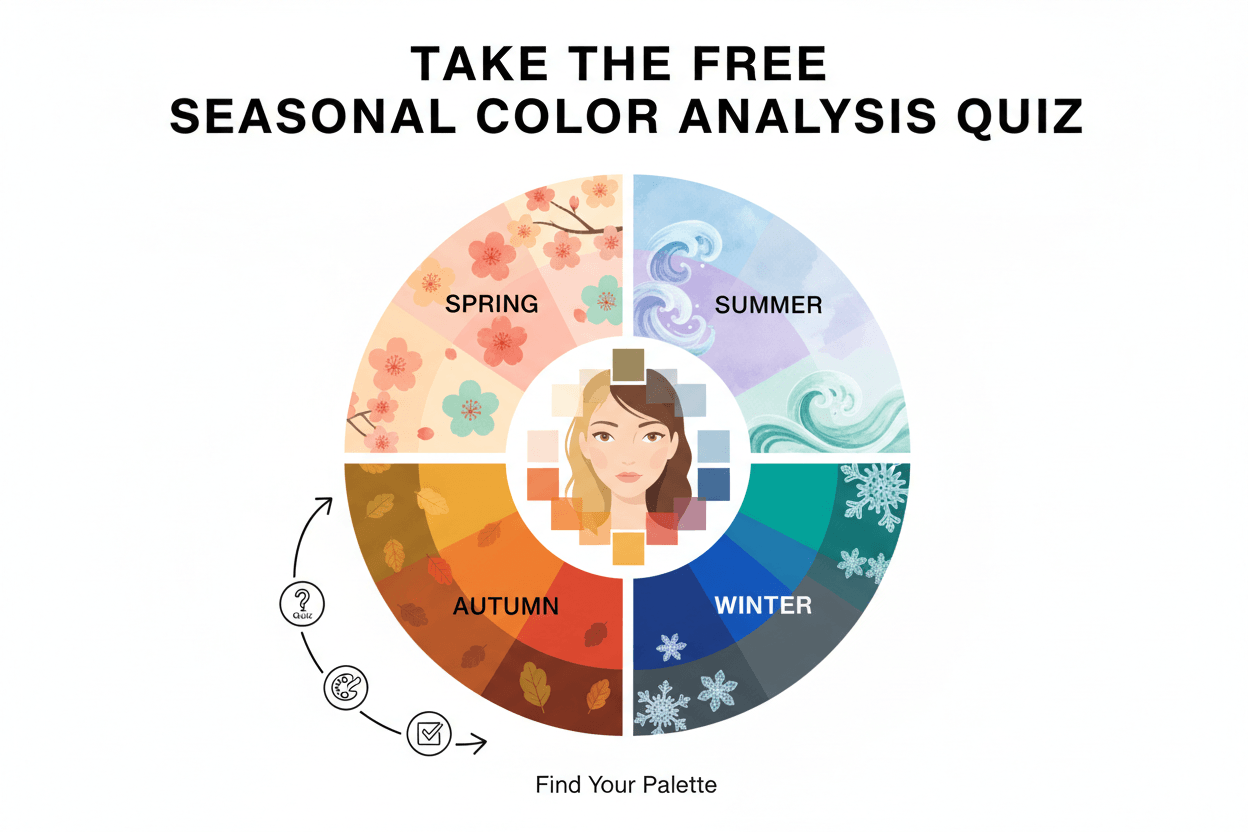
→ Start the Free Seasonal Color Analysis Quiz Now
What Your Seasonal Palette Result Means for Your Wardrobe
Once the quiz identifies your season, you get something immediately useful: a defined set of colors that work with your natural coloring instead of fighting it. This isn't about restricting your wardrobe — it's about knowing which choices will consistently make you look healthy, rested, and put-together.
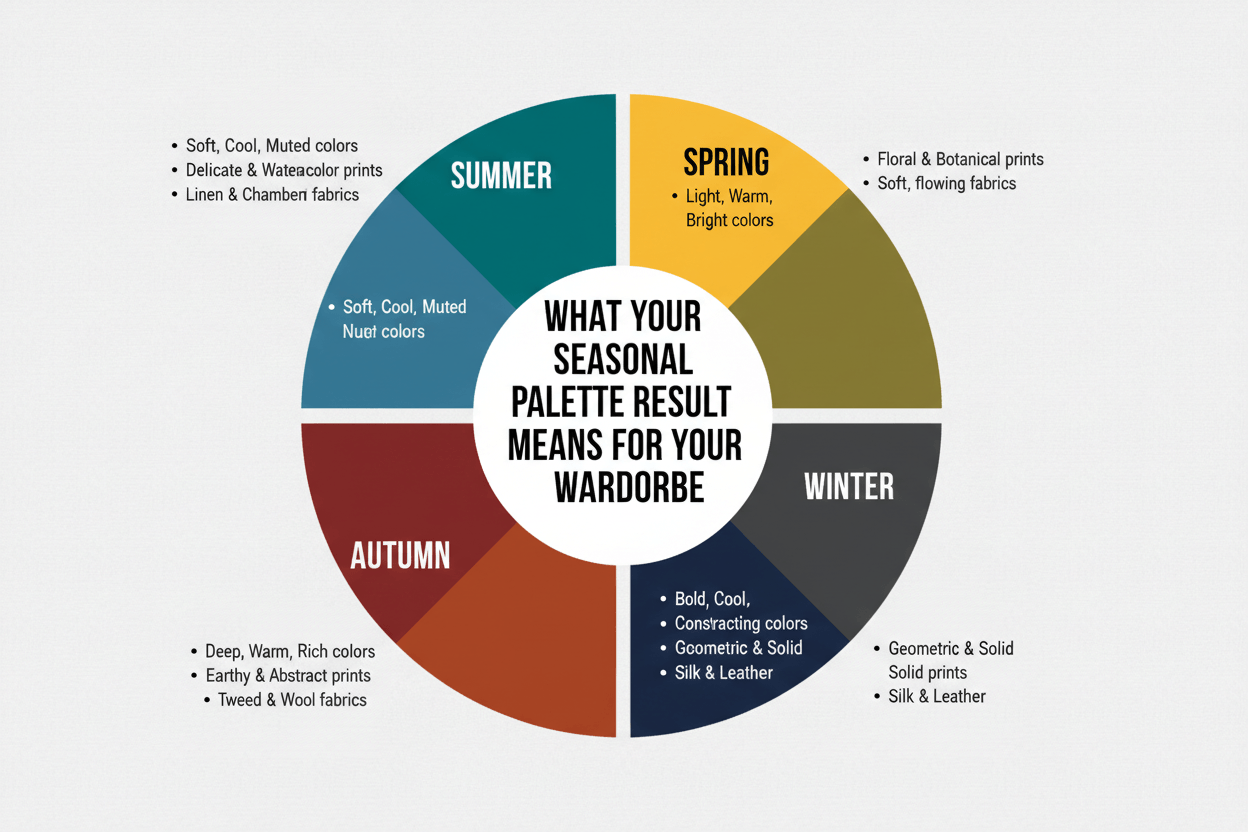
Your seasonal palette translates into practical guidance across a few areas:
- Clothing colors near your face — tops, scarves, and jacket lapels matter most because they sit closest to your complexion. These are the pieces where staying within your palette makes the biggest difference.
- Neutral choices — every seasonal palette includes neutrals (navy, camel, ivory, charcoal, and so on) that work as wardrobe foundations without clashing with your undertone.
- Metals and accessories — cool seasons tend to suit silver, white gold, and platinum; warm seasons suit gold and bronze; neutral seasons have more flexibility across both.
- Makeup shades — your palette points toward which lip, blush, and eyeshadow tones will harmonize with your complexion rather than sit on top of it.
The real value is that your palette gives you a stable reference point. Your undertone, hair shade, and eye color don't change with trends — so the colors that flatter you stay consistent regardless of what's on the rack this season.
Common Mistakes People Make When Guessing Their Season Without a Quiz
Self-diagnosing your seasonal palette is genuinely difficult without a structured tool. Color analysts train specifically to catch distinctions that look ambiguous to everyone else. Without that structure, the same errors come up again and again.
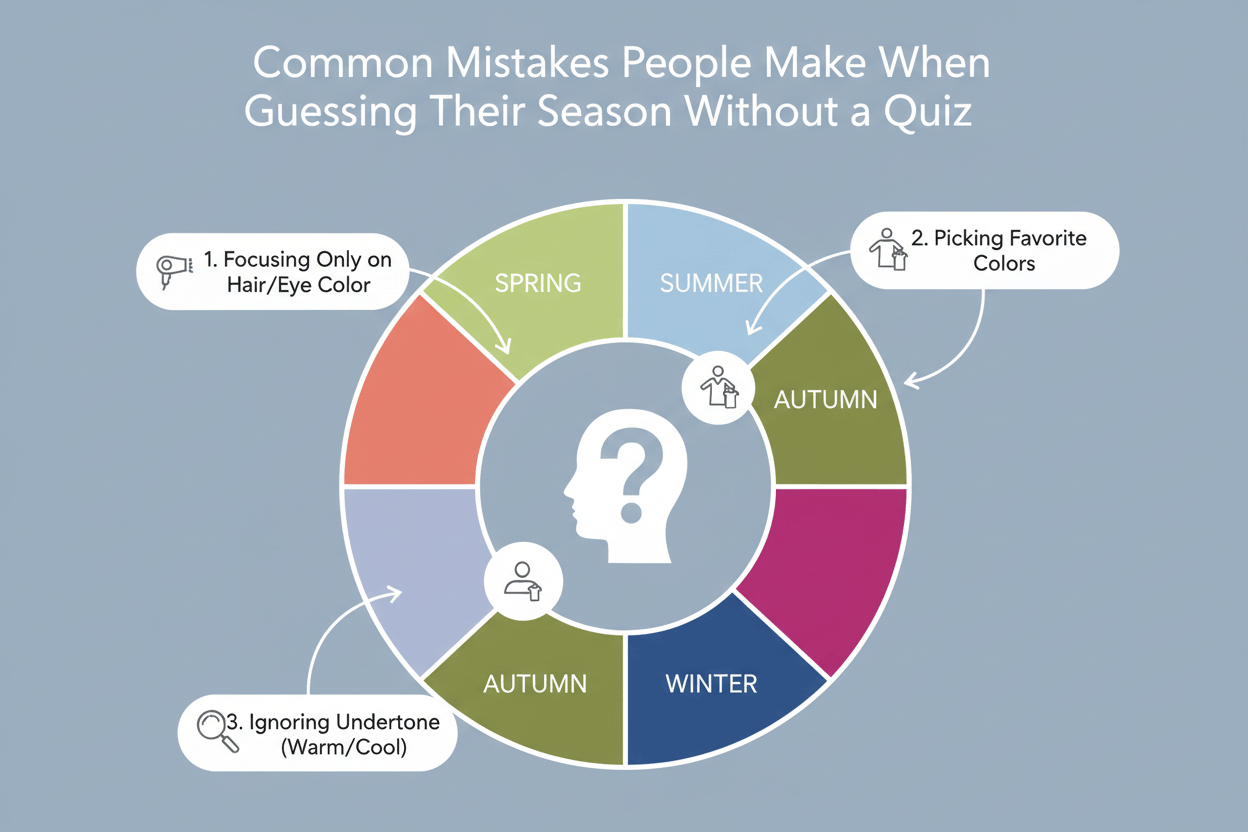
Confusing skin surface tone with undertone Skin can look tan, fair, or medium on the surface while having a cool, warm, or neutral undertone underneath. Someone with a deep tan may still have a cool undertone — warm colors will still look off against their complexion. Surface color changes. Undertone doesn't.
Assessing features in isolation Eye color alone, or hair color alone, won't tell you your season. All three inputs work together. Someone with warm golden hair might still be a cool season if their skin and eyes pull the overall picture cool — and contrast level determines which specific sub-season fits.
Guessing based on what you already own or like Your wardrobe isn't a reliable guide to your palette. People tend to buy colors they've been told look good on them, colors tied to their personality, or just whatever was available. The quiz asks about physical features, not preferences, for exactly this reason.
Underestimating the impact of the wrong undertone Wearing colors in the wrong undertone family shows up on your face — dullness, uneven skin tone, shadows under the eyes, a general look of tiredness that has nothing to do with sleep. This matters more than the other mistakes because it affects every outfit in that color family at once.
A free seasonal color analysis quiz cuts through most of these errors by walking you through the relevant inputs in order — undertone first, then depth and contrast — instead of asking you to size up your overall season in one unsupported guess.
People Also Ask
How accurate is a free seasonal color analysis quiz?
A well-structured free quiz gets most people to a reliable starting point. Quizzes that ask about undertone, depth, and contrast level — rather than style preferences — are working from the same inputs a professional analyst looks at in person. Platforms that have processed thousands of users demonstrate that the self-reported format actually works at scale.
The main limitation is self-reporting. If you misread your undertone or check your features under bad lighting, the result will drift. To get the most accurate outcome:
- Answer in natural daylight without makeup
- Look at your features together, not one at a time
- Use any illustrated guides the quiz provides as reference points
For most people, a free quiz narrows the field significantly. If the result feels slightly off, a professional consultation can refine it — but the quiz is a solid, free first step.
What is the difference between 12-season and 4-season color analysis?
The 4-season system puts everyone into one of four groups — Spring, Summer, Autumn, or Winter — based mainly on undertone and depth. It's simple and widely recognized, but broad enough that two people in the same season can look quite different from each other.
The 12-season model keeps those four anchors and splits each into three sub-types, giving you categories like Soft Summer, True Spring, or Deep Winter. Each sub-season reflects a more specific mix of undertone, depth, and contrast level.
| System | Seasons | Key benefit |
|---|---|---|
| 4-season | 4 | Easy to understand and apply |
| 12-season | 12 | More precise palette matching |
| 16-season | 16 | Most granular; harder to self-diagnose |
A 16-season framework also exists, pushing subdivisions even further. The difference between 12 and 16 seasons tends to matter most for people who sit on the boundary between adjacent palettes — a distinction that's genuinely hard to resolve without seeing someone in person. For everyday wardrobe decisions, the 12-season model is probably the most useful tradeoff between precision and practicality.
How do I find my seasonal color palette without a professional?
A free seasonal color analysis quiz is the most reliable way to do it yourself. The key is finding one that looks at measurable physical traits, not style preferences or favorite colors, and works through them in the right order:
- Determine your undertone first — cool, warm, or neutral. This matters more than anything else.
- Assess your depth — how light or dark your overall coloring looks across skin, hair, and eyes together.
- Identify your contrast level — the visual difference between your lightest and darkest features.
Beyond a quiz, the draping test is worth trying at home: hold fabric swatches in warm versus cool tones near your face in natural light and see which makes your skin look clearer. The silver versus gold jewelry trick is another common shortcut for undertone. Whichever metal looks more natural usually tells you whether you run cool or warm.
That said, figuring this out without any structured tool is genuinely hard. Even professional color analysts admit that untrained self-assessment gets it wrong a lot.
What questions does a seasonal color analysis quiz ask?
A typical seasonal color analysis quiz focuses on illustrated, trait-based questions rather than abstract self-description. Common topics include:
- Vein color on the wrist — blue/purple veins suggest cool undertones; green veins suggest warm undertones; a mix indicates neutral
- Skin's reaction to sun — whether you burn easily, tan gradually, or rarely burn
- Hair color and its underlying tone — whether your hair reads as ashy, golden, auburn, blue-black, or another shade
- Eye color and clarity — the hue of your iris and whether it appears muted or vivid
- Jewelry preference as a visual cue — whether silver or gold looks more natural near your face
- Overall contrast — how much difference exists between your skin, hair, and eye color taken together
Some quizzes also ask how specific shades affect your complexion — whether certain colors wash you out or make you look unexpectedly awake. Illustrated questions help here because you get visual reference points instead of having to decode color terminology on your own.
Can I take a seasonal color analysis quiz online for free?
Yes. Several free options exist, ranging from short six-question formats to more comprehensive versions. Some are standalone tools; others are embedded in broader style or beauty platforms.
When choosing one, look for a quiz that asks about undertone, depth, and contrast—not just one of the three. Visual references help. You also want a specific named result (ideally within a 12-season framework) rather than something vague like "you're warm-toned." And it shouldn't ask you to create an account or pay before showing you anything.
The free quiz on this platform covers all of that and gives you a full seasonal palette result.
Frequently Asked Questions About the Free Color Analysis Quiz
How many questions are in the free seasonal color analysis quiz?
Most free seasonal color analysis quizzes run six to eight questions. Some use six illustrated questions focused on observable facial traits; others work through eight to cover undertone, depth, and contrast level more precisely. Shorter versions are faster but may give you a broader result. Either way, you're done in under five minutes.
What do I need to know before taking the seasonal color analysis quiz?
Not much. A few simple steps will improve your result:
- Use natural daylight. Artificial or overhead lighting distorts how your skin tone, hair color, and eye color appear.
- Remove or minimize makeup. Foundation, blush, and colored lenses mask the features the quiz is actually measuring.
- Have a mirror handy. Several questions ask you to observe your vein color, eye tone, or hair undertone directly.
- Think about your features as a group, not in isolation. Seasonal analysis is based on how your skin, hair, and eyes interact — not any single trait on its own.
No color theory knowledge required. Quizzes that use illustrated questions with visual references make it easy to identify your traits even if you've never studied color terminology before.
Is a free online color analysis quiz as accurate as a professional consultation?
For most people, yes — accurate enough to act on. A well-designed quiz focuses on the same three things a trained analyst looks at in person: undertone, depth, and contrast level. Platforms that have put thousands of people through this process have shown that self-reported answers genuinely hold up.
The main limitation is self-assessment. Poor lighting makes undertones harder to read, and contrast level is easy to misjudge. A professional removes that variable by looking at your features directly.
Practically speaking: the free quiz is a good starting point, and it costs nothing. If the result feels slightly off, or you seem to fall between two adjacent seasons, a consultation can sharpen the diagnosis. For most people, though, the quiz result is specific enough to start making real wardrobe and makeup decisions.
What is the difference between the 12-season and 16-season color analysis systems?
Both systems expand on the original four-season model to achieve greater precision.
- The 12-season system divides each of the four classic seasons (Spring, Summer, Autumn, Winter) into three sub-types, resulting in categories like Soft Summer, Bright Spring, or Deep Winter. Each sub-season reflects a distinct combination of undertone, depth, and contrast.
- The 16-season system adds a further layer of subdivision, creating four variations per season rather than three.
| System | Total seasons | Practical use |
|---|---|---|
| 4-season | 4 | Easy starting point |
| 12-season | 12 | Best balance of precision and usability |
| 16-season | 16 | Most granular; harder to self-diagnose |
For most people taking a free quiz, the 12-season framework is the practical choice. It's specific enough to give you genuinely useful palette guidance without requiring the fine distinctions that 16-season analysis demands. The gap between the two systems mainly matters if you fall on the border between adjacent palettes — and that's exactly the kind of call that's hard to make through self-assessment alone.
How do I use my seasonal color palette result in my everyday wardrobe?
Your result gives you a named season with a set of hues that work with your specific undertone, depth, and contrast level. Here's how to actually use it:
- Start with clothing near your face. Tops, scarves, and jackets have the most direct impact on how your complexion looks. Bottoms matter less.
- Use your palette as a filter when shopping. If a color falls outside your season's range, pause before buying — even if you love everything else about the piece.
- Apply it to makeup too. Foundation undertone, blush, and lip color all get easier to choose once you know whether your palette runs cool, warm, or neutral.
- Think about accessories. Metal jewelry, bag colors, and eyeglass frames all factor into the overall picture.
You don't need to overhaul your wardrobe. Swapping in one or two pieces in your palette colors is usually enough to notice the difference.
Can my seasonal color palette change over time?
Your core season comes from the undertone, depth, and contrast level of your natural coloring — traits that stay pretty stable across your life. For most people, the season they get in their twenties still holds up decades later.
That said, a few gradual shifts are worth knowing about:
- Hair naturally lightens or darkens with age, which can shift your overall contrast and nudge you toward a sub-season with softer or deeper tones.
- Skin depth can change a little from sun exposure, health changes, or hormonal shifts.
- Color treatments and styling choices don't change your season, but they can make accurate self-assessment harder.
If your result starts feeling off, retake the quiz using your current natural coloring — ideally with your hair in its natural state and no makeup — to see whether anything has shifted.
What if my quiz result doesn't match the colors I already wear?
This is one of the most common reactions — and it's worth taking seriously rather than dismissing. A few possibilities:
- You've been dressing in colors that are familiar, not necessarily flattering. Most people default to what they've always worn. A quiz result that diverges from your current wardrobe may simply be pointing to untested territory.
- Your quiz answers may need revisiting. If you answered in artificial light, with makeup on, or made a close call on an undertone question, a single question shift can change the result. Try retaking it under better conditions.
- Some colors in your wardrobe may work for other reasons — cut, fit, pattern — rather than hue. Those pieces can still have a place; your palette is one input, not a rigid rule.
The most useful test: hold a piece in your current wardrobe and a piece from your suggested palette near your bare face in natural light. The difference in how your skin reads — clearer versus dull, energized versus washed out — is usually visible within seconds. Take the free seasonal color analysis quiz to get your palette and try the comparison yourself.