12 Season Color Analysis vs 16 Season
 Reviewed by Alexandra Gilmore
Twelve- and sixteen-season systems use the same core color dimensions but divide their boundaries differently. Compare the extra subtypes, naming conventions, precision, and learning curve so you can choose the framework that clarifies your draping results instead of multiplying labels.

If you've spent any time exploring personal color theory, you've likely encountered two competing frameworks: the 12 season color analysis system and the newer 16 season expansion. Both promise to match your natural coloring—skin tone, hair, and eyes—to a curated palette of flattering shades. But they go about it differently, and choosing the wrong system can leave you more confused than when you started.
💫 Discover Your Complete Color Palette
Ready to discover all the colors that make you look radiant? Our comprehensive color analysis will reveal your complete personal palette - perfect for hair, makeup, and wardrobe decisions.
Learn Seasonal Analysis →Here's what this article will do: break down exactly how the 12 seasonal color analysis system is built, show where the 16 season model adds complexity (and whether that complexity pays off), and give you a clear way to decide which framework suits your wardrobe goals.
A few grounding facts before diving in:
- The 12 season system organizes human coloring into four parent seasons—Spring, Summer, Autumn, and Winter—each divided into three sub-seasons, producing twelve distinct palettes in total.
- Color analysis itself is not a new idea. Its modern form traces back to 19th-century color theory, though the seasonal framework has been refined considerably since then.
- At first glance, twelve palettes can feel overwhelming. In practice, the structure is more logical than it appears once you understand the two or three variables driving every category.
Whether you're approaching this for the first time or trying to reconcile conflicting results from different systems, the comparison ahead is designed to be concrete and actionable—not another pass at vague seasonal stereotypes.
For the next diagnostic or service-choice step, continue with the companion article “Seasonal Color Analysis Quiz: How Accurate Is It”, which keeps the two closely related questions distinct.
📚 Recent Articles
How the 12 Season Color Analysis System Is Structured
The 12 season system runs on a simple branching logic. Four parent seasons—Spring, Summer, Autumn, and Winter—each split into three sub-seasons, giving you twelve distinct palettes. Each palette is defined by three things: undertone, value (how light or dark your overall coloring is), and chroma (how muted or saturated the colors are).
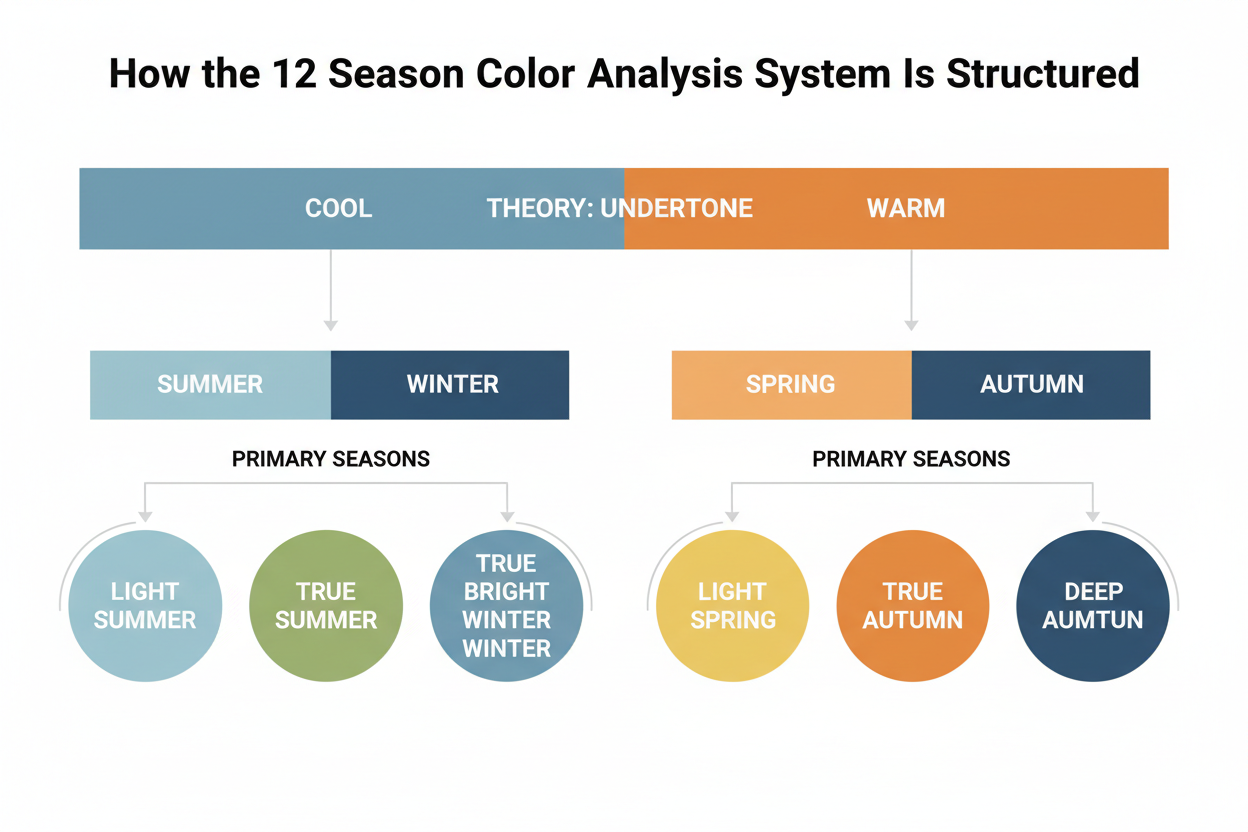
None of it is arbitrary. Every category comes from applying those same variables consistently across the full range of human coloring.
The Three Sub-Seasons Within Each Main Season
Each parent season branches into three sub-types based on which quality dominates a person's coloring:
- Spring → True Spring, Light Spring, Bright Spring
- Summer → True Summer, Light Summer, Soft Summer
- Autumn → True Autumn, Soft Autumn, Dark Autumn
- Winter → True Winter, Dark Winter, Bright Winter
Note: Sub-season names reflect established practitioner terminology; they are not explicitly listed in the source material referenced here.
The True sub-season in each group is the most straightforward expression of that season. The flanking sub-seasons borrow from a neighbor—Bright Spring shares Winter's intensity, Light Spring leans into Summer's softness. That borrowing is what makes the 12-season system flexible without needing an entirely new framework.
If you want to find out where your coloring lands, the [color analysis quiz →] walks you through the core variables in a few minutes.
How the 16 Season System Differs: Extra Layers Explained
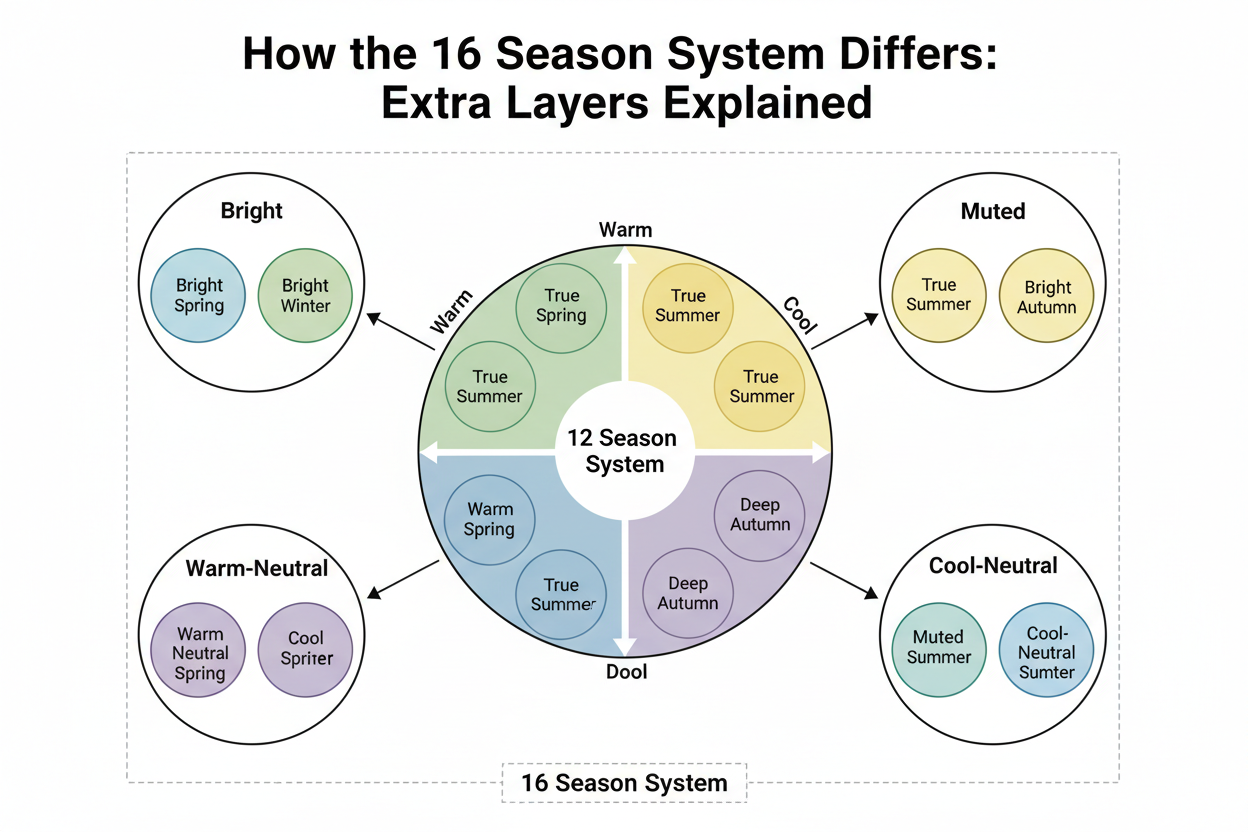
How the 16 season system differs: extra layers explained
The 16 season system keeps the same four parent seasons but adds a fourth sub-season to each, bringing the total from twelve to sixteen. The extra categories come from splitting undertone or contrast more finely—distinguishing, for instance, between a cool-neutral and a neutral-cool reading that the 12-season model treats as one.
In practice:
- More granular undertone distinctions. Where the 12-season system has cool, warm, and neutral, the 16-season model adds another position on that spectrum within certain seasons.
- Finer contrast gradations. Some palettes are split to separate high-contrast coloring from medium-contrast coloring within the same undertone family.
- Four sub-seasons per parent. The extra category usually sits between two existing 12-season sub-seasons, for people who never felt quite right in either.
The 16-season framework is not a replacement for the 12-season model. It is the same logic at higher resolution. Whether that extra resolution actually changes what you wear is a more useful question—and it's addressed below.
The Role of Undertone in Both Systems
Cool, Warm, and Neutral: Why Getting This Right Changes Everything
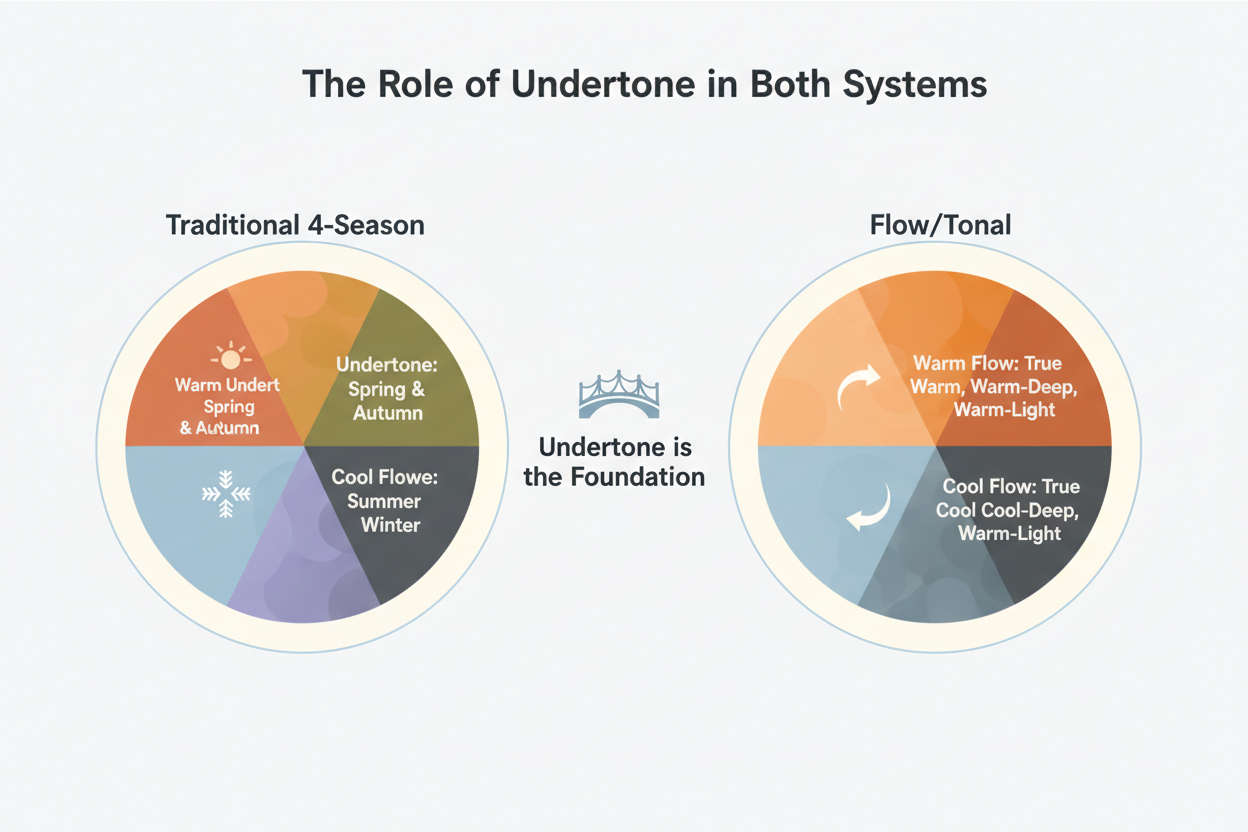
Undertone is the first variable both systems evaluate, and it causes the most visible problems when misidentified. The three positions on the undertone spectrum are cool, warm, and neutral, and the difference between them is not subtle when you hold fabric against your face.
One color analysis session made this concrete. A subject was draped in a warm-toned fabric and immediately described it as "terrible" and "horrible"—before the analyst had said a word. When the fabric switched to a cool-toned equivalent, the improvement was just as immediate and obvious to everyone watching.
That reaction matters because it shows something charts and written descriptions cannot fully capture: the wrong undertone does not just look less flattering in some abstract way. It pulls color from the face, flattens features, and draws attention to any unevenness in skin tone. The right undertone does the opposite.
Both the 12-season and 16-season systems treat undertone as the foundational variable—the first branch in the decision tree, before value or chroma enter the picture. Get undertone wrong and everything downstream is wrong too, regardless of which system you use. That is why undertone identification, not system selection, is the most important step before committing to a palette.
Practical Palette Size: 12 Seasons Gives You 80 Curated Colors
One concrete output of the 12-season system is a palette of roughly 80 colors distributed across the seasonal categories. That number matters for two reasons.
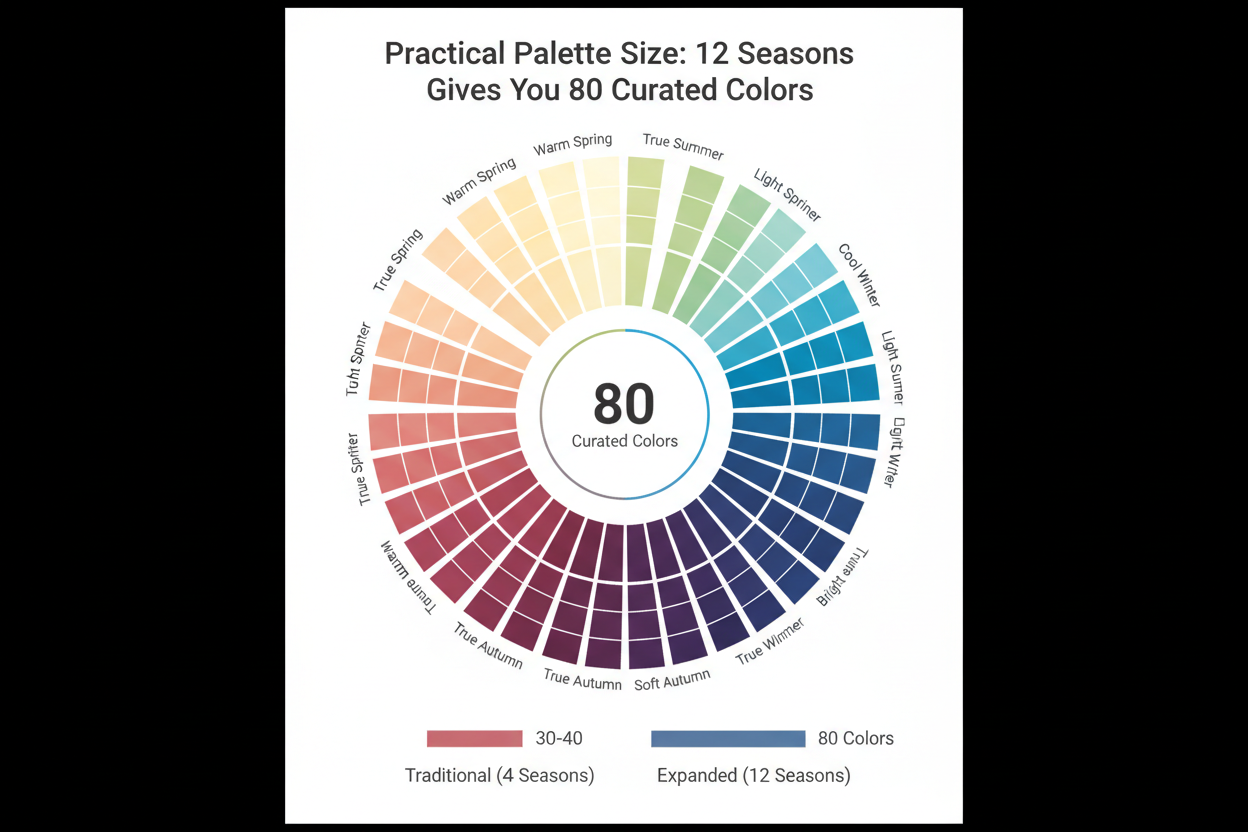
The first is variety. Eighty colors across twelve seasons means each seasonal palette covers neutrals, accent shades, and statement colors. You are not being handed five hues and told to make them work.
The second is usability. A constrained palette is a decision-making tool. When you know your colors, you can shop, build outfits, and cut options quickly. That is the practical payoff the system is designed to deliver.
The 16-season system's added granularity necessarily expands the palette further. Whether those extra colors represent genuinely distinct options or minor variations of existing ones depends on the specific palette. But the cognitive load of managing a larger set is real. For most people building an everyday wardrobe rather than a professional styling reference, 80 curated colors is a practical ceiling, not a limitation.
Ready to find your starting palette? The [color analysis quiz →] identifies your season and gives you a focused color set to work from immediately.
Which System Is Easier to Apply to Your Wardrobe?
The 12-season system has a practical edge in day-to-day use, and it comes down to structure.
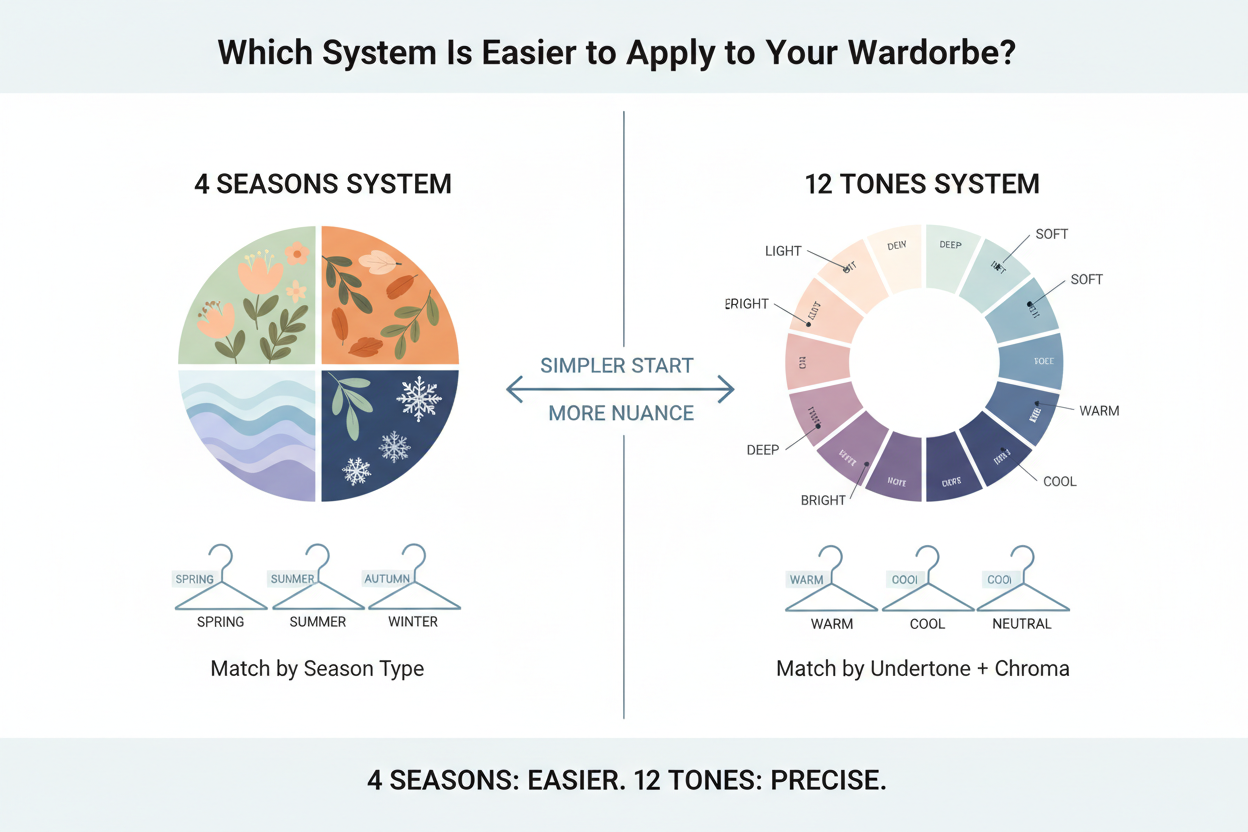
Twelve categories map cleanly onto how most people actually shop and get dressed. You identify one season, get a palette, and use it as a filter for clothing, accessories, and makeup. The logic is straightforward.
The 16-season system is more precise, but precision costs something upfront. Telling apart adjacent sub-seasons—especially the ones the 16-season model splits that the 12-season model keeps together—usually means a professional draping consultation or a very detailed self-assessment. Skip that step and the extra granularity doesn't help you; it just gives you more ways to second-guess yourself.
There's also the question of what you can actually hold in your head. A 16-palette system is harder to internalize than a 12-palette one. The whole point of knowing your colors is being able to apply that knowledge quickly, without stopping to cross-reference a chart. Frameworks that require constant lookup tend to get abandoned.
For anyone who isn't a professional stylist or seriously into color theory, the 12-season system tends to work better in practice—not because it's more accurate, but because you do it once and then actually use it.
Who Should Choose the 12 Season System vs the 16 Season System
Choose the 12-season system if you want a clear, usable palette you can act on right away. It's a better fit if you're new to color analysis, if you plan to self-assess rather than work with a professional, or if your main goal is a more coherent everyday wardrobe rather than an exhaustive styling reference. It's also easier to explain to someone else on the fly—helpful when you're shopping with a partner or stylist.
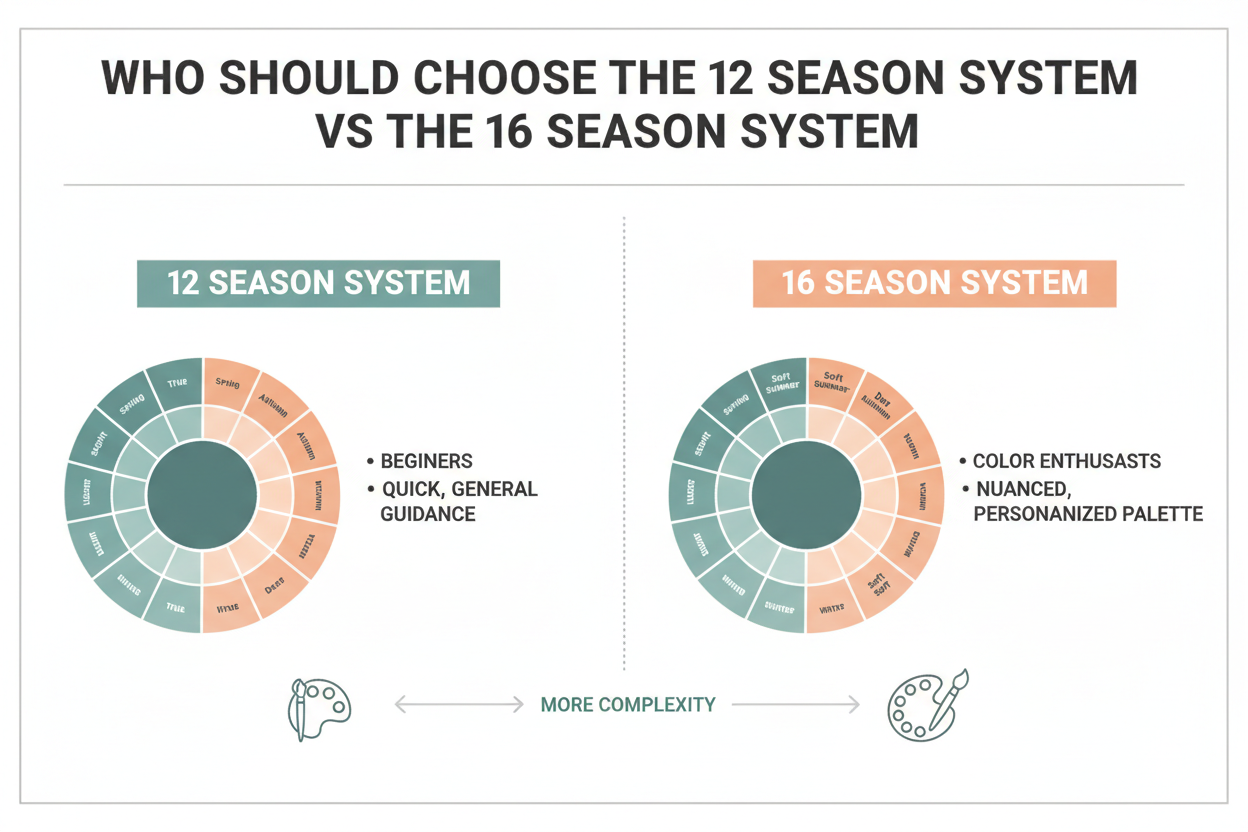
Choose the 16-season system if you've already worked through the 12-season framework and your result feels slightly off, or if two adjacent sub-seasons both seem partially right and you want something that splits the difference. It makes more sense if you work in styling or fashion where fine color distinctions matter professionally, or if you have access to a trained analyst who can do the additional draping steps the extra granularity requires.
For most people with wardrobe goals, the 12-season system is the better starting point. The 16-season version is genuinely useful, but mostly to people who already understand the 12-season logic well enough that its edges start to feel limiting.
How to Find Your Season Without a Professional Consultation
Seasonal color analysis isn't a new concept—its roots reach back to 19th-century color theory, and the methods for identifying your season have been refined for decades. That history means the self-assessment tools available today are more reliable than they were even ten years ago.
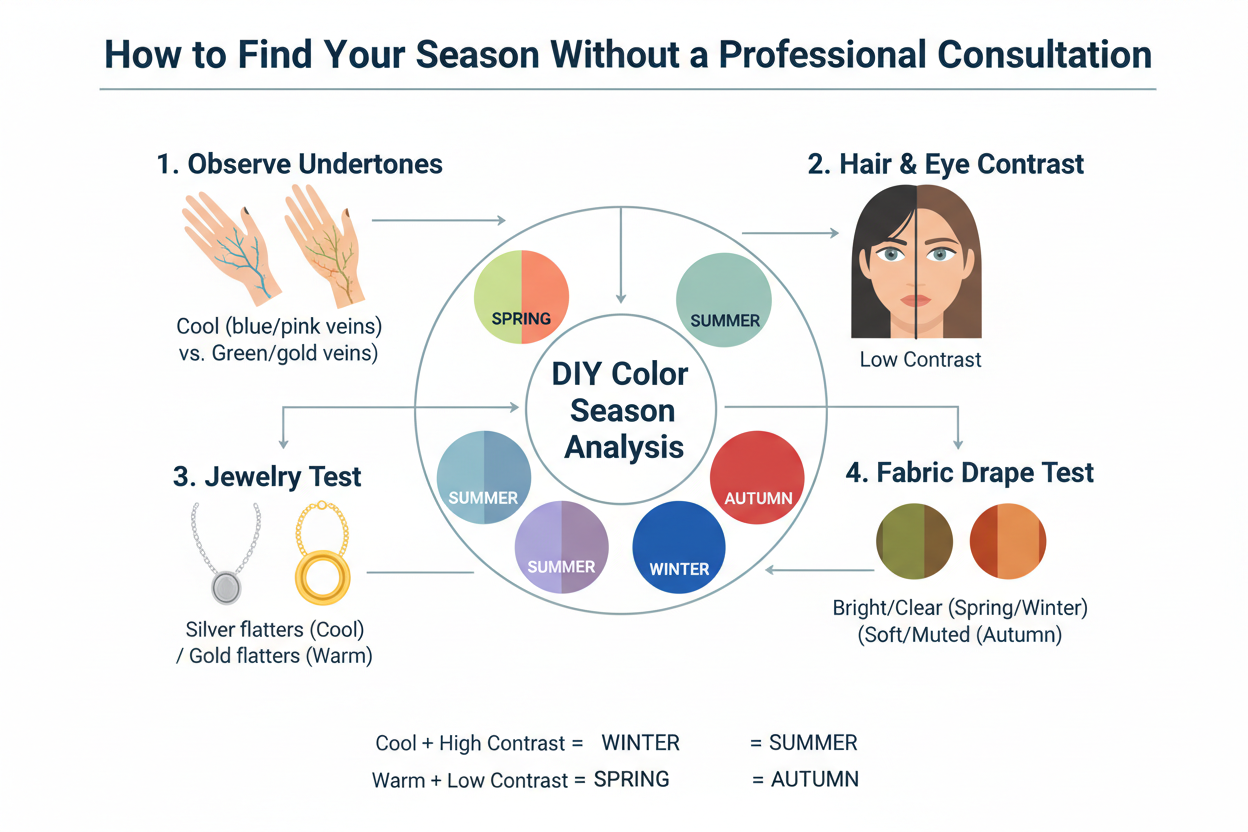
A structured self-assessment follows roughly the same sequence a professional analyst would use, just without the physical draping:
- Identify your undertone first. Look at the veins on the inside of your wrist in natural light. Blue-purple veins suggest cool undertones; green veins suggest warm; a mix of both suggests neutral. This is your first branch in both the 12-season and 16-season decision trees.
- Assess your value. Stand in natural light without makeup and evaluate whether your overall coloring reads as light, medium, or deep. This tells you whether you're more likely to land in a lighter or darker sub-season.
- Evaluate your chroma. Consider whether your coloring looks clear and vivid or soft and muted. High chroma coloring belongs to the Bright or True sub-seasons; lower chroma points toward Soft or Light.
- Notice how colors affect you. Hold different-colored fabrics near your face in natural light and watch whether your skin looks even and luminous or shadowed and flat. This is the most direct feedback you can get outside a professional setting.
If that feels like a lot to manage at once, a guided quiz simplifies it considerably—asking targeted questions about each variable in sequence and working out a season recommendation from your answers.
People Also Ask
What are the 12 color seasons in seasonal color analysis?
The 12 color seasons are built around four parent seasons—Spring, Summer, Autumn, and Winter—each split into three sub-seasons based on the dominant quality of a person's coloring:
- Spring: True Spring, Light Spring, Bright Spring
- Summer: True Summer, Light Summer, Soft Summer
- Autumn: True Autumn, Soft Autumn, Dark Autumn
- Winter: True Winter, Dark Winter, Bright Winter
Each sub-season reflects a specific combination of undertone (cool, warm, or neutral), value (light to dark), and chroma (muted to saturated). Together, the twelve palettes cover the full range of human coloring more precisely than the original four-season model.
What is the difference between 12 season and 16 season color analysis?
Both systems use the same four parent seasons and the same core logic—undertone, value, and chroma—but differ in how finely they slice things.
- The 12-season system assigns three sub-seasons to each parent season, for twelve palettes total.
- The 16-season system adds a fourth sub-season within each group, bringing the total to sixteen. Those extra categories typically split undertone or contrast more finely, and exist mainly to capture people who sit between two existing 12-season sub-seasons.
The 16-season system extends the 12-season framework rather than replacing it. For most people, the practical wardrobe difference between adjacent sub-seasons is small, and the added granularity can make the system harder to use day to day without a professional.
How do I find my color season using the 12 season system?
A reliable self-assessment follows the same sequence a professional analyst uses:
- Determine undertone. Check the veins on the inside of your wrist in natural light—blue-purple suggests cool, green suggests warm, a mix indicates neutral.
- Assess value. Look at your overall coloring in natural light, without makeup, and decide whether it reads as light, medium, or deep.
- Evaluate chroma. Decide whether your coloring looks clear and vivid (high chroma) or soft and muted (low chroma).
- Test colors against your face. Hold different fabrics near your face in natural light and watch whether your skin looks even and luminous or flat and shadowed.
These four steps narrow you to a parent season and then to a sub-season. A structured quiz can walk you through each variable in order if you prefer a more guided approach.
Is the 16 season color analysis more accurate than the 12 season system?
Not necessarily. Accuracy depends on the quality of the analysis, not the number of categories. The 16-season system offers finer distinctions, which can be useful if you've already worked through the 12-season framework and your result feels slightly off. But those extra distinctions are most reliable when verified through professional draping. Trying to self-identify among sixteen sub-seasons introduces more room for error, not less.
For most people, the 12-season system is accurate enough to produce a workable, flattering palette. The 16-season system's added precision matters mainly in professional styling contexts, or for people who already have a solid grounding in the 12-season logic.
What colors are in each of the 12 seasonal color palettes?
Each of the twelve palettes contains neutrals, mid-tones, and accent shades suited to a specific combination of undertone, value, and chroma. As a general guide:
- Spring palettes feature warm, clear, relatively light colors: peach, warm ivory, coral, golden yellow, fresh greens.
- Summer palettes lean cool and soft: dusty rose, lavender, powder blue, soft raspberry, cool greige.
- Autumn palettes are warm and muted: terracotta, olive, mustard, burnt orange, deep teal.
- Winter palettes are cool and high-contrast: true white, icy pastels, deep jewel tones, black.
Within each parent season, the sub-seasons shift the palette slightly. A Light Spring emphasizes the softer, more delicate shades within the Spring range; a Bright Spring pushes toward clearer, more saturated versions of the same warm family. Across all twelve seasons, the full system covers around 80 curated colors.
FAQ
What are the 12 colour seasons and how are they organized?
The 12 colour seasons start with four parent seasons—Spring, Summer, Autumn, and Winter—each split into three sub-seasons:
- Spring: True Spring, Light Spring, Bright Spring
- Summer: True Summer, Light Summer, Soft Summer
- Autumn: True Autumn, Soft Autumn, Dark Autumn
- Winter: True Winter, Dark Winter, Bright Winter
The sub-seasons sort by three variables: undertone (cool, warm, or neutral), value (light to deep), and chroma (muted to vivid). Together they cover the full range of natural human coloring.
How does the 12 season system differ from the original 4 season color analysis?
The original four-season model—developed from 19th-century color harmony theory and popularized in the mid-20th century—placed everyone into one of four broad categories: Spring, Summer, Autumn, or Winter. Useful starting point, but a lot of people ended up in palettes that felt only partially right.
The 12-season system adds three sub-seasons within each parent group. So someone who is a warm Spring but with lighter coloring lands in Light Spring rather than sharing a palette with someone whose Spring coloring is much more vivid. Same underlying logic, just more precise.
What is the difference between the 12 season and 16 season color analysis systems?
Both systems use the same four parent seasons and the same core variables—undertone, value, and chroma. The only difference is how many sub-seasons each parent season gets:
- 12-season system: three sub-seasons per parent season, twelve palettes total
- 16-season system: four sub-seasons per parent season, sixteen palettes total
The four extra sub-seasons in the 16-season framework cover people whose coloring falls between two adjacent 12-season categories. That added resolution can help, but it also makes self-identification harder. Think of the 16-season system as an extension of the 12-season framework, not a replacement or upgrade.
How many colors are in a 12 season color palette?
Each sub-season palette has neutrals, mid-tones, and accent shades chosen for that season's undertone, value, and chroma. Across all twelve seasons, the full system covers around 80 colors — enough to build a complete wardrobe without becoming overwhelming.
Can I determine my color season at home without a professional analyst?
Yes, and the process is essentially the same one a professional uses.
- Undertone: Look at the veins on the inside of your wrist in natural light. Blue-purple suggests cool, green suggests warm, a mix suggests neutral.
- Value: In unfiltered daylight, does your overall coloring—hair, skin, eyes together—read as light, medium, or deep?
- Chroma: Does your coloring look clear and vivid, or soft and muted?
- Color testing: Hold different colored fabrics or cards next to your face in natural light. Does your skin look even and luminous, or does it go dull and shadowed?
Go through these in order. You'll land on a parent season first, then narrow to a sub-season. If open-ended self-assessment feels hard to start, a guided quiz can walk you through the same steps.
Does undertone determine which of the 12 seasons I belong to?
Undertone is one of three variables, not the only one. It tells you which side of the seasonal wheel you're on—cool tones point toward Summer or Winter, warm tones toward Spring or Autumn, neutral tones can go either way. But undertone alone won't tell you your sub-season. Value (how light or deep your coloring is) and chroma (how vivid or muted) matter just as much. You need all three to land on the right one of the 12.
Which seasonal color analysis system is better for everyday wardrobe decisions?
For most people, the 12-season system is the more practical choice. Its twelve palettes are specific enough to produce genuinely flattering results while being easy to use without professional help every time you shop or get dressed. The 16-season system's extra sub-seasons can matter in professional styling contexts, or if you've already worked through the 12-season framework and found your result a bit off—but that added granularity is hard to use reliably without expert draping.
If you're new to seasonal color analysis or want something you can apply on your own, a 12-season quiz will give you a clear, usable palette without overcomplicating things.