
Warm Summer Color Palette: Common Confusion
 Reviewed by Alexandra Gilmore
Summer is a cool seasonal family despite the warmth suggested by its name, and 'Warm Summer' is not standardized across systems. Learn what consultants may mean by the label, then compare Light Summer, Soft Summer, Spring, and Autumn drapes instead of trusting a palette seller's terminology.

If you've landed on the phrase warm summer color palette after hours of research and still feel uncertain whether it applies to you, you're not alone. This particular season sits at one of the trickiest intersections in all of seasonal color analysis — and the confusion starts with the name itself.
💫 Explore Seasonal Color Analysis
Use the distinctions in this article to narrow the possibilities, then compare the seasonal system as a whole. Seeing the neighboring palettes together makes the result easier to test in real clothing and daylight.
Learn Seasonal Analysis →Here's the problem: "summer" sounds warm. Sunshine, beach days, golden light. But in color analysis, the Summer family is actually a cool-toned palette built on muted, soft hues rather than the sun-baked warmth the word implies. That disconnect catches people off guard before they've even begun comparing seasons.
Then there's the sub-season. Warm Summer — sometimes called Sunlit Summer or Gentle Summer depending on the system you're using — sits on the border between Summer and Autumn. It carries Summer's characteristic softness while layering in a gentle warmth that nudges it away from the cooler, crisper True Summer palette. That bridging quality is exactly what makes it hard to pin down: it looks like multiple seasons at once.
The result is a predictable spiral of second-guessing:
- Warm Summer vs. True Summer — How much warmth is "enough" to cross the line?
- Warm Summer vs. Soft Autumn — Both are muted. Both have warmth. So what's the actual difference?
- Warm Summer vs. Light Spring — Both feel gentle. But brightness separates them in ways that aren't always obvious in swatches alone.
This article cuts through that confusion directly. By the time you finish reading, you'll understand what the warm summer color palette actually contains, why the name misleads so many people, and how to distinguish this season from each of the neighbors it's most commonly mistaken for — using concrete, observable differences rather than vague generalities.
What 'Warm Summer' Actually Means in Seasonal Color Analysis
Warm Summer — sometimes called Sunlit Summer — sits at a specific point on the seasonal color wheel: the bridge between Summer and Autumn. It keeps Summer's softness and relatively light value range, but picks up a gentle warmth that tilts it toward Autumn without fully crossing over.
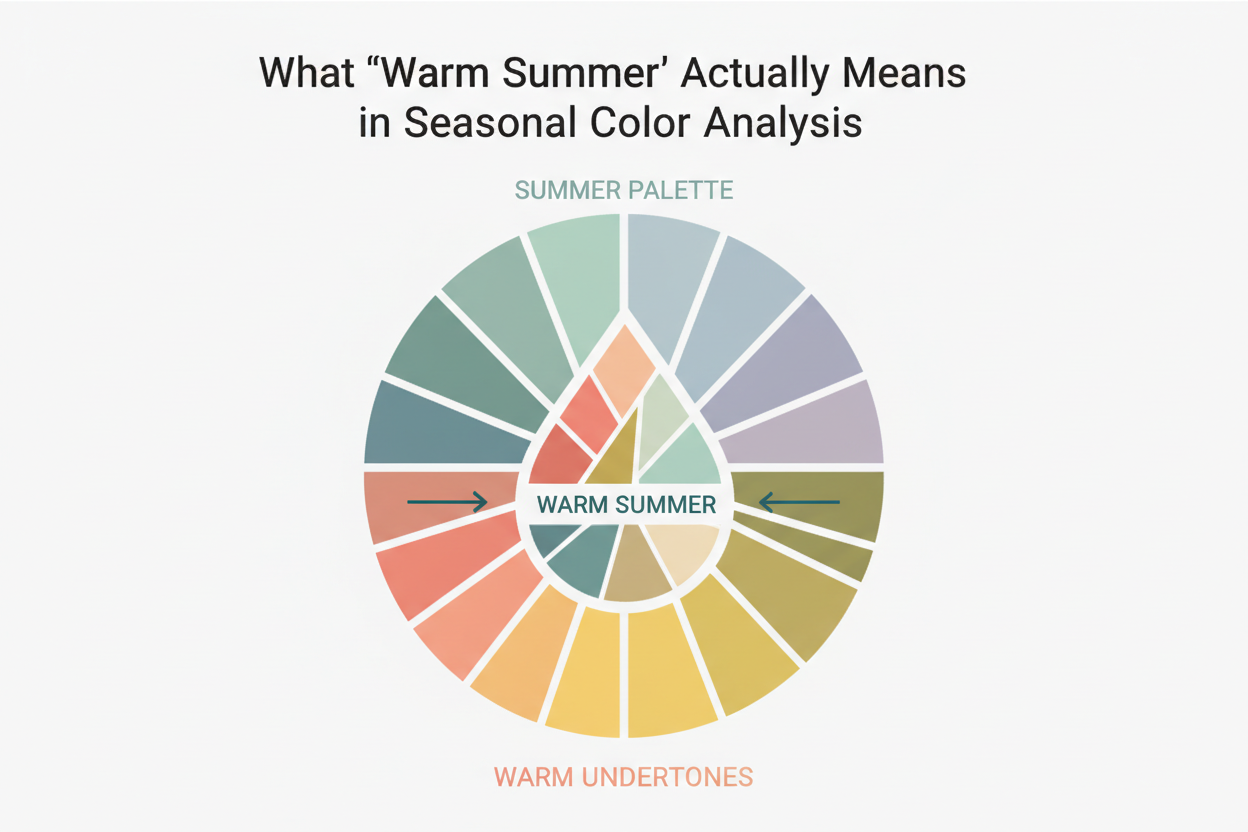
The operative word is gentle. This isn't warm the way Autumn is warm. Think of late afternoon light when the sun is still up but a thin layer of cloud is just starting to pull the gold out of it. That's the register of a Warm Summer palette — soft, slightly warm, nothing harsh.
Undertone-wise, Warm Summer sits on a neutral-cool base. Not as cool as True Summer, but not predominantly warm either. What sets it apart is its tolerance for warmth: colors with a subtle golden or peachy cast work here in a way they don't for the rest of the Summer family.
A useful mental anchor: Warm Summer colors look like they've been lightly dusted with gold, then softened with a thin wash of grey. That combination — warmth plus muting — is what makes the season recognizable.
Why the Name 'Warm Summer' Confuses People
The confusion starts before anyone looks at a color swatch. "Summer" in everyday language suggests heat, sun, and warmth — so when people encounter seasonal color analysis for the first time, they assume Summer seasons are warm-toned.
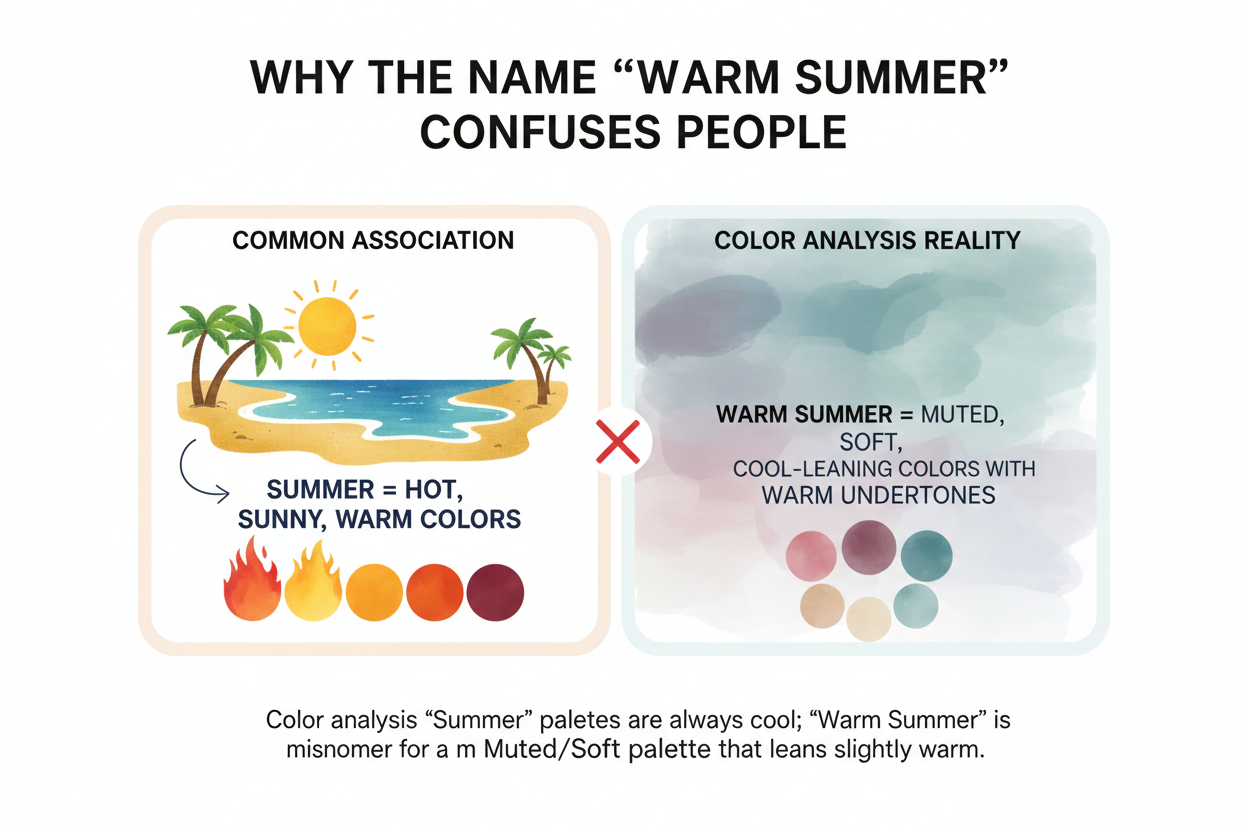
The opposite is true. The Summer family is built on a cool-toned foundation. Its palettes favor blue-based pinks, cool lavenders, and soft blue-greys — colors that feel calm and slightly cloudy rather than sun-warmed.
So when "Warm Summer" appears as a sub-season name, it creates an immediate paradox: How can a Summer be warm if Summer is cool?
The answer is about degree, not category. "Warm" in Warm Summer doesn't mean the season flips into warm territory. It means the season leans toward warmth relative to the rest of the Summer family. It still sits within a neutral-to-cool base. The warmth is directional, not dominant.
That distinction explains why Warm Summer is so easy to misassign. The warmth signal is real, but it's subtle — and that subtlety is exactly what trips people up when they're comparing it to something clearly warm like Soft Autumn or clearly cool like True Summer.
Warm Summer vs. True Summer: The Undertone Difference
True Summer is the coolest of the Summer seasons. Its palette runs blue-grey — muted, calm, and consistently cool. Every color sits firmly on the cool side of neutral, grounded in a blue or grey base.
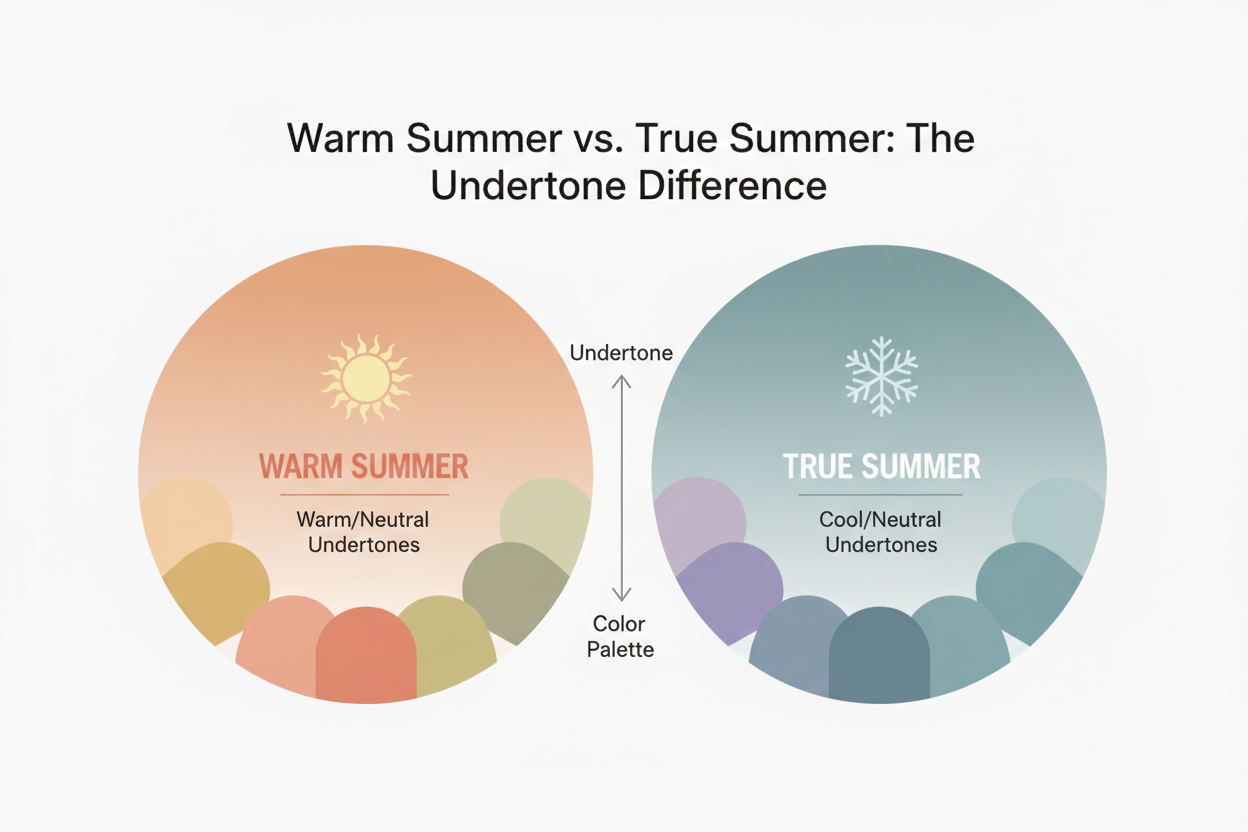
Warm Summer shares that muted quality but breaks away on undertone. Where True Summer reads cool and crisp, Warm Summer carries a faint golden softness — enough to read differently when held near the face.
The practical difference in plain terms:
| Quality | True Summer | Warm Summer |
|---|---|---|
| Undertone | Cool (blue-based) | Neutral-cool (slight warmth tolerance) |
| Color feel | Crisp, calming, refreshing | Soft, gently glowing |
| Warmth response | Cool colors refresh; warm hues can feel off | Gentle warm hues add glow; very cool hues can flatten |
| Typical palette | Dusty rose, lavender, soft blue | Warm mauve, rose-beige, muted terracotta-pink |
The real test is how the face responds to each type of color held close to the skin. Cool-leaning colors give True Summer clarity and calm. Those same hues on a Warm Summer can flatten the complexion — while a soft warm-rose or peachy nude pulls out a subtle warmth that wasn't visible before.
How Each Season Responds to Cool vs. Warm Colors Near the Face
You can run this as a mental exercise or physically with fabric swatches:
- Hold a cool, blue-based pink near your face. On a True Summer it looks harmonious, even brightening. On a Warm Summer it tends to go flat or slightly grey against the skin.
- Hold a muted warm-rose or soft peach near your face. On a Warm Summer, the face picks up a gentle luminosity. On a True Summer, the same hue can look muddy or slightly off.
The shift doesn't need to be dramatic to matter. Even a subtle change in how the skin reads — more alive versus more muted — is a reliable signal. Compare both directions on the same face rather than evaluating either one alone.
Warm Summer vs. Soft Autumn: Where the Overlap Happens
This is the comparison that trips up the most people, and it's easy to see why. Both Warm Summer and Soft Autumn are muted seasons. Both carry warmth. Both avoid bright, saturated colors. In a flat swatch comparison, they can look nearly identical.
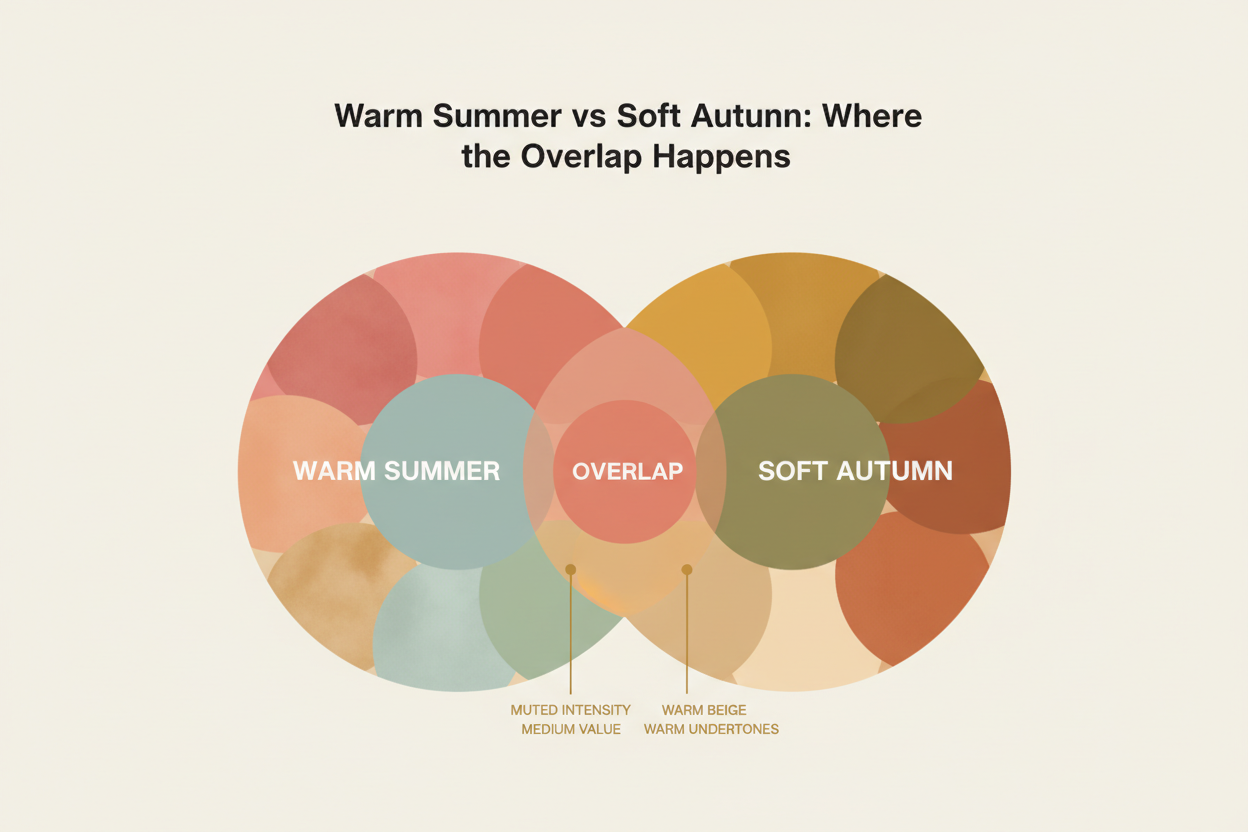
The difference comes down to where each season sits on the depth and warmth scales.
Soft Autumn runs deeper and earthier. Its warmth is more dominant — the palette reads like dried leaves, warm sand, and burnished wood. Colors have more brown in them, more richness, more weight.
Warm Summer stays lighter and softer. The warmth is barely there rather than fully present. The palette reads like faded rose petals, dusty lilac-pink, and blush — colors that carry warmth but also a characteristic Summer softness that keeps them from going fully earthy.
The bridge-season framing is useful here: Warm Summer sits on the Summer side of the Summer-Autumn boundary, while Soft Autumn sits on the Autumn side. They share the border, which is why they overlap in feel — but they belong to different families, and that origin difference shows in depth, saturation, and how far toward yellow-based warmth the palette travels.
If you're choosing between the two, ask yourself: do my best colors feel airy and soft, or grounded and earthy? Airy and soft points to Warm Summer. Grounded and earthy points to Soft Autumn.
Not sure which side of the line you fall on? The color analysis quiz can help map your specific coloring against both seasons to clarify where you actually land. Take the quiz →
Warm Summer vs. Light Spring: Why Brightness Is the Tell
Light Spring and Warm Summer can look deceptively similar side by side. Both avoid heavy, dark colors. Both have a certain softness. Both work with warm-ish, light hues.
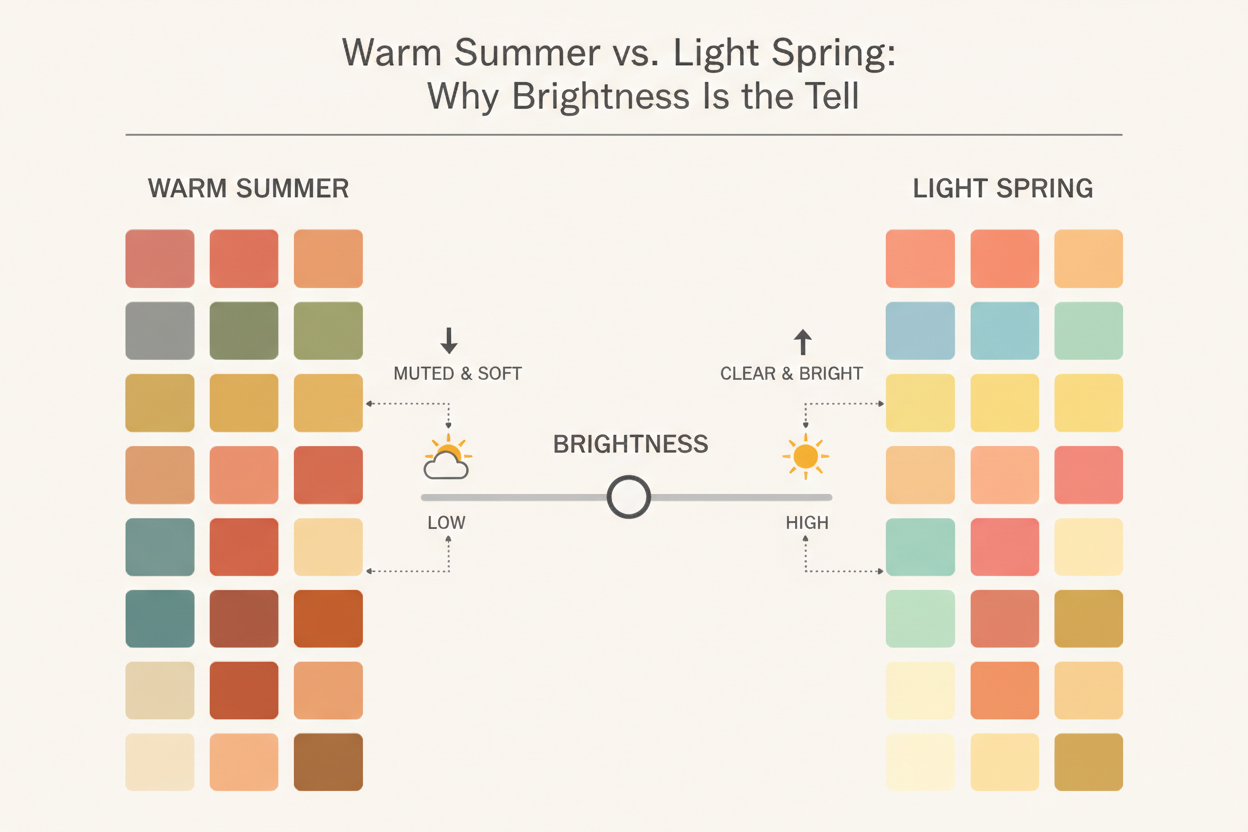
But they differ sharply on one axis: clarity.
Light Spring colors are clear — warm, yes, but undiluted, with a luminous, almost transparent quality. The Spring family as a whole has a brightness to it, a sense that colors haven't been softened or greyed down.
Warm Summer colors are muted. They've been softened, as if grey or taupe has been mixed into every shade. That dulling isn't a flaw — it's exactly what makes the palette work for Warm Summer coloring. But it means these two seasons are fundamentally different in finish even when they look adjacent in hue.
The practical effect matters. A Light Spring palette near a Warm Summer face will look too bright — it can overwhelm the skin's natural softness and make the complexion appear washed out. A Warm Summer palette near a Light Spring face tends to look flat and heavy, failing to bring out the natural clarity of that coloring.
The Muted vs. Clear Distinction Explained Simply
"Muted" and "clear" describe something fairly simple:
- Clear (Light Spring territory): Imagine a color straight out of a tube — no grey, no brown added. The hue is pure and bright. Red is unambiguously red. Pink is visibly pink. These colors have a transparency to them.
- Muted (Warm Summer territory): Take those same colors and mix in a small amount of grey or taupe. Red becomes dusty rose. Bright pink becomes blush-mauve. The grey softens the purity of the hue without stripping its warmth.
Warm Summer needs the grey-softened version. The muting is what lets colors sit harmoniously against the natural softness in Warm Summer skin, hair, and eyes. Clear, undiluted hues tend to jump off the face rather than settle into it.
Light Spring needs the clean, undiluted version. The brightness echoes the natural luminosity in Light Spring coloring and makes features come alive rather than recede.
If you're holding two swatches that seem similar in hue but one reads crisp and one reads dusty, the dusty one is more likely to work for Warm Summer. The crisp one belongs to the Spring side of the spectrum.
The Warm Summer Color Palette: What Shades Actually Work
The warm summer palette runs on mid-to-light values, soft warmth, and consistent muting. Nothing in it is harsh, saturated, or very dark.
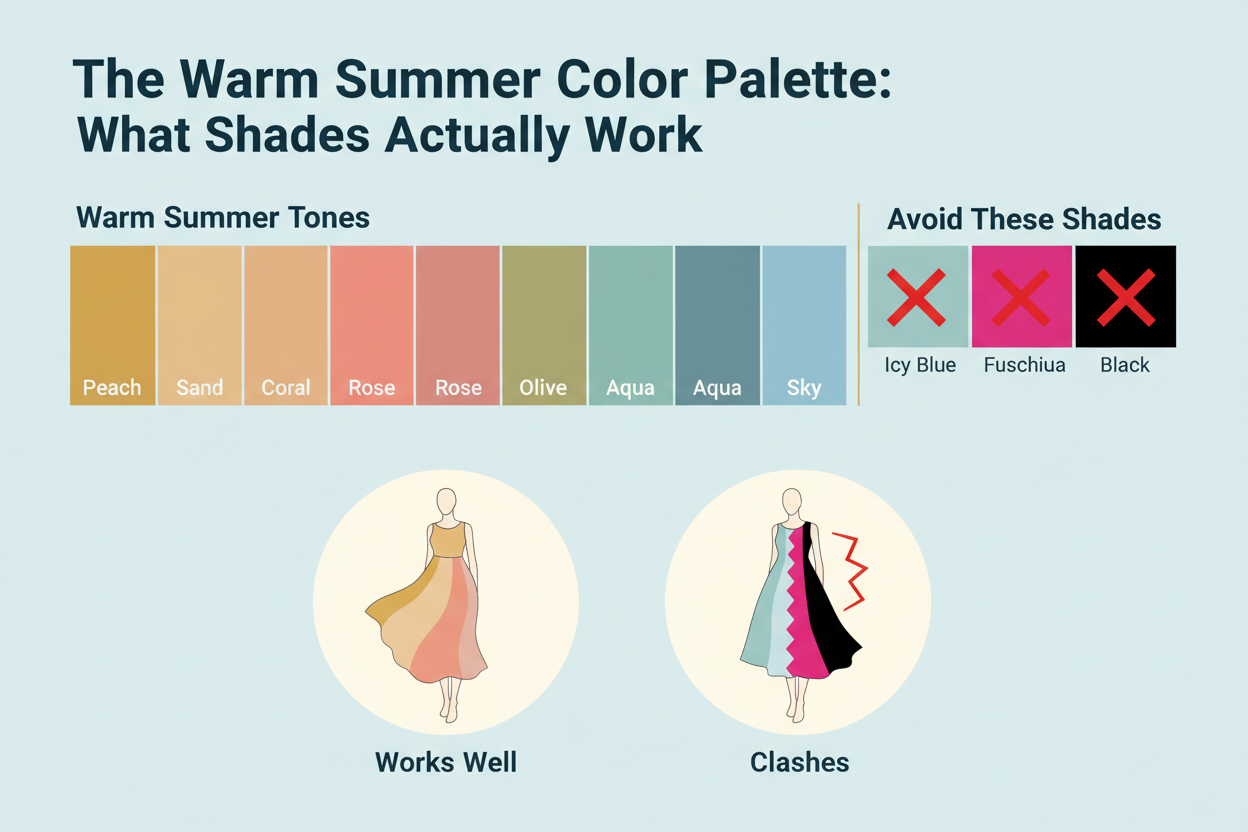
Core hues that work well:
- Dusty rose and muted mauve — the warmer pinks with grey in them, never cool-fuchsia
- Warm beige and rose-beige — neutrals with a slight yellow warmth, short of full caramel
- Soft terracotta-pink — lighter than true terracotta, closer to blush-orange
- Muted sage and warm greyed-green — greens pulled toward grey, not bright or yellow-lime
- Caramel and warm taupe — brown-adjacent neutrals that stay light and soft
- Soft periwinkle and muted blue-violet — the cooler end of the palette, kept light and dusty rather than vivid
- Warm lavender and dusty lilac — purples with a slightly warm or rose base, not blue-based
What to avoid:
- Pure white (too stark; off-white or warm cream works better)
- Black (too harsh; use warm charcoal or dark taupe)
- Bright, saturated colors in any hue family
- Very cool, blue-based shades (icy blue, bright fuchsia, cool lavender)
- Deep, dark earth tones (those belong to Soft or Dark Autumn)
A well-put-together Warm Summer wardrobe feels cohesive and quietly elegant. Nothing shouts. Everything blends. There's a warmth underneath the softness that gives the palette its character.
How to Confirm You Are a Warm Summer (Not a Neighboring Season)
Use this self-check to consolidate the comparison work from the sections above into a few observable questions:
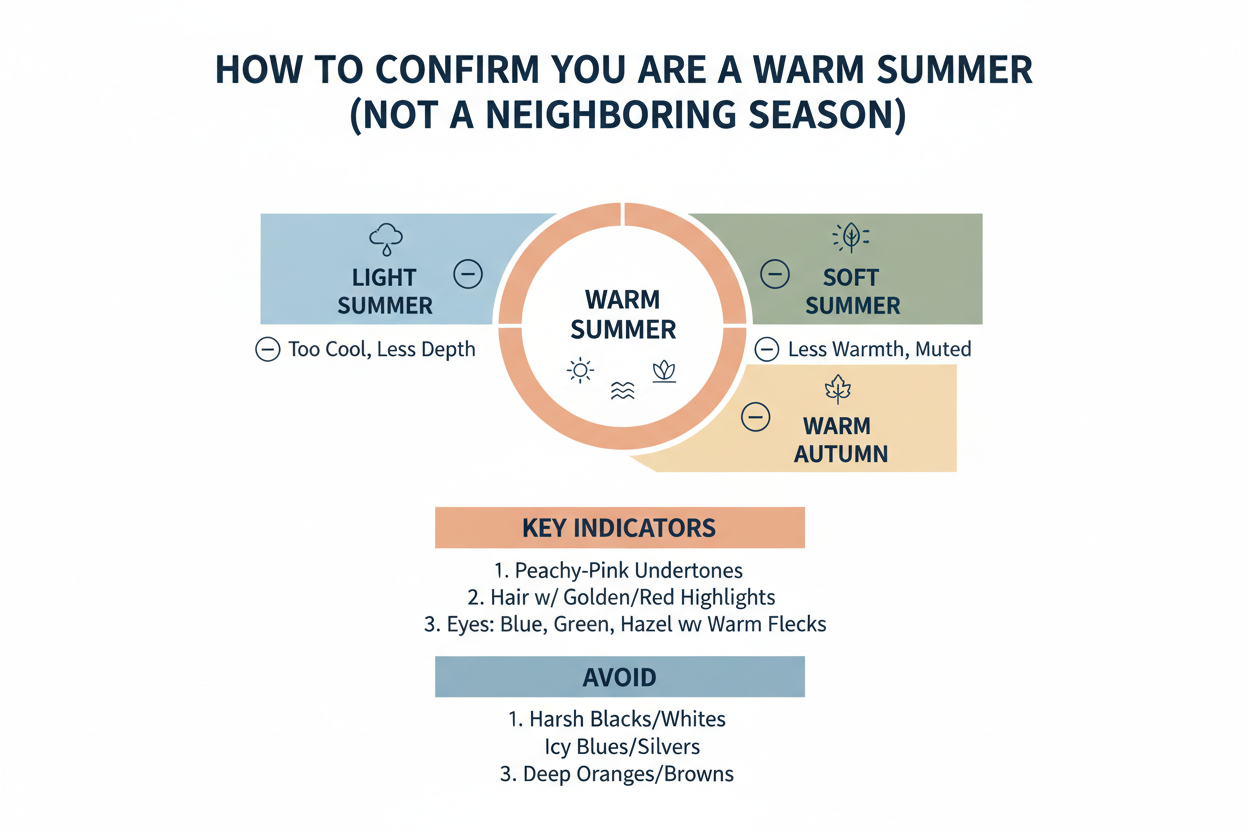
1. Check your undertone direction Does your skin have a neutral-to-cool base with a subtle golden or peachy cast when it catches light? Warm Summer sits in that neutral-cool zone with slight warmth tolerance — not fully warm, not fully cool.
2. Test your response to muted colors Do soft, dusty hues — muted rose, warm taupe, greyed sage — look harmonious near your face? If yes, Warm Summer is plausible. If bright, clear colors look better, move toward Light Spring.
3. Test your response to warmth vs. cool colors Does a gentle warm-rose or peach add quiet luminosity to your complexion? Does a cool, blue-pink feel slightly flattening? That response pattern points to Warm Summer rather than True Summer.
4. Check depth and earthiness Do the colors that work best stay relatively light and airy, or do you actually look better in deeper, earthier shades? Light and airy leans Warm Summer. Deeper and earthier leans Soft Autumn.
5. Check brightness tolerance Does a clear, bright color feel like it sits on top of your face rather than integrating with it? That mismatch is a Warm Summer signal. If bright colors make you look more alive, not less, move toward Light or True Spring.
If your answers consistently point toward muted, soft, gently warm, and light-to-mid depth — without the earthiness of Autumn or the brightness of Spring — you're likely a Warm Summer.
People Also Ask
What is the difference between Warm Summer and Soft Autumn?
Both seasons are muted and warm, which is why they get confused so often. The differences come down to depth and how much warmth is actually doing the work.
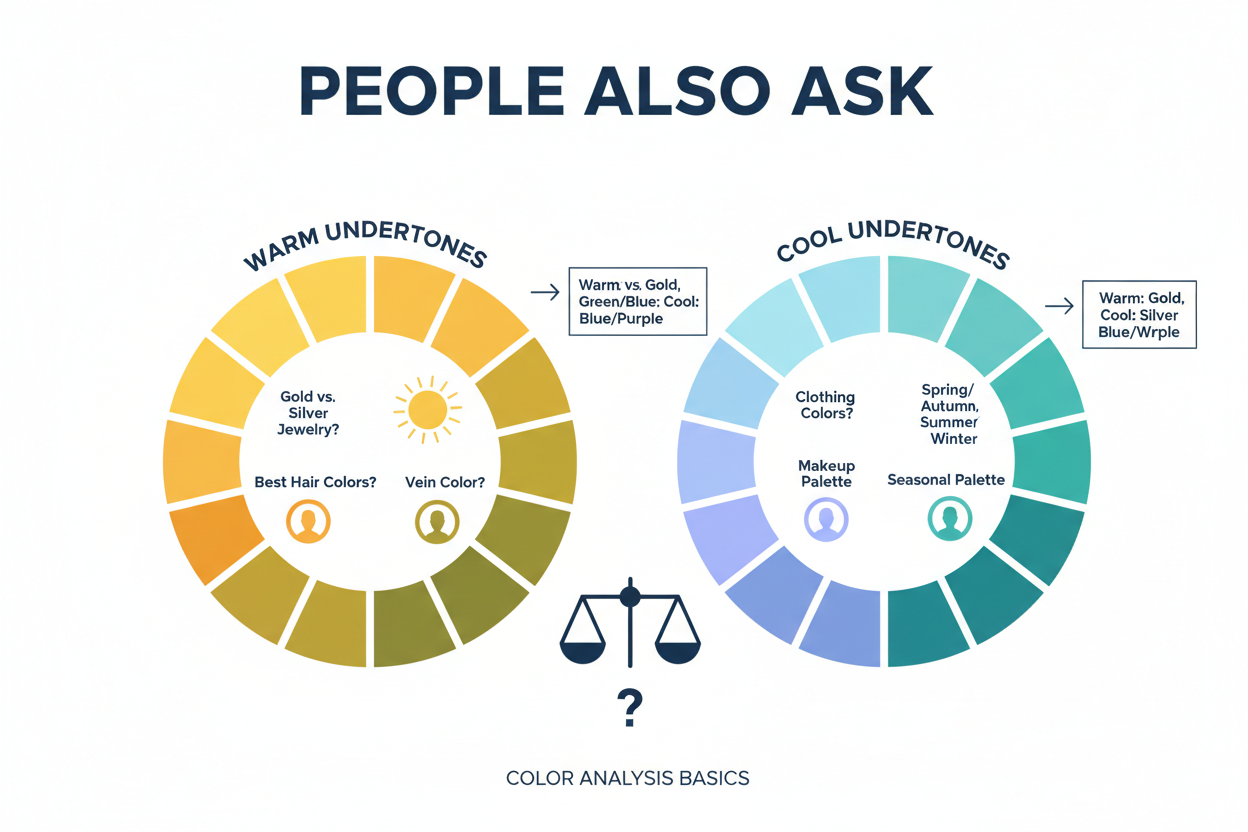
Warm Summer stays lighter and softer. The warmth is subtle — more of a gentle lean toward golden-rose than a full shift into earth tones. Colors feel airy rather than grounded.
Soft Autumn runs deeper and earthier. The warmth is more pronounced, with more brown and yellow in the mix. Think dried leaves, warm sand, and burnished wood rather than faded rose petals.
A useful shortcut: ask whether your best colors feel airy and blush-adjacent, or grounded and earthy. Airy points to Warm Summer. Grounded points to Soft Autumn.
Is Warm Summer the same as Sunlit Summer?
Yes, they refer to the same season. "Sunlit Summer" is an alternative name used by some analysts and systems; "Warm Summer" is the more common label in 12-season color analysis.
Both describe the same sub-season: a bridge between Summer and Autumn that carries Summer's softness with a slight warmth. The light quality both names are after is soft and diffused, with just a hint of gold rather than a full warm shift.
If you come across either term, treat them as interchangeable.
Can a Warm Summer wear warm colors?
Yes, but with a caveat. Warm Summers can wear warm colors when those colors are muted and relatively light. The season has a neutral-cool base with some warmth tolerance, so gently warm hues can work near the face in a way they simply don't for True or Soft Summer.
What works:
- Dusty rose and muted mauve with warm undertones
- Soft peach and rose-beige
- Muted terracotta-pink (lighter and blushier than true terracotta)
- Warm taupe and caramel neutrals kept at a light-to-mid depth
What doesn't work, even though it's "warm":
- Deep, saturated earth tones (these belong to Autumn)
- Bright warm hues like vivid orange or clear coral (too clear for Warm Summer)
- Very yellow-heavy shades that read heavily golden rather than softly warm
The warmth needs to stay gentle and muted. Harsh or saturated warm colors will overwhelm Warm Summer coloring just as much as harsh cool ones will.
How do I know if I am a Warm Summer or a True Summer?
The clearest tell is how your face responds to cool-toned versus gently warm-toned colors held close to the skin.
- True Summer has a cool, blue-based undertone. Cool-leaning colors — dusty blue-pinks, soft lavenders, cool rose — look harmonious and brightening. Warm hues can feel slightly off or muddy.
- Warm Summer has a neutral-cool base with a slight warmth tolerance. Gently warm hues — muted rose-peach, soft warm mauve — add quiet luminosity. Very cool, blue-based hues can flatten the complexion.
Additional signals to compare:
| True Summer | Warm Summer | |
|---|---|---|
| Best neutrals | Cool grey, soft blue-grey | Warm taupe, rose-beige |
| Pink response | Cool-rose and dusty blue-pink brighten | Warm-rose and peach-pink glow |
| Cool color test | Refreshing and clarifying | Can look slightly draining |
If cool shades consistently refresh your appearance and warm shades feel slightly off, you're likely True Summer. If a touch of warmth adds glow and pure cool shades fall flat, you're probably Warm Summer.
What colors should a Warm Summer avoid?
Warm Summers generally struggle with colors at the extremes — anything too stark, too saturated, or too deep will clash with the soft, gently warm quality of the palette.
Colors to avoid:
- Pure white — too stark and high-contrast; opt for warm off-white or soft cream instead
- Black — too harsh; replace with warm charcoal, dark taupe, or deep warm brown
- Bright, saturated colors — vivid red, electric blue, neon coral, and similar clear hues sit on top of the face rather than blend with it
- Icy or very cool hues — icy blue, bright fuchsia, and cool lavender lean too far cool for Warm Summer's neutral-cool base
- Deep, dark earth tones — shades like deep rust, dark olive, and rich chocolate cross into Soft or Dark Autumn territory
If a color is loud, stark, or heavily earthy, it's probably outside the Warm Summer range. The season's sweet spot is soft, muted, and moderate in depth.
FAQ
What makes Warm Summer different from the rest of the Summer color family?
All three Summer sub-seasons share the same softness and muted quality, but they sit at different points on the cool-to-warm spectrum.
- True Summer is the coolest, with a blue-based undertone and a palette that feels calm and refreshingly cool.
- Soft Summer sits closest to neutral — muted and slightly cool without leaning noticeably in either direction.
- Warm Summer is the warmest of the three, bridging Summer and Autumn by adding a gentle golden warmth to Summer's characteristic softness.
That warmth is what defines Warm Summer. It's not enough to tip into Autumn territory, but it's enough that purely cool palettes tend to fall flat — which is what separates this sub-season from the other two.
Does Warm Summer have cool or warm undertones?
Warm Summer sits in neutral-cool territory with some tolerance for gentle warmth. It's not purely cool like True Summer, and it's not warm-dominant like Soft Autumn.
In practice, the complexion reads as soft and relatively cool at its base, but responds well to colors with a subtle golden or peachy warmth. Think late afternoon light on a hazy day — not crisp and cool, not richly warm, somewhere between the two.
Pure cool shades can flatten the complexion. Strongly warm shades can feel heavy. The balance point is soft, slightly warm, and muted.
What is the difference between Warm Summer and Soft Autumn?
Both seasons sit in similar territory — muted, with warmth underneath — which is why people mix them up so often. The distinction comes down to how dominant that warmth is and how deep the palette runs.
| Warm Summer | Soft Autumn | |
|---|---|---|
| Warmth level | Gentle, background warmth | More pronounced, clearly warm |
| Palette depth | Light to medium | Medium to deeper |
| Overall feeling | Airy, blush-adjacent | Grounded, earthy |
| Undertone base | Neutral-cool | Neutral-warm |
A practical test: hold a dusty rose-pink next to a warm, brownish terracotta. If the dusty rose feels more harmonious, you're probably Warm Summer. If the terracotta looks more at home, Soft Autumn is the better fit.
Why do people confuse Warm Summer with Light Spring?
Both seasons share lightness and a soft, warm-adjacent quality, which is enough to create genuine confusion — especially in photos or low-quality draping conditions.
The critical difference is muting versus clarity:
- Light Spring has warmth and brightness. Its colors are clear, fresh, and luminous — warm but never hazy.
- Warm Summer has warmth and softness. Its colors are dusty, muted, and diffused — warm but never vivid.
When testing between the two, a clear warm color — bright coral, warm peach with no dustiness — will brighten a Light Spring and feel slightly too loud on a Warm Summer. A muted, slightly hazy version of the same hue will flatter Warm Summer and may read as a little flat on Light Spring. Brightness, not warmth, is the tell.
Can a Warm Summer wear bright or saturated colors?
Generally, no. Saturation is one of the clearest boundaries of the warm summer palette. Because this coloring is inherently soft and muted, highly saturated colors — warm or cool — tend to overwhelm rather than blend in.
Bright hues sit on top of the face instead of integrating with it. The clothes become the focal point, not the person.
What to reach for instead:
- Muted, dusty versions of warm hues (soft coral-rose instead of vivid coral)
- Colors that have been "greyed down" or have a slightly hazy quality
- Medium saturation at most — never vivid, never neon
If a color looks bold and clear on its own, it's probably too saturated for this season, regardless of whether it reads warm or cool.
What are the best neutrals for a Warm Summer palette?
Warm Summer neutrals work best when they carry a soft warmth and sit at a light-to-medium depth. Stark, high-contrast neutrals like pure white and true black are typically too harsh.
Recommended neutrals:
- Warm off-white and soft cream (instead of bright white)
- Rose-beige and blush-beige
- Warm taupe and greige
- Soft camel in lighter, dusty tones
- Warm charcoal or dark taupe (instead of black)
- Dusty mauve as a transitional neutral
These shades share the low-contrast, gently warm quality of the season, so they're easy to build outfits around without fighting the softness of Warm Summer coloring.
Is Warm Summer the same as Sunlit Summer or Gentle Summer?
In most practical contexts, yes. Sunlit Summer is an alternative label used by some analysts and color frameworks to describe the same sub-season that others call Warm Summer. Both names point to the same position on the seasonal spectrum — the Summer sub-season that bridges toward Autumn with a soft, diffused warmth.
"Sunlit" captures the visual effect well: not bright, direct sunlight, but light that's been filtered and softened, with a gentle golden quality. "Warm Summer" describes the same thing from an undertone perspective.
Gentle Summer is less standardized and may refer to either Soft Summer or Warm Summer depending on the framework. If you encounter it, check the source's full description rather than assuming it maps directly to either sub-season.
If you're uncertain which label applies to your coloring, a structured quiz can help map your features to the right sub-season before you invest in a full wardrobe update. → Find out your season
To test this Summer result from another useful angle, continue with the companion article “Deep Summer Color Palette: Myth or Valid Type?”, which keeps the two closely related questions distinct.