
Summer Palette for Men
 Reviewed by Alexandra Gilmore
A man with cool, ashy, low-contrast coloring can look drained in the default rotation of black, camel, and warm khaki. Confirm a Summer direction, then build shirts, suits, knitwear, casual outfits, shoes, and metals around cool navy, blue-gray, dusty accents, and softer contrast.

Most men spend years buying clothes in colors that feel almost right — shades that look fine on the hanger but oddly flat once they're actually wearing them. Seasonal color analysis explains why, and the cool summer color palette is one of the most distinctive seasons to understand.
💫 Explore Seasonal Color Analysis
Use the distinctions in this article to narrow the possibilities, then compare the seasonal system as a whole. Seeing the neighboring palettes together makes the result easier to test in real clothing and daylight.
Learn Seasonal Analysis →If your natural coloring runs cool, ashy, and soft — think blue-toned veins, muted hair, and a complexion with pink or rosy undertones — there is a high chance you belong to the True Summer season. Dressing within this palette means your skin looks clearer, your eyes appear brighter, and the overall effect reads as polished rather than washed out.
This guide covers everything a True Summer man needs to know:
- How to confirm your season using simple at-home checks
- The core colors of the True Summer palette and why they work
- Which shades to avoid and what they do to your complexion
- How True Summer differs from Light Summer and Soft Summer
- Practical wardrobe building blocks — from basics to statement pieces
By the end, you will have a clear picture of which colors belong in your closet, which ones should leave it, and how to tell the difference between the three Summer sub-seasons so you can dress with confidence rather than guesswork.
What Is the Cool Summer Color Palette for Men?
Seasonal color analysis divides complexions into 12 seasons, each defined by three qualities: undertone (cool or warm), value (light or dark), and chroma (bright or muted). True Summer sits squarely in the cool, low-chroma zone of the system. It is one of three Summer sub-seasons — alongside Light Summer and Soft Summer — and it represents the coolest point of the group.
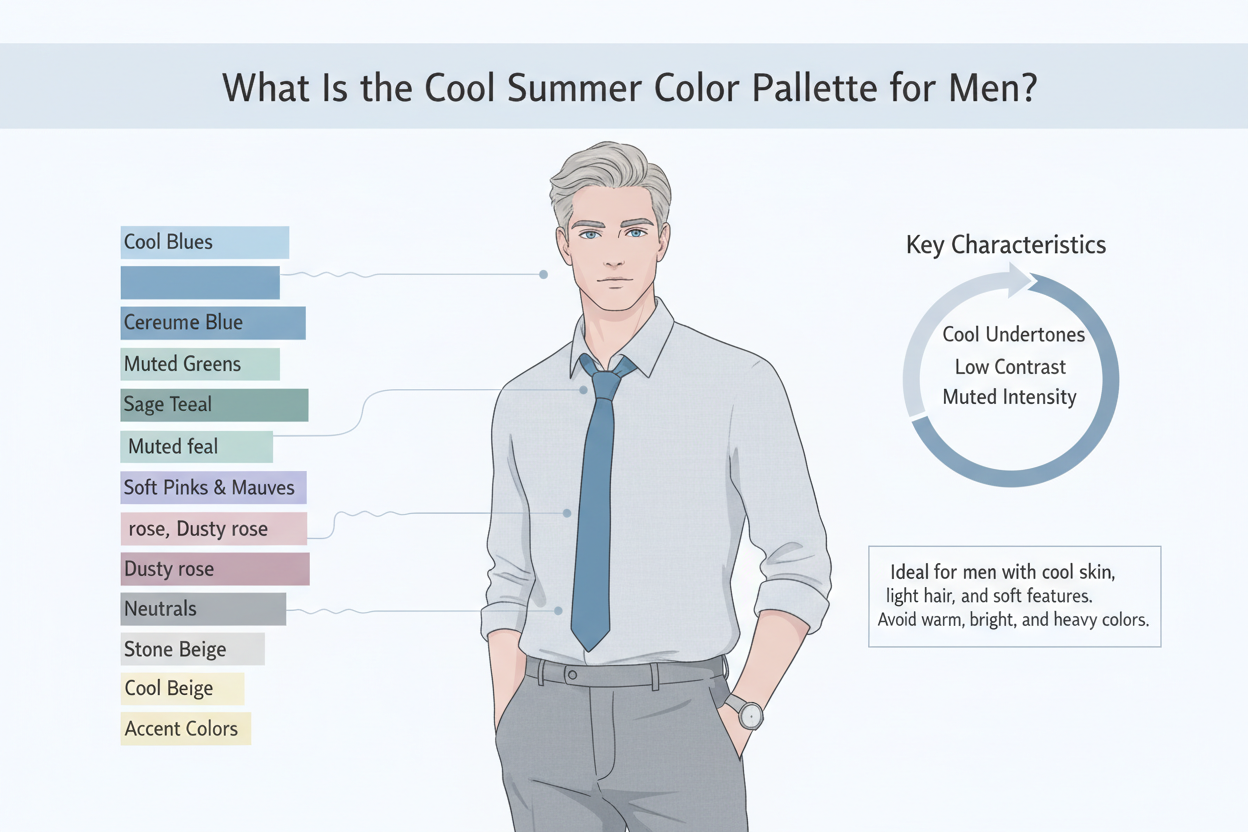
That word "cool" is worth pausing on. It refers entirely to undertone temperature — the blue or pink cast beneath the skin's surface — not to style personality or aesthetic. A True Summer man can dress formally, casually, or anywhere in between. The principle is simply that colors with a blue or pink base will harmonize with his natural coloring, while those with yellow, orange, or golden bases will work against it.
The palette runs muted rather than saturated, soft rather than stark. Desaturated blues, dusty roses, lavender-grays, cool taupes, soft navies. Not jewel-bright primaries, not earthy neutrals, not crisp black-and-white contrasts. Every color in the True Summer palette shares that same cool, slightly hazy quality — the way a landscape looks through thin morning fog rather than in direct midday sun.
Not sure if True Summer is your season? Take the color analysis quiz to get a result matched to your specific coloring. Take the color season quiz →
How to Tell If You Are a True Summer Man
The physical markers of True Summer are consistent enough that most men can identify a likely match with a few careful observations. The key identifiers are undertone, vein color, and the overall quality of your natural coloring.
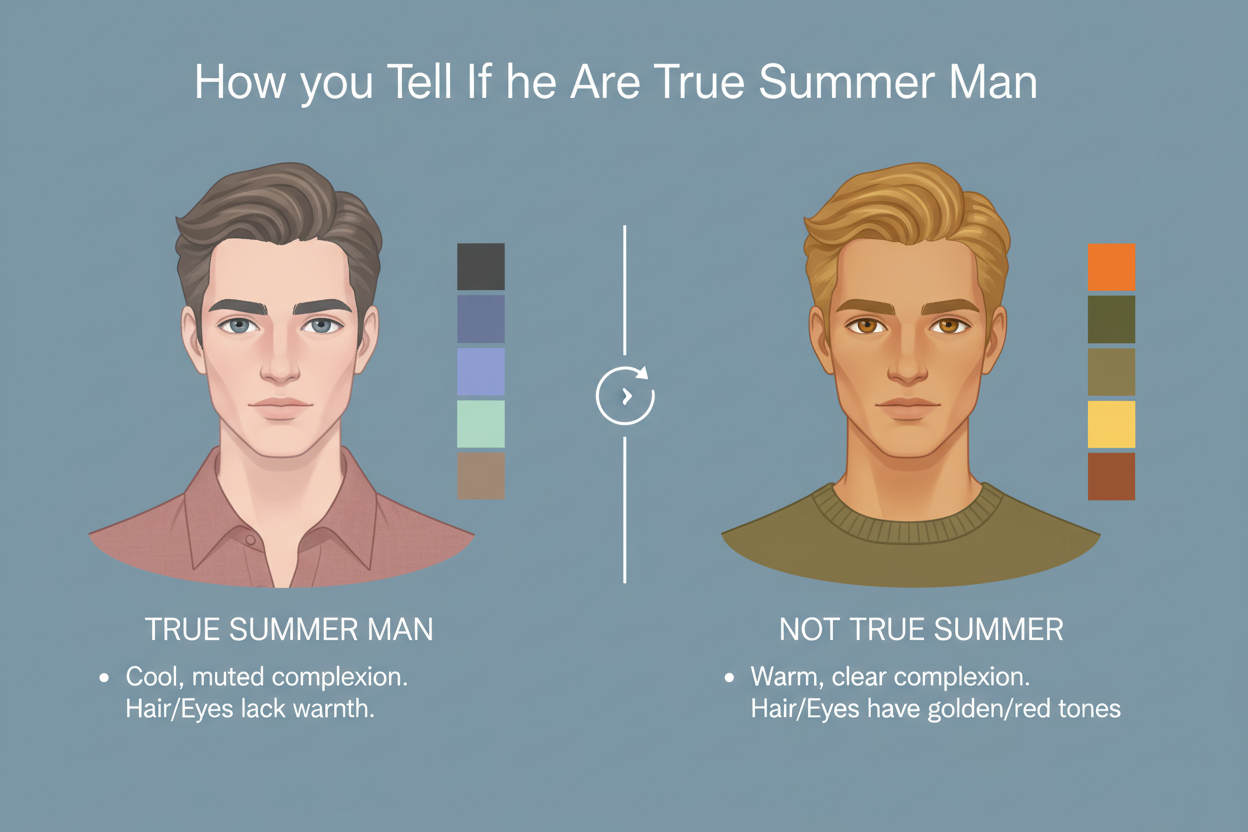
Look for these signs:
- Your complexion has a cool or neutral-cool undertone — it leans pink or rosy rather than golden or olive
- Your hair tends toward ash tones — ash brown, ash blond, or cool dark brown rather than warm chestnut or golden brown
- Your eyes are typically blue, gray, green, or a cool hazel — soft and desaturated rather than amber or warm brown
- Your overall impression is delicate and low-contrast — hair and skin are relatively close in depth, without a dramatic difference between them
- Taken together, your coloring reads cool, ashy, and quiet
If several of these fit, True Summer is a strong candidate. The vein test below gives you one more concrete check you can do right now.
The Vein Test and Undertone Check for Summer Men
Turn your wrist toward a neutral light — natural daylight works best, away from tungsten bulbs that cast yellow. Look at the veins running along the inside of your forearm.
- Blue or blue-purple veins indicate a cool undertone, consistent with True Summer
- Blue-green veins suggest a cool-to-neutral undertone — still potentially within the Summer range
- Clearly green veins point toward a warm undertone, which puts you outside the Summer seasons
The vein check works because blood appears bluish through cool-toned skin and slightly greenish through warm-toned skin. It's not the vein color itself but the way your skin filters it. Blue-tinted veins are one of the clearest physical signs of the cool undertone that defines the Summer man.
One caution: undertone can be subtle. A pink-toned complexion is sometimes misread as neutral because it doesn't announce itself the way an obviously golden or olive tone does. If your skin looks neither warm nor cool at first glance but flushes easily toward pink or red, that pinkness is the signal — it's characteristic of cool-based coloring, not evidence that you're color-neutral.
The Core Colors of the True Summer Palette
The True Summer palette is built entirely from cool, desaturated hues that share a blue or pink base. Saturation stays low to medium — nothing electric, nothing earthy. The overall effect is soft and understated, with quiet harmony rather than strong contrast.
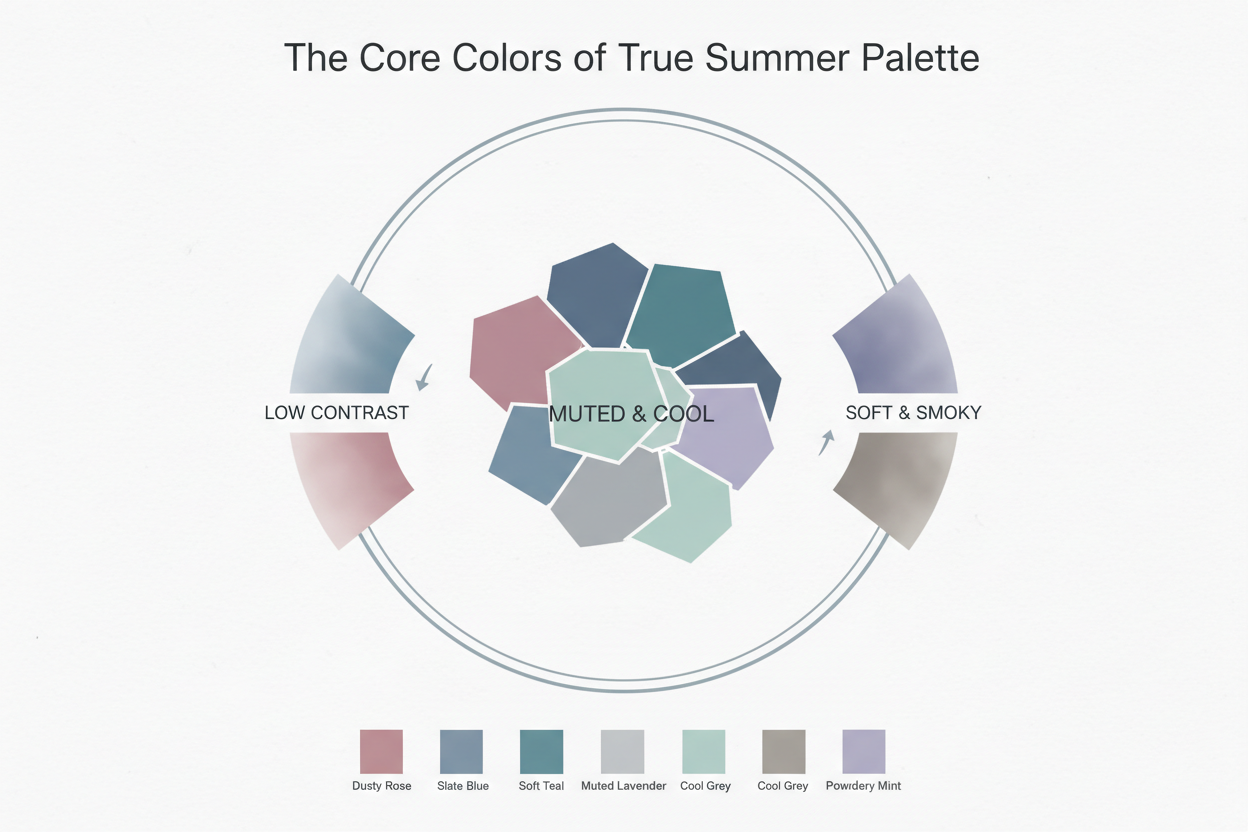
Primary hue families in the palette:
- Blues: Dusty mid-blue, powder blue, slate blue, soft periwinkle — all with a gray or lavender cast, not bright or cobalt
- Pinks and roses: Dusty rose, cool mauve, soft raspberry — pink-based rather than coral or peach
- Purples and lavenders: Soft lavender, muted lilac, cool plum — desaturated and cool rather than vibrant
- Greens: Sage, cool mint, soft blue-green — never yellow-based or olive
- Grays: All values of cool gray, from light silver-gray to deeper charcoal — the backbone of the palette
[Author note: Insert verified palette swatch reference here with specific color names or codes. The qualities described above are grounded in the cool-ashy-desaturated framework. Exact names such as "dusty blue" or "mauve" should be confirmed against a recognized True Summer palette source before publication.]
Neutrals and Basics for the True Summer Man
The neutral anchors of the True Summer wardrobe are cool-based and work as foundations that every other palette color can pair with.
Go-to neutrals:
- Cool gray (light to medium) — replaces warm beige or camel as the primary casual neutral
- Soft navy — a slightly desaturated, blue-based navy rather than a stark dark navy; works as the True Summer equivalent of black
- Rose-taupe or cool greige — a muted pinkish gray-tan that bridges the pink and gray families; sits far from warm beige
- Off-white with a cool or slightly pink cast — avoids the yellow warmth of cream or ivory
What these neutrals have in common is no yellow, orange, or golden undertones. Warm beige, camel, tan, and sand are off-palette no matter how versatile they look in general style advice. For True Summer men, those warm shades dull the complexion rather than lifting it.
Colors True Summer Men Should Avoid
The easiest way to understand what to avoid is to look at what actually happens to your face. When a True Summer man wears warm, earthy, or highly saturated colors, the effect goes one of two ways: either his face looks washed out and pale, or it reads red and ruddy. Neither is subtle once you notice it.
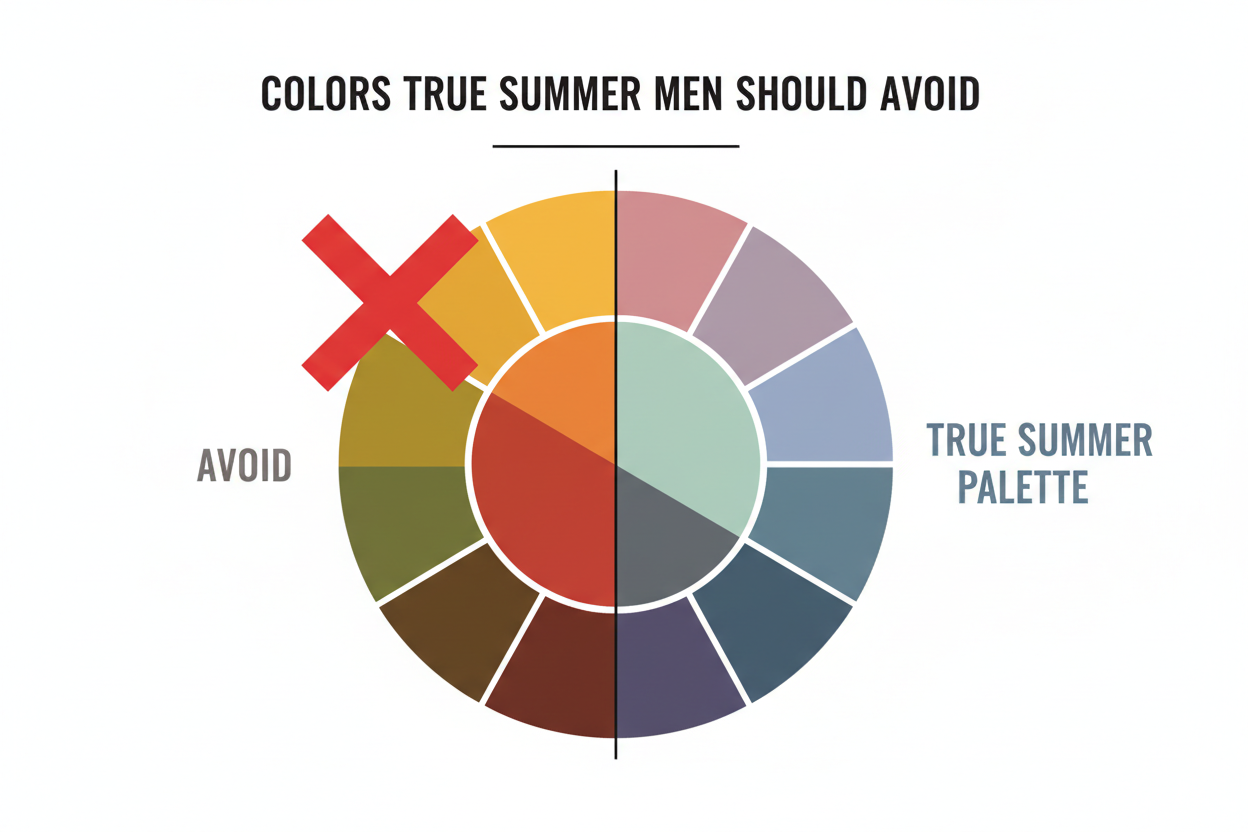
Colors that drain warmth from a cool palette expose pinkness in the skin as patchiness rather than healthy color. Colors that fight the skin's natural coolness can make underlying redness flare up.
Specific families to avoid:
- Warm yellows, golden tones, and mustard — these introduce warmth that directly opposes the cool undertone
- Orange and rust — among the most unflattering for any cool-based complexion
- Warm browns, camel, tan, and khaki — versatile for warm seasons, but dulling for True Summer
- Earthy olive greens — too yellow-based; the palette's green is cool-based sage, not warm olive
- Black — often surprising, but pure black creates stark contrast that can overwhelm the delicate quality of True Summer coloring; soft navy or deep cool gray are better dark anchors
- Brilliant, saturated brights — True Summer's palette is intentionally muted; electric blue, vivid red, or bright lime all read as harsh against cool-soft coloring
You don't need to memorize a banned list. The underlying principle is simple: if a color is warm, earthy, or highly saturated, it's working against you.
Still uncertain which colors belong in your wardrobe? The quiz maps your coloring against all 12 seasons to give you a confident result. Take the color season quiz →
Building a True Summer Wardrobe: Key Pieces and Combinations
Translating a color palette into an actual wardrobe is where seasonal analysis gets practical. For True Summer men, the goal is staying in cool, muted tones throughout the outfit and letting quiet harmony do the work that bold contrast does for other types.
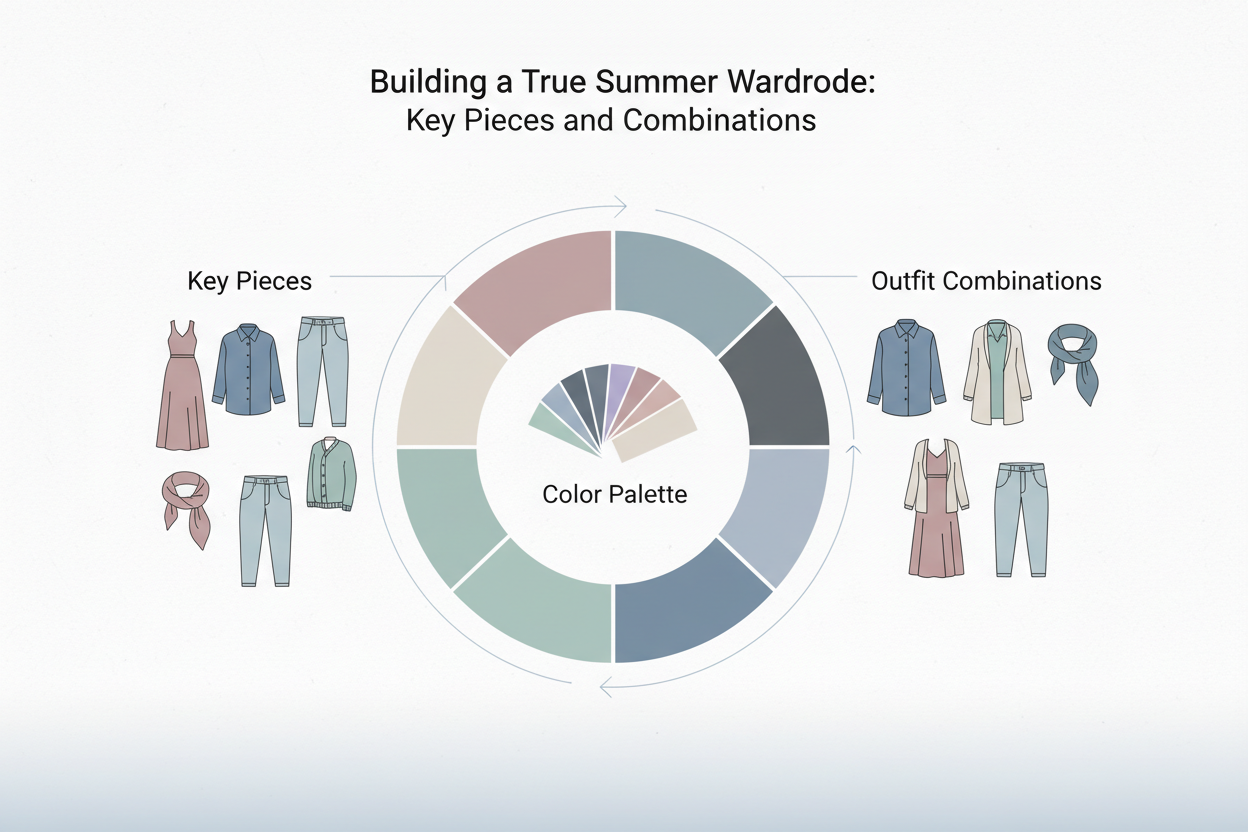
Wardrobe foundation pieces:
- A soft-navy blazer or sport coat — the primary layering piece from formal to casual; pairs with nearly everything in the palette
- Cool gray trousers in light, medium, and charcoal weights — a better fit than the warm khaki or tan that fills most men's closets
- Pale blue or dusty blue dress shirts — probably the single most flattering category for True Summer men; anything from near-white to medium dusty blue works
- A mauve or rose-pink shirt — underused but genuinely effective; cool pink reads as sophisticated rather than bold against cool-ashy skin
- Sage green casual pieces — a cool sage jacket, chino, or knit sits naturally in the palette without pulling warm
Outfit-building principles:
Color theory governs what looks harmonious, and for True Summer that means keeping contrast moderate. Pair light gray with soft navy rather than ivory with black. Layer dusty blue with rose-taupe rather than bright white with tan. The overall look should feel coordinated and calm, not high-contrast or earthy.
[Author note: Add two to three specific, fully described outfit examples here — for example, a casual weekend combination and a smart-casual work outfit — using the palette qualities described above. Confirm all color names against a verified True Summer palette reference.]
True Summer vs. Light Summer and Soft Summer: Knowing the Difference
All three Summer sub-seasons share cool undertones, but they differ in value (how light or dark the overall coloring is) and chroma (how muted or warm the colors run).
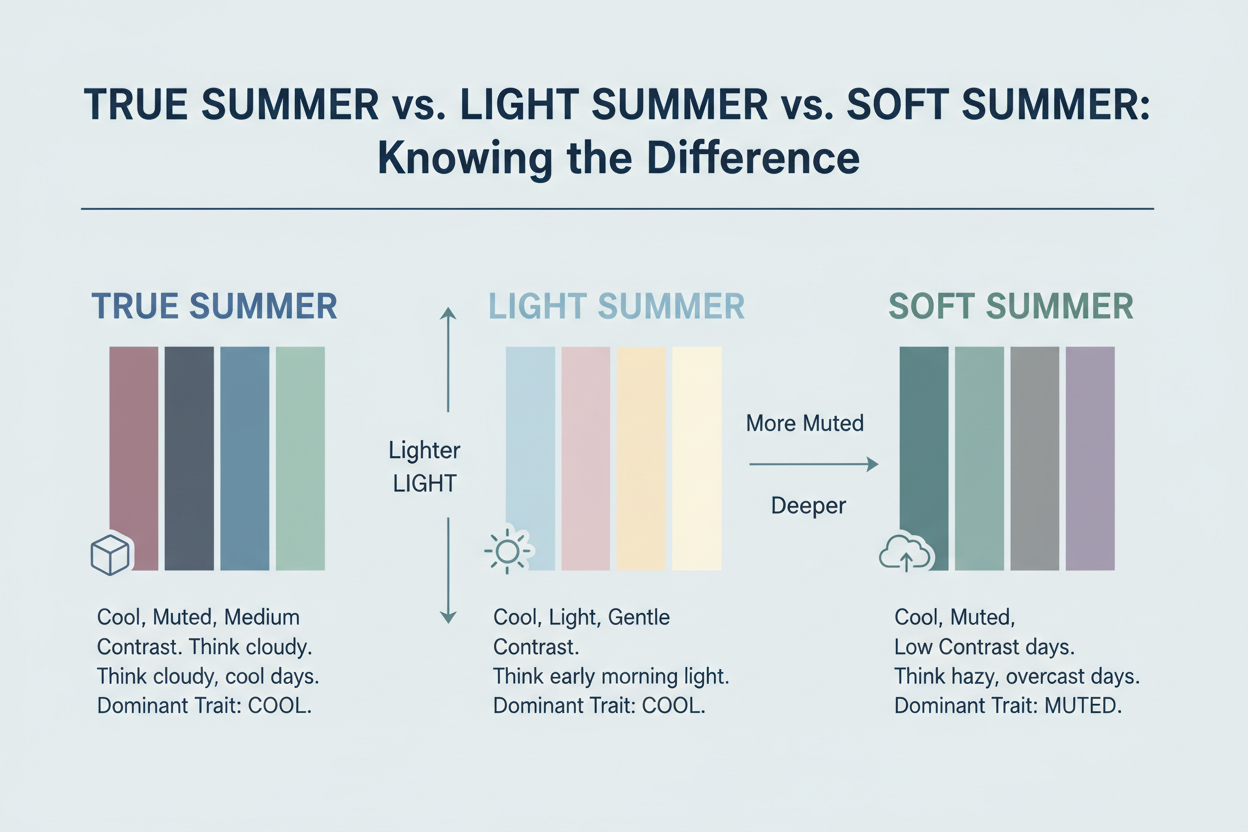
Knowing where True Summer sits relative to its neighbors matters most when your coloring falls near a boundary and neither palette feels like an obvious fit.
| Sub-season | Position | Defining quality | How it differs from True Summer |
|---|---|---|---|
| Light Summer | Cooler side, higher value | Lighter and more delicate overall | Coloring tends to be fairer, with less depth; the palette skews lighter and softer |
| True Summer | Center of the Summer group | Coolest undertone, medium depth, muted | The reference point — cool, ashy, balanced between light and muted |
| Soft Summer | Muted side, slightly warmer | More muted and subtly warmer than True | A hint of warmth enters the undertone; colors shift toward dusty warm-neutrals |
Boundary case: True Summer vs. Light Summer If your coloring is notably fair — very light hair and skin with little overall depth — you may belong to Light Summer. The palette runs lighter and more delicate than True Summer. If your coloring has some depth, or your hair reads as a medium ash tone, True Summer is usually the better fit.
Boundary case: True Summer vs. Soft Summer If the True Summer palette feels slightly too blue or too pink against your skin, and muted warm-neutrals seem to work better than expected, Soft Summer may be closer. Men in this category often have a trace of warmth in their undertone that makes purely cool colors feel slightly off. If you're unsure, a structured color analysis will surface the difference more reliably than self-observation.
Find Your Exact Season with a Personalized Color Analysis
Self-diagnosis using physical markers and the guides above covers a lot of ground. Most men who read carefully and run through the checks here will land on a season that's at least close to correct. But self-observation has real limits.
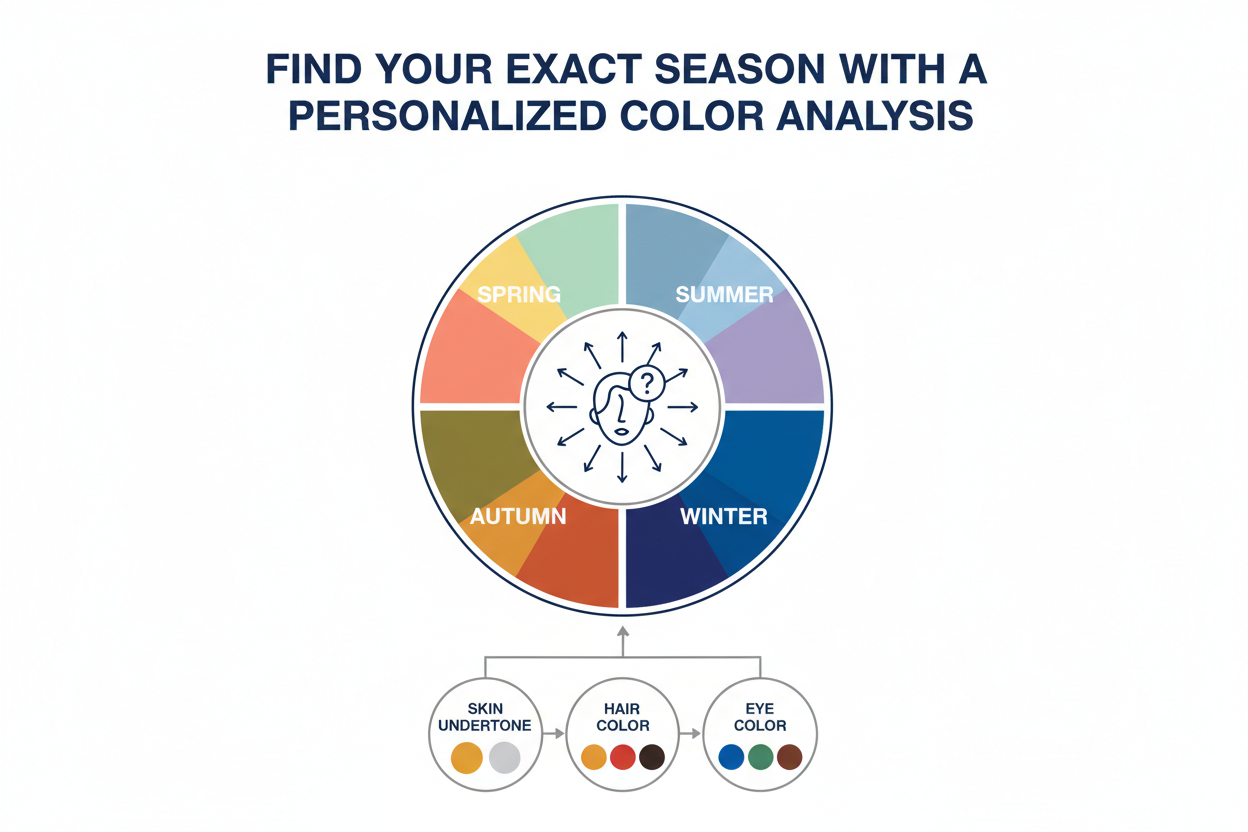
Undertone is especially easy to misread. A complexion that looks neutral in one light reads as distinctly cool in another. Hair color shifts with age and sun exposure. Men who sit close to a sub-season boundary — particularly between True Summer and Soft Summer, or True Summer and True Winter — can easily reach the wrong conclusion from physical observation alone.
A structured analysis tool cuts through that ambiguity by working through the relevant variables one at a time, cross-checking answers, and mapping the result across all 12 seasons rather than leaning on a single data point like vein color.
The sections below cover the People Also Ask questions and FAQ, with more detail on the specific distinctions between seasons, the physical indicators that matter most, and how to read borderline results.
People Also Ask
What colors should a cool summer man wear?
A True Summer man's wardrobe runs on cool, muted, blue-based hues. The reliable standbys are dusty blues, soft navies, powder blue, slate, cool gray across all values, dusty rose, mauve, lavender, sage green, and cool off-white. What these shades have in common: a cool blue or pink undertone and deliberately low saturation. The palette reads quiet and harmonious, not bold or earthy.
For everyday use, pale blue dress shirts and cool gray trousers are the most dependable options. Soft navy works as the dark neutral — doing what black and charcoal do for other seasons, without overwhelming the more delicate quality of cool summer coloring.
How do I know if I am a True Summer or Soft Summer?
Both sub-seasons share cool undertones and muted coloring. The main difference is that Soft Summer carries a faint trace of warmth that True Summer does not.
In practice:
- True Summer men find that purely cool colors — dusty blue, lavender, cool rose — sit comfortably against their skin
- Soft Summer men often notice that purely cool tones read slightly too blue or too pink, while softly warmed neutrals feel more wearable
A simple self-check: hold a cool dusty rose next to your face, then swap it for a soft warm blush. If the first looks cleaner and more alive, you're probably True Summer. If the warm blush settles more naturally, Soft Summer is worth considering. When you genuinely can't tell, a structured analysis will get you further than eyeballing it.
What is the difference between Light Summer and True Summer for men?
True Summer is the coolest point of the Summer group. Light Summer sits adjacent to it on the lighter, slightly softer side of the sub-season range. The practical differences are:
| Quality | True Summer | Light Summer |
|---|---|---|
| Undertone | Coolest within Summer | Cool, with slightly more delicacy |
| Overall depth | Medium | Lower — fairer skin and hair |
| Palette value | Medium-light to medium | Skews lighter throughout |
| Dominant impression | Cool, ashy, balanced | Light, airy, very delicate |
A man with medium ash-brown hair and a cool pink complexion typically fits True Summer. A man with very light ash-blond hair and notably fair skin — where everything reads as soft and low-contrast — is more likely a Light Summer. His palette shifts toward paler, softer versions of the same cool hues, rather than the medium-depth tones True Summer wears well.
Can men with dark hair be a cool summer color season?
Yes. Hair color alone doesn't determine your season. True Summer is defined by undertone — the cool, blue-tinted base beneath the skin — not hair depth. A man with dark ash-brown hair can be a True Summer if his complexion reads cool or pink, his veins look blue or blue-purple on the wrist, and his overall coloring leans ashy rather than warm.
The markers that matter most are:
- Skin undertone — cool, pink-leaning, or neutral-cool
- Vein color — blue or blue-purple on the inner wrist
- Hair tone quality — ashy rather than golden or warm, regardless of depth
- Overall impression — cool and delicate rather than warm and rich
Dark warm-brown or chestnut hair paired with a golden complexion points toward a warm season. Dark hair with an ashy, cool quality is fully consistent with True Summer.
What colors make a summer complexion look washed out?
The shades most likely to drain a True Summer complexion fall into two broad categories: warm tones and high-saturation brights.
Warm tones that tend to wash out cool summer coloring:
- Golden yellows, mustard, and ochre
- Orange, rust, and terracotta
- Camel, tan, warm beige, and khaki
- Warm olive and yellow-based greens
These shades introduce warmth that fights the skin's cool undertone, making the complexion look dull or grayish instead of healthy.
High-contrast and over-saturated shades that can make the complexion look ruddy or blotchy:
- Pure black (the stark contrast overwhelms cool summer coloring's softer quality)
- Electric or cobalt blue
- Vivid red or bright coral
- Saturated lime or neon tones
In both cases, the problem is the same: colors that don't share the cool, muted quality of the palette expose unevenness in the skin rather than smoothing it. When True Summer men wear colors that match their undertone, the skin reads as even and clear.
FAQ
What makes True Summer the coolest of the Summer sub-seasons?
The three Summer sub-seasons — Light Summer, True Summer, and Soft Summer — form a spectrum, but True Summer anchors the coolest end when it comes to undertone purity. Light Summer runs lighter and more delicate. Soft Summer picks up a trace of warmth and muting. True Summer has neither: the undertone is purely cool with no warm interference. That's what makes it the most distinctly cool-toned of the three. In practice, True Summer men can wear the most clearly blue-based and pink-based shades in the Summer group without the color working against their complexion.
How do blue-tinted veins confirm a cool summer undertone in men?
Vein color reflects the pigment beneath your skin rather than what's on the surface, which is why it's one of the more reliable ways to check your undertone. Blue or blue-purple veins on the inner wrist point to a cool, blue-based undertone — as opposed to green or olive veins, which suggest warmth. For True Summer men, that cool cast runs deeper than just the veins; it's baked into the skin's base pigmentation. Colors with the same cool quality tend to look natural against it. Warm or yellow-based shades often read as dull or slightly off, like something just isn't sitting right.
Why does a pink-toned complexion indicate a cool summer season rather than a warm one?
Pink feels warm, so this trips people up. But the pink in a True Summer complexion comes from a blue undertone, not a red or golden one. That blue pigment scatters light in a way that reads as rosy at the surface — not because the skin is warm, but because cool blue tones can look pink in practice. It's different from the flush you see in Spring or Autumn complexions, which comes from golden or peachy undertones. That's why True Summer men tend to look better in cool rose and dusty pink than in warm coral or orange-red.
What is the difference between the True Summer, Light Summer, and Soft Summer palettes for men?
All three share cool undertones and muted, low-saturation coloring, but each has a distinct character:
| Quality | True Summer | Light Summer | Soft Summer |
|---|---|---|---|
| Undertone | Purely cool | Cool, very delicate | Cool with a subtle warm trace |
| Depth | Medium | Low — fair and light | Low to medium, very muted |
| Palette feel | Cool, ashy, balanced | Airy, soft, pale | Hazy, blended, gently warm-cool |
| Best neutrals | Cool gray, soft navy | Pale gray, light blue-gray | Warm gray, greige |
The differences are subtle but real. A True Summer man does well in medium-depth dusty blues and cool grays. A Light Summer man wants those same hues but dialed down — the palest versions, nothing too heavy. A Soft Summer man is the odd one out: the purely cool shades that work for the other two can feel a bit stark on him. Slightly warmer, more blended tones — warm taupe, dusty rose with a hint of peach — tend to sit better.
Which colors should True Summer men avoid to prevent looking pale or ruddy?
Two categories cause the most visible problems:
Warm-toned shades that drain cool summer coloring:
- Golden yellow, mustard, ochre
- Orange, rust, terracotta, camel
- Warm beige, tan, and khaki
- Yellow-based or olive greens
High-contrast or oversaturated shades that emphasize unevenness:
- Pure black — the stark contrast overwhelms the delicate quality of True Summer coloring
- Electric or cobalt blue
- Vivid red and bright coral
- Neon or saturated lime tones
Warm shades introduce undertone conflict, making skin look gray or flat. High-contrast brights pull in the opposite direction — too much visual intensity for a palette built on softness, which tends to make the complexion look blotchy or ruddy rather than even.
Can a man with a darker skin tone belong to the True Summer color season?
Yes. How light or dark your complexion is doesn't determine your season on its own. A man with a medium or deeper skin tone can be a True Summer as long as his skin has a cool, blue-based undertone, his veins read blue or blue-purple, and his overall coloring has that cool, ashy quality the Summer group is known for — not warm, golden, or rich. The real markers are undertone and chroma, not depth. Dark hair works just as well with True Summer, provided it reads ashy or neutral-cool rather than warm. The practical test is simple: cool, muted shades should make the skin look alive, while warm or vivid ones fall flat.
How does wearing the wrong colors affect how a True Summer man's face looks?
The effect is immediate. When a True Summer man wears warm earth tones, oversaturated brights, or stark black, the face loses its healthy color. Warm shades drain cool pigment and leave the skin looking pale or washed out. High-contrast colors do the opposite — they amplify undertone differences and make the skin look red and uneven.
Wear colors that share the same cool, muted quality as the palette and the skin reads as clear and even. The difference is obvious once you see both side by side.
If you're not sure where your wardrobe falls, a personalized color analysis gives you a palette mapped to your actual coloring.