
Soft Summer Hair Colors That Actually Work
 Reviewed by Alexandra Gilmore
Salon menus favor dramatic blondes, coppers, and blacks, but those high-impact shades can overpower Soft Summer's muted, low-contrast coloring. Look for smoky blonde, cool taupe, ash brown, and softened dark options, then plan highlights and maintenance that preserve a naturally blended result.

Finding the best hair color for a soft summer palette is less about chasing trends and more about working with the natural harmony you already have. Soft summers carry cool, muted undertones and a low-to-medium level of contrast between skin, eyes, and hair — a combination that is quietly striking when the right shade is in place, and visibly off when the wrong one is chosen.
💫 Discover Your Complete Color Palette
One feature rarely explains every color that works for you. Compare your undertone, depth, clarity, and contrast as a complete palette, then use the results to test clothing, makeup, and hair colors more consistently.
Find My Color Palette →The challenge is that most salon color menus are built around high-impact results: bright blondes, rich coppers, glossy jet blacks. None of those are your friend. The colors that actually work for soft summer are the ones that feel almost effortless — ashy browns, cool taupes, muted blue-based blacks, and smoky blondes that echo the natural softness of your coloring rather than fighting it.
Here is what this guide will walk you through:
- What defines the soft summer color type and why it matters for hair decisions
- The natural hair shades soft summers are most commonly born with
- Specific hair colors that flatter the soft summer palette — with enough detail to take to your colorist
- Colors to actively avoid, and why they create visual clash rather than harmony
- How to keep soft summer tones from going brassy or warm over time
- How to confirm you are actually a soft summer before making any changes
Whether you are newly identified as a soft summer or have known your season for years but never found clear hair advice, this guide gives you grounded, specific answers — not vague direction to "stay cool and soft."
What Makes a Hair Color Right for Soft Summer
Three qualities determine whether a hair color actually works for a soft summer: it needs to read cool, read muted, and stay within a low-to-medium contrast range relative to your skin and eyes. Drop any one of those and the result tips from harmonious into either washed-out or jarring.
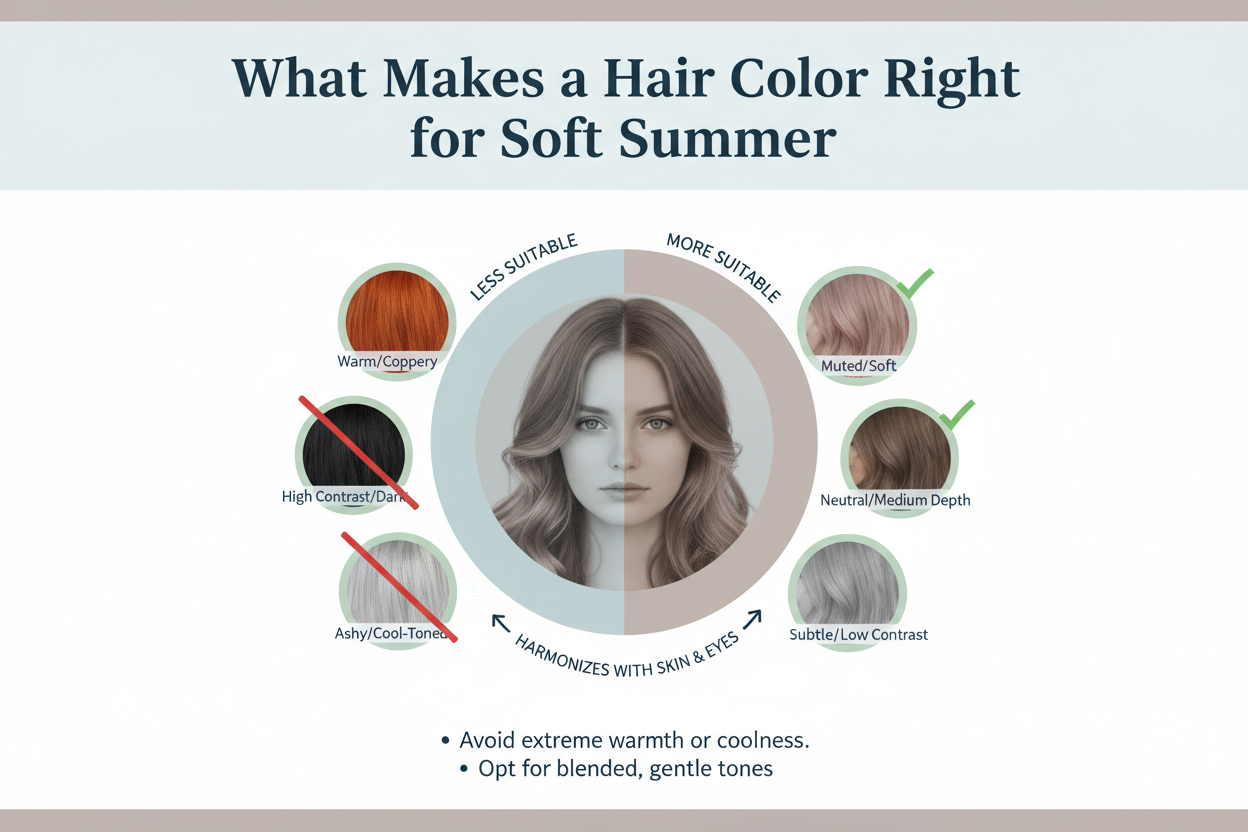
Soft summers have cool undertones running through their skin, eyes, and natural hair, with a quietness across all three that keeps contrast deliberately low. That's the blueprint. A hair color works when it respects it — which means anything warm, saturated, or sharply different from your skin tone is fighting your natural coloring rather than going with it.
A practical test for any shade you're considering:
- Is it cool or neutral-cool? Warm undertones — gold, copper, red, bronze — sit outside this palette.
- Is it muted or greyed-out? High saturation and vivid pigment overwhelm the softness of this season.
- Does it keep contrast gentle? A shade several levels lighter or darker than your natural baseline disrupts the low-contrast quality that defines the type.
Pass all three and the color almost certainly belongs in your soft summer range. Fail even one and the mismatch shows up on your face first — usually as dullness in the skin, shadows under the eyes, or a look of effort where there should be ease.
Not sure if soft summer is actually your season? Take the color analysis quiz before making any changes at the salon — a misidentified season is the most common reason the "right" color still looks wrong.
The Natural Hair Color Range Soft Summers Are Born With
Soft summers tend to be born with hair that already fits their palette — which is actually useful to know. The natural range runs from light ashy blonde through dirty blonde and into medium cool brown. What these shades share is the same quality that defines the palette: light to medium in depth, cool in tone, and visibly muted rather than glossy or richly pigmented.
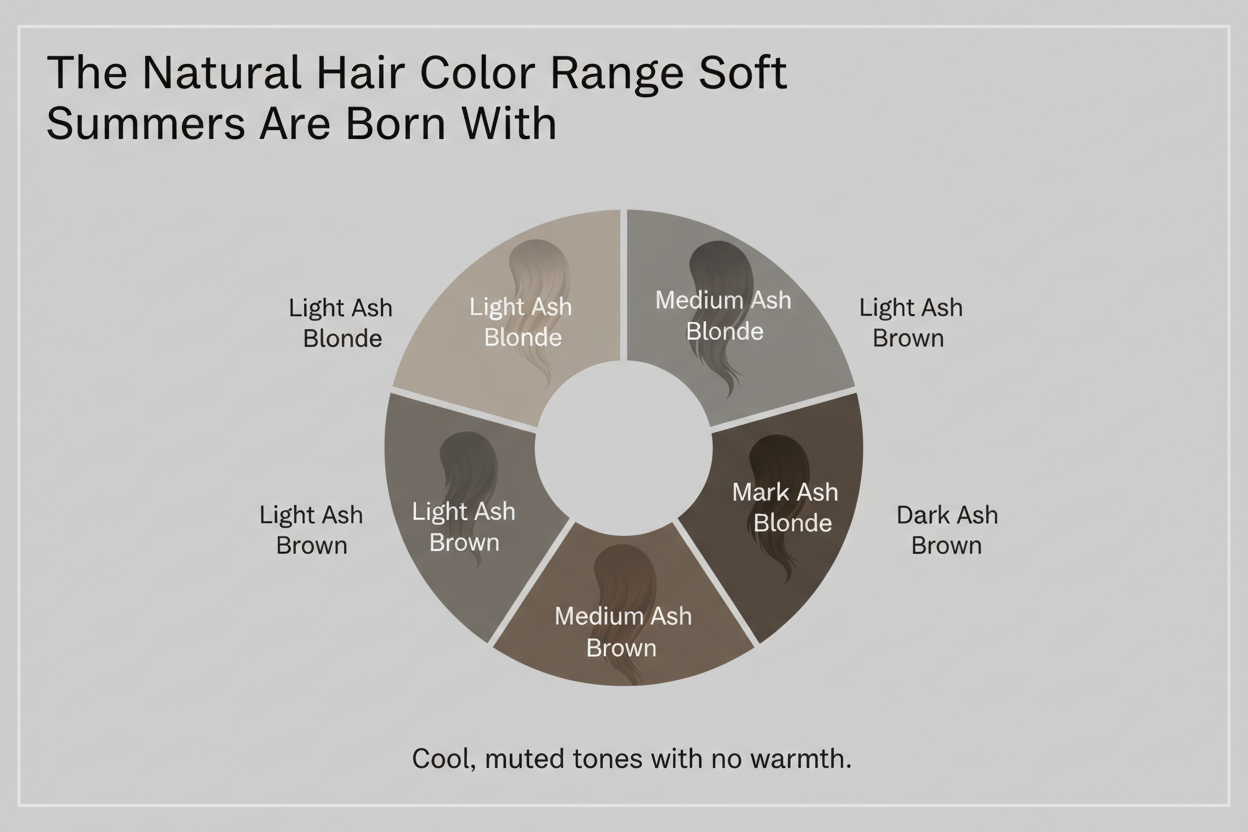
This isn't a coincidence. The soft summer type has low-to-medium contrast between hair, eyes, and skin, so the hair colors that occur naturally in this group reflect that. Someone with this coloring rarely has hair that reads strikingly light against very dark skin, or dramatically dark against very fair skin. The natural relationship between features is quiet and balanced.
One shade that comes up repeatedly as a soft summer signature is what colorists sometimes call mousy brown — a color many people spend years trying to escape, not realizing it's actually one of their most flattering options. The grey-brown quality of mousy brown is exactly the kind of desaturated, cool tone that works for this palette. Staying close to it, or getting back to it when color has shifted warm, is often the smartest thing a soft summer can do.
Best Hair Colors for Soft Summer: Shades That Work
Start with your natural range: ashy blonde, dirty blonde, and medium cool brown. There's enough room inside those categories to create dimension and variation without breaking the palette. Here's how each family works:
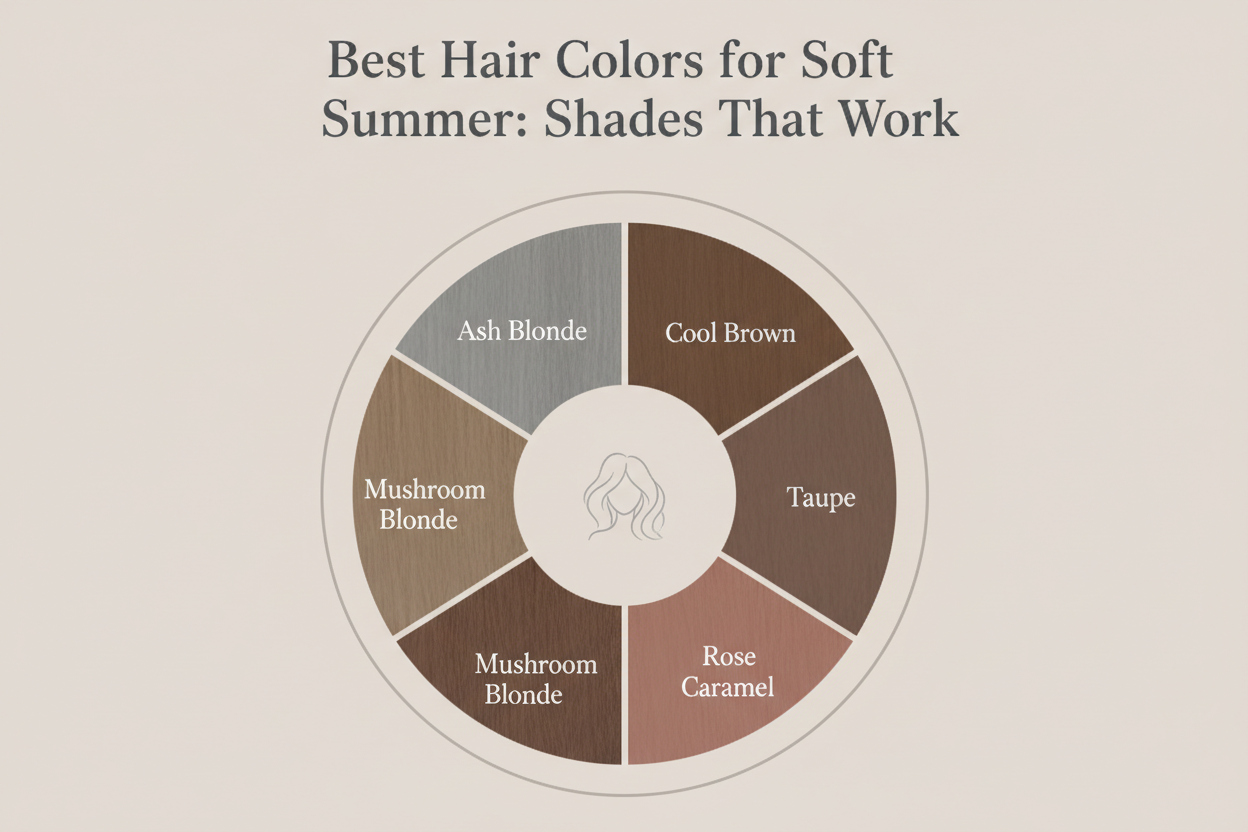
Ashy and smoky blondes These sit at the lighter end and work because the ash or smoke neutralizes warmth that would otherwise read as gold. A cool, slightly greyed blonde stays low in contrast against fair-to-medium soft summer skin and reinforces the muted quality of the overall look. Platinum and icy blonde push contrast too high and read as harsh.
Dirty blonde and taupe blonde Dirty blonde — that neutral, slightly brown-inflected shade — sits right in the soft summer sweet spot. The muted, dusty quality is built in. Taupe tones add a faint grey-green coolness that flatters this coloring particularly well. These shades are also among the lowest maintenance in the palette because they're close to what soft summers naturally grow.
Medium cool browns The most universally reliable category, covered in more detail below.
Soft blue-black or cool dark brown (for deeper soft summers) A small subset of soft summers have naturally deeper coloring while still carrying cool undertones and moderate contrast. For them, a very soft, slightly muted dark brown — not a glossy jet black — can work. The brown needs to read muted and cool, not rich and saturated.
Ashy and Dirty Blonde Variations for Soft Summer
The terms ashy and dirty aren't accidental — they describe the same thing soft summer hair needs most: a departure from pure, warm, saturated blonde toward something cooler, denser, and less reflective.
Ashy blonde gets its name from the grey-blue tone underneath the blonde base. That coolness is what stops the shade from pulling gold or honey against soft summer skin, where warmth creates a mismatch with the cool undertones in the face. When you ask for ashy blonde at a salon, you're asking for a blonde toned with grey or violet-blue — which is what keeps it palette-correct.
Dirty blonde describes a blonde weighted down with a touch of brown or grey, moving it away from the clean, bright end of the spectrum. The result reads soft, a little dusty, and naturally muted. That word — muted — is the defining requirement of the soft summer palette, so dirty blonde aligns almost perfectly by nature.
Both options give soft summers access to lighter hair without the high-contrast, high-saturation look that washes out this coloring type.
Cool Medium Browns: The Soft Summer Sweet Spot
If there's one shade that works for nearly every soft summer, it's medium cool brown — and the reason isn't complicated. This shade sits at roughly the same depth as most soft summers' natural coloring, which preserves the low-to-medium contrast between hair, skin, and eyes that defines the palette. It doesn't push lighter (creating a brightness the undertones can't support) or darker (introducing an intensity that reads wrong against soft, muted features).
Mousy brown falls squarely in this category and works as a benchmark tone. The grey-brown, desaturated quality is exactly the kind of highly greyed-out color that characterizes the soft summer palette. Many people with this coloring spend years trying to escape mousy brown with warmer or brighter alternatives. The irony is that a well-executed cool medium brown — right in that mousy range — consistently delivers the most flattering result.
Maintenance is easier here too. Because this shade sits close to the natural baseline, root regrowth is less visible and less jarring, toning appointments can be spaced further apart, and color is less likely to drift warm or brassy the way lighter shades tend to. If you want a palette-correct result without a lot of upkeep, cool medium brown is the obvious place to start.
Hair Colors to Avoid If You Are a Soft Summer
These aren't arbitrary rules. Each category creates a specific conflict with the cool, muted, or low-contrast qualities that define this palette.
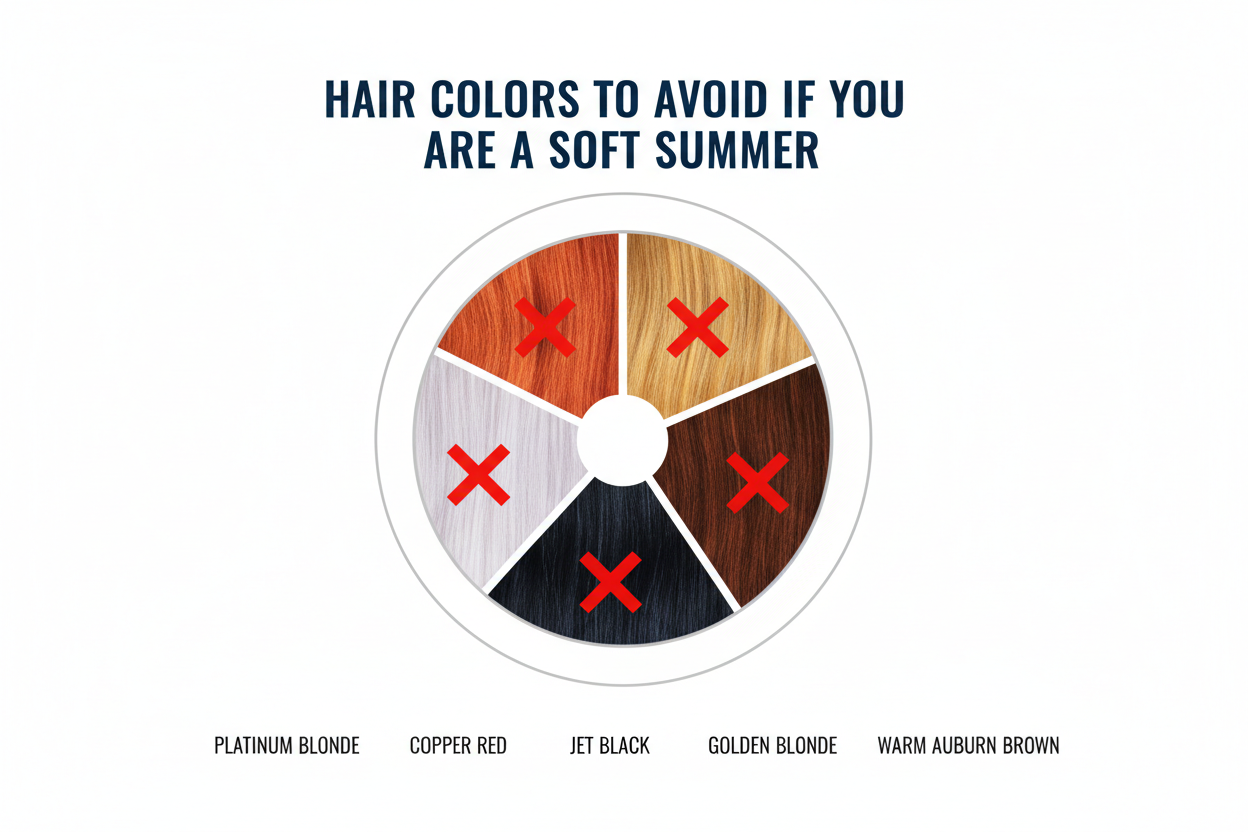
Warm and golden blondes Gold and honey tones pull directly against the cool undertones in soft summer skin. Instead of brightening the complexion, warm blonde tends to make it look sallow — the competing warmth sits on top rather than blending in.
Rich copper and auburn Highly saturated and warm, these shades conflict with every defining quality of the soft summer palette. Against cool-toned skin, the contrast reads harsh rather than striking, and the pigment intensity overwhelms the natural gentleness of this coloring.
Jet black Pure glossy black creates contrast well above the low-to-medium range that suits soft summer. Even when black reads cool on its own, the contrast it generates against soft summer skin and eyes is too sharp. It tends to look heavy rather than dramatic.
High-lift platinum and icy white-blonde These push contrast up from the opposite direction. Against soft summer skin, platinum reads stark and cold in a way that highlights complexion imperfections. The bleaching process also tends to introduce unwanted tone variations that are hard to keep in check.
Vivid or fantasy colors Deep violet, vivid red, bright teal — these place high-intensity pigment against coloring defined by low saturation. The mismatch is immediate.
Still second-guessing whether soft summer is your actual season? Start the quiz here — getting the palette right first is the single most important step before any of these avoidance rules apply to you.
How to Talk to Your Colorist About Soft Summer Tones
Most colorists aren't trained in seasonal color analysis, so asking for a "soft summer shade" will probably get you a blank look. The vocabulary that actually lands in a salon comes straight from the palette's core qualities: cool, muted, low contrast, ashy.
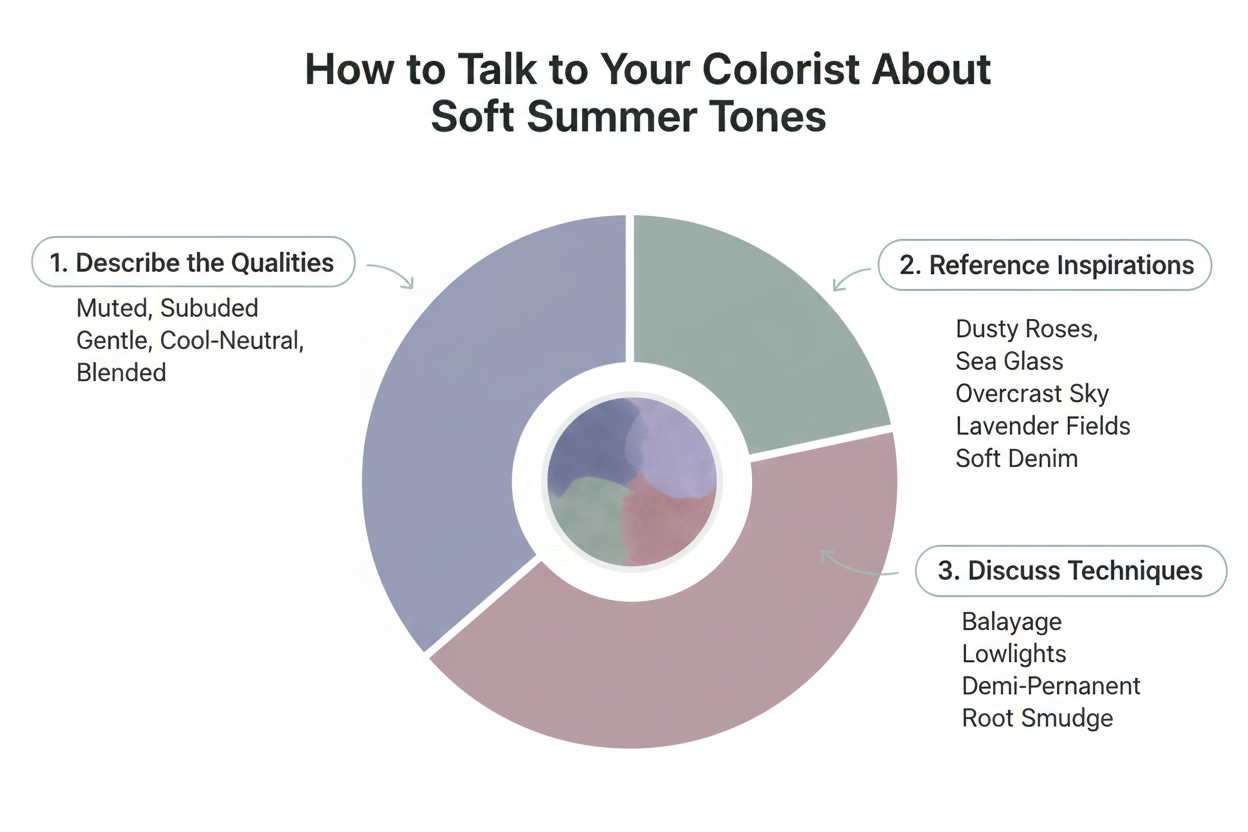
Phrases that point in the right direction:
- "I want a shade that leans cool or ash — no warmth, no gold, no honey."
- "I need the tone to be muted, not vivid or shiny — something that reads a little dusty or greyed."
- "I want to stay close to my natural depth — nothing dramatically lighter or darker than what I have."
- "I need toner to neutralize any brassiness — I want to avoid warmth coming through at all."
Show, don't just tell: Bring pictures. Screenshots of ashy blonde, dirty blonde, or mousy brown that clearly show the cool, low-saturation quality will do more work than any verbal description. Colorists think visually, and a concrete reference pulls the result toward what you actually want.
Questions to ask before they start:
- "How will you prevent brassiness during this process?"
- "What toner will you use, and what underlying tone does it correct?"
- "How much lift are you going to use, and will that push the result warmer?"
Asking these upfront signals that you know what warmth and saturation do to your coloring — and that tone management isn't a finishing touch. It's the whole point.
Maintaining Soft Summer Hair Color: Keeping Tones Muted and Cool
Cool, muted tones don't maintain themselves. The processes that create them — lightening, toning, depositing cool pigment — are temporary, and hair naturally drifts toward warmth as color fades. For soft summers, that drift is the main thing to stay ahead of.
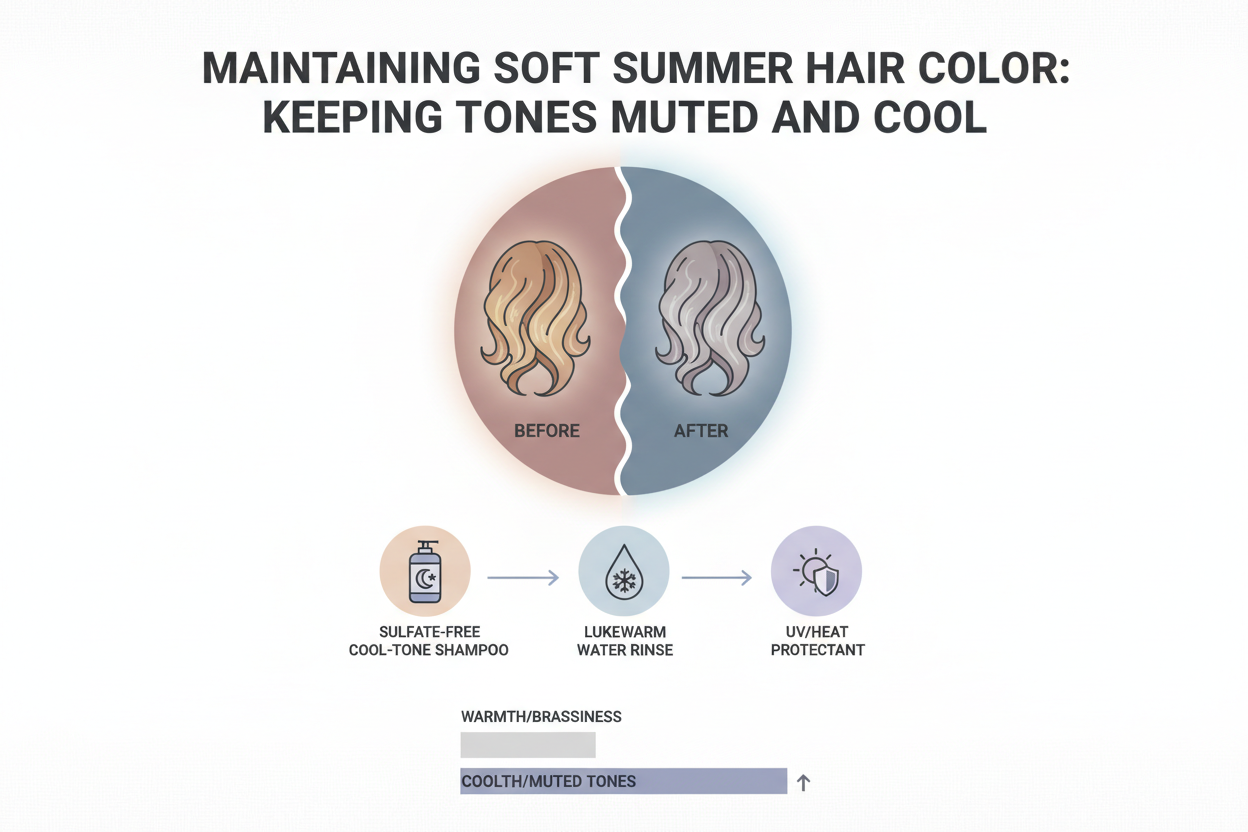
Purple and blue shampoos A violet or blue-toned shampoo used once or twice a week deposits cool pigment as it cleanses, pushing back against the brassiness that builds between color appointments. For ashy blondes, purple shampoo is the go-to. For cool browns, blue-toned shampoo tends to work better. If the cool quality matters to you, this isn't a step you can skip.
Gloss treatments and toning appointments A clear or cool-tinted gloss between full color appointments refreshes both tone and surface shine. For soft summers, a cool ash gloss every six to eight weeks can meaningfully extend the life of a color by resetting warmth before it gets obvious. Many colorists offer this as a standalone service.
Heat protection and UV exposure Both heat styling and sun exposure speed up color fade and warmth drift. A UV-protective leave-in, or a heat protectant that also contains toning agents, gives you a bit of coverage between washes. If you spend a lot of time outside, this step pays off.
When to re-tone versus re-color Re-toning — applying a cool toner without additional lightening or color deposit — is the cheaper, lower-damage fix when warmth creeps in but your base shade is still where it should be. Re-coloring is only necessary when the base itself has shifted. Knowing the difference saves you time, money, and a processing session you didn't need.
How to Confirm You Are Actually a Soft Summer Before Changing Your Hair
Applying soft summer hair advice to the wrong palette is a reliable way to end up with a color that doesn't quite work — and no idea why. Before committing to any of the shades above, it's worth making sure soft summer is actually your season.
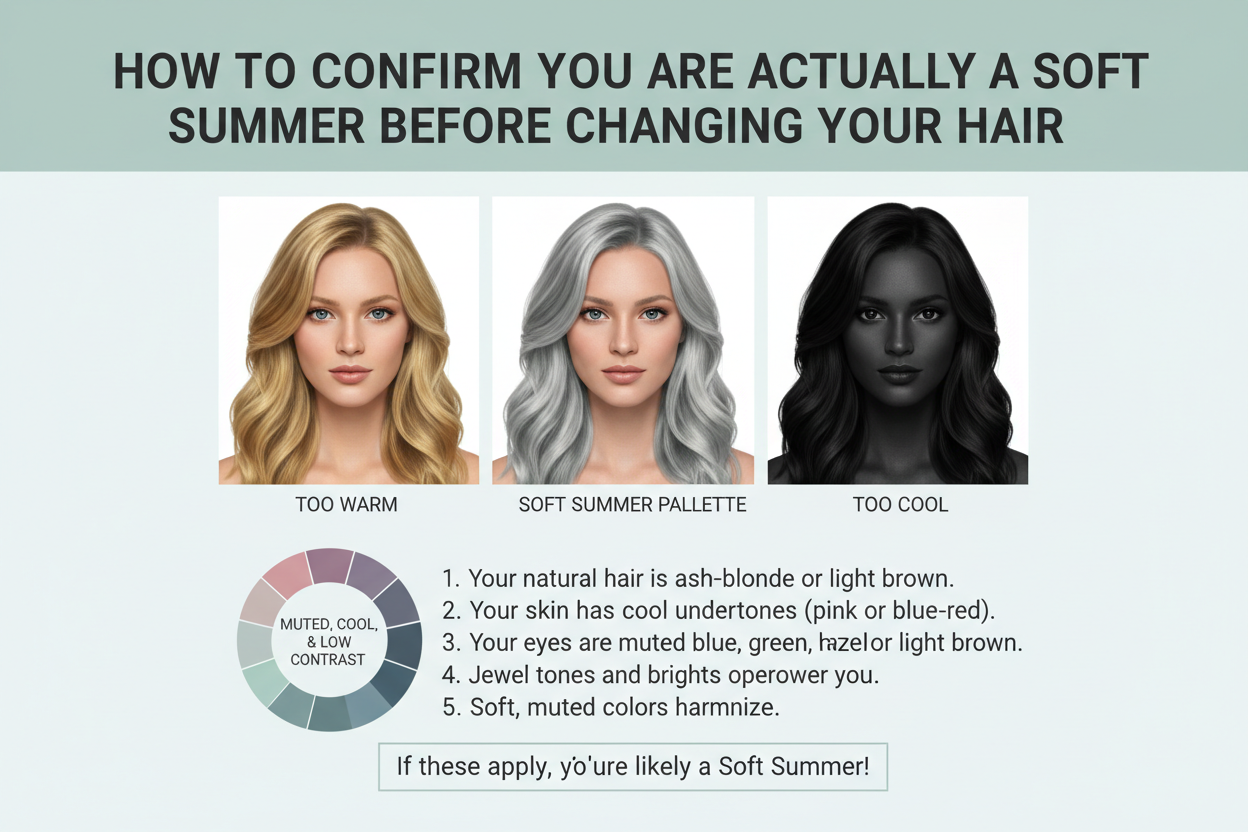
The diagnostic criteria come down to two things: cool undertones and low-to-medium contrast. Both need to be present.
Cool undertones show up most clearly in your wrist veins (blue or blue-green rather than green or olive), in how gold versus silver jewelry reads on your skin (silver tends to look more natural), and in the overall tone of your complexion, which leans pink, rosy, or grey-beige rather than yellow or golden.
Low-to-medium contrast means the difference in depth between your hair, eyes, and skin is gentle rather than dramatic. Soft summers don't typically have very dark hair against very fair skin, or very light eyes against very deep skin. The overall effect is harmonious — similar in depth across all three.
Where people go wrong: soft autumns share the muted quality but lean warm rather than cool, which makes them a common point of confusion. True summers share the cool undertone but carry slightly more contrast and saturation than soft summer does. If you're unsure between these adjacent types, undertone and saturation are what separate them.
The most reliable way to confirm your season before booking a salon appointment is a structured color analysis that looks at all of these variables together. The quiz at color-analysis.app walks through the relevant criteria and gives you a result you can take directly into a color conversation — which beats guessing and correcting after the fact.
People Also Ask
What hair color is best for soft summer skin tone?
The most reliable choices are cool, muted shades in a low-to-medium contrast range relative to your skin and eyes. Ashy blonde, dirty blonde, taupe blonde, and medium cool brown all fit here. What they share is a greyed-out, desaturated quality — not bright, not warm, not richly pigmented. Medium cool brown is the most universally flattering because it tends to match the natural depth of most soft summers, keeping contrast harmonious without much maintenance.
Can soft summers go blonde?
Yes, but the type matters. Ashy blonde and dirty blonde work because their cool or muted undertones keep the shade from reading warm or golden against soft summer skin. Warm blonde — honey, golden, caramel — doesn't work. Those tones introduce warmth that conflicts directly with the cool undertones soft summers carry. High-lift platinum and icy white-blonde are also a problem, pushing contrast higher than the palette supports. The shorthand: blonde is fine as long as it reads cool and slightly dusty rather than bright, warm, or vivid.
What hair colors should soft summers avoid?
The categories to steer clear of:
- Warm and golden blondes — honey and caramel tones pull against cool undertones and tend to make the complexion look sallow
- Copper and auburn — both warm and highly saturated, which conflicts with every defining quality of the palette
- Jet black — creates sharper contrast than the soft summer range supports, even if the black tone itself reads cool
- Platinum and icy white-blonde — too stark and high-contrast against soft summer skin
- Vivid or fantasy colors — high saturation placed against low-saturation coloring creates an immediate and visible disconnect
The common thread: anything warm, highly saturated, or dramatically different in depth from your natural baseline.
Is soft summer the same as cool summer for hair color?
No, though they share the same cool undertone foundation. True summer (sometimes called cool summer) carries slightly more saturation and contrast. In practice, a true summer can wear somewhat brighter, cleaner cool tones — a sharper ash brown or a crisper cool blonde — that might read slightly too vivid or high-contrast for a soft summer.
Soft summer sits at the intersection of the summer and autumn families, so muting is the priority alongside coolness. A shade that is cool but vivid works for true summer; for soft summer, it also needs to be greyed-out and low in saturation. The distinction shows up most clearly when you're choosing between two otherwise similar shades — the softer, dustier option will almost always read better on a soft summer than the cleaner, brighter version.
How do I know if I am a soft summer or a soft autumn?
The main difference comes down to undertone. Soft summers have cool undertones — skin that leans pink, rosy, or grey-beige, veins that read blue or blue-green, and a complexion that looks better with silver jewelry than gold. Soft autumns have the same muted, low-saturation quality but run warm — skin that leans golden, peachy, or yellow-beige, veins that read green, and a complexion where gold jewelry sits more naturally.
For hair color, this distinction is practical: the ashy, grey-toned browns and blondes that work on soft summer will look slightly cold and off on a soft autumn, who needs warmer muted tones like camel brown, soft golden blonde, or warm taupe. A useful test is to hold cool-toned and warm-toned swatches near your face. If the cool ones make your skin look clearer and more even while the warm ones add a flattering glow, you're likely soft autumn. If it goes the other way — cool tones look natural and warm tones throw you off — soft summer is probably the better fit.
FAQ
What is the best hair color for a soft summer palette?
Cool, muted shades in a low-to-medium depth range tend to work best. Ashy blonde, dirty blonde, taupe blonde, and medium cool brown all share that greyed-out, desaturated quality that sits well with soft summer's cool, low-contrast coloring. Medium cool brown is usually the safest starting point — it often mirrors the natural depth many soft summers already have, so the overall look stays balanced without much upkeep.
Can soft summers dye their hair warm tones like auburn or copper?
Auburn and copper are two of the worst choices for soft summers. Both are warm in undertone and high in saturation — the opposite of what this palette needs. Put either against soft summer skin and the complexion reads off, slightly sallow. The same goes for warm caramel, honey blonde, and golden brown. If you want something with a hint of warmth, a very slightly warm taupe at the cool end of the spectrum is about as far as you can push it. True warm shades tend to fight the coloring rather than work with it.
What is the difference between soft summer and true summer hair colors?
Both seasons share a cool undertone base, but they part ways on saturation and muting:
- True summer can carry slightly cleaner, crisper cool tones — a sharper ash brown or a more defined cool blonde reads well because the palette supports a touch more vibrancy
- Soft summer sits at the intersection of summer and autumn, making muting just as important as coolness — shades need to read dusty and desaturated, not just cool
In practice, two otherwise similar ash browns might both be technically cool, but the slightly richer, cleaner version works better on true summer while the softer, more greyed-out version works better on soft summer. When choosing between two shades, soft summer should default to the more muted option every time.
Will highlights work for a soft summer, and what kind?
Yes, highlights can work well within the right parameters.
The safest options are ashy or cool-toned highlights no more than two or three levels lighter than the base, placed softly without sharp lines of demarcation. Babylights or diffused balayage tend to suit this palette because they blend rather than contrast. What to avoid: warm or golden highlights, chunky placement, anything that creates a strong two-tone effect between highlight and base.
The goal is dimension that reads like natural light variation, not a bold transformation. Heavy highlighting with significant depth contrast pushes the look outside what soft summer supports.
How do I keep my soft summer hair color from going brassy?
Brassiness is the main enemy of soft summer tones, since warmth is exactly what these shades need to avoid. A few things that actually help:
- Use a purple or blue-toned toning shampoo once or twice a week to neutralize yellow and orange as they develop
- Ask your colorist for a cool toner at every appointment to keep the grey-beige or ashy quality intact
- Always use heat protectant before styling—heat speeds up oxidation and pulls color warm faster than almost anything else
- Wear UV-protective hair products in the sun, since UV exposure is one of the most common causes of brassiness in color-treated hair
- Try a gloss treatment between appointments to maintain the muted, cool finish without doing a full color service
Is my natural hair color already right for soft summer?
Very often, yes. Natural soft summer hair tends to fall somewhere in the range of light ashy blonde through dirty blonde to medium cool brown — shades that sit right in the middle of the palette. If your natural color reads cool and slightly muted rather than warm or vivid, it's probably already doing what it needs to do.
The most common mistake is assuming natural hair is too plain and trying to brighten or warm it up. That usually moves the hair away from the palette rather than improving it. Before changing anything, hold some soft summer fabric swatches next to your hair in natural light. If they feel harmonious, leave it alone.
How do I confirm I am a soft summer before changing my hair color?
Before committing to a color, run through a few quick checks:
- Undertone test: Look at the veins on your inner wrist in natural light. Blue or blue-green veins point to a cool undertone, which fits soft summer. Green or olive veins suggest a warmer season.
- Jewelry test: Hold silver and gold jewelry next to your bare face. Silver tends to look cleaner and more natural on soft summers; gold can make the complexion look a little off.
- Draping contrast: Hold pure white and soft off-white fabric near your face. Soft summer skin usually looks more even against the slightly muted version.
- Saturation check: If vivid, saturated colors wash you out but dusty, greyed tones make your skin look more even, that's a consistent soft summer indicator.
If you want something more structured before your appointment, take the quiz at color-analysis.app to get a personalized season assessment.