Soft Summer Clothing, Makeup, Jewelry, and Hair
 Reviewed by Alexandra Gilmore
Soft Summer works when every choice respects cool-leaning color and gentle, gray-muted contrast. Coordinate clothing, makeup, jewelry, and hair around dusty blues, mauves, rose browns, soft navy, and brushed silver so the result feels polished without becoming bright, warm, or sharply defined.

What makeup works for Soft Summer? Choose a skin-matched cool or neutral-cool base, a softly blended cool-pink or dusty-rose blush, matte gray-mauve eyeshadow, slate liner, and satin dusty-berry lips. Keep contour sheer and cool taupe. Skip glittery gold bronzer and graphic black wings: their warmth and sharp contrast can overpower Soft Summer's muted coloring. The same cool, gray-softened palette guides your clothing, jewelry, and hair choices throughout this guide.
Soft Summer is one of three Summer sub-seasons in the 12-season color analysis system. Its colors are cool-leaning and softly desaturated, so they look blended and understated rather than bold.
💫 Build Your Personal Color Palette
Turn the useful colors from this article into a palette you can repeat across real outfits. A personal palette makes it easier to coordinate neutrals, accents, and combinations without treating every recommendation as a rigid rule.
Build My Palette →What sets Soft Summer apart is precisely that mutedness. Its palette is built from greyed-out, low-chroma hues that would read as washed out on someone with stronger coloring — but on a Soft Summer, those same tones create an effortless, polished harmony. Wearing colors that match your season's natural softness allows your skin, eyes, and hair to take center stage rather than compete with what you have on.
This guide covers every category that matters for Soft Summer color palette clothing, makeup, jewelry, and hair recommendations:
- Clothing — which hues, fabrics, and pattern scales work best
- Makeup — foundation undertones, blush, lip, and eye shadow guidance
- Jewelry — which metals, stone colors, and finishes complement Soft Summer skin
- Hair — how to maintain or enhance your natural coloring through color choices
- Capsule wardrobe building — how to create a cohesive, wearable Soft Summer closet
- Everyday vs. evening makeup — how to shift intensity without leaving your palette
Whether you have already confirmed your season or are still exploring, the sections ahead offer concrete, actionable guidance grounded in the core principles of Soft Summer color theory.
What Makes Soft Summer Unique in the 12-Season System
The 12-season system organizes personal coloring into twelve types across three qualities: hue (warm or cool), value (light or dark), and chroma (bright or muted). Soft Summer belongs to the Summer family — broadly cool and muted — and sits at the far end of the chroma scale, making it the most desaturated of all twelve seasons.
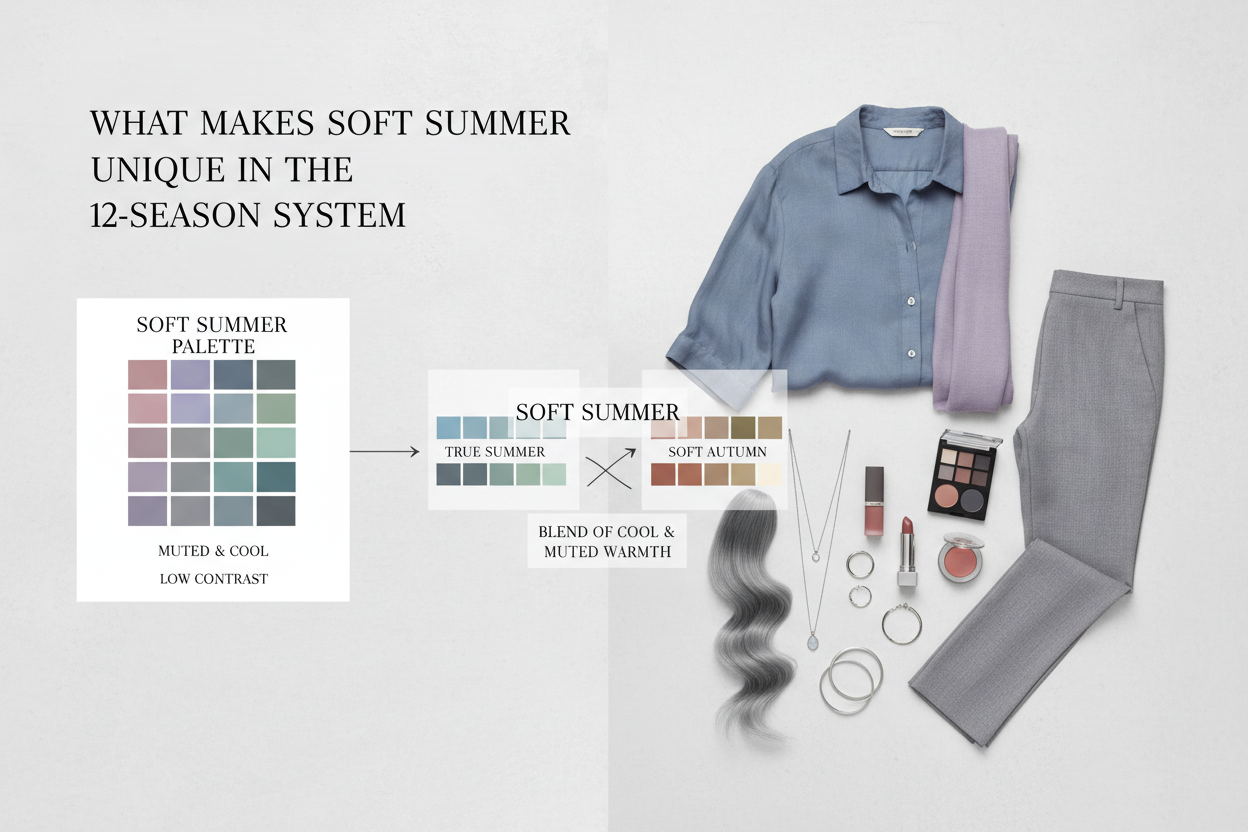
That desaturation isn't a weakness. It's the whole point.
Soft Summer sits within the Summer family like this:
- Summer family: Cool, True Summer | Soft Summer | Light Summer
- Dominant quality: Muted/soft (chroma leads)
- Secondary quality: Cool, with a slight neutral-cool undertone that allows very subtle warm-neutral overlap
Because Soft Summer's palette runs on heavily greyed-out, low-saturation color, those same hues would drain someone with vivid, high-contrast coloring. The opposite is just as true: colors that look sharp and alive on a Clear Spring or True Winter will overwhelm and harden Soft Summer features. Palette specificity isn't arbitrary — it reflects the actual visual weight of your natural coloring.
The practical upshot: if you're a Soft Summer, the colors that other people write off as "too muted to wear" are probably your strongest options.
Not sure if Soft Summer is your season? The characteristics described throughout this guide are a strong starting point, but a structured color analysis removes the guesswork. [Take the color analysis quiz →]
The Soft Summer Color Palette: Key Hues and Undertones
Soft Summer colors share two qualities that never change: they are cool-leaning and muted. Within those limits, the palette covers a surprisingly wide range of hues — it just renders each one in its softest, most greyed-out form.
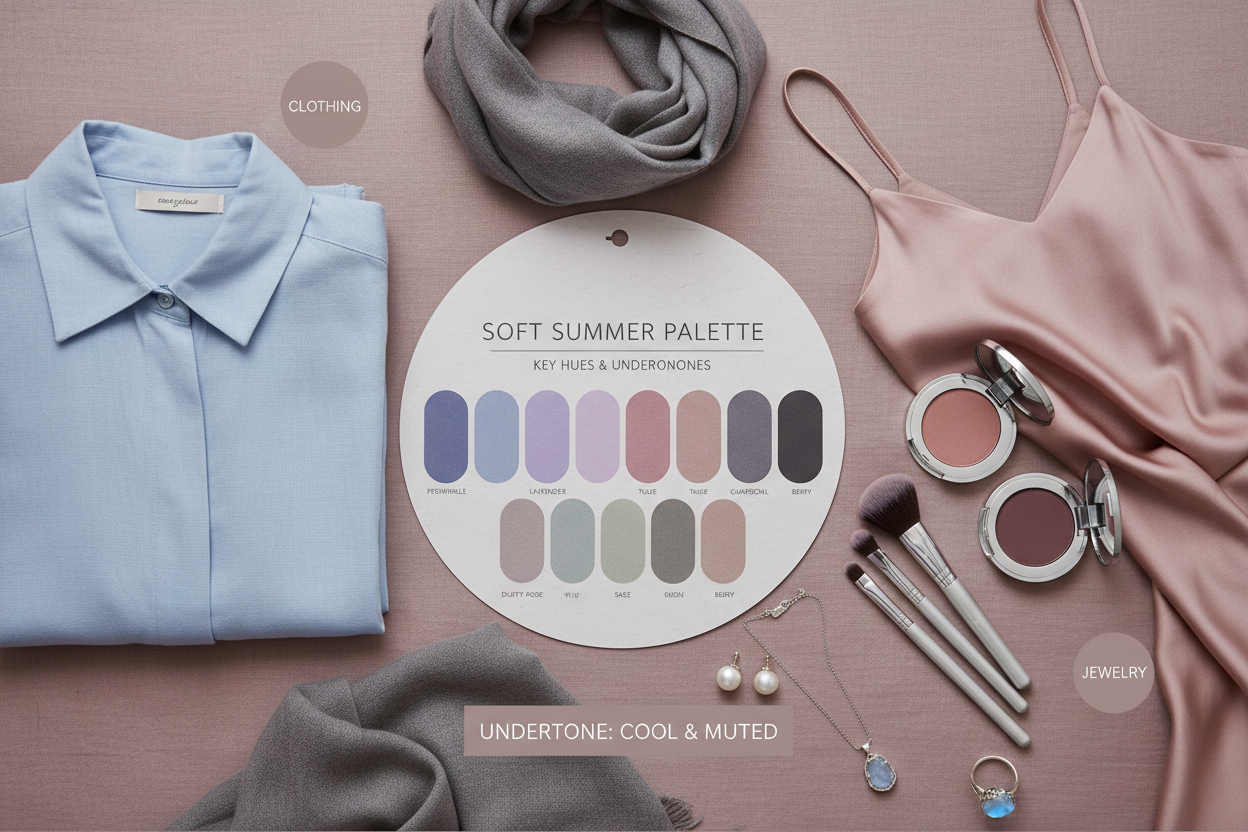
Palette character in concrete terms:
| Category | Example hues |
|---|---|
| Pinks & mauves | Dusty rose, muted mauve, soft raspberry, heather |
| Blues & greens | Greyed blue, soft teal, muted sage, dusty periwinkle |
| Neutrals | Soft greige, cool taupe, muted lavender-grey, bluebell grey |
| Deeper tones | Dusty plum, slate blue, muted burgundy, smoky berry |
| Near-whites | Soft white, lavender-tinted white, cool off-white |
| Near-blacks | Charcoal (used sparingly), soft navy |
Undertone guidance:
Soft Summer skin has cool-to-neutral-cool undertones — typically described as an ashy, rosy, or slightly blue-tinted base rather than yellow or golden. In practice, this means:
- Colors with grey, lavender, or ash mixed in tend to sit naturally against the skin
- Colors built on yellow, orange, or golden bases create visual friction
- Bright or vivid versions of otherwise compatible hues (electric blue instead of dusty periwinkle, for example) bring too much chroma and overwhelm the season's natural softness
The palette in a phrase: gentle and quietly mysterious — colors that feel like a slightly overcast sky rather than full midday sun.
Soft Summer Clothing: Fabrics, Patterns, and Color Combinations
Clothing choices for Soft Summer work best when they mirror the palette's diffused, blended quality — down to fabric texture and pattern scale. The right color in the wrong fabric finish can still throw everything off.
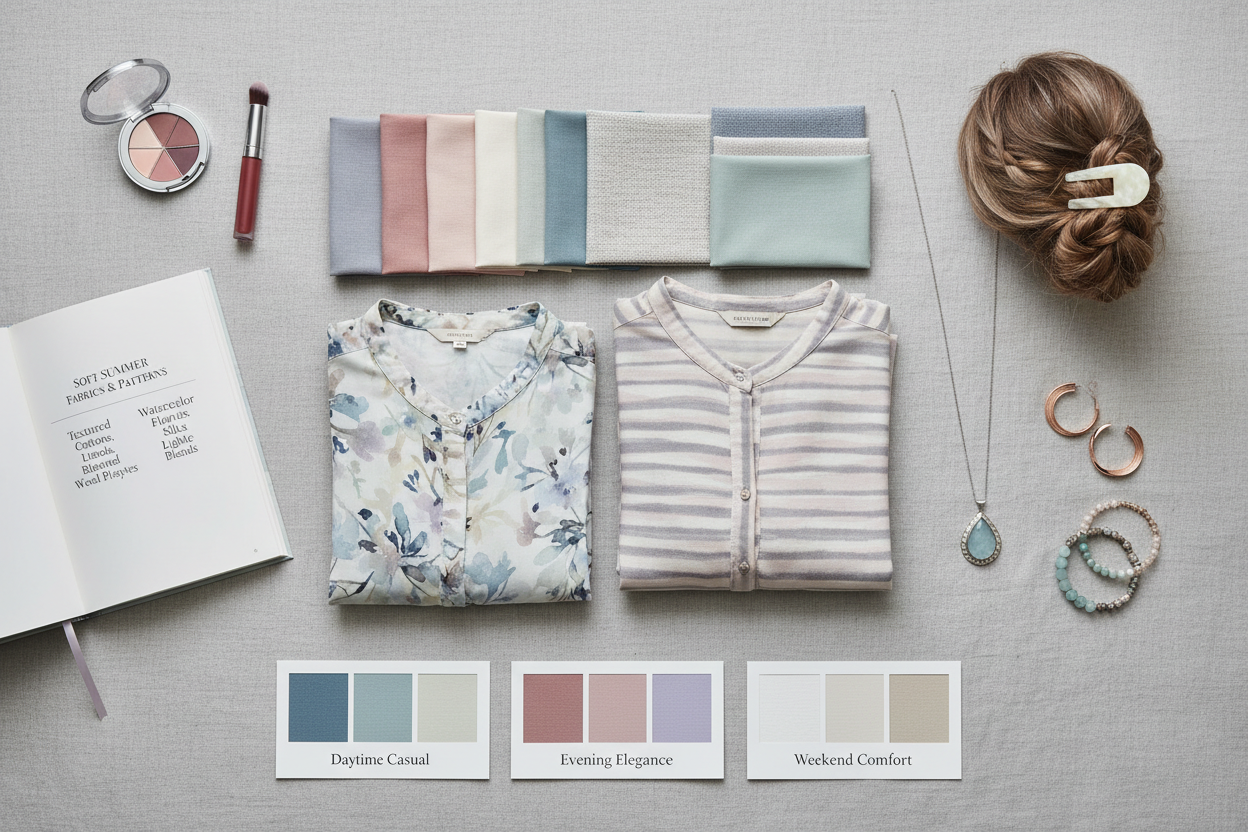
Color Combinations
The core principle for Soft Summer outfit building is tonal dressing: pairing colors that are close in value and saturation rather than pushing strong contrast between light and dark, or bright and neutral.
Combinations that work:
- Dusty rose top with greyed taupe trousers
- Soft sage blouse layered over muted lavender-grey trousers
- Charcoal soft blazer over a muted periwinkle shirt
- Dusty mauve dress with soft greige accessories
- Layered neutrals: cool off-white, greige, and slate together
What to avoid:
- High-contrast pairings (bright white top + black trousers)
- Warm accent pieces — a camel scarf or golden-yellow bag brings in yellow undertones that clash with the season's cool base
- Neon or vivid saturated colors anywhere in an outfit, even as a small accessory
- True black as a dominant color — it reads too harsh; soft navy or charcoal does the same job without the heaviness
Pattern Scale and Type
Soft Summer benefits from patterns that blend rather than pop:
- Best: soft florals with muted tones, small-scale checks, watercolor prints, blended abstract patterns, tone-on-tone textures
- Avoid: high-contrast graphic prints, bold stripes, large-scale prints with saturated colors, animal prints in warm tones
Fabrics and Finishes
Fabric choice either reinforces the season's softness or works against it:
- Best: matte jersey, brushed cotton, cashmere, linen (unwaxed), soft wool, chiffon, suede
- Avoid: high-sheen fabrics (lacquered leather, metallic lamé, patent finishes), stiff structured fabrics that create a hard silhouette
- Leather and denim: both work well in soft, faded, or matte forms — dusty grey leather, worn-in denim in muted indigo
Building a Soft Summer Capsule Wardrobe
A Soft Summer capsule is built around a core of cool, greyed neutrals with palette-compatible accent hues layered in around them.
Core neutrals (build the majority of the wardrobe here):
- Soft greige or cool taupe — the everyday neutral base
- Muted lavender-grey — a cool alternative to plain grey that works with the season's undertone
- Dusty navy — a softer stand-in for true black in trousers, blazers, and outerwear
- Soft charcoal — for when you need some depth
Accent hues (add personality without disrupting the harmony):
- Dusty rose or heather pink
- Muted sage or dusty teal
- Soft mauve or smoky berry
- Greyed periwinkle
Practical capsule starting point (10–12 pieces):
- Cool greige or taupe wide-leg trousers
- Dusty navy tailored blazer
- Soft white or lavender-tinted white blouse
- Muted mauve knit sweater
- Dusty rose or heather midi dress
- Muted sage linen shirt
- Soft charcoal trousers or jeans in muted indigo
- Greyed blue or periwinkle top
- Cool taupe or greige coat
- One soft floral or blended print dress using multiple palette hues
Every item here coordinates with at least two or three others. Because all the hues share the same greyed, cool quality, they blend without much effort on your part.
Soft Summer Makeup Palette: A Step-by-Step Routine
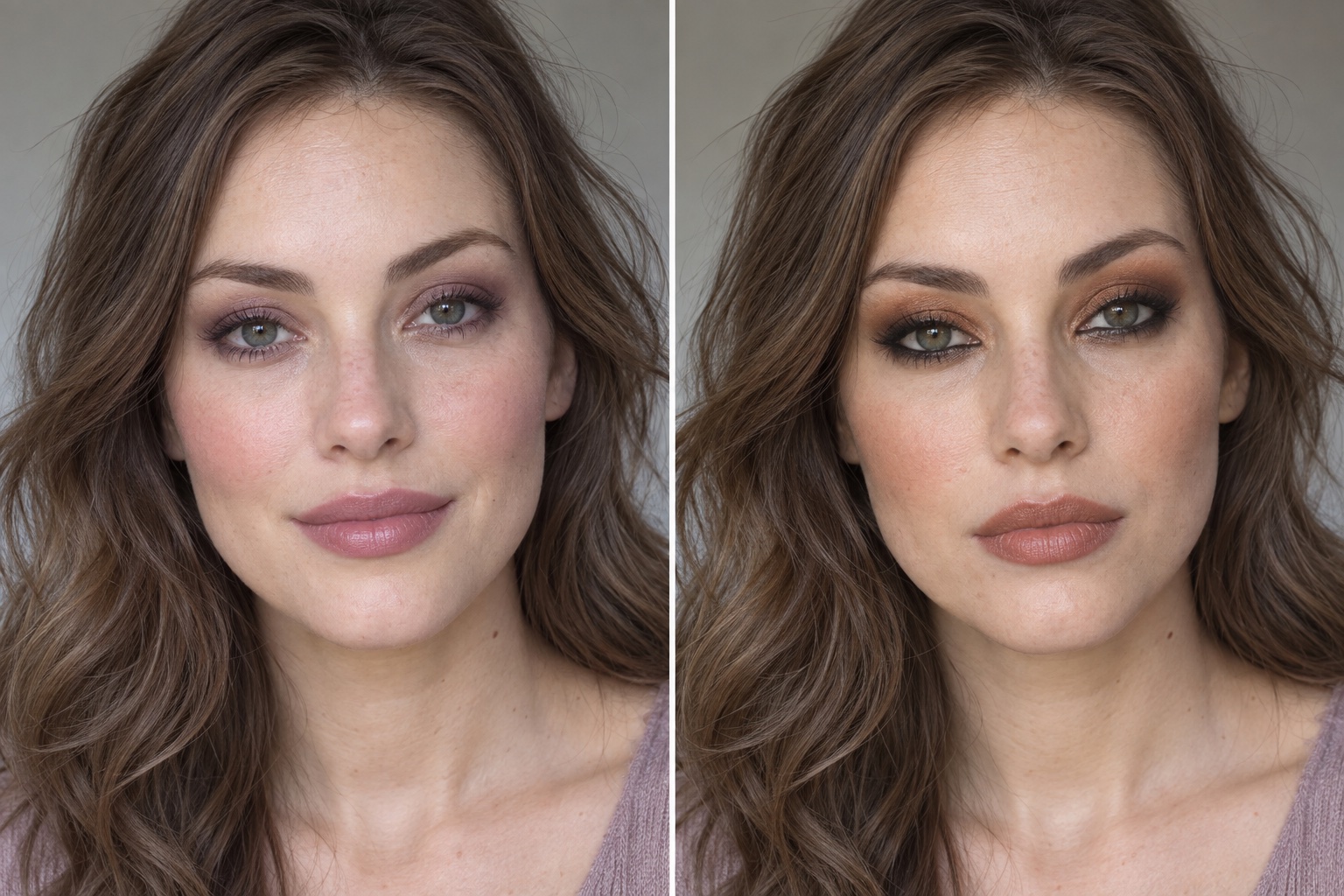
Build Soft Summer makeup in thin, blended layers. Match the depth of each shade to your own skin and lip color; the shared thread is a cool or neutral-cool undertone, muted pigment, and a soft edge. These are shade and texture formulas to test in daylight, not promises that one product will suit every complexion.
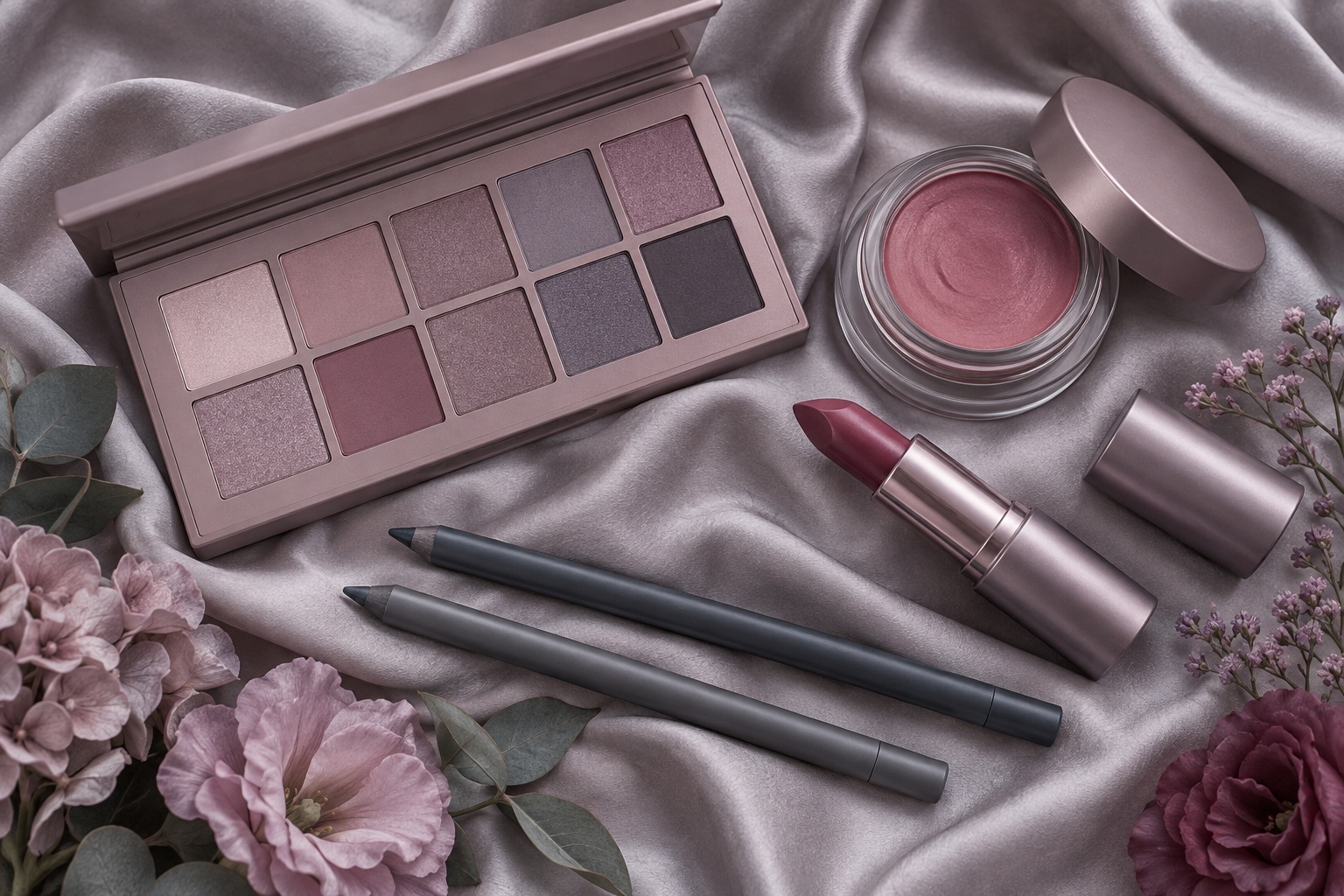
Swatch base products on the jaw in natural light and check again after they dry. A label such as "cool" or "neutral" is only a starting point: the finished color must blend into your actual skin rather than turning pink, gray, or yellow.
Step 1: Foundation and Concealer
- Formula: a light-to-medium coverage liquid, skin tint, or cream foundation with a natural or soft satin finish; apply a thin layer from the center of the face and blend outward.
- Shade: test rosy, pink, or neutral-cool options at your skin depth. If a cool label looks visibly pink, try a balanced neutral instead; avoid a yellow or golden cast.
- Concealer: spot-conceal with a close skin match, then use a slightly lighter neutral-cool shade only where you want gentle brightness. Powder sparingly to keep skin looking like skin.
Step 2: Cool Taupe Contour and Mineral Blush
Contour should read as a subtle shadow, not a stripe of tan. Sweep a sheer matte cool taupe cream or powder beneath the cheekbone and blend until the edge disappears. If it looks orange or muddy, remove it or skip contour entirely.
- Formula: finely milled, buildable mineral blush in cool pink or dusty rose, with a matte or soft satin finish. A muted berry cream blush is another option for a skin-like flush.
- Application: tap off excess, place color high on the cheeks, and diffuse toward the temple. Add a second light layer only if your natural coloring can carry it.
- Avoid: coral, terracotta, hot pink, and glittery gold bronzer. Gold shimmer adds warmth and sparkle that can dominate muted, cool features.
Step 3: Satin Dusty-Berry Lips
- Formula: a satin lipstick or tinted balm in dusty berry, gray-rose, or mauve pink. Blot once and soften the edge with a fingertip rather than drawing a sharp outline.
- Daytime: choose a shade one step deeper than your natural lip color; smoky rose and muted raspberry offer color without a bright finish.
- Evening: layer a deeper cool berry or gray-plum satin lipstick, keeping the color blurred instead of opaque and sharply defined.
- Avoid: yellow-beige nude, orange red, coral, and vivid fuchsia. Compare the lipstick beside your blush so both read as part of one muted palette.
Step 4: Matte Gray-Mauve Eyes and Soft Liner
- Formula: a matte gray-lilac or gray-mauve powder shadow across the lid, with cool greige in the crease and a little soft plum at the outer corner. Blend each transition until no hard border remains.
- Liner: smudge a slate-gray, gray-brown, or soft charcoal pencil close to the upper lashes. Short, blurred strokes give definition without a graphic wing.
- Mascara: dark brown, brown-black, or soft black, applied lightly so the lashes stay separated.
- Avoid: orange-brown or copper shadow, gold shimmer, and thick black liquid liner. A crisp black arrow pulls attention to its hard edge before the eye color and softer facial features.
Soft Summer Everyday vs. Evening Makeup
Soft Summer scales from day to evening by adding depth within the same muted family — not by introducing brighter or different colors. The palette builds through tonal layering, not contrast.
Everyday look (5–10 minutes):
- Tinted moisturizer or light foundation in a cool-neutral tone
- Soft rose or muted pink blush, well-blended
- One muted taupe or greyed rose shadow across the lid, no liner
- Clear or lightly tinted balm on lips
- Brown-black mascara
Evening look (same palette, added depth):
- Full coverage cool-neutral foundation with light setting powder
- Deeper mauve or heather blush, slightly more defined
- Muted plum or dusty lavender in the crease, soft grey or slate along the upper lash line, blended softly
- Dusty berry or smoky mauve lip in a satin finish
- Additional coat of dark brown or soft black mascara
The shift from day to evening comes from layering and deepening existing tones, not from switching to vivid or warm products. A Soft Summer evening look should still feel like the same person, just more defined.
Want to confirm your season before investing in a new makeup wardrobe? A structured color analysis gives you a clear, personalized answer. [Start the color analysis quiz →]
Soft Summer Jewelry: Metals, Stones, and Finishes
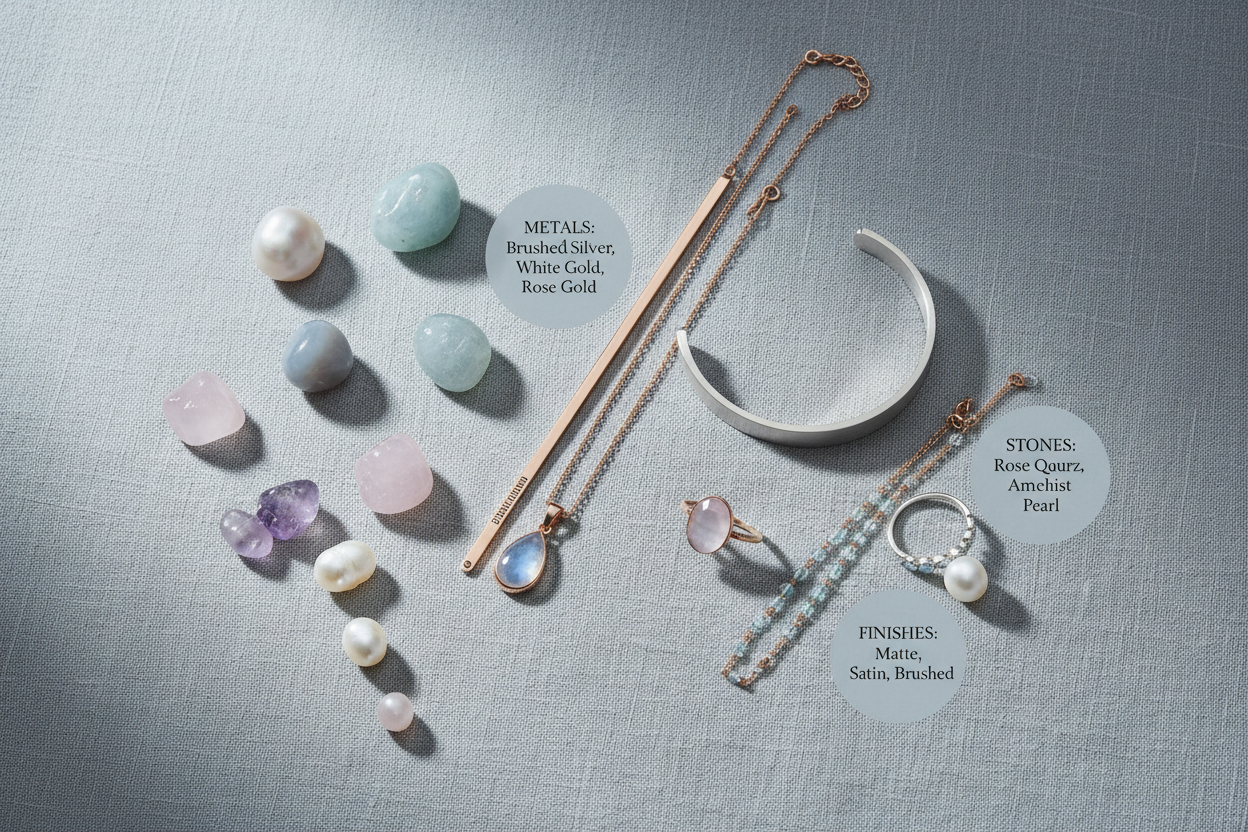
Jewelry for Soft Summer should echo the palette's cool-neutral, low-contrast, muted quality. The wrong metal finish or gemstone color can clash with Soft Summer skin just as easily as a warm-toned blouse.
Metal Tones
| Metal | Verdict | Notes |
|---|---|---|
| Matte or brushed silver | ✅ Best | Cool undertone, non-reflective finish suits muted coloring |
| Rose gold (grey-undertoned) | ✅ Good | Works when the rose gold leans more grey-pink than warm copper |
| White gold or platinum | ✅ Good | Clean, cool — pairs well with silver tones |
| Oxidized silver | ✅ Good | The darker, aged tone adds depth without warmth |
| High-polish bright gold | ❌ Avoid | Yellow-gold is too warm and creates undertone conflict |
| Copper or bronze | ❌ Avoid | Strong warm tones that overpower the season's cool base |
Gemstones and Pearls
Cool, muted, softly hued stones work with Soft Summer. Vivid or warm-toned gems tend to fight it.
Best choices:
- Amethyst (medium, muted purple) — a near-perfect Soft Summer stone
- Moonstone — soft, diffused iridescence in cool greys and blues
- Grey or lavender pearl — muted and cool; more harmonious than warm cream or yellow pearl
- Soft rose quartz — pale, greyed pink
- Aquamarine or blue topaz (lighter, less vivid versions) — cool blue hues
- Labradorite — cool, shifting grey-blue tones
- Soft grey or white diamond — clean and cool without high flash
Avoid:
- Vivid rubies, emeralds, or sapphires — too saturated
- Citrine, amber, or topaz in golden or warm tones
- Coral or warm orange stones
- Heavily faceted stones with intense brilliance — the high contrast reads too sharp
Finishes and Styles
- Best finishes: matte, brushed, hammered, oxidized, or softly polished
- Avoid: mirror-polish, lacquered, or high-reflective finishes that add visual intensity
- Style: delicate to mid-weight pieces sit better than chunky statement jewelry; layered fine chains in brushed silver are a Soft Summer signature
Soft Summer Hair: Natural Color Maintenance and Coloring Guidance
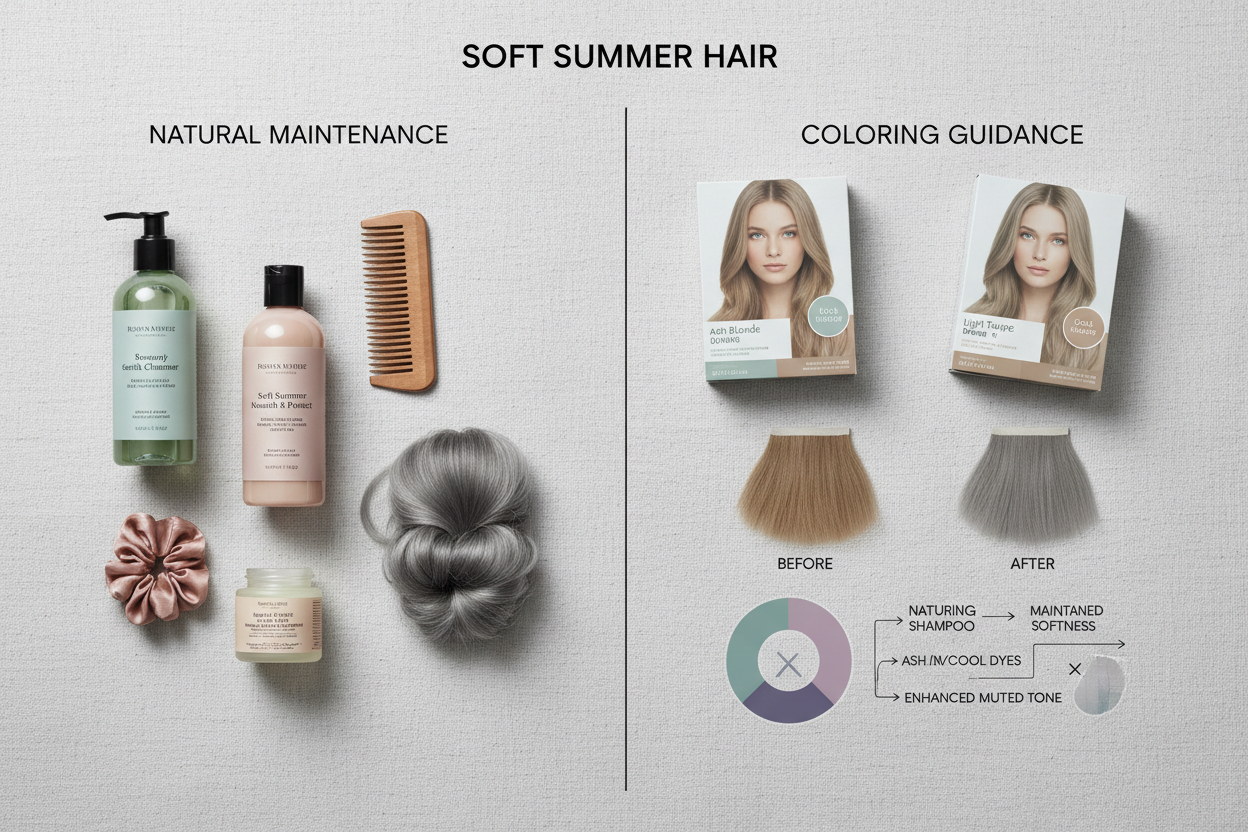
Your natural coloring is the starting point for good hair color decisions. Soft Summer hair tends toward cool, ashy, or muted tones — ash blonde, cool medium brown, greyed dark brown, or softly faded hair with a naturally blended, low-contrast look. Working with that quality rather than against it produces the most harmonious results.
Natural Hair Colors Common in Soft Summer
- Ash blonde to light ash brown
- Cool medium brown or dark ash brown
- Salt-and-pepper or silvering hair (one of the most flattering natural progressions for this season — lean into it)
- Medium brown with naturally greyed or dusty tones
Coloring Guidance
When adding color or maintaining dyed hair:
- Best techniques: soft, blended balayage in ash tones; cool highlights in smoky blonde or ash brown; babylights in muted cool shades; grey blending (extending the silver naturally rather than covering it)
- Best shade families: ash blonde, cool medium blonde, smoky platinum (softly applied, not stark), ash brown, cool dark brown
- Avoid: warm golden or honey highlights — these introduce a yellow-orange undertone that conflicts with the season's cool base
- Avoid: vivid or fashion colors (copper, auburn, warm red) — they read as warm and create the same dissonance as wearing a warm-toned blouse
- Avoid: stark platinum or jet black — both are too high in contrast for the season's soft, blended quality
Styling Notes
- Hair that looks naturally blended, with soft movement and a slightly diffused finish, suits the season well
- Overly sleek, high-gloss styling — a tight, polished blowout, for example — adds contrast that can overpower the season's softness
- Matte or natural-finish products (texturizing sprays, light creams) support the soft, diffused look better than high-shine serums
How to Confirm You Are a Soft Summer
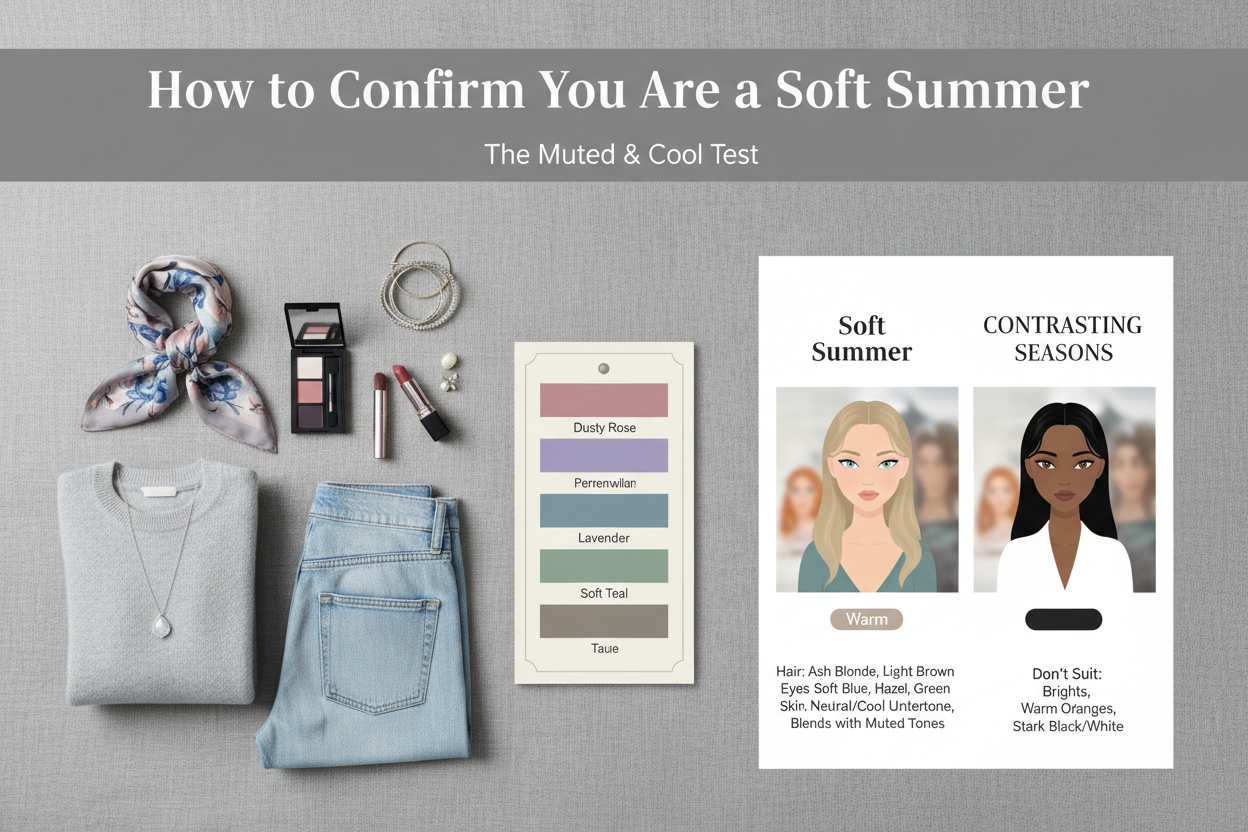
Reading a description of Soft Summer and recognizing yourself in parts of it is a good start. But self-diagnosis has real limits. The characteristics that define Soft Summer — muted coloring, cool-neutral undertone, low contrast — overlap with Soft Autumn, True Summer, and Light Summer, and those distinctions matter because the palettes diverge in ways that affect what you actually wear.
Common Signs You May Be a Soft Summer
- Your hair, skin, and eyes look naturally blended, with no single feature creating strong contrast
- Your skin has a cool or neutral-cool undertone — slightly pink, rosy, or ashy rather than yellow or golden
- Bright, saturated colors near your face tend to make you look tired, washed out, or harsh
- Warm-toned colors like orange, camel, and warm yellow create a muddy or sallow effect
- Muted, greyed colors that other people write off as boring tend to make your complexion look healthy and clear
- True black feels too stark; bright whites feel glaring rather than fresh
Where Self-Diagnosis Gets Difficult
- Soft Summer vs. Soft Autumn: Both are muted, but Soft Autumn leans warm. If earthy, warm-toned colors make you glow rather than clash, you may lean Soft Autumn.
- Soft Summer vs. True Summer: Both are cool and muted, but True Summer tolerates slightly more saturation and cooler depth. Soft Summer needs more grey mixed into every shade.
- Soft Summer vs. Light Summer: Both share the soft quality, but Light Summer's coloring is lighter overall and benefits more from pale, airy tones than the deeper dusty hues Soft Summer can carry.
Draping — holding colored fabric near your face in natural light — is the most reliable at-home test. It still takes practice and an honest eye to read the results accurately.
A structured color analysis with standardized drapes and consistent lighting removes the guesswork and gives you a confirmed answer you can actually rely on when buying clothes. If you've read this far and still feel uncertain whether you fully match the Soft Summer description, that uncertainty is worth resolving before you build a wardrobe around it.
People Also Ask
What colors should a Soft Summer avoid?
Soft Summer coloring gets overwhelmed by anything high-chroma, high-contrast, or warm-toned. Colors to avoid:
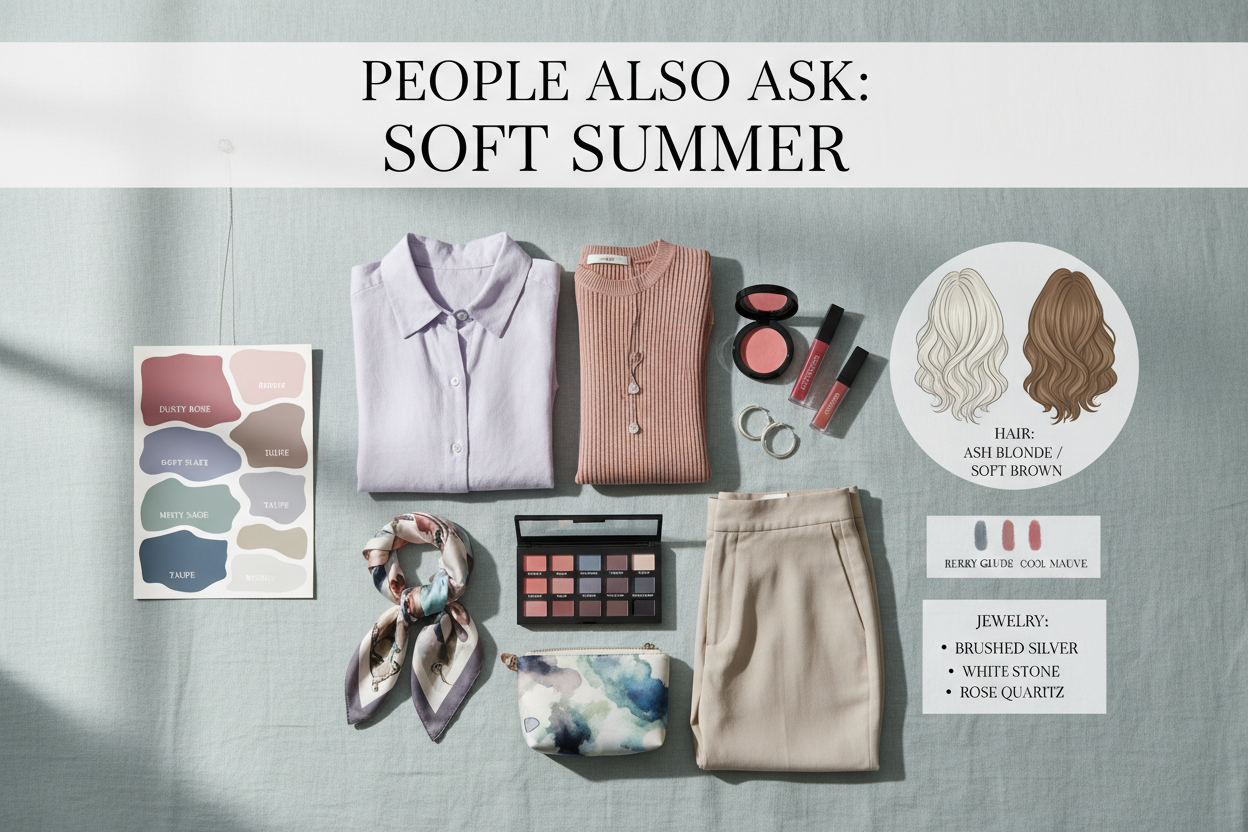
- True black and bright white — both create contrast that's too sharp for the season's naturally blended, low-contrast features
- Warm earth tones — camel, mustard, terracotta, burnt orange, and golden yellow all carry a yellow-orange undertone that conflicts with Soft Summer's cool base
- Vivid, saturated hues — electric blue, hot pink, vivid red, bright purple — any color at full intensity introduces too much chroma
- Neon or fluorescent shades — maximum saturation, maximum conflict
- Warm neutrals — cream with a yellow cast, warm beige, and tan can make Soft Summer skin look sallow
The through-line: warm, bright, or strongly contrasting colors tend to overpower rather than harmonize with the season's soft, greyed, cool-neutral character.
What is the difference between Soft Summer and True Summer?
Both Soft Summer and True Summer belong to the Summer family in the 12-season system, which means both are cool-leaning and relatively muted compared to warmer seasons. The key difference is how much chroma each can handle and how much grey is built into the palette.
| Quality | Soft Summer | True Summer |
|---|---|---|
| Dominant trait | Muted (chroma first) | Cool (hue first) |
| Palette saturation | Highly greyed-out, lowest chroma of all seasons | Muted, but with slightly more color clarity |
| Contrast level | Very low — blended and tonal | Low to medium — can carry a bit more definition |
| Depth range | Light to medium-deep, all dusty | Light to medium, more consistently cool |
In practice: a True Summer can wear a dusty rose that still reads clearly as pink, while a Soft Summer needs that same pink pushed further toward grey-mauve to stay harmonious. If the Soft Summer palette feels slightly too flat and you find you can wear cooler jewel tones without looking overwhelmed, True Summer is probably the closer fit.
What jewelry metals look best on Soft Summer?
The most flattering metals for Soft Summer are cool-toned and non-reflective:
- Brushed or matte silver — top choice; the cool undertone and low shine match the season's muted quality
- White gold or platinum — clean and cool without high gloss
- Oxidized silver — the slightly darkened tone adds depth while staying cool
- Grey-leaning rose gold — works when it reads more grey-pink than warm copper
Avoid bright yellow gold, copper, and bronze. These metals carry warm undertones that create visual friction against Soft Summer's cool-neutral skin. High-polish finishes add a reflective intensity that suits high-contrast seasons better.
Can a Soft Summer wear warm-toned makeup?
Generally, no — or only sparingly. Soft Summer skin has a cool-to-neutral-cool undertone, so warm-toned makeup tends to work against the skin's natural base rather than with it.
Here's where warm shades typically go wrong:
- Warm-toned foundations (yellow, golden, or peachy undertones) can make skin look muddy or slightly orange
- Coral or terracotta blush introduces warmth that clashes with a cool-rosy complexion
- Bronze or copper eye shadow adds warm shimmer that competes with the season's grey-cool quality
- Warm nude lips (beige with a yellow cast) can look washed out or slightly sallow
The closest Soft Summer gets to "warm" is a muted mauve or dusty rose — shades that read rosy without carrying a yellow or orange undertone. They're technically neutral-cool, but they have enough warmth-adjacent softness to avoid a stark finish.
What hair color is best for Soft Summer?
The best hair colors for Soft Summer maintain or enhance the season's naturally cool, ashy, low-contrast quality. Whether you're working with natural color or coloring professionally, the guiding principle is the same: keep it muted and cool-toned.
Most flattering options:
- Ash blonde or light ash brown (natural or colored)
- Cool medium brown with softly blended, ashy highlights
- Smoky or platinum blonde applied softly — not stark
- Natural grey or salt-and-pepper allowed to grow in and blend (genuinely flattering for this season in a way that feels intentional rather than incidental)
- Subtle ash balayage or babylights in cool-blonde tones
What to avoid:
- Warm honey, golden, or caramel highlights — the yellow-orange tones fight the season's cool base
- Auburn, copper, or warm red — these introduce too much warmth
- Jet black — too high contrast
- Stark, bright platinum — too much contrast without enough grey softness to ease it
Whatever technique you use, the goal is a blended, softly diffused result rather than defined streaks or strong light-dark contrast.
How do I know if I am a Soft Summer or Soft Autumn?
Soft Summer and Soft Autumn are the two most commonly confused seasons because both are defined by low chroma — both look best in muted, greyed-out, blended colors. The dividing line is undertone: Soft Summer is cool-neutral, Soft Autumn is warm-neutral.
Key questions to help distinguish them:
| Question | Points to Soft Summer | Points to Soft Autumn |
|---|---|---|
| How does your skin's undertone read? | Slightly pink, rosy, or ashy | Slightly golden, peachy, or yellow |
| What happens when you wear camel or warm beige? | Looks muddy or clashing | Looks natural and harmonious |
| How do cool, greyed hues look near your face? | Fresh and clear | Slightly flat or draining |
| How do warm, earthy tones look near your face? | Harsh or sallow | Soft and glowing |
| What is your natural hair tone? | Ash blonde, cool brown, or greying | Golden brown, warm blonde, or auburn-adjacent |
The overlap zone sits in the most neutral, greyed muted shades — colors that could plausibly work for either season. Where they clearly part ways is at the edges: Soft Summer's cool dusty plums versus Soft Autumn's warm terracottas. Holding those edge colors up to your skin in natural light is one of the fastest ways to figure out which direction your undertone actually leans.
FAQ
What makes the Soft Summer palette different from other Summer seasons?
All three Summer seasons — True Summer, Light Summer, and Soft Summer — share a cool or cool-neutral undertone and a general preference for muted over saturated color. What sets Soft Summer apart is how far that desaturation goes. The Soft Summer palette contains the most heavily greyed-out, low-chroma colors in the entire 12-season system. True Summer can carry colors that still read with some clarity. Light Summer works in a soft but relatively bright range. Soft Summer needs colors pushed further toward grey before they harmonize with its naturally blended, low-contrast features. It's also the season most defined by muted-first character — chroma takes priority over either cool hue or light value.
Which clothing colors are most flattering for Soft Summer?
The most flattering clothing colors for Soft Summer are cool-to-neutral-cool, heavily muted, and medium in depth. Strong performers include:
- Dusty rose, mauve, and muted berry — rosy without reading warm or vivid
- Soft grey-blue, slate, and smoky teal — cool without being stark
- Lavender and muted lilac — light and cool with enough grey to stay soft
- Greyed-out olive or sage — the warmest shades that work, and only when clearly muted
- Soft charcoal and cool taupe — reliable neutrals that avoid the harshness of true black or warm beige
- Dusty plum and muted eggplant — add depth without high contrast
The common thread: every color in the palette looks like it has been quietly mixed with grey. If a shade reads as bright, vivid, or warm, it is outside the season's range.
What makeup shades work best for Soft Summer skin tones?
Soft Summer makeup follows the same muted, cool-neutral logic as the clothing palette:
- Foundation: cool-to-neutral undertones — avoid yellow, golden, or peachy finishes that push warm
- Blush: dusty rose, soft mauve, or cool berry — nothing coral, orange, or hot pink
- Lips: muted rose, greyed-pink, soft berry, cool nude-mauve; lip colors should be soft and blended rather than vivid or warm
- Eyes: taupe, cool greige, soft grey-brown, muted plum, dusty lavender; avoid warm bronze, copper, or golden shadows
- Liner and mascara: soft brown, cool grey, or charcoal — these create definition without the stark contrast of jet black
The overall effect should feel cohesive and low-contrast, with no single feature competing for attention. Heavy contour, bold liner, or vivid statement lips tend to fight the season's naturally harmonious quality rather than work with it.
Should Soft Summers wear silver or gold jewelry?
Silver is usually the safest choice. Brushed or matte finishes work especially well because the low reflectivity matches the season's overall softness. White gold and platinum read similarly — cool and polished without any harsh shine. Oxidized or antique silver can also be good; it adds a little depth while staying in a cool range.
Rose gold is a gray area. Some pieces lean close enough to grey-pink that they work fine. Standard rose gold, though, tends to pull warm enough to feel slightly off.
Yellow gold, copper, and bronze are generally worth avoiding. Their warm undertones sit at odds with Soft Summer's cool-neutral skin and interrupt the season's naturally blended quality. High-polish finishes in any metal can also be a problem — they bring a level of reflective intensity that tends to compete rather than complement.
For gemstones, muted and cool-toned options tend to fit best: grey pearl, rose quartz, amethyst, pale aquamarine, labradorite. Vivid or warm-toned stones usually read as too loud against the palette.
What hair colors complement Soft Summer natural coloring?
The most harmonious hair colors for Soft Summer stay cool-toned, ashy, and softly blended:
- Ash blonde or light ash brown — whether natural or achieved through color, these are the season's most flattering base tones
- Cool medium brown with ashy highlights — blended balayage or babylights rather than defined streaks
- Smoky or platinum blonde applied with a diffused, low-contrast technique
- Natural grey or salt-and-pepper — one of the most genuinely flattering progressions for this season; the silver-grey tones are essentially the season's ideal neutral
Directions to avoid:
- Honey, golden, or caramel highlights — these add warm-toned contrast that fights a cool base
- Copper, auburn, or warm red — too much warmth for this season
- Jet black — too high contrast against soft, medium-depth features
- Stark or very bright platinum — only works when softened with enough ashy grey to avoid a harsh result
The guiding rule for any coloring technique is to keep transitions blended and results muted, not defined or high-contrast.
Can Soft Summers wear black or bright white?
True black and bright white are generally the least flattering choices for Soft Summer. Both create a high-contrast, sharp-edged effect that works against the season's naturally low-contrast, blended features. Near the face, black can make the complexion look tired or flat, and bright white can wash out cool-neutral skin.
Better alternatives:
| Instead of… | Try… |
|---|---|
| True black | Soft charcoal, dark grey, or deep dusty navy |
| Bright white | Soft white, cool off-white, or light grey |
If black or white appears in a print or pattern, wearing it further from the face — in trousers, shoes, or accessories — reduces the harshness. An all-black outfit can also be softened with a muted, cool-toned top or scarf near the face.
How can I find out if I am truly a Soft Summer?
The most reliable method is professional in-person color analysis using draping — placing fabric samples of known seasonal palettes near your face in natural light and watching how each one affects your skin, eyes, and features. It removes the guesswork that comes from judging your own coloring in artificial light or from photos.
If you want a starting point before booking a professional, an online color analysis quiz can help you figure out whether your coloring shows the key Soft Summer markers: cool-to-neutral undertone, naturally low contrast between hair, eyes, and skin, and features that look better in muted, greyed-out colors than in vivid or warm ones.
→ Take the color analysis quiz to get an initial read on your season and see whether Soft Summer fits your natural coloring.