
Soft Summer Celebrities and Why
 Reviewed by Alexandra Gilmore
Soft Summer celebrities make muted, cool, low-contrast styling easier to visualize than an isolated swatch card. Notice how dusty colors support their features and how warmth or brightness becomes distracting, then use those patterns to test your own palette without assuming a visual resemblance confirms it.

When you look at someone like a celebrity and think their coloring is so soft and understated, yet so put-together, there is a good chance you are looking at a Soft Summer. This color season is defined by a specific combination of coolness and low contrast — features that respond beautifully to muted, dusty palettes and look washed out or harsh when placed against anything too bright or too warm.
💫 Explore Seasonal Color Analysis
Use the distinctions in this article to narrow the possibilities, then compare the seasonal system as a whole. Seeing the neighboring palettes together makes the result easier to test in real clothing and daylight.
Learn Seasonal Analysis →Studying well-known Soft Summer celebrities is one of the most practical shortcuts available when you are trying to understand your own season. Seeing what colors work on someone with similar features — and more importantly, what drains them — gives you a concrete visual reference that abstract palette swatches rarely provide.
Here is what makes this approach worth your time:
- Coolness with softness: Soft Summer sits at the intersection of cool undertones and low color saturation, making it distinct from the brighter, clearer True Summer on one side and the warmer Soft Autumn on the other.
- Gentle contrast: Hair, skin, and eyes tend to blend into each other rather than creating sharp definition, which is why bold or high-contrast looks often overpower this coloring.
- A specific color language: Shades like dusty mauve, smoky taupe, and powdery blue tend to harmonize with this season's natural coloring in a way that richer or more saturated colors simply do not.
- The blonde trap: Lightening hair to a bright blonde is a common styling mistake for Soft Summers — it breaks the muted, blended quality that makes this coloring so distinctive.
By the end of this article, you will have a clear picture of which celebrities carry Soft Summer features, why those features place them in this season, and how to translate those observations into practical decisions about your own wardrobe, hair color, and makeup.
Why Celebrity Examples Actually Help You Identify Your Season
Color season theory gets abstract fast. You're staring at a pile of fabric swatches, and none of the descriptions quite click. Celebrity examples solve a specific problem: they give you a real face to compare against your own, one where you can actually see what colors work and what colors don't.
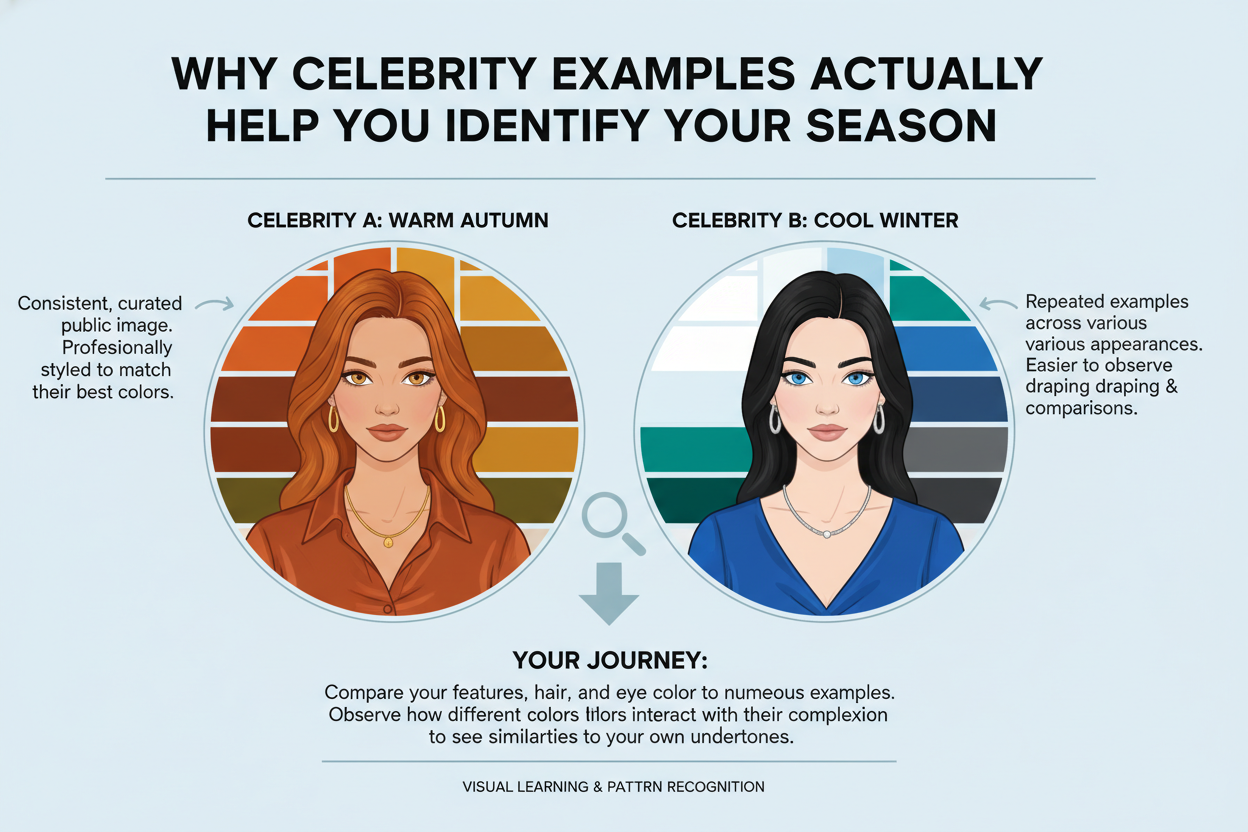
The logic isn't about imitation. It's about feature comparison. When you find someone whose skin tone, hair depth, and eye color are in the same neighborhood as yours, you get a ready-made visual library. You can see which red-carpet looks make their coloring glow and which choices fall flat. That's more useful than any written description of a season, however carefully worded.
One thing worth holding onto as you read: celebrity examples illustrate the season, they don't define its edges. Soft Summer covers a wider range of human coloring than any list of famous names can show. Treat these as a starting point for pattern recognition, not a diagnostic checklist. If you're still uncertain after browsing, a quiz or professional analysis will get you further than celebrity-matching alone.
Curious where you land? Take the color season quiz to get a personalized starting point before diving into the celebrity comparisons below.
The Core Soft Summer Feature Set: What to Look For
Soft Summer coloring has three overlapping characteristics. Before looking at specific celebrities, it's worth understanding what you're actually looking for.
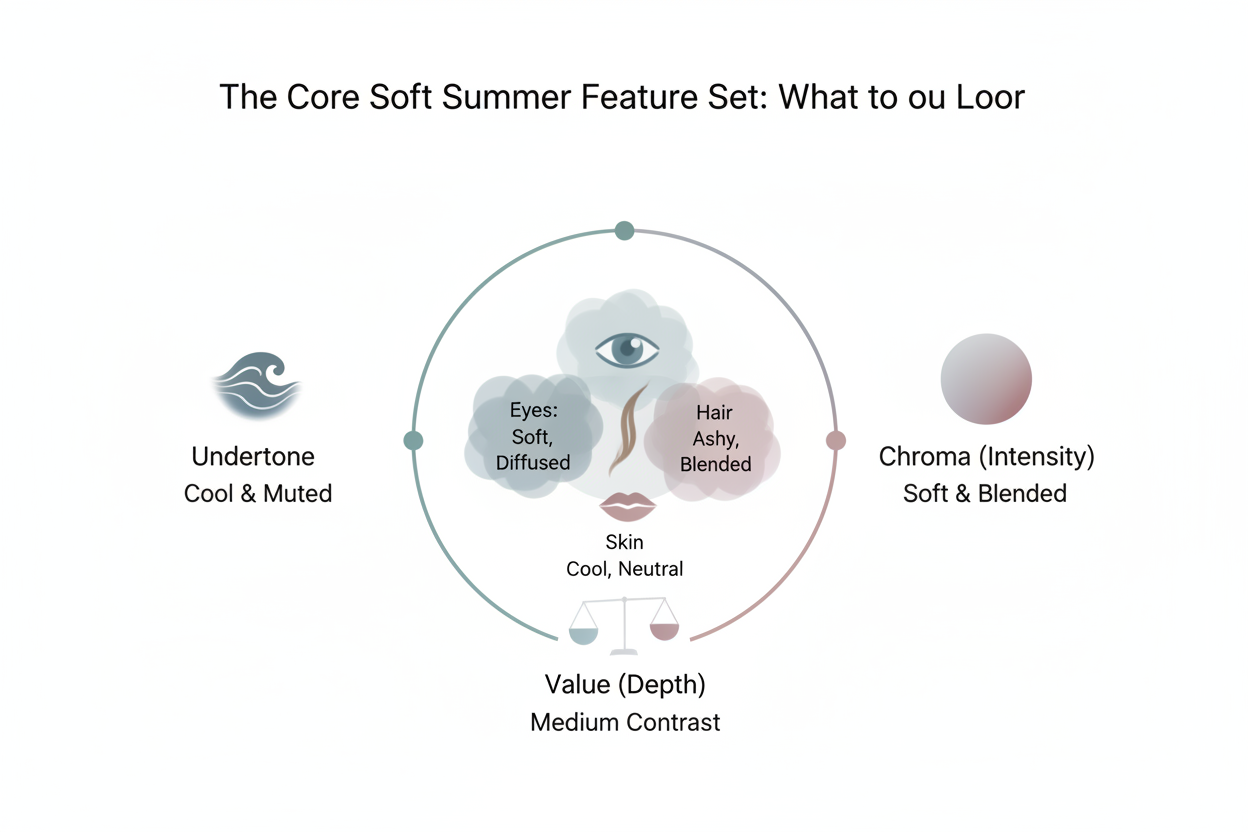
1. Cool undertones Soft Summer skin reads pink, rosy, or neutral-cool rather than peachy, golden, or olive. No warmth pulls the complexion toward yellow or bronze. This coolness shows up even in medium or deeper Soft Summer complexions.
2. Soft, muted color saturation Hair, eyes, and skin all sit in a lower-saturation range. Nothing is vivid or highly pigmented. Eyes tend toward grey-blue, grey-green, soft hazel, or understated brown — not sharp amber or intense dark brown. Hair naturally falls in ash blonde, ash brown, or soft medium brown, always with cool or neutral-cool undertones, never golden or red-shifted.
3. Low to medium contrast between features The boundary between hair color, skin tone, and eye color is gentle rather than dramatic. Soft Summers don't have the striking light-dark contrast you see in Deep or True Winter coloring. Features blend into one another in a way that reads as harmonious rather than high-impact.
These three qualities point directly to the palette that flatters this season: dusty mauves, smoky taupes, powdery blues, soft lavender, blued greens, and muted rose. These shades mirror the natural softness and coolness of Soft Summer features. Bright, saturated, or warm-toned colors do the opposite — they amplify contrast where there should be blending and introduce warmth the coloring can't absorb.
Soft Summer Celebrities and the Features That Place Them Here
The celebrities most reliably cited as Soft Summers share the feature profile above: cool-leaning skin with no strong warmth, hair in the ash or cool-brown range, and eyes with a soft, slightly veiled quality. What unites them is not a single look but a consistent response to color — they shine in dusty, muted palettes and look washed out or unwell in bright, warm, or heavily saturated tones.
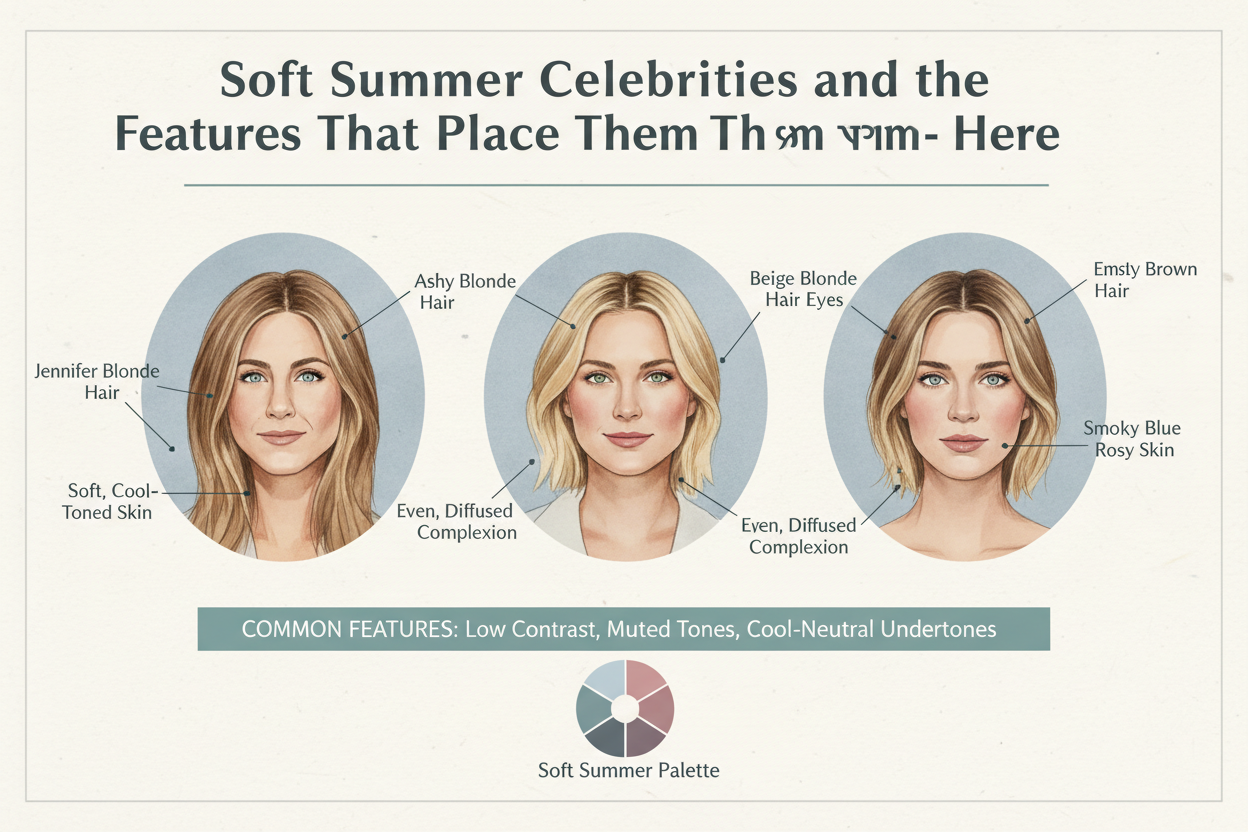
Some frequently referenced examples:
- Jennifer Aniston (natural coloring): In her pre-highlighted years, Aniston's ash brown hair, cool-beige skin, and grey-green eyes place her squarely in Soft Summer territory. Her coloring has the characteristic low contrast and softness that defines the season.
- Gwyneth Paltrow: Her cool, fine-featured complexion and naturally light ash hair read as Soft Summer. She consistently photographs well in dusty pinks, soft greens, and blued neutrals.
- Reese Witherspoon: Her cool-toned complexion and naturally soft hair depth align with Soft Summer, even though her public styling frequently veers into warmer territory.
- Kate Winslet: Naturally ash-toned hair, cool rosy skin, and softly colored eyes carry the season's characteristic muted, blended quality.
The pattern here is consistent: none of these people has vivid, high-pigment coloring. What they share is a quality of softness — features that look their most polished when surrounded by colors that are equally soft and cool, rather than bold or bright.
Worth noting: this list isn't exhaustive. Soft Summer coloring appears across a wide range of ethnicities and complexion depths, and the celebrities most visible in mainstream media skew toward lighter complexions. The feature logic matters more than the names.
When Celebrity Choices Go Wrong: The Over-Lightened Hair Problem
Some of the clearest lessons in Soft Summer coloring come not from when celebrities look their best, but from when something visibly misfires. The most common culprit is hair lightened too far — toward bright, warm, or platinum blonde.
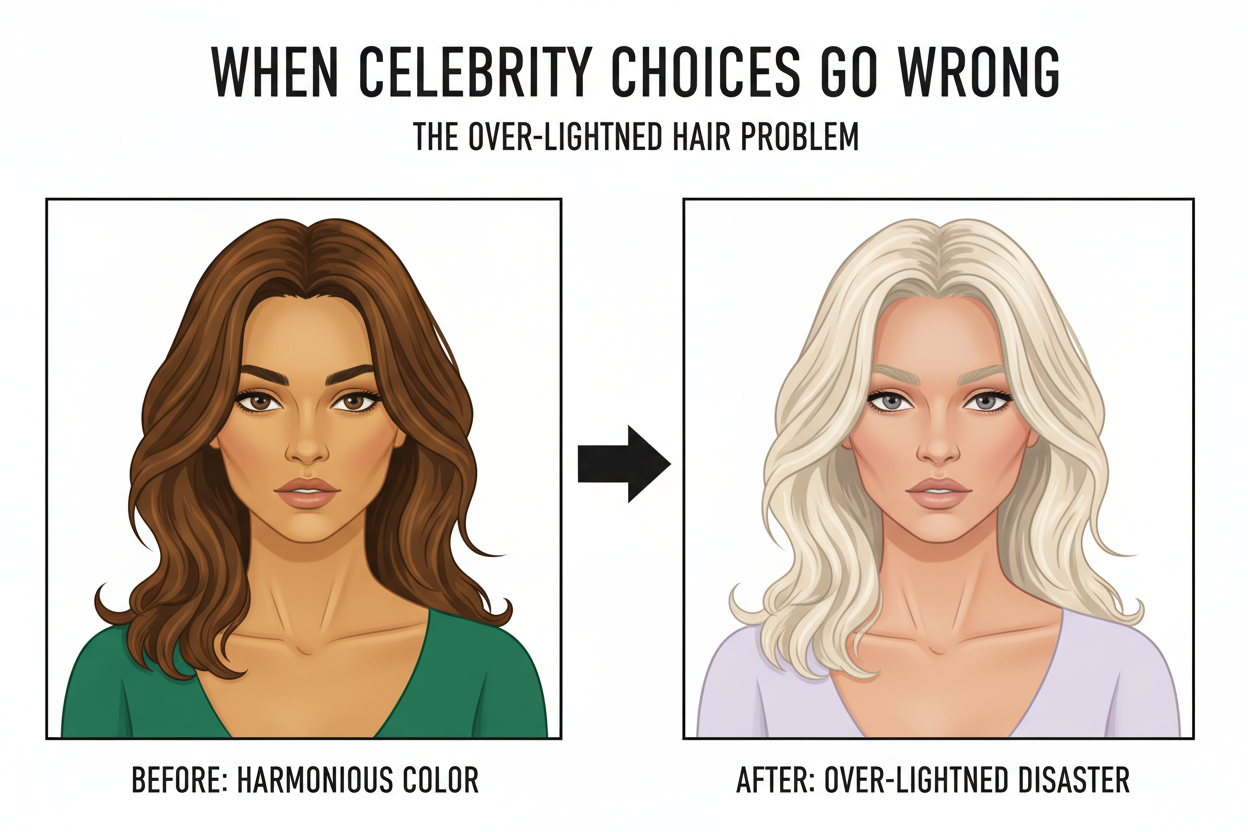
Blonde generally doesn't work well for Soft Summers. The season's appeal depends on a soft, blended relationship between hair, skin, and eyes. Push the hair into a light, high-contrast tone and that balance breaks down. The hair pulls all the attention, and the softer features — especially the eyes — lose their presence. Instead of reading as quietly expressive, the eyes start to look oddly dark or flat by comparison, as though the depth has been drained out of them rather than drawn forward.
The underlying problem is a contrast mismatch. Soft Summer features are built to harmonize at a low-contrast register. A very light hair tone artificially spikes that contrast, and the face's naturally muted coloring can't absorb the shift.
Emma Roberts: What Happens When Hair Goes Too Light
Emma Roberts gets cited often as a Soft Summer who has tried a wide range of hair colors. The choices that consistently draw the least favorable responses from color analysts are the ones involving very light blonde — particularly pale or warm blonde tones.
In photographs where Roberts is wearing a bright, lightened blonde, something specific happens: her eyes, which naturally have a soft and gentle quality, seem to recede and look strangely dark against the lighter hair. The contrast between very light hair and her cool-toned features creates an imbalance that makes both elements look slightly off. Her natural softness, which is genuinely an asset, ends up working against her here because the gap between the hair's lightness and the muted depth of her other features is too wide.
Compare those photographs with ones where her hair sits at a cooler, medium depth — an ash or dirty blonde, or a soft medium brown — and the balance comes back. Her eyes read clearly again. Her skin looks cleaner. The whole impression holds together.
This isn't a criticism of her styling choices. It's a demonstration of how color harmony actually works. The same dynamic applies to anyone with Soft Summer coloring: when the hair goes too light, the rest of the face pays for it.
How to Use These Examples for Your Own Wardrobe and Makeup
Watching what works on Soft Summer celebrities only matters if you can actually use it. Here's how to apply those observations when you're shopping, getting dressed, or sitting in a makeup chair.
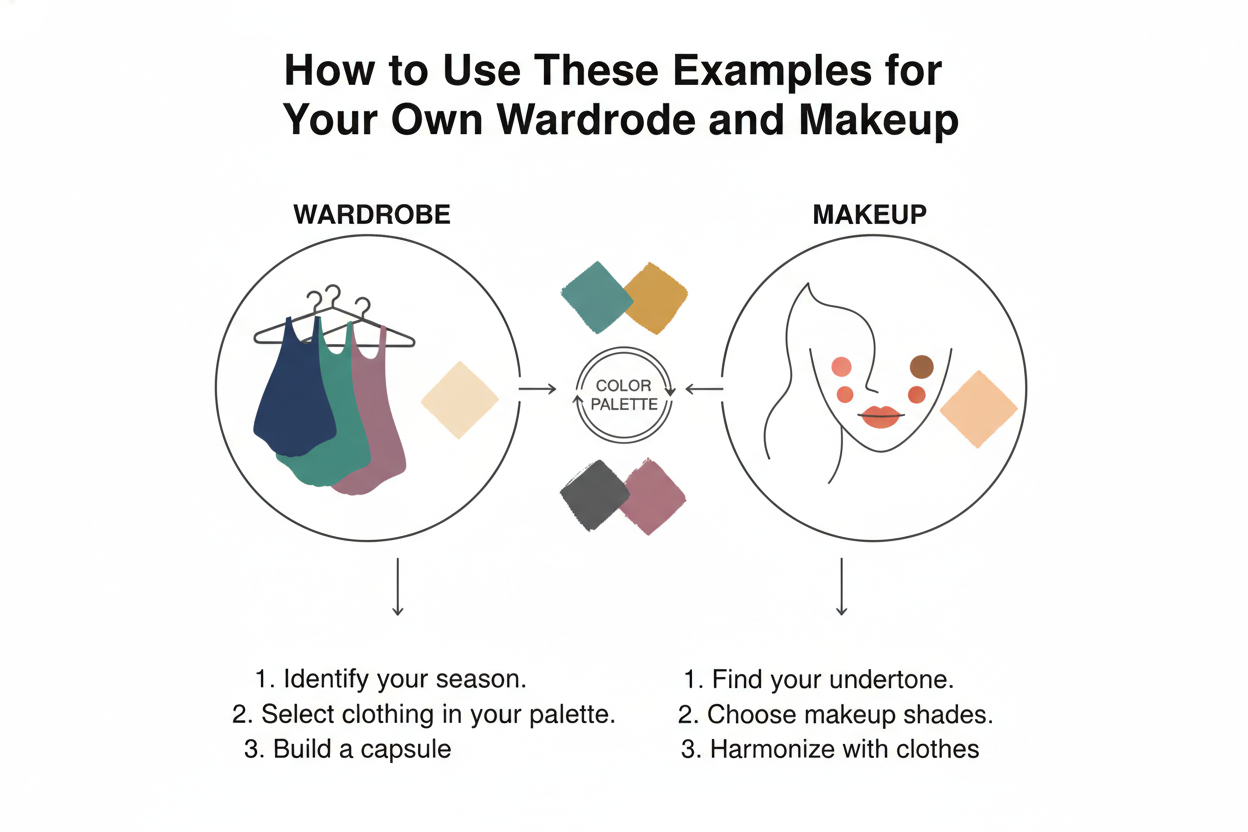
Clothing and outfit colors You're looking for that same dusty, blued quality you see on the celebrities above. Soft mauves, muted rose, smoky blue-grey, dusty teal, blued sage, warm-but-muted taupe — these all fall within range. Skip anything saturated, neon, or warm-shifted. Earth tones in golden, orange, or bronze registers pull against Soft Summer's natural coolness rather than working with it.
Makeup shades Soft berry, rose-brown, and dusty mauve tend to work well for lips. Clear reds, corals, and orange-based nudes introduce warmth the coloring can't balance, so they're worth avoiding. For eyes, smoky grey, dusty plum, muted sage, and soft taupe are better bets than anything bright or metallic. Foundation should run neutral-cool — adding artificial warmth to skin that already reads cool tends to look off.
Hair color direction If you're thinking about coloring your hair, stay in the ash, cool, or neutral-cool range. Soft ash brown, cool-toned medium brown, and lightly ash-brightened natural color all work. The thing to avoid is gold, copper, or warm honey — those tones fight the season. The Roberts example above is a good argument for not going too light either: depth and ashness matter more than brightness.
Jewelry metals Silver, white gold, and rose gold in soft or brushed finishes tend to suit Soft Summer coloring. A vivid, polished yellow gold introduces warmth that can clash with the season's cool undertone. If you prefer gold, look for antique or muted finishes with a greyed, cooled-down quality — not the warm brightness of traditional yellow gold.
The Limits of Celebrity Comparison: Why Self-Analysis Needs More
Celebrity examples are a useful starting point, but they have real limits as a diagnostic tool. Knowing those limits keeps you from misidentifying your season based on surface resemblance.
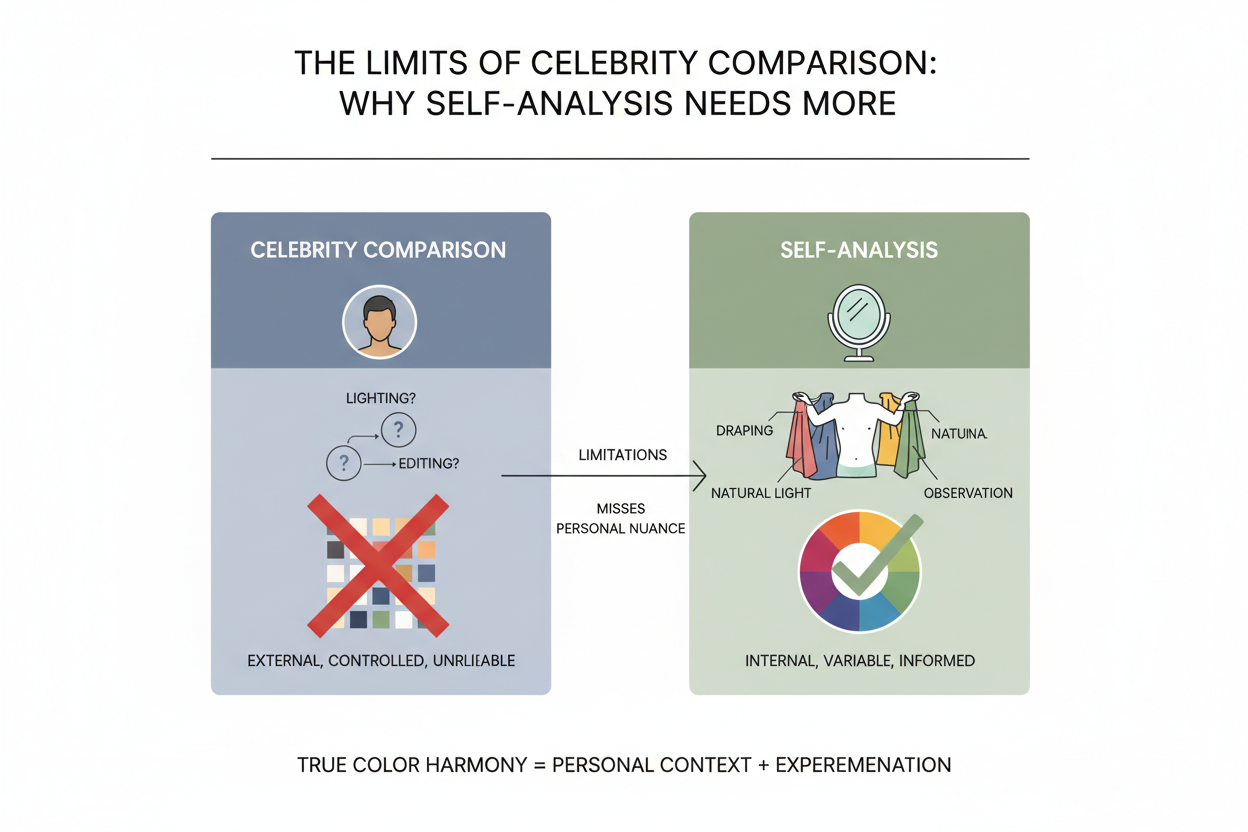
Photography alters everything Celebrities are almost always photographed under controlled lighting, with professional makeup, and after significant post-production. A cool complexion can look warm under golden-hour lighting; an ash hair tone can shift toward golden in a yellow-lit room. What you see in a magazine spread is not the person's natural coloring.
Celebrity styling is often an intentional mismatch Celebrities regularly wear colors and hair tones that don't suit their season because fashion and trend override harmony. A known Soft Summer photographed in bright coral doesn't mean coral works for Soft Summer — it may just mean their stylist chose it for a campaign.
The examples don't capture the full range The Soft Summer examples that surface most often in color analysis content don't reflect the full human range of the season. If your complexion is deeper, warmer in depth (while still cool in undertone), or doesn't closely match any celebrity on a given list, that doesn't rule you out.
Resemblance isn't confirmation Finding a celebrity whose eyes and hair look similar to yours is suggestive, not conclusive. Accurate season identification depends on how your entire coloring interacts with fabric swatches and color drapes placed near your face — something photographs and self-comparison can't fully replicate. For a confident answer, you need in-person testing with a trained colour analyst who can watch how specific colors react against your skin in real time.
Use celebrity examples for what they're actually good at: building intuition about the season, getting a sense of what flatters cool, muted coloring, and finding styling directions worth exploring. For anything more definitive, pair that intuition with a more structured analysis.
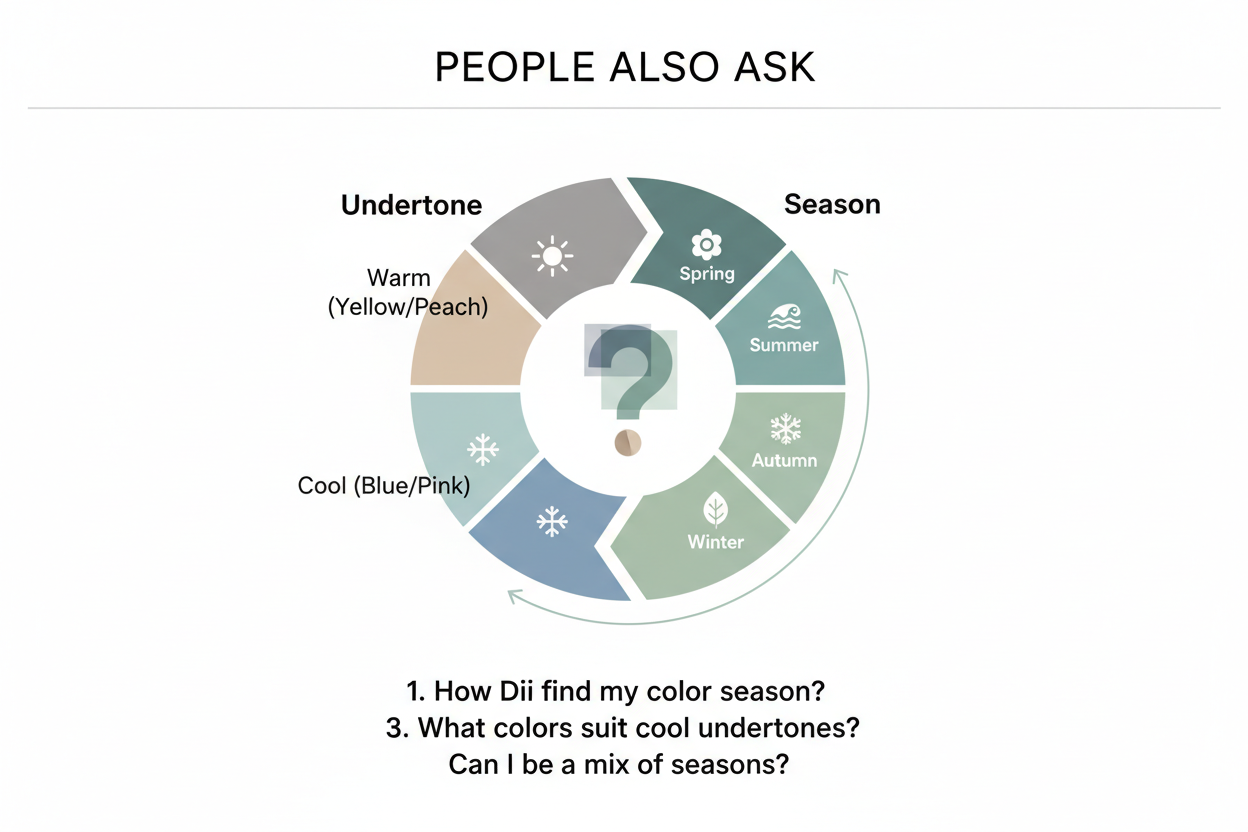
People Also Ask
Who are some famous Soft Summer celebrities?
Celebrities most frequently cited as Soft Summers include Jennifer Aniston (in her natural, pre-highlighted coloring), Gwyneth Paltrow, Kate Winslet, Reese Witherspoon, and Emma Roberts. What these individuals share is not a single identical look but a common feature profile: cool or neutral-cool skin undertones, hair in the ash or cool-brown range, and eyes with a soft, low-saturation quality. They consistently photograph best in dusty, muted palettes — soft mauves, blued greens, smoky taupes — and look less harmonious in warm or vivid tones.
It's worth noting that the celebrities who come up most in color analysis discussions tend to skew toward lighter complexions. Soft Summer coloring spans a much broader range of ethnicities and skin depths than any single list reflects. The feature logic — cool undertones, muted saturation, low contrast — matters more than matching a specific famous face.
How do I know if I am a Soft Summer?
Soft Summer coloring shows up in three places:
- Cool or neutral-cool undertones — skin reads pink, rosy, or neutral rather than peachy, golden, or olive
- Muted, low-saturation coloring — hair is ash blonde, ash brown, or cool medium brown; eyes tend toward grey-blue, grey-green, soft hazel, or understated brown rather than vivid amber or sharp dark brown
- Low to medium contrast between features — hair, skin, and eyes blend into one another rather than creating a sharp light-dark boundary
A quick test: hold a dusty blued-pink or soft lavender fabric near your face in natural light. If your skin looks clearer and your eyes easier to read, muted cool shades are probably working with you. If you're still not sure, a color drape analysis — in person or tool-assisted — will tell you more than matching yourself to a celebrity ever will.
What colors should Soft Summers avoid?
Soft Summers generally do best avoiding:
- Bright, saturated colors — vivid reds, electric blues, neon shades, and high-chroma tones overwhelm naturally muted coloring
- Warm earth tones — golden yellow, terracotta, burnt orange, bronze, and camel all introduce warmth that clashes with cool undertones
- Very dark or very light high-contrast shades — stark black and bright white spike contrast in a way that fights the season's soft, blended features
- Clear, warm-based neutrals — camel, warm beige, and golden tan read as too warm against cool-toned skin
The short version: Soft Summer coloring is built around softness and coolness. Strong warmth, high saturation, or dramatic contrast will look off.
What is the difference between Soft Summer and Soft Autumn?
Both Soft Summer and Soft Autumn are muted seasons — that low-saturation softness is what they share. The dividing line is undertone temperature:
| Feature | Soft Summer | Soft Autumn |
|---|---|---|
| Skin undertone | Cool to neutral-cool | Warm to neutral-warm |
| Hair tones | Ash blonde, ash brown, cool medium brown | Golden brown, warm medium brown, soft auburn |
| Eye colors | Grey-blue, grey-green, cool hazel | Warm hazel, golden brown, soft amber-brown |
| Best palette | Dusty mauves, smoky blues, cool taupes | Warm taupes, muted terracotta, dusty olive |
If dusty rose and smoky lavender read as your most flattering neutrals, you're probably leaning Soft Summer. If warm, earthy mutes like dusty peach or soft camel do more for your complexion, Soft Autumn is the likelier fit.
Can a Soft Summer wear blonde hair?
Blonde generally isn't the most flattering direction for Soft Summer coloring. The issue is contrast: Soft Summer features look most harmonious when hair, skin, and eyes all sit in the same closely blended, muted register. Lightening hair significantly — toward anything bright, warm, or platinum — creates a contrast spike that the season's naturally soft features can't absorb.
What usually happens is that very light hair makes the eyes look oddly flat or dark by comparison, and the skin reads washed out or uneven. Emma Roberts gets cited a lot here: photos from when her hair is lightened to a pale or warm blonde tend to show this imbalance pretty clearly, while cooler or deeper tones bring everything back into cohesion.
If blonde is a strong preference, the most workable approach is a cool-toned, ashy blonde kept at moderate depth — nothing honey or golden, nothing platinum. The point is to keep hair from dominating, so the muted, low-contrast relationship between all the features stays intact.
FAQ
What makes someone a Soft Summer rather than another Summer sub-season?
Soft Summer sits within the broader Summer family — alongside True Summer and Light Summer — but its defining characteristic is muted, low-saturation coloring layered on top of cool undertones. True Summer has cleaner, slightly crisper cool tones. Light Summer carries a delicate, lighter quality with less depth. Soft Summer is distinguished by the dusty, almost smoky quality across all features: ash-toned hair, low-chroma eyes, and skin that reads soft pink or neutral-cool rather than vividly pink or blue-veined. If your coloring feels gentle and blended rather than clear or bright, and your undertone reads cool rather than warm, Soft Summer is the most likely fit among the three.
Are Soft Summer features always cool-toned, or can they be neutral?
Soft Summer sits at the cooler edge of the muted spectrum, but the undertone is often neutral-cool rather than strictly cool. Some Soft Summers have a faint warmth in their skin — not enough to push them toward Soft Autumn, but enough that an entirely cool palette can feel a bit harsh. The palette reflects this: the best shades are never icy or blue-heavy, but soft mauves, gentle taupes, and dusty rose tones that carry just enough warmth to stay wearable. If your features read as unambiguously cool, you land closer to the classic Soft Summer center. If there's a slight warmth alongside low saturation, you're still within the season's range — the softness matters as much as the coolness does.
Why does blonde hair often look unflattering on Soft Summers?
The short answer is contrast disruption. Soft Summer features work together because hair, skin, and eyes are all similarly muted and close in value — they blend rather than compete. Lighten the hair significantly, especially toward a warm or bright blonde, and it breaks out of that relationship and draws disproportionate attention to itself.
The effect tends to be visible. Eyes can look flat or unexpectedly dark against pale hair, and the skin may appear washed out or uneven. Emma Roberts gets cited often here — photos from her pale or warm-blonde periods show this imbalance pretty clearly, while cooler, deeper tones bring the face back into balance. If you want to go lighter, a cool ashy blonde at a moderate depth is the safer move: it keeps the muted, low-contrast look without pulling the hair out of the overall picture.
Can I use celebrity examples to confirm my own color season?
Celebrity examples are a useful starting point, not a final confirmation. If you find a celebrity whose natural features genuinely resemble yours — similar undertone, similar hair depth and tone, similar eye quality — watching which colors photograph well on them can give you a practical reference for your own wardrobe and makeup.
The catch is that celebrities change their appearance constantly. Hair gets colored, skin gets professionally lit, and makeup artists are paid to create a specific effect with no regard for seasonal harmony. The reasoning behind why a feature set belongs to Soft Summer is more useful than copying any specific celebrity's look. Use these examples to understand the pattern; use a structured analysis to confirm your own placement.
What jewelry metals work best for Soft Summer coloring?
Silver, white gold, and rose gold tend to work well for Soft Summer coloring — they stay in the cool to neutral-cool range without pulling warm. Bright yellow gold can clash with the season's cool undertones, and very shiny or high-contrast metals add a sharpness that works against the naturally soft, blended quality of this coloring.
Matte or brushed finishes are often a good fit because they carry the same low-intensity, understated quality as the season's best palette shades. Stones in soft grey, lavender, dusty rose, or pale blue round out the look without overwhelming it.
Do all Soft Summers look the same, or is there variation within the season?
There's real variation within Soft Summer. The unifying thread is the combination of cool-to-neutral-cool undertones and muted, low-saturation features — but that formula can produce a fairly wide range of appearances in terms of skin depth, hair tone, and eye color. A medium-toned person with ash-brown hair and grey-green eyes and a deeper-complexioned person with cool-toned, muted brown hair and soft dark eyes can both fall within Soft Summer if the underlying feature logic matches.
Published celebrity lists tend to skew toward lighter-skinned examples, mostly because of who gets discussed most in color analysis spaces online. That's not a reflection of who actually falls in this season. The feature markers — softness, coolness, low contrast, muted saturation — matter far more than matching any particular complexion or ethnicity.
Is an in-person color analysis necessary if I strongly resemble a Soft Summer celebrity?
A close celebrity resemblance is a good sign, but it's not the same as looking at your own face. Even two people who look similar can differ enough in undertone or saturation to land in adjacent seasons — and those differences matter when you're making real decisions about clothes and makeup.
Celebrity photos are also shot under professional lighting, styled with makeup, and edited afterward, which makes feature-reading less reliable than looking at your own face in natural light against neutral drapes. If you identify with the Soft Summer pattern and celebrity references keep clicking for you, you're probably in the right territory. But if you're about to invest in a wardrobe overhaul, a proper color analysis — in person or through a well-designed digital tool — will get you from probably to confirmed faster than scrolling through celebrity comparisons. Take the color analysis quiz →
To test this Summer result from another useful angle, continue with the companion article “Summer Palette Neutrals and Accent Colors”, which keeps the two closely related questions distinct.