Olive Skin Warm vs Cool Undertone
 Reviewed by Alexandra Gilmore
Olive's greenish cast can mask the warmer or cooler direction underneath, causing standard vein and jewelry tests to contradict each other. Use olive-specific fabric and foundation comparisons to identify warm, cool, or neutral results, then apply that answer to colors rather than treating olive as automatically warm.

Olive skin is one of the most misunderstood complexions in beauty—and the warm-versus-cool question is where that confusion runs deepest. Ask five makeup artists and you may get five different answers, because olive skin sits at an unusual intersection: it carries its own greenish-yellow pigment layer that can mask, mimic, or muddy every standard undertone test in the book.
💫 Discover Your Complete Color Palette
One feature rarely explains every color that works for you. Compare your undertone, depth, clarity, and contrast as a complete palette, then use the results to test clothing, makeup, and hair colors more consistently.
Find My Color Palette →This guide cuts through that confusion with a clear, evidence-backed framework built specifically for olive complexions. Here is what you will walk away knowing:
- What actually makes olive skin different from neutral, warm, or cool complexions
- Which at-home tests work—and which ones give olive skin false readings
- How to decode your result as warm olive or cool olive
- Practical color, makeup, and foundation guidance tailored to each undertone category
- When and why a professional color analysis gives you the most reliable answer
Whether you have spent years reaching for the wrong foundation shade or you simply want to stop second-guessing your wardrobe palette, the information ahead is designed to give you a definitive answer—not another maybe.
What Makes Olive Skin Different From Other Skin Tones
Olive skin isn't just a shade. It's a structural category defined by a greenish or grayish cast that sits over the complexion like a translucent filter. Most people with olive skin fall somewhere in Fitzpatrick Scale types III through V, but the Fitzpatrick scale measures sun-sensitivity and melanin depth, not the specific pigment combination that produces the olive effect. What creates that effect is a higher-than-average concentration of a yellowish-green pigment compound in the skin, layered over whatever warm or cool base sits underneath.
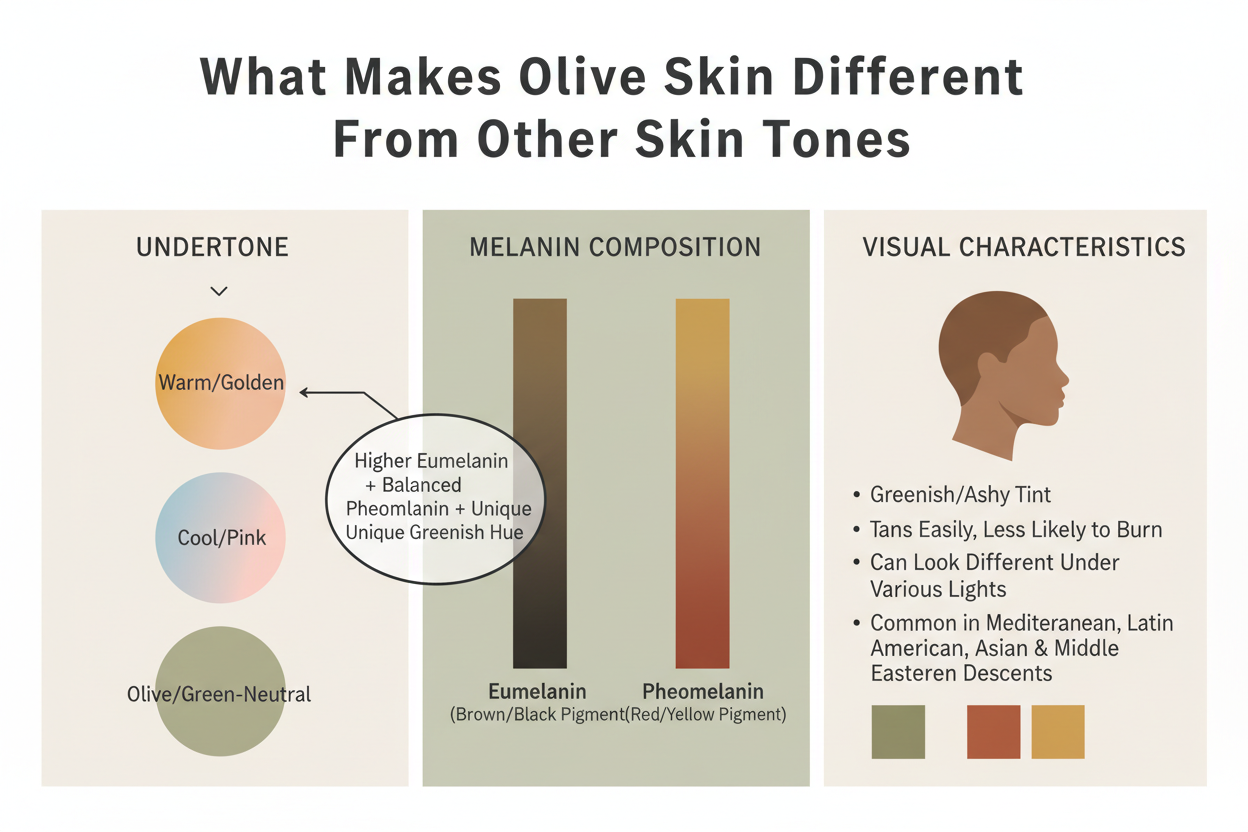
This is where most generic undertone advice gets it wrong: the green cast is not your undertone. It's an overtone—a surface modifier. Your actual undertone lives beneath it, pulling toward yellow, golden, and peachy warmth, or toward pink, rose, and bluish coolness. The greenish layer just makes that underlying signal harder to read.
That two-layer structure explains why olive skin routinely stumps standard beauty tests, why foundations that work for other warm-toned complexions sometimes oxidize orange on olive skin, and why a lot of olive-toned people spend years classified as "neutral" simply because the signal is harder to decode.
Why generic undertone advice fails olive skin:
- Standard skin tone charts treat warm, cool, and neutral as the only options. Olive rarely gets its own entry.
- The greenish overtone competes visually with the warm or cool base, making both harder to see in isolation.
- Most at-home tests assume the undertone sits close to the surface, not behind a green filter.
- Foundations formulated for "warm" skin often contain yellow or orange pigments that clash with the green cast rather than work with it.
Getting this layered structure clear is the foundation for every reliable self-test and every flattering color decision that follows. Take our free color analysis quiz to identify your exact undertone category →
The Warm vs Cool Spectrum: What Undertone Actually Means for Olive Skin
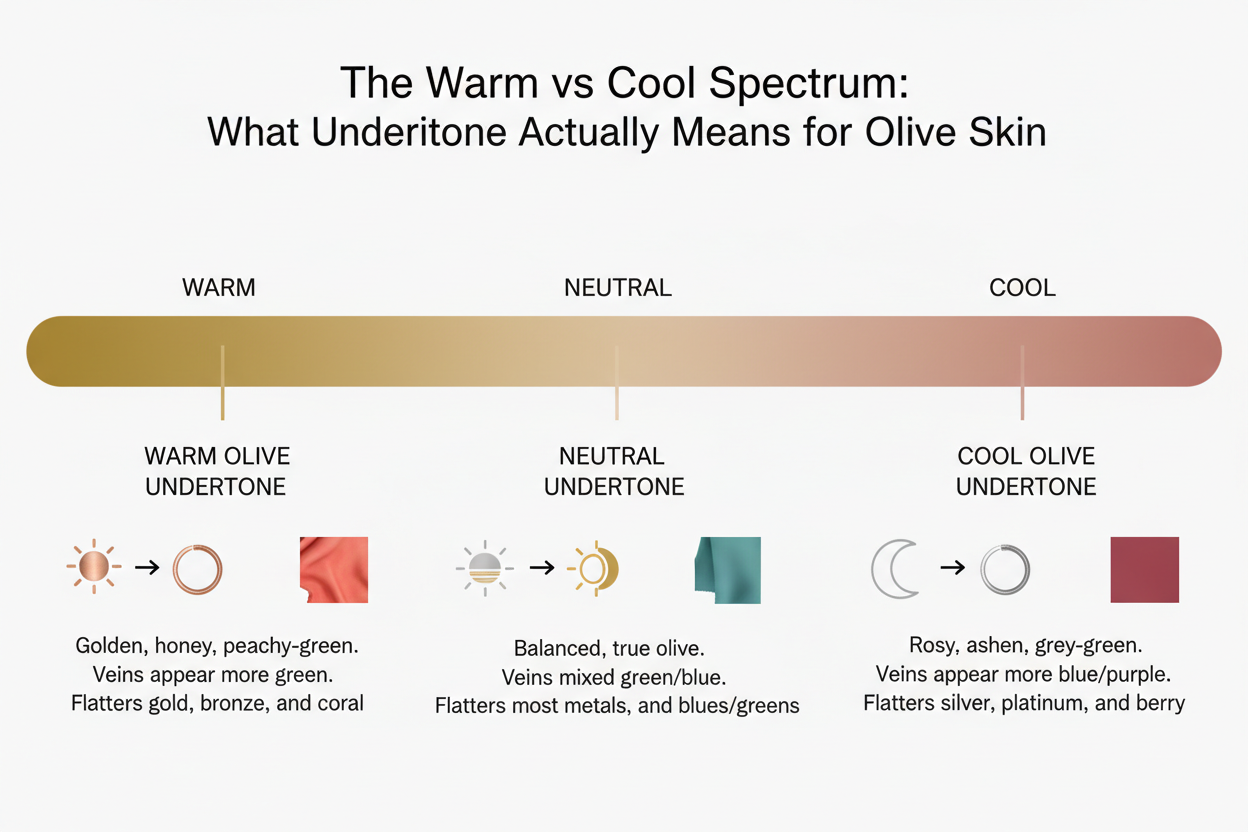
Undertone is the persistent color signal beneath your skin's surface. It stays constant regardless of tanning or fading, and it determines which colors in clothing, makeup, and jewelry make your complexion look luminous versus dull or sallow.
For olive skin, the spectrum breaks down like this:
Warm olive means the base beneath the greenish cast pulls toward yellow, golden, honey, or peachy hues. In practice, this creates a complexion that looks sun-kissed even in winter, bronzes evenly, and glows in earthy, amber, or terracotta tones. Gold jewelry almost always looks natural. This is the more common of the two olive undertone categories.
Cool olive means the base beneath the green cast pulls toward pink, rose, or faintly bluish tones. This is rarer and frequently misidentified—partly because green overtone plus cool base reads as simply "grayish" to an untrained eye, and partly because most beauty resources assume olive automatically means warm. Cool olive skin tends to look more vibrant in jewel tones and silver jewelry, and can appear sallow or muddy in heavily golden or orange-tinted products.
A third group sits at neutral olive, where neither warm nor cool dominates. Neutral olive skin has more flexibility but still benefits from knowing which direction its base leans, since the green overtone can still interfere with product selection.
The key conceptual distinction:
| Layer | What it is | Example in olive skin |
|---|---|---|
| Overtone | The visible surface color | Greenish or grayish cast |
| Undertone | The subsurface base color | Warm (golden/yellow) or cool (pink/rosy) |
| Depth | How light or deep the complexion is | Light olive through deep olive |
Your undertone does not change with sun exposure. Your overtone can deepen or shift slightly with a tan, but the warm-or-cool base beneath stays constant—which is why identifying it correctly unlocks color decisions that work year-round.
Five At-Home Tests to Identify Your Olive Undertone
Because olive skin's greenish overtone interferes with standard tests, some classic methods are less reliable here than they would be on other complexions. The following five tests are ranked from least to most reliable for olive skin specifically. Use at least three in combination for a confident result.
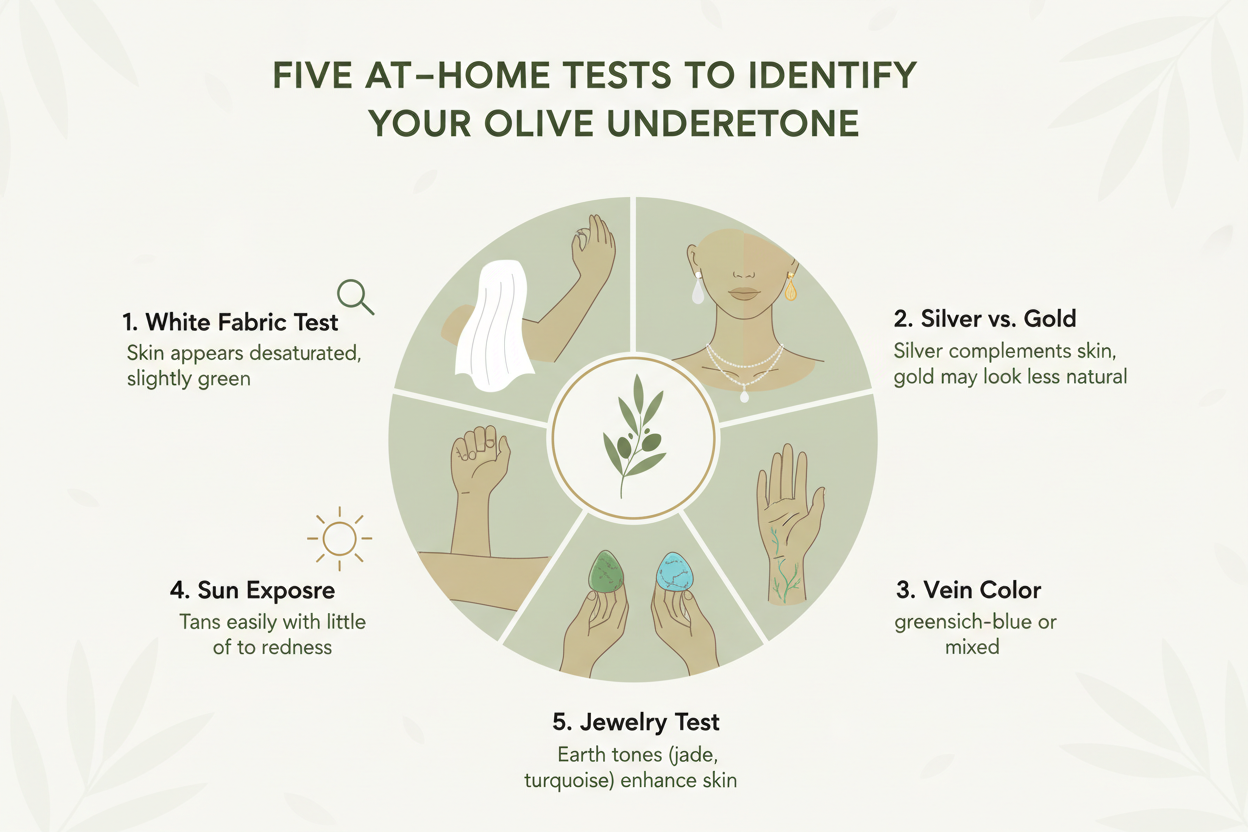
Test 1 — The White Paper Test (Moderate reliability)
Hold a plain white sheet of paper next to your bare face in natural daylight, with no makeup and away from colored walls or clothing. Study what color your skin appears against the paper's true white.
- If your skin reads yellowish, golden, or peachy: warm olive signal
- If your skin reads pinkish, grayish, or faintly rosy: cool olive signal
- If neither is clear, the greenish overtone may be drowning out the signal—try the jewelry test next
Olive caveat: The green overtone can muddy this reading. If your skin just looks "greenish" against the white paper, that's the overtone talking, not a warm or cool signal. Try to look past the green to whatever secondary tint sits underneath.
Test 2 — The Jewelry Test (High reliability)
Hold a gold piece of jewelry and a silver piece against your bare inner wrist in natural light, or try them on separately. Look at which metal makes your skin look cleaner, brighter, and healthier.
- Gold looks more natural and your skin glows: warm olive
- Silver looks more polished and your skin appears clearer: cool olive
- Both look equally wearable: likely neutral olive, but lean toward whichever felt slightly more comfortable
This test sidesteps the overtone problem. Instead of asking you to read your own skin color, it asks how your skin reacts to the color next to it.
Test 3 — The Sun Reaction Test (High reliability)
Think back to how your skin behaves in direct sun exposure over time.
- Tans quickly, rarely burns, develops a warm golden or caramel tone: warm olive
- Burns before tanning, or tans slowly and develops a grayish-tan rather than golden tone: cool olive
Sun behavior is one of the most honest long-term signals because it reflects the actual melanin and pigment chemistry in your skin, not just what's visible on the surface.
Test 4 — The White vs Ivory Clothing Test (Moderate reliability)
Hold a bright white garment and a cream or ivory garment against your bare face—no makeup, natural light.
- Bright white is more flattering, makes skin look fresh: cool olive
- Ivory or off-white is more flattering, bright white looks harsh: warm olive
Olive caveat: Olive skin often tolerates both better than very fair or very deep complexions, so the difference may be subtle. Focus on which makes your under-eye area look more rested.
Test 5 — The Foundation Oxidation Test (High reliability for confirming warm vs cool)
If you've worn foundation before, think back to how it looks after two or three hours.
- Foundation consistently turns orange or overly yellow: probably warm olive, but with enough green in your skin to clash with heavily yellow-based formulas—try golden-neutral shades rather than pure yellow ones
- Foundation turns ashy or flat gray after a few hours: cool olive—your skin is canceling out the warm pigments
- Foundation rarely shifts much: neutral olive
Why the Vein Test Is Unreliable for Olive Skin (and What to Do Instead)
The vein test—checking whether the veins on your inner wrist look blue-purple (cool) or green (warm)—is one of the most widely repeated undertone tests in beauty. For olive skin, it's also one of the least useful.
Here's why: olive skin gets its greenish-yellow cast from pigment distributed throughout the skin, including the thin layer over your inner wrist. That pigment acts as a filter, pulling the apparent vein color toward blue-green no matter what your actual undertone is. Someone with definitively cool olive undertones can look at their wrist and see green veins. Someone with warm olive undertones can see the exact same thing. The test can't tell them apart.
What to do instead:
- Prioritize the jewelry test and the sun reaction test. Both are more reliable for olive complexions because they measure how your skin responds, not just what color it is.
- Use the vein test only as a tiebreaker—and only after other tests have already pointed you in a direction. If your veins read blue-green, treat that as genuinely ambiguous, not as a "warm" signal.
- Photograph your inner wrist outdoors in shade and compare it to reference photos of confirmed warm-olive and cool-olive wrists. Comparing relative tints is more informative than staring at your veins directly.
If your vein test result is inconclusive or contradicts everything else, ignore it. The jewelry, sun reaction, and foundation oxidation tests will give you more to work with.
Warm Olive Undertone: Colors, Makeup, and Styling That Work
Warm olive undertones create one of the most naturally sun-kissed complexions in the warm spectrum. The golden or peachy base underneath the greenish overtone means colors in the warm, earthy, and amber family don't just flatter — they bring out a kind of inner radiance that makes the skin look luminous rather than dull.
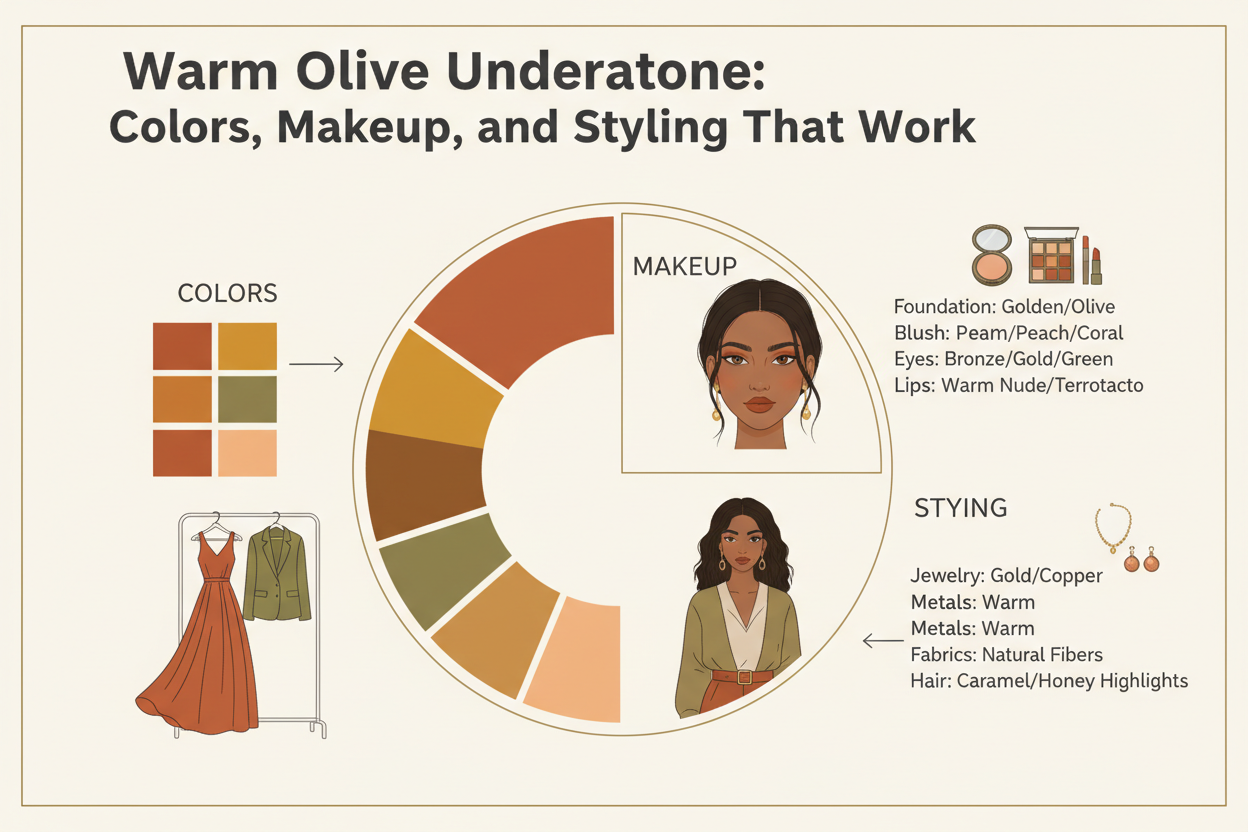
Clothing palette: The most flattering colors for warm olive skin work in harmony with the golden-yellow base, while offering enough contrast to keep the complexion from washing into the fabric.
- Earthy warms: camel, terracotta, burnt sienna, warm rust, ochre, and olive green (yes — olive on olive works because it harmonizes with the overtone rather than fighting it)
- Warm neutrals: warm beige, caramel, chocolate brown, cognac
- Warm brights: coral, mango, warm peach, tomato red
- Metals: gold, bronze, copper
- Whites to choose: Ivory, cream, warm white — avoid stark blue-based whites, which pull the green overtone forward and can make skin look sallow
Colors to use cautiously: Cool jewel tones in very saturated form (icy blue, fuchsia, cool purple) can work if the warm olive undertone is strong, but they take some confidence to pull off. Pastel cool tones — baby pink, lavender, powder blue — are generally less flattering because they set up a cool-versus-warm contrast that can make the skin look yellowish or muddy by comparison.
Blush and bronzer: Choose warm peach, terracotta, or amber-toned blushes. Avoid anything with an obvious pink or cool-berry base — it will sit on top of warm olive skin rather than melting into it. For bronzer, look for words like "golden," "sun-kissed," or "amber" rather than "cool bronze" or anything with visible gray undertones.
Hair color: Warm olive undertones pair well with golden brown, caramel highlights, honey blonde, auburn, rich chocolate, and warm black. Cool ash tones — platinum blonde, ash brown, cool gray — can work against a warm undertone, making the skin look sallow or yellowish by comparison.
Foundation Shades for Warm Olive: What to Look for on the Label
Foundation shopping is where warm olive skin runs into the most trouble, for one specific reason: not all warm-labeled foundations are the same kind of warm. Some lean heavily yellow, some lean orange, some lean golden, and each reacts differently with olive skin's greenish overtone.
Shade descriptors to look for:
- "Golden," "honey," "warm golden," "caramel," "golden beige": These tend to work well because the golden pigment complements rather than fights the green overtone — the combination reads as naturally sun-warmed rather than artificially tinted
- "Warm neutral" or "neutral warm": A good middle-ground option, especially if you're unsure of exactly how warm your undertone is
Shade descriptors to approach carefully:
- "Yellow" or strongly yellow-based shades: The green overtone in warm olive skin reacts unpredictably with heavy yellow pigment, which is why these often oxidize orange. Always test before buying.
- "Peach" or "peachy warm": Can work on lighter warm olive skin, but on medium-to-deep olive it tends to pull pink unless there's a strong peachy base in the undertone itself.
The decision framework:
- Start with shades described as "golden" or "warm golden" at your depth level
- Apply to your jawline and inner forearm in natural light—check after 15 minutes for color shift
- If it oxidizes orange after 30–60 minutes, move toward a shade with a more neutral or slightly olive-correcting base
- If it oxidizes ashy, your olive undertone may run cooler than you thought—go back and revisit your test results
If orange oxidation keeps showing up, that's your skin telling you the foundation has too much yellow or orange pigment for your specific chemistry. The fix isn't going cooler overall. It's finding a golden formulation that lands in the warm-neutral zone.
Cool Olive Undertone: Colors, Makeup, and Styling That Work
Cool olive is the less-discussed—and more often misidentified—half of the olive undertone spectrum. Most beauty references treat olive as inherently warm, so cool olive skin goes uncategorized for years. People with cool olive undertones get told they're neutral, handed warm-leaning foundations that never quite look right, and steered toward warm-palette style advice that leaves their skin looking muddier than it should.
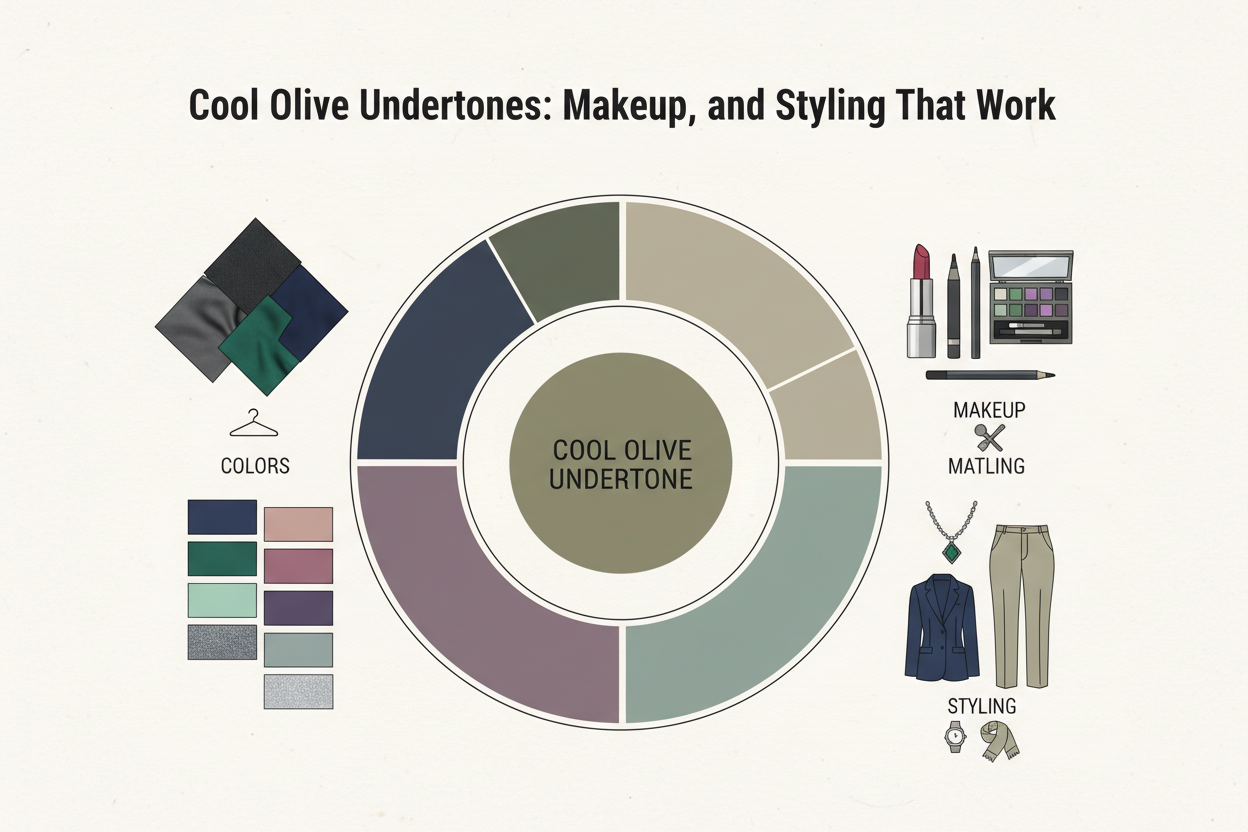
Cool olive is its own distinct complexion type. The combination of a pink or rosy base with a greenish overtone creates unusual depth and real versatility, especially with rich, saturated cool tones.
Clothing palette:
- Jewel tones: Emerald green, sapphire blue, deep plum, amethyst, burgundy, and teal all work particularly well—they create enough color contrast to make the complexion appear luminous and counterbalance the greenish overtone without fighting it
- Cool neutrals: Dusty mauve, slate, cool gray, navy, soft lavender in deeper shades
- Crisp white and near-black: Stark white flatters cool olive more than ivory, making the complexion look brighter—the opposite of warm olive
- Metals: Silver and white gold are the most flattering; rose gold can work depending on how strong the cool base is
Colors to use cautiously: Heavy earth tones—mustard yellow, burnt orange, warm terracotta—can pull the greenish overtone forward and create a muddied effect. Camel and warm beige may read as sallow against cool olive skin.
Blush and bronzer: Cool-leaning blushes in rose, berry, or muted pink tones integrate best. Heavy orange-bronzers clash with the cool base. A rosy-bronze or neutral-cool bronzer is the safer choice when you want warmth without the orange interference.
Hair color: Cool ash shades—ash brown, cool-toned dark chocolate, espresso with ash tones, cool black—sit most naturally with cool olive skin. Icy or platinum blonde can work on fairer cool olive complexions. Warm golden highlights and auburn tones tend to create noticeable contrast and don't always integrate well.
Foundation Shades for Cool Olive: Navigating the Neutral-to-Cool Range
Cool olive foundation matching is tricky for two reasons at once: the cool base pulls toward pink, but the greenish overtone means a foundation with a strong pink cast can read gray or ashy on olive skin. The sweet spot isn't "the coolest shade available"—it's neutral-to-cool, where the pink base shows up but stays balanced.
Shade descriptors to look for:
- "Neutral," "neutral cool," or "cool neutral": The reliable starting point for most cool olive skin—these shades carry enough coolness to align with your undertone without the strong pink that can read grayish over a green overtone
- "Rose beige" or "pink beige": Works well for lighter cool olive depths where the green overtone is less dominant
- "Cool" without "icy" or "strongly pink": Fine in medium depths where the overtone is strong enough to absorb some of that cool pigment
Shade descriptors to approach carefully:
- "Warm," "golden," "honey," or "caramel": The most common mismatch for cool olive skin—these foundations often oxidize to a yellowish-orange against a cool base, and the green overtone makes it worse
- "Porcelain" or strongly pink-cool shades: At the other extreme, very pink foundations can sit on top of olive skin and look gray or ashy rather than blending in—especially common in lighter shades made for very fair cool complexions
The decision framework:
- Start in the "neutral" to "neutral cool" zone at your depth level—cool enough to harmonize with your undertone, not so cool it goes ashy against the overtone
- Apply to your jawline and check in natural daylight after 15 minutes
- If it looks pink or flushed right away, it's too cool—move toward neutral
- If it disappears into your skin but turns yellowish-orange after an hour, it has more warm pigment than the label suggests—move back toward neutral-cool
- Save strongly cool shades for setting or color-correcting, not as a base
The most common mistake cool olive shoppers make is reaching for a warm foundation because they assume olive skin is always warm. The second is going too cool and ending up with an ashy finish. The neutral-to-cool zone between those two is where cool olive foundation matching almost always lands.
Common Mistakes When Identifying Olive Undertones—and How to Avoid Them
Mistake 1: Treating the green overtone as a cool signal The greenish cast in olive skin is not a cool undertone. It's a surface modifier that shows up in both warm and cool olive complexions. Seeing green in your skin doesn't mean you're cool-toned—it means you're olive-toned. The warm or cool signal lives beneath that layer.
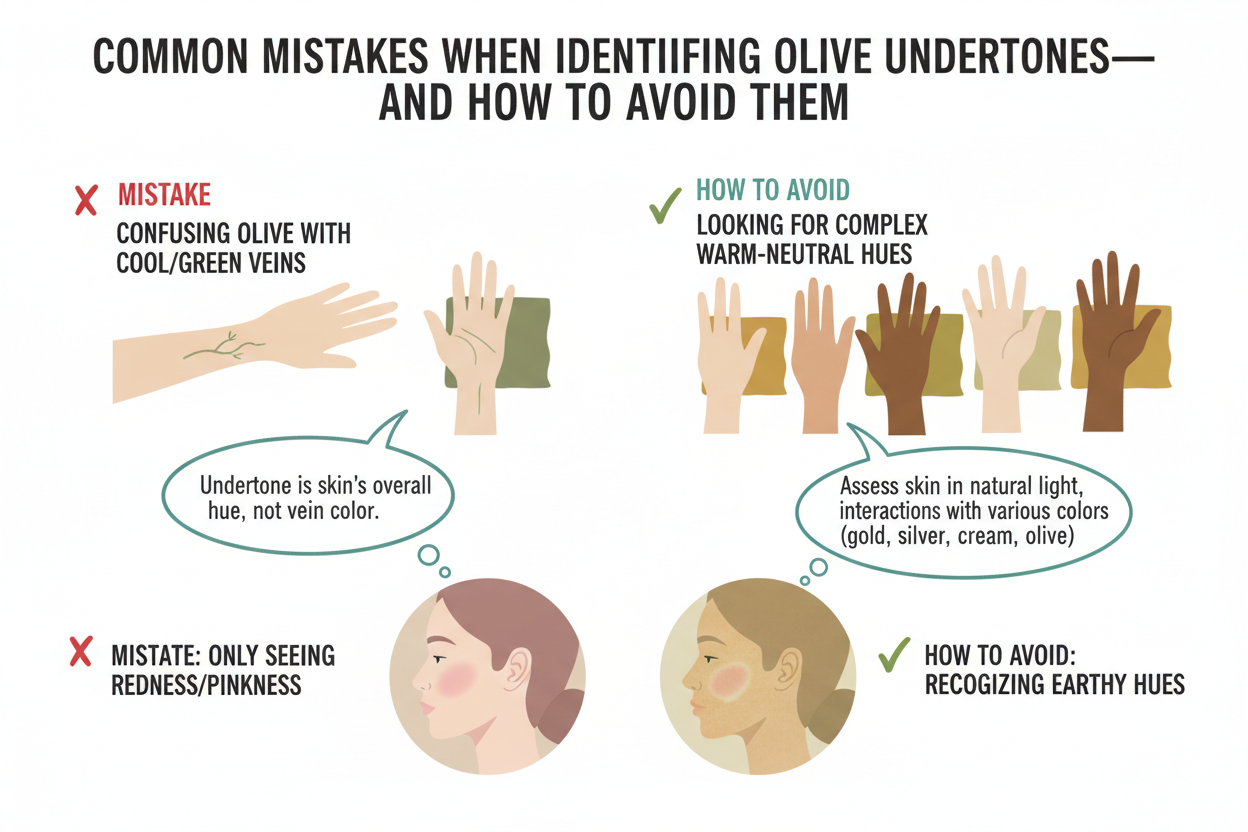
Fix: Use the jewelry test and sun reaction test to get past the overtone and read the undertone directly.
Mistake 2: Defaulting to "neutral" because nothing seems clear When standard tests give contradictory results, a lot of olive-toned people land on neutral as a compromise. Sometimes that's right. More often, the overtone is just masking a real warm or cool base, and a more targeted test would uncover it.
Fix: Run all five tests above, weight the jewelry and sun reaction results most heavily, and look for a pattern across all of them rather than leaning on any single result.
Mistake 3: Choosing warm foundations because olive = warm This is the most common foundation mistake for cool olive skin. Assuming olive always reads warm leads cool olive people to reach for golden, honey, or warm-labeled foundations that oxidize strangely and never quite settle right.
Fix: If your foundations consistently look off and you've always assumed you're warm, re-run your undertone tests with cool olive as a real possibility.
Mistake 4: Relying only on the vein test Olive skin's pigment distribution makes the vein test particularly unreliable. Using it as your primary or only test leads to frequent misreadings.
Fix: Treat the vein test as a supplementary signal, not a deciding factor.
Mistake 5: Shopping for foundation by depth alone without checking undertone descriptors Matching only to depth—light, medium, tan, deep—without looking at undertone descriptors gets you shades that technically match your darkness level but oxidize or clash in undertone.
Fix: Always cross-reference depth with the shade descriptor (golden, neutral, rose, cool) and test in natural light before buying.
How a Professional Color Analysis Confirms Your Olive Undertone
Self-testing is a useful starting point, but olive skin is one of the complexion categories that benefits most from a structured analysis. The overtone interference that makes self-testing difficult doesn't disappear with better lighting or more careful observation.
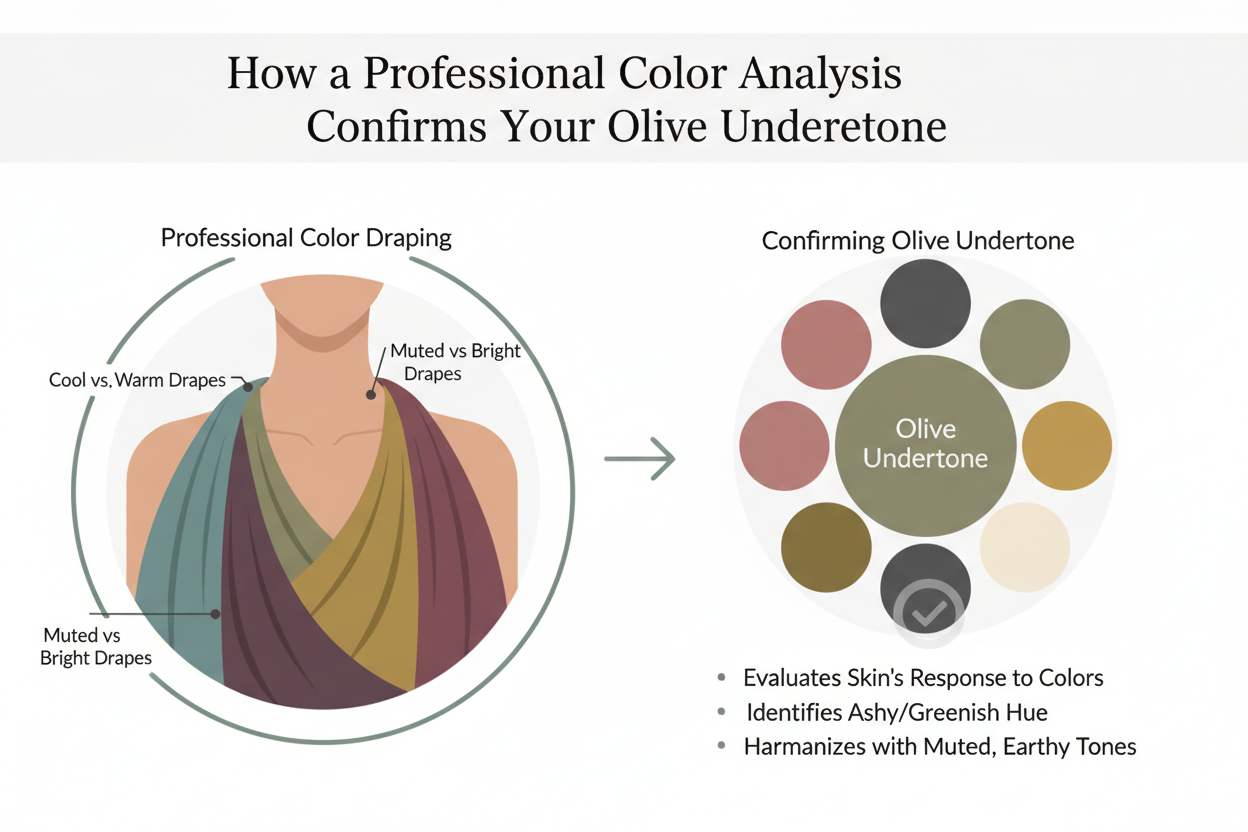
A professional color analysis—whether done in person with fabric draping or through a calibrated digital tool—approaches the undertone question differently than self-testing does. Rather than asking you to read your own skin color (which the overtone disrupts), it observes how your complexion reacts to a controlled series of color stimuli, looking for patterns that emerge across warm, cool, and neutral drapes or color inputs.
What a structured analysis adds beyond self-testing:
- Systematic color draping removes guesswork by showing side-by-side reactions to warm and cool hues across a broad spectrum—the contrast effect makes warm-versus-cool shifts visible even when the overtone is strong
- Algorithmic analysis in digital tools can account for the green overtone as a separate variable, isolating its visual contribution from the underlying undertone signal
- Seasonal system placement (where applicable) gives olive-toned individuals a full palette rather than just an undertone category—distinguishing, for example, between a warm olive who leans toward deep Autumn coloring and one who sits in the Spring range
- Structured analysis removes confirmation bias—self-testing tends to confirm what you already believe, whereas color draping shows you what the evidence actually indicates
For olive skin, professional analysis tends to resolve three persistent uncertainties: whether the skin is truly neutral or has a masked warm or cool base; whether the overtone is strong enough to require olive-specific product adjustments even once the undertone is known; and which seasonal color category provides the most useful palette guidance.
People Also Ask
Is olive skin warm or cool toned?
Olive skin can be either. What defines olive skin is a greenish or grayish overtone sitting on the surface of the complexion—and that overtone is not your undertone. Beneath it, your skin's base can pull toward golden, yellow, or peachy warmth, or toward pink, rose, or bluish coolness. Warm olive is more common, which is why the myth that olive always equals warm persists. But cool olive is a real, distinct category, and a lot of people spend years misidentified as neutral simply because the signal is harder to read.
How do I know if my olive skin has a warm or cool undertone?
The most reliable approach is to run multiple tests and look for a consistent pattern. Olive skin's greenish overtone interferes with several standard methods, so two tests tend to work better than the rest:
- The jewelry test: Hold gold and silver jewelry against your bare inner wrist in natural light. Gold looking more natural points to warm olive; silver looking cleaner and more harmonious points to cool olive.
- The sun reaction test: Warm olive skin tends to tan quickly and go golden or caramel. Cool olive skin burns more easily, or develops a grayish rather than golden tan.
Supplement those with the white-vs-ivory clothing test and the foundation oxidation test for a fuller picture. Avoid relying on the vein test alone—it's particularly unreliable for olive complexions.
Why does the vein test not work for olive skin?
The vein test asks you to check whether the veins on your inner wrist look blue-purple (cool) or green (warm). For olive skin, this breaks down. The yellowish-green pigment that creates an olive complexion is distributed throughout the skin—including the thin skin over your inner wrist—and acts as a filter, shifting the apparent color of your veins toward blue-green regardless of your actual undertone.
Someone with definitively cool olive undertones and someone with definitively warm olive undertones can both look at their wrists and see the same ambiguous blue-green. The test can't distinguish between them. Rather than treating a green vein reading as a "warm" result, treat it as inconclusive and move on to the jewelry test, sun reaction test, and foundation oxidation test.
What foundation undertone is best for olive skin?
It depends on whether your olive undertone is warm or cool:
- Warm olive: Look for foundations described as "golden," "honey," "warm golden," or "golden beige." These work with the olive overtone without triggering the orange oxidation that heavily yellow or orange-based formulas can cause. Avoid purely pink or cool-labeled shades.
- Cool olive: Look for "neutral," "neutral cool," or "cool neutral" shades. A strongly pink or cool formula can go gray-ashy over the greenish overtone, so the sweet spot is neutral-to-cool rather than the coolest shade available.
In both cases, test the foundation on your jawline in natural daylight and check for color shift after 30–60 minutes of wear. Orange oxidation means too much warm pigment; an ashy or flat result means too much cool pigment.
Can olive skin be cool toned?
Yes. Cool olive is a real undertone category, even though most beauty resources treat olive skin as inherently warm. Cool olive skin has a pink, rose, or faintly bluish base beneath the characteristic greenish overtone. This complexion tends to look most vibrant in jewel tones—sapphire, emerald, deep plum, burgundy—and in silver jewelry, while heavily golden or orange-tinted products often look muddy or mismatched.
Cool olive gets misidentified as neutral fairly often. The combination of a green overtone and a pink base can just read as "grayish" to an untrained eye. If warm-labeled foundations have never quite worked on your skin, and you've always been told you're neutral without that label feeling right, cool olive is worth trying as your actual undertone category.
FAQ
Is olive skin always warm toned, or can it be cool?
No. Warm olive is more common—which is why the "olive equals warm" myth has stuck around—but cool olive is real and distinct. Olive refers to the greenish or grayish overtone you can see on the skin's surface, not the underlying base. That base can lean golden and yellow (warm) or pink and rose (cool). Getting this wrong matters: styling advice aimed at warm olive will actively work against someone with cool olive undertones.
What is the difference between olive skin tone and olive undertone?
Skin tone is the surface color you see at first glance—light, medium, deep, or in this case, that greenish or grayish cast. Undertone is the subtler hue beneath the surface, and it stays the same regardless of sun exposure or the time of year. You can have an olive skin tone with either a warm undertone (golden, yellow, peach) or a cool one (pink, rose, faintly blue). Mixing up the two is usually why olive-skinned people end up with foundations that don't match and colors that don't work.
How do I find my undertone if I have olive skin?
Olive skin throws off most standard tests, so run several and look for a consistent pattern rather than trusting any single result:
- Jewelry test: Hold gold and silver pieces against your bare wrist in natural light. Gold looking more harmonious suggests warm; silver looking cleaner suggests cool.
- Sun reaction test: A golden or caramel tan that develops quickly points to warm olive. Burning easily or developing a grayish tan points to cool.
- White vs. ivory clothing test: Hold a bright white fabric and an ivory or cream fabric near your face in natural light. If ivory is more flattering, you're likely warm; if bright white looks better, you're likely cool.
- Foundation oxidation test: Apply a golden-warm foundation and check after 30–60 minutes. If it shifts orange, the formula runs too warm for your base.
Skip the vein test—it's especially unreliable for olive complexions.
Why do foundations oxidize orange on olive skin?
Oxidation happens when foundation pigments react with your skin's oils and natural chemistry after application. On olive skin, a formula with a strong yellow or orange pigment base will hit that existing greenish undertone and, over time, shift orange. It's most likely to happen when you pick something labeled "yellow" or heavily warm instead of something on the cooler side of warm. Test on your jawline and check back after 30–60 minutes before buying.
What colors should warm olive skin avoid?
Warm olive skin tends to look washed out or muddy next to:
- Pastels and muted tones: Soft pink, baby blue, and lavender dilute the richness of the complexion.
- Stark cool colors: Icy whites and cool-based grays can create a yellow-gray contrast that makes the skin appear sallow.
- Overly orange tones: Burnt orange and heavily orange-red clothing can amplify the warm undertone to the point of looking garish rather than glowing.
Earthy neutrals, warm rich hues, and deep jewel tones in the amber-to-olive range tend to be far more flattering.
What colors should cool olive skin avoid?
Cool olive skin tends to look duller or clashing next to:
- Heavy earth tones in orange and mustard: These amplify the green overtone and make the complexion appear muddy.
- Gold-heavy metallics: Gold jewelry and gold-toned clothing can conflict with the cooler base, looking mismatched rather than luminous.
- Warm beiges and camel tones: These can flatten the complexion by echoing the greenish overtone without the contrast needed to make the skin look alive.
Deep jewel tones—sapphire, emerald, plum, burgundy—and true navy tend to work much better.
Does olive skin look better with gold or silver jewelry?
It depends on your undertone, not your olive skin tone as a whole. Warm olive skin tends to work well with gold, which echoes the yellow base and adds warmth. Cool olive skin usually looks better with silver, white gold, or platinum, which work with the pink or rose base without pulling out the greenish overtone. If you've never been sure which metal suits you, this is one of the easier ways to start figuring out your undertone—and once you know it, your color analysis results can confirm where you actually fall.
To compare this result with a neighboring skin-tone question, use the companion article “The Ultimate Guide to Olive Skin Tone: Are You One of Us?”, which keeps the two closely related questions distinct.