Fair Olive Skin Color Guide
 Reviewed by Alexandra Gilmore
Fair olive skin combines light depth with gold-green or muted undertones, so ordinary fair-skin advice may turn too pink or too pastel. Compare its strongest clothing, makeup, hair, and metal options, then adjust each family for warm, cool, or neutral olive direction.

Fair olive skin occupies a genuinely unusual position in the color spectrum. It reads as light at first glance, yet carries a distinct mix of golden and green undertones beneath the surface — a combination that sets it apart from simply "fair" or simply "warm" skin. That dual nature is exactly what makes choosing colors both exciting and, at times, confusing.
💫 Discover Your Complete Color Palette
One feature rarely explains every color that works for you. Compare your undertone, depth, clarity, and contrast as a complete palette, then use the results to test clothing, makeup, and hair colors more consistently.
Find My Color Palette →The good news: olive skin is one of the most versatile skin tones there is. Its built-in warmth and subtle depth mean a wide range of shades can look genuinely striking on it. The catch is that, like any distinctive coloring, it has clear best friends and clear mismatches — and knowing which is which changes everything about how you dress, do your makeup, and style your hair.
This guide exists to remove the guesswork. Here is what you will find inside:
- A plain-language explanation of what fair olive skin actually is and how it differs from similar tones
- Three quick self-tests to confirm your skin falls into this category
- A core color palette covering clothing, makeup, and hair — with the reasoning behind every recommendation
- A clear list of colors to avoid and practical alternatives for each
- Seasonal adjustments so your palette stays flattering year-round
- Answers to the most common questions about foundation undertones, blush shades, and what to do when test results conflict
Whether you have always suspected you have olive skin but never been sure, or you know your tone well and simply want a sharper color strategy, this ultimate color guide for fair olive skin gives you a complete, actionable framework from start to finish.
What Makes Fair Olive Skin Tone Unique
Olive skin gets its character from a combination of golden and green pigments sitting beneath the surface — present regardless of how light or dark the skin appears overall. Fair olive sits at the lighter end of that spectrum. It lacks the deeper tan of medium or dark olive, but it's never purely pale or pink-toned. The greenish cast is often subtle, sometimes only visible in certain lighting or against stark white, but it's always there, and it shapes every color decision that follows.
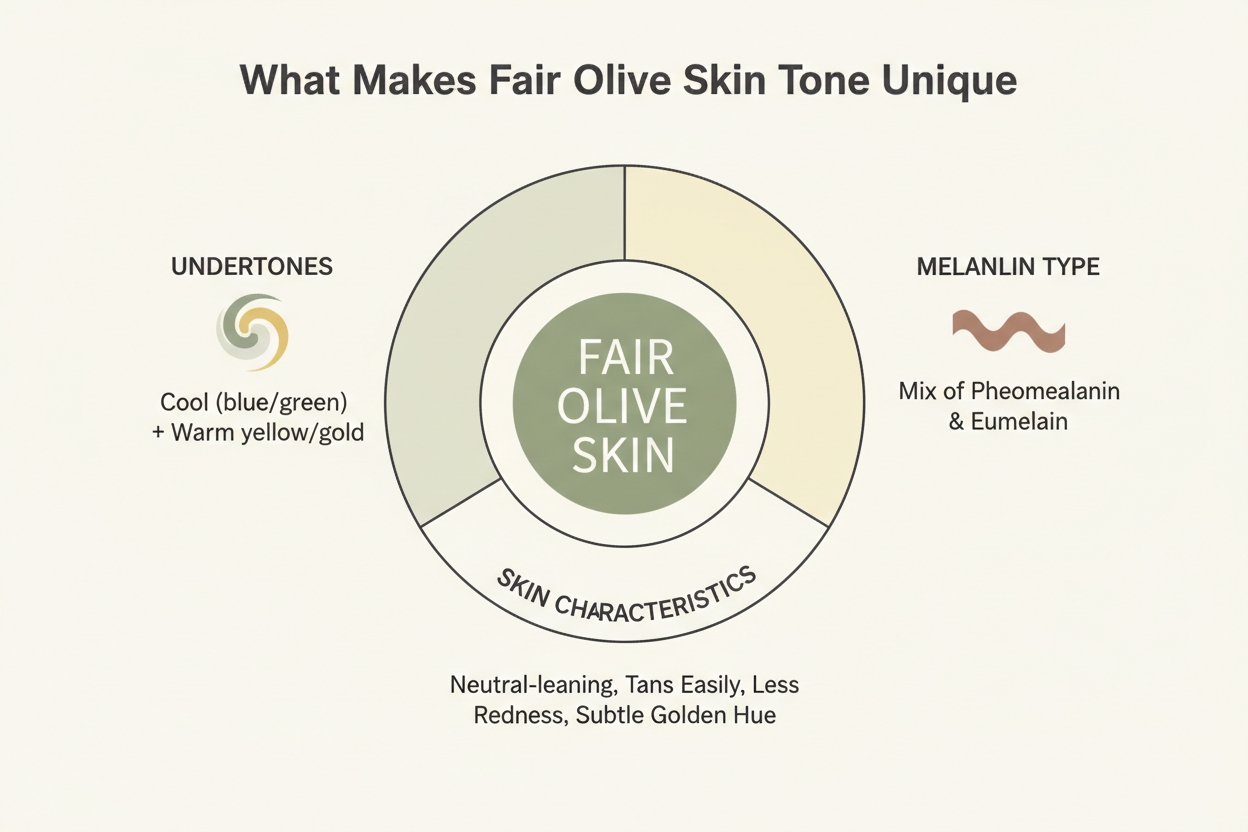
What separates fair olive from other light skin tones is that dual-undertone structure. Standard fair skin reads as pink, neutral beige, or cool porcelain. Fair olive reads as warm-but-not-golden, with a slight muted or sallow quality that can work for or against you depending on what colors sit next to it. Against the right shades, the skin glows. Against the wrong ones, it can look flat or yellowish.
That built-in warmth and depth is also what makes fair olive genuinely versatile. A wide range of colors — earthy terracottas, deep jewel tones — can look striking against it in ways that neither purely cool nor purely warm skin pulls off as easily. The golden-green undertone is the engine behind every flattering color choice, and that's the foundation this whole guide builds on.
Not sure if your skin fits the fair olive description? Take the color-analysis.app quiz to get a personalized reading based on your specific undertone combination.
How to Confirm You Have Fair Olive Skin: 3 Quick Tests
Olive skin is notoriously hard to self-diagnose because it doesn't behave like a clean warm or cool category. Use all three tests together — no single one is conclusive.
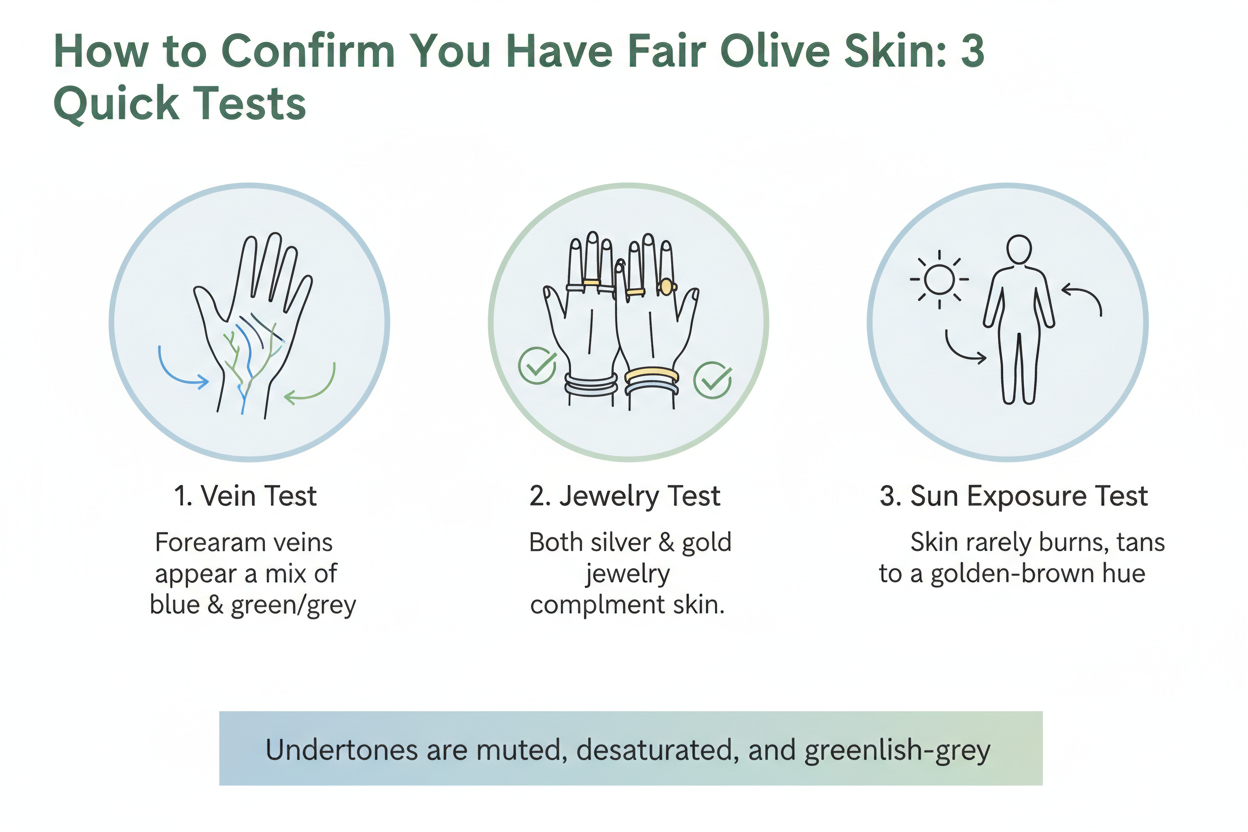
Test 1: The Vein Test
Look at the veins on the inside of your wrist in natural daylight.
- Blue or purple veins → cool undertones
- Green veins → warm undertones
- A mix of blue-green → neutral or olive undertones
Fair olive skin most often shows blue-green veins that are genuinely hard to call. If you're still staring at your wrist trying to decide, that ambiguity is itself useful information.
Test 2: The White Paper Test
Hold a plain white sheet of paper next to your bare face in natural light with no makeup on.
- Skin looks pink or rosy beside the white → likely cool
- Skin looks yellowish, sallow, or slightly greenish → likely olive or warm
- Skin looks grey or ashy → strong olive signal
Fair olive skin tends to read slightly yellow or olive-grey next to pure white — which is part of why stark white clothing so rarely works.
Test 3: The Jewelry Test
Try on a plain gold piece and a plain silver piece separately against your bare skin.
- Gold looks more natural and luminous → warm or olive undertones
- Silver looks crisper and cleaner → cool undertones
- Both look fine, but gold feels slightly warmer → neutral-olive
Most people with fair olive skin find gold flattering without it being a dramatic difference — the response is warm, but silver isn't obviously wrong either.
When Test Results Conflict: What Mixed Signals Mean for Olive Skin
If your vein test points one way and your jewelry test points another, you didn't make an error. That kind of conflict is common with olive and neutral-leaning skin, and it's actually diagnostic. If you can't place yourself cleanly in the warm or cool column, that difficulty often points to neutral undertones — which are a core characteristic of olive skin.
The practical takeaway: don't force your skin into a warm or cool box. Olive undertones have two sides, and the colors that work best tend to honor both — warm enough to harmonize with the golden layer, without so much yellow that they tip into sallow.
If your three tests came back mixed or contradictory, a structured color analysis built around neutral undertones is the most useful next step — which is exactly what the color-analysis.app quiz is designed to handle.
The Best Colors for Fair Olive Skin: Your Core Palette
Olive skin's golden-green undertone sits somewhere between warm and cool, which means it plays well with two kinds of colors: warm neutrals that echo the earth tones already in the skin, and deeper, richer hues that give the undertone something to work against. The core palette below covers both.
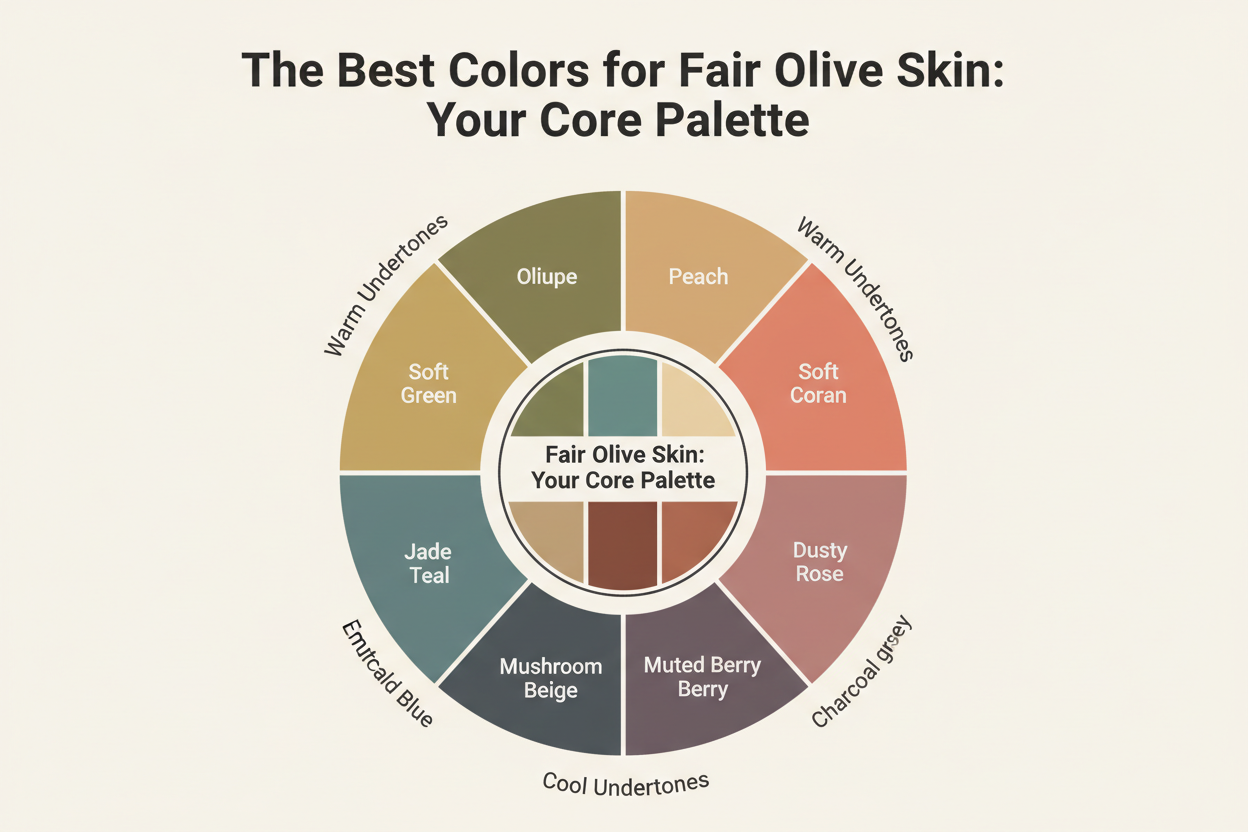
Earthy Neutrals
- Camel and warm tan
- Warm taupe and mushroom
- Olive green
- Rust and terracotta
- Warm ivory and cream (not stark white)
These tones sit close enough to fair olive skin that they read as cohesive. Cooler or starker neutrals don't do the same thing.
Warm Jewel Tones
- Deep teal
- Amber and burnt orange
- Forest green
- Warm burgundy and wine
- Plum (warm-shifted, not blue-pink)
These add richness and contrast without fighting the green-gold undertone. On fair olive skin they tend to look vivid rather than muddy.
Muted and Dusty Hues
- Dusty rose (peach-leaning, not blue-pink)
- Sage green
- Warm mauve
- Soft terracotta
These work when jewel tones feel like too much. The warmth is gentler, which suits fair olive's lighter surface without ignoring the undertone underneath.
Warm Neutrals: The Non-Negotiable Foundation
Of everything here, warm neutrals are the most reliably flattering category for fair olive skin — work, casual, evening, it doesn't matter. Camel, warm taupe, rust, and olive green harmonize with the golden layer of the undertone while staying neutral enough not to overwhelm the green cast. The effect is cohesion rather than competition.
Cool grays, off-whites with blue bases, and stark whites tend to underperform for exactly this reason. Against those tones, the olive cast can look sallow or faintly greenish, because nothing in the color responds to it. Switch a cool gray blazer for a warm taupe one, or a white tee for a warm cream, and the same skin looks clearer. Warm neutrals are probably the highest-return investment in a fair olive wardrobe.
Jewel Tones That Amplify Fair Olive's Natural Depth
Fair olive skin is light, but the undertones give it enough depth to hold its own against richer colors. Warm jewel tones work because they give the undertone something to resonate with. Forest green and teal pick up the green layer; amber and burgundy pick up the gold.
What tends to fall flat: cool jewel tones like icy blue, cool lavender, or violet-pink. They work against the golden-green undertone rather than with it, which can leave skin looking dull or washed out. The fix is a warm shift — teal instead of baby blue, plum instead of lilac, deep olive instead of cool mint. Rich jewel tones are absolutely on the table for fair olive skin; they just need to come from the warm or neutral side of the spectrum.
Colors to Avoid with Fair Olive Skin (and What to Wear Instead)
Knowing what to skip is as useful as knowing what to reach for. The following colors tend to work against fair olive's golden-green undertone rather than with it — but each one has a warm-shifted alternative that delivers a similar look without the problem.
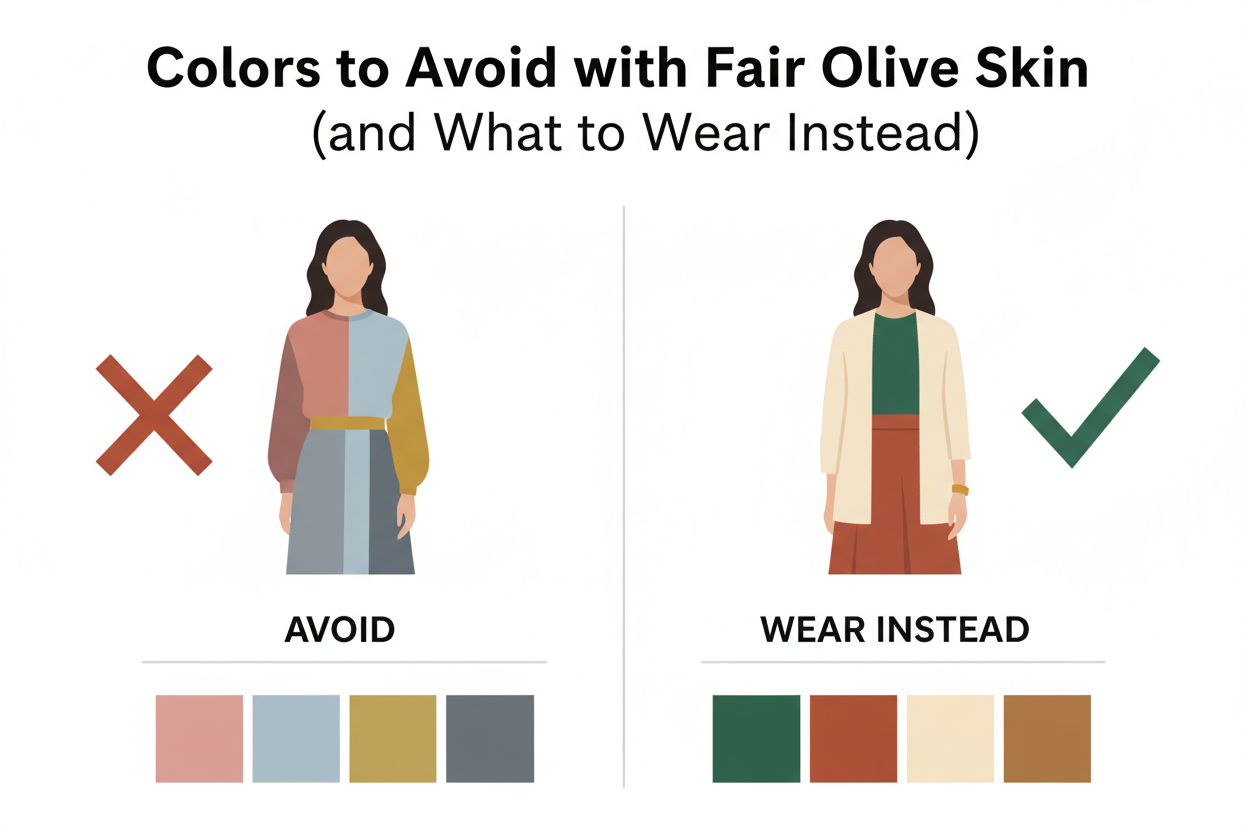
| Avoid | Why It Clashes | Wear Instead |
|---|---|---|
| Stark white | Amplifies yellow-green cast, can make skin look sallow | Warm ivory or cream |
| Cool gray | Flattens the warm undertone, reads as ashy against olive | Warm taupe or greige |
| Icy blue | Too cool to harmonize with golden-green pigments | Deep teal or slate blue |
| Cool lavender | Blue-purple base competes with the green undertone | Warm mauve or plum |
| Blue-pink (bubblegum pink) | Cool pink pulls away from warmth, creates disconnect | Dusty rose or peach-pink |
| Black-white high contrast | Can look harsh against fair olive's muted depth | Navy with cream, or charcoal with camel |
| Neon yellow | Over-amplifies the yellow layer, reads as sallow | Warm mustard or golden yellow in moderate saturation |
The pattern: anything with a strong cool or blue base pulls the wrong way. The fix is almost always a warmer, slightly more muted version of the same color family — not a different color entirely, just a better-calibrated one.
Still unsure which colors belong in your specific wardrobe? The color-analysis.app quiz generates a personalized palette based on your actual undertone reading — start here to get your results.
Makeup Colors That Complement Fair Olive Skin
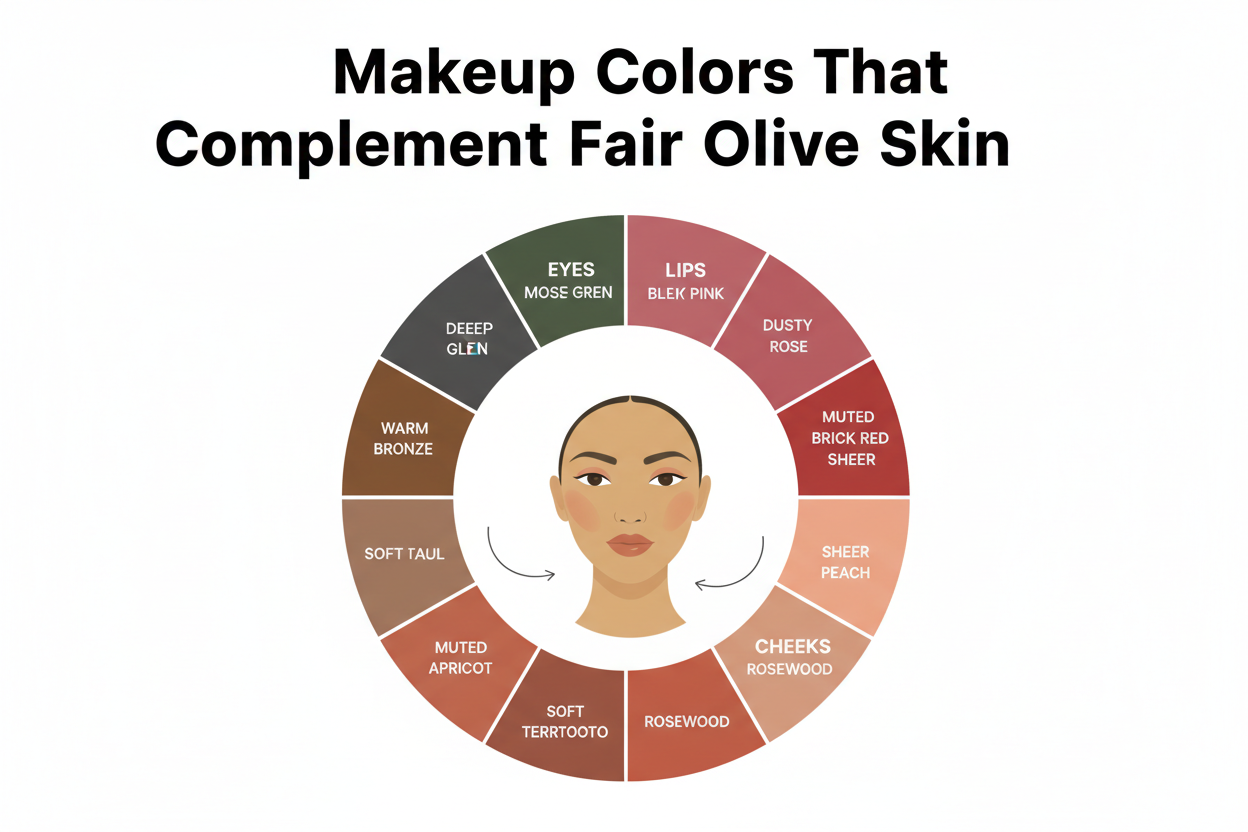
Makeup for fair olive skin follows the same logic as clothing color: warm undertone first, cool base last. The most common mistake is reaching for products formulated for cool-fair or pink-fair skin, which can leave fair olive looking ashy, dull, or slightly grey.
Foundation
The single most important step. Fair olive skin needs a foundation with a neutral-to-warm undertone — one that accounts for both the yellow and the green in the skin. Foundations labeled "neutral" or "warm beige" in a fair depth are usually the best starting point. Avoid foundations with pink or rose undertones. They sit on top of the olive cast rather than blending with it, and the mismatch shows at the jawline.
Blush
Terracotta, warm peach, and warm apricot blushes integrate naturally with fair olive skin. They add warmth without clashing with the green layer. Cool-toned blushes — rose, blue-based mauve, berry-pink — can look artificial because the cool pigment doesn't blend into the undertone. A light bronzer used as a blush substitute works well for daytime.
Eyeshadow
Bronze, copper, warm brown, and olive-toned eyeshadows echo the skin's own undertones and create a cohesive warm eye look. Earthy neutrals — taupe, caramel, warm sand — work for everyday wear. Deeper options like forest green or warm burgundy add intensity for evening. Cool-toned shadows (silver, icy lavender, steel blue) tend to look disconnected from the warmth in the skin.
Lip Color
Warm nudes — tawny, warm beige, peachy nude — photograph naturally and never look washed out. Warm berry and brick red add depth without veering cool. Warm rosy browns and terracotta are especially strong on fair olive skin. Colors to sidestep: true blue-red, cool fuchsia, and very pale pink nudes that read almost white. Those tend to look stark or chalky against the skin's warmth.
Building a Wardrobe Palette Around Fair Olive Skin
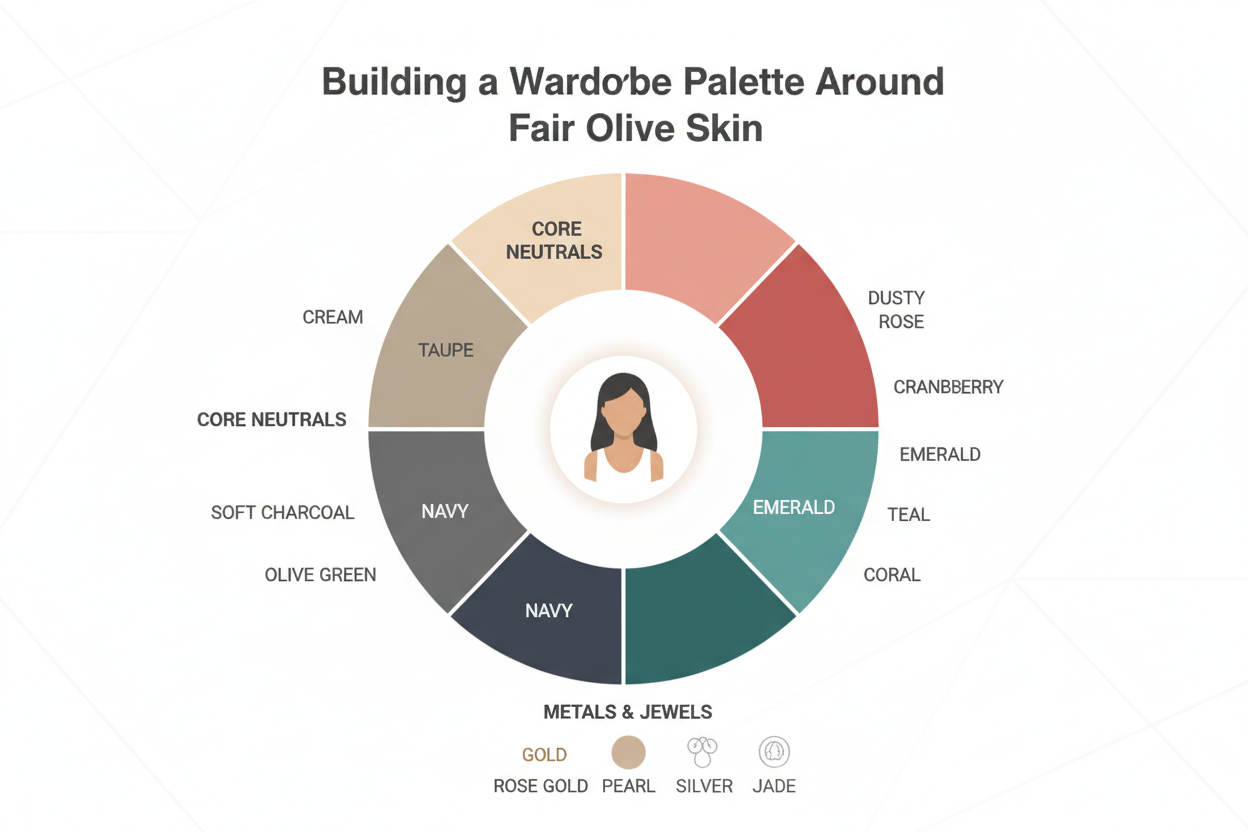
One of the most common frustrations with olive skin is building a wardrobe that feels cohesive and genuinely flattering — especially when mainstream fashion defaults to cool neutrals and pastel basics. The framework below is designed to fix that, specifically for fair olive skin.
Step 1: Lock in your neutral anchors
These are the pieces you reach for most — trousers, blazers, outerwear, knitwear. For fair olive skin, anchors should come from the warm neutral family: camel, warm taupe, cream, warm ivory, olive green, warm greige. They work with almost everything else in the palette and consistently look good against the skin.
Step 2: Add your accent colors
These are the pieces that create visual interest — blouses, dresses, scarves, statement outerwear. Pull from the warm jewel tones: deep teal, amber, warm burgundy, forest green. One or two accent colors is usually enough.
Step 3: Use the avoid list as an editing tool
When shopping, treat the avoid list as a filter. Before buying a "neutral" piece in cool gray or stark white, ask whether a warm alternative exists. It usually does — and it will be easier to style without any extra effort.
Step 4: Test combinations against your actual skin
The paper test works for clothing too. Hold fabric up to your face in natural light before buying. Fair olive skin looks clearer and warmer next to the right colors, and slightly flat or sallow next to the wrong ones. Trust what you see over what the label says.
Step 5: Keep it simple at the foundation, flexible at the accent layer
Warm neutrals are versatile enough that a fair olive wardrobe doesn't need to be large to feel complete. A solid set of neutral anchors handles most daily situations. The accent layer is where personal style and seasonal variety come in.
Seasonal Color Shifts: Adapting Your Fair Olive Palette Year-Round
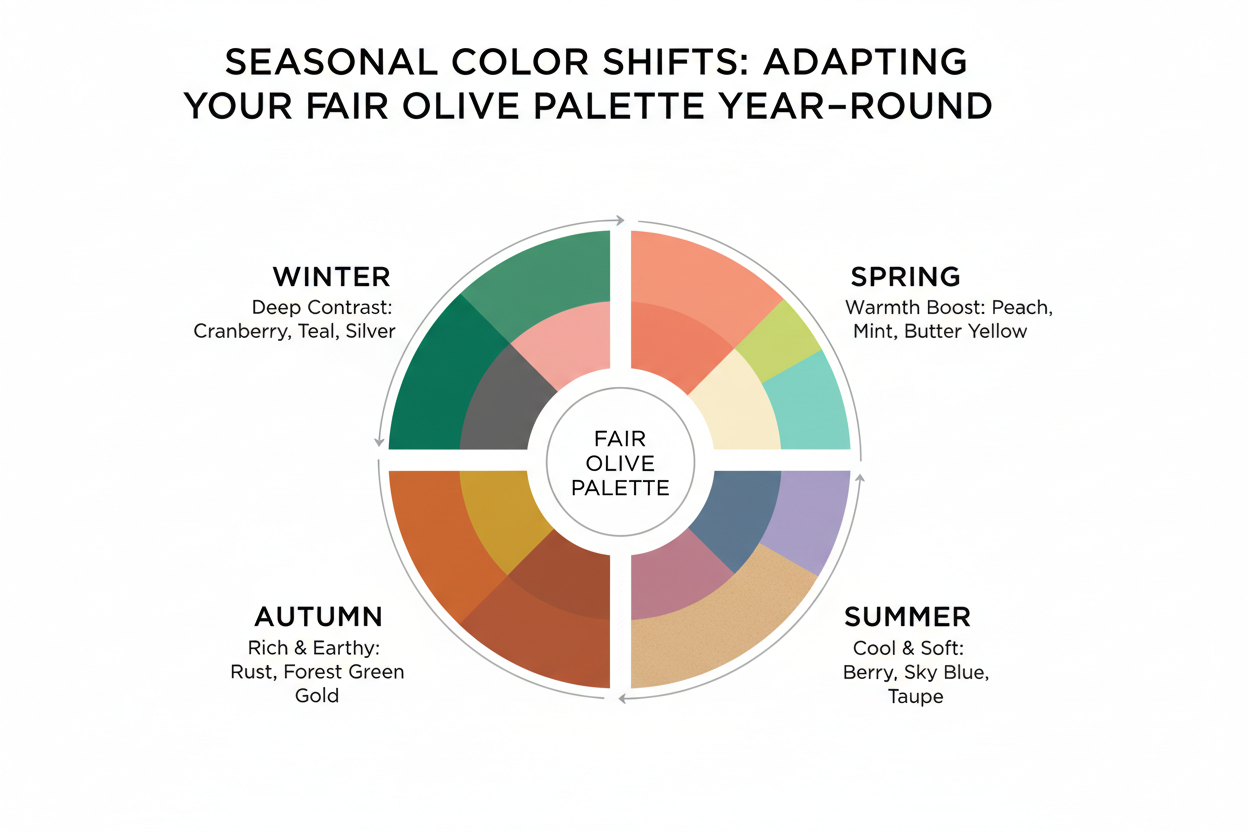
The core palette for fair olive skin doesn't change with the seasons — the golden-green undertone is what it is, year-round — but how you weight different parts of that palette shifts naturally depending on the time of year, both for looks and practicality.
Spring
Move toward the lighter, dustier end of the warm palette. Warm dusty rose, sage green, soft terracotta, and peach-toned neutrals all work as temperatures rise. The trick is staying on the warm-muted side of spring pastels: peach rather than baby pink, sage rather than mint, warm butter yellow rather than lemon. Cool pastels are where spring gets tricky for olive skin.
Summer
Summer opens up room for higher contrast and bolder color. Warm whites — cream, warm ivory — replace the camel and taupe of winter layering. Bright terracotta, warm coral, and amber translate well in lighter fabrics. If you want to wear white (and in summer, you will), go off-white or ivory rather than optical white, which tends to pull sallow against fair olive skin.
Autumn
This is fair olive skin's best season. The warm jewel tones and earthy neutrals that define autumn fashion — rust, burnt orange, forest green, warm burgundy, camel, deep teal — happen to be exactly what this skin tone does best. The seasonal palette and the skin tone are genuinely aligned here. No editing needed; just lean in.
Winter
Winter takes the most work. The season's default palette — cool grays, stark whites, icy blues, silver metallics — runs straight against golden-green undertones. The fix is anchoring outfits in the warmer end of the winter range: deep navy instead of icy blue, warm charcoal instead of cool gray, rich burgundy, deep forest green. Gold jewelry and accessories will carry winter looks better than silver.
People Also Ask
What colors look best on fair olive skin?
Fair olive skin tends to do well with warm, earthy tones and deeper jewel hues that work with its golden-green undertone rather than fight it. The strongest options:
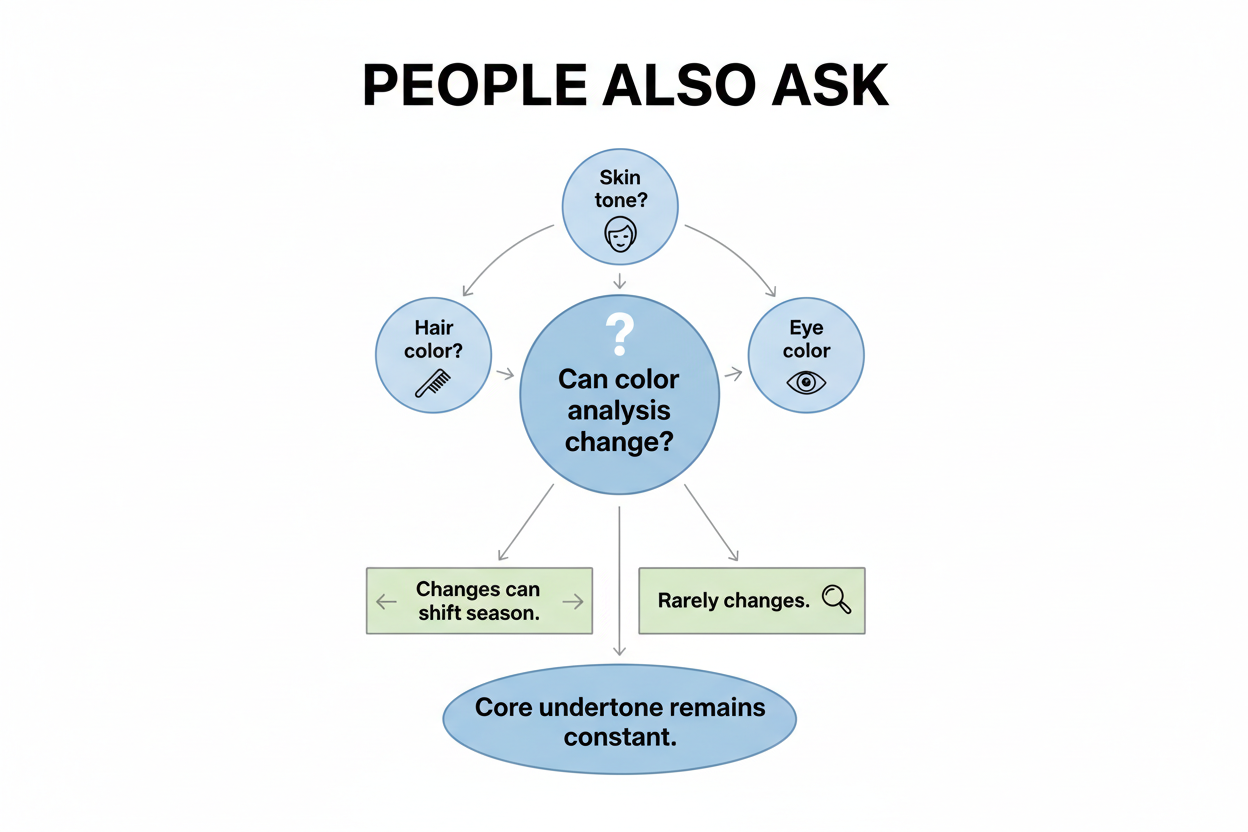
- Earthy neutrals: camel, warm taupe, rust, terracotta, cream, and olive green
- Warm jewel tones: deep teal, amber, forest green, warm burgundy, and plum (warm-shifted)
- Muted warm pastels: dusty rose (peach-leaning), sage green, warm mauve, soft terracotta
The pattern across all of these is the same: they complement the warm golden layer in the skin without pulling out the greenish cast in a way that reads as sallow. The more you draw from these families, the more the skin's natural depth and warmth become something to work with rather than around.
How do I know if I have fair olive skin or just fair skin?
The difference comes down to undertone, not how light your skin is. Standard fair skin reads as pink, neutral beige, or cool porcelain. Fair olive skin, even at the same lightness, carries a subtle yellow-green cast that behaves differently next to certain colors and backgrounds.
Three quick checks can help:
- White paper test: Hold plain white paper next to your bare face in natural light. If your skin looks slightly yellowish, sallow, or greenish beside it, you probably have olive undertones. Pink-fair skin looks rosy or neutral.
- Vein test: Blue-green veins that are genuinely hard to call as warm or cool are a common olive signal. Pure blue or purple usually means cool-fair skin.
- Color response test: If warm neutrals like camel and cream consistently look more natural on you than stark white or cool gray, that points toward olive undertones even at a fair depth.
If you keep struggling to place yourself in either the "warm" or "cool" category, that difficulty is itself a clue. Neutral or olive undertones are often the reason.
What makeup foundation undertone is best for fair olive skin?
Look for foundations labeled neutral-to-warm in a fair depth range. The main thing to avoid is pink or rose undertones — they sit on top of olive skin's greenish layer instead of blending in, and you'll usually see a visible mismatch at the jawline.
A few pointers when shopping:
- Neutral beige or warm beige in fair shades is usually the safest place to start
- Test shades on your jawline in natural light, not under store lighting
- If a shade looks ashy or grey, it's pulling too cool; if it looks orange or cakey, it's pulling too warm — the right shade just disappears
- Some fair olive skin benefits from mixing a neutral and a slightly warm shade to get the balance right
Fair olive skin sits at the lighter end of the olive spectrum, so the depth range is narrow. But the undertone call — neutral-to-warm, not pink — matters more than the exact shade number.
What colors should fair olive skin avoid?
Colors that tend to work against fair olive skin share one trait: a cool or blue base that pulls against the golden-green undertone.
| Avoid | Wear Instead |
|---|---|
| Stark white | Warm ivory or cream |
| Cool gray | Warm taupe or greige |
| Icy blue | Deep teal or slate blue |
| Cool lavender | Warm mauve or plum |
| Blue-pink (bubblegum pink) | Dusty rose or peach-pink |
| Neon yellow | Warm mustard in moderate saturation |
These aren't absolute rules. Outfit context, personal style, and how much of the color appears all matter. But if something has a strong cool or blue base, it's worth a second look before it ends up in a fair olive wardrobe.
Is fair olive skin warm or cool toned?
Fair olive skin is best described as neutral, leaning warm — and that nuance matters. It doesn't sit cleanly in the warm or cool category, which is exactly why people with olive undertones often find standard "warm vs. cool" color advice frustrating or just flat-out inconclusive.
The skin has two distinct layers of pigment: a golden warmth and a greenish cast. That combination is what produces the olive quality. Because both are present at the same time, cool-based colors clash and pure warm colors can over-amplify the yellow. Colors that actually work are the ones that honor both sides — warm enough to complement the golden layer, but muted or deep enough that the green cast doesn't read as sallow.
If you've repeatedly struggled to figure out whether you run warm or cool, that difficulty isn't a sign you're doing it wrong. It's a pretty reliable indicator that your undertone is genuinely neutral or olive. Working with that neutrality, rather than forcing it into a warm or cool box, tends to produce much better results.
FAQ
What is the difference between fair olive skin and light neutral skin?
Both can look similar in photos and even in person. The difference shows up next to certain colors.
- Light neutral skin has a beige or balanced base — not noticeably warm or cool — and tends to work with a wide range of colors without strong pattern preferences.
- Fair olive skin has a yellow-green undertone beneath the surface. Cool-based colors don't just feel slightly off against it — they actively clash, making the skin read as sallow or gray.
The most reliable test is holding a white piece of paper next to your face in natural light. Light neutral skin looks balanced or slightly pink beside white. Fair olive skin tends to look subtly yellowish or greenish by comparison. That shift is the olive undertone showing itself.
Can fair olive skin wear pastels?
Yes, but the type of pastel matters.
Pastels that tend to work:
- Dusty rose (peach-shifted, not blue-pink)
- Sage green
- Warm mauve
- Soft terracotta
Pastels that tend to clash:
- Icy lavender
- Baby blue
- Cool mint
- Bubblegum pink
Cool pastels have a strong blue base that fights with the golden-green undertone in fair olive skin, often making the complexion look washed out or sallow. Warm, muted pastels don't have that problem — they share enough warmth with the skin's underlying tone to sit comfortably rather than clash.
What hair color complements fair olive skin?
Fair olive skin works well with colors that echo or contrast its warm-neutral undertone without going too cool or ashy.
Good options:
- Warm brunettes: chestnut, caramel brown, warm chocolate — they pick up the golden depth in the skin
- Golden or honey highlights: add warmth without going brassy
- Warm auburn and copper: create contrast that works with the green undertone rather than fighting it
- Dark espresso or warm black: adds richness and grounds the complexion
Colors to be careful with:
- Platinum or ash blonde — the cool, silvery tone can make fair olive skin look sallow
- Blue-black with cool undertones — tends to bring out any greenish cast
- Ash brown without warmth — can make the skin read flat or gray
If the shade is labeled "warm" or "golden" and sits anywhere in the brown-to-red family, it will generally work.
Why does white clothing sometimes look unflattering on fair olive skin?
Stark white reflects cool, blue-spectrum light back onto the face. Against fair olive skin's yellow-green undertone, that reflected light amplifies the greenish cast instead of brightening anything — the result looks sallow or dull rather than fresh.
The fix is simple: swap stark white for warm ivory, cream, or off-white. These softer whites carry enough warmth to work with the golden layer in olive skin without the contrast that makes pure white a problem. The difference is more noticeable than you'd expect — cream makes skin look alive, stark white makes it look tired.
What blush color works best for fair olive skin?
Peachy, warm pink, and terracotta shades tend to work best. They add warmth and mimic a natural flush without looking cool or artificial against olive undertones.
Good options include peach and peachy-coral, warm rose (salmon-leaning, not blue-pink), soft terracotta or warm bronze for a sun-kissed effect, and warm mauve.
The shades to avoid are cool pink, fuchsia, and anything with a blue base. These sit against the undertone rather than with it, and can make the skin look slightly gray at the edges.
Cream blush formulas tend to integrate more naturally than powders because they blend into the skin surface rather than sitting on top of it, which reduces the risk of patchiness or a disconnected look.
How do I find the right foundation shade for fair olive skin?
Undertone matters more than depth level here. The most common mistake is reaching for foundations with a pink or rosy undertone — they sit on top of the olive layer instead of blending into it, and the mismatch is obvious.
A practical approach:
- Filter by undertone first. Look for shades labeled neutral, neutral-warm, or warm beige in a fair depth range. Rule out anything described as rose, pink, or cool.
- Test at the jawline in natural light. The right shade disappears into the skin. If it looks gray or ashy, it's too cool. If it looks orange, it's too warm.
- Consider mixing. Many fair olive skin types find that blending a neutral and a slightly warm shade gets closest to their exact undertone.
- Watch for the sallow trap. A foundation that's even slightly too yellow on its own can over-emphasize the greenish cast. Neutral-warm is the target, not pure yellow.
Fair olive sits at the lighter end of the olive range, so depth options are narrower than for medium or deep olive skin — but the undertone principle is the same.
Does fair olive skin tan easily or burn?
Fair olive skin tends to tan more readily than fair pink or cool-fair skin. The olive undertone usually signals a higher baseline of melanin, which gives it slightly more natural sun protection.
That said, "fair olive" is still on the lighter end of the spectrum — it's not immune to burning, especially with prolonged unprotected exposure. Some fair olive skin types go golden quickly with minimal burning. Others, particularly those closer to the fairer end, may burn before any tan develops.
Either way, SPF still matters. Worth testing formulas carefully: some sunscreens leave a white or gray cast that's especially obvious against an olive undertone. Tinted or chemical options tend to disappear more cleanly on this skin type.
Not sure exactly where your skin tone and undertone sit? A personalized color analysis can map your specific complexion against a tested palette — take the quiz at color-analysis.app to get results built around your actual coloring.
To compare this result with another established color-analysis guide, continue with the companion article “True Summer Color Palette Guide”, which keeps the two closely related questions distinct.