Digital Color Analysis vs In-Person
 Reviewed by Alexandra Gilmore
Online analysis is convenient and affordable, but a camera cannot control color as reliably as physical drapes under trained observation. Compare both methods by budget, access, privacy, lighting, feedback, and uncertainty so you can choose the level of evidence your wardrobe decision actually needs.

If you've ever searched for your season online and ended up more confused than when you started, you're not alone. The question stylists hear most often right now is a simple one: is online color analysis really as accurate as sitting down with a trained analyst and a stack of draping cloths?
💫 Take the Color Analysis Quiz
If the signals in this article still point in different directions, compare them together instead of relying on one clue. The quiz gives you a consistent starting point you can check against the practical tests above.
Take Color Analysis Quiz →The honest answer is: it depends on what you need, what you're willing to spend, and how much control you have over the variables involved.
This article breaks down exactly how each method works, where each one succeeds and where it falls short, and which option makes the most sense for your specific situation. By the end, you'll have a clear framework for deciding between digital color analysis vs in-person analysis — not a generic "both are great" non-answer.
Here's what this guide covers:
- How in-person color draping actually works and why live color shifts matter
- How digital and AI-based tools approach the same problem without physical fabric
- Where accuracy gaps exist between the two methods — and when they don't
- Practical factors like cost, access, and convenience that should drive your decision
- Which method suits beginners versus people who've already done some self-analysis
One thing worth flagging upfront: "digital color analysis" is not a single thing. An AI tool that scans uploaded photos is a fundamentally different experience from a live video consultation with a trained stylist. That distinction matters enormously for accuracy, and this guide treats the two separately.
Why This Question Comes Up So Often
Stylists and color educators hear this comparison constantly, and for good reason. Color analysis has moved from a niche in-person service into something you can do on your phone in ten minutes. That shift creates real uncertainty: if a free quiz can tell you your season, why pay for an appointment?
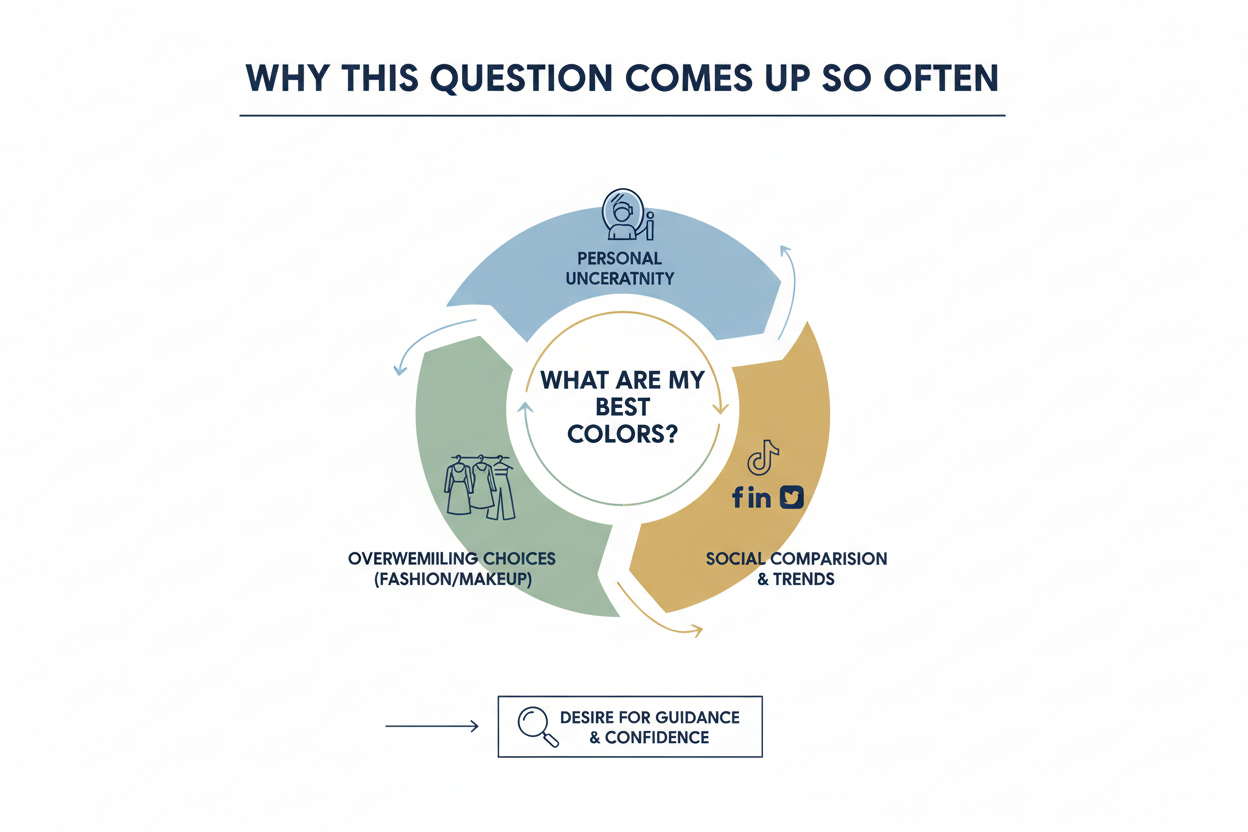
The confusion gets worse because different digital tools often disagree with each other — and sometimes disagree with a prior in-person result. That inconsistency makes people wonder whether either method can be trusted, or whether the whole framework is too subjective to be useful.
Stylists who work in both formats tend to say the same thing: this is a genuinely nuanced debate, and neither method is universally better. The right choice depends on your lifestyle, your schedule, and what you're actually looking for. That might sound like a dodge, but the comparison only becomes useful once you understand what each method is and isn't doing.
A few things worth keeping in mind:
- The two methods use completely different inputs — physical fabric held against your face versus digital photos or video
- Accuracy depends heavily on variables that differ between people, not just between methods
- The cost and access gap between the two options is large enough to genuinely change decisions
- "Digital" covers a wide range of tools with very different accuracy profiles
If you've been going back and forth on this, you're not overthinking it. It's a real question with a real answer.
How In-Person Color Draping Actually Works
In-person color analysis follows a process that has stayed largely consistent for decades. A trained analyst drapes large swatches of colored fabric — organized by season or temperature — across your shoulders while you sit in front of a neutral surface under controlled lighting, usually something close to natural. Makeup comes off first so your actual coloring is what's being read.
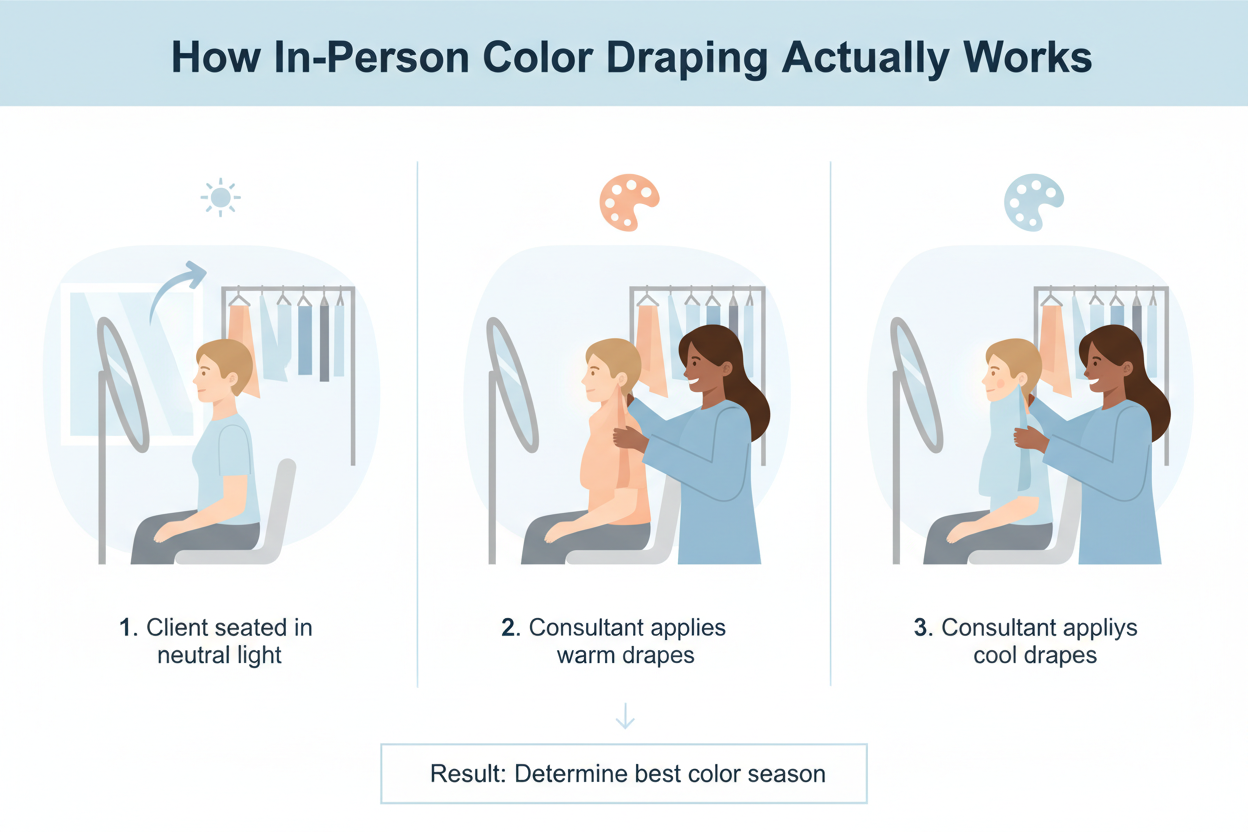
The analyst watches your face as each drape goes on, looking for specific reactions: shadows appearing under the eyes, skin going sallow or staying clear, lines and texture sharpening or softening. These are called color shifts, and seeing them happen in real time is the main thing in-person work has going for it. The changes can be subtle and quick, and a trained eye catches them more reliably than a camera does.
What the in-person process typically includes:
- A pre-consultation to discuss your coloring history and goals
- Makeup and accessories removed so they don't interfere with the assessment
- Sequential draping under consistent lighting
- Live observation of how each color interacts with your skin, eyes, and hair
- A final season or palette determination with explained reasoning
- Usually a physical or digital copy of your palette to take home
The value isn't just the result — it's the conversation. You can ask why a particular drape is making your skin look uneven, or why two similar colors land differently. That back-and-forth teaches you something a report or quiz result doesn't.
The practical constraints are real: finding a qualified analyst nearby isn't always easy, sessions run 1.5 to 3 hours, and costs vary by market and analyst experience. Geographic access is a genuine barrier if you're outside a major city.
How Digital Color Analysis Works
Digital color analysis isn't one thing. It's a category that covers several meaningfully different approaches, and which type you're using matters a lot for how much you should trust the result.
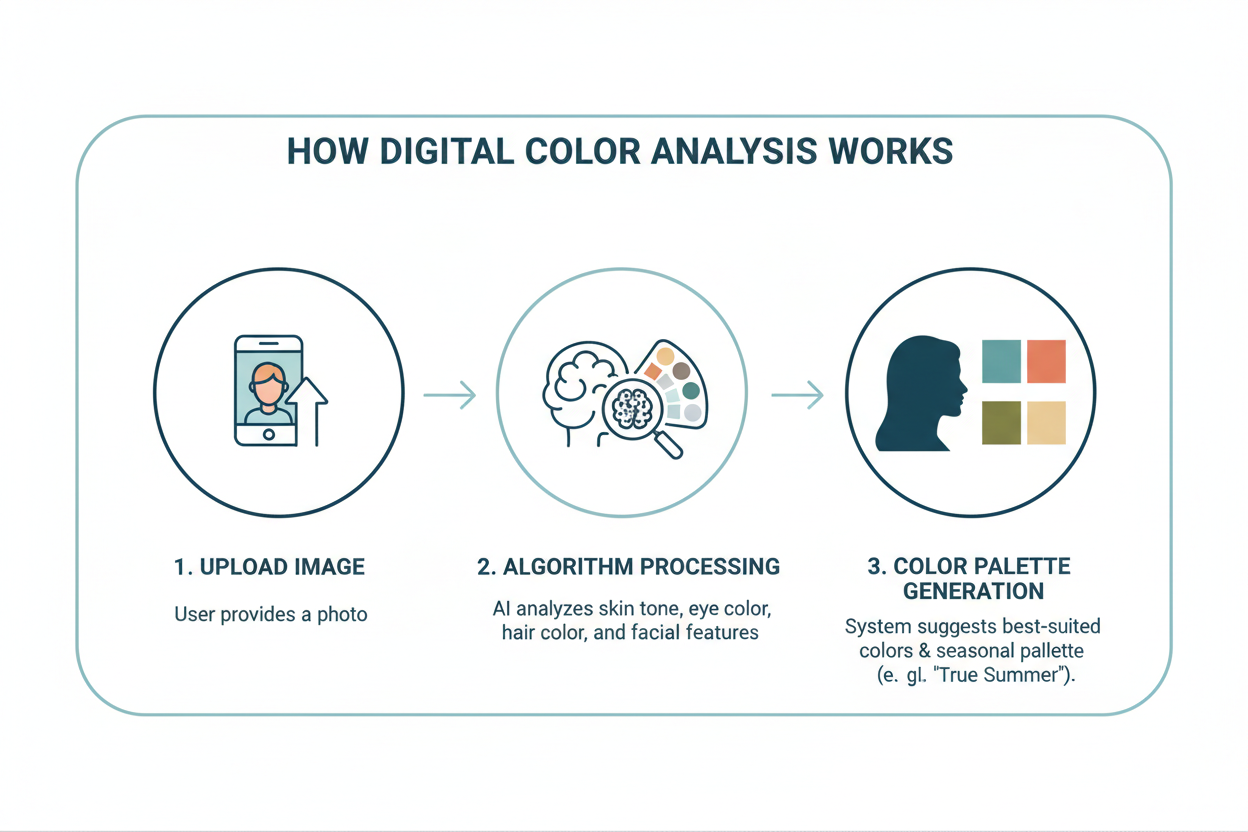
The three main formats are:
- Automated quiz or AI photo tools — You upload photos or answer questions about your features, and an algorithm returns a season or palette. No human analyst is involved.
- Analyst-reviewed photo submissions — You send photos (often taken under specific lighting conditions) to a trained stylist, who manually reviews them and provides a written or video report.
- Live video consultations — A real analyst works with you over a video call, using the same observational logic as an in-person session, adapted for screen.
Each has a different accuracy ceiling. Practitioners like Julia from Color Analysis Studio have shown that skilled analysts can do meaningful color analysis remotely, as long as the protocols are careful. That word — protocol — is the whole thing. The quality of the process on both ends determines whether you can trust the result.
What a structured digital session typically involves:
- Specific photo or lighting requirements sent in advance
- A review of your features by an analyst (or algorithm, depending on the format)
- A seasonal or palette result with supporting explanation
- Sometimes a follow-up Q&A or revision if results feel off
The accessibility advantages are real. Digital formats cut out travel, often cost less, and reach people in places where no qualified analyst works locally.
Accuracy: Where Each Method Wins and Where It Falls Short
This is the question most people actually want answered. Short version: in-person draping has a higher theoretical accuracy ceiling, but digital analysis can be highly accurate when done well — and in-person analysis isn't infallible either.
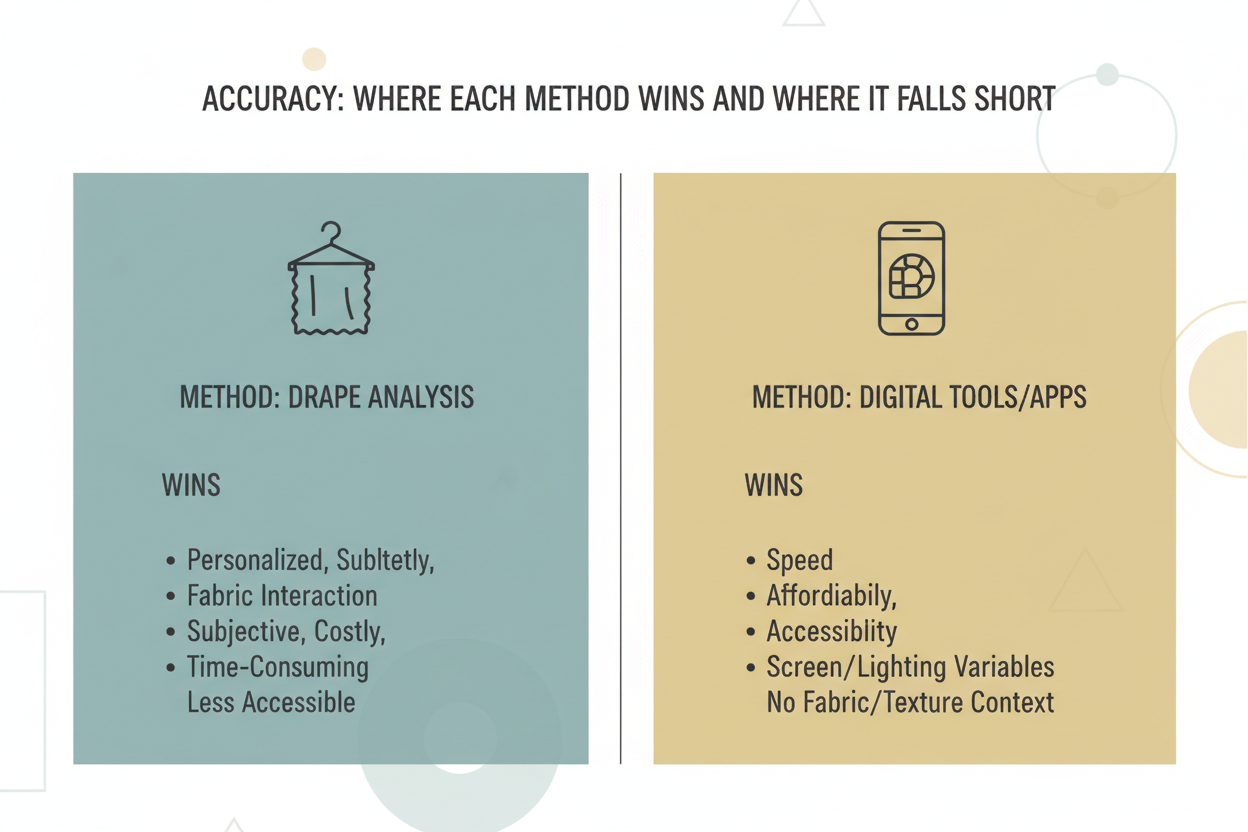
Where in-person analysis has an edge:
- A trained analyst watching live color shifts under controlled lighting is reading information no camera currently captures with full fidelity
- Controlled lighting removes one of the biggest variables in color perception
- Real-time adjustment — the analyst can try edge cases or borderline drapes to refine the result
- Human observation of subtle texture changes and shadow patterns is more nuanced than current image analysis
Where digital analysis is genuinely competitive:
- A skilled remote analyst working from good photos in natural light can reach accurate conclusions for most clients
- For people with clearly defined coloring (high contrast, obviously warm or cool), digital tools frequently agree with in-person results
- Video consultations preserve much of the observational back-and-forth that makes in-person sessions useful
- Automated tools, while less precise, can identify broad seasonality correctly often enough to be a reasonable starting point
The honest limitations of each:
| Method | Key Limitation |
|---|---|
| In-person | Analyst subjectivity; geographic and cost barriers; no universal certification standard |
| Digital (AI/photo) | Photo lighting variability; camera color reproduction; lack of live adjustment |
| Digital (video/analyst) | Screen color calibration; reduced lighting control; harder to catch subtle shifts |
Neither method is immune to getting it wrong. The difference is in where error is most likely to enter the process.
The Lighting Problem: Why Your Phone Camera Affects Your Results
Of all the technical limitations in digital color analysis, inconsistent lighting is the most consequential and the most commonly overlooked.
Your phone camera doesn't capture color the way a human eye does. It auto-adjusts white balance, applies computational processing, and interprets ambient light in ways that can shift undertone readings significantly. A photo taken under warm indoor lighting can make a cool-toned complexion look neutral or warm. A photo in shade can push warm undertones cool. These aren't small errors — they can produce a completely different seasonal result.
The problem gets worse with filters, color correction apps, or even the default "enhance" function many gallery apps apply automatically. What you submit may look accurate on your screen but read differently to the analyst or algorithm on the other end.
Practical steps to reduce the lighting problem:
- Take photos in indirect natural daylight — outdoors in open shade, or near a large north-facing window
- Avoid direct sunlight, which creates harsh shadows and blows out undertones
- Turn off artificial lighting if you're shooting indoors
- Use portrait or standard mode with all filters and enhancements off
- Take a few photos from different angles and in slightly different conditions so an analyst has options to work with
- Don't edit the photos before submitting — send the raw file if you can
No mitigation fully closes the gap between a photo and a live observation. But a poorly lit photo and a well-lit one can produce completely different results. If you're putting time into a digital consultation, this part is worth getting right.
Practical Factors That Should Drive Your Decision
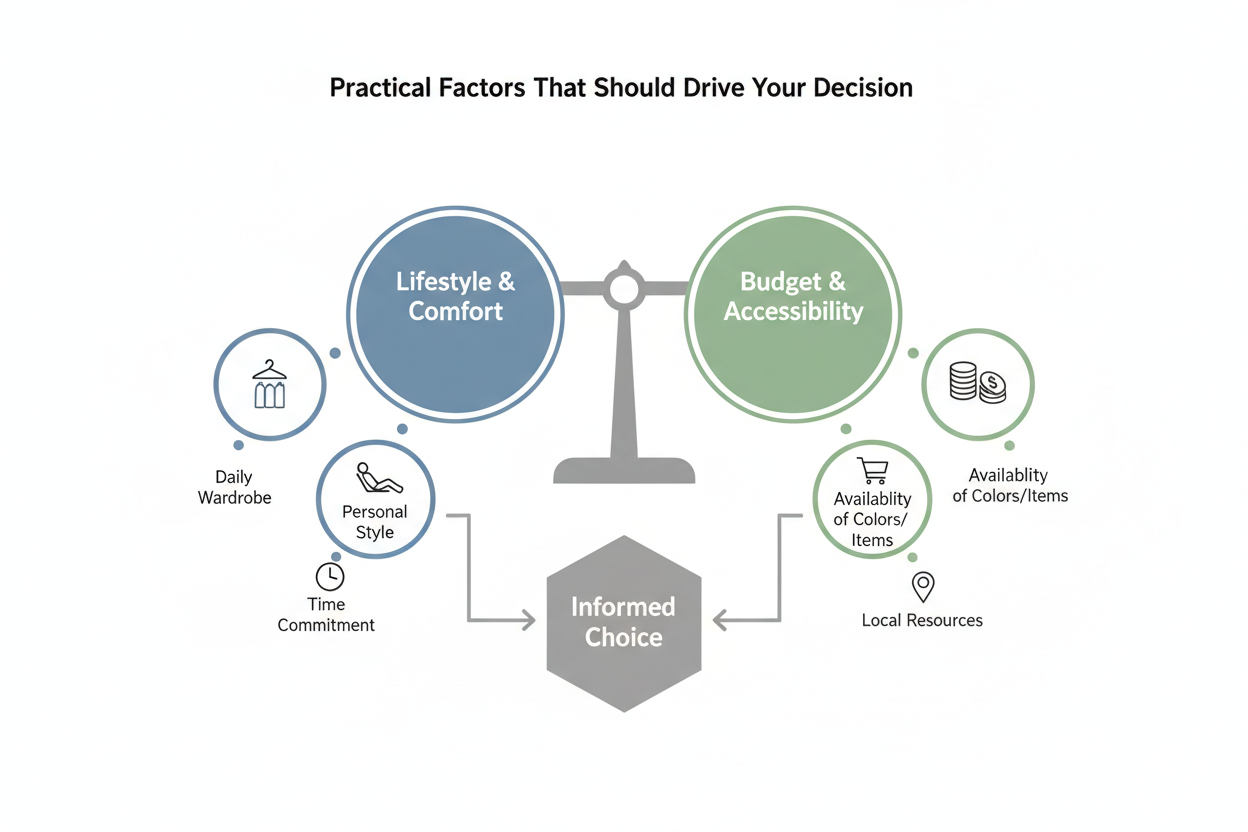
Abstract accuracy comparisons only go so far. For most people, the deciding factors are practical.
Cost
In-person consultations vary widely depending on the analyst's experience, location, and session length. In major markets, expect to pay $150 to $400 or more for a full draping session. Digital options range from free (basic AI tools) to $50–$150 for analyst-reviewed photo reports or video sessions. For many people, the cost difference settles the question.
Geographic access
Qualified in-person analysts are concentrated in cities. If you live somewhere smaller or rural, finding a certified practitioner may mean real travel. Organizations like House of Colour have stylist search tools, but availability varies a lot by region. Digital analysis sidesteps this entirely.
Time commitment
A full in-person session typically runs 1.5 to 3 hours, not counting travel. Digital options range from a few minutes (automated tools) to under an hour for a video consultation. If your schedule is the main constraint, digital is the easier call.
Comfort with the process
Some people learn best in person — seeing the drapes, asking questions as they come up, hearing the analyst explain each observation live. Others are fine working through a written report or video breakdown on their own time. Neither is wrong. The honest question is which format you'll actually use, not just which one is technically available to you.
Technology comfort
Live video consultations need decent lighting, clear audio, and some comfort with video software. Photo-submission formats are less demanding but still require attention to lighting. Fully automated tools need nothing beyond an internet connection.
When In-Person Analysis Is Worth the Extra Effort
A few situations make the added cost and logistics genuinely worth it.
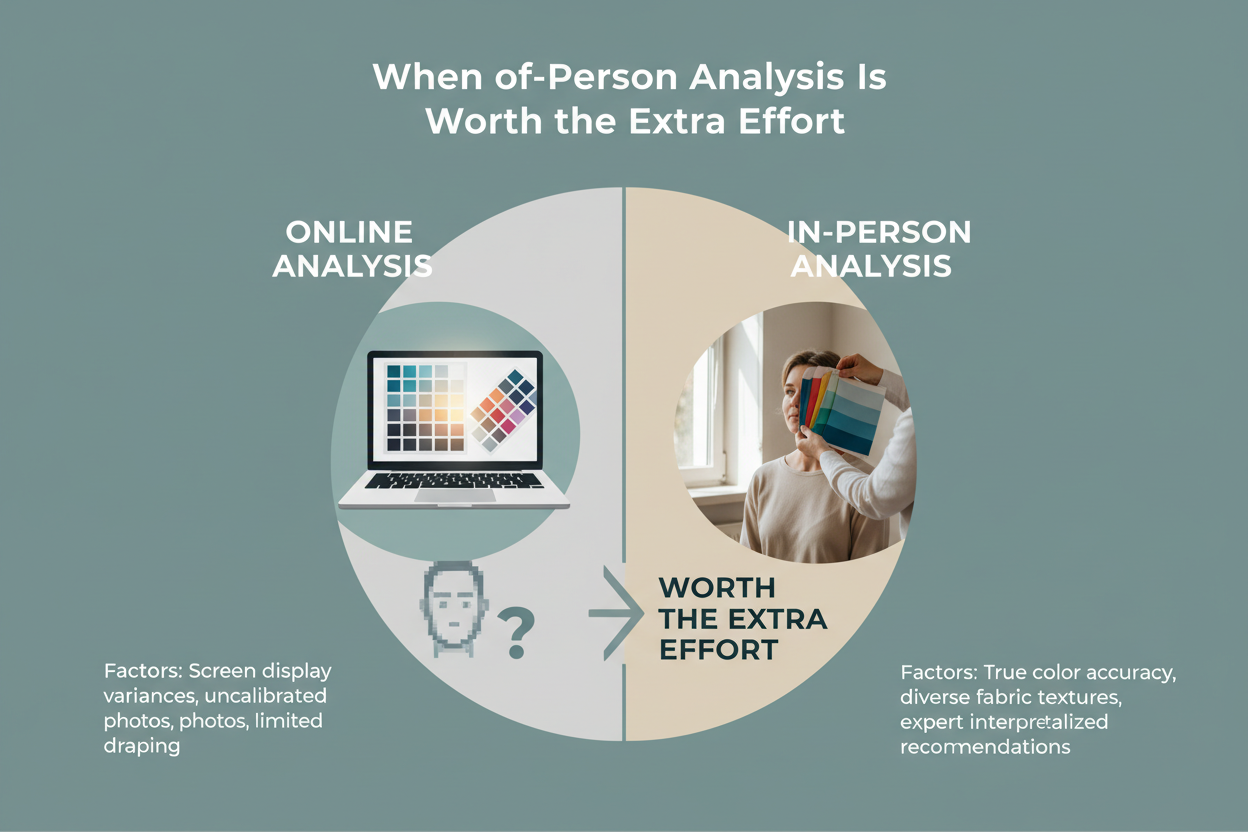
You're on a borderline between seasons. Live draping is the most reliable way to distinguish a Soft Summer from a Soft Autumn, or a True Spring from a Light Spring. If you've done digital analysis and kept getting different answers from different tools, that's a sign your coloring is hard to classify remotely. An analyst watching your skin respond in real time has the best shot at resolving it.
You're a visual and tactile learner. Watching the drapes shift how your skin looks — and actually handling the fabrics — creates a different kind of memory than reading a report does. If you want to internalize your palette rather than just look it up, the in-person process tends to stick.
You have a specific professional reason. People in color-adjacent fields — styling, fashion buying, consulting — often get more out of an in-person session because they can observe why certain colors work, not just which ones do. That's harder to get from a digital result.
You've already tried digital analysis and something felt off. If the result never quite fit, or you got conflicting answers across multiple tools, in-person is the most reliable way to settle it.
In-person analysis isn't better for everyone. But for these situations, the gap between the two methods is real.
How to Get Started with Digital Color Analysis Today
If in-person analysis isn't accessible right now — cost, location, schedule, whatever the reason — digital analysis is a real starting point, not a consolation prize. The main thing is knowing which type of tool you're actually using and what it can reasonably tell you.
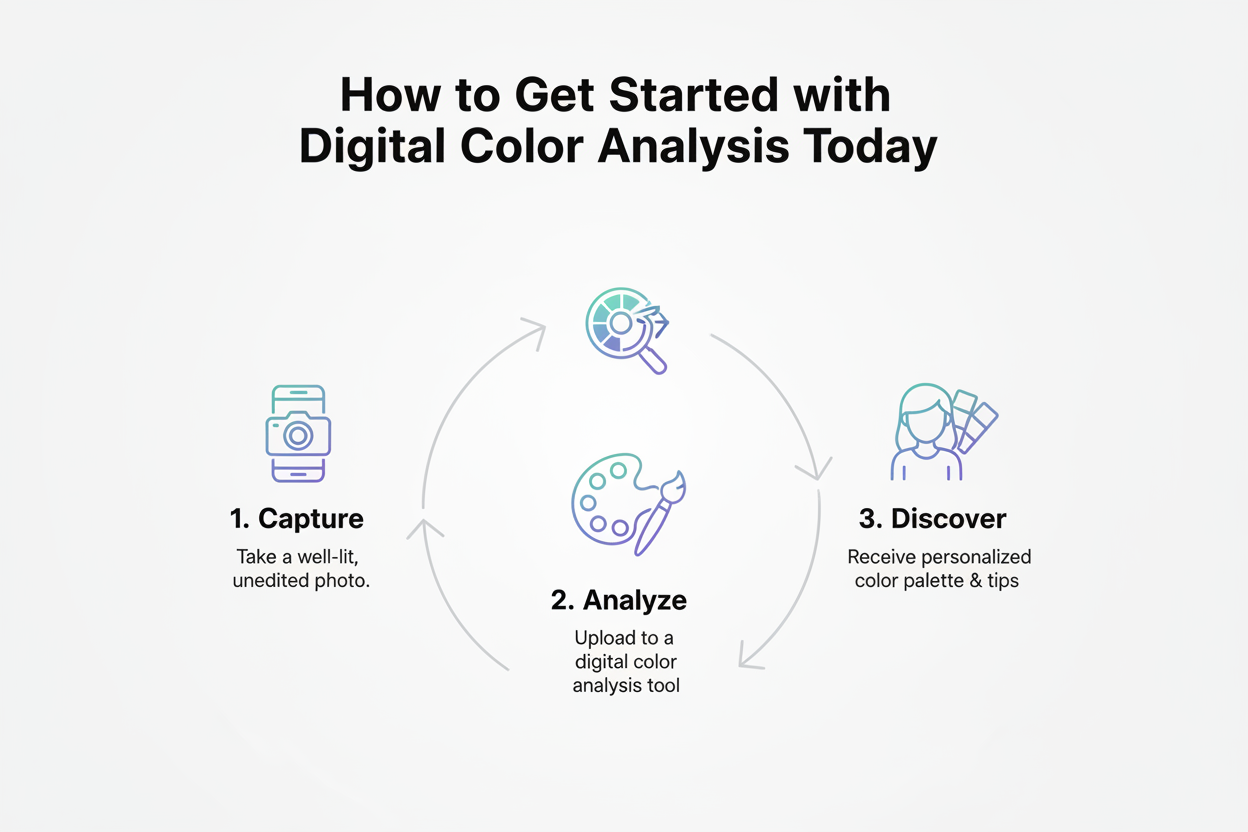
A fully automated AI quiz gives you a directional result. It's most useful if you're new to color analysis and want some orientation before spending more time or money. Treat it as a hypothesis, not a verdict.
A photo-submission review by a trained analyst gets you much closer to a real assessment, as long as your photos meet the lighting standards described above. The gap between this and in-person analysis exists, but it's narrower than most people expect.
A live video consultation with a qualified stylist is the closest digital equivalent to sitting across from someone. You lose some of the live color-shift observation, but you get real-time dialogue, follow-up questions, and a human making judgment calls rather than an algorithm returning a match.
AI Tools vs. Live Video Consultations: Not the Same Thing
Worth saying directly: an AI photo tool and a live video session with a trained analyst are not comparable in accuracy, even though both get labeled "digital color analysis."
An automated tool runs pattern recognition on your uploaded image. It can't ask you to step into better light, notice that your photo looks artificially warm, or rethink its assessment because something looks borderline. It returns whatever the algorithm was trained to see — and that training has real limits, especially for undertones that don't photograph cleanly.
A human analyst working over video can do most of what they'd do in person, short of physical draping and the subtlest live observations. They can ask you to shift your position, change your lighting, take off a scarf, or describe what you're noticing. That back-and-forth changes the accuracy considerably.
Practitioners who have built remote color analysis practices — like Julia from Color Analysis Studio, who works with clients across digital formats — show that human-led remote analysis is a legitimate professional service, not a workaround. The format is different from in-person, but the process is the same.
If you're weighing digital options, the thing worth remembering is this: who is doing the analysis matters as much as the format it happens in.
People Also Ask
Is digital color analysis as accurate as in-person draping?
It depends on what kind of digital analysis you're talking about. A live video session with a trained analyst can get surprisingly close to in-person accuracy — they can still see your features, ask you to fix your lighting, and work through the same reasoning an in-person session would. Good natural light closes the gap further.
The bigger accuracy difference shows up with automated AI tools and photo-submission services. Take out the live human judgment and you lose the ability to catch subtle undertone shifts or sort out borderline results. If your coloring is clear and defined, automated tools often get it right. If it's more complex or sits between categories, in-person draping is still the more reliable call.
Short version: human-led digital analysis can be genuinely accurate. Automated tools are a decent starting point, not a final answer.
Can you get your colors done online?
Yes, and it's a real option, not a compromise. A few formats exist depending on your budget and how much detail you want:
- Free or low-cost AI tools that analyze photos or quiz answers and return a seasonal result
- Photo-submission services where a trained analyst reviews your images and sends back a written or video report
- Live video consultations with a qualified stylist that get reasonably close to the in-person experience
The result you get depends on the format and how carefully you prepare — lighting matters a lot, whether you're submitting photos or setting up a video call. A good photo submission to a skilled analyst will often beat a rushed in-person session with someone who isn't very experienced.
How much does an in-person color analysis consultation cost?
Prices vary a lot depending on where you live, how experienced the analyst is, and what the session includes:
- Major cities or experienced analysts: $150–$400 or more for a full draping session
- Smaller markets or newer analysts: $75–$150 is more common
- Digital alternatives: Free for basic AI tools; $50–$150 for analyst-reviewed photo reports or video sessions
The gap between digital and in-person is often big enough to settle the question on its own. If budget is the main concern, a video consultation with a trained stylist gives you real value at a fraction of the cost.
What is the difference between seasonal color analysis done online vs in person?
The core framework is the same either way: both methods try to identify which seasonal palette fits you best, based on your skin's undertone, your natural contrast level, and the depth and clarity of your coloring. What differs is how that assessment actually happens.
In person, a trained analyst drapes physical fabric swatches across your shoulders under controlled lighting and watches how your skin, eyes, and face respond in real time. Those live color shifts are the most reliable signal available.
Online, the analyst or algorithm works from photos or video rather than direct observation. You get accessibility and lower cost. You give up some of the real-time precision that physical draping provides, which matters most when the result is borderline and subtle shifts are what settle the question.
For most people, the seasonal result comes out the same regardless. Where the method actually matters: complex undertones, borderline palettes, or coloring that doesn't read clearly through a camera.
Do I need a professional stylist for color analysis or can I do it myself?
You don't strictly need a professional, but it's worth knowing what self-analysis can and can't tell you.
AI tools and photo quizzes can point you in a useful direction — particularly if your coloring is clearly warm or cool and your contrast is easy to read. A lot of people use those results to experiment with their wardrobe before committing to anything more formal.
The harder part is objectivity. You see your own face in constantly changing light, and you already have opinions about what looks good on you. Both of those things skew self-assessment. A professional — in person or over video — doesn't have that baggage.
A reasonable path for most people: start with a digital tool, use the result to test a few low-stakes wardrobe choices, and book a consultation if you're still uncertain or want something you can actually rely on.
FAQ
Is digital color analysis as accurate as in-person color draping?
For most people, yes — a well-executed digital analysis lands in the same place in-person draping would. The accuracy gap is real, but smaller than people tend to assume, and it shrinks further when a trained analyst is doing the work rather than an automated tool.
Where in-person draping has a genuine edge is in borderline cases. Watching how your skin actually shifts under different physical swatches, in controlled lighting, gives an experienced analyst information a camera can't fully capture. If your coloring sits between two seasons or your undertones are subtle, that live feedback matters.
For most clients with clearly defined coloring, the difference in outcome is minimal.
What are the biggest disadvantages of online color analysis?
The most common limitations to know before you start:
- Camera and screen distortion — Even a well-calibrated camera interprets color differently than the human eye, and monitor settings vary from device to device
- Lighting dependency — Poor or mixed lighting when photos are taken can shift how your skin tone reads, leading to incorrect undertone assessments
- No live draping feedback — The real-time color shift that happens when a swatch is held up to your face cannot be replicated through a static photo
- Variable analyst quality — Digital services span a wide range of practitioner experience, and there's no universal standard to filter by
- Automated tools lack nuance — AI and quiz-based tools work well for clearly defined coloring but often struggle with complex or borderline results
None of these are dealbreakers. They're just things worth knowing before you start.
How do I find a qualified in-person color analyst near me?
A few practical approaches:
- Search by training system — Many analysts train through established programs like House of Colour, Kettlewell, Color Me Beautiful, or Dressing Your Truth. Their directories are a good place to start because the practitioners are vetted.
- Ask about credentials and training — A qualified analyst should be able to tell you clearly how they trained and which system they use. If they can't, that's worth noting.
- Look for portfolio work — Analysts who share before-and-after client results give you something concrete to evaluate.
- Check local style communities — Forums, Facebook groups, and subreddits focused on personal style often have location-specific recommendation threads buried in the archives.
If nobody qualified is nearby, a live video consultation with a remote analyst who uses physical swatches on their end is usually the closest alternative.
Can bad lighting in my photos affect my digital color analysis results?
Yes — lighting is one of the most significant variables in digital color analysis accuracy. Specific problems to watch for:
- Warm artificial light (incandescent or yellow-toned bulbs) adds an orange cast that can make cool-toned skin read as warm
- Cool fluorescent light shifts skin in the opposite direction, making warm undertones harder to detect
- Mixed lighting from multiple sources creates competing color casts that are difficult for any analyst or algorithm to filter out
- Flash photography flattens depth and washes out the subtle tonal variation analysts rely on
Shoot near a window in natural daylight, facing the light, with no overhead artificial lighting in the frame. Getting this right before you submit anything does more for your results than most people expect.
Which method is better for beginners who have never had their colors done?
For a first-time experience, digital analysis is a reasonable starting point, and for many people it's enough.
Starting digitally lets you get a feel for the seasonal framework without spending much upfront. You can test your result in a low-stakes way before touching your wardrobe, and by the time you sit down with a professional you'll already know the vocabulary.
The main risk for beginners is taking an automated result as settled fact. Better to treat it as a working hypothesis: wear the colors, notice what happens, and check in with a professional (in-person or by video) if something feels off.
If you have the access and budget and want the most reliable answer right away, start in-person.
How long does each type of color analysis session typically take?
Session lengths vary by practitioner and format, but here are general ranges to plan around:
| Format | Typical Duration |
|---|---|
| In-person draping session | 1.5 – 3 hours |
| Live video consultation | 45 minutes – 1.5 hours |
| Photo-submission service (turnaround) | 2 – 7 days |
| AI or quiz-based tool | 5 – 15 minutes |
In-person sessions run longest because they include the full draping process, a walkthrough of your results, and often some guidance on makeup and wardrobe. Video consultations cover similar ground but tend to move faster. Photo submissions cut out real-time interaction entirely, so the "session" is really just however long it takes you to prep and send your images.
Is digital color analysis worth it if I can't afford an in-person consultation?
Yes. A thoughtfully done digital analysis gives you real, actionable information, and for many people it's the most realistic way to get their colors done at all.
The practical value is real even from a basic result: knowing your season helps you shop more deliberately, cuts down on wardrobe mistakes, and gives you a consistent framework for decisions about clothing, makeup, and hair color. You don't need in-person draping to get that clarity.
A few ways to get the most out of a digital approach on a limited budget:
- Use a reputable AI tool to get an initial result, then test those colors against your skin in natural light to see what holds up
- Look for photo-submission services from trained analysts — they typically cost less than live video sessions but still involve human judgment
- Come back to a live video consultation once your budget allows, especially if your initial result felt uncertain
Take the free color analysis quiz and get a starting result you can build on.
For the next diagnostic or service-choice step, continue with the companion article “AI Personal Color Analysis From a Portrait”, which keeps the two closely related questions distinct.