Deep Autumn Greens and Yellows
 Reviewed by Alexandra Gilmore
Deep Autumn greens and yellows need richness and warmth, not the light freshness associated with Spring. Compare olive, moss, forest, mustard, ochre, and amber at different depths, then pair them with espresso, rust, teal, or burgundy to keep outfits grounded rather than muddy.

Picture the floor of a mature forest in late October: fallen leaves turning the colour of wet earth and dried moss, low amber light catching on pools of standing water, the deep olive canopy filtering the last warm rays of the year. That scene is the closest real-world equivalent to the Deep Autumn colour palette — and nowhere is it more vividly expressed than in its greens and yellows.
💫 Explore Seasonal Color Analysis
Use the distinctions in this article to narrow the possibilities, then compare the seasonal system as a whole. Seeing the neighboring palettes together makes the result easier to test in real clothing and daylight.
Learn Seasonal Analysis →Deep Autumn (also called Dark Autumn) sits at the intersection of the Autumn and Winter families in 12-season colour analysis. Its defining character is depth. Where True Autumn leans warm and golden, and Soft Autumn leans muted and hazy, Dark Autumn pushes every hue toward its darkest, richest expression. Colour analysts consistently describe the palette as "full of depth and mystery — like an autumn forest at sunset," with signature tones including rich forest greens, dark chocolates, and burgundies alongside spiced, earthy golds.
Greens and yellows are among the most versatile and wearable categories within this palette. For a Dark Autumn, the right shade of forest green or harvest gold can:
- Function as a neutral base in place of black or navy
- Bring immediate warmth to the face without overpowering natural colouring
- Create high-impact, tonal outfits that feel grounded rather than garish
- Translate across casual, professional, and formal contexts
This guide focuses specifically on those hues. You will find a breakdown of exactly which greens and yellows belong to the Deep Autumn palette, how they differ from related seasons, how to combine them in outfits and makeup, and how to avoid the most common mistakes — such as reaching for a shade that is too bright, too cool, or too pale to serve you well.
Whether you are newly confirmed as a Dark Autumn or simply refining your wardrobe around deep autumn greens, this article will give you the precision and practical detail to shop, style, and wear these colours with confidence.
What Makes a Green or Yellow 'Deep Autumn'
Not every green or yellow works in a Dark Autumn wardrobe. Three things have to line up: depth, warmth, and muted saturation.
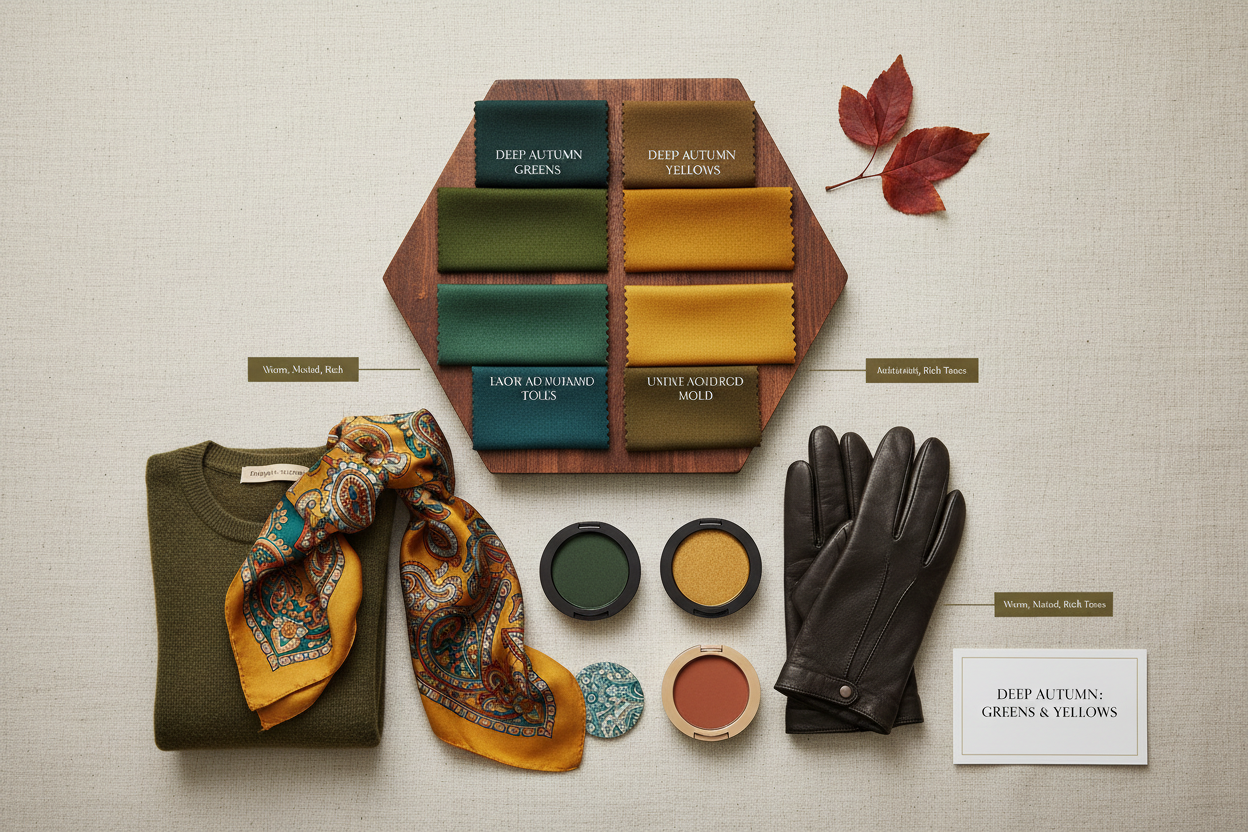
Depth means the color carries enough darkness to sit comfortably with Dark Autumn coloring — deeper skin undertones, medium-to-dark hair, eyes with visible warmth or intensity. Pale mint, lime, or lemon yellow are too light; they float above the coloring instead of settling into it.
Warmth means every qualifying green tilts toward yellow rather than blue, and every qualifying yellow tilts toward amber or ochre rather than white or acid tones. A blue-leaning teal or an icy chartreuse won't work here.
Muted saturation is the subtler one. Dark Autumn greens and yellows are rich and full-bodied, but they're not neon or electric. Think pigment deepened with a touch of brown or gold, not brightened with white. That's what separates a Dark Autumn forest green from a True Summer sage (too cool and pale) or a True Spring grass green (too bright and clear).
Compared to True Autumn, the greens go noticeably darker — a True Autumn copper-green becomes a Dark Autumn forest green. Compared to Soft Autumn, the depth increases and the haziness drops off — Soft Autumn greens are dustier and lighter, where Dark Autumn greens are denser and more saturated.
If you're not sure whether your palette is actually Dark Autumn, that uncertainty is worth paying attention to — take our colour analysis quiz to confirm your season before building a wardrobe around these colors.
The Core Deep Autumn Green Family: From Forest to Olive
The greens in the Dark Autumn palette run from deep forest shadow to the golden-edged light at the canopy's edge — the full range of an actual autumn afternoon in the woods.
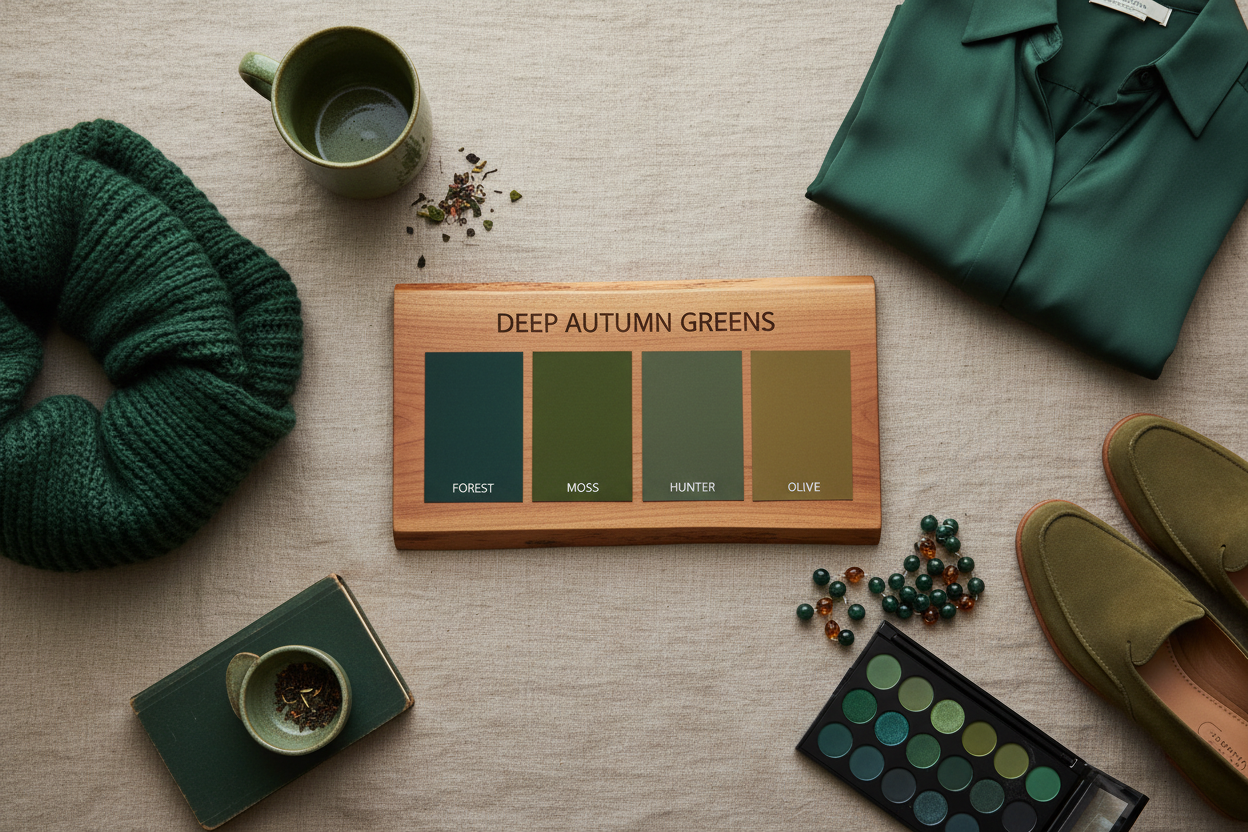
Rich forest green is the anchor. Dark, warm-toned, and closer to hunter green in depth — but without the cool blue that hunter green sometimes carries. Think of the deep interior of a forest at dusk: dark and lush enough to glow rather than grey out.
Moss green sits a step lighter and more yellow. It reads as aged and organic — lichen on bark, damp ground cover. A workhorse tone that bridges the greens into the palette's neutral territory.
Olive green leans so far toward gold that it can read as a warm neutral rather than an obvious green. This makes it one of the most versatile shades in the entire Dark Autumn range — it sits more naturally alongside brown and camel than with jewel tones.
Bronze-green and dark khaki round out the family. Transitional shades that blur the line between green, brown, and gold, and feel completely at home in a warm-dark palette.
Forest Green vs. Olive: Understanding the Depth Difference
Forest green and olive sit at opposite ends of the Dark Autumn green axis. Knowing the difference helps you dress with intention.
Forest green is the deeper end. Not cool in the seasonal sense — darker and more saturated. It holds its own as a statement color and works best in larger surface areas: a coat, a structured dress, wide-leg trousers. Against Dark Autumn skin, it creates immediate impact — the kind you might want for an evening look or something more dressed up.
Olive is the shallower, warmer end. More golden, more neutral, more forgiving. It works as an everyday neutral the way taupe or camel does for other palettes. If forest green is the deep interior shadow, olive is the edge of the canopy where green and amber light are still mixing.
A useful rule: if your natural coloring runs deep — very dark hair, deep skin — you can carry forest green in prominent placements. If your Dark Autumn coloring sits at the lighter end, or you just want something easier to reach for daily, olive is the more reliable starting point.
Deep Autumn Yellows and Golds: Amber, Ochre, and Harvest Tones
The yellows in Dark Autumn never go pale, bright, or cool. Every one of them is grounded in golden or earthy depth — the kind of amber light you'd see filtering through a forest canopy at dusk.
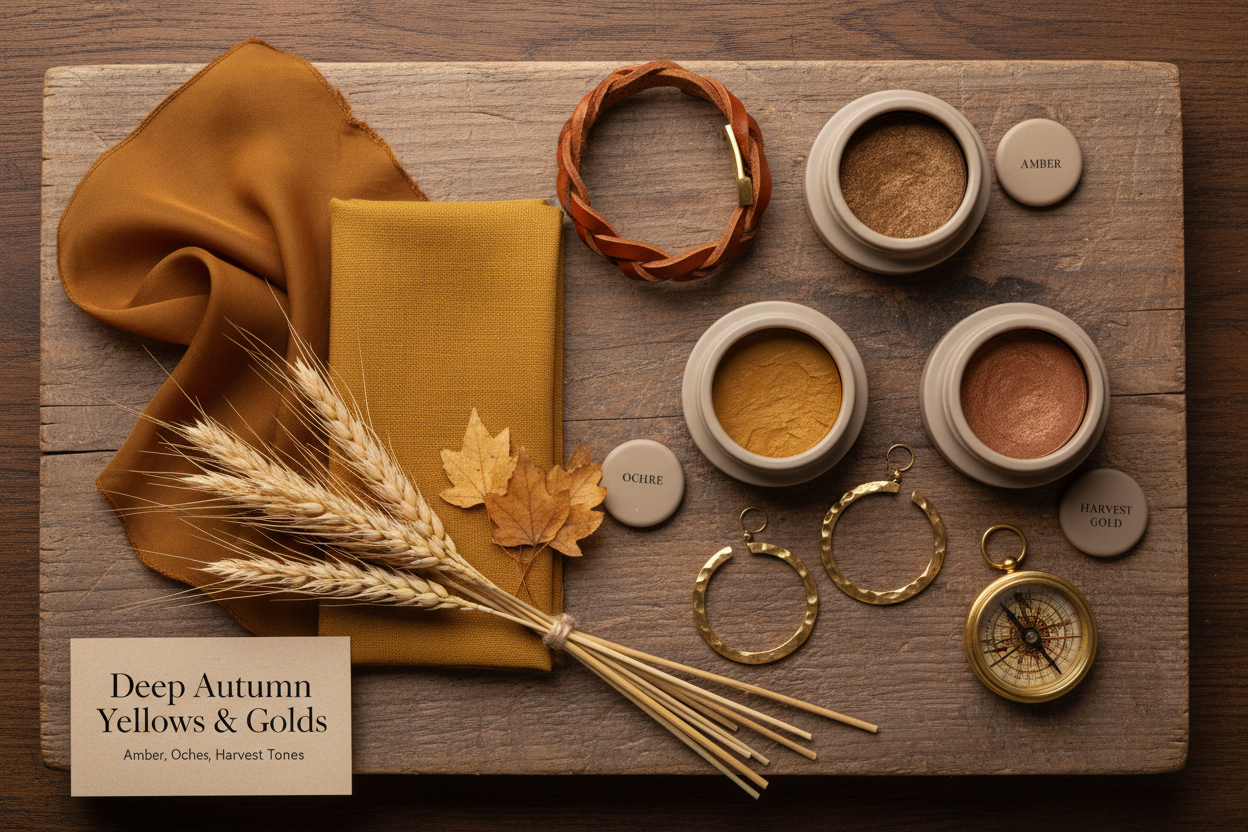
Amber is the signature yellow-orange of the group: warm, deep, and luminous the way backlit autumn leaves are. It works as an accent and, in darker versions, pulls toward neutral territory.
Ochre is amber's earthier sibling. More yellow, more muted, with a mineral quality, as though the pigment was mixed with clay. It's one of the most wearable shades in the palette because it reads warm without feeling loud.
Mustard sits a bit sharper and more saturated than ochre. It's deliberately warm and has that "spiced" quality analysts tend to associate with Dark Autumn overall.
Harvest gold and dark gold push further into richness — deep, burnished tones closer to antique metal than to anything you'd call bright yellow. These are the accents that keep an all-dark outfit from feeling heavy.
What disqualifies a yellow from Dark Autumn? Cool yellows that lean green or lime without the amber base. Pale yellows that lack depth. Acid or neon yellows that blow past the palette's muted-saturation limit. Lemon yellow is the clearest example of what doesn't work — it's cool and clear, which is exactly what this palette isn't.
How Deep Autumn Greens and Yellows Work Together in an Outfit
The greens and yellows in the Dark Autumn palette come from the same source — think forest floor, leaf litter, late-afternoon light through branches. Because they share that warm, deep origin, they sit naturally next to each other. The real question is which shade does the heavy lifting as a neutral and which one gets to be the accent.
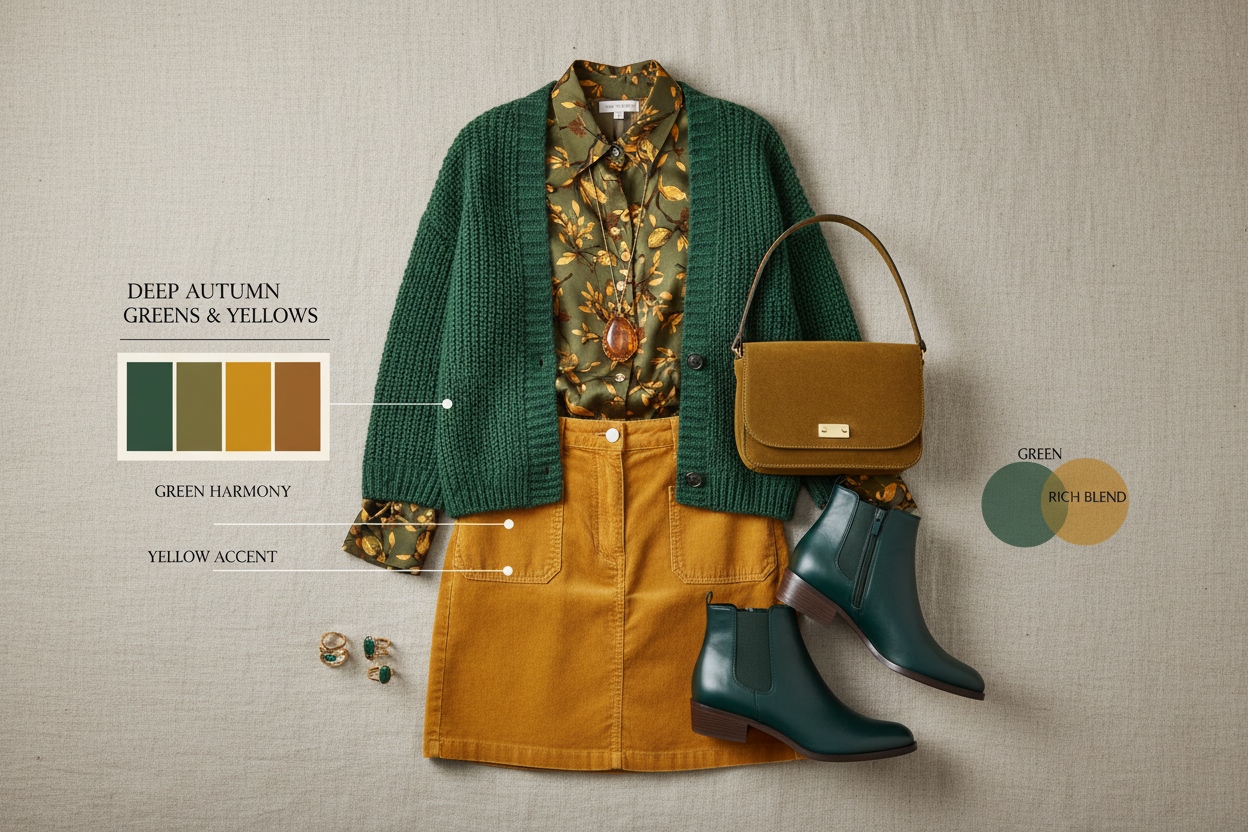
The tonal approach: Pair forest green with moss green for a deep, earthy monochromatic look. A bronze-green belt or bag completes the layering without pulling focus. Texture helps here — a suede coat over a knit sweater, say — because the depth variations read as deliberate richness rather than a mistake.
The grounded contrast approach: Use olive or dark khaki as your base (trousers, a wide skirt, a shirt-jacket) and bring in amber or mustard as the accent through a scarf, shoe, or structured bag. Both tones share the same underlying warmth, so they connect; the value difference between olive and amber gives the outfit just enough contrast to feel considered.
The statement approach: In a single-colour outfit built around forest green or rich ochre, bring in a second member of the same family — lighter or darker — rather than introducing a fully contrasting colour. A forest green dress with a dark amber wrap. Mustard trousers with an olive-toned shirt. The palette is vivid enough that loading in additional colour quickly tips from rich to busy.
Using Olive as a Neutral Base with Amber Accents
Olive works as the true neutral of the Deep Autumn green family because it contains enough yellow to connect naturally with every amber and gold in the palette, and enough brown to sit comfortably alongside dark chocolate and cognac.
A practical formula: olive as the base, amber or ochre as one accent, deep brown or dark gold as the grounding element. This three-colour combination works as trousers + top + accessory, or jacket + dress + shoe — it holds together because all three tones share the same warm-dark axis.
The thing to avoid is over-brightening. When you add an amber or mustard accent to an olive base, keep the amber at a medium-to-deep depth rather than reaching for a bright yellow. The point is warmth and richness, not contrast for its own sake.
Makeup Applications: Earthy Greens and Golden Yellows for Dark Autumn
The same colour logic that governs clothing applies to makeup, and the Dark Autumn green-and-gold family has some of the most wearable options around.
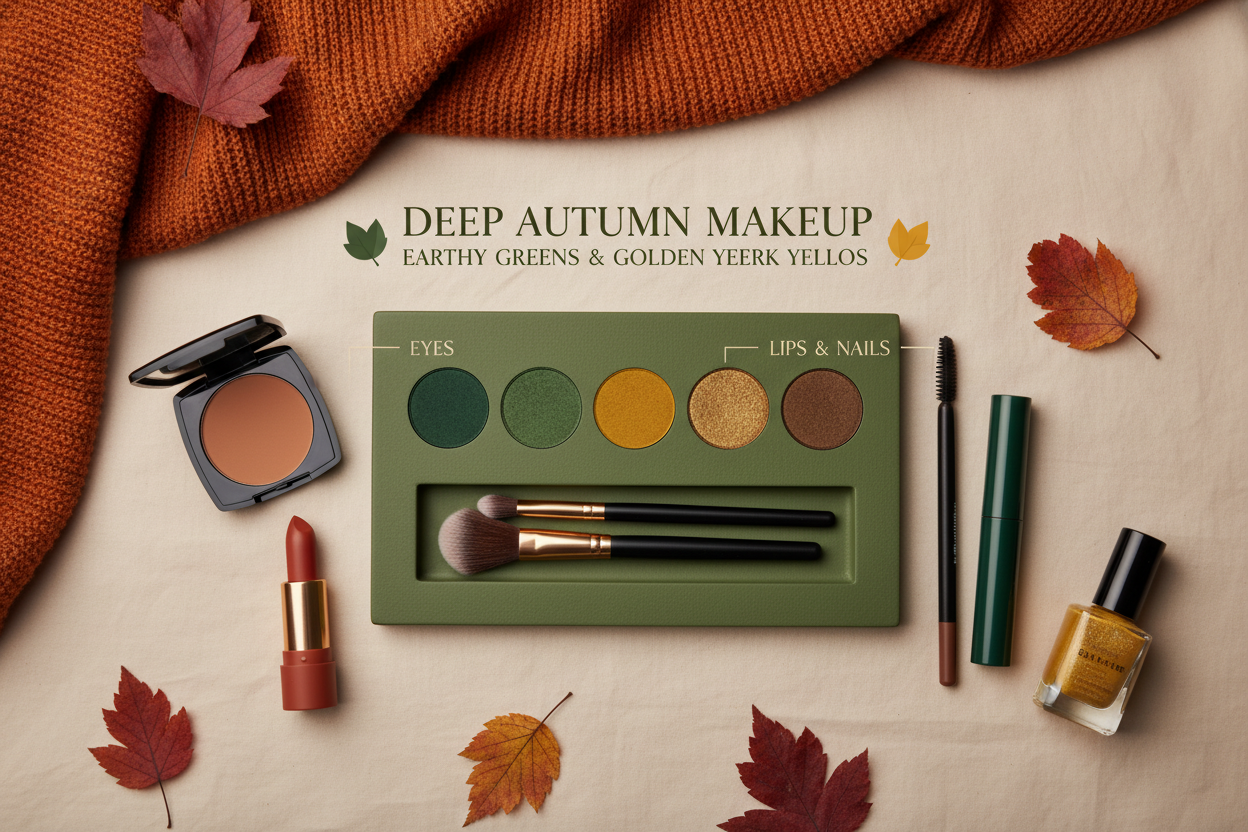
Eye shadow: Olive and moss green work well as transition and lid shades — earthy enough to look intentional rather than costume-like, warm enough to sit naturally with the golden-brown undertones most Dark Autumn eyes carry. A deeper forest green applied wet on the lid creates a statement eye that still reads as warm. Khaki or bronze-green layered into the outer corner and crease adds depth.
Liner: Deep forest green is a genuine alternative to black — it adds warmth and colour without sacrificing definition. It works particularly well on the upper lash line and waterline, where it picks up the depth of darker eye colours.
Highlight and accent: Gold-amber and warm ochre highlighters — matte or low-shimmer — sit naturally on the brow bone, inner corner, and cheekbone. Anything with a silver or pink base will look disconnected from warm-dark colouring, so avoid those.
Lips: Outside the scope of this article, but worth a quick note: golden-brown and amber-toned lip shades tie the look back to the same colour family, connecting eye and lip without requiring an exact match.
Common Mistakes When Wearing Deep Autumn Greens and Yellows
1. Reaching for too-bright greens. Emerald and vivid grass green have a clarity that falls outside the muted saturation of the Dark Autumn palette. They read as sharp rather than rich and pull the eye away from the face.
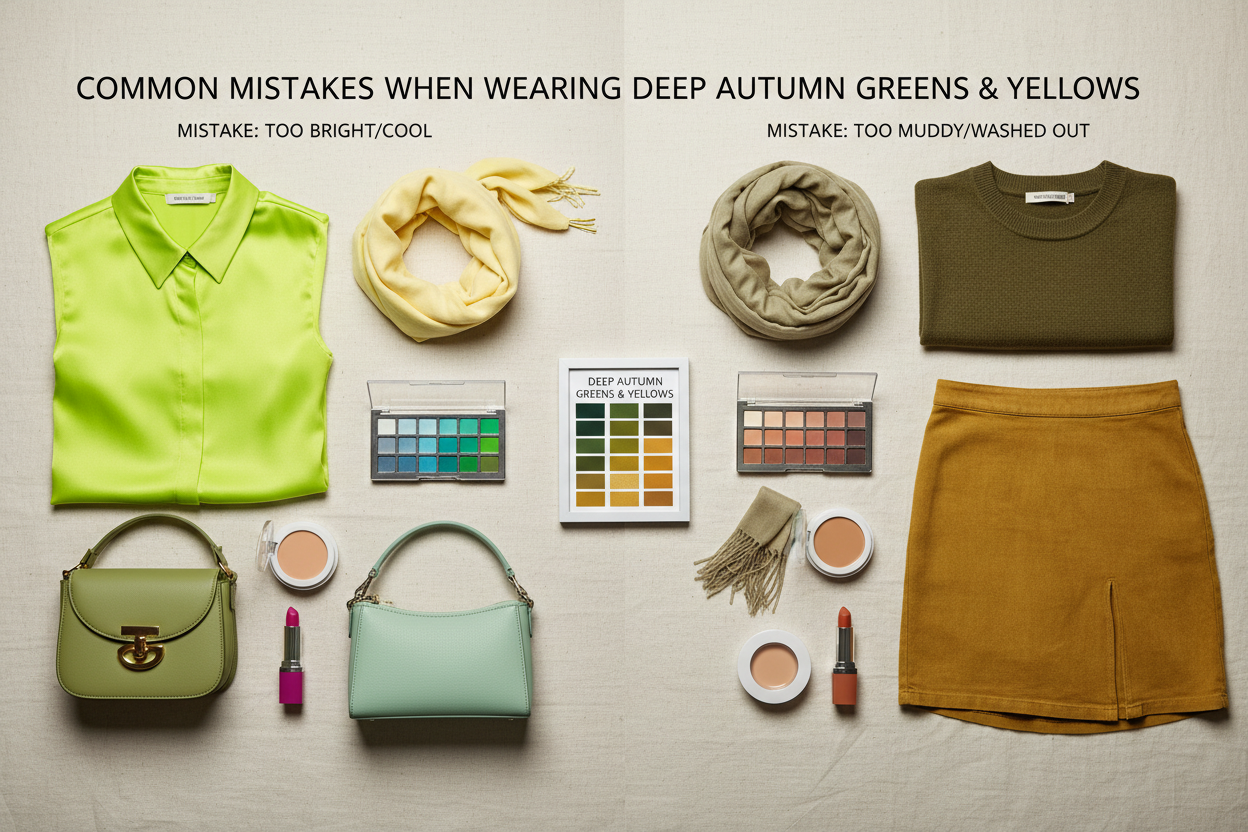
2. Choosing lime or yellow-green. These shades are both too cool (blue-shifted) and too bright. Against warm, deep Dark Autumn coloring, they create a contrast that makes the complexion look sallow or dull.
3. Wearing cool or pale yellows. Lemon, butter, and pastel yellow all lack the depth and warmth this palette needs. They wash out Dark Autumn coloring instead of enhancing it.
4. Over-saturating the outfit. Dark Autumn greens and golds are genuinely vivid within their muted range, so stacking multiple high-depth pieces without a grounding neutral can feel like too much. One statement color, one mid-tone, one true neutral — that's usually the limit.
5. Mixing in cool-season neutrals. Pairing forest green with cool grey, white, or navy creates a seasonal conflict. The cool tones compete with the warm depth of the green rather than supporting it. Swap cool grey for warm taupe, and navy for dark chocolate or a dark teal with amber undertones.
6. Treating all olive as equal. Olive varies a lot in the market. A yellow-leaning olive belongs in a Dark Autumn wardrobe; a grey-leaning or cool "military" olive does not, despite sharing the name. Check the undertone, not the label.
How to Confirm You Are a Deep Autumn Before Building Around These Hues
Building a wardrobe around deep autumn greens and harvest golds is a real commitment. Before investing, it's worth confirming that Dark Autumn is actually your season.
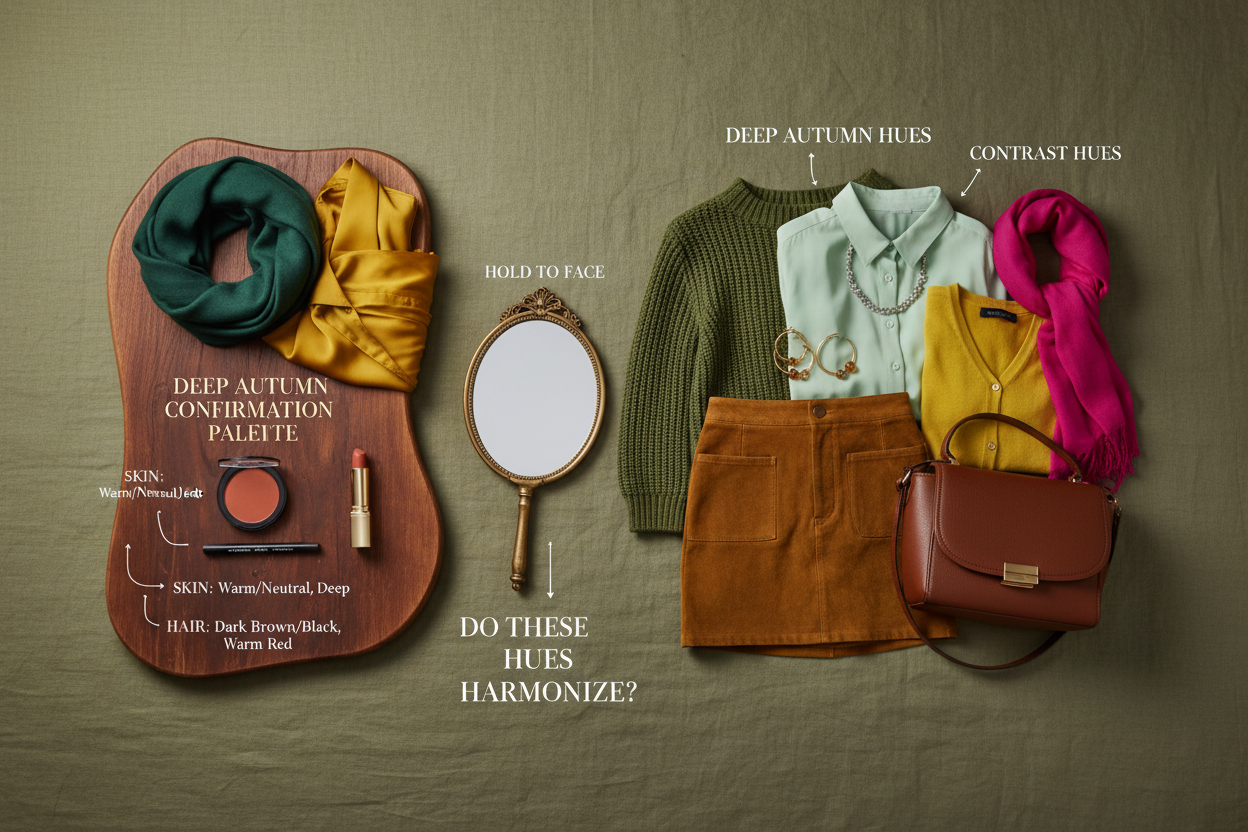
The key signals analysts look for:
- Skin undertone: Warm-to-neutral, often with golden, olive, or bronze tones rather than pink or rosy ones. The undertone may not be immediately obvious — it often shows up when cool colours make the complexion look sallow and warm tones make it glow.
- Hair depth: Typically medium brown to very dark brown or black, often with warm or golden highlights — natural or sun-induced. Rarely very light or ashy in its natural state.
- Eye character: Eyes tend to have warmth in them — amber, gold, hazel, or dark brown — and usually a visible depth or richness rather than a pale or icy quality.
- Overall contrast: Dark Autumn sits at a medium-to-high contrast level. There's a visible difference between hair, skin, and eyes — not as stark as Dark Winter, but more defined than Soft Autumn.
If some of these signals feel uncertain, or if you find yourself drawn to both warm and cool palettes at different times, a structured colour analysis is the most reliable way to get a clear answer. Our colour analysis quiz works through the specific combinations of depth, warmth, and contrast that distinguish Dark Autumn from its neighbouring seasons, and gives you a result based on those signals rather than general impressions.
Confirming your season first means that every forest green coat, olive trouser, and amber scarf you buy afterward will work together — and work for you.
People Also Ask
What greens are in the Deep Autumn colour palette?
Dark Autumn greens are warm, deep, and muted. Not bright, not cool. The core shades are:
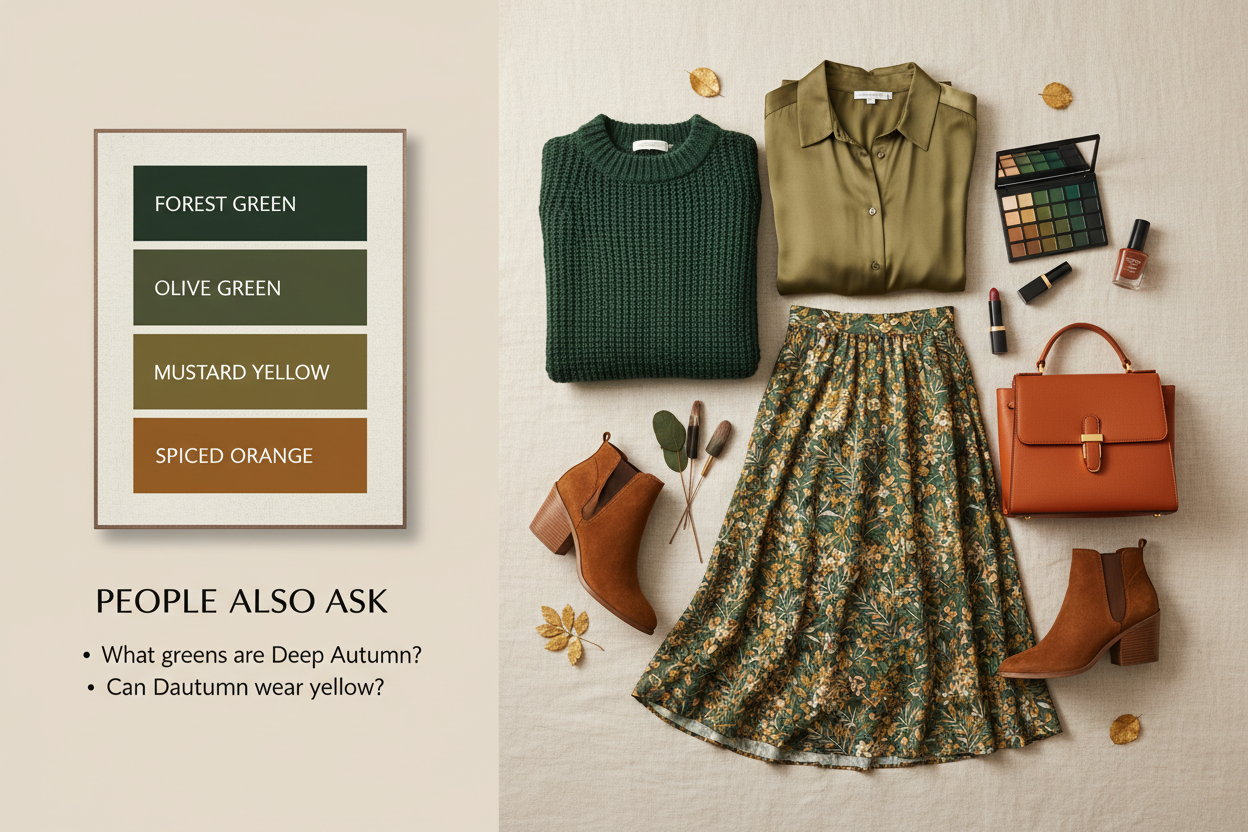
- Rich forest green — dark, warm-toned, and lush; the anchor shade of the family
- Moss green — lighter and more yellow-leaning, with an organic, almost aged quality
- Olive green — the most golden of the group; sits close enough to warm neutral territory that it works alongside browns and camels
- Bronze-green and dark khaki — transitional shades that blur the line between green, gold, and brown
Every shade here shares three qualities: warmth (shifted toward yellow, not blue), depth (dark enough to carry visible weight), and muted saturation (rich without tipping into neon).
What is the difference between Deep Autumn and True Autumn greens?
Depth, mainly. True Autumn greens are warm and earthy but sit at a medium value — think copper-influenced leaf green or a medium olive. Deep Autumn takes those same warm, muted qualities and pushes them darker and denser.
Where True Autumn might wear a medium warm olive, Dark Autumn wears a deeper, richer version of that same shade. Where True Autumn reaches for a golden-toned medium green, Dark Autumn goes for forest green — darker, heavier, more substantial. The warmth stays consistent between the two; what changes is how far down the value scale you go.
Can Deep Autumn wear yellow-green or lime?
No. Lime and yellow-green fall outside the Dark Autumn range for two reasons. First, they run too cool — there's a blue-shifted or acidic quality that clashes with the warm-dark foundation of this palette. Second, they're too bright and clear, which exceeds the muted-saturation threshold that all Deep Autumn greens share.
Against warm, deep Dark Autumn colouring, lime tends to pull attention away from the face and can make the complexion look sallow. The closest workable alternative is something like dark khaki or bronze-green — it keeps the yellow-green idea but grounds it in warmth and depth.
What colours go with forest green for a Dark Autumn?
Forest green pairs most naturally with other shades drawn from the same warm-dark palette:
- Amber and ochre — the most natural pairings; amber's golden warmth connects directly with the yellow undertone in forest green
- Dark chocolate and cognac brown — grounding neutrals that deepen a forest green outfit without creating seasonal conflict
- Mustard and harvest gold — slightly sharper accents that add warmth and richness without tipping into brightness
- Moss green and olive — for a tonal, forest-floor layering effect
- Warm taupe and dark camel — lighter neutrals that keep forest green as the statement colour
Colours to avoid in a Dark Autumn context include cool grey, crisp white, navy, and any pastel. These introduce a cool or pale contrast that works against the palette's warmth.
Is olive green a Deep Autumn colour?
Yes — olive is one of the most characteristic and versatile shades in the Dark Autumn palette. Its strong yellow-golden lean gives it the warmth the palette needs, and its natural mutedness keeps it within the palette's saturation range.
Olive sits at the warm-neutral end of the Deep Autumn green family. It functions less like a statement colour and more like a base tone — similar to how taupe or camel behaves in other palettes. That makes it useful as a foundation for outfits built around amber, ochre, or dark brown.
One caveat: not all olives qualify. A yellow-leaning olive belongs in the Dark Autumn wardrobe. A grey-leaning or cool-toned "military" olive — same name, different undertone — does not carry the warmth the palette requires. Check the actual undertone of the garment rather than trusting the label.
FAQ
What shades of green are considered Deep Autumn colours?
Greens that work for Deep Autumn share three traits: warm (yellow-shifted, not blue), deep (dark in value), and muted (rich but never electric). Shades that fit:
- Forest green — the darkest and most anchoring shade in the family
- Olive green — golden-leaning, sitting close to warm neutral territory
- Moss green — slightly lighter, with an organic yellow-green cast
- Dark khaki and bronze-green — transitional tones that blend green with gold and brown
Bright, cool, or pale greens — emerald, lime, sage — fall outside the palette.
Is mustard yellow a Deep Autumn colour?
Yes. Mustard works well in Dark Autumn because it's warm, golden, and muted — not clean or acidic. It has the same amber quality you see in Deep Autumn greens and golds. It pairs especially well with forest green and olive. Bright, cool yellows like lemon or neon don't fit; they're missing the depth and warmth the palette needs.
How do I tell if a green is too bright for my Deep Autumn palette?
The simplest test: hold the garment near your face in natural light and watch what happens to your complexion. If the colour pulls attention away from your face, drains your skin, or creates a harsh contrast, the green is probably too bright.
A rough rule of thumb:
- Too bright: the green looks electric or vivid, like light is coming through it
- Within range: the green looks rich and dense, slightly muted or dusty rather than luminous
If it reads as neon or jewel-toned without any warmth, it's past the saturation threshold for Deep Autumn.
Can Deep Autumn wear khaki and army green?
It depends on the undertone of the specific piece.
Warm khaki — the kind with a golden or yellow-brown cast — works well as a neutral base. It sits comfortably between the greens and browns in the palette.
Cool or grey-toned army green is a different story. Despite the rugged-sounding name, it doesn't carry enough warmth to work with the Dark Autumn foundation and tends to conflict with the palette's depth. Check the actual undertone of what you're looking at rather than trusting the category name.
What is the difference between Deep Autumn greens and Soft Autumn greens?
The main difference is depth and saturation. Both seasons are warm, but they sit at different points on the value and saturation axes:
- Soft Autumn greens are muted, light to medium in value, and gentle — dusty sage or a soft, faded olive. The overall effect is low-contrast and delicate.
- Deep Autumn greens are muted but darker and denser — rich forest green or a deep, golden olive. The overall effect is grounded and high-drama.
Soft Autumn greens tend to look washed out on someone with Deep Autumn coloring because the shades don't have enough weight. Deep Autumn greens on a Soft Autumn can do the opposite — the contrast overwhelms rather than flatters.
How do Deep Autumn greens work in a capsule wardrobe?
Deep Autumn greens are unusually capsule-friendly because several of them read as neutrals rather than accent colours:
- Olive and dark khaki act as base tones — the equivalent of navy or grey in other palettes — pairing easily with chocolates, camels, and ambers
- Forest green anchors outfits the way black does in cooler palettes
- Moss green adds variety at a slightly lighter value while staying within palette range
A practical starting point: one olive or dark khaki trouser or skirt, one forest green top or jacket, one amber or ochre piece. Those three mix in multiple directions without needing anything else.
Are there Deep Autumn green options for formal or evening wear?
Yes. The depth of Dark Autumn greens makes them work naturally for formal occasions. Forest green in particular translates well; a rich, warm-toned forest green in velvet or satin carries the same visual weight as dark navy or midnight blue without the coolness those shades bring.
For evening, consider:
- Deep forest green velvet — the texture amplifies the richness of the colour
- Dark olive satin — less conventional, but it works beautifully with gold accessories
- Bronze-green or deep moss in structured fabrics — for occasions where forest green feels too expected
Warm gold, antique brass, or amber accents complement all of these and keep the overall look within the Dark Autumn palette. Not sure you're a Dark Autumn before investing in these pieces? Take the colour analysis quiz to confirm your season first.