Best White Shades for Each Color Season
 Reviewed by Alexandra Gilmore
Stark white is not neutral on every complexion; its temperature and intensity can make skin look clearer or unexpectedly tired. Match optic white, soft white, ivory, cream, and other variations to each season, then use fabric texture and outfit contrast to make difficult whites wearable.

White feels like the safest choice in your wardrobe. Crisp, clean, universally available — it seems impossible to get wrong. But if you have ever pulled on a white shirt and walked away from the mirror looking tired, sallow, or somehow less like yourself, you already know the truth: not all whites are created equal, and the one you reach for most often may be quietly working against you.
💫 Find Your Color Season
The clues in this article can narrow your options, but a season result should compare temperature, depth, clarity, and contrast together. Use the quiz as a starting point, then confirm it with the practical comparisons above.
Find My Season →Color analysis explains why. Every seasonal palette — Spring, Summer, Autumn, Winter, and their subcategories — responds differently to the undertone, intensity, and warmth of a white. Some people are brightened by pure, stark white. Others are washed out by it and need a softer ivory or a warm cream to make their features read clearly. A surprisingly common realization for people going through seasonal color analysis is that their best white might not technically be white at all.
This guide cuts through the confusion. Here is what you will find inside:
- Which specific white shades suit each of the four main color seasons and their subtypes
- Why bright white can make warm-toned people look yellowish or sallow — and what to wear instead
- How to test a white at home without booking a professional draping session
- The wedding white problem: finding a flattering shade when your options feel limited
- Common myths about white being universally safe or universally tricky
Whether you are a confirmed Winter who loves a clean bright white or a soft Summer who has been wearing the wrong shade for years, understanding the best white shades for each color season gives you a concrete, usable answer — not just a theory. White seems simple until you try it on and realize something is off. This guide explains exactly what that something is.
Why White Is Not a Safe Neutral for Every Season
Think about the last time you put on a white t-shirt and something felt off. Your under-eye circles looked deeper. Your skin read slightly yellow, or flat, or tired. You changed, told yourself it was the lighting, and moved on. It was not the lighting.
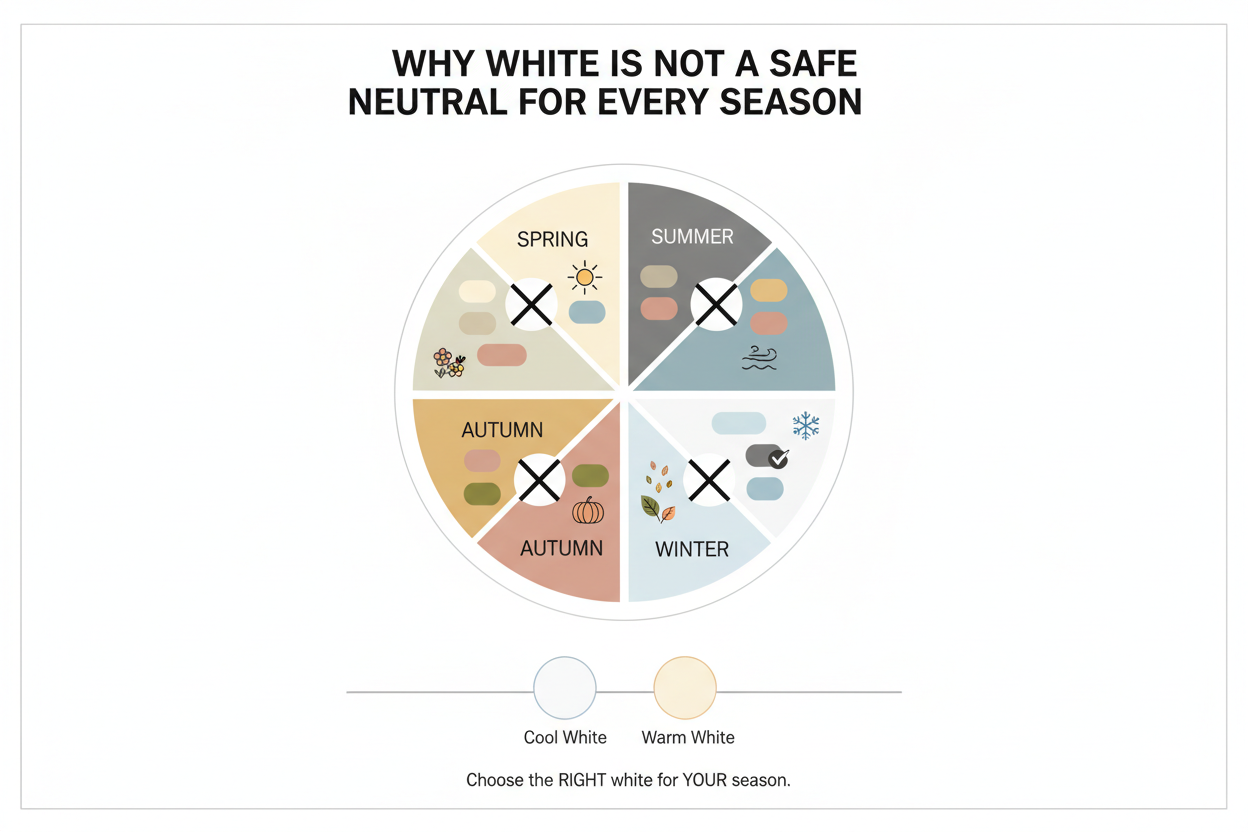
White sits at maximum lightness on the value scale, which means it reflects enormous amounts of light back at whatever is closest to it — your face. If the undertone and intensity of that white do not harmonize with your own coloring, the reflection is not flattering. It creates shadows, pulls out unwanted undertones, or drains the warmth or brightness that makes your features read clearly.
The problem is that "white" is not one color. Walk into any fabric store or scroll through any white clothing section and you will find:
- Stark, blue-cool optical whites
- Warm ivory and cream
- Soft off-white with grey undertones
- Warm ecru with yellow-beige undertones
- Cool powder white — barely there, almost lavender
- Warm milky white — soft but not quite cream
There are dozens of whites, and only a few of them belong to you. Most people spend years in the wrong ones, wondering why white never quite works the way it does on someone else.
The seasonal color system gives you a way to stop guessing. Once you know which qualities — warmth, coolness, softness, intensity — define your season, you can identify which whites will look effortless on you and which ones will quietly undermine every outfit you build around them.
Not sure of your color season yet? Take the free color analysis quiz →
How Color Analysis Determines Your Best White
Color analysis identifies your season by mapping three characteristics of your natural coloring: undertone (warm or cool), value (light or dark), and chroma (clear or bright versus soft or muted). Your best colors in any category — including white — need to match or harmonize with those three qualities.
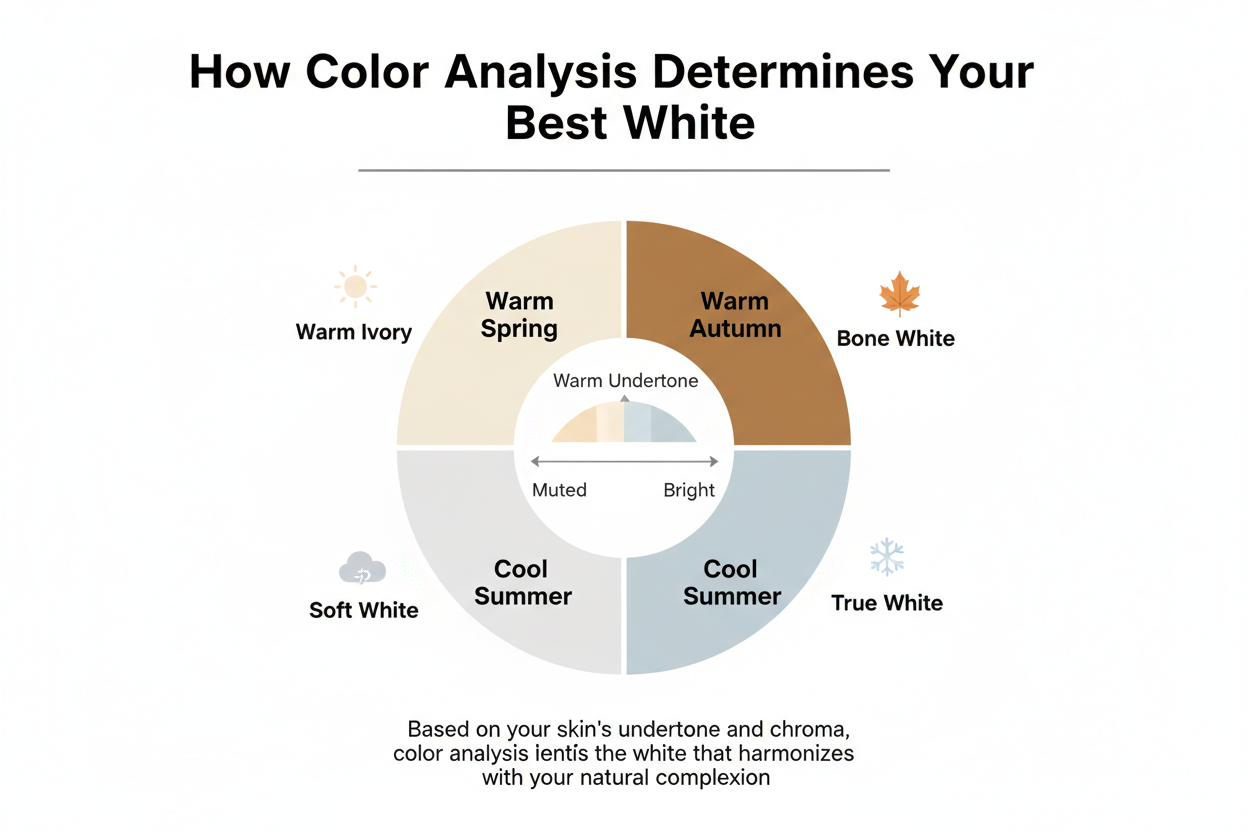
When it comes to white specifically, two axes matter most.
Warm vs. cool undertone in the white itself
A warm white contains yellow, peach, or beige undertones — ivory, cream, ecru. A cool white contains blue or grey undertones — optical white, stark white, cool powder white. Wearing a cool white against warm-toned skin tends to pull out the yellow or orange in your complexion and make it look sallow. Wearing a warm white against cool-toned skin can make the skin look muddy or flat.
Intensity or chroma
Some whites are high-chroma — clean, sharp, saturated. Others are low-chroma — dusty, greyed, quiet. Seasons that are naturally high-contrast and clear-toned (Winters, Bright Springs) handle intense whites well. Seasons that are soft and muted (Soft Summer, Soft Autumn) tend to get washed out by them and need something with less punch.
Color analysis doesn't tell you to avoid white. It tells you which white will brighten your features and which one will dull them. That's a practical distinction, and it's what the rest of this piece is based on.
Best Whites for Spring and Summer Seasons
Spring Seasons: Warm, Clear, and Light Whites
Spring coloring is warm-undertoned and relatively clear — think fresh, sun-lit, and light. The Spring family cannot wear cool, stark whites without looking washed out, because the blue-grey undertone in a bright optical white pulls against the warmth in Spring skin and hair. Instead, Springs need whites that carry warmth of their own.
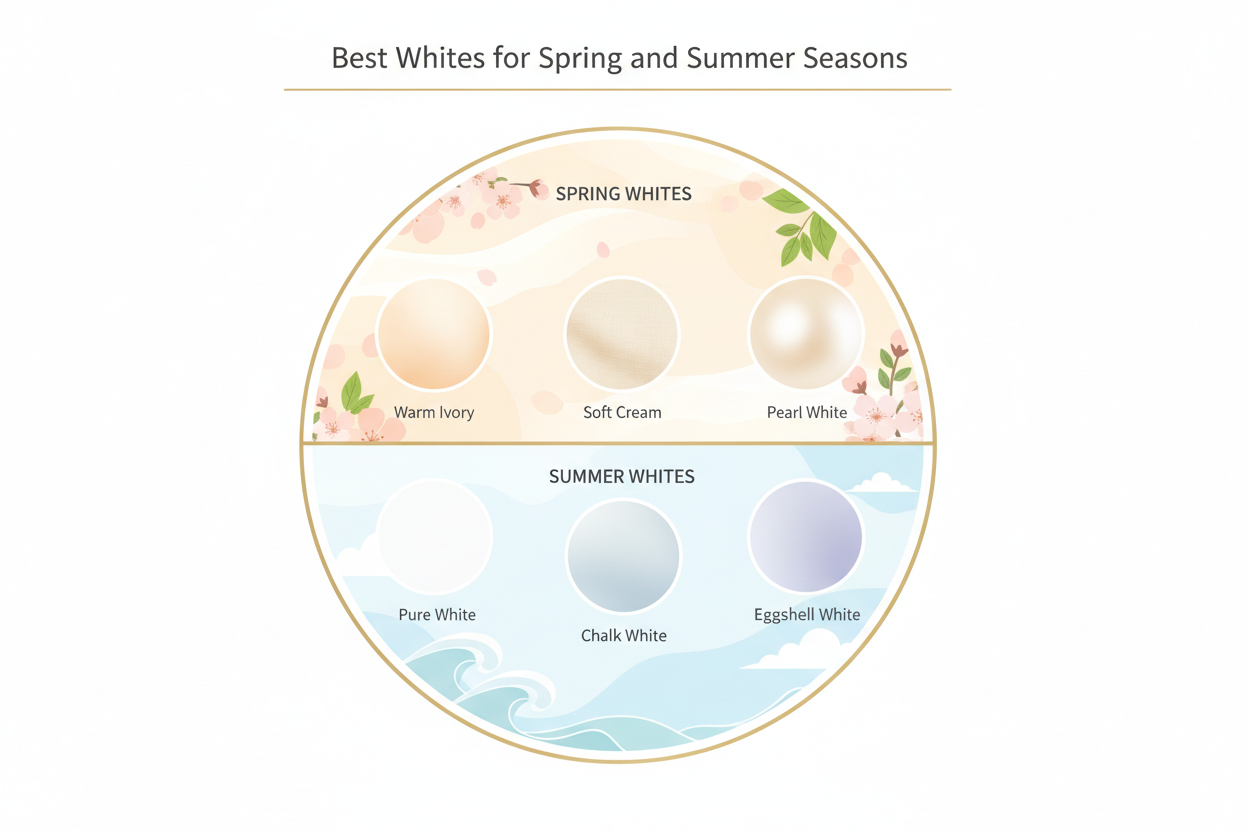
But "warm white" is not one-size-fits-all across the three Spring subtypes:
Light Spring Light Spring is the most delicate of the Spring family — lower contrast, softer coloring, light in value overall. The ideal white is a warm powder white or soft warm ivory — warm enough to harmonize with the undertone, but light and airy enough not to overwhelm Light Spring's coloring. A rich, heavy cream would be too much weight; a stark bright white would be too cool and harsh. Think a warm white with just a whisper of cream in it.
True Spring True Spring sits at the warm, clear, medium-value center of the family. It can handle a brighter warm white than Light Spring — a clean warm white or light ivory works well here. The white should still carry warmth, but it can have more clarity and presence. True Spring is the Spring type most likely to look good in what people casually call "warm white" without further qualification.
Bright Spring Bright Spring borrows intensity from the Winter side of the spectrum, giving it the highest chroma of the Spring family. This means it can handle more contrast and clarity in a white than the other Springs. A clear, warm-toned bright white — still warm, but sharper and more vivid — works here in a way it would not for Light or True Spring. Bright Spring is the only Spring subtype that can approach something close to optical white, as long as the white still reads warm rather than blue-cool.
What all Springs share: avoid cool, grey-toned, or blue-white optical whites. These read harsh and cold against Spring's naturally warm complexion and will pull out any yellow in the skin in an unflattering way.
Summer Seasons: Cool, Soft, and Muted Whites
Summer coloring is cool-undertoned and muted — softer, less saturated, with lower contrast overall. The Summer family looks terrible in stark, high-contrast white because the intensity overwhelms their naturally gentle coloring, making them look washed out rather than luminous. Summers need whites that are cool-leaning but soft — never sharp.
Light Summer Light Summer is the lightest and most delicate of the Summer types, with very soft contrast between hair, skin, and eyes. The ideal white is a pale, airy cool white — think barely-there, almost like cool snow rather than bright paper. No warmth (no cream or ivory), but also very little intensity. The goal is something that floats near the face without overpowering it. A stark bright white would be jarring against Light Summer's softness.
True Summer True Summer has a cool undertone and a distinctly dusty, slightly muted quality to all of its best colors. The ideal white reflects that: a dusty white or greyed white — soft, cool, and slightly toned down. Not quite grey, but not sharp and clean either. Think sea foam or aged cotton. That quiet quality is what lets True Summer's features come forward rather than recede.
Soft Summer Soft Summer is the most muted and blended of all the Summer types, sitting at the crossover between Summer and Autumn. Its best colors are neither fully cool nor fully warm — they're softly blended. So Soft Summer's best white is a warm-cool blended off-white: a soft, slightly warm, slightly greyed shade that sits somewhere between cream and mist. It may not read as "white" to a casual observer at all. This is a direct expression of the principle that your best white might not technically be white — for Soft Summer, that's almost always the case.
What all Summers share: avoid stark optical white, bright white with blue undertones, or anything that reads as high-contrast or sharp. These create a harsh frame around Summer's naturally soft, cool features.
Best Whites for Autumn and Winter Seasons
Autumn Seasons: Warm, Earthy Near-Whites
Autumn coloring is the warmest and most richly muted of all the seasonal families. Deep, earthy undertones in the skin and hair mean cool whites are simply incompatible — they fight against the warmth and make the complexion look sallow or yellowed. But unlike Springs, Autumns also tend to be lower-chroma, so a very bright warm white can feel too sharp.
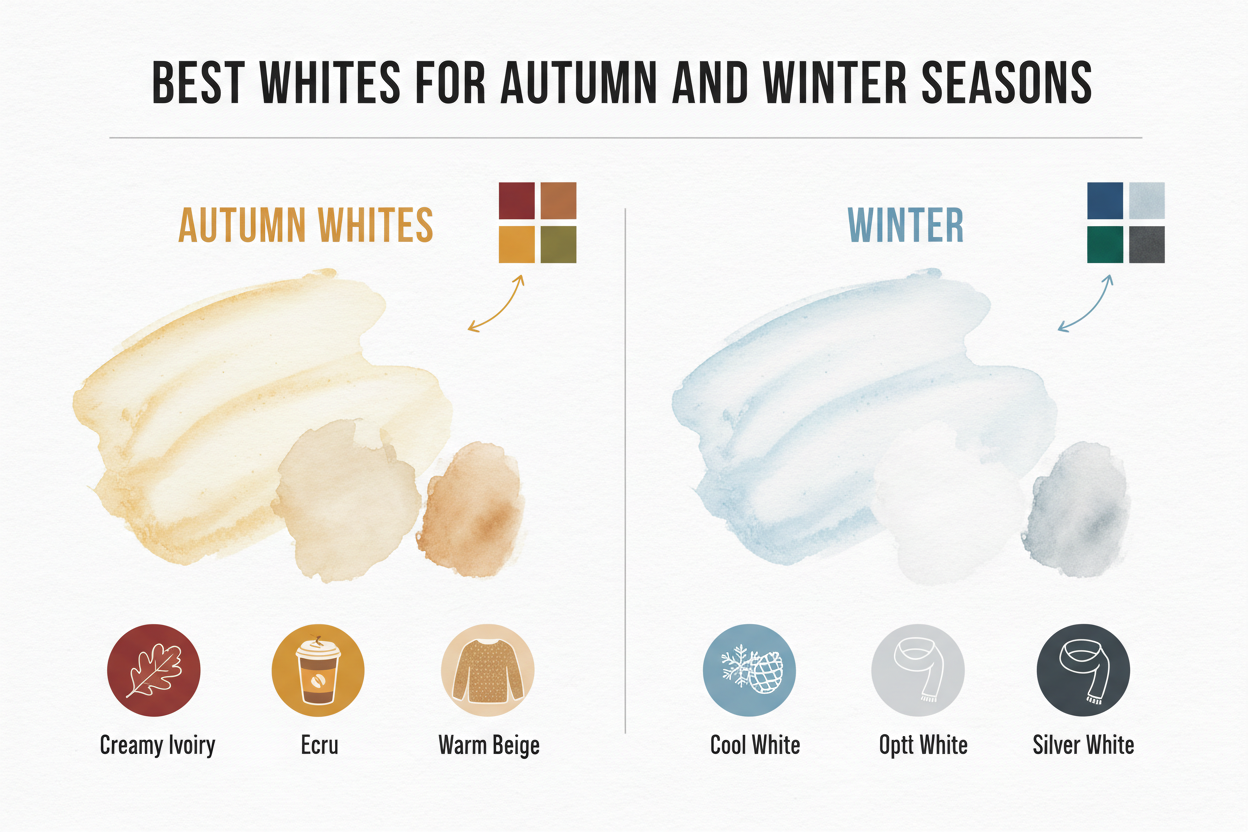
For Autumn types, the honest answer is this: the best white is very often not white at all. It is oyster, ecru, warm cream, or soft camel-adjacent off-white — shades so warm and so far from optical white that they sit at the edge of the neutral category entirely.
Soft Autumn Soft Autumn is the most muted of the Autumn types, with low contrast and softly blended coloring. The ideal shade is a warm, dusty off-white — something like oyster or aged linen. It carries warmth but is never bright or crisp. This is the Autumn type least likely to ever wear anything resembling true white.
True Autumn True Autumn sits at the warm, rich, earthy center of the family. The ideal white-adjacent shade is warm ivory or a golden cream — deeper and richer than what works for Spring, but still clearly warm. True Autumn can carry a little more saturation in its off-whites than Soft Autumn, as long as the warmth stays.
Dark Autumn Dark Autumn is the deepest of the Autumn types, with higher contrast and more intensity than Soft or True Autumn. It borrows some clarity from the Winter side, which means it can handle a slightly crisper off-white — a rich ivory or warm ecru with some depth to it. Stark cool white is still a miss, though. The warmth has to stay.
What all Autumns share: avoid cool whites, bright whites, and anything with blue or grey undertones. These shades actively clash with Autumn's warm coloring and are among the least flattering choices this family can make.
Winter Seasons: Cool, High-Contrast, and Pure Whites
Winter is the season most naturally suited to bright, cool, high-contrast white — but not all Winters are the same, and those differences matter.
True Winter True Winter has a clean, cool-neutral undertone and high natural contrast. This is the season for pure, clean, blue-cool white — the kind of crisp, stark white that overwhelms almost every other season. It does not make True Winter look washed out; it makes the features pop. True Winter's coloring is high enough in contrast to hold a very intense white without being flattened by it.
Bright Winter Bright Winter sits between Winter and Spring, borrowing some of Spring's clarity. That crossover gives it the highest chroma tolerance of the Winter types — it can wear the most saturated, most vivid whites, including very bright optical whites with a clear, almost electric quality. Of all twelve seasons, Bright Winter has the broadest access to high-intensity white.
Dark Winter Dark Winter is the deepest and most dramatic of the Winter types, with very high contrast between features and significant depth in the overall coloring. A very sharp, bright white can be almost jarring against that depth. A clean cool white works, but it may be slightly less stark than what True or Bright Winter wears — crisp and cool, but not necessarily the most blinding optical white. Some Dark Winters find a barely-warm white works surprisingly well, particularly those with deeper warm-neutral skin tones.
What all Winters share: they can handle cool whites that would wash out every other season. Warm cream, ivory, and ecru are generally poor choices — those warm undertones fight against Winter's cool base.
Ready to find your season and your best white? Start the free color analysis quiz →
The Wedding White Problem: Choosing the Right White for Your Season
Bridal shopping is where the wrong white becomes impossible to ignore. Under bright studio lighting, in a fabric that covers most of your body, the undertone of a gown reflects directly onto your face — and everyone in the room can see whether it's working.
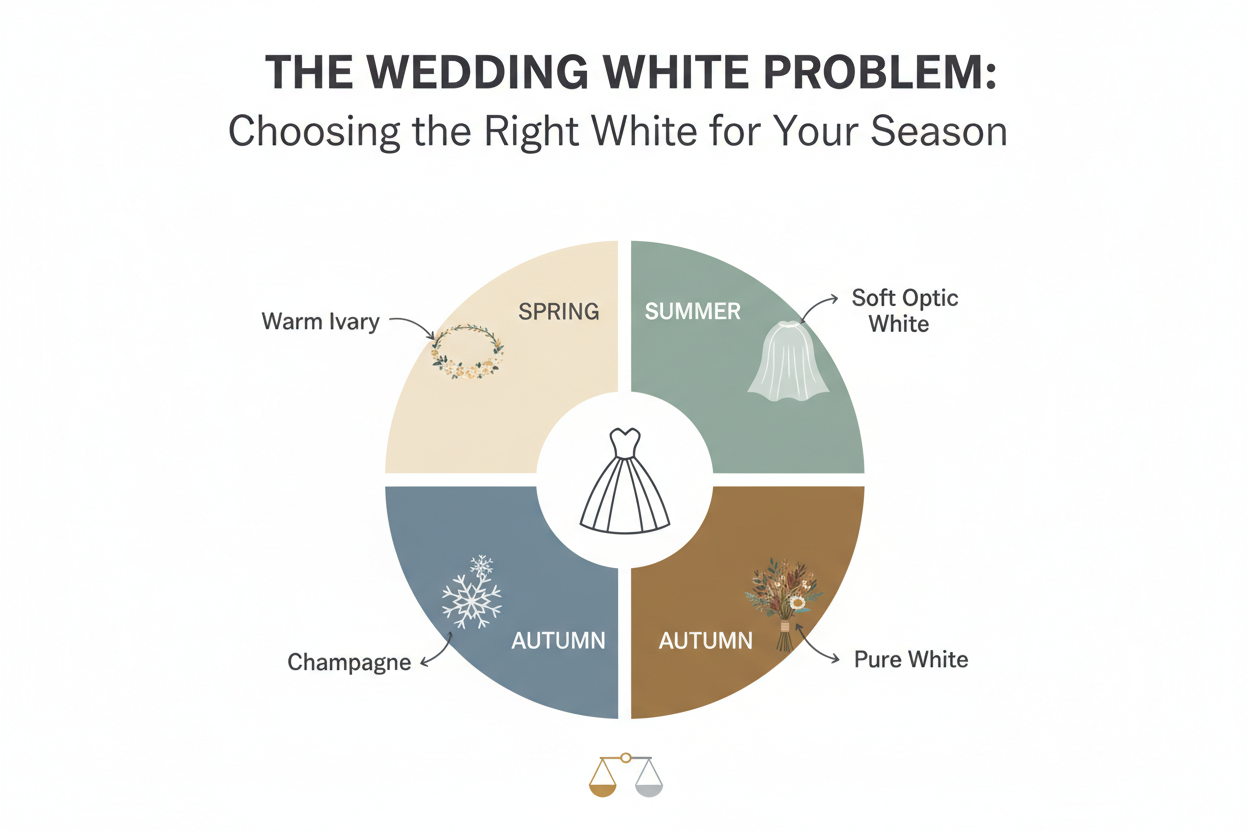
The bridal market typically offers these whites:
- Bright white / diamond white — cool, high-chroma, stark
- Ivory — warm-neutral, softer than bright white
- Champagne — warm, yellow-gold undertone
- Blush — warm or neutral pink undertone
- Ecru — warm, slightly beige-grey
Here is how seasons generally map to those options:
| Season | Best Bridal White |
|---|---|
| Light Spring | Soft ivory or warm champagne |
| True Spring | Warm ivory |
| Bright Spring | Warm-bright ivory or clean warm white |
| Light Summer | Ivory or very soft bright white |
| True Summer | Soft ivory with cool undertone, or blush |
| Soft Summer | Blush or warm-cool blended ivory |
| Soft Autumn | Champagne or ecru |
| True Autumn | Ivory or champagne |
| Dark Autumn | Rich ivory or champagne |
| Dark Winter | Bright white or ivory |
| True Winter | Bright white or diamond white |
| Bright Winter | Bright white |
Practical steps for bridal shopping by season:
- Bring a fabric swatch of a color you know works on you. Hold it near your face alongside the gown fabric as a reference.
- Test in natural light, not just the boutique's artificial lighting. Step outside with samples if you can.
- Ask to drape fabrics, not just look at finished gowns. You can compare shades before getting attached to a silhouette.
- Watch your face, not the fabric on its own. Step back from the mirror and look at what is happening around your eyes, jaw, and cheeks — that is where the white is either helping or hurting.
Don't let a sales consultant default you to bright white because it photographs well. It photographs well on Winters. On an Autumn, it photographs sallow.
How to Test Whether a White Shade Is Working for You
You do not need a professional draping session to evaluate a white. Here is a reliable method you can use at home or in a fitting room:
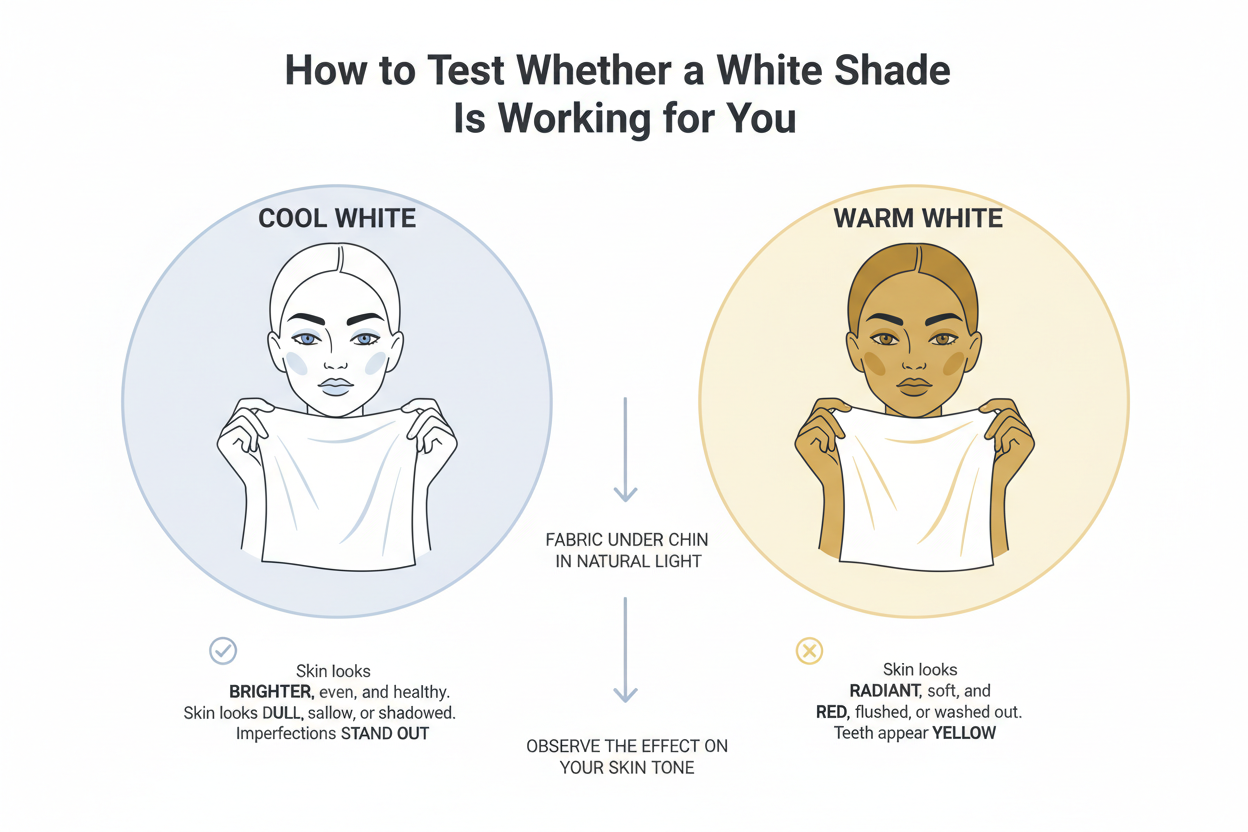
Step 1: Hold the white close to your face in natural light Go to a window or step outside. Artificial lighting distorts — it adds warmth, coolness, or flatness depending on the bulb, making it hard to see your skin accurately.
Step 2: Look at your face, not the fabric Most people instinctively look at the garment. Look at your skin instead — your cheeks, under your eyes, along your jaw. Ask:
- Do the shadows under your eyes deepen or fade?
- Does your skin look more yellow or grey than usual?
- Does your complexion look alive and clear, or flat and tired?
Step 3: Apply the "effortless" test The right white looks good on its own. You should not need more makeup, better lighting, or a specific hairstyle to make it work. If you catch yourself thinking "this would work if I just added more bronzer" — the white is working against you.
Step 4: Compare two whites side by side If you can, hold a warm ivory and a cool stark white near your face at the same time and look back and forth. The difference is usually immediate. One will make your features look more vivid; the other will flatten them.
Step 5: Check the effect at distance Take a few steps back from the mirror. At normal conversational distance, which white makes you look more put-together? That one is your white.
Common Myths About Wearing White by Season
Myth 1: "White is a safe, universal neutral." White is one of the most impactful colors in your wardrobe because it reflects so much light. Far from neutral, it actively affects how your skin reads. The assumption that white is safe has probably caused more unflattering outfit choices than almost any other fashion belief.
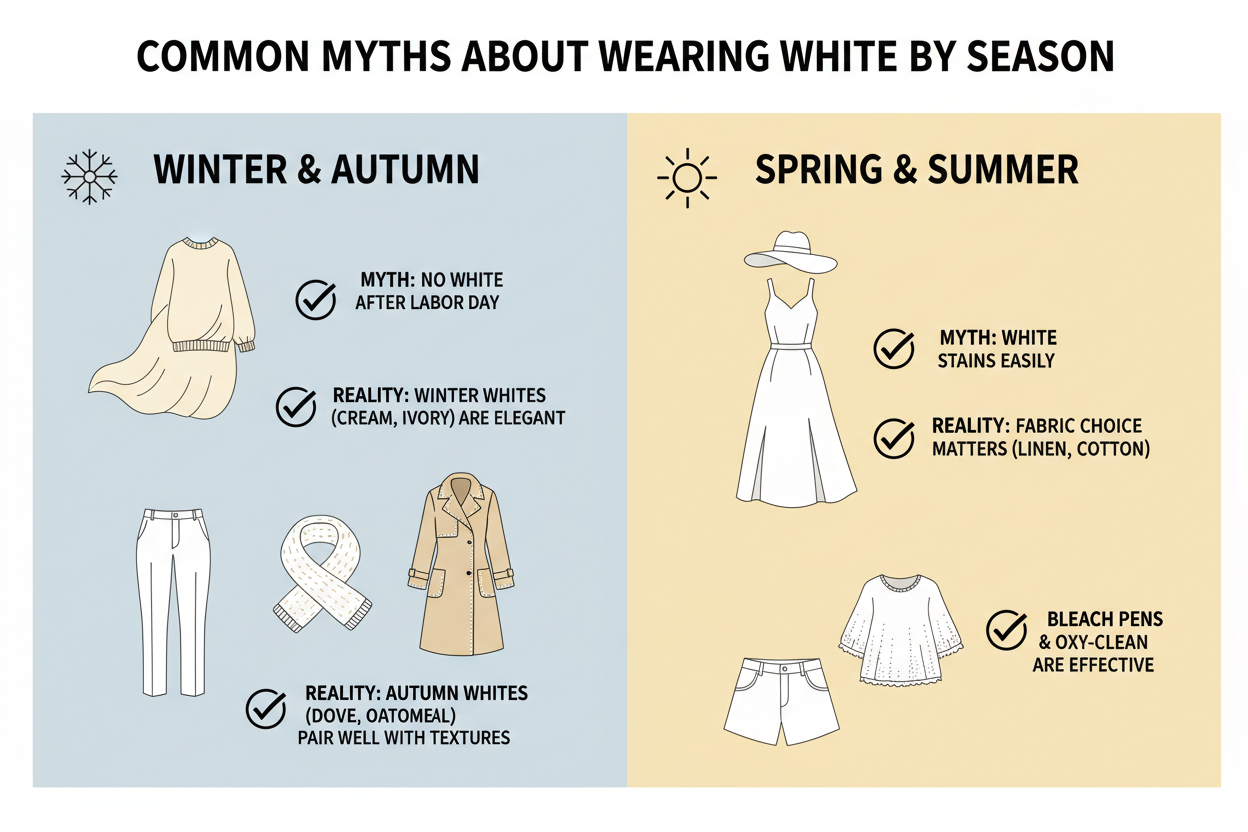
Myth 2: "Everyone looks good in white for formal occasions." Formal white — a white suit, bridal gown, or dress shirt — is worn close to the face at high-visibility moments. The stakes are highest in formal contexts, not lowest. An Autumn in stark white evening wear is fighting her own complexion all night.
Myth 3: "If white washes you out, you need more makeup, not a different white." Makeup compensates. The right white doesn't require compensation. If you're reaching for extra bronzer or blush to make an outfit work, that's the white working against you — not a gap in your makeup routine.
Myth 4: "Warm people should always avoid white and wear cream instead." Too blunt. Bright Springs can handle a warm-bright white that's quite vivid. Dark Autumns can wear a richer ivory with real depth. The actual guidance is about undertone and intensity, not a blanket swap from white to cream.
Myth 5: "Winters are the only people who can wear white." Winters can wear the starkest optical whites, sure. But every season has a white or near-white that works — it's just a different white. Springs have warm ivories and warm-bright whites. Summers have soft, cool off-whites. Autumns have oyster and ecru. Nobody's locked out of the white family entirely.
Myth 6: "No white after Labor Day." A calendar rule with no grounding in color science. It has nothing to do with what white actually does to your face. A True Winter in cream-white linen looks less flattering in August than in a crisp cool-white wool in November. The time of year is irrelevant. Your color season is what matters.
People Also Ask
What white should a warm season wear instead of bright white?
Warm seasons — Springs and Autumns — should swap bright, cool-toned optical white for whites with a warm undertone. The right shade depends on the subtype:
- Springs tend to do well with warm ivory, light cream, or a clean warm white (yellow-peach base rather than blue-grey)
- Autumns often need to move further from white entirely — toward oyster, ecru, warm cream, or aged linen
The through-line is that the white itself needs to share your warmth rather than fight it. Optical white has a cool, blue undertone that bounces back onto warm skin and pulls out yellow or sallow tones you'd rather not emphasize. A warm-based off-white removes that conflict without making the shade any darker.
Can cool seasons wear cream or ivory?
Generally, no — or at least not as a first choice. Cool seasons (Summers and Winters) have blue or blue-neutral undertones in their skin, and the yellow-beige base in cream or ivory tends to clash with that cool foundation. The result can make cool-toned skin look muddy or dull.
That said, there are nuances:
- Light Summer and True Summer can sometimes pull off a very soft, barely-warm ivory without much conflict, especially if the ivory reads more neutral than distinctly yellow
- Dark Winter is the one Winter subtype where a slightly less-stark white occasionally works, particularly for people with deeper warm-neutral skin tones
- Soft Summer sits at the Summer-Autumn crossover and may find a warm-cool blended off-white more flattering than a sharply cool white
If you're a Summer or Winter and cream looks appealing to you, it's worth testing in natural light against your face — but be honest about whether it's making your skin look more vibrant or more flat.
Why does white make me look tired or washed out?
White reflects a lot of light directly back toward your face. When the undertone or intensity doesn't match your natural coloring, that light works against you — it deepens shadows under your eyes, pulls out unwanted yellow or grey in your skin, or drains the warmth that makes your features look alive.
Three mismatches cause this most often:
- Undertone clash — a cool white against warm skin pulls out yellow; a warm cream against cool skin reads muddy
- Intensity mismatch — a stark, high-chroma white overwhelms soft or muted coloring and flattens everything out
- Value contrast — a very bright white next to very light coloring (Light Spring, Light Summer) can erase the natural contrast in your features
The fix isn't more makeup. It's a different white — one whose undertone and intensity actually work with your coloring instead of against it.
What is the difference between warm white and cool white in clothing?
The difference is in the undertone baked into the fabric's base color:
- Warm whites carry traces of yellow, peach, or beige. They read as creamy, soft, or golden depending on their depth. Examples include ivory, cream, ecru, and champagne-white.
- Cool whites carry traces of blue or grey. They read as crisp, clean, stark, or icy. Examples include optical white, bright white, diamond white, and powder white.
Hold two whites side by side and you'll usually see it immediately. The one that reads slightly golden is the warm white; the one that looks sharper or faintly blue is the cool white. Natural light makes this much easier to spot than store lighting, which tends to flatten the difference.
Your color season tells you which category to shop in. Within that category, intensity — soft versus vivid — narrows it down further.
How do I find my best white shade without a color analyst?
A few simple tests at home or in a fitting room will get you most of the way there.
Work in natural light. Artificial lighting distorts undertones enough to make accurate comparison nearly impossible. Move to a window or step outside.
Test warm and cool whites side by side. Hold an ivory and a stark cool white near your face at the same time. Look at your skin, not the fabric. One will make your complexion look more awake; the other won't.
Watch for specific warning signs. Under-eye shadows deepening, skin reading more yellow or grey than usual, features looking flat — these mean the white is working against you.
Apply the effort test. The right white requires nothing extra from you. If you feel the urge to add more makeup or find better lighting to make it work, that's not your white.
Use a known-good color as a reference. Bring a fabric or garment in a color you already know flatters you and hold it alongside the white you're testing. Your face will tell you quickly which pairing looks more harmonious.
If you already know your color season, use it as a starting filter: warm seasons start with warm-based whites, cool seasons start with cool or neutral whites, then refine from there.
FAQ
Is there a white that works for every color season?
No single white shade flatters every season equally. White isn't one color — it runs from warm ivory to cool optical white, and each end suits different coloring. Warm-toned seasons need whites with yellow or peach undertones; cool-toned seasons need whites that read crisp and blue-neutral. A white that makes a Winter look sharp and luminous will likely make an Autumn look sallow or washed out.
If you're dressing a group with mixed seasons — bridesmaids, for example — a soft neutral white with minimal undertone saturation tends to cause the least conflict. But for individual dressing, the honest answer is that your best white may look very different from someone else's best white.
What is the difference between ivory, cream, and off-white in color analysis?
All three are warm-based whites, but they differ in depth and saturation:
- Ivory is the lightest of the three — a white with a faint yellow or warm-neutral base that remains close to white in overall value
- Cream is warmer and slightly deeper, with a more visible yellow-beige component that gives it a softer, richer appearance
- Off-white is a broader, less precise term that can refer to any white shifted slightly away from pure optical white — it may be warm, cool-neutral, or slightly greyed depending on the specific shade
In seasonal color analysis, the distinction matters because it tells you how far from bright white a shade has moved and in which direction. Autumns usually need cream or deeper warm neutrals. Springs often do well with ivory. Summers tend to prefer a cool-toned off-white with grey rather than beige. Winters stay closest to pure, bright white.
Can a Winter season wear warm white or cream?
Typically not. Winter coloring is defined by cool or neutral-cool undertones and high natural contrast, and cream's yellow-beige base conflicts with that cool foundation. Worn near the face, cream on a Winter can make the skin look muddy, dull, or slightly sallow in a way that pure white does not.
The exception is Dark Winter, which sits at the Winter-Autumn border. People in this subtype sometimes have slightly warmer neutral undertones, and a very muted, low-saturation warm white — not rich cream — can occasionally work. The test is whether the skin looks more vibrant or more flat under natural light.
If you are a Winter and cream appeals to you, try it in a scarf or accessory away from your face before committing to it near your neckline.
Why does bright white make some people look yellow or sallow?
Bright optical white has a blue-toned base. When you wear it next to warm or golden skin, that cool reflected light creates a visual contrast — your eye reads the skin's natural warmth as excess yellow rather than a healthy glow. The white isn't actually turning your skin yellow. It's an undertone clash that looks like a complexion problem when the issue is really the fabric.
This effect is most noticeable when:
- The white is high-chroma (stark and saturated rather than soft or muted)
- Your skin has a distinctly warm or peach-gold undertone
- The garment sits close to your face, like a shirt collar or neckline
The fix is a warm-based white that matches rather than fights your skin's undertone. Ivory or cream removes the cool-warm clash entirely.
What white shades should Autumn seasons avoid?
Autumn seasons should generally avoid:
- Bright optical white — too cool and too high in contrast for Autumn's warm, muted coloring
- Icy or powder white — the blue-grey undertone clashes directly with Autumn's golden-bronze warmth
- Stark diamond white — the intensity overwhelms the depth and earthiness that defines Autumn coloring
These shades tend to make Autumn complexions look harsh, flat, or sallow. The cool brightness of the fabric fights the warmth in the skin instead of working with it. The closer you get to pure white, the more unflattering the result.
Autumns do better with oyster, ecru, warm cream, and aged linen — shades that stay warm and soft while still reading as a light neutral.
How do I test whether a white garment suits my color season at home?
You don't need any special tools:
- Use natural light only. Step near a window or go outside. Artificial lighting flattens undertone differences and makes accurate assessment unreliable.
- Hold the garment against your face, not your torso. You're evaluating the effect on your skin and features, not the overall outfit.
- Compare two whites simultaneously if possible. Hold a warm ivory and a cool bright white side by side near your face. The difference becomes obvious when you see them next to each other.
- Look at your skin, not the fabric. Watch for under-eye shadows deepening, your skin reading more yellow or grey, or your face looking flat and tired.
- Apply the effort test. If you feel the urge to compensate with more makeup or better lighting, that white isn't working. The right white doesn't need rescuing.
Does my best white change if I color my hair or tan significantly?
Yes, it can — though usually within a range rather than crossing into a completely different category.
Color analysis is based on the interaction between your skin undertone, your natural coloring depth, and the contrast between your features. When you change your hair color significantly or acquire a deep tan, you shift some of those variables:
- Darkening your hair increases the contrast between your hair and skin, which can let you wear slightly brighter or higher-contrast whites than before
- Lightening your hair reduces that contrast, and stark bright whites can start to feel overwhelming against lighter overall coloring
- A deep tan shifts your skin's apparent warmth and value, which can make certain cool whites feel harsher temporarily
If you've recently changed your hair color or spent extended time with a noticeably different skin tone, it's worth re-testing your whites in natural light rather than assuming your previous answer still holds. The underlying season framework stays the same, but the specific shade that works best within your season may shift at the edges. Take our free color season quiz to confirm your seasonal profile if you're reassessing after a significant change.
To turn this principle into another practical outfit decision, continue with the companion article “Can You Wear Black in Every Color Season”, which keeps the two closely related questions distinct.