Best Hair Colors for Cool Summer Palette
 Reviewed by Alexandra Gilmore
Cool Summer hair looks most harmonious when its ash direction and gentle contrast stay intact. Compare smoky blondes, ash browns, cool beige, and subtle highlights, then avoid overly warm, dark, or brilliant color that makes the complexion look shadowed or the hair disconnected from softer features.

Choosing the wrong hair color when you belong to the Cool Summer palette can quietly dull your complexion, make shadows appear heavier under your eyes, and drain the natural softness from your features. Choosing the right one does the opposite — it brings a quiet luminosity that looks effortless rather than overdone.
💫 Discover Your Complete Color Palette
One feature rarely explains every color that works for you. Compare your undertone, depth, clarity, and contrast as a complete palette, then use the results to test clothing, makeup, and hair colors more consistently.
Find My Color Palette →Cool Summer sits within the broader Summer family of seasonal color analysis. As a season, it is defined by three consistent qualities: light value, muted saturation, and cool undertone. Those three qualities shape everything — your skin, your eyes, and critically, your natural hair. For most Cool Summers, that hair falls somewhere along a narrow band running from ashy light blonde through dirty blonde to soft, cool-toned medium brown. What ties every shade in that range together is a gentle, hushed quality rather than warmth or vibrancy.
This guide exists to answer a specific question: which hair colors — natural, colored, and highlighted — genuinely work within the Cool Summer palette, and which ones quietly work against it?
By the end, you will know:
- The full natural hair color range typical of Cool Summer types
- The best on-palette shades for coloring or enhancing your hair
- Which techniques (balayage, toning, glazing) preserve the soft, muted effect the palette needs
- Shades and tones to avoid, and why they clash at a structural level
- How to confirm you are a Cool Summer before committing to a color change
- How to maintain your color so it stays true to the palette over time
Whether you are considering your first color appointment or reassessing a previous result that felt slightly off, this guide gives you a season-specific framework grounded in color analysis rather than trend cycles.
What Makes Cool Summer Coloring Unique
Cool Summer comes down to three qualities that work together: coolness, softness, and mutedness. Understanding how they interact is what separates a flattering color choice from one that quietly undermines your natural coloring.
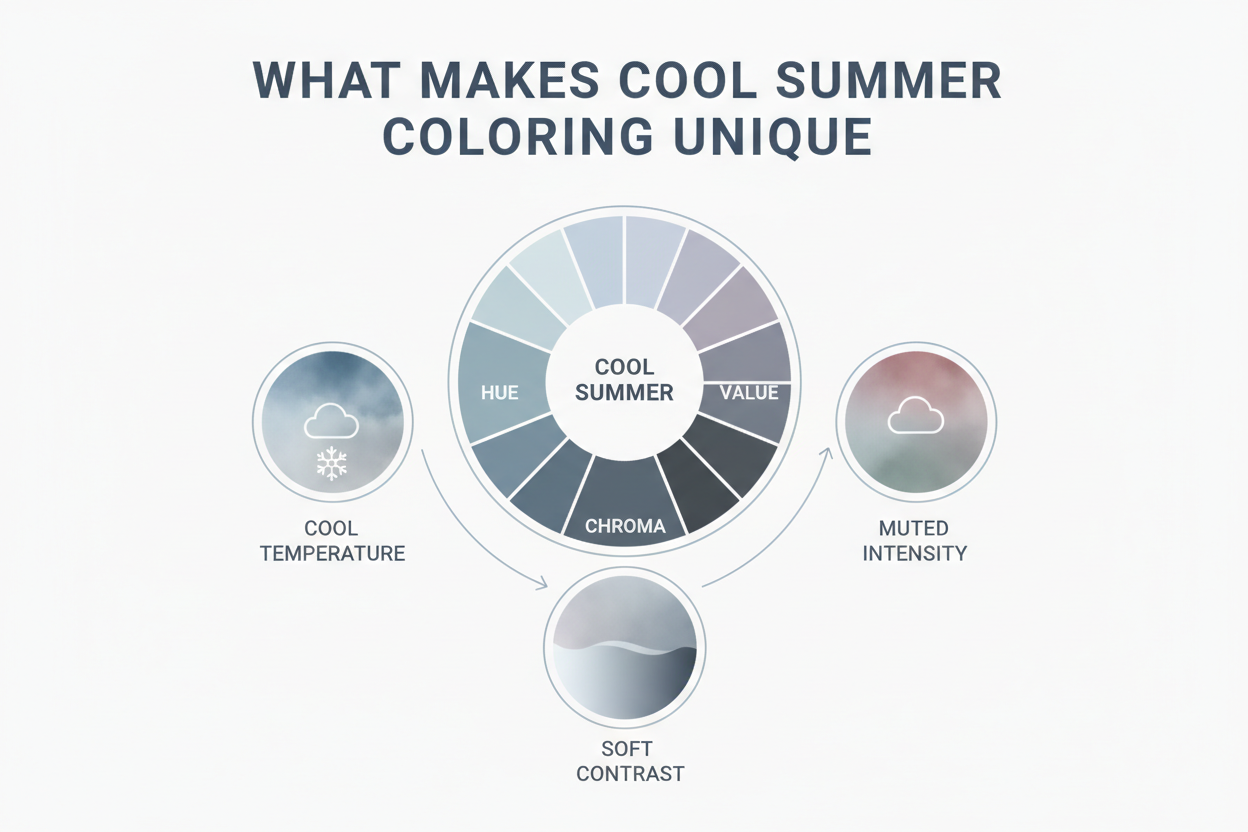
Cool means no yellow, orange, or golden warmth. Cool Summer skin and hair have a blue or violet-leaning undertone rather than a peachy or golden one. Any hair color that introduces warmth — even subtly — creates a small but visible conflict with the skin.
Soft refers to value contrast. Cool Summers are not high-contrast types. Skin, eyes, and hair tend to blend into one another gently rather than creating sharp definition. Hair colors that are dramatically light or dark break that softness, even if they are technically cool in tone.
Muted means reduced saturation. A Cool Summer blonde is not bright platinum. A Cool Summer brown is not rich, glossy chocolate. Both read as too vivid. The palette's defining quality is a gentle, slightly veiled appearance — what some color analysts describe as an overcast English garden rather than a sun-drenched Mediterranean scene.
If you recognize all three in your natural coloring — no warmth, low contrast, slightly hushed tones — you are probably looking at a Cool Summer palette. If you are unsure whether you fit this season or one of its neighbors, it is worth sorting out before your next color appointment.
Not sure if you are a Cool Summer? Take the free color analysis quiz at color-analysis.app to confirm your season type before reading on.
The Natural Hair Color Range of Cool Summers
Cool Summer natural hair falls within a recognizable band even before any color work is applied.
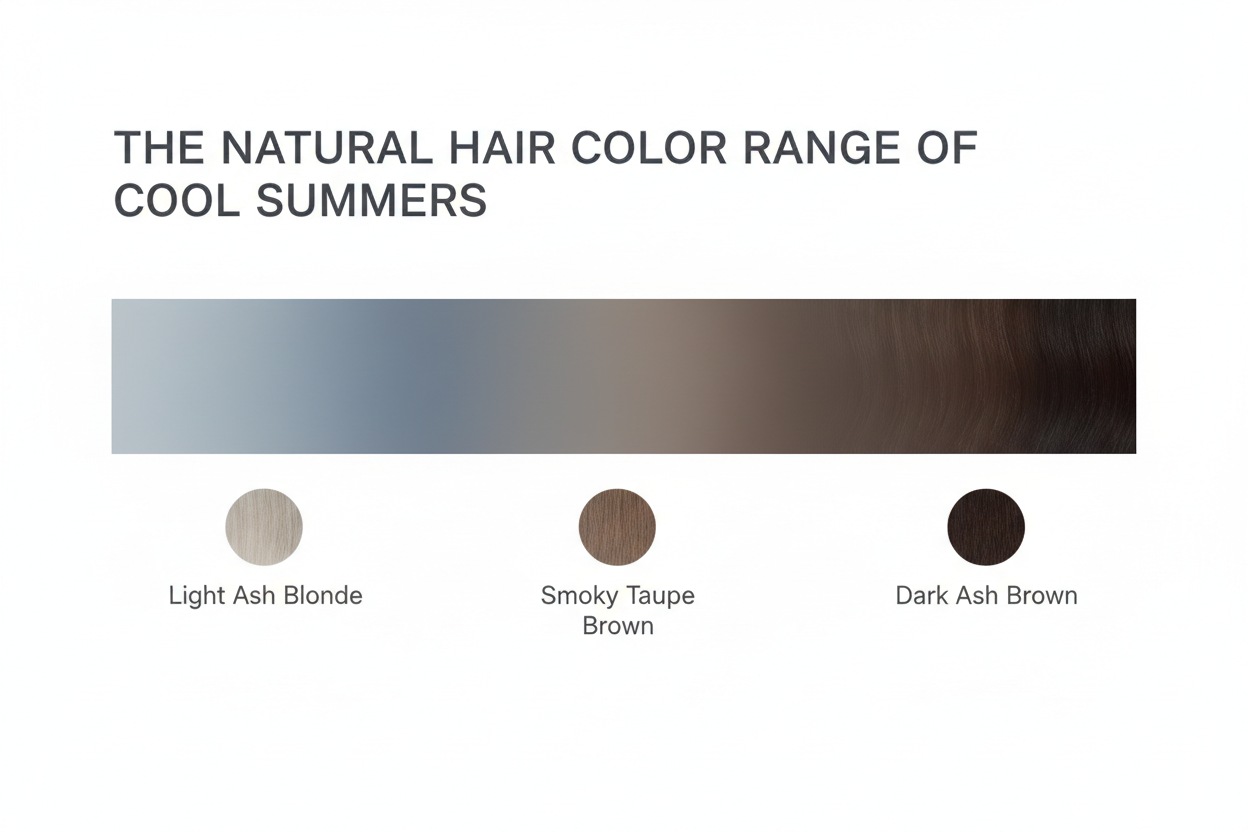
That range runs from:
- Light ashy blonde — pale, no golden cast; sometimes called "dishwater" blonde, and not as an insult
- Dirty blonde or dark blonde — mid-depth, already reads slightly cool and slightly muted rather than honey-toned
- Medium cool brown — soft, ash-based, sits at roughly medium depth without leaning chocolate, chestnut, or auburn
What ties these together is the absence of warmth. Cool Summer hair doesn't catch light with a golden or copper shimmer. In full sun it still reads calm, quiet, a little low in saturation.
That ash quality is the anchor for every recommendation in this guide. When evaluating a shade, the first question is simple: does this introduce warmth or a golden tone? If yes, it's outside the palette — regardless of how well it might work on another season type.
On-Palette Hair Colors That Enhance Cool Summer Features
The best hair colors for Cool Summers stay within the natural range or gently extend it while keeping that soft, muted, cool character intact. The goal is harmony, not transformation.
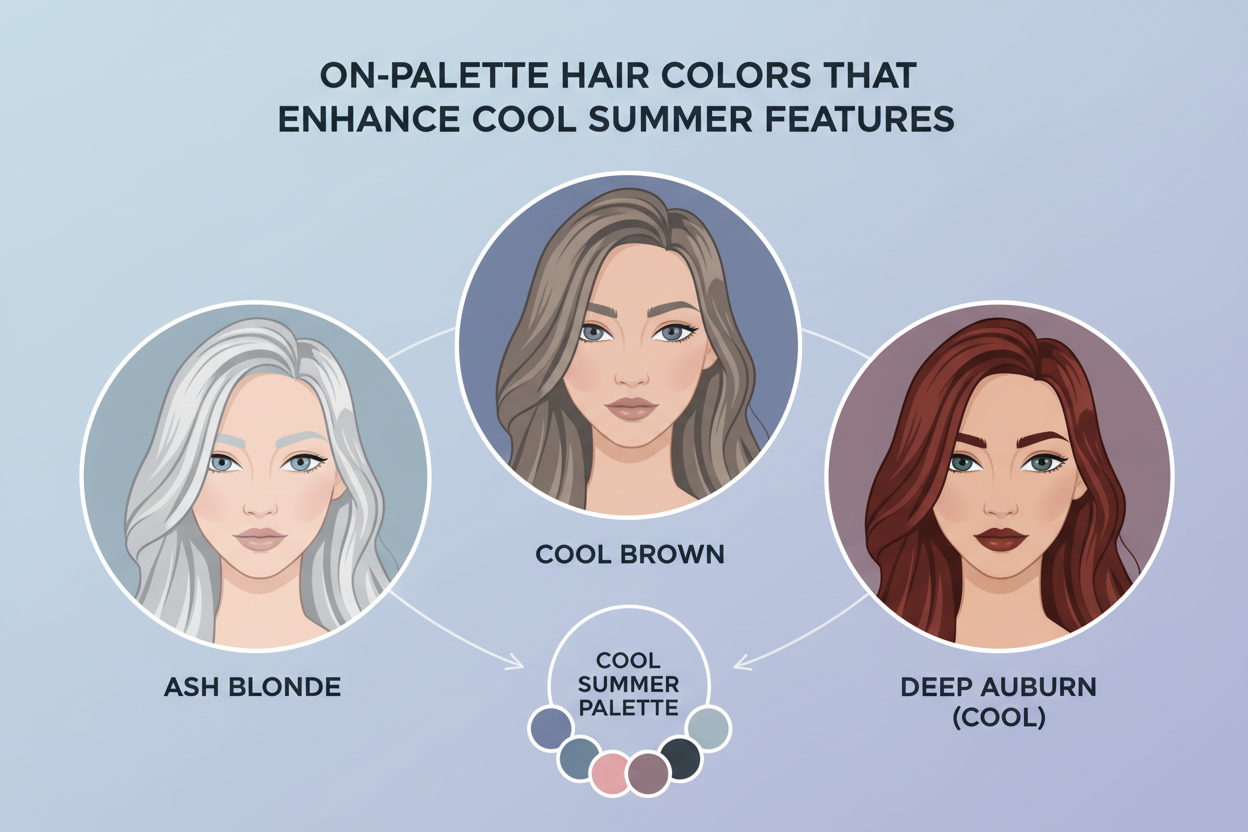
Ash Blonde Variations for Cool Summers
Ash blonde is the signature shade for Cool Summers at the lighter end of the spectrum, but it's not a single fixed color — it runs across a range of depths.
- Light ash blonde — the palest option; works best for Cool Summers whose natural hair is already in the lightest part of the range. Should read pearl or silver-blonde, never golden or creamy.
- Medium ash blonde — slightly deeper, closer to a cool dirty blonde; good for those whose natural depth sits in the mid-blonde range and who want to refresh or brighten without going lighter.
- Dark ash blonde — approaching the border between blonde and brown; sometimes called "mushroom blonde." Still fully on-palette as long as the tone stays genuinely ash and doesn't drift toward warm beige or caramel.
What all these variations share is the absence of gold or yellow warmth. A platinum blonde with violet toner is on-palette. A honey blonde with golden highlights is not, even if the overall effect looks "natural."
When lifting or toning to reach these shades, aim for a neutral-to-cool result. Never warm.
Cool Brown Shades That Stay True to the Palette
For Cool Summers at the deeper end of their natural range — or those who want a richer look without going blonde — cool browns are solid on-palette options.
- Soft cool brown — a medium brown with an ash or slightly violet-leaning base. This is the natural hair color of many Cool Summers and holds up well when maintained with cool-toned toning treatments.
- Mushroom brown — a greige-inflected brown that blends grey, beige, and cool undertones without reading warm. Particularly useful for those transitioning into grey or trying to extend the muted quality of their natural color.
- Taupe-brown — a slightly grey-brown in the cool-neutral zone; works well as a base with very subtle, cool-toned lowlights for dimension without contrast.
The shades to watch out for are chocolate brown (red-brown warmth), chestnut (red-orange undertones), and walnut (warm golden-brown). Those belong on warmer season palettes. For Cool Summers, the test is simple: does the brown carry any hint of red, copper, or golden warmth? If yes, it pulls away from the palette.
Coloring Techniques That Preserve the Soft, Muted Effect
The shade matters, but so does how it's applied. Some techniques that work on other season types actively disrupt the Cool Summer palette.
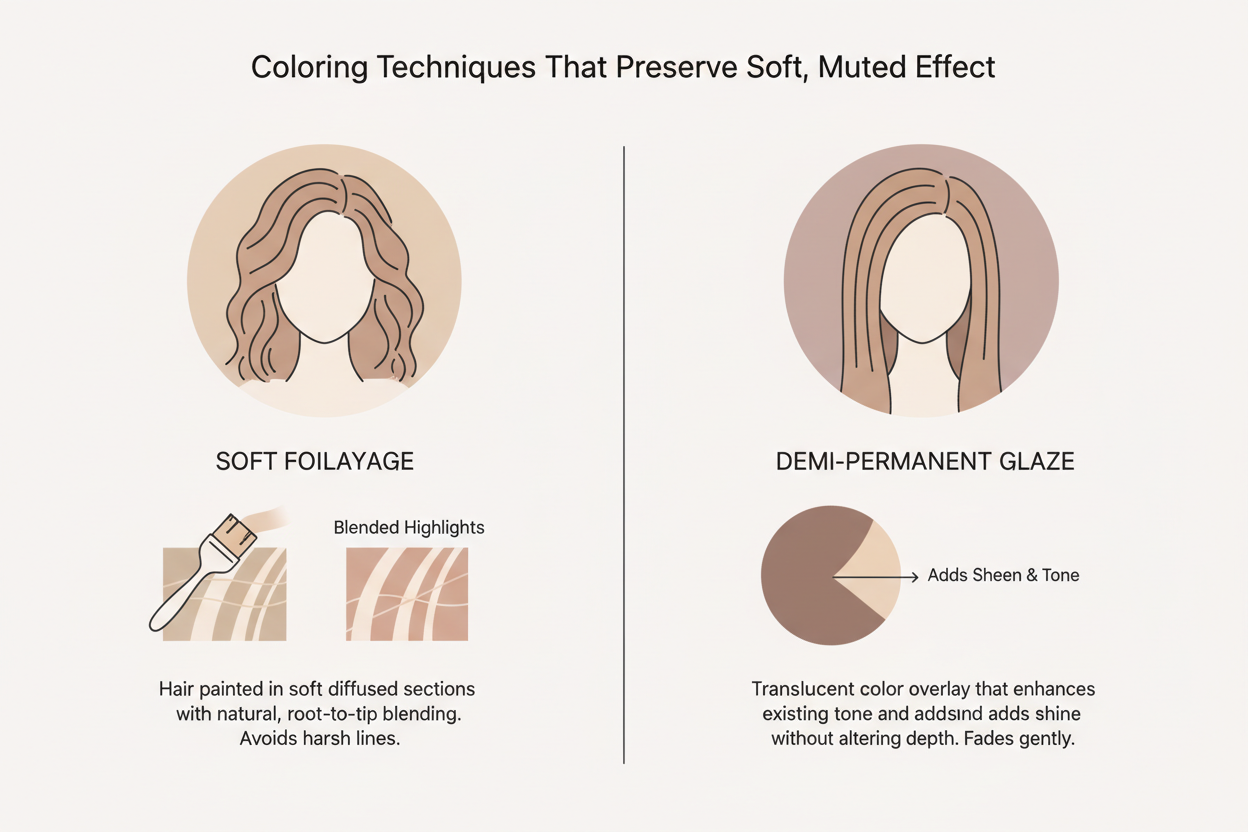
Techniques that support the palette:
- Toning and glazing — the most palette-consistent approach. A cool-toned glaze or toner applied over natural or previously colored hair refreshes the ash quality without adding lightness or contrast. Good for maintenance and for neutralizing unwanted warmth.
- Soft balayage with cool ends — with a subtle hand and cool-toned lightener, balayage can add gentle dimension without high contrast. Keep the transition gradual and the final tone ash, not golden or caramel.
- Lowlights in a slightly deeper cool brown — cool-toned lowlights in ash blonde create soft depth that stays within the palette. The difference between base and lowlights should be minimal — two shades at most — or the palette's characteristic low-contrast softness starts to break down.
- Root shadowing with cool brown — a small amount of cool-toned depth at the root can reduce how often you need a touch-up, as long as the brown is genuinely ash-based.
Techniques that work against the palette:
- High-contrast highlights — bright, chunky, or widely spaced highlights introduce bold contrast that sits outside the Cool Summer range, regardless of the highlight tone.
- Warm balayage — caramel, honey, or golden balayage is one of the most common reasons Cool Summers walk out with results that feel off. The warmth conflicts with their cool skin undertone.
- Heavy bleach lifts without toning — lifting without toning almost always produces a yellow or orange intermediate stage. Without a corrective cool toner, the result pushes warm and outside the palette.
Not sure your current color is working within the palette? Confirm your season type first with the color analysis quiz at color-analysis.app before your next appointment.
Colors to Avoid If You Are a Cool Summer
The shades that conflict with this palette are the direct inverse of its defining traits — cool, soft, muted. There's logic behind the list.
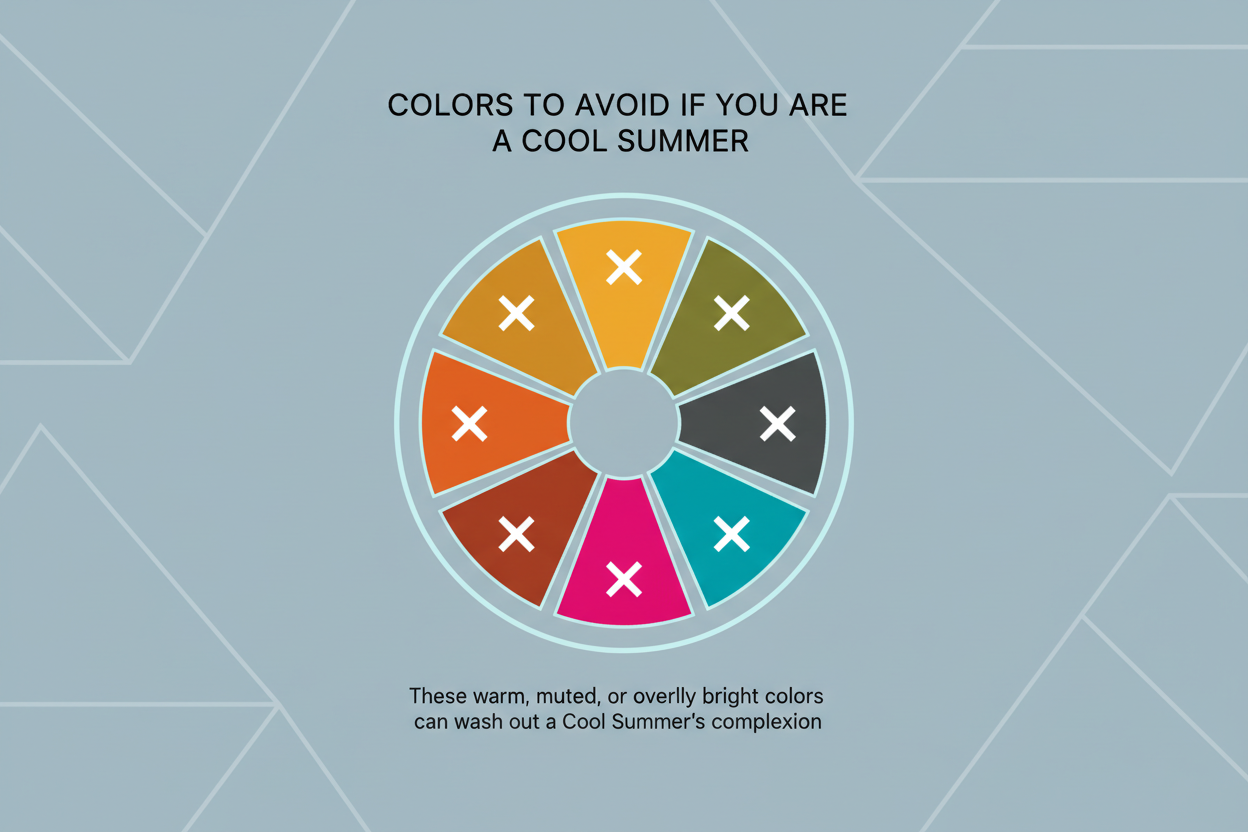
Avoid these families of color:
- Golden and honey blondes — the warm, luminous blonde that looks radiant on Spring and Warm Autumn types creates direct conflict with Cool Summer's cool undertone. Even "natural-looking" golden highlights can make the skin appear sallow or slightly off.
- Copper and strawberry tones — these sit at the opposite end of the undertone spectrum. Copper, auburn, and red-orange all read warm and vivid, clashing with both the cool and muted parameters at once.
- Red-based browns — mahogany, chestnut, auburn-brown, and warm walnut all carry orange-red undertones. They may add depth, but they move the color entirely outside the Cool Summer range.
- Bright or vivid fashion colors — highly saturated colors (bright red, vivid violet, electric blue) break the muted parameter. Even when cool in undertone, the saturation level doesn't work with the palette's characteristic hushed quality.
- Very dark near-black shades — deep espresso or near-black creates too much contrast for Cool Summer. The season sits at light-to-medium depth; very dark shades make the face read heavy and lose the soft blending that defines the type.
The logic holds throughout: if a color is warm, high-saturation, or very dark, it conflicts with at least one — usually all three — of Cool Summer's defining traits.
How to Confirm You Are a Cool Summer Before Changing Your Hair Color
Season confusion is common, especially among types that share the Summer undertone family. Cool Summer, True Summer, and Light Summer all have cool undertones, and the differences can be subtle enough that they're hard to spot without a structured assessment.
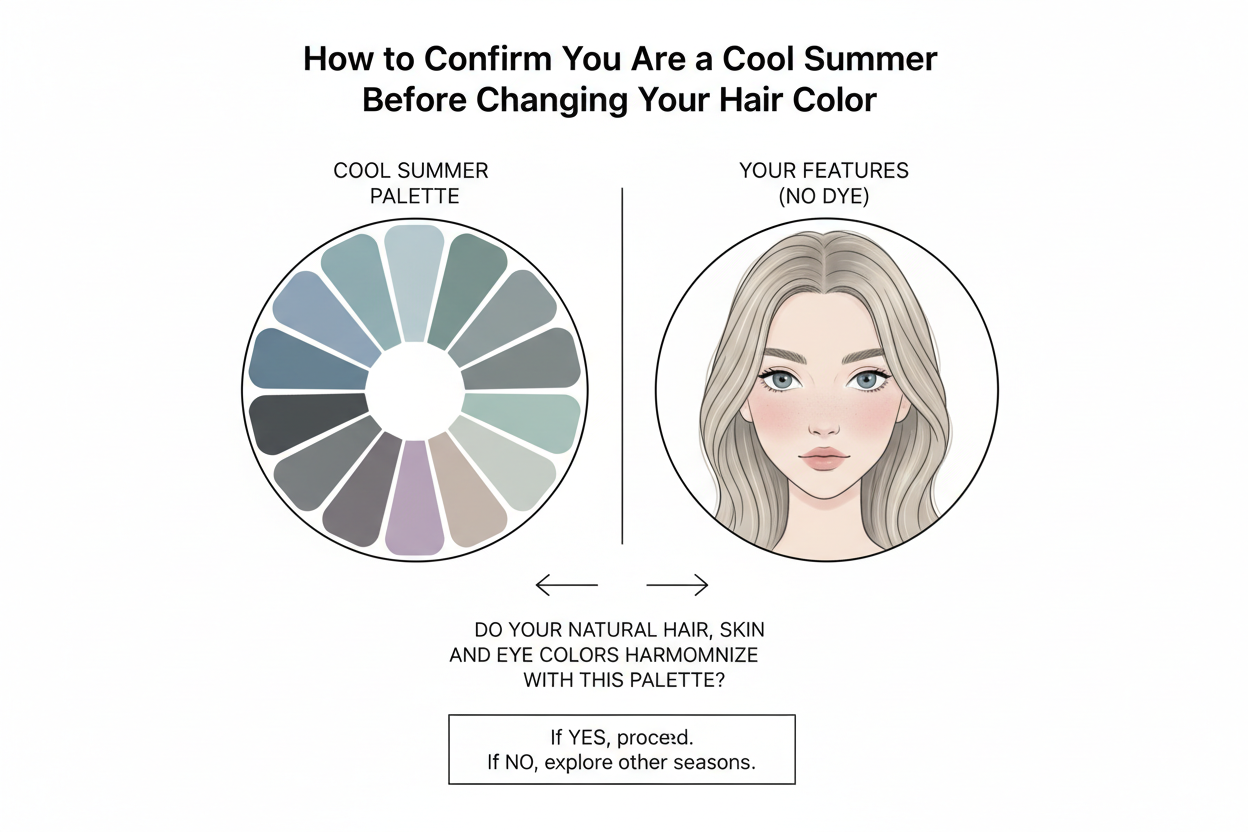
Before you book a color appointment based on this guide, it's worth making sure Cool Summer is actually your season. A misidentification means spending time and money on a color that works against your natural coloring instead of with it.
Some signs that point toward Cool Summer specifically:
- Your natural hair falls somewhere in the ash blonde to medium cool brown range, with no visible warm or golden cast
- Your skin has cool, blue-leaning undertones and a slightly muted quality — not olive, not peachy
- You have low-to-medium natural contrast between your skin, eyes, and hair
- Cool, muted colors in clothing (soft lavender, dusty rose, powder blue) look noticeably better on you than warm or vivid ones
If any of these feel uncertain — especially if you're wondering whether you might be a Soft Summer, Light Summer, or even a cool Autumn — a structured color analysis will give you a clear answer. The free quiz at color-analysis.app works through these distinctions methodically.
Confirming your season before the appointment is the most efficient way to avoid a result that needs immediate correction.
Maintaining Cool Summer Hair Color Over Time
The biggest practical challenge for Cool Summers with colored hair is oxidation — the natural process by which cool ash tones gradually shift warmer over time. A freshly toned ash blonde or cool brown can look precisely on-palette at the salon, then drift toward brass or gold within four to six weeks.
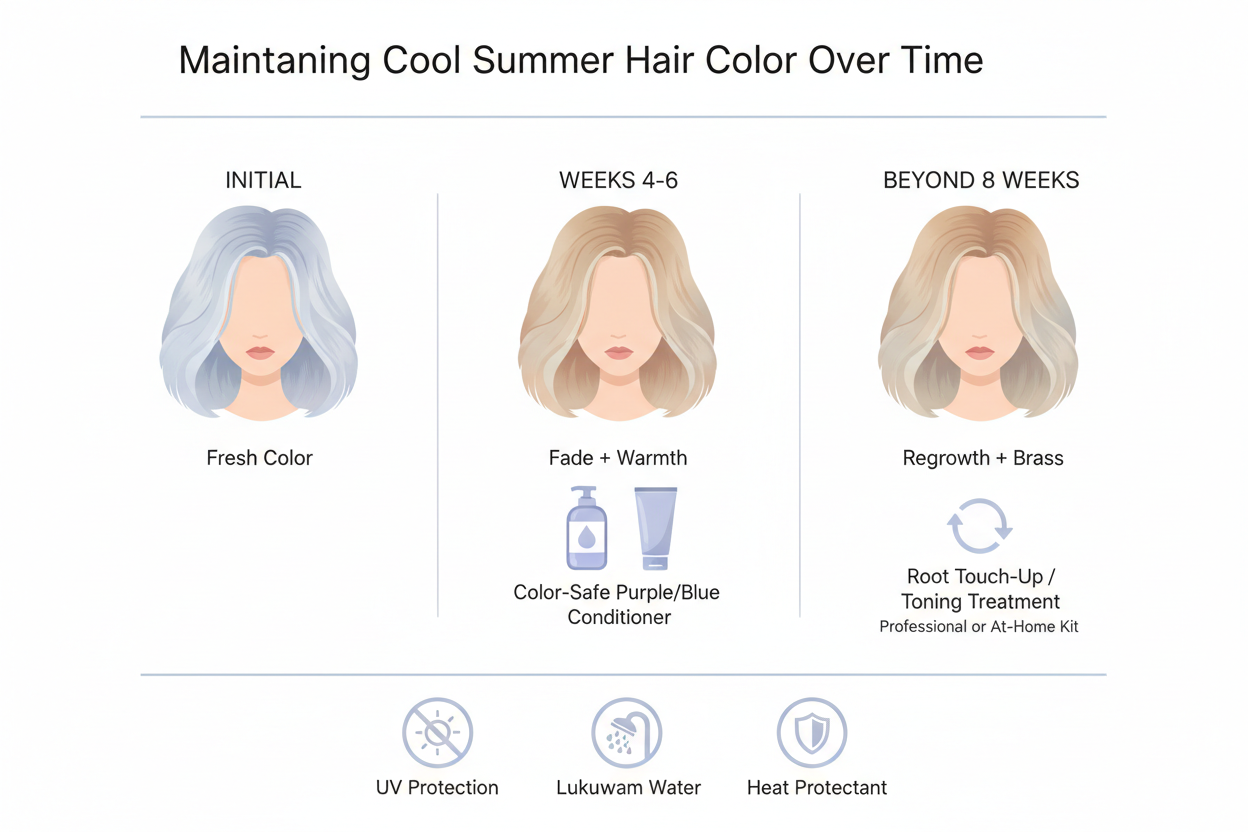
This warm shift doesn't mean the original color was wrong. It means maintenance is part of the commitment.
Key maintenance principles:
- Tone regularly. A cool-toned gloss or toner every four to six weeks pulls color back toward its intended ash quality. You can do this at a salon or at home with a violet-based toning product.
- Use color-preserving shampoo formulated for cool or ash tones. Purple or blue-tinted shampoos deposit small amounts of pigment that counteract brassiness between toning appointments. They won't replace a proper toning session, but they slow the warm drift.
- Limit heat and UV exposure where possible. Both accelerate oxidation. Heat protectants and UV-filtering hair products help without adding more color appointments to your schedule.
- Talk to your colorist about the oxidation timeline. Asking for a shade that starts slightly cooler than your target — knowing it will warm over the following weeks — is a practical strategy that extends the life of the result.
The soft, muted cool quality that defines this palette is achievable with colored hair, but it needs ongoing attention to tone. Color that drifts warm isn't just an aesthetic preference issue — for Cool Summers, it creates a visible mismatch with the skin's cool undertone, and the longer it goes unaddressed, the more noticeable it gets.
People Also Ask
What hair color is best for a cool summer skin tone?
The most flattering options share three qualities: cool in undertone, soft in depth, and muted rather than vivid. The strongest choices within those parameters:
- Ash blonde at light to medium depth — nothing golden or creamy
- Soft cool brown — ash-based, around medium depth, no red or chocolate warmth
- Mushroom blonde or mushroom brown — greige-toned shades that stay cool without tipping warm
The common thread is the absence of golden, copper, or red undertones. Cool summer skin has a blue-leaning undertone that works with ash and muted tones and quietly fights anything warm or vivid.
Can cool summers go blonde?
Yes — blonde is actually one of the most natural directions for this palette, since many cool summers already have hair somewhere in the ash blonde to dirty blonde range. The key is which blonde.
- On-palette: light ash blonde, medium ash blonde, dark ash blonde, mushroom blonde
- Off-palette: honey blonde, golden blonde, platinum with a warm cast, caramel-toned blonde
The difference is tone, not depth. A cool summer can go lighter or stay mid-depth as long as the result is genuinely ash and free of golden warmth. That usually means toning after any lightening, since lifting hair without toning almost always passes through a yellow or orange stage that needs to be neutralized.
What hair colors should cool summers avoid?
Anything that introduces warmth, high saturation, or strong contrast — all of which work against this palette.
Shades to avoid:
- Golden and honey blondes
- Copper, auburn, and strawberry tones
- Red-based browns: mahogany, chestnut, warm walnut
- Very dark near-black shades, which create contrast too sharp for a soft, low-contrast palette
- Highly saturated fashion colors, even cool ones — vivid saturation sits outside the muted cool summer range
A rough test: if a shade would look radiant on a warm autumn or spring type, it's probably working against a cool summer's coloring rather than with it.
How do I know if I am a cool summer color type?
Cool summer falls within the broader Summer family, so all cool summers share cool undertones and a soft, muted overall appearance. A few indicators that point specifically to this type:
- Natural hair falls somewhere between light ashy blonde and medium cool brown, with no visible warm or golden shimmer
- Skin has cool, slightly blue-leaning undertones and a gentle quality — not olive, not peachy, not deeply tanned
- Natural contrast between skin, hair, and eyes is low to moderate — features blend together rather than creating sharp definition
- Cool, muted clothing tones — dusty rose, soft lavender, powder blue — look noticeably more harmonious than warm or vivid alternatives
Where it gets harder is telling cool summer apart from its neighbors. True Summer, Light Summer, and Soft Summer all share that cool-muted quality to varying degrees. If you're unsure which one fits, a structured color analysis is the most reliable way to confirm before making any hair color decisions.
Does ash brown work for a cool summer palette?
Yes — ash brown is one of the most straightforward options for cool summers who want something deeper and richer without going blonde. A soft ash brown at medium depth sits right in the natural hair range for this type and keeps all three core palette qualities intact: cool undertone, muted tone, soft depth.
The ones to avoid are the warm browns — chocolate, chestnut, mahogany, warm walnut. They all carry red, orange, or golden undertones that work against cool summer coloring. As long as the brown base is genuinely ash-toned rather than red- or gold-leaning, it fits well. Regular cool-toned toning treatments help keep that ash quality as the color oxidizes over time.
FAQ
What is the difference between a Cool Summer and a True Summer in color analysis?
True Summer and Cool Summer are closely related — many frameworks use the terms interchangeably, while others treat Cool Summer as a distinct subtype sitting at the cooler edge of the Summer family.
Where they converge:
- Both are defined by cool undertones, soft depth, and muted saturation
- Both have natural hair in the ash blonde to medium cool brown range
- Both look best in colors that are gentle and low-contrast rather than vivid and bold
Where they can differ (in systems that separate the two):
- True Summer is the most balanced expression of the season — equally cool, muted, and soft
- Cool Summer leans more strongly toward the cool axis, sometimes tolerating slightly deeper or cooler shades than True Summer
For practical hair color purposes, the guidance is nearly identical across both types. If you're unsure which label applies to you, the underlying principles — ash tones, muted depth, no warmth — apply either way.
Can a Cool Summer wear warm highlights without clashing with their palette?
Technically yes, but in such limited doses that most stylists familiar with color analysis don't recommend it.
The problem is that warm highlights — honey, golden, caramel — bring in exactly the undertone a Cool Summer palette is built around avoiding. Even a small amount can:
- Clash with cool undertone skin, making the complexion look slightly sallow or uneven
- Undermine the soft, muted quality the palette depends on by adding contrast and brightness
- Require more upkeep to stop the warm tones from pulling further orange as they fade
If you want dimension, cool-toned techniques — soft ash or mushroom pieces, or babylights kept within the ash family — get you there without pulling the result warm. Dimension works; it just has to stay within the cool, muted range.
Is ash blonde the best hair color for a Cool Summer?
Ash blonde is one of the strongest options, but "best" depends on your natural depth and how much change you want from your baseline.
Ash blonde works well for Cool Summers because the gray-leaning undertone sits naturally within the palette, depth options run from light to dark without pushing outside it, and many Cool Summers already have something close to ashy blonde naturally — so it reads more like an enhancement than a reinvention.
That said, it's not the only option. Soft ash brown works just as well for anyone who wants something darker. Mushroom blonde, which sits between blonde and brown, holds the same muted, cool quality.
What actually matters isn't the shade name — it's the underlying qualities: cool undertone, muted finish, soft depth. Ash blonde delivers all three reliably, which is why it comes up so often. But there's more than one way to get there.
What happens if a Cool Summer dyes their hair a warm or golden shade?
The most common outcome is a visible mismatch between the hair color and the person's natural coloring — particularly at the face.
Specific effects to expect:
- Skin can appear more sallow or washed out — warm hair against cool-undertone skin tends to make the skin's natural blue-leaning undertones look tired rather than luminous
- Under-eye shadows and any skin unevenness may become more visible, since the contrast between warm hair and cool skin draws attention to the transition zone at the face
- Features can look heavier or less defined, because the palette's natural harmony — soft, muted, cool — is disrupted
The effect is rarely obvious to an untrained eye, but it works against the person's coloring rather than with it. A lot of Cool Summers who try warm shades say something feels "off" even if they can't quite put their finger on it. Going back to ash or cool-based tones usually fixes it.
How often should a Cool Summer tone their hair to maintain the muted, cool effect?
There's no single fixed interval, but here's a rough guide based on how color fades:
- Every 4–6 weeks is a reasonable starting point if you're maintaining a lighter ash blonde, since lifted hair oxidizes and can pull yellow or brassy between appointments
- Every 6–8 weeks may be enough for medium ash shades, which tend to fade more slowly
- At-home toning — a cool or ash-toned gloss, purple conditioner, or diluted toner — can stretch the time between salon visits
The real trigger isn't a date on the calendar. It's the moment your color starts reading warm. Once you can see yellow or golden tones coming through, the cool, muted quality that defines the palette is already slipping. Getting ahead of that keeps the result consistently where it should be.
Can Cool Summers go darker, and if so, how dark is too dark?
Yes, cool summers can go darker. Soft ash brown at medium depth is a well-established option within the palette. The limiting factor isn't depth alone but the combination of depth and contrast.
Medium ash brown adds richness without losing the cool, muted quality. Soft dark ash brown stays within range if the tone remains genuinely ashy and the skin isn't very fair.
Where things start working against the palette is at very dark shades. Near-black or deep espresso creates contrast between hair and skin that sits outside the soft, low-contrast nature of the cool summer palette. Dark shades with any warm or red base compound the problem by adding both high contrast and an off-palette undertone.
A useful check: if the darkened result makes your complexion look washed out, or makes the boundary between your hair and skin look harsh rather than soft, the depth has likely gone too far. Staying at medium depth, or consulting a colorist familiar with seasonal color analysis, helps keep the result on track.
How do I confirm my season type before committing to a new hair color?
Seasonal color analysis is the most reliable way to confirm your type before making a change that's hard to undo.
A few approaches worth considering:
- In-person color analysis with a trained consultant — fabric draping under controlled lighting is still the most accurate method, since it shows how your skin actually responds to different color temperatures and saturations, without makeup or existing hair color muddying the result
- AI-assisted seasonal analysis tools — apps like color-analysis.app use your photos to assess undertone and palette fit, which is a reasonable starting point before you commit to a salon appointment
- Self-assessment indicators to look for before your analysis:
- Natural hair in the ash blonde to medium cool brown range
- Cool, blue-leaning skin undertones
- Low to moderate natural contrast between hair, skin, and eyes
- Muted cool clothing tones that consistently look more harmonious than warm or vivid alternatives
If your results point toward Summer but you're not sure whether you fall into the Cool, True, Light, or Soft subtype, that distinction actually matters for hair color. The shades that work for a Light Summer (softer, lighter) differ from those that work for a Cool Summer (cooler, with slightly more depth tolerance). Knowing your specific type before your appointment gives your colorist something concrete to work with.
Before finalizing a shade, compare this advice with the companion article “Cool Summer Hair Colors and Highlights”, which keeps the two closely related questions distinct.