Best Colors for Brown Skin Tone
 Reviewed by Alexandra Gilmore
Brown skin ranges from honey and caramel to mahogany and espresso, and undertone determines why the same garment changes across that spectrum. Identify warm, cool, neutral, or olive direction first, then use concrete colors and outfit combinations to make the complexion look clearer and more dimensional.

You've probably experienced it: a color looks stunning on the rack, you bring it home, and something feels off the moment you put it on. That disconnect rarely has anything to do with the shade itself — it almost always comes down to undertone.
💫 Build Your Personal Color Palette
Turn the useful colors from this article into a palette you can repeat across real outfits. A personal palette makes it easier to coordinate neutrals, accents, and combinations without treating every recommendation as a rigid rule.
Build My Palette →Brown skin spans an enormous range, from warm honey and caramel through rich mahogany and deep espresso. What those shades share is that each one sits on top of an undertone — warm, cool, or neutral — that quietly governs which clothing colors will make your complexion glow and which will dull it. Get the undertone right, and even an unexpected color choice can look intentional and polished.
This guide is built around that principle. Here's what you'll find inside:
- How undertone works and why it matters more than your surface shade when choosing brown skin tone clothes color
- Practical tests you can do at home today to identify your own undertone
- Curated color palettes for warm-undertone and cool-undertone brown skin, plus universally flattering options that work regardless of undertone
- Colors to approach with care — and how to style them when you still want to wear them
- A capsule wardrobe framework so you can build a cohesive, confidence-boosting closet rather than guessing outfit by outfit
Whether your skin leans golden, olive, red, or ashy, the answers start with understanding what's underneath the surface. Let's begin there.
Why Brown Skin Tone Clothes Color Starts With Undertone, Not Shade
Generic color advice for "dark skin" tends to miss the mark because it treats all brown skin as one thing. Two people with nearly the same surface depth can have completely different undertones — and those undertones are what determine whether a clothing color works with your complexion or fights against it.
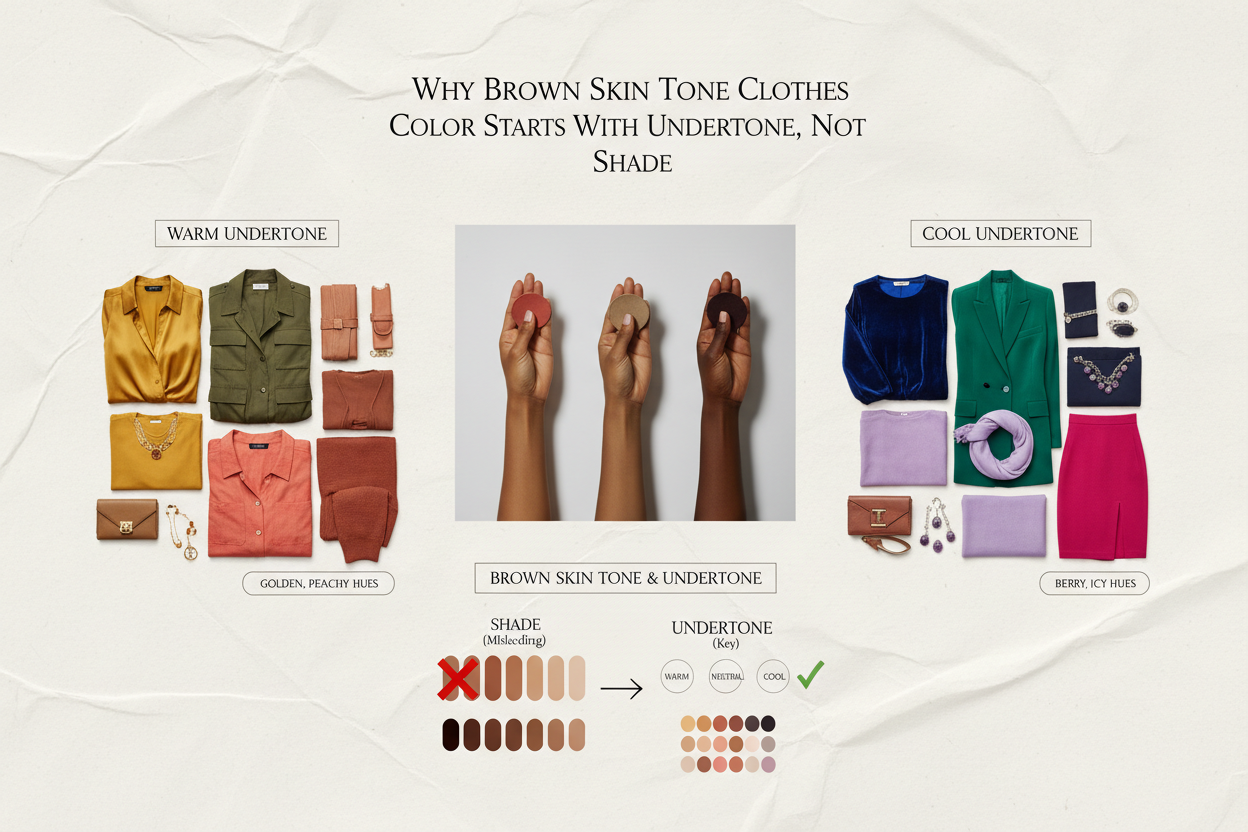
Surface shade tells you how light or dark your skin reads. Undertone is the secondary hue sitting beneath that surface — and it doesn't shift with seasons, sun exposure, or age. That's why figuring out your undertone comes before any other palette decision. A rich mustard can look luminous on warm-undertone brown skin and muddy on cool-undertone brown skin at the exact same depth. The color didn't change; the undertone interaction did.
This is also why the "looked perfect on the hanger, wrong once you tried it on" problem happens — the color was evaluated in isolation, not against your undertone.
Ready to skip the guesswork? Take the color-analysis.app quiz to get your undertone and personalized palette in minutes →
How to Identify Your Undertone If You Have Brown Skin
Brown skin can have a warm, cool, or neutral undertone. Here's what each one actually looks like:
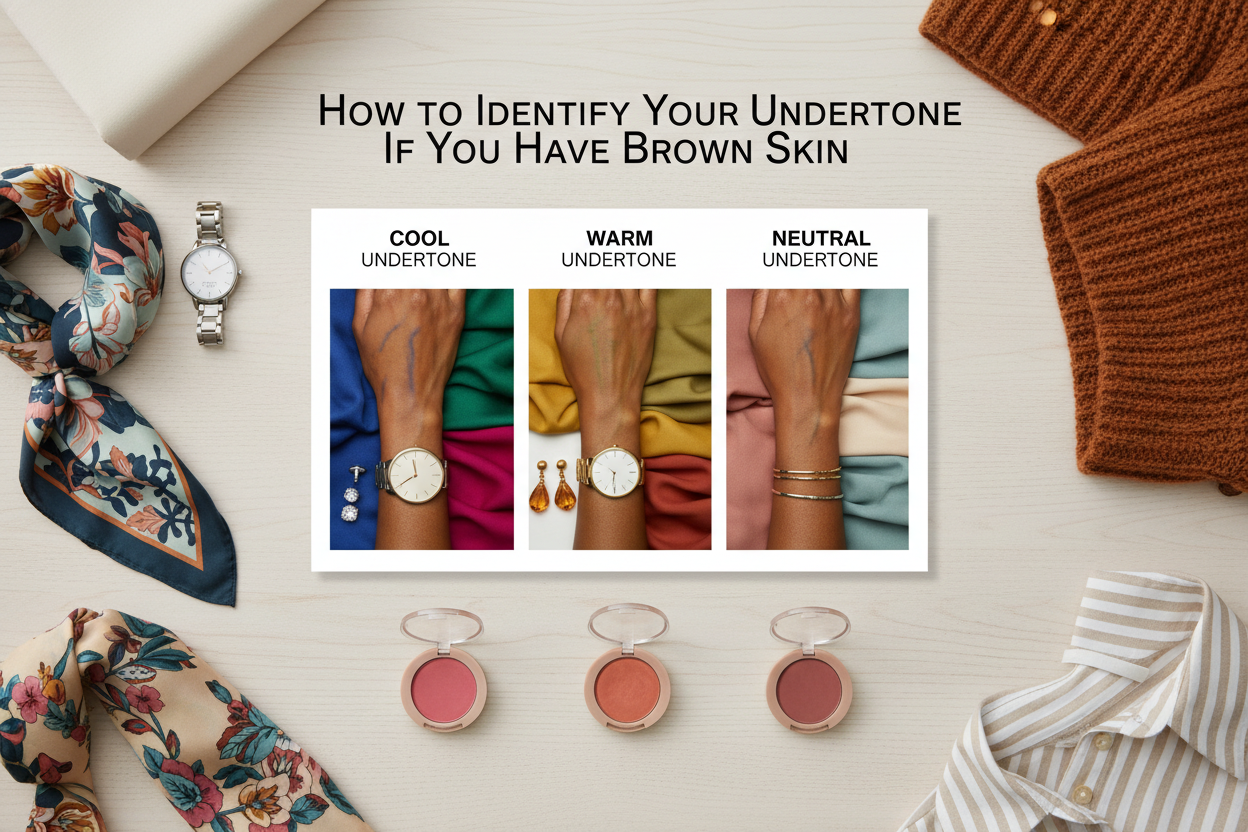
- Warm undertones — golden, amber, olive, or yellow-based hues beneath the skin
- Cool undertones — red, blue, or ashy hues beneath the skin
- Neutral undertones — a mix of warm and cool with no single dominant cast
Because brown skin already carries a rich pigment layer, some standard undertone tests need a small adjustment to be reliable. Use two or three tests together for the most accurate read.
The Vein and Fabric Tests: Quickest Ways to Confirm Your Undertone
The vein test
- Look at the veins on the inside of your wrist in natural daylight, not indoor lighting.
- Greenish veins point toward a warm undertone.
- Bluish or purple veins point toward a cool undertone.
- If you genuinely can't tell and both colors seem present, you're probably neutral.
Note: On deeper brown skin, vein color can be hard to read with confidence. If the result feels ambiguous, skip ahead to the fabric test.
The fabric test
- Hold a piece of bright white fabric next to your face, then swap it for warm ivory or cream.
- If the bright white makes your skin look ashy or washed out while the ivory looks right, you lean warm.
- If the bright white makes your skin look clear and alive while the ivory looks flat against you, you lean cool.
- If both work, you're likely neutral.
The jewelry test (bonus check)
- Gold jewelry making your skin glow = warm undertone signal
- Silver looking sharper and more natural on you = cool undertone signal
- Both metals working comfortably = neutral
Best Clothing Colors for Brown Skin With Warm Undertones
If your tests pointed to a warm undertone — golden, amber, or olive — you have a rich group of earth-based and saturated hues that will consistently work in your favor.
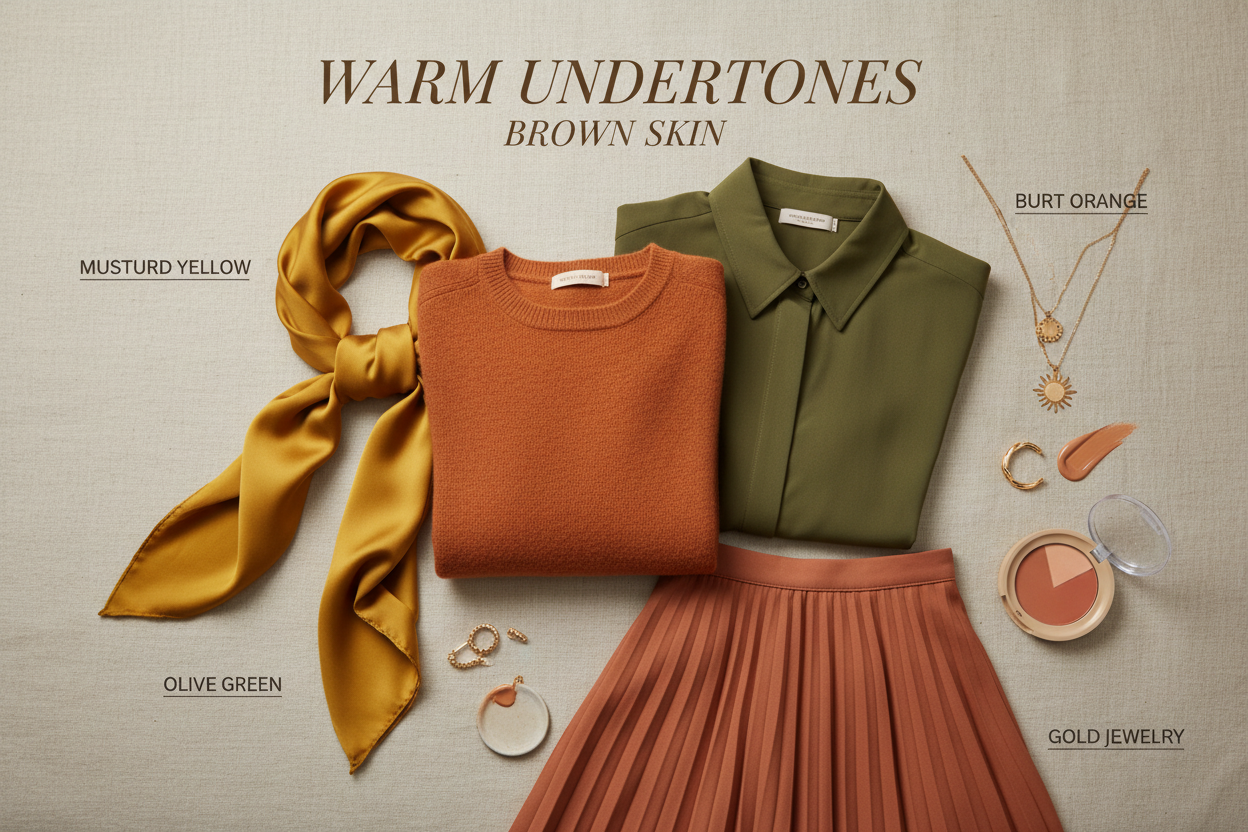
Your strongest colors:
- Terracotta and burnt orange — among the most flattering shades for warm brown skin; the orange family shares chromatic DNA with golden undertones
- Mustard and golden yellow — amplify the warmth already present in your complexion without overwhelming it
- Olive and warm greens — earthy greens with yellow undertones sit in harmony with warm skin rather than pulling against it
- Camel and warm tan — deep enough to contrast while staying in the same warm family
- Warm reds and rust — brick and tomato reds with orange leanings work better than cool blue-based reds
- Warm browns and chocolate — a tonal approach that creates elegant depth rather than blending in (saturation is key)
- Coral and peach — softer warm options for days when you want something lighter without losing luminosity
Colors to reach for with intention:
Icy pastels and cool lavenders can work on warm-undertone brown skin, but they'll need a warm anchor — a gold necklace, a warm-toned bag — to keep the look from feeling off.
Warm-Undertone Brown Skin and Earth Tones: Why the Pairing Works
Color theory calls colors that sit close together on the wheel analogous — and analogous pairings create harmony instead of tension. Warm-undertone brown skin carries amber and golden hues. Terracotta, mustard, olive, and camel all live in the same warm, yellow-orange-red arc. Place those colors next to warm brown skin and they echo the undertone rather than fight it, which the eye reads as cohesion and glow.
The opposite happens when a cool, blue-leaning color sits against warm brown skin — the two hues pull in different directions and the complexion can look less vibrant as a result. Get that one principle down and you can experiment freely across the warm spectrum without second-guessing every choice.
Best Clothing Colors for Brown Skin With Cool Undertones
Cool-undertone brown skin — with its red, blue, or ashy base — tends to work well with saturated, clear colors at both ends of the depth spectrum. This undertone also handles high contrast well, so stark white and true black can both serve as strong wardrobe anchors.
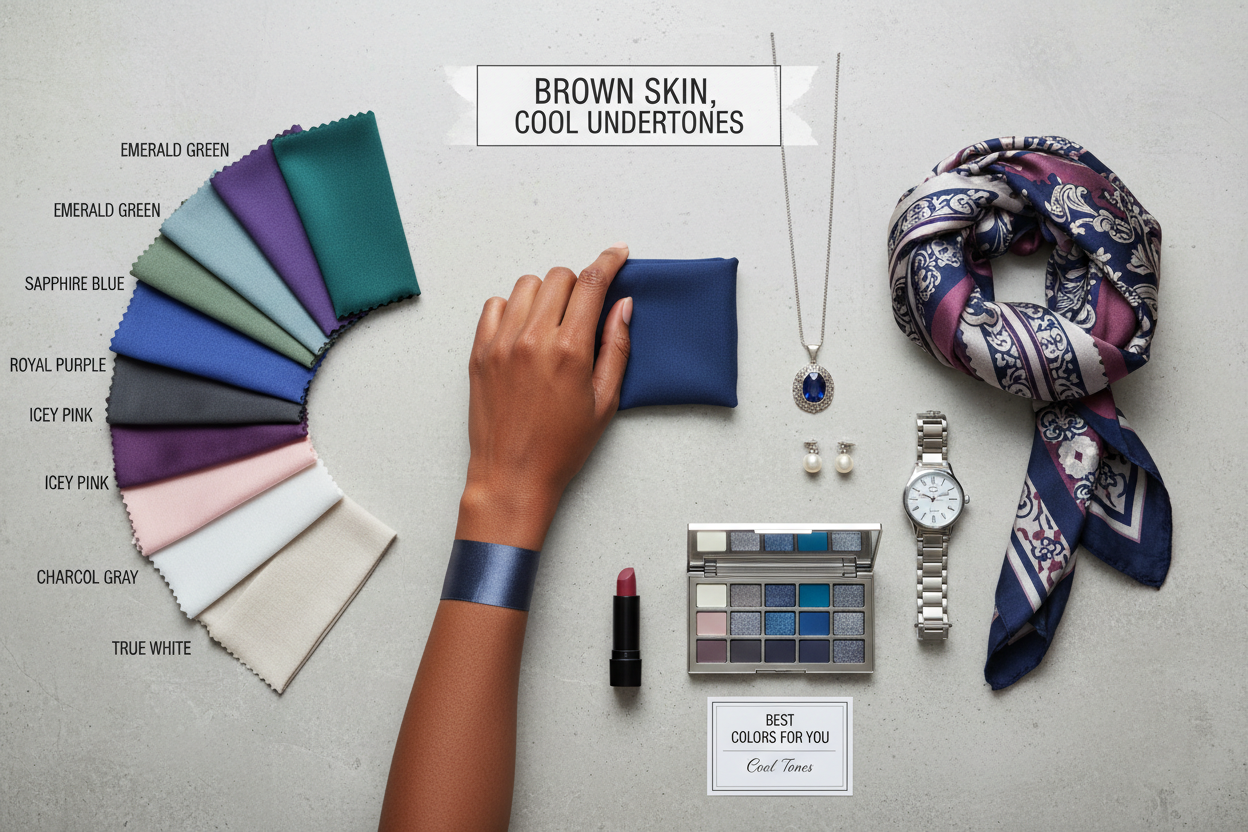
Your strongest colors:
- Sapphire and cobalt blue — jewel-toned blues create a clean, striking contrast against cool brown skin
- Emerald green — rich and saturated, it reads as vivid without clashing
- Plum and deep purple — the reddish-blue end of the purple family aligns naturally with cool undertones
- Burgundy and wine — cool-leaning reds with blue or violet undertones, where warm reds may fall flat
- Cool pink and magenta — the brighter, more saturated pinks rather than peachy or salmon tones
- True black — high saturation, no muddy middle tones; works as a strong neutral
- Bright white — cool undertones can wear pure white without it pulling gray or green against the skin
A note on evening looks: Deep jewel tones — navy, emerald, deep plum — tend to work especially well for evening on cool-undertone brown skin. They read as dramatic without needing heavy contrast styling to pull it off.
Not sure if your undertone is warm or cool? Start the free quiz at color-analysis.app and get your answer in under two minutes →
Universally Flattering Colors That Work Across All Brown Skin Undertones
Still figuring out your undertone — or just want reliable choices while you get your bearings — these colors hold up consistently across warm to cool on brown skin:
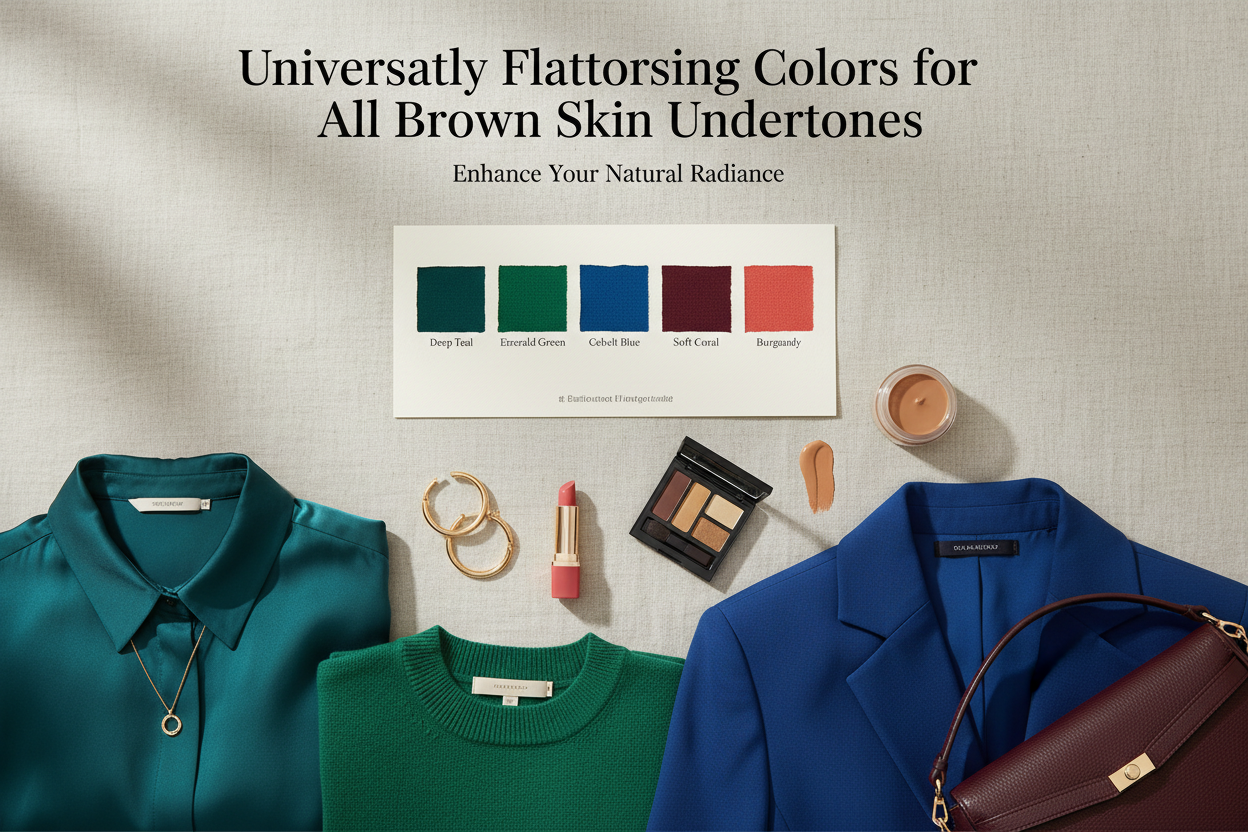
| Color | Why It Works |
|---|---|
| True red | High saturation creates contrast without depending on undertone matching |
| Forest and deep teal | Mid-depth greens with enough richness to read against brown skin without washing out |
| Warm white / ivory | Softer than stark white; works for both warm and neutral undertones |
| Deep navy | Versatile, saturated, and flattering at virtually every depth of brown skin |
| Chocolate brown | Tonal dressing works when saturation is rich enough to create definition |
| Bright coral | Bridges the warm-cool divide; vibrant enough to pop on deeper brown skin |
The through line: saturation matters more than hue family on brown skin. A washed-out version of any of these will fall flat. A richly pigmented one will land.
Colors to Approach Carefully When You Have Brown Skin
"Approach carefully" isn't the same as "never wear." These colors can work — they just require more deliberate choices to avoid the "perfect on the hanger, off once you tried it on" effect.
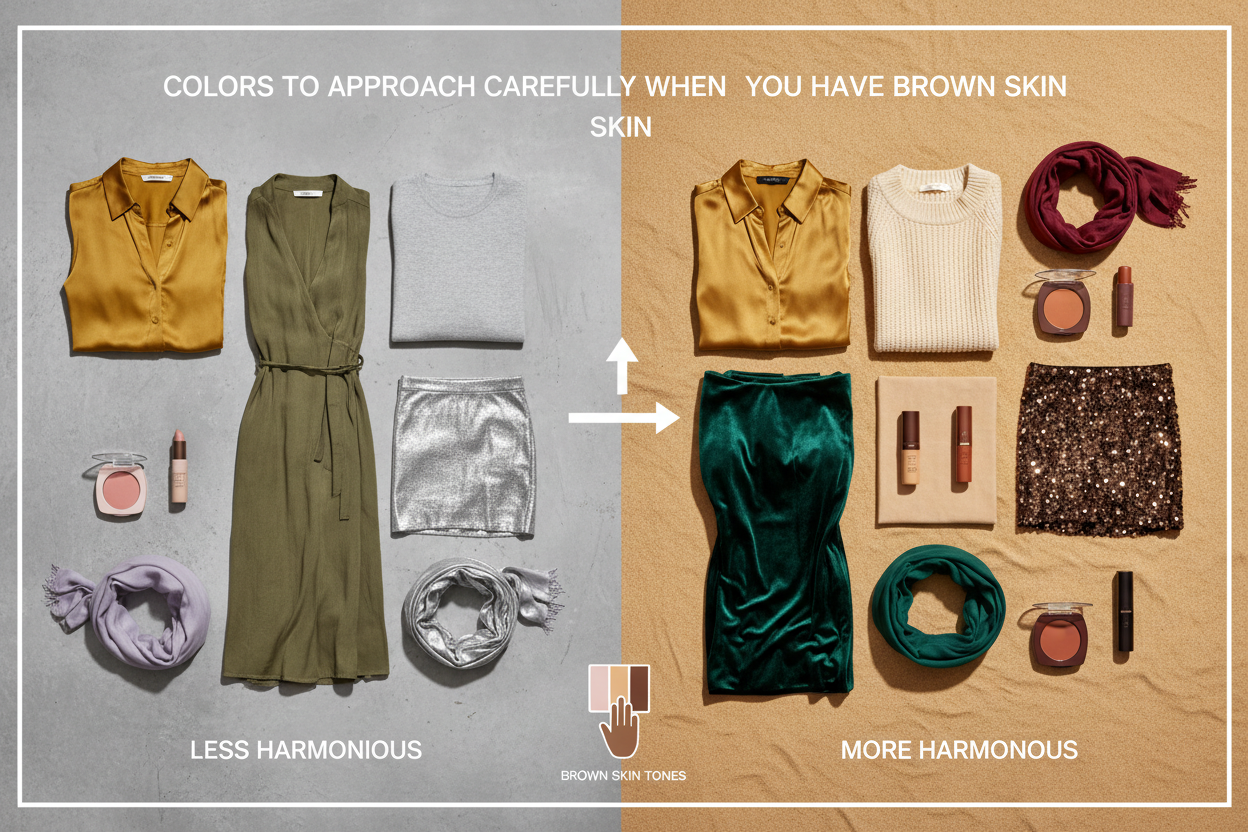
Neon yellow and lime green Very bright, cool-leaning neons can throw an unflattering cast against warm undertones, and can overwhelm even cool-undertone brown skin unless you offset them with strong neutral accessories. If you love neons, anchor them with black or white to keep the contrast in check.
Pale beige and nude tones close to your skin When a "nude" garment lands within a few shades of your actual skin, the clothing and complexion blur together instead of complementing each other. Look for nudes that read clearly lighter or warmer than your skin — something with an obvious contrast.
Washed-out or icy pastels Baby blue, powder pink, pale mint — the low-saturation versions of these can look diluted against the richness of brown skin, warm or cool. If you want pastels, go for the more saturated end: dusty rose over blush, sage over mint, periwinkle over powder blue.
Cool gray Light, stark grays with a blue or silver cast can fall flat against warm brown skin especially. Warm greige or a deep charcoal tends to perform better.
The fix for almost all of these: bump up the saturation, bring in a strong anchor color through accessories, or go with the deeper version of whatever hue you're drawn to.
Building a Capsule Wardrobe Palette Around Your Brown Skin Tone
A capsule approach turns individual color knowledge into a wardrobe that actually gets worn. The goal: a small set of colors that work together, reflect your undertone, and cut down on daily decision fatigue.
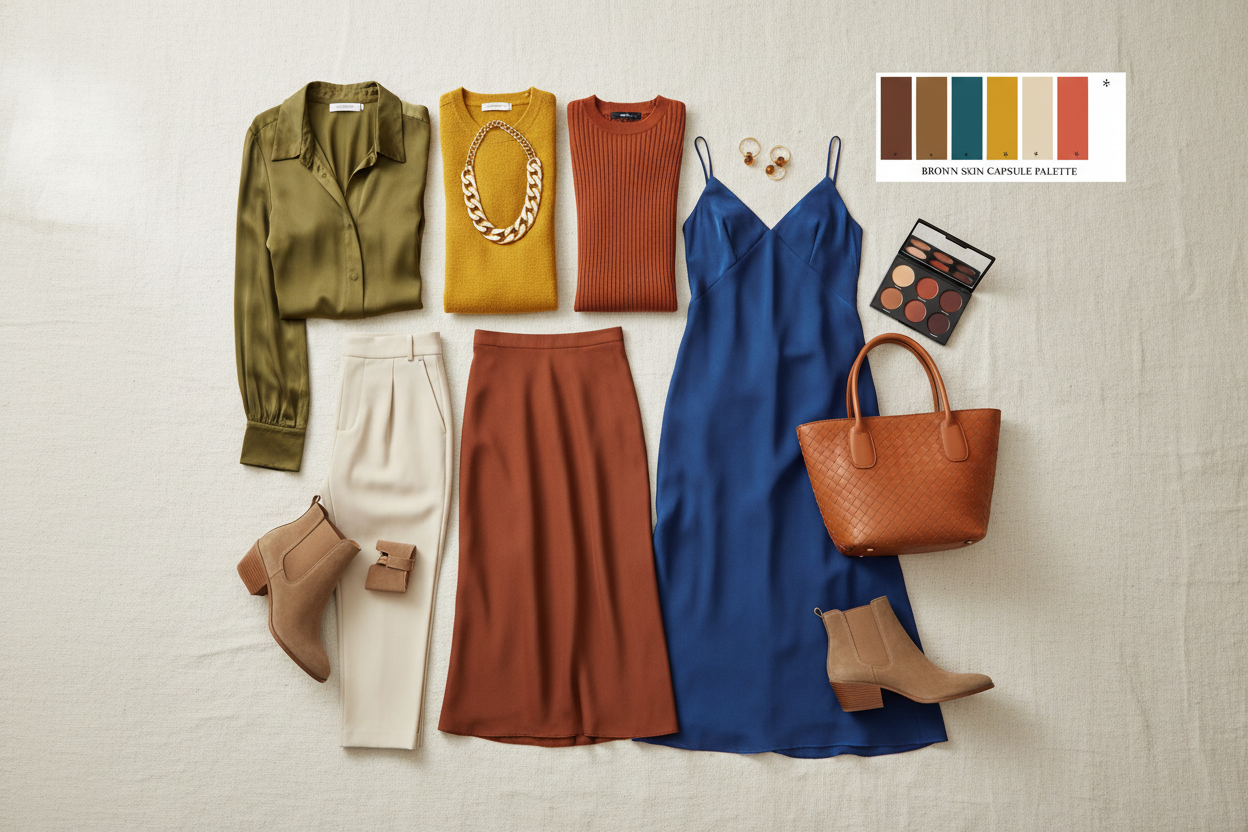
The structure:
3–4 anchor colors (your most-worn, mix-and-match base)
- Warm undertone example: camel, olive, warm white, chocolate brown
- Cool undertone example: navy, true black, bright white, deep teal
2–3 accent colors (personality pieces — tops, scarves, accessories, or one statement garment)
- Warm undertone example: terracotta, mustard, coral
- Cool undertone example: emerald, plum, cobalt
1 versatile neutral that bridges both (true red and deep navy both qualify, as does forest green)
Building tips:
- Choose anchors first. They form the backbone of about 80% of your outfits.
- Test accent colors in smaller pieces before committing to a full garment.
- When picking anchors, prioritize saturation over trend. Richly pigmented staples outlast seasonal colors.
- If a color looks great held near your face, trust that. Trends are not a reliable guide.
Built this way, every piece in your wardrobe coordinates with at least two others, and every color works with your undertone rather than against it. If you want a palette mapped to your specific undertone, the color-analysis.app quiz generates one in a few minutes.
People Also Ask
What colors look best on brown skin tone?
It depends on your undertone, but some shades consistently work well across the spectrum. Richer, more saturated colors almost always outperform washed-out versions of the same hue.
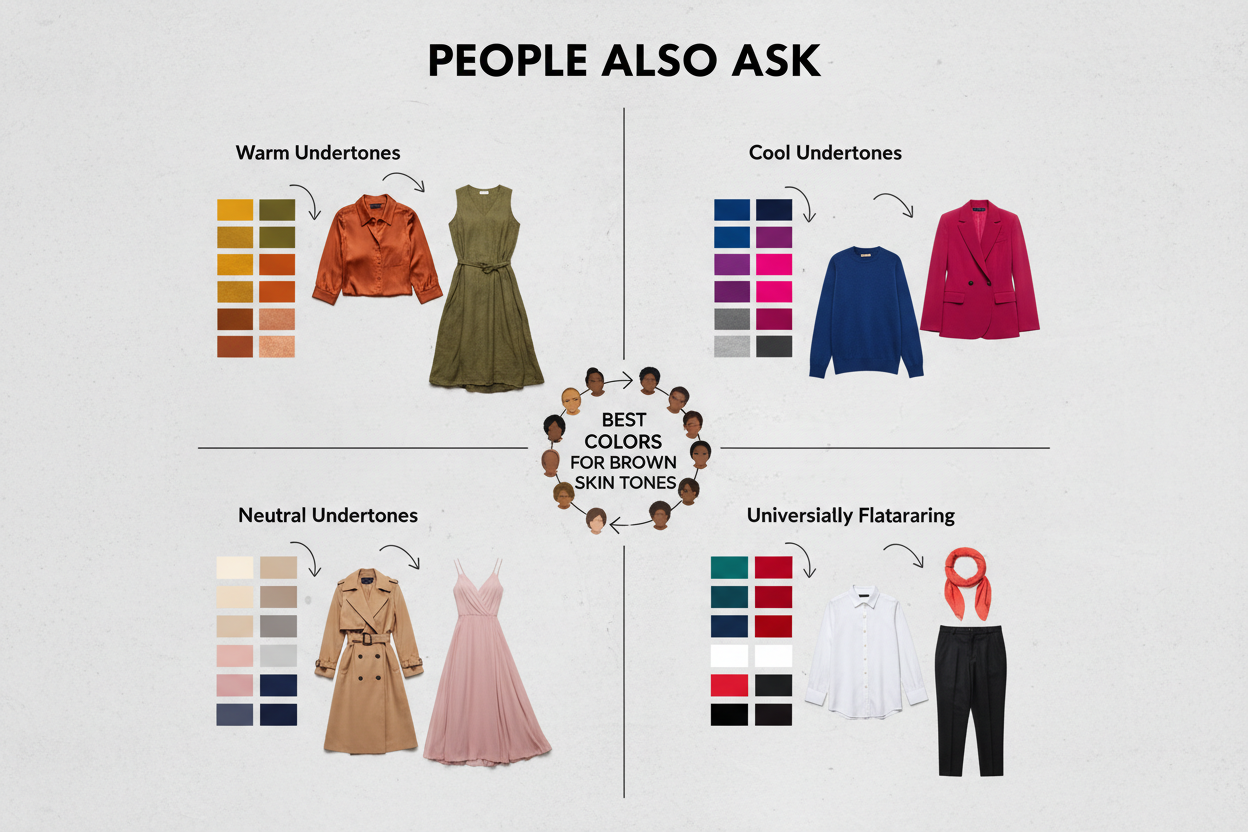
For warm-undertone brown skin: terracotta, mustard, burnt orange, olive, camel, coral, and warm reds.
For cool-undertone brown skin: sapphire blue, emerald, plum, burgundy, magenta, and jewel tones broadly.
Across all undertones: true red, deep navy, forest green, and richly saturated versions of almost any color tend to work. Saturation creates contrast, and contrast is what makes brown skin look vibrant rather than flat.
How do I find my undertone if I have brown skin?
Your undertone is the secondary hue beneath the surface — it stays constant regardless of sun exposure or seasons. Three tests work well for brown skin:
- Vein test: Look at the veins on your inner wrist in natural daylight. Greenish veins suggest warm; bluish or purple suggest cool; a mix points to neutral.
- Fabric test: Hold bright white fabric next to your face, then swap for warm ivory. If white looks harsh and ivory looks natural, you lean warm. If white looks clear and ivory looks dull, you lean cool.
- Jewelry test: If gold makes your complexion glow, you're likely warm. If silver looks sharper and more natural, you're likely cool.
Deeper brown skin can make the vein test harder to read, so use at least two tests and look for agreement before settling on a result.
Can people with brown skin wear pastels?
Yes, with one adjustment. Icy pastels in very low saturation — powder blue, blush pink, pale mint — can look washed out against the richness of brown skin. The fix is to go toward the more saturated end of the pastel range:
- Dusty rose instead of blush
- Sage instead of pale mint
- Periwinkle instead of powder blue
- Warm peach instead of baby pink
For warm-undertone brown skin, a warm-toned anchor — a gold accessory, a camel bag — can help a cool pastel feel intentional rather than out of place. Pastels aren't off-limits; they just need more pigment behind them to hold their own.
What colors should brown skin tones avoid?
There are no absolute rules, but some colors need more deliberate styling to avoid looking flat:
- Neon yellow and lime green — very cool-leaning neons can create an unflattering cast, particularly on warm undertones; anchor with black or white if you love them
- Skin-adjacent nudes — beige or nude tones that sit within a few shades of your skin create a blending effect rather than a complementary contrast
- Washed-out icy pastels — low-saturation versions of light colors tend to look diluted against brown skin; always choose the more saturated end
- Cool light gray — stark, blue-cast grays can read flat against warm brown skin; charcoal or warm greige performs better
The common thread: the problem is usually low saturation or an undertone mismatch, not the hue family itself. Going more saturated, or picking a deeper version of the same color, often fixes it.
Do warm or cool colors suit brown skin better?
Neither — it depends on your undertone, not how deep your skin is. Two people with identical brown skin can have completely different undertones, and what flatters one may do nothing for the other.
- If you have a warm undertone, warm colors (earth tones, amber-based hues, terracotta, mustard) tend to work naturally because they share something with the golden or olive tones already in your skin.
- If you have a cool undertone, cool colors (jewel tones, blue-based reds, deep purples, true black, bright white) will read cleaner and more vibrant.
- If you're neutral, you have the most flexibility. Both families work — saturation is still the thing to watch.
Figure out your undertone first, then let that guide your choices rather than generic advice about "dark skin."
FAQ
What is the difference between skin tone and undertone for brown skin?
Skin tone is the surface color you see — the depth of brown that ranges from light tan to deep espresso. It shifts with sun exposure, seasons, and age. Undertone is the secondary hue beneath the surface that stays constant regardless of how much time you spend outdoors or how you age.
For brown skin, undertones generally fall into three categories:
- Warm — golden, yellow, or olive hues beneath the surface
- Cool — pink, red, or bluish hues beneath the surface
- Neutral — a roughly even mix of both
This matters for clothing because two people with nearly identical brown skin depth can have completely opposite undertones. Colors that look effortless on one can look flat or clashing on the other. Getting your color palette right means identifying your undertone, not just your surface shade.
Does the shade of brown skin (light brown vs. deep brown) change which colors are most flattering?
Depth affects one important variable: contrast. Deeper brown skin creates stronger natural contrast with light colors, so bright whites, ivory, and vivid jewel tones often land with particular impact. On lighter brown skin, those same colors can be equally beautiful but may work better at lower saturation.
That said, depth is secondary to undertone. The core principle — match warm colors to warm undertones, cool colors to cool undertones — applies across the full range of brown skin, from light caramel to deep mahogany. Depth shifts how dramatic the contrast looks, but undertone determines whether a color actually harmonizes with your complexion.
Can brown skin tones wear all-black outfits effectively?
Yes, and consistently well. Black is one of the most universally flattering colors for brown skin because it creates clean, high contrast that makes warm and cool undertones alike appear more defined and luminous. It doesn't compete with your complexion or create the blending effect that skin-adjacent neutrals can.
A few styling notes that help all-black outfits land well on brown skin:
- Mix textures — a satin top with structured trousers, for example, prevents the look from reading as flat
- Add a warm or cool accent — a gold necklace for warm undertones or a silver cuff for cool ones keeps the look from feeling one-note
- Pay attention to fit — since color isn't doing the visual work, silhouette and proportion carry the whole outfit
What jewelry metal tones—gold or silver—complement brown skin undertones?
Your undertone is the most reliable guide:
- Warm undertones tend to look better with gold. The amber and yellow base of gold shares chromatic DNA with the golden or olive hues in warm brown skin, so it creates a natural glow rather than a stark contrast.
- Cool undertones tend to look better with silver. Silver's cool, bright finish complements the pink or blue-based hues beneath cool brown skin and reads crisp rather than clashing.
- Neutral undertones can work with either metal. Rose gold is a particularly good option here because it bridges warm and cool simultaneously.
If you're not sure about your undertone, try the jewelry test: hold each metal near your face in natural light and see which one makes your complexion look more alive rather than dull.
Are there specific color combinations that always work for brown skin tones?
A few pairings hold up across brown skin tones regardless of undertone, because they work through contrast and saturation rather than undertone-matching:
| Combination | Why It Works |
|---|---|
| Deep navy + warm white or ivory | High contrast, no undertone conflict |
| Rich emerald + camel or gold | Jewel tone anchored by a warm neutral |
| True red + black | Maximum contrast, universally bold |
| Burgundy + forest green | Deep, complementary tones that work for both warm and cool |
| Cobalt blue + bright white | Clean contrast that pops against any brown skin depth |
The pattern is consistent: pair one richly saturated color with either a strong neutral or another deep tone. Two low-saturation colors together tend to look flat against the natural warmth and depth of brown skin.
How does fabric texture affect how a color looks on brown skin?
Texture changes how light interacts with a color, which changes how the color reads against your complexion.
Matte fabrics like cotton, linen, and ponte absorb light and show a color at its most straightforward — what you see on the bolt is roughly what you get. Shiny or reflective fabrics — satin, silk, sequins — amplify lightness and luminosity, so even a medium color can feel more dramatic and radiant against brown skin. Textured weaves like boucle, ribbed knit, and jacquard create micro-shadows that add depth, often making a single color look richer than it would in a flat weave.
A practical implication: if a color feels slightly flat on you in a matte fabric, try the same color in a satin or silk version. The result can be completely different. Texture is an underused variable in color dressing.
What is the easiest way to test a new color before buying a full outfit?
The lowest-risk approach is to hold an accessory or scarf in that color against your face in natural daylight. This shows how the color sits next to your complexion without committing to a full garment.
If you want something more systematic:
- Identify your undertone first using the vein, fabric, or jewelry test — this narrows your starting palette significantly
- Try a draping test in-store — hold fabric flat against your collarbone and jaw in natural or daylight-balanced light and watch whether your complexion looks vibrant or washed out
- Start with accessories — a scarf, bag, or shoe in the new color lets you live with it before investing in a full look
If you'd rather skip all that, a personalized color analysis based on your actual undertone and coloring can map out the whole palette for you — take the quiz at color-analysis.app to get your results.