African American Skin Tone Palette
 Reviewed by Alexandra Gilmore
African American complexions span an exceptionally broad range of depths and undertones, so ethnicity cannot supply one flattering palette. Use the visual spectrum and undertone framework to describe skin more precisely, then translate that information into clothing, makeup, and digital color references without treating shade names as fixed categories.

African American skin colors span one of the widest and most nuanced ranges of any ethnic group — from porcelain-adjacent light beige to the deepest espresso brown. Yet most mainstream color-analysis resources still treat darker complexions as an afterthought, offering little guidance beyond a generic "you're a Winter." This article sets out to change that.
💫 Discover Your Complete Color Palette
One feature rarely explains every color that works for you. Compare your undertone, depth, clarity, and contrast as a complete palette, then use the results to test clothing, makeup, and hair colors more consistently.
Find My Color Palette →Here is exactly what you will find in the sections ahead:
- A plain-language explanation of why African American skin colors vary so dramatically — rooted in melanin biology and evolutionary history
- A mapped palette of the African American skin tone spectrum, anchored to real hex references you can use for digital matching
- A practical guide to identifying your undertone — warm, cool, or neutral — even when standard tests feel unreliable on deeper complexions
- Myth-busting around common color-analysis errors made for Black skin
- Actionable color recommendations organized by both depth and undertone
A few grounding facts worth keeping in mind throughout:
- Melanin is the pigment directly responsible for skin color depth. It also shields the skin from UV-driven DNA damage and sunburn. Darker skin contains higher concentrations of melanin than lighter skin — this is the core biological fact that shapes everything else in color analysis for African American complexions.
- Because melanin levels exist on a continuous gradient rather than in fixed boxes, African American skin colors do not cluster neatly into a handful of shades. Curated hex palettes for this spectrum routinely include five or more distinct reference tones just to approximate the range.
- Skin tone (how light or dark your complexion appears) and skin undertone (the subtle warm, cool, or neutral cast beneath the surface) are two separate variables. Getting both right is what makes a color truly flattering.
Whether you are approaching this for wardrobe styling, makeup selection, or digital design work, understanding the science behind African American skin colors is the foundation. Everything else — the palette, the tests, the recommendations — builds directly from it.
Why African American Skin Colors Span Such a Wide Range
The range of African American skin colors isn't random. It has deep evolutionary roots.
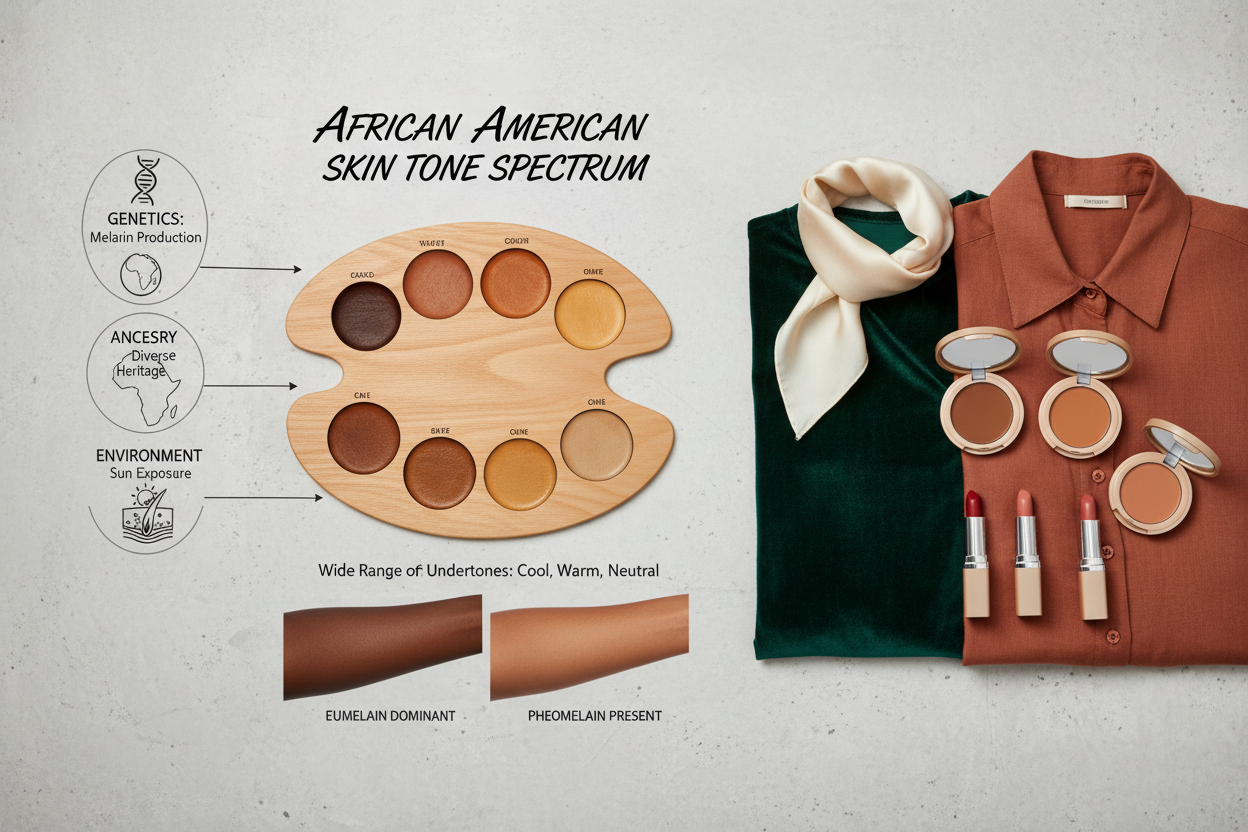
Hundreds of thousands of years ago, as early human populations adapted to life on sun-drenched African savannas, two major biological shifts happened: body hair thinned to allow more efficient sweating, and skin pigmentation darkened significantly. That darker pigmentation served a real protective function — it guarded the body's folate (vitamin B9) against breakdown from intense UV radiation and, to a lesser extent, shielded DNA from UV-induced damage.
As human populations spread across continents, melanin levels shifted in response to different UV environments. Groups moving into lower-UV regions gradually developed lighter skin. Those staying in or returning to high-UV zones kept or deepened their pigmentation. The African diaspora carries the genetic legacy of thousands of years of that adaptation — layered further by centuries of movement, genetic mixing, and ancestry from across the African continent and beyond.
The result is a spectrum, not a fixed set of categories. African American skin colors today run continuously from very light to very deep, with every gradation in between. Understanding that is the first step toward taking the spectrum seriously in color analysis.
Ready to identify your exact place on the spectrum? Take the free skin tone quiz →
The Role of Melanin in Skin Tone Depth and Sun Protection
Melanin is the pigment molecule that gives skin its color. More melanin means a deeper tone. Darker-skinned individuals have higher concentrations of it than lighter-skinned individuals — that's the direct biological mechanism behind the tonal depth seen across African American complexions.
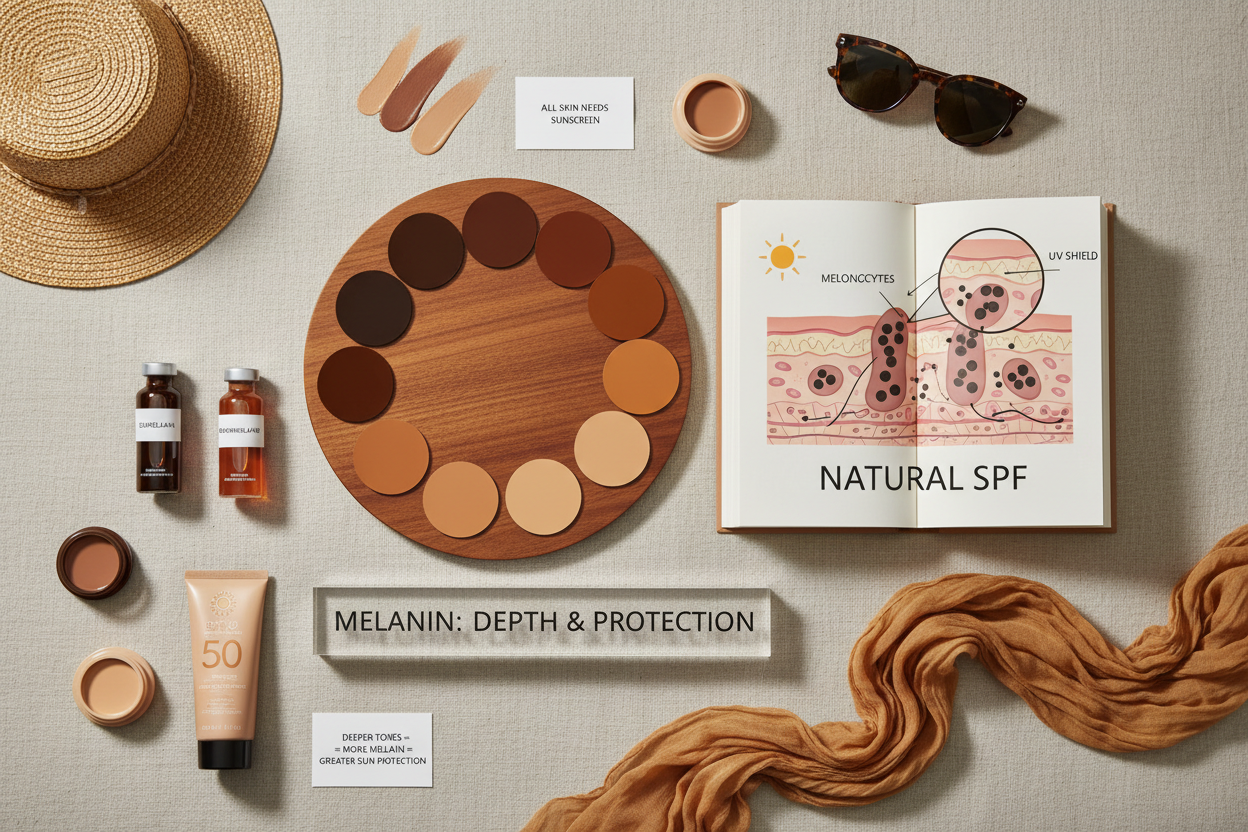
Melanin also does two other things worth knowing:
- UV protection: It absorbs and scatters ultraviolet radiation before it reaches deeper skin layers, reducing the risk of sunburn and UV-related DNA damage.
- Folate preservation: UV radiation breaks down folate, a B vitamin essential for cell division and fetal development. Higher melanin levels help protect those stores by filtering out the wavelengths responsible.
For color analysis, there's a second distinction that matters. Melanin comes in two primary forms:
| Melanin Type | Color Range | Influence on Skin |
|---|---|---|
| Eumelanin | Brown to black | Primary driver of tone depth; dominant in darker complexions |
| Pheomelanin | Yellow to red | Contributes warm, golden, or reddish cast to the skin |
The quantity of melanin determines how light or deep your skin tone appears. The ratio of eumelanin to pheomelanin — along with how melanin is distributed in the skin — shapes your undertone. That distinction between depth and undertone is what connects the biology to practical color analysis.
Mapping the African American Skin Tone Palette: From Light to Deep
Color practitioners and digital tools use curated hex palettes to categorize and reference African American skin tones. Reference collections like those on color-hex.com translate the continuous skin tone spectrum into comparable values that can inform foundation matching, garment color selection, and digital design work.
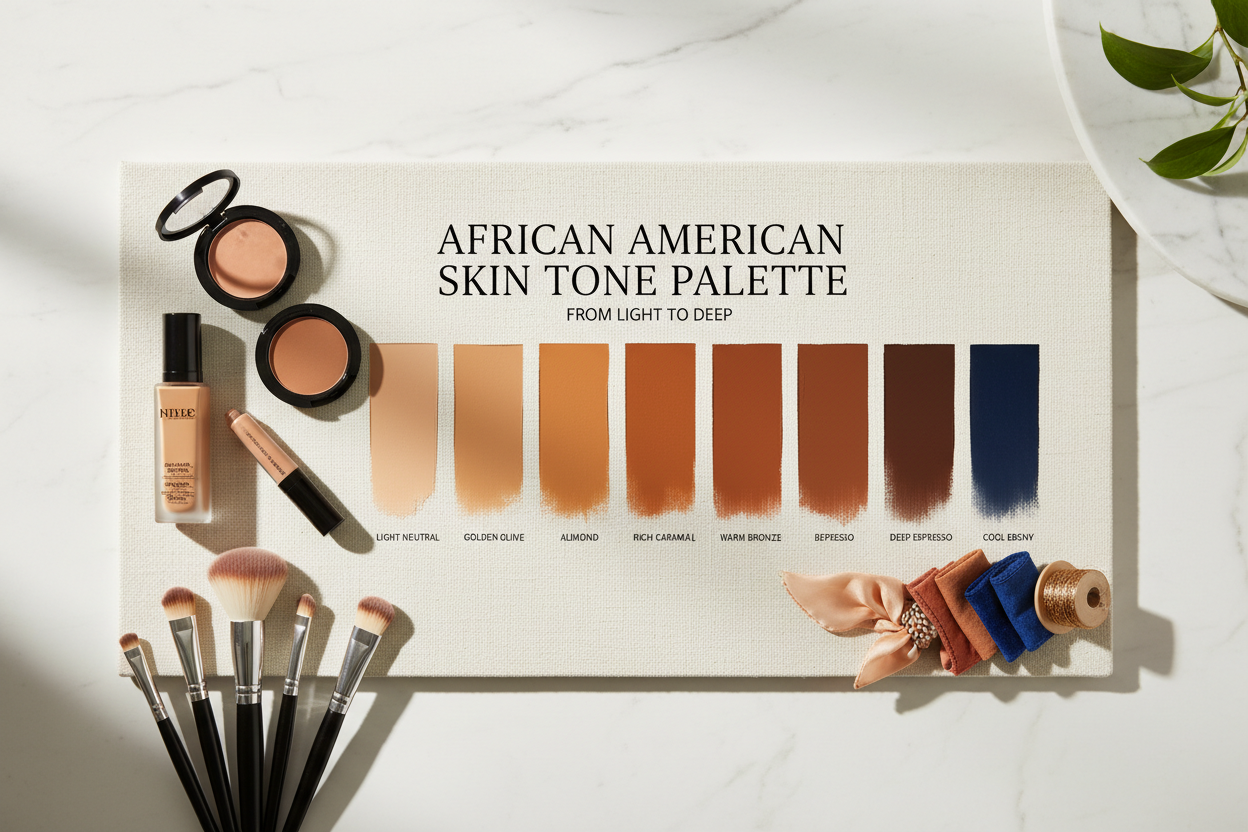
The spectrum is genuinely continuous, so any band system is an approximation. That said, broad bands help orient you:
Light-Medium Warm peachy-beige to golden tan, often with a honey-toned surface. Undertones tend to be warm (golden) or neutral.
Medium Rich caramel to warm brown — one of the most common bands in the African American skin color range. Warm and neutral undertones are frequent; cool undertones occur but are less commonly recognized here.
Medium-Deep Chestnut to warm mahogany. Surface redness becomes less visible as melanin density increases. Warm, neutral, and cool undertones all appear at this depth.
Deep Deep chocolate brown. High melanin concentration visually subdues surface-level color variation. All three undertone categories exist across this band.
Rich Deep Ebony to blue-black, the deepest end of the spectrum. Cool and neutral undertones are actually quite common here, often presenting as subtle blue, violet, or ash notes in the skin.
Reading Hex Palette References for Skin Tone Matching
Digital color practitioners curate specific hex value ranges to represent African American skin tones. These codes assign precise red-green-blue values to approximate how a given skin shade reflects light — the same way a paint chip captures a wall color.
What these palettes do in practice:
- Foundation matching: Makeup algorithms compare your photographed skin tone to hex reference values to suggest shade ranges.
- Clothing and styling tools: Digital color analysis apps measure the contrast and warmth relationships between your skin hex value and candidate garment colors.
- Design and photography: Hex references allow accurate color correction and representation of darker skin tones in visual media.
The practical takeaway: when a tool asks you to select your skin tone, the underlying hex reference determines every recommendation that follows. Tools built with a comprehensive African American skin tone palette — rather than a generic four-shade selector — produce meaningfully more accurate results.
Warm, Cool, and Neutral Undertones in Darker Skin: How to Tell Them Apart
Undertone is the subtle chromatic layer beneath your surface complexion. It doesn't change with sun exposure, and it doesn't always match the surface color of your skin. On deeper African American complexions, identifying undertone requires a slightly different approach than the tests designed for lighter skin — higher melanin density changes how color reads at the surface.
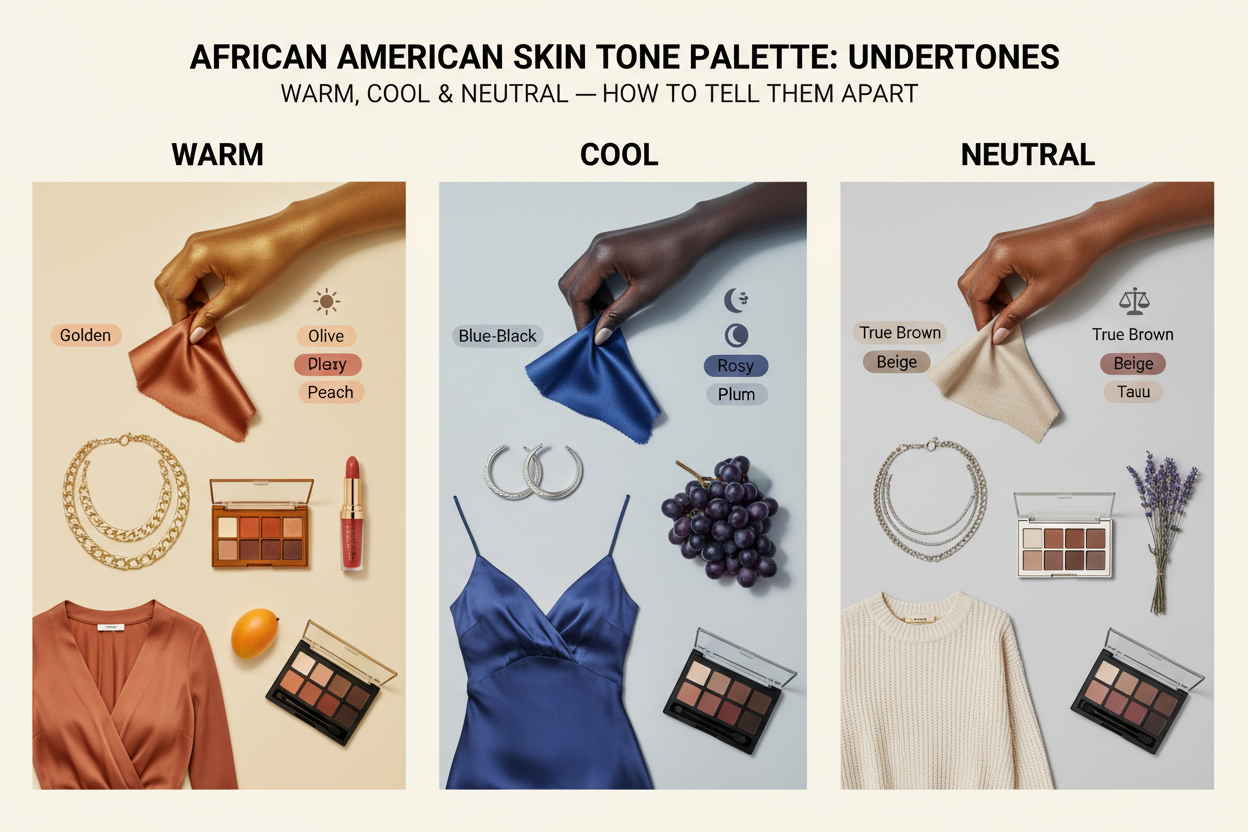
The three undertone categories:
- Warm: Golden, peachy, or yellow-orange cast. Skin may have a bronzed, honey, or caramel quality.
- Cool: Pink, red, or blue-violet cast. Skin may have ashy, berry, or blue-toned notes, especially in deep complexions.
- Neutral: A balance of warm and cool, with neither dominant. Skin often appears true brown without a strong directional pull.
A common mistake is assuming all darker African American complexions are warm. In reality, deep and rich-deep skin tones often carry cool or neutral undertones — they just look different from the pink-toned "cool" typically shown on lighter skin.
The Vein and Jewelry Tests Adapted for Deeper Complexions
The Vein Test
Look at the veins on your inner wrist in natural daylight — not under yellow indoor lighting, which distorts color. Focus on the dominant hue of the visible vessel:
- Greenish veins → warm undertone
- Blue or blue-purple veins → cool undertone
- A mix of green and blue, or hard to distinguish → neutral undertone
On deeper complexions, higher melanin concentration can obscure vein color, making this test harder to read. If the veins aren't visible on the wrist, try the inner forearm or just below the inner elbow, where vessels tend to sit closer to the surface.
The Jewelry Test
This test bypasses melanin interference entirely, which makes it particularly reliable for darker skin:
- Hold a gold piece of jewelry against your face in natural light. Does your skin look vibrant, or slightly dull?
- Repeat with silver.
- Gold flatters you more → warm undertone
- Silver flatters you more → cool undertone
- Both look equally good → neutral undertone
The White Fabric Test
Hold a bright white cloth next to your bare face. Against pure white, undertone contrast often becomes more visible:
- Skin appears yellow or golden → warm
- Skin appears pink, rosy, or ashy → cool
- Neither effect is strong → neutral
Melanin density can complicate any single test, so run at least two before settling on a conclusion. When tests disagree, that often points to a neutral undertone rather than a testing error.
Not sure which undertone you have? Start the free color analysis quiz — it's built for the full range of African American skin colors →
Common Misconceptions About Color Analysis for African American Skin
Generic color-season systems were largely developed using lighter European complexions as the reference point. Applying them unchanged to African American skin tones produces results that range from mildly off to actively misleading. Here are the most common errors:
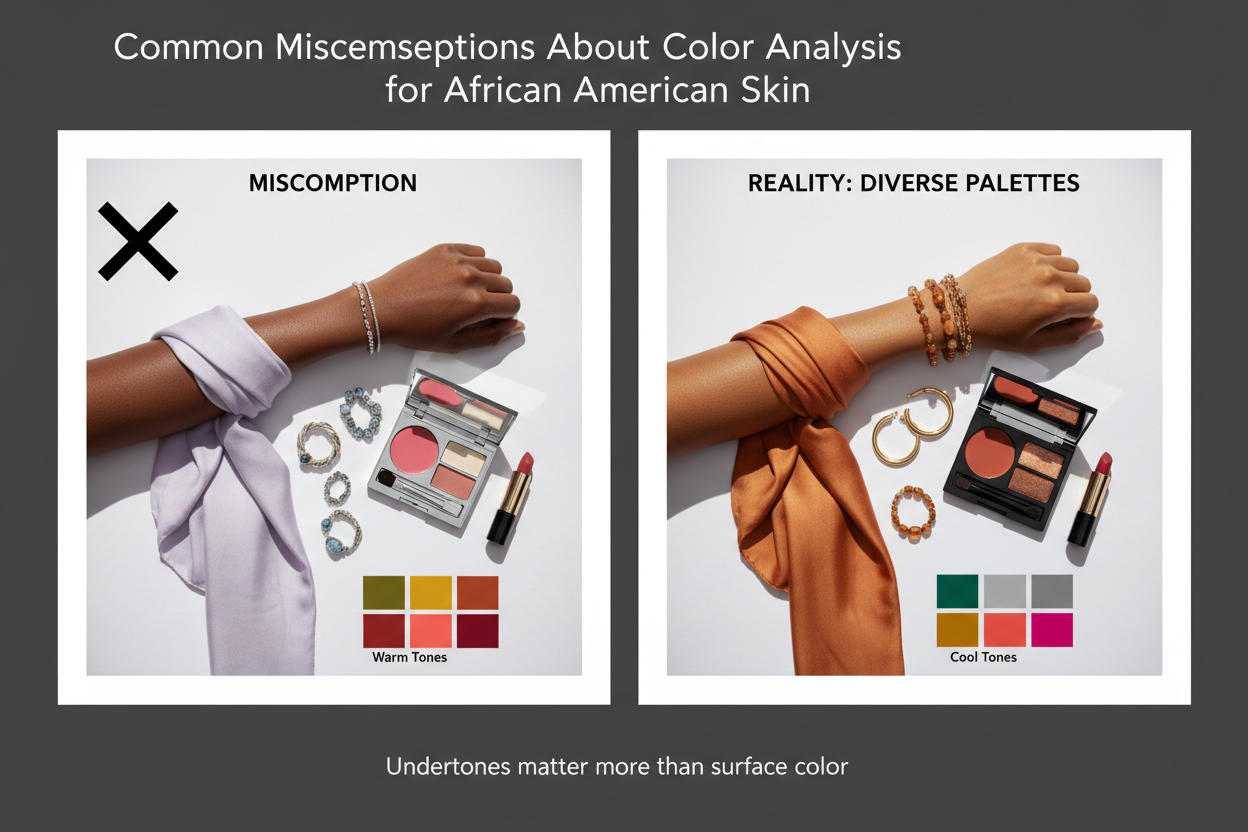
Misconception 1: All dark skin is warm. The idea that deeper African American complexions are inherently warm is widespread and wrong. Deep and rich-deep skin tones often carry cool or neutral undertones. At high concentrations, melanin can give skin blue, violet, or ash qualities that read as distinctly cool.
Misconception 2: The "Winter" season covers all dark-skinned people. "Winter" in classic seasonal color analysis means a high-contrast, cool-undertoned complexion. Some African American individuals do fit that profile, but many don't. Dropping every darker-skinned person into Winter ignores the real variation in depth and undertone across the spectrum.
Misconception 3: Standard undertone tests are always reliable on dark skin. Higher melanin levels change how the skin's surface reflects light, which can throw off tests designed for lighter complexions. That's not a failure of the individual — it's a limitation of tools that weren't built with deeper skin in mind. Using adapted tests and confirming results through multiple methods helps get around this.
Misconception 4: Color contrast rules don't apply to deeper skin. Some stylists assume deep skin tones are automatically high-contrast and can pull off anything. They can't, not automatically. The right level of contrast between your outfit and your skin depends on your specific tone-undertone combination, not just how deep your coloring is.
How to Use Your Skin Tone and Undertone to Choose Flattering Colors
Once you know your tone depth and undertone, choosing colors becomes a two-variable process. Tone depth tells you how much contrast a color creates against your skin. Undertone tells you which color families will harmonize rather than fight with it.
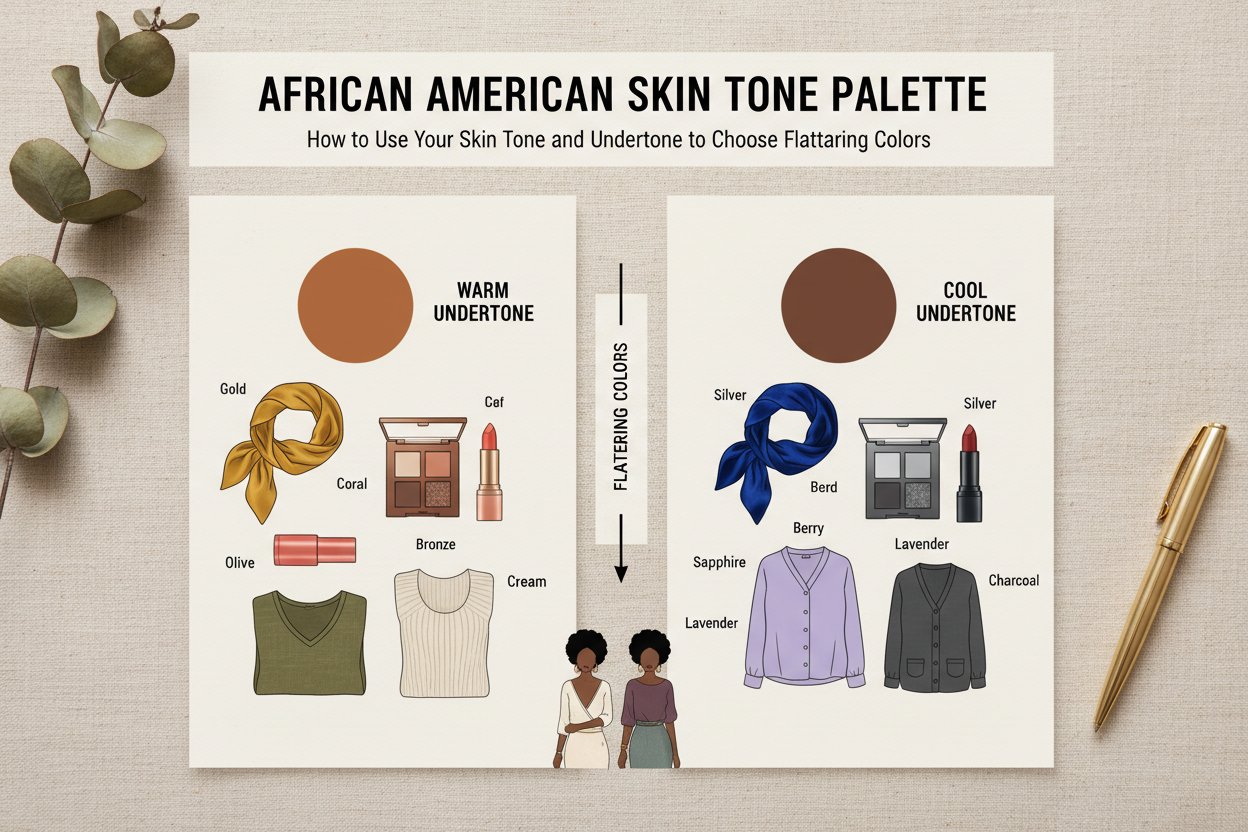
By undertone:
- Warm undertones tend to look best in earth-adjacent hues: terracotta, mustard, olive, camel, warm red, burnt orange, rich chocolate brown. For metals, go with gold, bronze, or copper.
- Cool undertones tend to look best in jewel tones and clear, blue-adjacent colors: cobalt, emerald, plum, berry, royal blue, true red. For metals, silver, white gold, and platinum.
- Neutral undertones have the most flexibility. Both warm and cool palettes work, and neutral tones like greige, taupe, soft white, and slate tend to be particularly harmonious.
By tone depth:
- Light-medium to medium tones create natural contrast with most colors, so you have a lot of flexibility. Pastels can work but may wash out if the saturation is too low.
- Medium-deep to deep tones are better served by saturated, rich versions of colors rather than pale or muted ones. A deep cobalt reads very differently than a powder blue on a deep complexion.
- Rich-deep tones handle high-saturation and high-contrast combinations especially well. Bright white, vivid jewel tones, and true metallics can be particularly striking.
The contrast principle: The contrast level in your outfit should complement your natural coloring. If your complexion is deep and rich, very low-contrast monochromatic dressing can flatten everything out. A single point of color contrast near the face — a top, a scarf, a piece of jewelry — adds definition without much effort.
These are starting points, not rules. There's enough individual variation within any category that personal testing will always do more than general guidance can.
People Also Ask
What are the different African American skin tones called?
There's no single universal naming system. Color practitioners tend to describe African American skin tones across five broad bands:
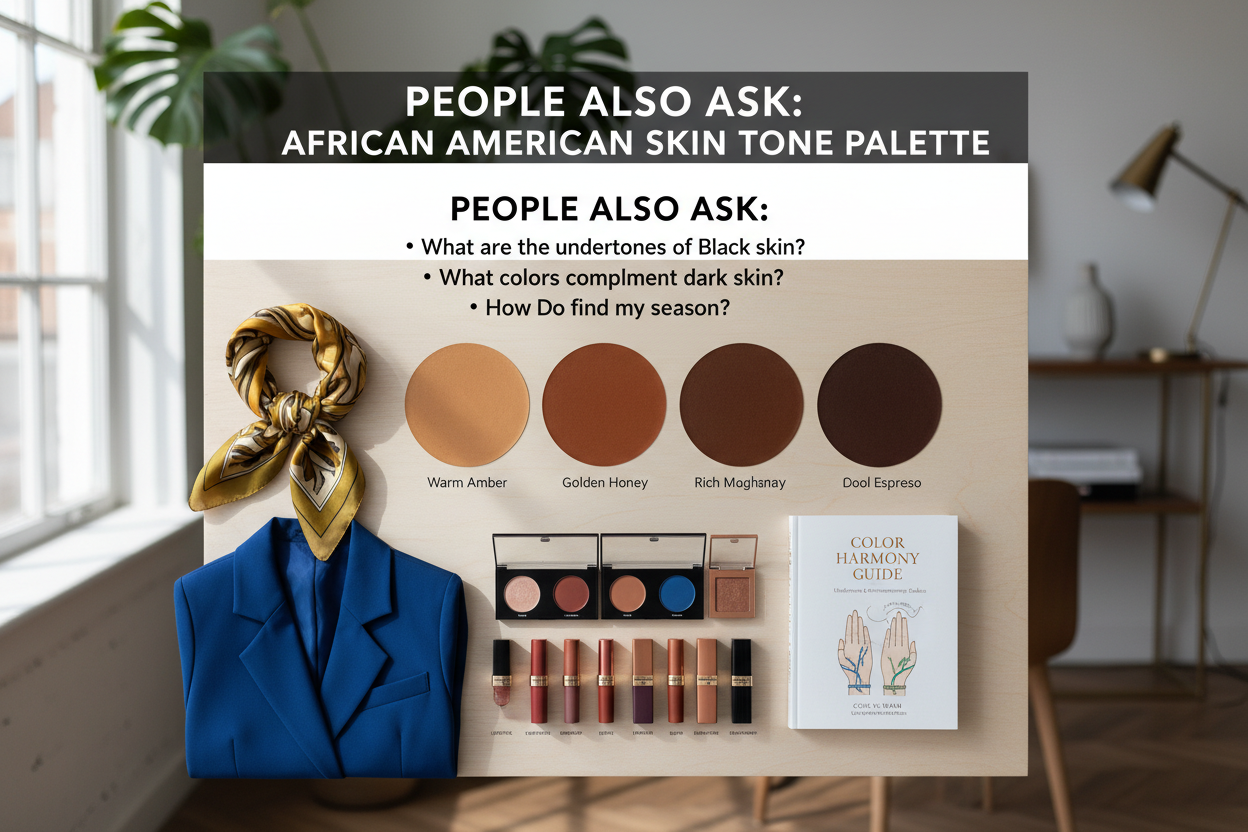
- Light-Medium – warm beige to golden tan
- Medium – caramel to warm brown
- Medium-Deep – chestnut to mahogany
- Deep – rich chocolate brown
- Rich Deep – ebony to blue-black
Makeup and skincare brands often use names like "sand," "honey," "espresso," or "mahogany." Digital tools reference hex values for precision. Dermatological frameworks like the Fitzpatrick scale use numbers (Types IV–VI cover most darker African American complexions).
None of these systems captures everything. The spectrum is continuous, and the bands are approximations. For color analysis, your specific tone depth and undertone matter more than which named category you fall into.
How do I find my undertone if I have dark skin?
Standard undertone tests can be harder to read on deeper skin because higher melanin concentration changes how color reflects at the surface. The most reliable approach is to use multiple tests and look for agreement:
Vein test: Check inner-wrist veins in natural daylight. Greenish veins suggest warm undertones; blue or blue-purple suggest cool; a mix indicates neutral. If veins are hard to see, try the inner forearm or the crease below the elbow.
Jewelry test: Hold gold and then silver jewelry against your bare face in natural light. If gold makes your complexion look more vibrant, you lean warm. If silver does, you lean cool. If both work equally well, you're probably neutral. This test tends to be more reliable on deeper skin because it sidesteps melanin interference.
White fabric test: Hold a bright white cloth next to your face. A golden or yellow cast suggests warm; a pink, rosy, or ashy cast suggests cool; no strong pull either way suggests neutral.
If your results conflict, neutral undertone is usually the explanation — not a testing error.
What colors look best on deep African American skin tones?
Undertone drives most of this, but a few things hold across deeper complexions generally:
- Rich, saturated colors tend to be more flattering than pale or washed-out versions of the same hue. Deep cobalt, emerald, plum, and burnt orange read powerfully against deeper skin in a way pastels usually don't.
- Warm undertones work well with terracotta, mustard, camel, warm red, and gold metallics.
- Cool undertones tend toward jewel tones — cobalt, berry, royal blue, true red, and silver metallics.
- Neutral undertones can pull from both warm and cool palettes; soft whites, taupes, and true neutrals also tend to work well.
- Bright white and high-contrast combinations can be particularly striking on rich-deep complexions.
The common mistake is defaulting to earth tones for all deeper skin. That's undertone-specific advice, not a universal rule.
Why do African American skin tones vary so widely?
The variation has evolutionary and historical roots. Early human populations in high-UV environments developed greater melanin production to protect folate stores and guard against UV-related DNA damage. As populations moved into lower-UV regions over thousands of years, melanin levels followed — lighter in the north, deeper near the equator.
The African diaspora draws on genetic lineages from across the entire African continent, which itself spans enormous variation in UV exposure and climate. Layer centuries of migration and ancestral mixing on top of that, and you get not a single skin tone but a wide, continuous spectrum. Treating African American skin colors as one or two fixed shades ignores both the biology and the history.
How does melanin affect skin color and undertone?
Melanin is the body's main pigment and UV filter. More melanin means a deeper skin tone; less means a lighter one. It also absorbs and scatters ultraviolet radiation before it reaches deeper skin structures, and helps preserve folate, a vitamin your cells need to function and replicate.
For undertone, the type of melanin matters as much as the amount:
| Melanin Type | Color Range | Undertone Effect |
|---|---|---|
| Eumelanin | Brown to black | Drives tone depth; dominant in darker complexions |
| Pheomelanin | Yellow to red | Contributes warm, golden, or reddish cast |
The ratio of these two types — along with how melanin is distributed across the skin — determines whether a complexion reads as warm, cool, or neutral. A high-melanin complexion with more pheomelanin tends to look warm and golden or bronze. One where eumelanin dominates at high concentration can read cool, even ashy. This is why skin depth and undertone are separate variables. Both need to be assessed on their own for accurate color analysis.
FAQ
What is the difference between skin tone and undertone for African American skin?
Skin tone is the surface depth of your complexion — how light or deep your skin appears, from light-medium to rich deep. Undertone is the underlying hue beneath that surface color, and it stays relatively constant regardless of sun exposure, seasons, or aging.
For African American skin:
- Skin tone ranges from warm beige through caramel, chestnut, chocolate, and ebony — a wide spectrum driven primarily by melanin concentration.
- Undertone falls into three categories: warm (golden, yellow, peach), cool (pink, red, blue-ash), or neutral (a blend of both).
The distinction matters because color analysis is built on undertone, not depth. Two people with the same deep complexion can have opposite undertones and look best in completely different palettes. Treating skin tone and undertone as the same variable is one of the most common mistakes in color styling for African American skin.
Can people with deep African American skin tones have cool undertones?
Yes. Undertone and depth are independent variables. A very deep, high-melanin complexion can carry cool, warm, or neutral undertones — no depth automatically locks you into one category.
Cool undertones in deeper skin often show up as:
- A slightly ashy, blue, or grey-tinged quality at the surface
- Veins that look blue or blue-purple at the inner wrist
- Complexions that read more vibrant against silver jewelry than gold
- Skin that pairs especially well with jewel tones like cobalt, berry, plum, and true red
The misconception that deep skin equals warm undertone probably comes from the fact that warm undertones are common — but common isn't universal. Cool-toned deeper complexions exist and deserve accurate analysis.
Why is melanin higher in African American skin and what does that mean for color analysis?
Higher melanin in African American skin is an evolutionary adaptation. Populations living in high-UV environments developed increased melanin production to protect folate (vitamin B9) and shield DNA from ultraviolet radiation. Melanin works as a built-in UV filter, absorbing and scattering harmful rays before they reach deeper skin structures.
For color analysis, this has two practical implications:
- Tone depth — more melanin creates richer, deeper surface color that interacts differently with clothing hues than lighter skin does. Saturated, bold colors tend to read better against deeper complexions than pale or muted ones.
- Undertone reading — higher melanin can make undertone tests harder to interpret, since the concentration of pigment near the surface can obscure subtle pink, yellow, or neutral cues. That's why multiple tests are recommended rather than relying on a single method.
How do I identify my undertone if standard tests don't seem to work on my darker skin?
Standard tests can be harder to read on deeper complexions because melanin density changes how color reflects at the skin's surface. If you're getting unclear results, try these adapted approaches:
- Vein test: Look at the inner forearm or the crease below the elbow rather than the wrist, where veins tend to be more visible. Greenish tones indicate warm; blue or blue-purple indicate cool; a mix suggests neutral.
- Jewelry test: Hold gold then silver jewelry against your bare face in natural daylight. If gold looks better, you likely lean warm; silver suggests cool. This test sidesteps a lot of melanin interference because you're reacting to color contrast, not trying to read your skin directly.
- White vs. off-white fabric test: Hold bright white and then cream fabric near your face. If cream makes you glow and bright white looks harsh, you likely lean warm. If bright white looks cleaner and cream looks muddy, you likely lean cool.
- Trusted observer: Ask someone in natural light whether your complexion reads golden-bronze or blue-ash.
If the tests still conflict, neutral is probably the most accurate call — not a testing failure.
What colors are universally flattering across the African American skin tone spectrum?
No single color works for everyone, but a few patterns hold across a wide range of skin tones and undertones:
- Rich, saturated colors — deep emerald, cobalt blue, burgundy, plum — tend to complement deeper complexions more reliably than washed-out pastels.
- High-contrast combinations like deep navy or black with bright white read with particular power on richer skin depths.
- True red sits in a sweet spot that works for both warm and cool undertones at deeper depths, though the exact shade (orange-red vs. blue-red) can be fine-tuned by undertone.
- Jewel tones broadly — sapphire, amethyst, forest green, deep teal — flatter across much of the spectrum.
The most common mistake is defaulting to earth tones for all African American skin. Warm earth tones like rust, camel, and mustard are specifically flattering for warm undertones, but can look flat or muddy on cool-toned complexions. Undertone always refines the recommendation.
Are color-season systems like 'Spring' and 'Winter' accurate for African American skin tones?
Traditional four-season and twelve-season color systems can work for African American skin, but they need real adaptation to be useful. These systems were developed with lighter skin tones as the primary reference, which creates two practical problems:
- Representation gaps — the visual examples used to identify seasons rarely show deeper complexions, so self-identification is harder.
- Depth-saturation assumptions — some season descriptions (particularly "Spring" and "Summer") lean toward lighter, softer palettes that underestimate how well deeper skin handles high saturation.
The underlying logic still holds: matching your natural contrast level, undertone, and color intensity to a harmonious palette range is valid for any skin tone. African American complexions show up most often in Autumn (warm, muted, deep), Winter (cool or neutral, high contrast, saturated), and Deep sub-season categories. A well-calibrated system treats tone depth as its own variable alongside undertone and contrast, rather than collapsing all deeper skin into a single season.
How can a digital color analysis quiz account for the full range of African American skin colors?
A well-designed tool handles this by treating undertone and depth as separate inputs rather than bundling them together. A few things to look for:
- Granular tone selection with hex-referenced swatches that accurately represent light-medium through rich-deep complexions, not just three or four generic options
- Undertone questions that use reliable visual cues (jewelry response, vein color, fabric contrast) rather than asking you to describe your tone in vague terms
- Output palettes calibrated by both variables, so a deep cool-toned complexion gets different recommendations than a deep warm-toned one
- Photographic reference examples that include a wide range of African American skin colors at each undertone category
Take the color analysis quiz to find your undertone and personalized palette.
To compare this result with a neighboring skin-tone question, use the companion article “Best Clothing Colors for Asian Skin Tones: Depth and Undertone Guide”, which keeps the two closely related questions distinct.