What Colors Look Good on Warm Olive Skin
 Reviewed by Alexandra Gilmore
Generic warm-color advice can turn warm olive skin muddy because it ignores the complexion's green-gold base. Choose colors that support both warmth and olive depth, using rich teal, tomato red, aubergine, cream, warm navy, and carefully selected earth tones instead of defaulting to peach and yellow.

If you've ever followed generic color advice for "warm skin tones" and walked away feeling like something still wasn't quite right, you're not imagining it. Most color guides treat warm olive skin as a minor variation of the standard warm category — and that one mistake leads to recommendations that consistently miss the mark.
💫 Discover Your Complete Color Palette
One feature rarely explains every color that works for you. Compare your undertone, depth, clarity, and contrast as a complete palette, then use the results to test clothing, makeup, and hair colors more consistently.
Find My Color Palette →Here's what those guides overlook: warm olive skin carries a green-gold undertone that sits underneath the surface warmth. That combination of yellow, green, and brown in the skin behaves differently than a straightforwardly peachy or golden complexion. Colors that look radiant on warm peach skin can appear muddy, sallow, or flat against an olive base — and colors that mainstream advice warns against can actually be stunning.
The result? A lot of olive-skinned people cycling through "flattering" color recommendations that never quite deliver, because the advice was never built with their undertone in mind.
This guide is built differently. Rather than folding warm olive skin into a broader warm-tones bucket, it treats the green-gold undertone as the core variable it actually is. You'll find:
- Which colors genuinely work — earth tones, jewel tones, and specific neutrals that interact well with the green-gold base
- What to approach with caution — and the specific reasons why certain shades undercut the complexion
- How to distinguish warm olive from cool olive before you shop, so you're working with accurate information
- Practical guidance for different depths of olive skin, from light to deep
Whether you're building a wardrobe capsule, trying to nail down your seasonal color palette, or just trying to stop second-guessing your color choices in the dressing room — the answers here start with understanding what warm olive skin actually is, not just what warm skin is assumed to be.
What Makes Warm Olive Skin Different From Other Warm Tones
Most people understand warm skin tones as having golden, peachy, or yellow undertones. Warm olive fits within that family — but there's a catch: a green cast woven through the warmth. The result is a complexion that reads as a blend of yellow, green, and brown rather than pure gold or peach.
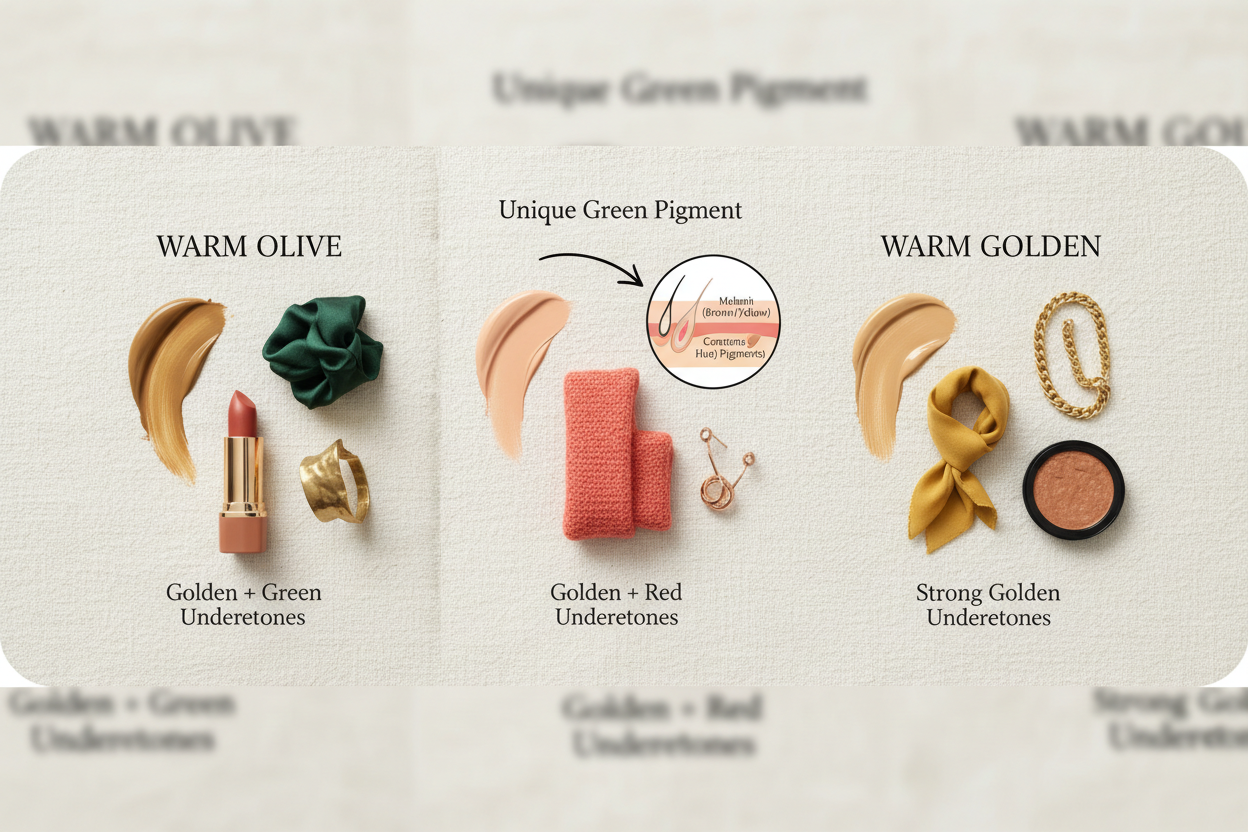
That green-gold combination is what makes olive skin its own category rather than a subset of general warm skin. It's why colors that look gorgeous on a warm-peachy complexion can appear muddy or sallow on olive skin, and why some colors that seem like they shouldn't work — forest green, deep teal — actually do.
Before working through any color recommendations, it helps to ask which kind of olive applies to you.
Warm Olive vs. Cool Olive: Why the Distinction Matters for Color Choices
Olive skin can lean either warm or cool, and the recommendations for each are genuinely different. This isn't a technicality — it determines whether the advice in this guide actually applies to you.
- Warm olive has a yellow-green base. The green cast is warmed by gold and yellow, giving the complexion a slightly honeyed quality. Veins may look green or olive-tinted. Gold jewelry almost always looks more natural than silver.
- Cool olive has a gray-green base. The green cast is tempered by cool undertones, and the complexion can read more muted or ashy. Silver jewelry may feel equally comfortable or more flattering than gold.
If you've tried warm-toned color advice and it made you look sallow instead of glowing, you may actually have a cool olive complexion. The rest of this article focuses on warm olive specifically — keep that in mind as you read.
Not sure which you are? The self-check methods in the How to Confirm Your Warm Olive Undertone section below can help you sort this out before you start shopping.
The Colors That Work Best: Earth Tones and Rich Neutrals
The colors that flatter warm olive skin follow a simple logic: they echo the skin's warmth without fighting the green cast. That means staying in ranges with yellow, brown, orange, or warm green in their base.
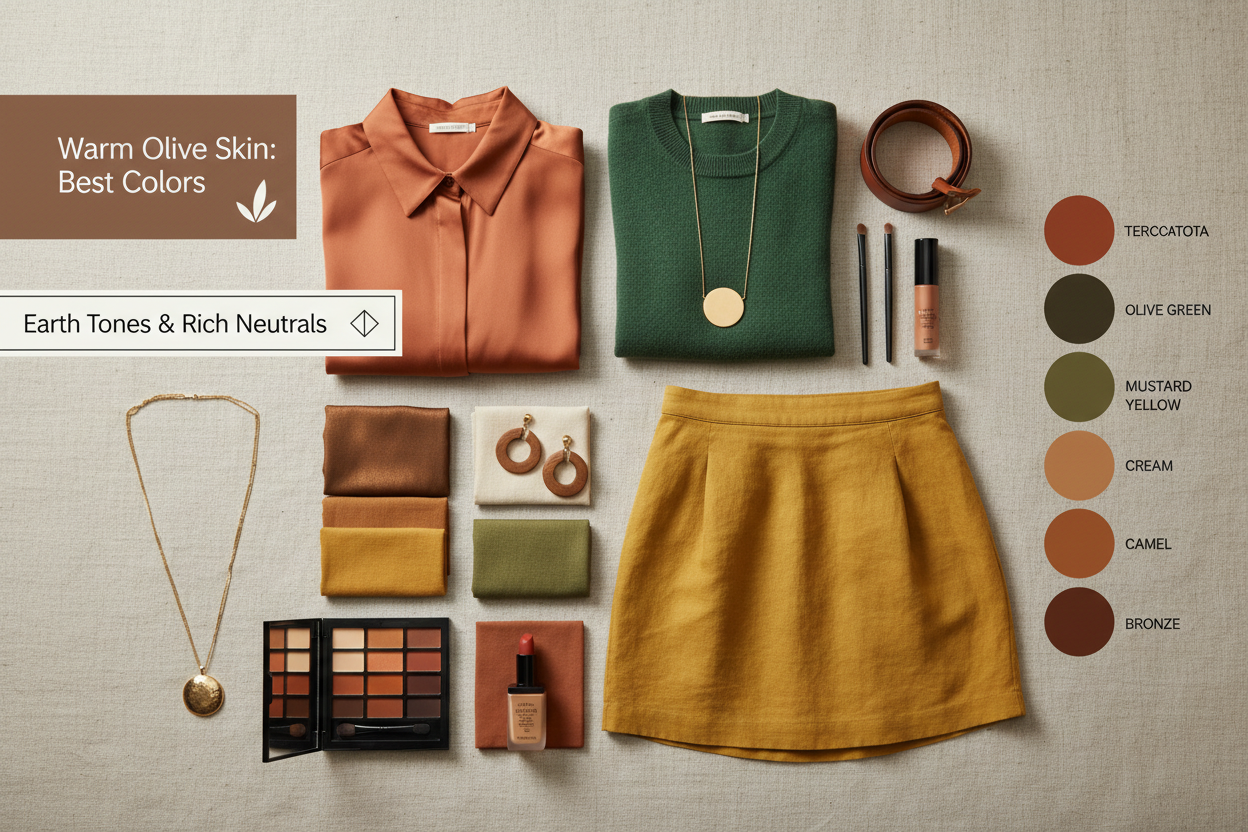
Top performers:
- Terracotta — the red-orange clay tone mirrors the warmth in olive skin without reading as too vivid
- Warm camel — a golden-tan that sits close to the skin's natural undertone and enhances it
- Olive green — the most direct complement to the skin's own green cast; wearing your undertone often works in your favor
- Burnt sienna — a deeper, bronzed rust that creates luminosity against olive skin
- Deep mustard — warm, yellow-forward tones like this energize the complexion; avoid cooler or greener mustards
- Warm chocolate brown — a rich, brown-based neutral that grounds the complexion without clashing
- Warm rust and copper — anything in the orange-brown family tends to work
These colors reinforce the warmth in the skin rather than pulling attention toward any single aspect of the undertone. The green cast doesn't disappear — it contributes to the overall warmth of the combination.
Building a Capsule Palette Around Warm Olive Skin
If you want a practical starting point for shopping decisions, these six to eight colors form a strong foundation:
| Color | Why It Works |
|---|---|
| Terracotta | Echoes warmth without overwhelming the green cast |
| Warm camel | Close to the skin's own undertone; naturally harmonious |
| Olive green | Wears the undertone rather than fighting it |
| Burnt sienna | Adds depth and warmth simultaneously |
| Deep mustard | Activates the golden notes in the complexion |
| Warm chocolate | Rich neutral that pairs with nearly everything |
| Forest green | Deepens the green cast into something dramatic |
| Warm burgundy | Red-brown base works with warmth; avoids the blue-pink clash |
This is a starting point, not an exhaustive list. Your specific depth of olive skin (covered below) will affect how each of these reads on you personally — and a personalized color analysis will always be more precise than a category recommendation.
Jewel Tones That Elevate Warm Olive Complexions
Jewel tones can look exceptional on warm olive skin, but the temperature of the jewel tone matters more than most people expect. Warm and deep versions tend to work. Cool or icy versions of the same hue often don't.
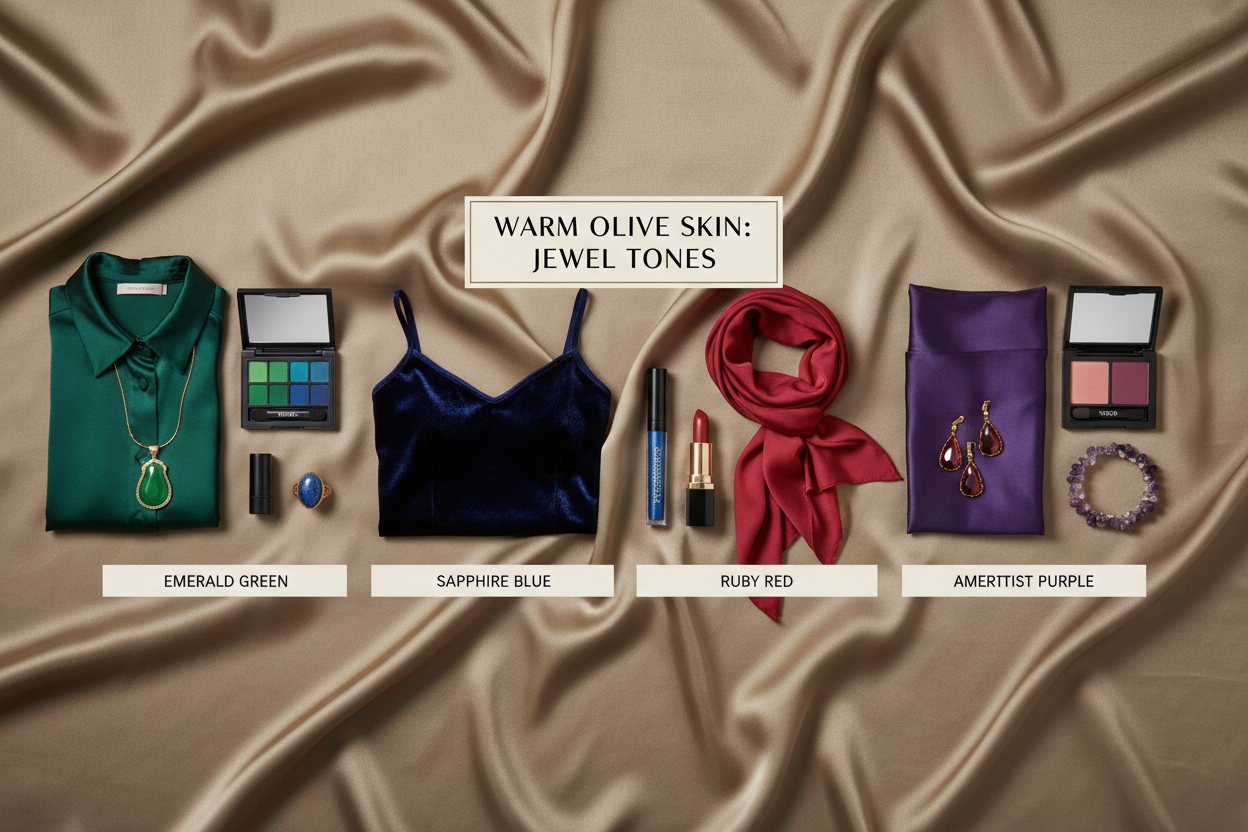
Jewel tones that tend to flatter:
- Forest green — deep enough to anchor the green-gold undertone and create contrast without clash
- Deep teal — the green-blue blend harmonizes with the olive cast; works better when it leans warm than cool
- Warm burgundy — a wine or claret shade with brown-red undertones; sidesteps the pink and blue tones that conflict
- Rich plum — when it reads more eggplant (warm-dark) than violet (cool-bright), it tends to be very flattering
- Amber and warm sapphire — goldened blues can work; pure icy blue or periwinkle usually doesn't
Jewel tones to approach with caution:
- Icy lavender or cool violet — the blue-pink base can make olive skin look gray or washed out
- Cool fuchsia — the blue-red combination often conflicts with the green cast, producing muddiness rather than contrast
- Bright, cold cobalt — without any warm base, stark blue can flatten the complexion
The pattern holds: the warmer and deeper a jewel tone, the better the odds for warm olive skin. Saturation at the right temperature enhances; cool brightness flattens.
Colors to Approach With Caution on Warm Olive Skin
Most color advice for warm skin stops at "avoid cool tones." For warm olive skin, that's not specific enough — the green cast creates conflicts that plain warmth wouldn't.
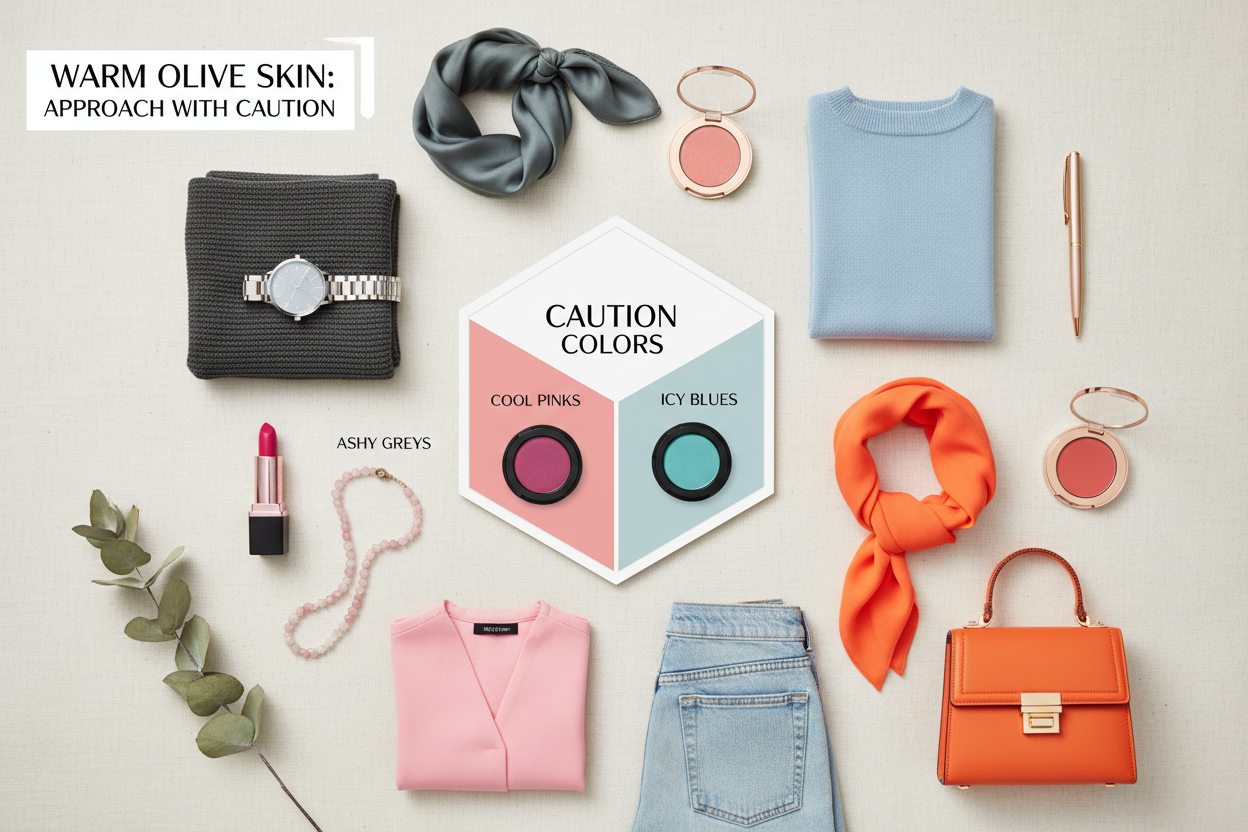
Colors that frequently undercut warm olive skin:
- Stark, cool white — a bright blue-white can make the skin look sallow or greenish rather than glowing. It amplifies the cool contrast instead of the warmth.
- Cool pastels (baby pink, lavender, powder blue, mint) — these read as gray or washed-out against olive skin because they pull toward the cooler dimension of the undertone without adding any warmth
- Ashy or cool gray — taupe with a cool base and silvery grays can flatten the complexion; the green cast in olive skin reads as dull rather than fresh against them
- Neon or very cool yellow-green — a green that skews cooler or more acidic doesn't necessarily flatter olive skin; it can create an unflattering echo rather than a harmonious one
- Cool nude and beige — beiges with a pink or gray base often look mismatched against warm olive skin, creating an odd contrast near the face
The reason these colors cause problems is the green-gold dimension that most color advice ignores. It's not just that these shades are cool — it's that they interact with the green cast in a way that produces muddiness, sallowness, or a washed-out effect.
Still unsure which colors are working against your specific undertone? The color analysis quiz can identify your warm olive profile and give you a personalized palette — not a general warm-tones list.
How to Wear Neutrals Without Looking Washed Out
Neutrals are where warm olive skin requires the most deliberate choices, because the difference between a flattering and unflattering white, beige, or gray can be subtle but significant.
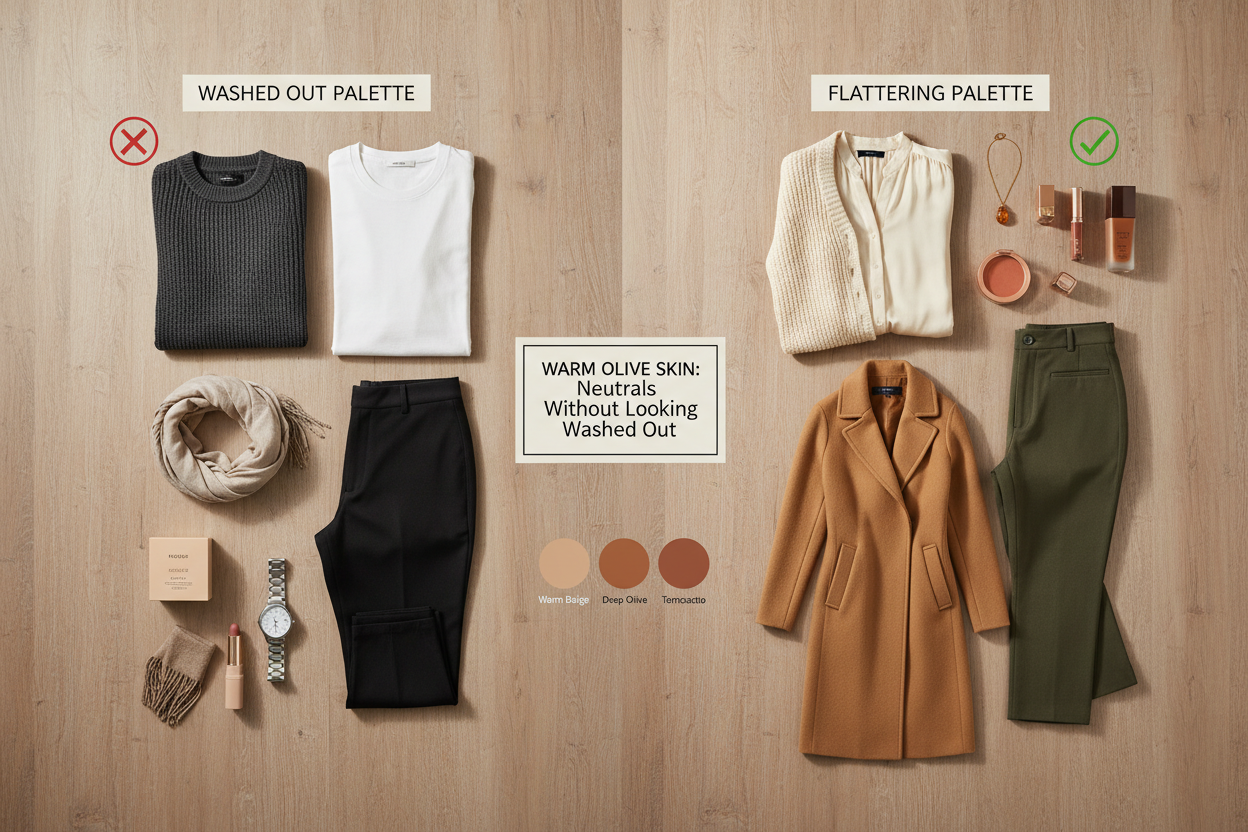
White: Warm versus cool white matters more here than with most colors.
- Cream and ivory — off-whites with yellow or warm undertones work well on warm olive skin; they complement the warmth without triggering a green cast
- Stark, optical white — the blue-white of most bright whites needs care near the face; it can make the complexion look sallow or uneven
Beige and greige:
- Warm camel-adjacent beiges — anything with a yellow-tan base tends to work
- Cool greige or pinkish taupe — beiges that lean gray or mauve often clash; they sit in an uncomfortable middle ground that doesn't harmonize with warm olive undertones
Gray:
- Most cool or silvery grays are unflattering near the face on warm olive skin
- Warm charcoal — a gray with brown or olive undertones can work because the warmth in its base softens the contrast
Black:
- Black works well for warm olive skin, particularly at medium and deeper depths. It creates clean contrast rather than the murkiness that ashy cool tones often produce. Black reads as neutral-dark; it doesn't introduce a conflicting undertone the way cool-cast grays and whites do.
Warm Olive Skin Across Different Depths: Light, Medium, and Deep
Warm olive skin runs from lighter complexions — where the green cast shows clearly against a fairly fair base — to deeper ones where the warmth and green-gold tones are more concentrated. The core palette stays the same, but depth shifts how certain colors land.
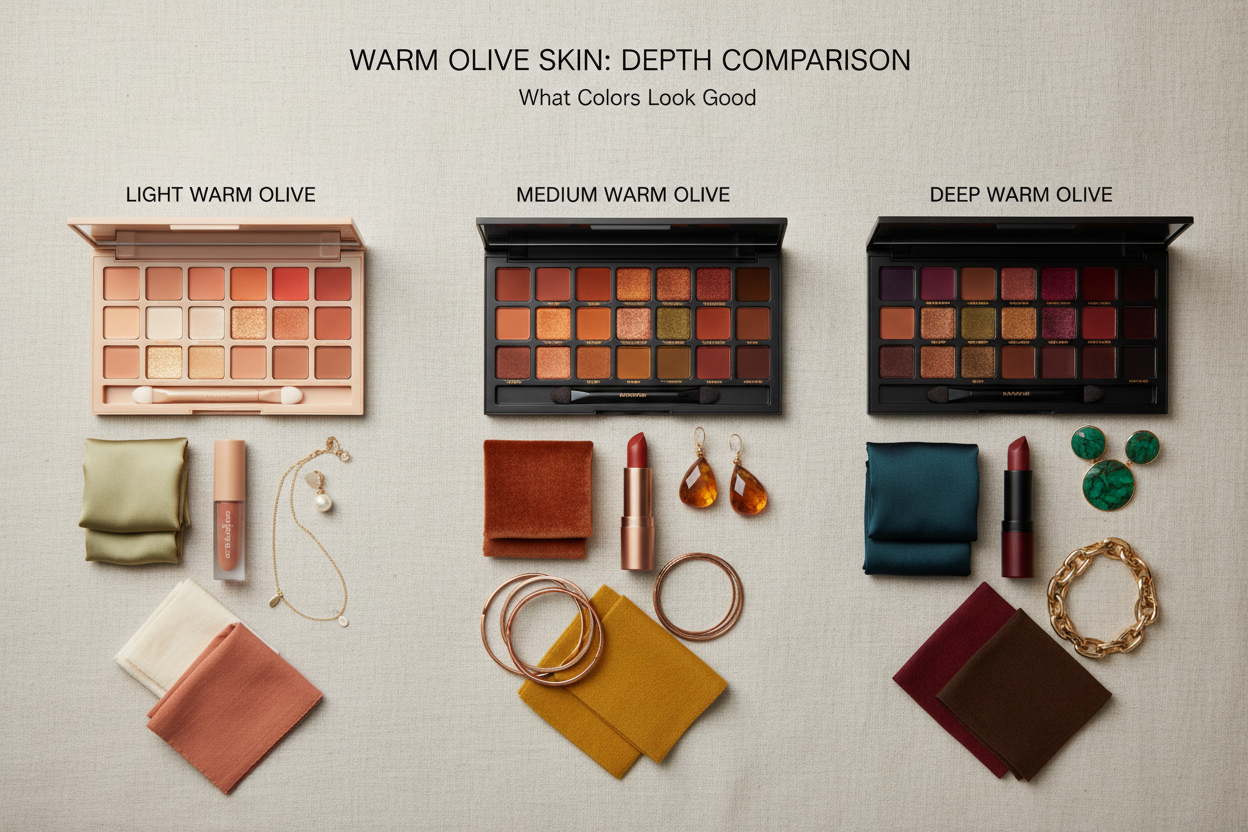
Lighter warm olive:
- Very pale yellows and light camels can blend into the skin rather than create definition
- Medium terracotta, warm golden yellow, and other slightly more saturated earth tones tend to offer better contrast than their pastel versions
- Deep jewel tones like forest green and burgundy make a strong statement that often feels more balanced against a lighter base
Medium warm olive:
- This depth handles the widest range — lighter earth tones and deep saturated colors both work here
- Rich neutrals like warm chocolate and camel sit comfortably
- Most of the capsule palette applies directly
Deeper warm olive:
- Deep, saturated colors can look particularly luminous — rich plum, deep teal, warm burgundy, forest green
- Pale, lighter versions of colors can feel disconnected; more saturated hues tend to read better
- Deep mustard needs to lean golden rather than yellow at this depth, or it risks fading into the complexion
These are tendencies, not rules. Individual variation within any depth range is real, which is why depth refines the core warm-olive guidance rather than replacing it.
How to Confirm Your Warm Olive Undertone Before Shopping
Before buying anything, it helps to know whether warm olive is actually your undertone. Three quick checks can get you most of the way there:
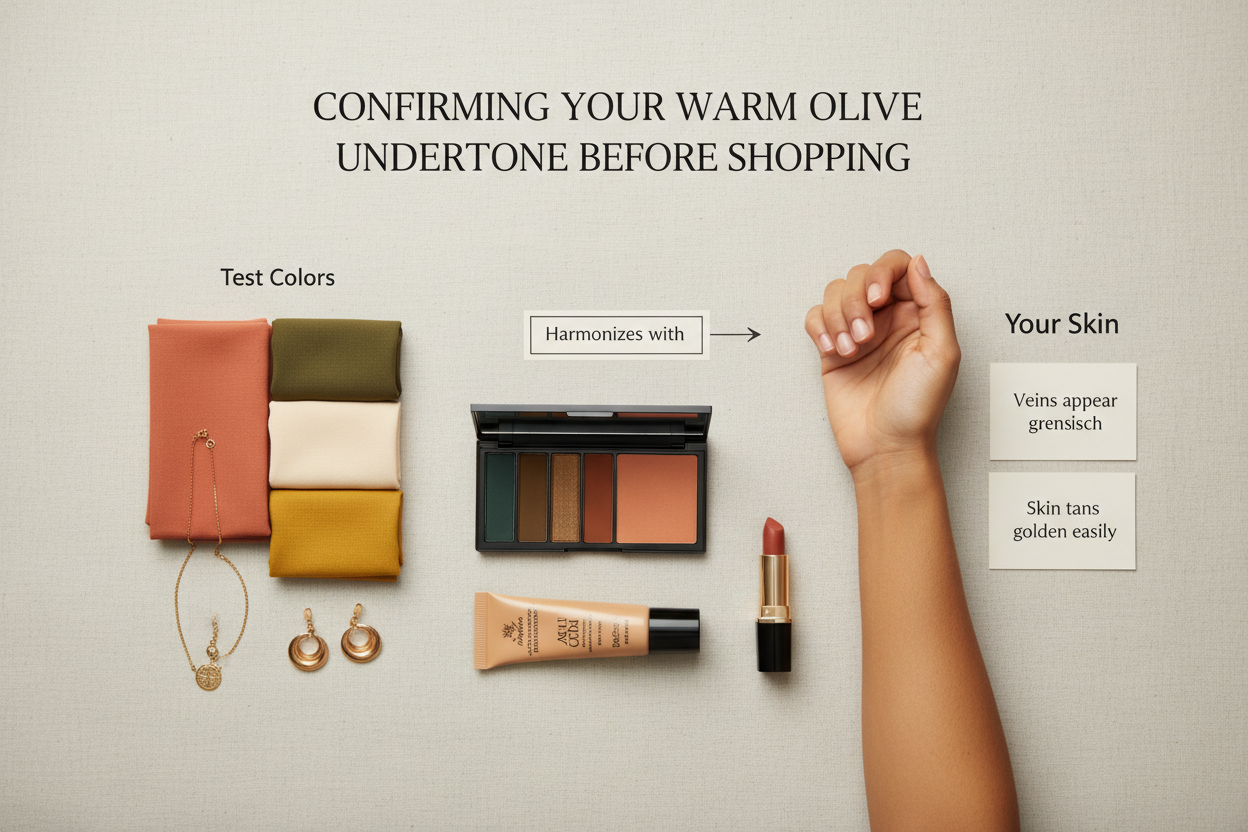
1. The vein test — with caveats The classic version says blue-purple veins mean cool, green means warm. For olive skin, that rule breaks down. Olive skin tends to read as greenish regardless of your actual undertone, because the green cast in the skin itself colors what you see. Still, if your veins look strongly golden-green rather than gray-green or blue-green, warm olive is the more likely answer.
2. The jewelry test Hold gold and silver jewelry near your face in natural light. If gold looks natural and silver looks flat or a little harsh, that points toward warm. If both work fine, or silver looks better, cool olive is more likely.
3. The fabric draping test Hold warm fabrics against your face — terracotta, warm camel, golden yellow — then switch to cool ones: icy lavender, cool gray, bright white. If the warm fabrics make your skin look clearer and your features sharper while the cool ones create a slightly muddy or grayish quality, you have a warm olive base.
These tests point in a useful direction, but olive skin is genuinely tricky to self-diagnose. The green cast can throw off all three methods. If you're still unsure, or want recommendations calibrated to your specific undertone rather than a general category, a personalized color analysis will give you a more reliable answer than any mirror test.
People Also Ask
What colors should olive skin avoid?
Warm olive skin tends to be undermined by colors that introduce a cool or blue-based contrast near the face. The most consistent problem colors are:
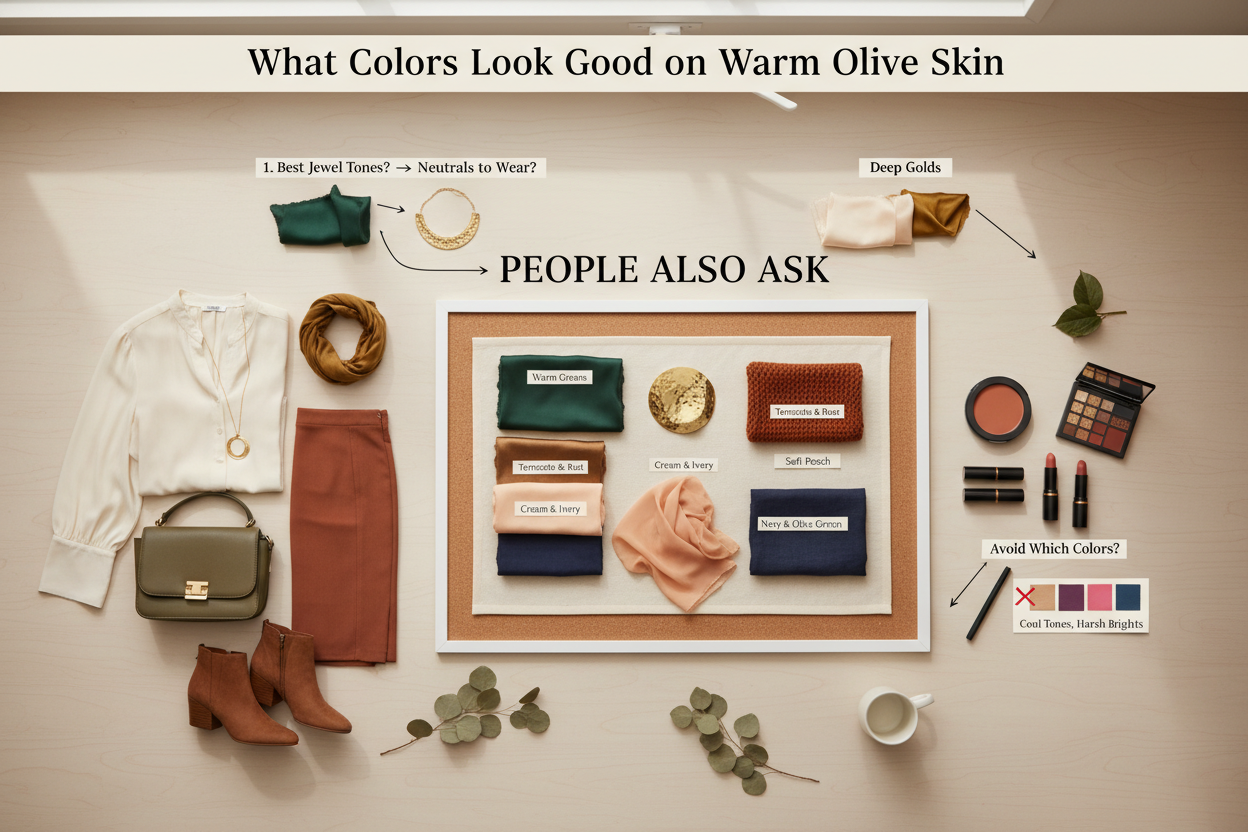
- Stark, optical white — the blue-white base amplifies the green cast rather than the warmth
- Cool pastels — baby pink, lavender, powder blue, and mint tend to read washed-out or gray against olive skin
- Cool or silvery gray — without warm undertones in its base, gray can make the complexion appear flat and dull
- Pink-based nudes and beiges — these create an odd mismatch at the neckline and near the face
- Cool fuchsia and icy violet — the blue-pink base conflicts with the green-gold dimension of olive undertones
The pattern is consistent: colors that interact with the green cast in olive skin tend to produce muddiness or sallowness rather than clarity. Cool tones aren't all equally problematic — it's specifically the blue-based ones that cause trouble.
Is warm olive skin the same as yellow undertone?
Not exactly. Yellow-undertoned skin has a straightforward golden or warm-yellow base. Warm olive skin adds a green dimension layered into that warmth — so the result is green-gold rather than pure yellow. That's why olive skin gets its own category instead of just being lumped in with warm or yellow tones.
The distinction matters when you're choosing colors. Some shades that look great on yellow-warm skin — certain peachy or golden pastels, for instance — can read slightly off on warm olive because they don't account for the green cast. Colors like olive green and forest green, which might feel redundant on yellow-toned skin, often work well on warm olive for exactly that reason: they harmonize with the green rather than fighting it.
What is the difference between warm olive and cool olive skin?
Both types share the green cast that defines olive skin, but the temperature of that cast differs:
| Warm Olive | Cool Olive | |
|---|---|---|
| Base | Yellow-green | Gray-green |
| Overall impression | Honeyed, slightly golden | Muted, slightly ashy |
| Veins | Green or olive-tinted | Can appear more blue-gray |
| Jewelry | Gold typically more flattering | Silver may feel equally natural or better |
| Best colors | Earth tones, warm jewel tones | Cooler jewel tones, muted cool neutrals |
The practical difference matters: color advice for one type doesn't reliably transfer to the other. Follow warm-olive recommendations on a cool-olive complexion and the result tends to look sallow rather than glowing, and vice versa. Figure out which type you have before applying any palette guidance.
Do earth tones always work for olive skin?
For warm olive skin, earth tones are a reliable starting point. Colors like terracotta, camel, burnt sienna, deep mustard, and olive green tend to work well because they share a yellow-brown-green base that plays off the skin's natural undertones rather than fighting them.
That said, a few caveats:
- Depth matters. On lighter warm olive skin, pale or washed-out earth tones can blend into the complexion instead of creating contrast. More saturated versions of the same hues usually hold up better.
- Temperature within the category matters. A cool-leaning khaki or ashy taupe technically qualifies as an earth tone, but it behaves more like a cool neutral on olive skin — which means it can flatten rather than flatter.
- Cool olive skin is different. Warm, golden earth tones aren't as universally flattering on cool olive complexions as they are on warm ones.
Earth tones are a good starting point, not a guaranteed formula.
What neutrals are most flattering for olive skin tones?
For warm olive skin, the goal is neutrals that carry warmth in their base rather than cool or gray undertones.
Most flattering:
- Cream and ivory — off-whites with a yellow base complement the warmth without the cool-white clash
- Warm camel — a golden tan that sits close to the skin's natural undertone
- Warm chocolate brown — creates clean depth without competing undertones
- Warm charcoal — gray with brown or olive in the base; the warmth softens what would otherwise be a cool contrast
Approach with caution:
- Bright, cool white — can make warm olive skin look sallow near the face
- Pink-based beige or cool greige — tends to sit awkwardly against the green-gold cast
- Silvery or cool gray — without warm undertones, gray often flattens the complexion
Black is its own category here. It creates strong, clean contrast and doesn't introduce a competing undertone, which makes it one of the more forgiving options across olive depths.
FAQ
What is the green-gold undertone in olive skin and how does it affect color choices?
Olive skin has a green-gold layer in its undertone — not just yellow or golden like many warm skin types, but a mix of the two with a visible green dimension. Most color advice ignores this and treats olive skin as straightforwardly warm-golden, which is why so many standard recommendations miss the mark.
In practice, this green-gold cast changes how colors behave near the face:
- Colors with a similar warmth and green base (olive green, forest green, terracotta, warm brown) tend to harmonize rather than clash
- Colors with a blue or cool base — even subtle ones like dusty lavender or certain pinks — can amplify the green dimension in a way that reads as muddy rather than warm
- Purely yellow-warm color advice doesn't fully translate, because the green component needs different calibration
This undertone is the foundation for any color choice that actually works with warm olive skin rather than against it.
Can people with warm olive skin wear cool-toned colors?
Yes, but with some care. Cool-toned colors aren't automatically off-limits.
The ones that tend to cause problems are those where the cool base directly conflicts with the green-gold cast: icy pastels, pink-based nudes, cool silvery grays, and stark optical whites. These don't so much clash in an obvious way as flatten or muddy the complexion.
Deep jewel tones are a different story. Rich plum, sapphire blue, and deep emerald carry enough saturation to hold their own against warm olive skin without washing it out. A useful rule: the richer and deeper the cool tone, the better the odds. Pale, muted, or icy versions of the same hues are more likely to cause trouble.
What is the best white shade for warm olive skin?
Off-white, cream, or ivory — anything with a yellow or warm base — works far better than optical or bright white.
Stark, cool white has a blue undertone that tends to pull out the green cast in warm olive skin rather than its warmth. Near the face, the result can look slightly sallow or uneven. Off-whites and creams share a warm base that works with the skin's natural green-gold undertone instead of fighting it, giving a more cohesive, glowing effect.
If you're not sure which whites work for you, hold fabric samples near your face in natural light and see which one makes your skin look clearer and more alive. It's usually the cream or ivory end of the spectrum.
Does warm olive skin look better in gold or silver jewelry?
Gold is usually the better choice. The warm yellow base in gold echoes the warmth in olive undertones, so the two read as harmonious rather than fighting each other.
Silver tends to work against it. The cool, gray-leaning brightness can make warm olive skin look a bit flat or ashy near the face instead of glowy.
That said, it's not a hard rule. Rose gold often splits the difference nicely, and mixed-metal pieces can go either way. It's also worth noting that not all olive skin runs warm — those with cooler olive undertones sometimes find silver more flattering than gold.
Are pastels flattering on warm olive skin?
Warm pastels can work; cool pastels generally don't.
Most pastels are formulated with cool or gray bases — baby pink, lavender, powder blue, mint. That coolness fights the green-gold undertone and tends to make the skin look dull or washed out.
Warm pastels — peach, apricot, soft yellow, pale terracotta — share a yellow-warm base with the skin's undertone, so they don't create the same conflict. They can work well, especially in softer styling contexts, though depth matters: very pale or muted versions may blend into the complexion instead of creating contrast.
The short version: pastels work best on warm olive skin when they lean warm and have enough pigment to read against it.
How do I know if my olive skin is warm or cool?
A few tests can help you figure it out:
- Vein test: Check the inside of your wrist in natural light. Green or olive-tinted veins lean warm; blue-gray or purple veins lean cool.
- White vs. cream test: Hold bright white fabric near your face, then swap it for cream or ivory. Whichever makes your skin look clearer is the tell — cream points to warm, bright white to cool or neutral.
- Gold vs. silver test: Try both near your face in daylight. If gold looks better, you're likely warm; if silver holds its own or looks better, you probably lean cool.
- Tan behavior: Warm olive skin tends to tan to a golden-brown; cool olive skin often goes more ashy or grayish.
If those tests still feel ambiguous, color analysis tools (including AI-powered quizzes that weigh multiple variables at once) can give you a more precise read.
What makeup colors complement warm olive skin the same way clothing colors do?
The same principle applies: warm, earth-based tones and rich saturated colors work with the green-gold undertone, while cool or muted shades tend to flatten it.
Foundation and concealer: Look for yellow or neutral-warm bases rather than pink or cool-beige formulas. The latter can create a mismatched gray effect on olive skin.
Eyeshadow: Warm browns, bronze, copper, terracotta, and deep olive all complement the undertone. Deep jewel tones like plum, forest green, and sapphire work for more dramatic looks.
Blush and bronzer: Peachy-warm, terracotta, or warm coral blushes suit olive skin better than cool pink or mauve. For bronzer, a golden or warm-brown base reads more natural than orange or cool gray.
Lip colors: Warm nudes (caramel, mocha, terracotta), rich berries with warm undertones, and warm reds all work well. Cool-pink nudes or mauve-pink shades can look flat against the green-gold cast.
If you want a more precise read on which shades suit your exact depth and tone, taking the color analysis quiz can map your full palette — makeup included — instead of leaving it to trial and error.