Silver vs Gold Jewelry by Color Season
 Reviewed by Alexandra Gilmore
Gold and silver can change how even or shadowed the face appears, but the better metal depends on more than personal preference. Connect metal temperature, finish, and contrast to Spring, Summer, Autumn, and Winter, then test comparable pieces near the face instead of relying on wrist color.

The question of whether to wear gold or silver jewelry feels like a matter of personal taste — but it's actually a question of undertone. The metal you wear closest to your face either harmonizes with your natural coloring or works against it, and that difference shows up in your skin's clarity, the brightness of your eyes, and whether you look rested or washed out.
💫 Find Your Color Season
The clues in this article can narrow your options, but a season result should compare temperature, depth, clarity, and contrast together. Use the quiz as a starting point, then confirm it with the practical comparisons above.
Find My Season →Color analysis gives you a systematic answer. By assigning you to one of four seasonal color types — Spring, Summer, Autumn, or Winter — it maps your skin undertone, hair depth, and eye contrast onto a palette of colors and metals that will consistently flatter you. The result is a simple, repeatable rule: warm seasons lean toward gold, cool seasons lean toward silver.
Here's what this article will walk you through:
- Why the gold vs silver debate is really an undertone debate, and how seasonal color analysis resolves it
- Which specific metals flatter each season — including the differences between yellow gold, rose gold, antique finishes, high-polish silver, and softer white metals
- How to test your own undertone if you haven't done a formal color analysis
- What to do if you're neutral or land between seasons, and whether mixing metals is ever the right call
- How to style your chosen metal beyond the neckline — rings, earrings, and layering that reinforce your seasonal palette
Whether you already know your season or are still figuring out where you land, the guidance here is grounded in color analysis principles and designed to help you make confident, flattering choices at the jewelry counter.
Why the Gold vs Silver Question Is Really an Undertone Question
Most people treat the gold vs silver decision as aesthetic preference — the same way they might favor a particular gemstone or necklace length. But preference and flattery are not the same thing, and the gap between them is undertone.
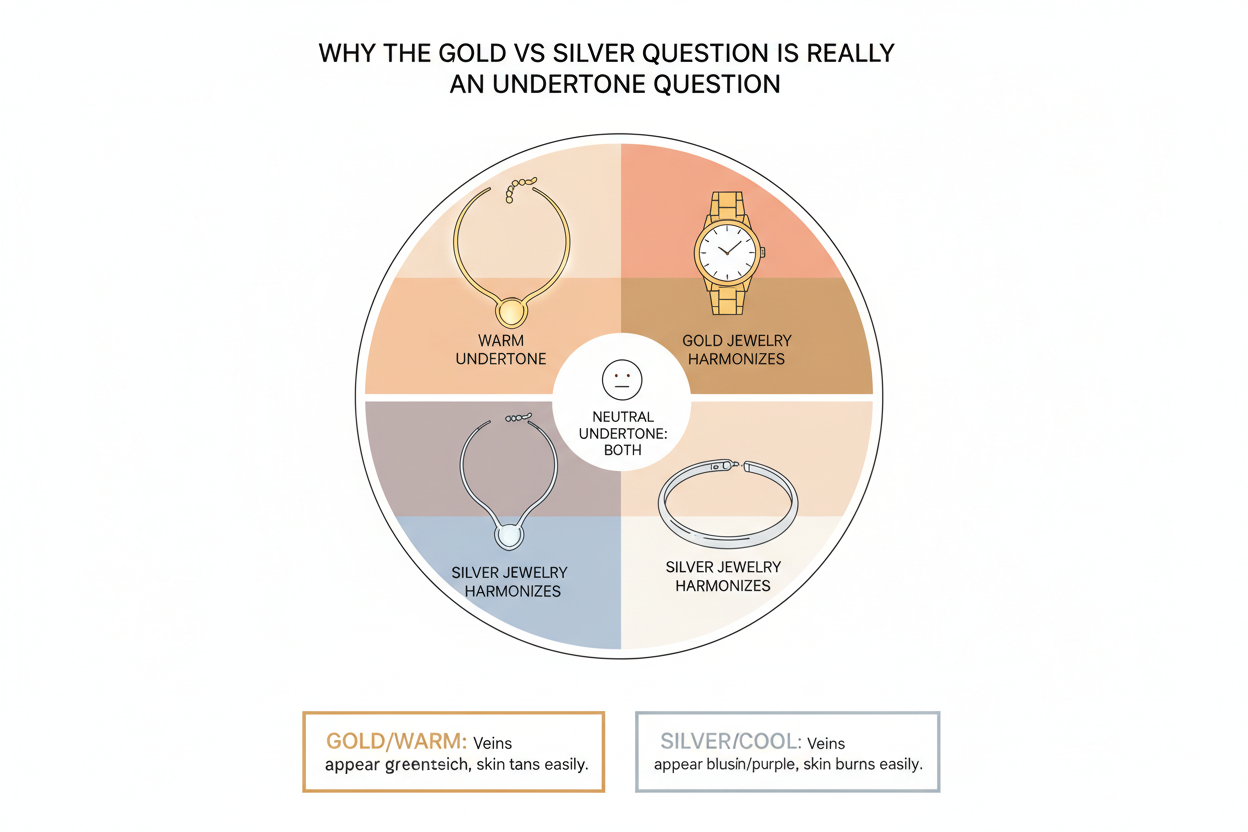
Your skin's undertone is the underlying hue that persists regardless of how tanned or pale you are at a given moment. It runs warm (golden, peachy, yellow) or cool (pink, red, bluish) — and it never changes. The metal you position closest to your face interacts with that undertone the same way a fabric color at your neckline does: it either echoes what's already there, making your complexion look clear and radiant, or it introduces a competing hue that reads as redness, sallowness, or dullness. This is the mechanism behind every gold-vs-silver recommendation you've ever received — and once you understand it, the choice stops feeling arbitrary.
Not sure of your undertone yet? Take the free color season quiz → to find your season in minutes before reading on.
How Color Analysis Assigns You a Season Based on Undertone
Color analysis identifies the colors — and by extension the metals — that work with your natural features rather than against them. It looks at your skin tone, eye color, and hair color together to find the palette that suits you best.
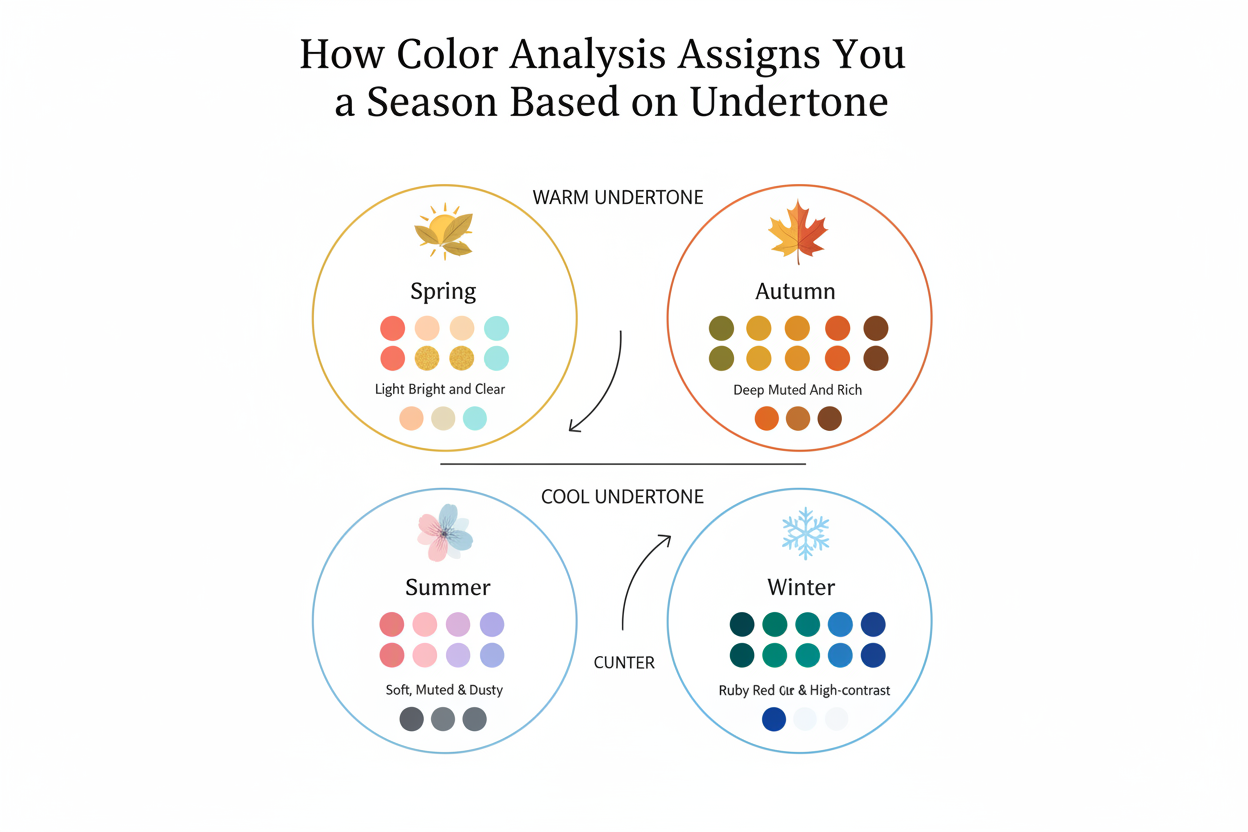
The foundational step is the warm-cool axis. Once your undertone is identified, you fall into one of four seasonal color types:
| Season | Undertone | Depth | Clarity |
|---|---|---|---|
| Spring | Warm | Light to medium | Clear, bright |
| Autumn | Warm | Medium to deep | Muted, earthy |
| Summer | Cool | Light to medium | Soft, muted |
| Winter | Cool | Medium to deep | High contrast, clear |
Each season corresponds to a set of clothing colors that work with your natural coloring — and the same logic applies directly to metal choice. A ring, necklace, or earring sits right next to your skin, so it functions as a color within your palette, not some separate decision.
Warm Seasons (Spring and Autumn): Why Gold Jewelry Flatters You
If your undertone is warm, yellow-based metals work in your favor. Gold's warm hue mirrors the golden or peachy cast already in your skin, so instead of creating contrast, it echoes what's already there. The result is a complexion that looks warmer and more luminous — not because the jewelry is doing something dramatic, but because it isn't working against your natural coloring.
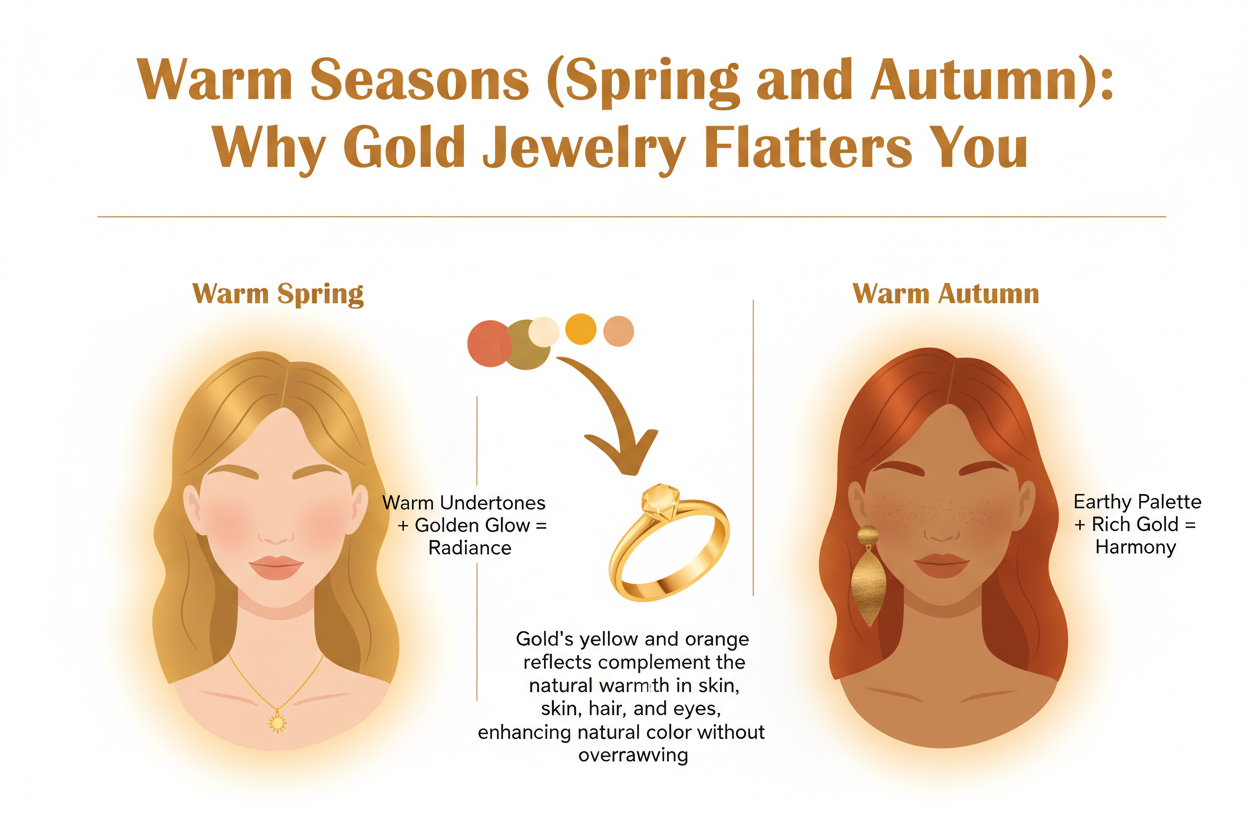
That's why jewelry color analysis consistently points warm-season people toward gold: it flatters by harmonizing with the undertone that's already present.
Spring and Autumn are both warm seasons, but they're not identical — and that difference matters when you're choosing between gold finishes.
Spring vs Autumn: Choosing Between Yellow Gold, Rose Gold, and Antique Finishes
Spring profiles are warm and light, with a brightness and clarity to their coloring. The gold tones that work best share those qualities:
- Yellow gold in a polished or satin finish captures Spring's natural brightness without overwhelming it
- Rose gold suits Spring well because its peachy-pink warmth mirrors the delicate blush tones common in Spring complexions
- Avoid heavy, dark, or oxidized metals — they can overwhelm the lightness of a Spring palette
Autumn profiles are also warm, but deeper and more earthy. The richness of Autumn coloring calls for metals that match that depth:
- Antique gold, oxidized gold, and bronze-toned finishes feel at home against Autumn's deeper, more complex undertones
- Yellow gold still works, particularly in heavier or more textured pieces that carry visual weight
- Rose gold is less natural for Autumn — its softness can feel a little light against Autumn's richness, though it's still a better choice than silver
- Avoid bright, icy, or high-polish white metals, which tend to look stark against warm, deep coloring
The principle is the same across both warm seasons: match the intensity of the gold finish to the depth of your coloring. Spring calls for lighter, cleaner golds; Autumn calls for deeper, earthier ones.
Cool Seasons (Summer and Winter): Why Silver Jewelry Flatters You
Cool undertones carry pink, red, or bluish casts in the skin. Put a warm metal like yellow gold next to cool-undertoned skin and it amplifies any sallowness or unevenness — you're introducing a competing warmth where there isn't one. Silver, white gold, and platinum-finish metals run cooler and bluer, so they work with those undertones instead of against them. Same principle as warm seasons, just reversed.
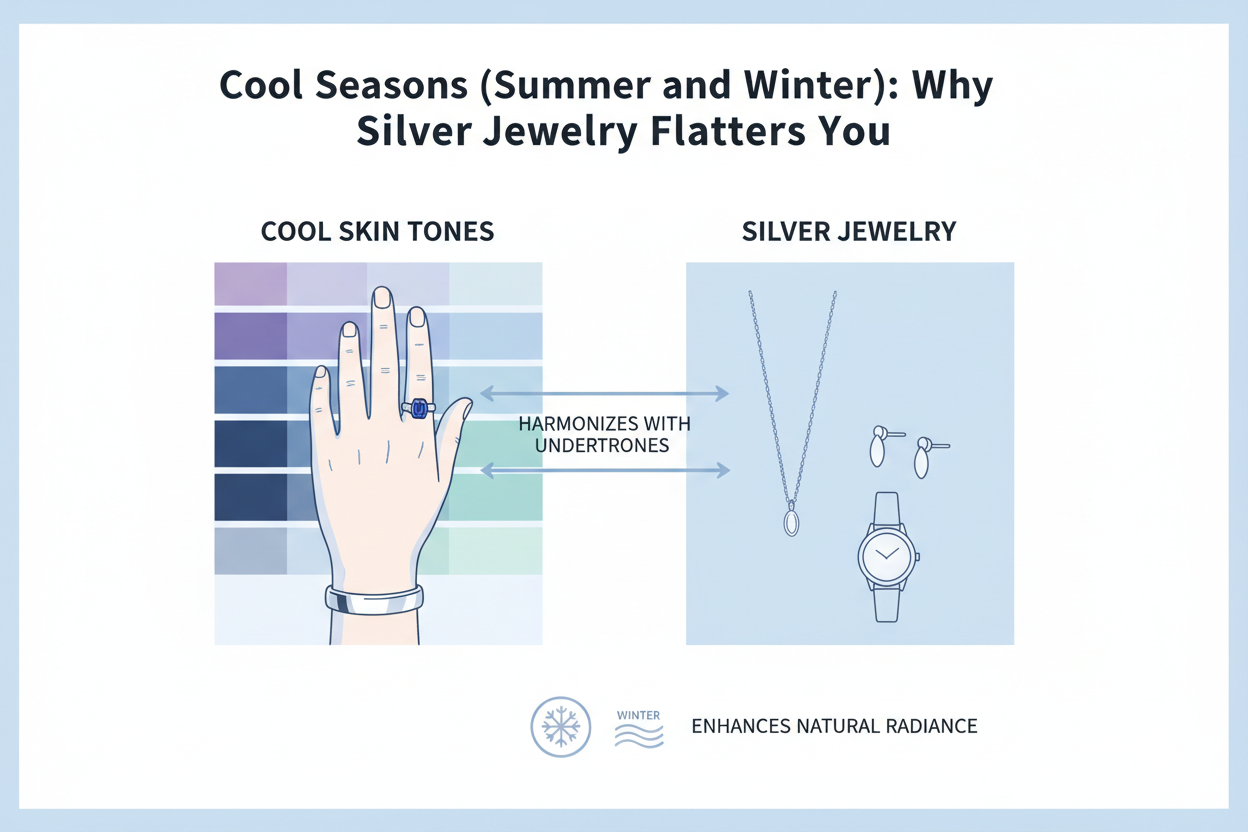
For Summer and Winter, silver-family metals reinforce your natural coloring rather than interrupting it. Earrings and necklaces stay visually quiet in the best sense: they add elegance without drawing attention to undertone mismatch.
Ready to confirm your season? Start the free color analysis quiz → and find out whether you're a Summer or Winter before building your jewelry wardrobe.
Summer vs Winter: Soft Silver Tones vs High-Polish White Metal
Like Spring and Autumn, Summer and Winter share a cool undertone but differ in depth and contrast — and those differences should guide your finish choice.
Summer profiles are cool but soft and muted, with low contrast between features. The metals that suit Summer reflect that same quietness:
- Brushed silver, matte silver, and white gold with a satin finish complement Summer's gentle, blended coloring
- High-shine, mirror-polished metals can overpower Summer's palette — their intensity is too much
- Delicate chains, fine settings, and understated pieces feel most at home here
Winter profiles are cool and high-contrast — dark hair against pale skin, or a striking eye color against a clear complexion. Winter can carry visual drama that most other seasons can't, and the metals should match:
- High-polish silver, platinum, and bright-finish white gold reinforce Winter's clarity and contrast
- A polished silver surface has a sharpness that echoes the clean, defined quality of Winter coloring
- Winter is also the season best suited to statement pieces — geometric forms, architectural designs, and bold scale all land well in silver
The pattern mirrors the warm-season rule: match the intensity of the finish to the depth and contrast of your coloring.
What If You Can Wear Both? Neutral Undertones and Mixed-Season Rules
Not everyone falls cleanly on one side of the warm-cool axis. Some seasonal profiles — particularly Soft Summer and Soft Autumn — sit near the boundary, with undertones that aren't strongly warm or cool in either direction. If you've tried both metals and genuinely found each flattering depending on context, neutral undertone is a real explanation, not wishful thinking.
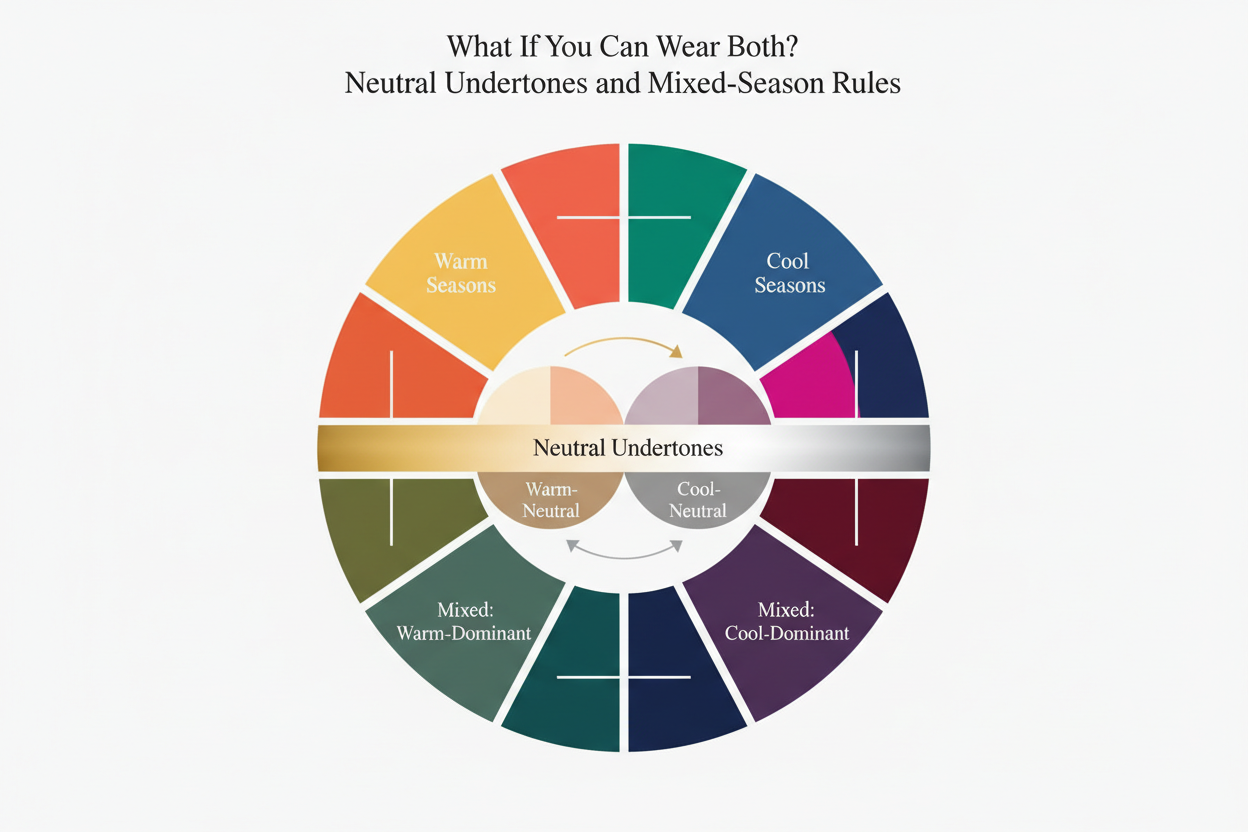
A few principles for navigating the ambiguity:
- Finish and saturation become the secondary lever. When undertone is neutral, the brightness and polish of a metal matters more than its base hue. Brushed or matte gold reads less warm than high-gloss yellow gold; dark gunmetal reads less cool than bright white gold.
- Mixed metal stacking is more workable for neutral seasons. Layering a thin yellow gold chain with a fine silver bracelet can feel intentional rather than conflicted when your undertone isn't pulling strongly in either direction.
- Context still matters. Even people with neutral undertones often notice one metal family performs slightly better in certain lighting or alongside certain clothing colors. That's worth paying attention to over time.
The goal isn't to force a binary where none exists. It's to understand your undertone well enough to make informed choices — including the choice to mix.
Practical Tests to Identify Your Undertone Before Choosing a Metal
If you haven't had a formal color analysis, a few self-assessment methods are worth trying. Color analysis looks at skin tone, eye color, and hair color together, so no single test is definitive — but these can help you get a clearer picture.
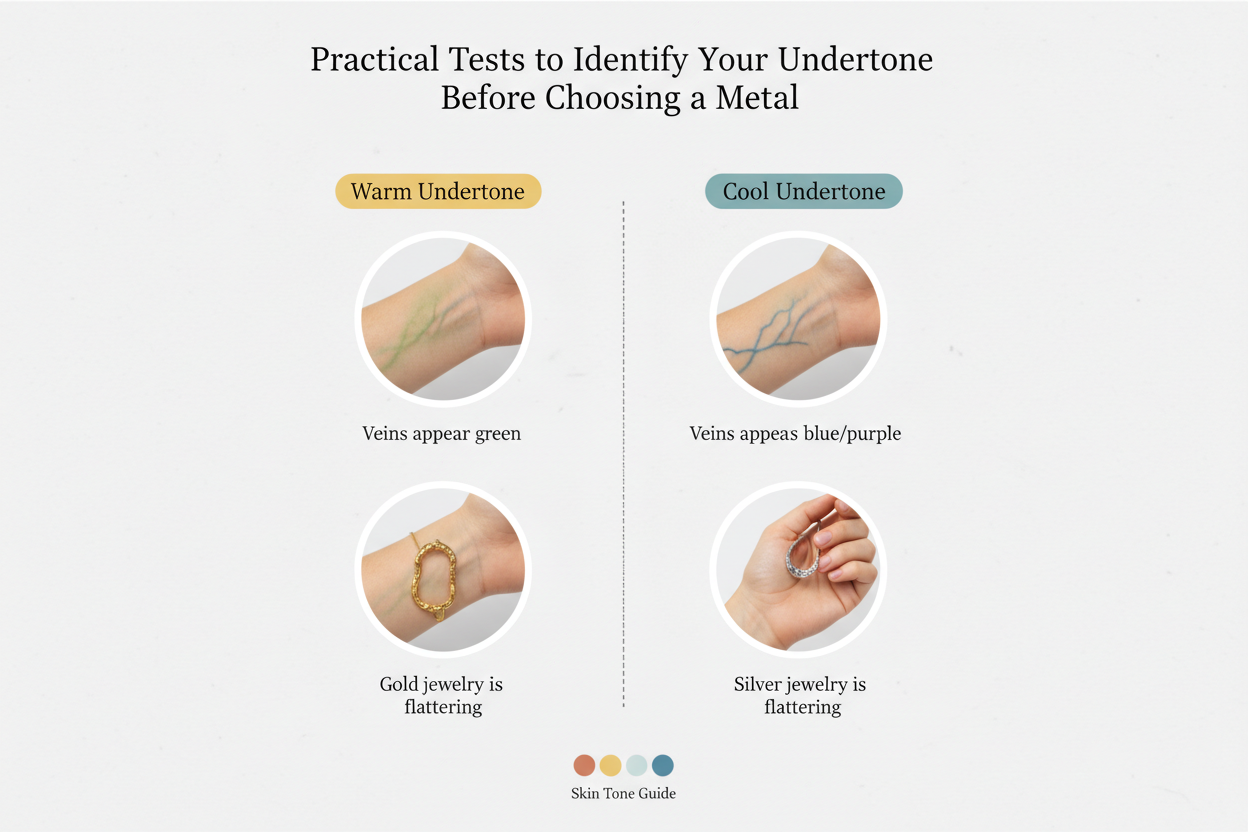
1. The Vein Test Look at the veins on the inside of your wrist in natural daylight. Blue or purple veins suggest cool undertones; green or olive-green suggest warm; a mix of both may indicate neutral.
Note: This is widely cited but treat it as a starting point, not a conclusion. Vein appearance can be affected by skin depth, lighting, and individual variation.
2. The Sun Response Test Think about how your skin reacts to sun exposure. Warm undertones tend to tan easily and rarely burn; cool undertones are more prone to burning first. Neutral undertones often do both at different times.
Note: This is an authorial insert based on commonly referenced undertone indicators, not a claim derived from the source material.
3. The White vs Cream Test Hold a bright white fabric and a warm off-white or cream fabric against your face in natural light. If bright white makes your complexion look clear and fresh, you likely have cool undertones. If cream or ivory looks more natural, warm undertones are probable.
4. The Jewelry Reaction Test (covered in more detail below) Hold gold and silver pieces near your face in daylight and see which one makes your skin look better. This is arguably the most direct test of the four.
All of these work best in natural daylight, away from artificial lighting that skews warm or cool.
Styling the Right Metal for Your Season: Beyond the Neckline Rule
Choosing the right metal for earrings and necklaces matters most — those pieces sit closest to your face — but the undertone principle runs through your entire jewelry wardrobe.
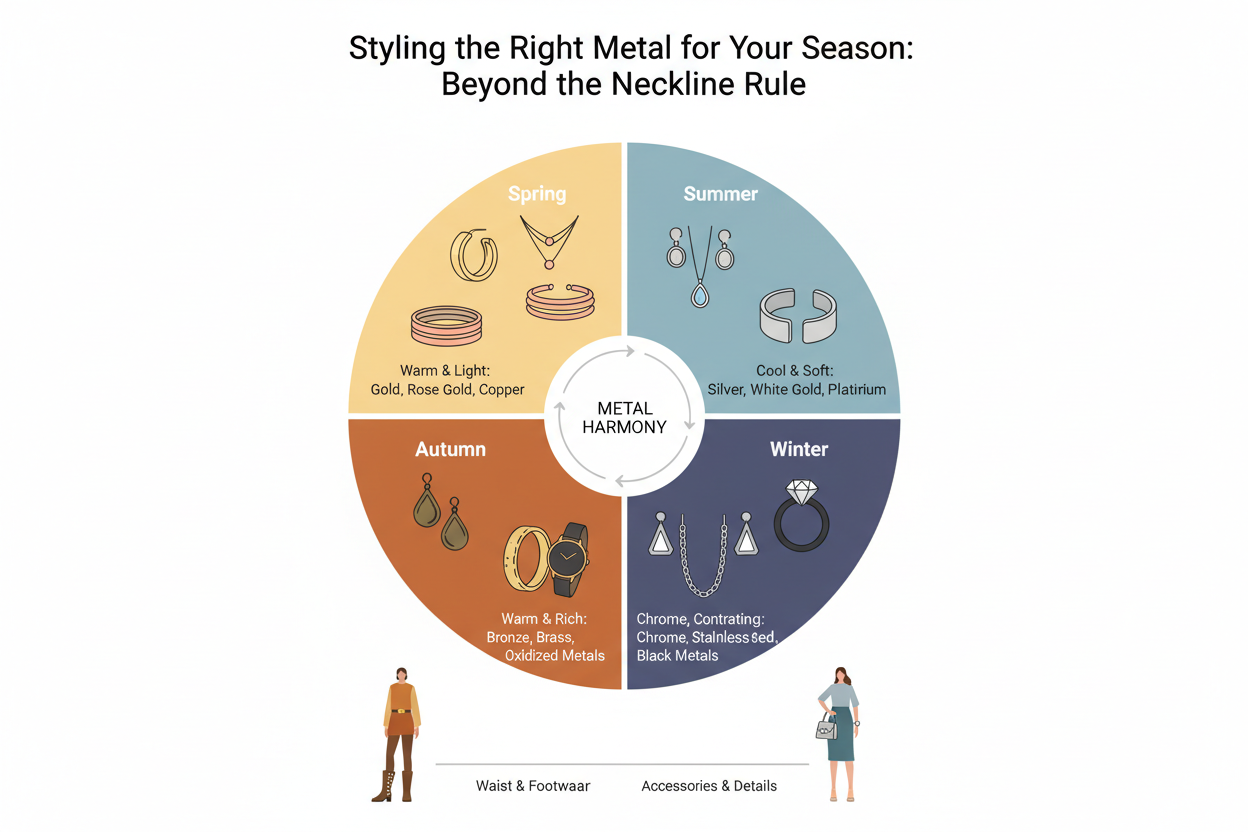
Jewelry is the finishing layer of an outfit. It brings things together and adds personality, but only when it's moving in the same direction as your overall palette. A few ways to extend your seasonal metal guidance:
Earrings Earrings frame the face directly and carry the highest visual impact after a necklace. Get your season's preferred metal right here before worrying about anything else.
Rings and bracelets These sit further from your face, so the undertone effect is less noticeable — but it still adds up. A warm-season person wearing silver rings with gold earrings creates a low-level visual friction that's hard to name but easy to feel.
Layering and stacking Within a single metal family, layering is fair game. Warm seasons can stack yellow gold chains in different weights; cool seasons can mix silver and white gold without any conflict. For neutral undertones, intentional mixing works — anchor it with one dominant metal and let the others support.
Occasion and outfit context Your season's metal also responds to clothing color. Autumn profiles in earthy terracotta or olive will find warm gold reinforces the whole look; Summer profiles in dusty rose or lavender will find soft silver keeps the tonal story intact. Let your outfit's palette guide the finish and weight — delicate and matte for quieter moments, bolder and more polished when the occasion calls for it.
The principle holds in every context: the metal nearest your skin is a color choice, and it deserves the same attention as any other color choice in the outfit.
Spring vs Autumn: Choosing Between Yellow Gold, Rose Gold, and Antique Finishes
(See the full breakdown under the Warm Seasons section above.)
When building full looks, Spring profiles should reach for lighter-weight gold with cleaner lines and brighter finishes — delicate chains, small hoops, polished settings. Autumn profiles can go heavier and more textured: hammered gold, antique settings, burnished layered chains all reinforce the depth of an Autumn palette.
Summer vs Winter: Soft Silver Tones vs High-Polish White Metal
(See the full breakdown under the Cool Seasons section above.)
In a full look, Summer tends toward fine, understated silver — thin chains, small drops, brushed finishes — keeping the visual volume low. Winter can carry bold, architectural silver jewelry that would overwhelm a softer season. Statement cuffs, geometric drops, chunky high-polish pieces — all of these work for Winter in a way that fits the season's high-contrast energy.
The Jewelry Reaction Test: Using Silver and Gold to Confirm Your Season
Hold a piece of gold jewelry against your skin. Then hold a piece of silver. One of them will make you look better. That's the test.
How to do it:
- Find a gold piece and a silver piece — ideally something simple like a plain chain or hoop, so you're testing metal color rather than design.
- Stand near a window in natural daylight. Avoid direct sunlight or artificial light, which skews the result.
- Hold the gold piece against your skin just below the chin or along the jawline. Look in a mirror. Does your skin look clearer? Does redness or sallowness reduce?
- Repeat with the silver piece.
- The metal that makes your complexion look more balanced and even is almost certainly the better match for your undertone.
Note: This is an authorial application of the undertone-harmony principle from the source material, not a formally validated diagnostic test. That said, it follows the same logic professional colorists use when observing how colors near the face affect skin appearance.
You're not looking for which metal you find prettier on its own. You're looking for which metal makes you look better. That's the whole point of applying seasonal color analysis to jewelry — and this test makes the principle visible rather than theoretical.
People Also Ask
Does your skin tone determine whether you should wear gold or silver jewelry?
Skin tone plays a role, but undertone is the more precise answer. Your surface tone — how light or dark your complexion reads — shifts with sun exposure and seasons. Your undertone, the underlying warm or cool hue, stays constant.
When you hold a metal next to your face, it reacts with that undertone. Yellow gold against cool-undertoned skin can bring out redness or add a yellowish cast. Silver against warm-undertoned skin can look harsh or drain your color. Undertone is what determines whether a metal looks like it belongs there.
Color analysis formalizes this through seasonal types — Spring, Summer, Autumn, Winter — based on undertone, depth, and clarity. Your season points toward metals that actually flatter, not just the ones you've always worn out of habit.
What color season looks best in silver jewelry?
Silver and its close relatives — white gold, platinum, and other cool-finish metals — tend to work best on cool-undertoned seasons, mainly Summer and Winter.
- Winter types usually have high contrast between their features and carry cool, clear coloring. High-polish silver and bright white gold reinforce that clarity and can hold their own against bolder pieces.
- Summer types share the cool undertone but are softer and more muted overall. Brushed or satin-finish silver tends to harmonize better than high-shine polished metal, which can overpower Summer's lower-contrast coloring.
Neutral-undertone seasons — Soft Summer in particular — can also pull off silver, especially in more muted finishes. Warm-season types (Spring and Autumn) often find that silver works against their undertone rather than with it.
Can warm-toned people wear silver jewelry?
Technically yes. No rule prohibits it. But the effect near the face is worth understanding before you make it a habit.
Silver's cool, bluish undertone contrasts with warm skin rather than echoing it. For Spring and Autumn types, this can make the complexion look slightly washed out or uneven, especially in earrings and necklaces that sit close to the face. The further from the face a piece sits — a bracelet, a ring — the less it matters.
If you're warm-toned and drawn to silver anyway, a few adjustments soften the contrast:
- Choose brushed or oxidized silver over high-polish finishes — the reduced reflectivity makes the cool tone less pronounced
- Keep silver pieces below the neckline where the undertone clash is less noticeable
- Use silver as an accent within a look that's otherwise anchored by gold near the face
Warm-toned people who love silver aren't making a mistake. But knowing the trade-off means you're choosing it deliberately, not wondering why something feels slightly off.
How do I know if I have a warm or cool undertone for jewelry?
A few simple tests can help you figure this out:
The vein test Check the veins on the inside of your wrist in natural daylight. Blue or purple veins point to cool undertones; greenish veins point to warm; a mix of both suggests neutral.
The white vs cream test Hold a bright white fabric and a warm cream fabric near your face in natural light. If the bright white makes your complexion look clearer, you're probably cool-toned. If cream or ivory looks more natural, you likely run warm.
The jewelry reaction test Hold a plain gold piece and a plain silver piece near your jawline, one at a time, in natural daylight. Whichever metal makes your skin look more even and less sallow is the better match.
Color analysis The most reliable option is a full color analysis, which identifies your season by looking at your skin tone, eye color, and hair color together — not any single feature on its own. Once you know your season, your undertone and ideal metal family are both sorted at the same time.
What is the difference between gold and silver jewelry for cool undertones?
For cool undertones, the difference comes down to harmony versus friction:
- Silver (along with white gold and platinum) has a cool, slightly bluish hue that mirrors the pink or reddish casts in cool-undertoned skin. Wearing silver near the face reinforces what's already there, making the complexion look more balanced and even.
- Gold introduces a warm, yellow-based hue that sits opposite cool undertones. Near the face, this contrast can amplify redness, make skin look uneven, or create a slightly muddy effect — not because gold is inherently unflattering, but because it's introducing a competing color temperature.
Within silver, finish still matters depending on your season:
- Summer (cool and soft) tends to look better with matte or brushed finishes that keep visual intensity low
- Winter (cool and high-contrast) can carry bright, mirror-polished silver and white metals without being overwhelmed
The choice between gold and silver for cool undertones isn't just preference — it's whether the metal is working with your skin's natural hue or against it.
FAQ
What seasonal color types should wear gold jewelry?
Gold jewelry — yellow gold, antique, and oxidized finishes — tends to work best on the two warm-undertoned seasons:
- Spring types have warm, light, clear coloring. Bright or polished yellow gold suits them well, as does delicate rose gold. Both pick up the sunny warmth in their complexion without competing with it.
- Autumn types have warm, deep, muted coloring. They can carry richer, more textured finishes — hammered yellow gold, antique brass, burnished tones — that sit naturally alongside Autumn's earthier palette.
For both seasons, gold works because its warm, yellow-based hue echoes the golden or peachy undertones already in the skin. The complexion ends up looking more even rather than at odds with the metal.
What seasonal color types should wear silver jewelry?
Silver and related metals — white gold, platinum, and other cool-finish options — tend to work best for cool-undertoned seasons:
- Winter types have cool, high-contrast coloring and can pull off bright, high-polish silver without any trouble. The reflectivity matches Winter's natural clarity and intensity.
- Summer types share the cool undertone but run softer and more muted overall. Brushed, satin, or lightly oxidized silver suits them better than a mirror finish, which can feel a bit stark against gentler coloring.
Neutral seasons — Soft Summer and Soft Autumn especially — often have the most flexibility. Lower-sheen silver finishes can work well for them, and they're less locked into one metal family than true cool or warm seasons.
Can I wear both gold and silver jewelry if I have a neutral undertone?
Yes. A neutral undertone is the one profile where mixing metals actually works rather than just being overlooked. Neutral undertones sit between warm and cool, so neither yellow gold nor silver introduces a competing temperature close to the face.
What that means in practice:
- Both metals can work, though the specific finish still matters. Rose gold and warm-tinted silver tend to feel more natural on neutral types than the more extreme versions of either metal.
- Mixing gold and silver in a single look is genuinely easier without visual conflict.
- Context helps: a rose gold piece alongside cool white gold can feel cohesive on a neutral undertone in a way it simply wouldn't on a strongly warm or cool type.
If self-tests leave you feeling like both metals suit you equally well, that's useful information. It probably means you're neutral.
How does color analysis determine which metal jewelry flatters me?
Color analysis maps your natural coloring — your skin tone, hair color, and eye color — onto a seasonal framework: Spring, Summer, Autumn, or Winter. Each season is defined by undertone (warm or cool) first, then by depth (light to deep) and clarity (clear to muted).
Once you know your season, the metal question follows from the undertone:
- Warm undertone → warm-hued metals (yellow gold, antique gold, rose gold with warm tints)
- Cool undertone → cool-hued metals (silver, white gold, platinum)
- Neutral undertone → flexibility across both families, with finish and saturation used to fine-tune
The logic is simple: metal worn near the face behaves like any other color placed next to your skin. It either works with your natural coloring or it fights it. Color analysis gives you a systematic way to figure out which direction your skin pulls, instead of guessing.
Does rose gold count as warm or cool for color season purposes?
Rose gold is a warm metal, so it tends to work best on warm-undertoned seasons — Spring especially.
The mix of yellow gold and copper gives it a pinkish-peach warmth that sits naturally with many Spring complexions. It's softer than traditional yellow gold, which suits Spring's lighter coloring without overwhelming it.
Autumn types can wear it, but the peachy-pink cast can read a little light next to Autumn's deeper, earthier warmth. Richer yellow or antique gold usually feels more at home there.
For Summer and Winter, rose gold introduces warmth that can compete with their natural coloring — less jarring than yellow gold, but still noticeable. Neutral-undertone types often get away with it fine, especially if they lean slightly warm.
What if I love gold jewelry but have a cool undertone — can I still wear it?
Yes. Color analysis describes what tends to flatter most people most of the time, not a dress code you have to follow. But understanding why something can feel slightly off helps you make better calls.
When gold sits close to a cool-undertoned face, the warm hue can amplify redness or pinkness, create a faint yellow cast around the jawline, or make your complexion look less even than it would next to a cooler metal.
If you love gold and want to keep wearing it, a few adjustments help:
- Choose lower-saturation finishes. Aged, brushed, or antique gold is less assertive than bright high-polish yellow gold.
- Keep gold pieces below the neckline. Rings, bracelets, and layered chains sit far enough from your face that the undertone conflict mostly disappears.
- Use gold as an accent rather than the main event if you're wearing earrings or a choker.
Personal style matters. Knowing the trade-off just means you're choosing it on purpose.
How does the metal I wear near my face affect my complexion?
The metal closest to your face acts as a color neighbor — and like any color placed next to skin, it either reinforces or works against what's naturally there. A reflective metal at the neckline or as earrings bounces its own hue back onto surrounding skin, making undertone interactions visible in a way that a bracelet or ring rarely does.
The effects in practice:
- A warm metal on a cool undertone can make skin look redder, uneven, or slightly sallow depending on depth
- A cool metal on a warm undertone can look harsh, draining the warmth a complexion depends on
- A harmonizing metal — warm on warm, cool on cool — tends to make skin look clearer and more rested without changing anything else
This is why necklaces and earrings matter more to the metal decision than rings or bracelets. The closer to the face, the more the metal engages directly with your skin's undertone.
To find out which metal family genuinely flatters you, take the color analysis quiz to identify your seasonal type.
To turn this principle into another practical outfit decision, continue with the companion article “How to Choose the Perfect Makeup for Your Color Season”, which keeps the two closely related questions distinct.