Seasonal Color Analysis for Men: Full Guide
 Reviewed by Alexandra Gilmore
Defaulting to navy, gray, and black can leave a man's wardrobe consistent but still unflattering. Assess undertone, depth, saturation, and contrast to find a seasonal direction, then apply it to suits, shirts, ties, casual clothes, grooming, and shopping without turning style into a complicated ritual.

Most men pick colors by habit—the same navy, grey, or black rotation—without ever asking whether those shades are actually working with their natural coloring or quietly working against it. Seasonal color analysis for men answers that question with a structured, repeatable framework.
💫 Explore Seasonal Color Analysis
Use the distinctions in this article to narrow the possibilities, then compare the seasonal system as a whole. Seeing the neighboring palettes together makes the result easier to test in real clothing and daylight.
Learn Seasonal Analysis →The system maps every man's complexion to one of 12 seasonal palettes built around three measurable traits: undertone, depth, and saturation. Get those three dials right and your clothes stop competing with your face. Get them wrong and even an expensive suit can leave you looking washed out, sallow, or older than you are.
This guide covers everything you need to put the system to work:
- What seasonal color analysis actually is and why it translates directly to a man's wardrobe
- How to read your own coloring—skin, eyes, and hair—without professional tools
- All 12 men's seasonal palettes explained with specific palette characteristics
- Wardrobe-building strategies for suits, casualwear, and accessories
- The most common mistakes men make when applying their results
Whether you've never heard of color seasons or you've taken a quiz and ended up more confused than when you started, this guide gives you a clear path from your current coloring to a palette you can shop from today.
What Is Seasonal Color Analysis and Why Does It Matter for Men?
Seasonal color analysis groups colors into palettes that work with a person's natural coloring—the undertone, depth, and saturation of their skin, hair, and eyes. The system maps every complexion into four seasonal families (Spring, Summer, Autumn, Winter), each split into three sub-palettes, for 12 distinct types.
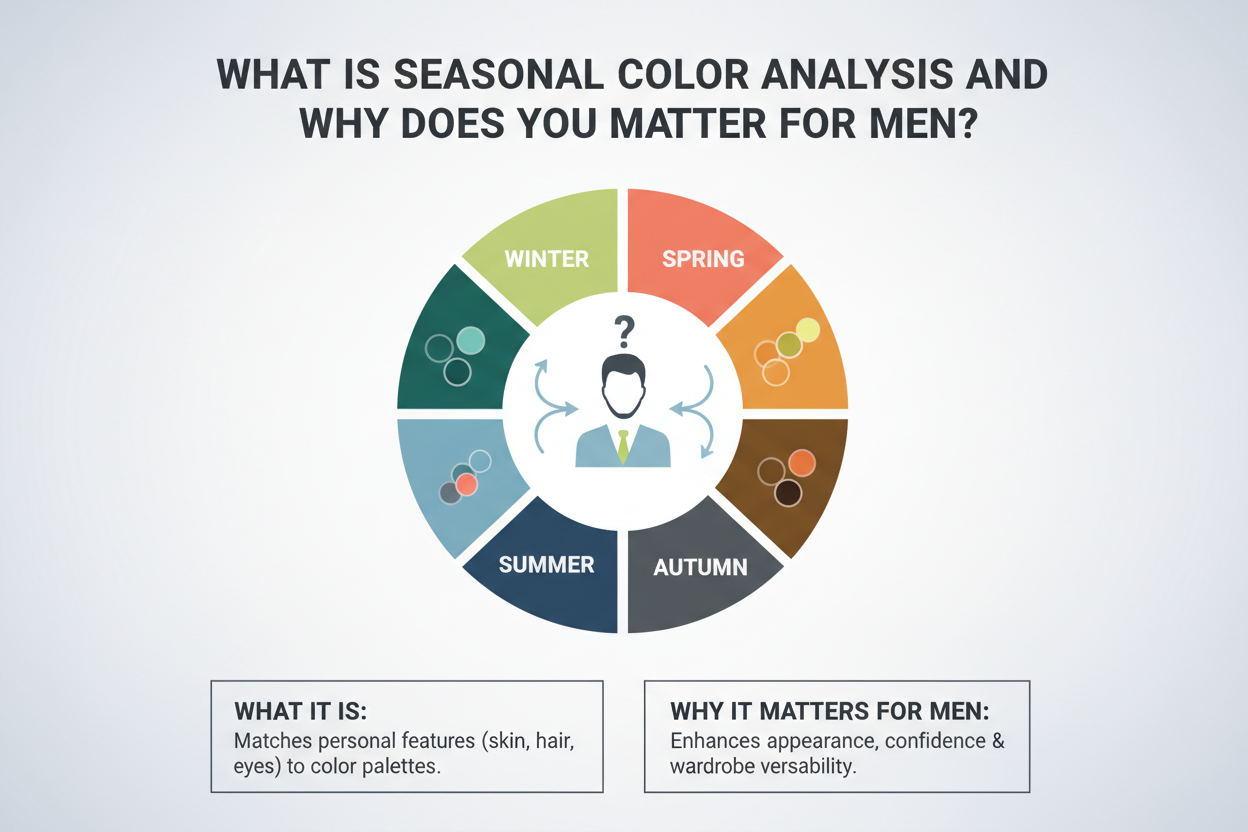
It's been marketed almost entirely to women, but the logic applies just as well to men. A shirt collar sits inches from your face. The right color there makes skin look even and clear. The wrong one pulls out redness, adds grey, or ages you by several years. That's not a matter of taste—it's a contrast and undertone reaction that happens every time you get dressed.
The practical upside is straightforward. Learning which colors work for your complexion takes some effort up front, but after that you consistently look more polished and put-together without buying more clothes or spending more money. You're just steering what you already buy toward shades that actually do something for you.
→ Take the Free Color Analysis Quiz for Men to see which season fits your coloring before you read further.
The Three Dimensions That Determine Your Season: Undertone, Depth, and Saturation
Every seasonal palette comes down to three variables. Once you understand them, the 12-palette system stops feeling arbitrary.
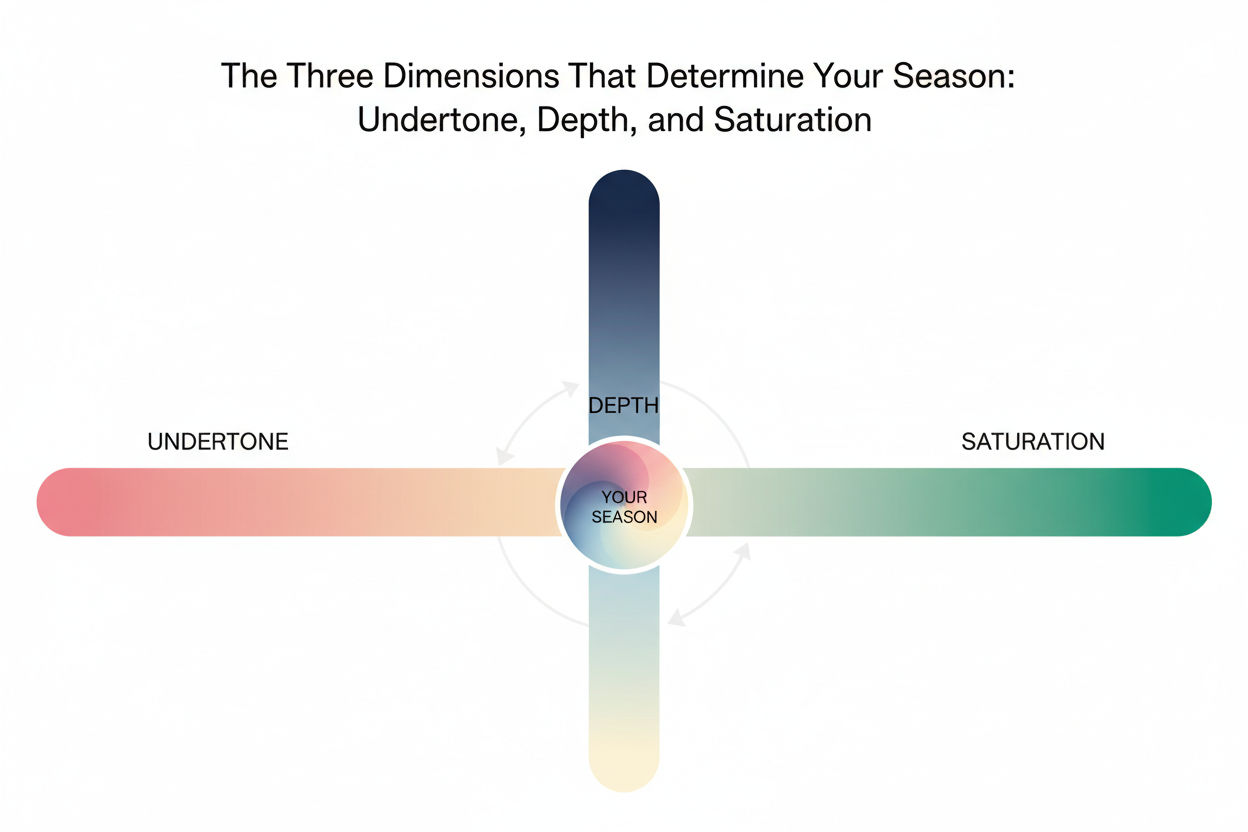
1. Undertone: Cool, Warm, or Neutral
Undertone is the base hue beneath your skin—the quality that makes two men with similarly light complexions look completely different in the same shirt. There are three states:
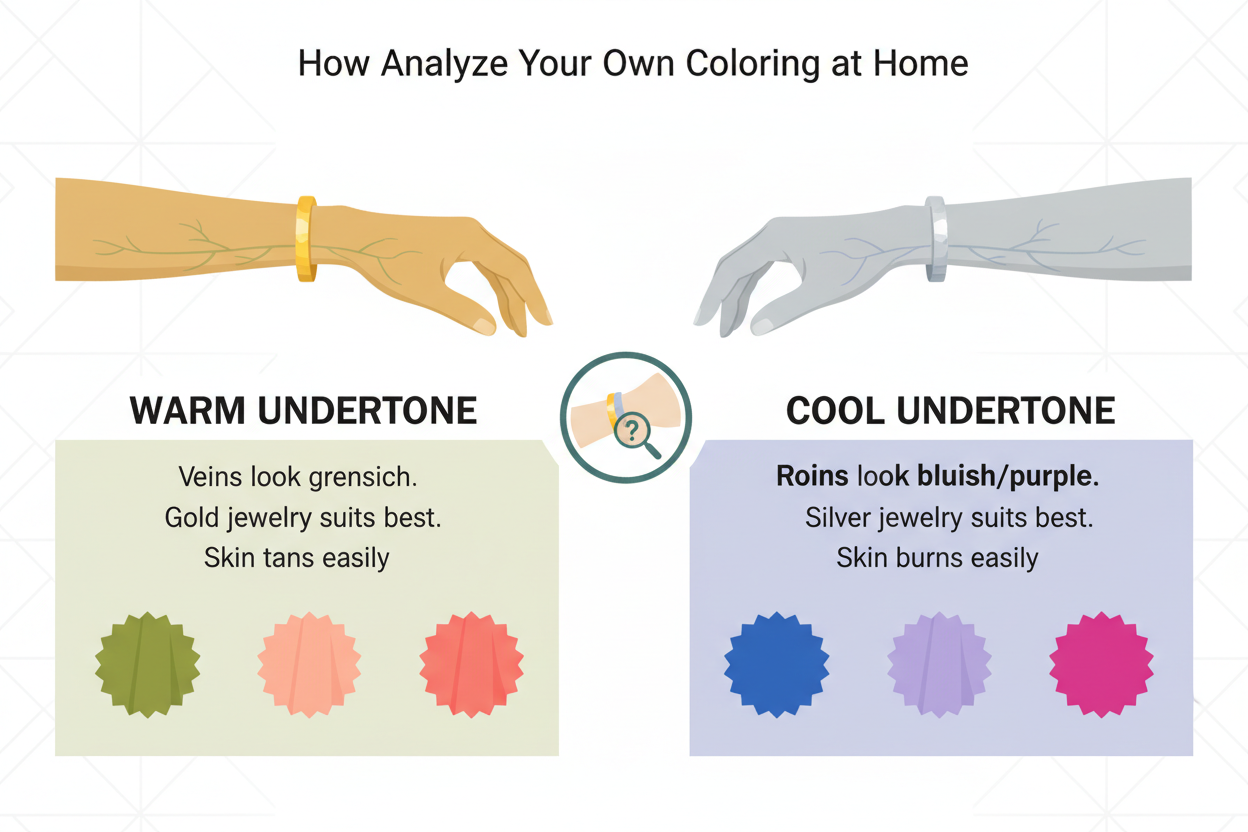
- Cool – pink, red, or bluish casts in the skin; blue or grey veins on the wrist
- Warm – golden, peachy, or olive casts; green veins on the wrist
- Neutral – a mix of both; veins appear blue-green
When a cool-toned man wears a warm-toned fabric, the reaction is immediate and often dramatic. A live draping makes this obvious: put a warm-colored cloth near a cool-toned face and the man wearing it will call it "terrible" or "horrible" before any analysis happens—the skin reads as sallow or sickly at a glance. Swap in a cool-toned fabric and everything clarifies instantly.
Undertone determines which half of the 12-palette wheel you belong to: the warm side (Spring, Autumn) or the cool side (Summer, Winter).
2. Depth: Light to Deep
Depth describes how light or dark your overall coloring is—hair, eyes, and skin taken together. Platinum hair, light eyes, fair skin puts you at one end. Very dark hair, dark eyes, deep skin puts you at the other.
Depth separates seasons within the same undertone family. Light Spring and Light Summer both have a light overall look; undertone is what tells them apart. Dark Winter and Dark Autumn are both deep; same idea.
3. Saturation: Muted to Vivid
Saturation describes how clear and intense your coloring appears versus how softened or blended it looks. High-saturation men have strong contrast—jet-black hair against pale skin. Low-saturation men have features that blend together softly—ash hair close in value to their skin, eyes that are neither striking nor dull.
Saturation is what separates adjacent sub-palettes like Soft Autumn (muted) from True Autumn (more saturated), or Bright Winter (high-chroma) from True Winter (moderate-chroma). Get depth and undertone right but miss saturation and you'll still be wearing colors that are slightly off.
How to Analyze Your Own Coloring at Home
You don't need a professional colorist to figure out your season. A careful self-assessment in good light will get you to the right palette—or narrow it down to two candidates that the quiz can resolve.
What you'll need:
- A window with indirect natural daylight (no warm bulbs or fluorescent light)
- Two fabric swatches or solid-color garments: one clearly warm (mustard yellow, terracotta, warm beige) and one clearly cool (icy lavender, slate blue, cool grey)
- A mirror
Step 1: Clear the field
Remove any colored clothing near your face. Wear a white or grey T-shirt so your skin is the only variable. If you have significant facial hair, be aware it will influence the perceived depth of your coloring.
Step 2: Check your veins
In natural light, look at the underside of your wrist.
- Veins appear blue or purple → lean cool
- Veins appear green → lean warm
- Veins appear blue-green → likely neutral
Quick signal, not a final verdict. Some men with olive skin read warm on the vein test but have enough cool grey in their complexion to land in a neutral or even cool palette. Treat it as a starting hypothesis.
Step 3: Observe your hair and eye color
- Hair with golden, auburn, or red tones → warm signal
- Hair with ash, platinum, or blue-black tones → cool signal
- Eyes that are blue, grey, or cool green → cool signal
- Eyes that are hazel, warm brown, amber, or olive green → warm signal
Note whether your hair and eyes are high contrast against your skin (→ higher saturation, deeper palettes) or close in value to your complexion (→ softer, lighter palettes).
Step 4: Run the fabric draping test (detailed instructions below)
Hold each fabric against your face and look at the result in the mirror. One will make your skin look clearer. The other will introduce shadows, redness, or a flat cast. That single test often resolves undertone more reliably than the vein check alone.
Step 5: Cross-reference with depth
Once you've confirmed undertone, ask: is my overall coloring light, medium, or deep? Do my features contrast sharply against each other, or do they blend softly? Those two answers point you toward the sub-palette within your seasonal family.
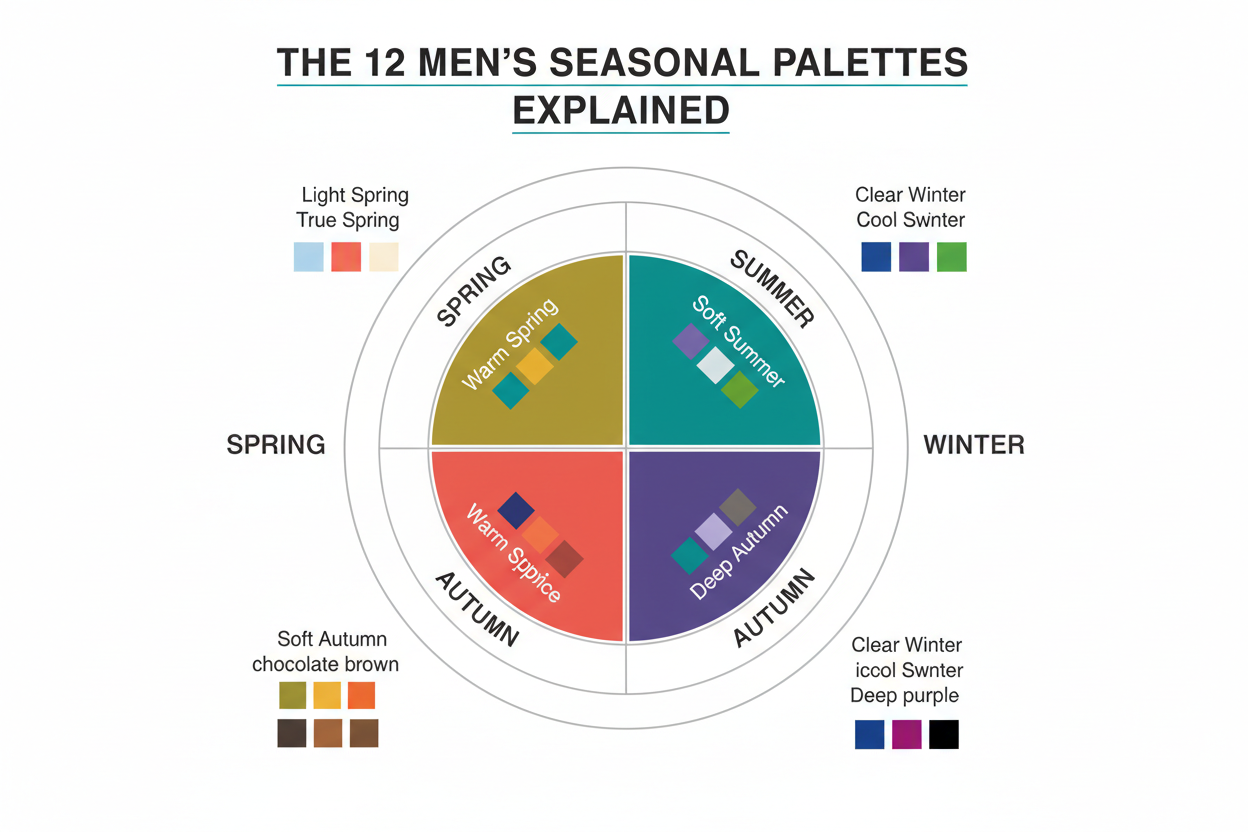
The 12 Men's Seasonal Palettes Explained
The 12-palette system organizes every man's coloring into one of four seasonal families, each split into three sub-palettes. Here's how they break down, with the characteristics that matter most for a men's wardrobe.
→ Not sure which palette is yours? Start the quiz here for a guided version of the analysis below.
Spring Palettes
Light Spring Coloring: Light-to-medium skin with warm peachy or golden undertones, light eyes (blue, green, hazel), and hair that's blonde, light brown, or strawberry. The overall impression is delicate and warm. Best colors: Warm ivory, light camel, soft coral, warm aqua, peach, light golden yellow. Heavy, saturated, or cool colors will overwhelm the palette.
True (Warm) Spring Coloring: Medium warm skin, golden or caramel hair, eyes often green or hazel. Features run warmer and slightly more defined than Light Spring. Best colors: Clear warm tones — coral, turquoise, warm medium blue, camel, golden khaki, tomato red. Colors should stay clear and bright, not muted.
Bright Spring Coloring: Medium or light skin with high contrast between hair and skin, eyes often vivid (bright blue, green, or warm brown). Easy to confuse with Bright Winter because of the contrast — the giveaway is the warm undertone. Best colors: Clear, saturated warm colors — bright coral, clear teal, warm cobalt, vivid green, bright warm yellow. This palette handles intensity well. Muted colors will flatten the look.
Summer Palettes
Light Summer Coloring: Light, cool-toned skin (often pinkish), light ash or blonde hair, blue or grey eyes. The overall look is soft and cool—no strong contrasts. Best colors: Soft powder blue, cool lavender, dusty rose, cool light grey, off-white. Keep saturation low; intense colors are too heavy.
True (Cool) Summer Coloring: Light to medium skin with pink or cool neutral undertones, ash brown or ash blonde hair, blue, grey, or soft blue-green eyes. Best colors: Rose, soft teal, cool medium blue, mauve, slate grey, burgundy with a cool base. Colors should stay muted and cool—nothing too warm or overly saturated.
Soft Summer Coloring: Light to medium skin, muted undertones that can read slightly cool or neutral, eyes soft grey-blue or dusty hazel, hair ash brown or medium brown with no warm highlights. Best colors: Dusty rose, cool taupe, soft sage, muted periwinkle, cool greyed-blue. The defining characteristic is softness: colors should look slightly greyed rather than clear or vivid. Compared with Soft Autumn, which is equally muted but warm, Soft Summer stays on the cool side of neutral.
Autumn Palettes
Soft, True, and Dark Autumn explained in the dedicated H3 below.
Winter Palettes
Dark, True, and Bright Winter explained in the dedicated H3 below.
Winter Palettes: Dark, True, and Bright Winter for Men
True Winter sits in the middle of the Winter family and is the reference point from which the other two sub-palettes deviate.
True (Cool) Winter Coloring: Cool or neutral-cool undertones with moderate-to-high contrast between hair and skin. Skin ranges from fair to medium with pink or cool olive casts; hair tends to be medium brown to black; eyes are typically cool—grey, blue, dark brown with a cool quality, or icy green. Best colors: True black, bright white, deep navy, icy pastels (icy pink, icy blue), cool jewel tones—royal blue, cool emerald, magenta. Colors need to be pure and vivid. Muted or warm colors wash this type out.
Dark Winter Dark Winter leans toward the Autumn border: deeper and slightly more muted than True Winter, with an undertone that reads neutral rather than strongly cool. Coloring: Deep skin, very dark hair (black or near-black), dark eyes—often dark brown. Men with deep South Asian, East Asian, Middle Eastern, or African complexions frequently land here. The overall coloring is rich and heavily pigmented. Best colors: Very deep, rich tones—dark burgundy, forest green, deep plum, chocolate brown (handled carefully, since it can veer warm), charcoal, dark navy. Pure black and white work, but the palette tolerates slightly earthier darks that would look off on True or Bright Winter.
Bright Winter Bright Winter leans toward the Spring border. The defining characteristic is high contrast combined with a cool-but-vivid quality. It's the most saturated Winter sub-palette. Coloring: High contrast between a relatively light or medium skin tone and dark, cool-toned hair. Eyes are often striking—bright blue, vivid green, or very dark brown against a lighter complexion. Best colors: Vivid, high-contrast combinations—true red, cobalt blue, bright cool pink, high-saturation emerald, pure white with deep navy or black. The palette carries brightness that neither True nor Dark Winter handles as well. Muted or earth-toned colors reduce the natural drama of this coloring.
Key distinction: If you know you're a Winter but can't place your sub-palette, ask: Is my contrast level very high? Are my best colors vivid and clear? → Bright Winter. Is my coloring very deep and rich overall? → Dark Winter. Do I sit between those two—moderately contrasted with a clearly cool undertone? → True Winter.
Autumn Palettes: Soft, True, and Dark Autumn for Men
All three Autumn sub-palettes share a warm undertone as their foundation. The differences come down to depth and saturation.
Soft Autumn The defining word for this palette is muted. Soft Autumn is warm, but the warmth is blended and softened rather than rich or intense. Think of it as the warm-season counterpart to Soft Summer—both palettes prioritize softness over saturation, with undertone as the differentiator. Where Soft Summer is muted then cool, Soft Autumn is muted then warm. Coloring: Light to medium warm skin with golden or peachy undertones that read as understated rather than vivid; hair often medium ash-brown or warm blonde, blended rather than bright; eyes hazel, soft warm brown, or greyed green. Best colors: Warm but soft—camel, warm taupe, muted terracotta, dusty gold, olive, warm off-white, muted coral. Highly saturated colors read as too intense; cool tones clash with the undertone. Strong contrast outfits tend to overpower this palette.
True (Warm) Autumn True Autumn is richer, deeper, and more saturated than Soft Autumn, while staying fully in the warm family. It is the classic autumn palette most people picture when they hear the season name. Coloring: Medium to medium-deep warm or golden skin, hair that is chestnut, auburn, copper, or warm dark brown, eyes brown, hazel, or amber with warmth and depth. Best colors: Forest green, burnt orange, rust, warm brown, mustard, olive, dark teal with a warm cast, chocolate. These are the archetypal earthy, rich warm tones. Colors can run more saturated than Soft Autumn allows—this palette needs richness to hold up against the depth of the coloring.
Dark Autumn Dark Autumn borders Dark Winter and shares some of its depth, but stays definitively warm. Men with deep warm-toned complexions—often of South Asian, Southeast Asian, Middle Eastern, or Latin heritage—frequently fall here. Coloring: Deep golden, olive, or warm brown skin; dark brown or black hair; dark brown or warm-black eyes. The overall impression is rich, warm, and deeply pigmented. Best colors: Very deep warm tones—dark burnt sienna, deep burgundy with a warm base, dark olive, espresso brown, dark warm teal, deep gold. Black can function as a neutral, but warm dark charcoal or very dark brown often flatters better. Cool or icy tones fight the palette's natural richness.
Key distinction between Soft and True Autumn: Hold a highly saturated warm color—bright rust, vivid orange—near a Soft Autumn man's face and it tends to compete rather than complement, working against his blended coloring. On a True Autumn man, the same color settles and looks at home. How someone responds to saturation is the clearest way to tell the two apart.
The Fabric Draping Test: A Practical Demonstration
The draping test is the most reliable home method for confirming undertone because it skips the guesswork and produces a visible reaction on your own skin.
How to run the test:
Set up in indirect natural daylight. Window light works well. Avoid incandescent bulbs (they add warmth) and fluorescent lights (they cast green). Mid-morning or midday is best.
Pick two opposing fabrics. You want one clearly warm and one clearly cool. Good pairings:
- Warm: mustard yellow, terracotta, warm golden beige
- Cool: icy lavender, slate grey-blue, cool charcoal
Hold the warm fabric against your jaw and neck. Look straight into the mirror and note what you see:
- Does your skin look even and clear?
- Or do you notice redness, shadows under the eyes, or a yellowish or greyish cast?
Swap to the cool fabric and repeat. One will usually look noticeably better. The difference can be immediate — men often react before they can explain why. The wrong fabric just looks off, and you'll know it.
If neither produces a strong reaction, you probably have a neutral undertone. That narrows your season to palettes near the warm-cool border: True Spring, True Summer, True Autumn, True Winter, or one of the soft/neutral sub-palettes.
What the test reveals: The draping test settles the undertone question first. Once you know whether your skin responds better to warm or cool, you're down to four palettes. From there, depth and saturation narrow it to one — or to a specific sub-palette within a family.
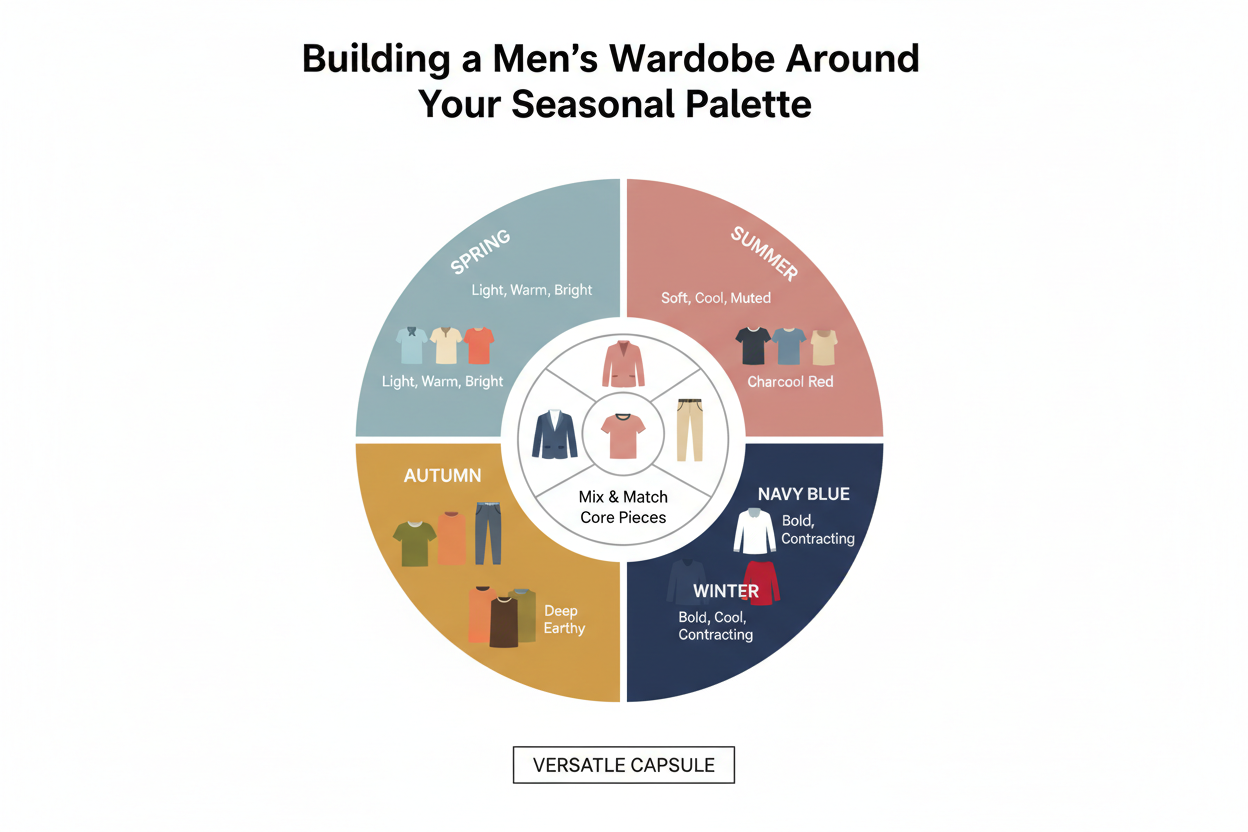
Building a Men's Wardrobe Around Your Seasonal Palette
Knowing your palette is the analysis. Using it is the payoff. Here's how to translate seasonal color knowledge into concrete wardrobe decisions.
Start with what's closest to your face
Your dress shirt collar, shirt fabric, and jacket lapel sit directly adjacent to your complexion. These are the highest-impact items in the system. A shirt in your best neutrals or accent colors will make your face look clear and even-toned in the same way the right draping fabric does.
Priority order for color investment:
- Dress shirts and casual shirts (highest face-proximity impact)
- Blazer and jacket color
- Knitwear and crewneck sweatshirts worn without a jacket
- Ties and pocket squares (for formal contexts)
- Trousers and chinos (lower priority; more forgiving)
Neutrals vs. accent colors
Every seasonal palette has neutrals (the foundation) and accent colors (the interesting part). Using both correctly matters:
- Cool seasons (Summer, Winter): navy, cool grey, charcoal, and true black (especially Winter) all work. Warm-based neutrals like camel and warm beige tend to look slightly off.
- Warm seasons (Spring, Autumn): warm camel, warm tan, dark brown, olive, and off-white are the go-to neutrals. Pure cool grey and jet black can read as too stark, particularly for softer Autumn sub-palettes.
Suits and formal wear
A suit stays on your body for hours and takes up a lot of visual real estate. Picking from within your seasonal palette pays off here:
- Winter men: True black, charcoal, and deep navy are natural fits. True and Bright Winter can handle high contrast, so pair dark suits with bright white shirts.
- Autumn men: Warm charcoal, brown, dark olive, and warm grey work better than cool charcoal. Dark Autumn men can pull off near-black suits; Soft Autumn men tend to fare better in medium warm grey or warm tan for daywear.
- Summer men: Cool grey, soft navy, and cool charcoal are solid choices. Warm brown or camel suits work against the underlying cool undertone.
- Spring men: Warm mid-grey, warm navy, and lighter camel or tan suits all hold up. Light and True Spring can carry lighter fabrics; Bright Spring handles medium-depth warm tones.
Casual and everyday wear
For T-shirts, casual shirts, and knitwear, the same undertone rules apply with lower stakes. Start by cutting out the obvious opposites: if you're cool-toned, skip the warm yellows and oranges; if you're warm-toned, skip icy pastels and slate greys. You don't need to overhaul your whole wardrobe at once. Pick one or two shirts in your palette's best accent colors and see what happens in photos and mirrors.
Accessories
Leather goods (belts, shoes, bags) should stay on the same warm-cool axis as the rest of your wardrobe. Warm seasons go with tan, cognac, and brown leather. Cool seasons go with black, dark grey, and cool-toned dark brown.
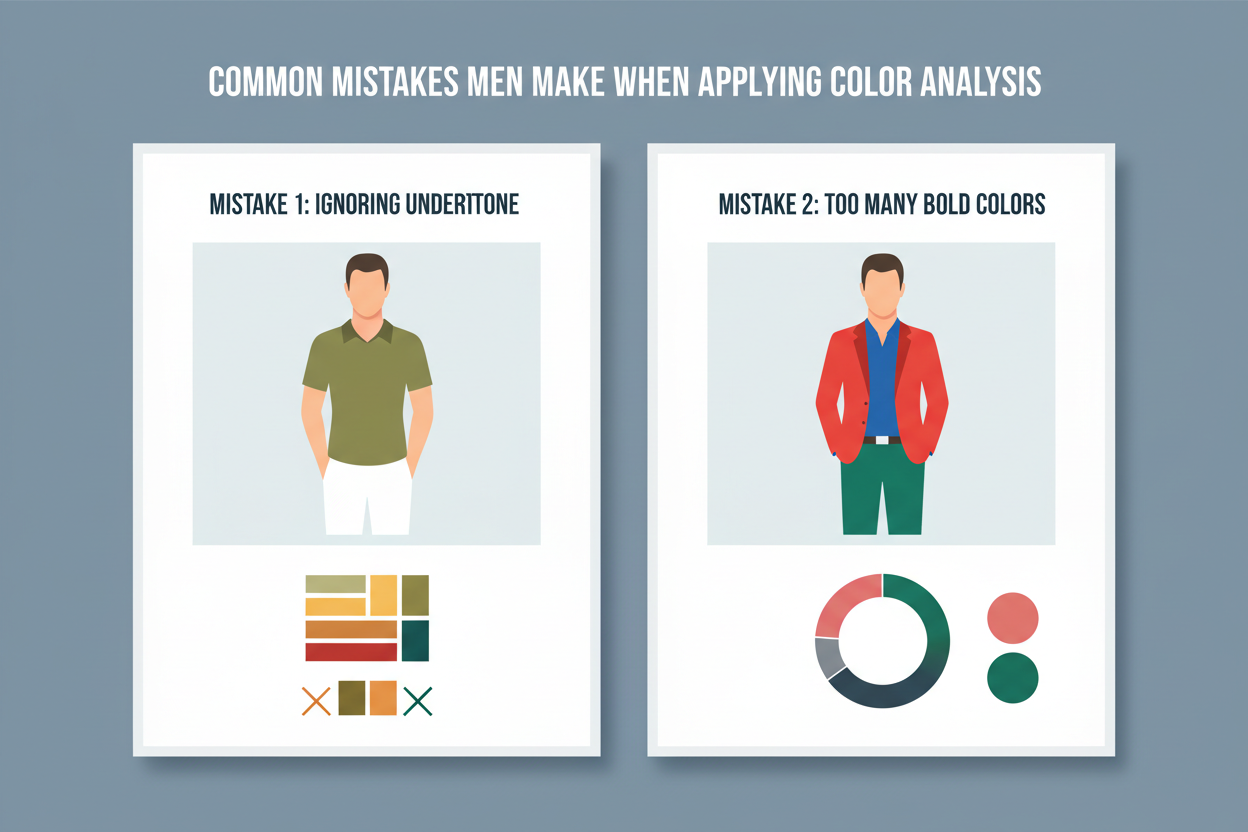
Common Mistakes Men Make When Applying Color Analysis
The system is straightforward, but a few consistent errors reduce its effectiveness.
1. Relying only on "safe" neutrals
Many men conclude that sticking to navy, grey, and black avoids all color risk. It doesn't. Those neutrals still have undertones. A cool, blue-based navy looks sharp on a Winter man and flat on a Soft Autumn. The right shade still matters, even when you're playing it safe.
2. Confusing depth with undertone
A man with deep brown skin may assume he's a warm season because his complexion looks warm in photographs. But depth and undertone are separate things. Men with very deep skin can have cool or neutral undertones and land in Dark Winter rather than Dark Autumn. The draping test and vein check are more reliable than guessing from skin depth.
3. Wearing the right season but the wrong sub-palette
Knowing you're an Autumn isn't enough if you haven't figured out whether you're Soft, True, or Dark Autumn. You can end up wearing colors that are technically warm but too saturated for Soft Autumn, or too muted for Dark Autumn. Most of the precision comes from the sub-palette, not the season.
4. Ignoring what you actually see
If you hold a color up to your face and it makes you look tired, sallow, or older, that's your answer—regardless of how much you like the color in the abstract. When a warm fabric goes near a cool-toned man's face, the effect shows up immediately. Trust the mirror more than the theory.
5. Treating the system as a rigid prescription
Seasonal color analysis describes what tends to work, not what you're required to wear. The goal is to understand why certain colors improve your appearance so you can make smarter choices—not to permanently ban entire color groups from your wardrobe. Favorites can stay. Knowing their limitations just helps you use them better: as a trouser or shoe color, say, rather than a shirt.
Take the Quiz to Confirm Your Season
The self-assessment steps above—vein check, fabric draping, hair and eye observation—get most men close. But edge cases are real: neutral undertones, sitting between two sub-palettes, depth and saturation sending conflicting signals. Those benefit from something that weighs all three dimensions at once.
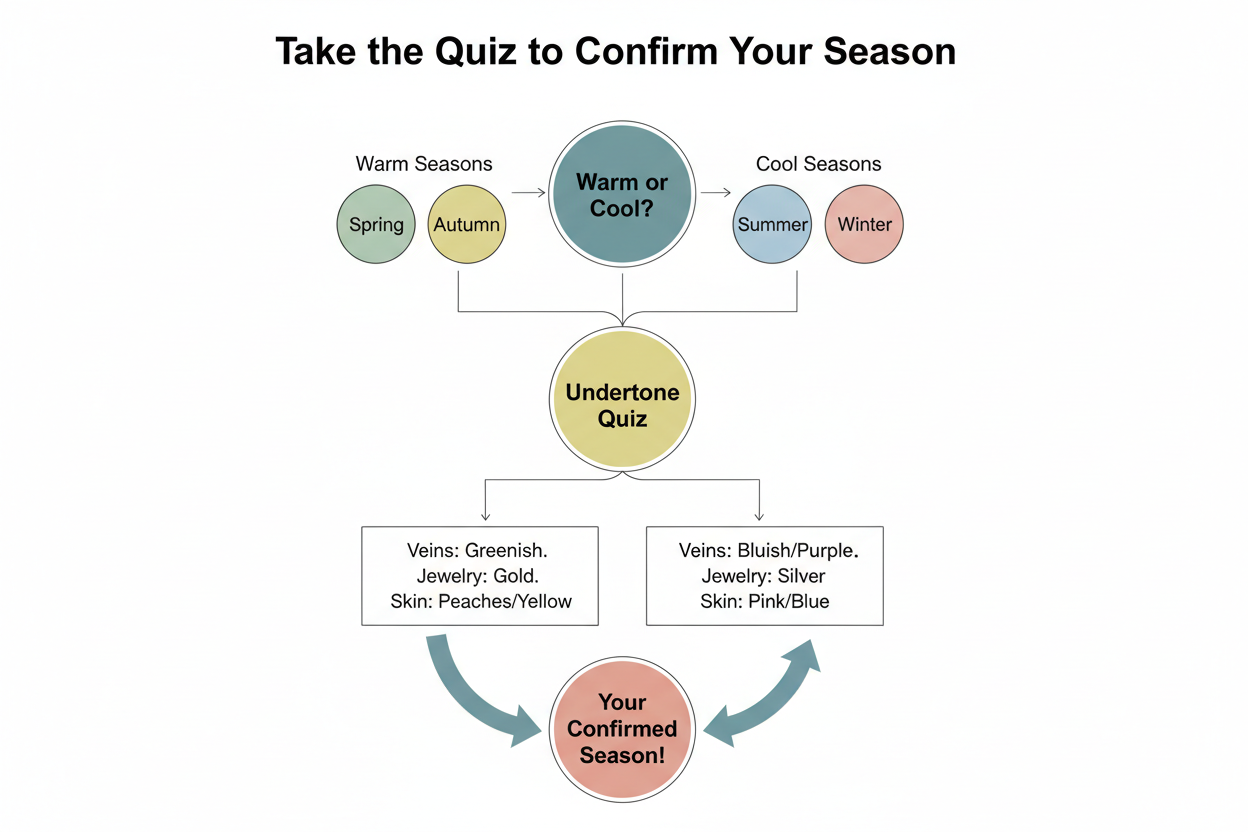
The quiz on this site is built for that. If the self-assessment pointed you toward a season, the quiz either confirms it or flags the adjacent palette worth a look.
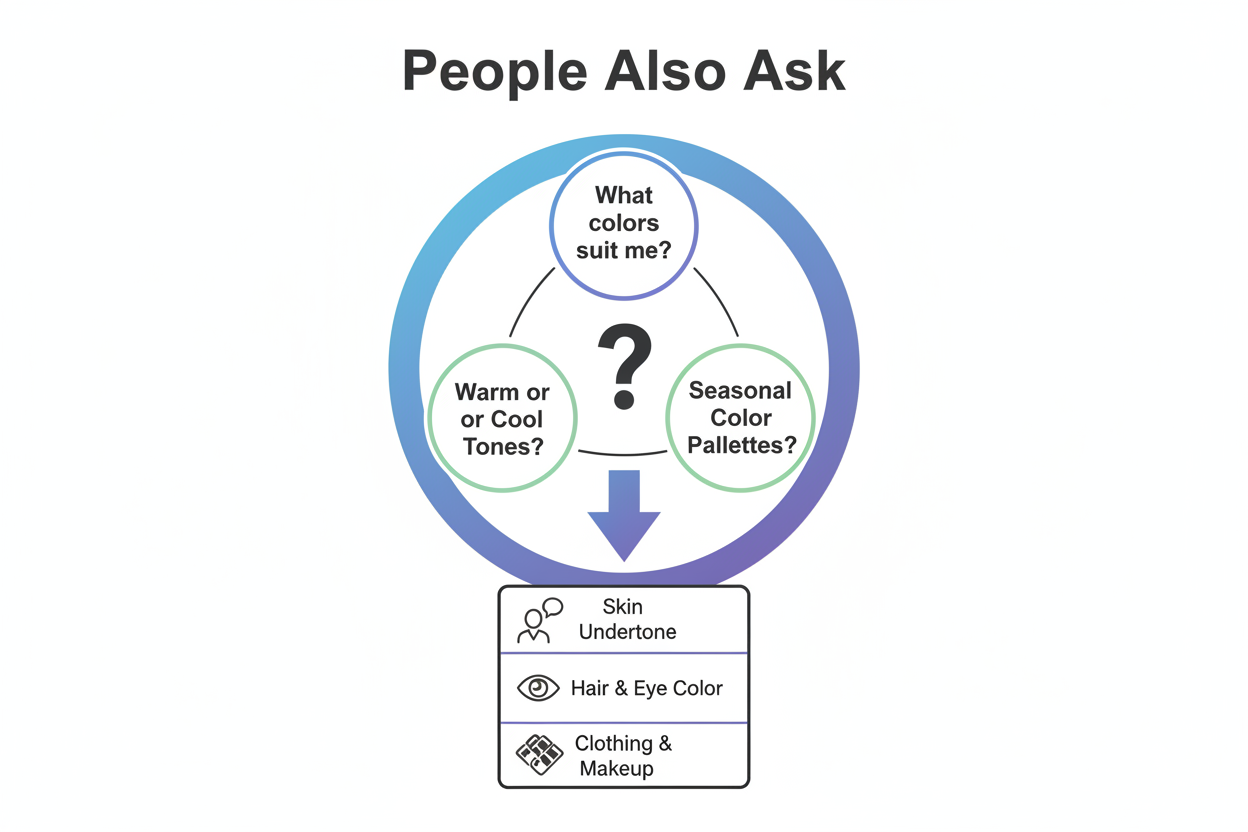
People Also Ask
How do I find my seasonal color palette as a man?
Start with three things you can check at home in natural light:
- Look at the veins on your inner wrist. Blue-purple means cool undertone. Green means warm. Blue-green puts you somewhere in the middle.
- Look at your hair and eyes. Golden, auburn, or warm brown tones push you toward Spring or Autumn. Ash, platinum, or blue-black hair — or grey and cool blue eyes — push you toward Summer or Winter.
- Hold fabric up to your face. Try a warm color (terracotta, mustard) and a cool color (slate blue, icy lavender), one at a time, in natural light. Whichever makes your skin look clearer and more even is your undertone.
Once you know your undertone, two more questions narrow it down: how light or deep is your overall coloring, and do your features contrast sharply or blend together? That lands you in one of the 12 palettes. If two of those variables point in different directions, a structured quiz can sort it out.
What is the difference between warm and cool undertones for men?
Undertone is the base hue running beneath your skin's surface—separate from how light or dark your complexion is.
- Warm undertones give skin a golden, peachy, or olive cast. These men tend to look good in earthy, yellow-based colors: camel, terracotta, warm browns, olive, coral, mustard. They fall into the Spring or Autumn seasonal families.
- Cool undertones give skin a pink, reddish, or bluish cast. These men do better with colors that have a blue or grey base: true navy, charcoal, icy pastels, jewel tones, black. They fall into the Summer or Winter families.
- Neutral undertones are a mix of both. There's more flexibility here, but it still helps to figure out which side you lean toward—that determines whether a "True" seasonal palette or a softer blended sub-palette is the better fit.
The easiest way to see this in practice is fabric draping. Hold a warm-toned fabric near a cool-toned man's face and his skin will look sallow or tired. Swap in the right cool fabric and his complexion clarifies immediately—and the same works in reverse.
Can men use seasonal color analysis for their wardrobe?
Yes—and the practical case is arguably stronger for men than for women in several ways. Men's wardrobes are built around a smaller number of repeatable items: dress shirts, suits, jackets, and knitwear. Because these pieces are worn repeatedly and sit close to the face, getting their color right has a compounding return on a limited investment.
The underlying mechanics are identical regardless of gender. Skin undertone, depth, and saturation react to color the same physical way. A cool-toned man's skin responds to warm fabric the same way a cool-toned woman's does—the color either harmonizes or creates an unflattering reaction at the jawline and around the eyes.
The application is also straightforward in a men's context. Most men already have a de facto color palette (navy, grey, white, black); seasonal analysis sharpens that existing habit by identifying which shade of those neutrals works best and flagging a small set of accent colors that lift the overall look without requiring a style overhaul.
What colors should men with cool undertones wear?
Cool-undertoned men fall into either the Summer or Winter seasonal families. The right palette depends on depth and saturation, but a few principles apply across both.
Colors that work:
- True navy and cool-toned dark blue
- Charcoal and cool grey
- True black (especially for Winter men)
- Icy pastels—pale blue, lavender, soft pink (Summer men in particular)
- Cool jewel tones—royal blue, cool emerald, magenta (Winter men)
- Burgundy and plum with a cool or blue-based tone
- Pure white and crisp off-white
Colors to approach with caution:
- Warm yellows and mustards (they read sallow against cool skin)
- Terracotta, rust, and burnt orange
- Warm camel and golden beige
- Anything with a clearly yellow or orange base
Summer men should stick to softer, more muted versions of these shades—vivid or high-contrast combinations tend to feel heavy. Winter men can handle bold, saturated cool colors that would swamp a Summer complexion.
What season is best for men with olive or Asian skin tones?
No single season maps to any ethnicity or heritage group. Olive and East or South Asian skin tones show up across multiple seasonal palettes because undertone, depth, and saturation determine the season — not ethnic background.
That said, some patterns come up often:
- Olive skin tends to carry a neutral undertone with either a warm or cool lean. Men with warm olive skin frequently land in Soft Autumn, True Autumn, or Dark Autumn. Those with cool olive skin — where the grey quality dominates — often fall in Dark Winter or True Winter.
- East Asian men asking which colors suit them tend to land in Dark Winter (deep, cool or neutral-cool coloring with high contrast) or True Autumn / Dark Autumn (warm golden or yellow-cast skin with dark features).
- South Asian men with warm, golden-brown complexions frequently align with Dark Autumn or True Autumn; those with cooler undertones tend toward Dark Winter.
The most reliable approach is still the three-step assessment — vein check, hair and eye observation, and fabric draping — applied to the individual rather than assumed from skin tone alone. Depth is usually easy to identify. Undertone is where draping adds the most clarity.
FAQ
What are the four main seasons in color analysis for men?
The four seasons—Spring, Summer, Autumn, and Winter—each describe a distinct combination of undertone, depth, and saturation:
- Spring: Warm undertone, light-to-medium depth, clear and bright colors. Think warm peach, coral, camel, and light golden brown.
- Summer: Cool undertone, light-to-medium depth, soft and muted colors. Think dusty rose, powder blue, lavender, and cool grey.
- Autumn: Warm undertone, medium-to-deep depth, rich and earthy colors. Think terracotta, olive, mustard, and burnt sienna.
- Winter: Cool undertone, medium-to-deep depth, bold and saturated colors. Think true black, pure white, jewel tones, and icy pastels.
The 12-season framework splits each of these into three sub-palettes—Soft, True, and Bright (or Light/Dark depending on the season)—for men whose coloring falls between the classic types.
How is seasonal color analysis different for men than for women?
The underlying science is identical: undertone, depth, and saturation determine which colors work with a person's natural coloring regardless of gender. The difference is almost entirely in application.
Men's style revolves around a narrower, more repetitive set of garments—suits, dress shirts, outerwear, knitwear—worn close to the face again and again. That repetition makes color accuracy more consequential per item. A misaligned shade isn't diluted by variety; it just keeps showing up.
Most men already gravitate toward a neutral palette anyway: navy, grey, charcoal, white. Seasonal color analysis doesn't require a wardrobe overhaul. It narrows down which specific shades of those neutrals actually work, then adds a small group of accent colors that lift the overall picture.
Can I have a neutral undertone and still find a seasonal palette?
Yes. Neutral undertone means your coloring carries both warm and cool characteristics without a strong lean either way. That doesn't disqualify you from a seasonal palette—it just means depth and saturation become the primary sorting tools instead of undertone.
Most neutral-undertoned men end up in one of the "True" or transitional palettes: True Autumn, True Winter, or occasionally Soft Summer or Soft Autumn, where muted, blended tones work well because they don't demand a clearly warm or clearly cool base.
The fabric draping test is especially useful here. Even when vein color is ambiguous, your face responds visibly to fabric—one side of neutral will make your skin look clearer, and that reaction points you toward your seasonal family.
What if I fall between two seasons—am I a 'soft' or 'bright' sub-palette?
It depends on which dimension creates the overlap:
- If your undertone is clear but your saturation is low and colors blend softly: You likely belong to a Soft sub-palette—Soft Autumn or Soft Summer. These palettes work for men whose features are harmonious rather than high-contrast: vivid colors wash them out, but very muted ones make them look flat.
- If your undertone is clear and your coloring is high-contrast or vivid: You likely belong to a Bright sub-palette—Bright Spring or Bright Winter. These men have a natural clarity that can handle saturated colors without looking overdone.
- If your depth is the variable in question: The Dark and Light sub-palettes (Dark Autumn, Dark Winter, Light Spring, Light Summer) are for men whose depth sits at either extreme within their seasonal family.
A practical shortcut: Soft Autumn is rich but never loud, sitting at the warm-neutral crossover between muted and saturated. True Autumn is deeper and more saturated within the same warm family. If you're unsure which fits, pay attention to how your face reads in highly saturated colors versus toned-down ones—that reaction usually settles it.
Does seasonal color analysis apply to men with darker or deeper skin tones?
Yes. Seasonal color analysis works across all skin tones and ethnic backgrounds because it measures undertone, depth, and saturation—not how light your skin is.
Men with deeper complexions most often fall in the Dark Winter, Dark Autumn, or True Autumn palettes, though any season is possible. Deep, cool-toned skin with high contrast between skin and eyes usually points to Dark Winter. Deep, warm golden-brown skin tends toward Dark Autumn or True Autumn. If the features read as softer overall, Soft Autumn is also worth considering.
Depth alone doesn't determine a season—undertone has to be assessed on its own. The vein check and fabric draping test work just as well on deeper complexions. The reactions at the face (shadow versus clarity, vitality versus dullness) are equally readable regardless of how deep the complexion runs.
How do I use my seasonal palette when buying a suit or formal wear?
A suit is one of the highest-leverage applications of seasonal color analysis for men because it's a significant investment worn close to the face on important occasions. A few practical principles:
- Start with your seasonal neutral. Each palette has neutrals that work as base colors for tailoring. Cool-season men (Summer, Winter) gravitate toward charcoal, cool grey, navy, or true black. Warm-season men (Spring, Autumn) look stronger in warm grey, camel, warm navy, or medium brown.
- Match formality to saturation. Darker, more saturated versions of your seasonal palette work for formal settings. A Dark Winter man in deep charcoal or true black, paired with a crisp white shirt, is using his palette at full strength.
- Use your shirt and tie as the color delivery mechanism. The suit can stay within safe neutrals; the shirt, tie, or pocket square bring in your accent colors. A True Autumn man in a mid-brown suit can introduce terracotta or warm rust through his tie without taking any risk with the suit itself.
- Avoid your most disharmonious colors at the collar. The collar sits closest to your face, which is where a wrong undertone does the most visible damage. A cool-toned man in a warm mustard shirt will look sallow no matter how well the suit fits.
Is seasonal color analysis scientifically proven or just a style theory?
It sits somewhere between established color science and applied style theory. The perceptual principles behind it are real: the eye reads color relative to surrounding colors, and certain hue combinations create harmony while others create dissonance. When a warm or cool fabric undertone interacts with your skin pigmentation, the effect—healthy glow or sallow, washed-out cast—is an actual optical phenomenon, not a stylistic judgment call.
What hasn't been rigorously tested is the specific four- or twelve-season categorization system. That's a practical framework developed by stylists to make color theory actionable, not a laboratory-validated taxonomy.
The evidence that matters in practice is immediate: drape the wrong-undertone fabric against your face and most people notice something is off, even if they can't name why. That reaction is consistent across observers. The seasonal labels are a convention; the underlying perceptual response isn't.
Think of it as a practical tool built on sound perceptual principles—reliable enough to make real wardrobe decisions, loose enough that you shouldn't treat it as gospel. If you want to test it yourself, take the quiz and see what a difference the right palette makes.