Red Undertone vs Surface Redness
 Reviewed by Alexandra Gilmore
Visible redness can hijack every undertone shortcut and make a correct foundation look wrong in selected areas. Separate a stable red or rosy undertone from temporary or persistent surface redness, then match the jaw and neck rather than letting flushed cheeks dictate clothing and base-product choices.

You've taken the vein test. You've held fabric swatches next to your face. You've squinted at your jawline in natural light. And somehow, every foundation you try still looks off — either too orange, too ashy, or bizarrely pink in some spots and muddy in others.
💫 Discover Your Complete Color Palette
One feature rarely explains every color that works for you. Compare your undertone, depth, clarity, and contrast as a complete palette, then use the results to test clothing, makeup, and hair colors more consistently.
Find My Color Palette →There's a good chance the problem isn't your foundation shade. It's that you're solving the wrong problem.
Red undertone and surface redness are not the same thing. One is a permanent, structural quality baked into your skin at the melanin level. The other is a temporary (or chronic) condition sitting on top of your skin — and it can completely hijack every standard undertone test you try.
Confusing the two is one of the most common reasons people end up with a foundation that looks wrong within an hour of application, or a color palette that flatters them in some lights and clashes in others.
Here's what this article will do for you:
- Clearly define what a red undertone actually is in the context of color analysis — and what it isn't
- Explain what surface redness is, what causes it, and why it behaves so differently from undertone
- Walk you through five concrete differences between the two so you can identify which one (or both) you're dealing with
- Show you how surface redness corrupts the most popular undertone tests, including the vein test
- Give you a redness-resistant testing protocol so you can isolate your true undertone regardless of how your skin looks today
Whether you have occasional flushing, chronic rosacea, or simply skin that always seems to photograph redder than it looks in person, this guide will help you stop chasing the wrong fix and finally match your foundation to what your skin actually needs.
What 'Red Undertone' Actually Means in Color Analysis
Undertone has nothing to do with how your skin looks on a tired Tuesday or after a run. It's about what's happening beneath the surface at the level of your skin's pigment — the subtle hue that radiates through from deeper layers and stays constant regardless of your tan, stress level, the weather, or your skincare routine.
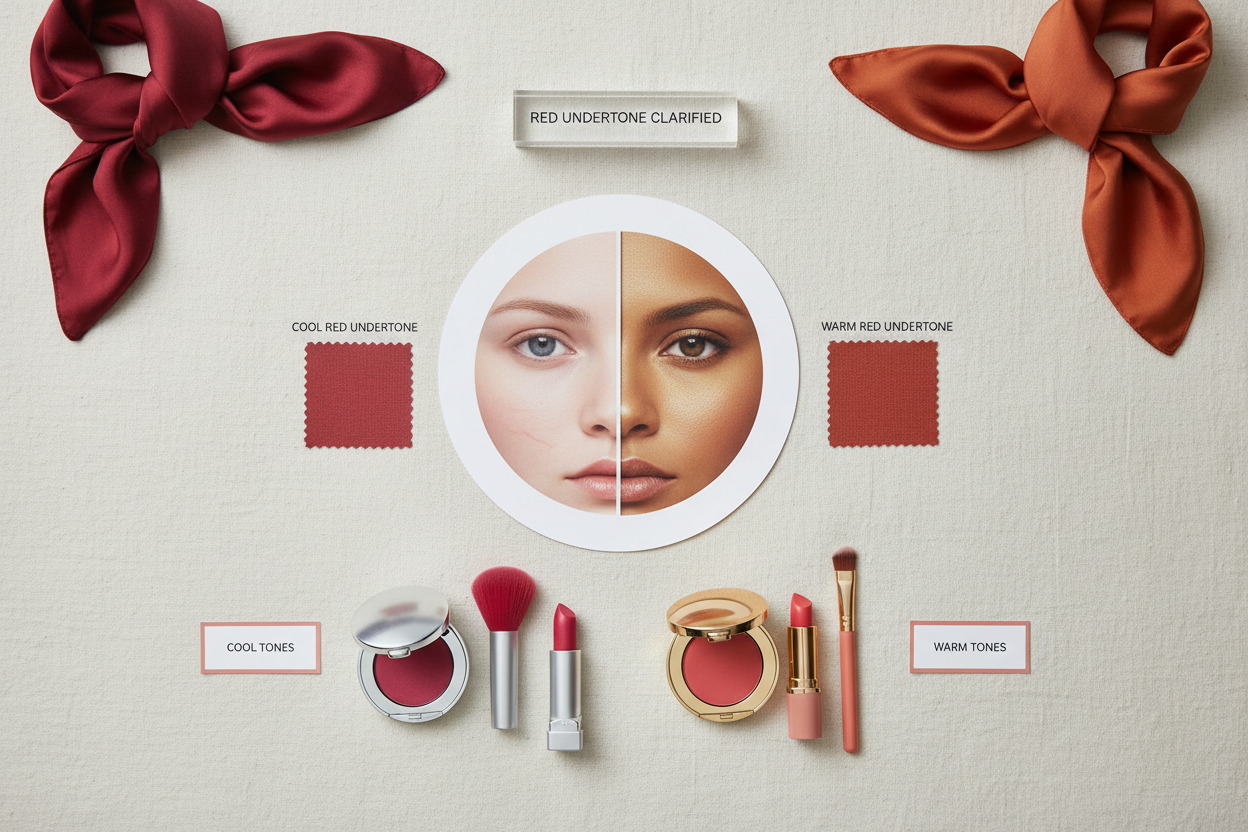
In color analysis, undertones fall into three categories:
- Warm — a golden, peachy, or yellow-based cast
- Cool — a pink, blue, or bluish-red cast
- Neutral — a balance of warm and cool without a dominant direction
A red or warm-red undertone sits within the warm-to-neutral spectrum. It shows up as a peachy-pink or rosy warmth that isn't caused by anything external — not exercise, not allergies, not your environment. It's just the color your skin carries as part of its permanent makeup. The idea in color analysis is to find foundations, blushes, and eyeshadow shades that work with that undertone rather than against it.
The key word is permanent. Your undertone doesn't improve or worsen, flare up, or respond to treatment. It's a fixed characteristic that determines which shades will reliably look right on you — and which will always look slightly off, no matter how good the product otherwise is.
If you're not sure whether your skin leans warm, cool, or neutral, a color-analysis method will tell you more than a skincare consultation will. Take the undertone quiz →
What Surface Redness Actually Is — and What Causes It
Surface redness is something different entirely. While undertone lives in the deep pigment layers, surface redness lives in your capillaries — the tiny blood vessels just beneath the outermost layers of skin. When those vessels dilate, become damaged, or stay chronically inflamed, they produce visible redness that sits on top of your skin's true color.
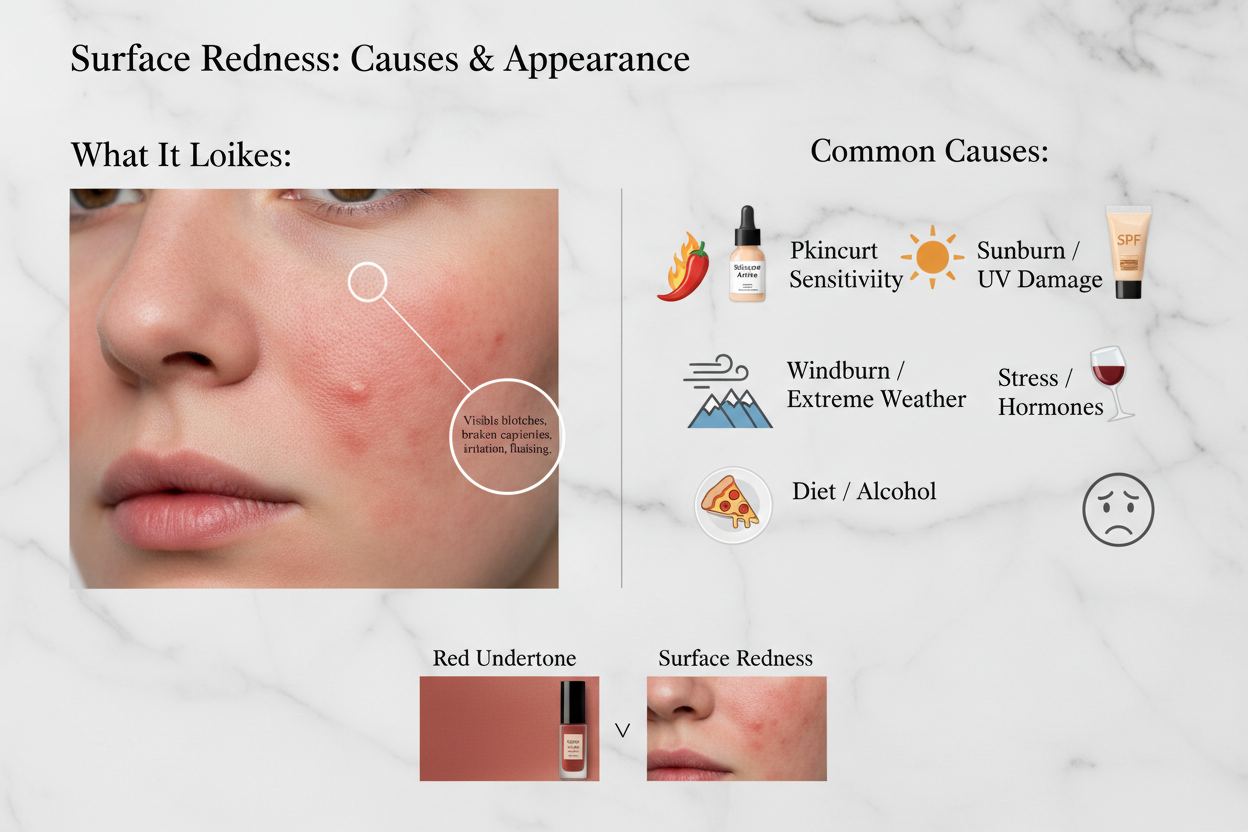
Dr. Sam Ellis, a board-certified dermatologist, describes this kind of redness as something that "can be improved" — a framing that immediately separates it from undertone, which can't be improved because it isn't a problem.
Common causes include:
- Rosacea — a chronic inflammatory condition causing persistent facial redness, often on the cheeks, nose, and chin
- Post-exercise flushing — temporary capillary dilation from elevated heart rate and body temperature
- Allergic or irritant reactions — redness from skincare ingredients, fragrance, or environmental allergens
- Broken or dilated capillaries — small vessels near the skin surface that have become permanently visible, often from sun damage, temperature extremes, or repeated flushing
- Sunburn or windburn — acute inflammatory redness from UV or environmental exposure
Notice the pattern: every cause on that list is either temporary, treatable, or both. Surface redness is a dermatological or physiological event. It changes day to day, hour to hour. It can be reduced with the right skincare, medical treatment, or even a cold compress. It's not a color-analysis category — and treating it as one is where the confusion starts.
The 5 Key Differences Between Red Undertone and Surface Redness
Use this table as a quick reference when you're trying to figure out which one you're dealing with.
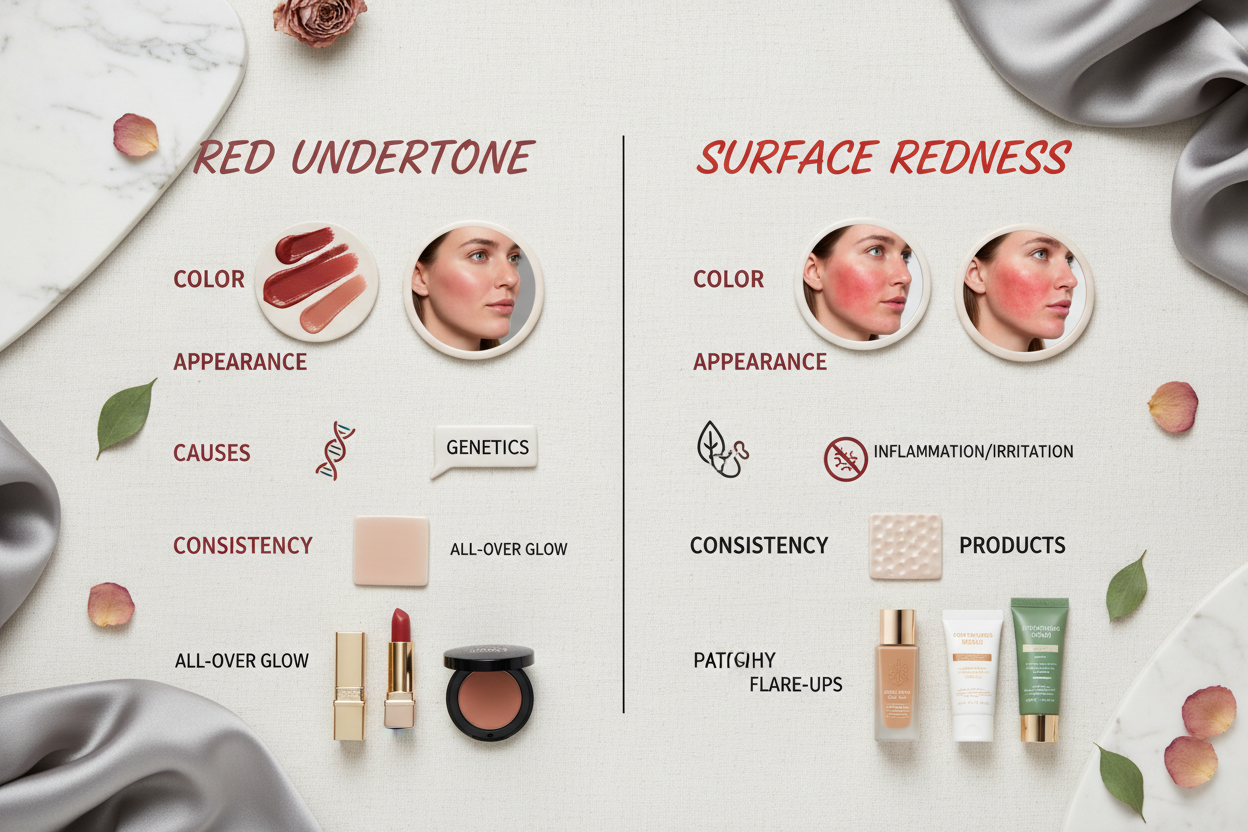
| Red / Warm Undertone | Surface Redness | |
|---|---|---|
| Origin | Sub-dermal pigment — melanin and the color of blood vessels at depth | Superficial capillary dilation, inflammation, or broken vessels at the skin surface |
| Permanence | Permanent and unchanging — present from birth | Variable — can be temporary (flush) or chronic (rosacea), but is improvable |
| Changes with triggers? | No — consistent across weather, stress, exercise, emotion | Yes — worsens with heat, exercise, alcohol, spicy food, stress, and sun exposure |
| Visible in all lighting? | Yes — undertone shows up in natural, indoor, and artificial light as a consistent cast | Often more pronounced in certain lighting; can look worse under fluorescent light or after triggers |
| Who addresses it? | Color analyst or makeup professional — the goal is to harmonize with it | Dermatologist (for treatment) or makeup artist using color correction (for coverage) |
The most important distinction: undertone is something you work with; surface redness is something you work around or treat.
How Surface Redness Tricks You During Undertone Tests
Standard undertone tests are designed to detect the subtle color cast in your skin's deeper layers. The problem is that surface redness adds a competing signal at the outermost layer — and most tests aren't built to filter it out.
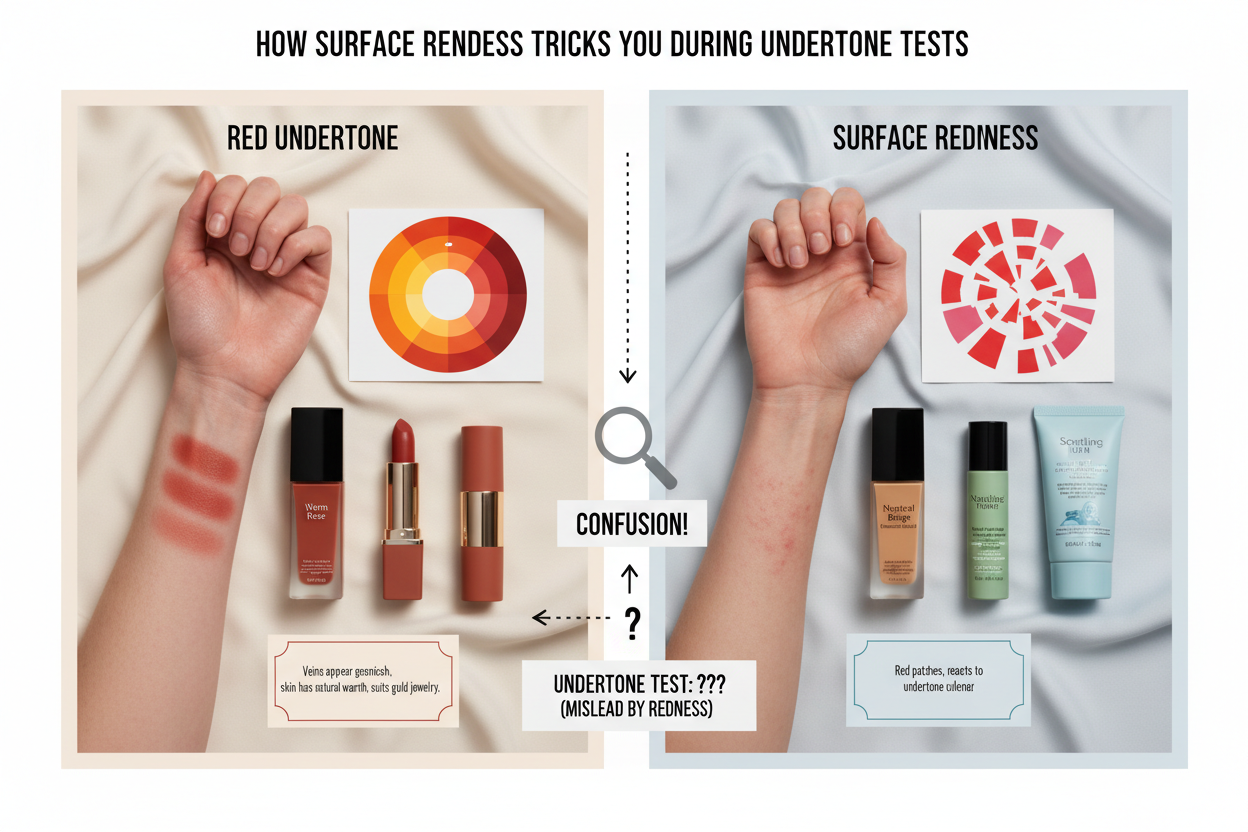
Here's what happens to each common test when active redness is present:
The vein test Check the veins on your inner wrist under natural light. Blue-purple veins suggest a cool undertone; green veins suggest warm; a mix suggests neutral. Simple enough — until surface redness adds a pinkish overlay to everything beneath it. Blue veins read as more purple or even warm-pink, pushing the result toward a false "neutral" or "warm" when your true undertone may be cool.
The white paper test Hold a white sheet next to your bare face. The color cast your skin shows relative to the paper reflects your undertone. Active redness across your cheeks or nose hijacks this. The most visible color becomes red, drowning out the subtler yellow, pink, or peachy signal your undertone would otherwise produce.
The jewelry test Gold flattering you suggests warm undertone; silver suggests cool. You do this test by looking at your face and neck in a mirror — the area most likely to show surface redness. That redness visually warms your whole appearance, making gold look more harmonious even if silver actually suits your true undertone better.
The fabric and wardrobe test Same problem. Holding warm or cool fabrics near a flushed face introduces the same interference. The red pulls attention and skews the comparison.
All standard undertone guidance specifies natural daylight, no makeup, no tints, no tanners. Surface redness is just as distorting — it's less obvious only because it looks like your skin rather than a product you put on. Before trusting any result, check whether active redness is in the picture.
If your skin is currently red or irritated, skip to the redness-resistant protocol in the next section, then start the color-analysis quiz once your skin is calm.
How to Isolate Your True Undertone When You Have Surface Redness
Surface redness creates two problems: timing and location. Fix both, and your underlying undertone becomes readable.
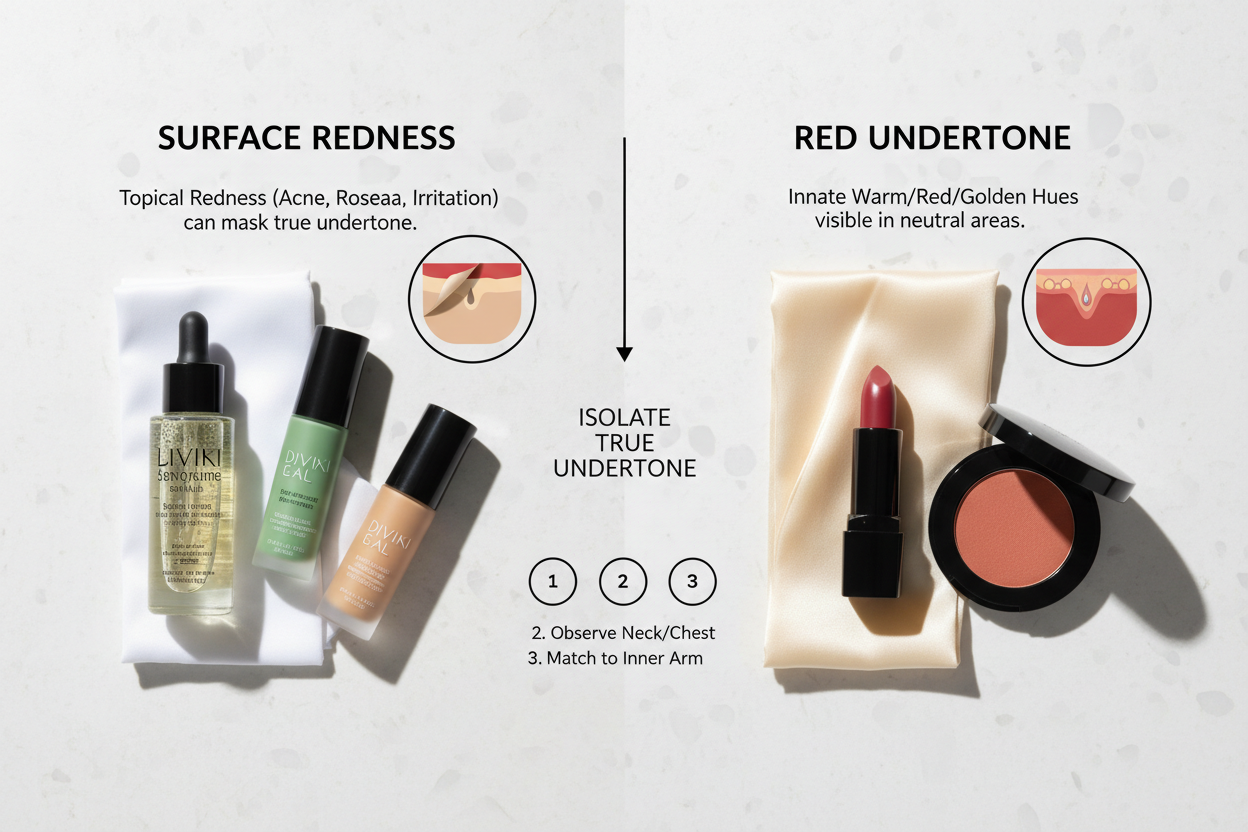
Step 1: Calm the skin before testing
- Press a cold, damp cloth to your face and testing area for 5–10 minutes before you start
- Wait at least 30 minutes after exercise, a hot shower, or anything that stimulates circulation
- If you flush easily, avoid alcohol, spicy food, and hot drinks for at least an hour beforehand
- Don't test on sunburned or recently irritated skin — wait until the redness has fully cleared
Step 2: Choose the right testing location
Your face and outer forearms are the most redness-prone zones — they take the most sun, temperature swings, and environmental exposure. Use the inner upper arm instead (see the dedicated protocol below).
Step 3: Run at least two tests in your chosen location
Cross-referencing multiple methods improves accuracy. Combine:
- The vein check at the inner upper arm
- The white paper or white fabric test held at the same location
- The jewelry test, looking at your inner arm rather than your face
Step 4: Compare results across tests
If two out of three tests point to the same undertone, that's likely your real answer. Still getting mixed results? That might not mean something's wrong with your testing — it may mean you genuinely have a neutral undertone, which tends to read as ambiguous no matter what method you use.
Foundation Matching Strategies for Each Scenario
Once you know what you're actually dealing with, the strategy splits into three paths.
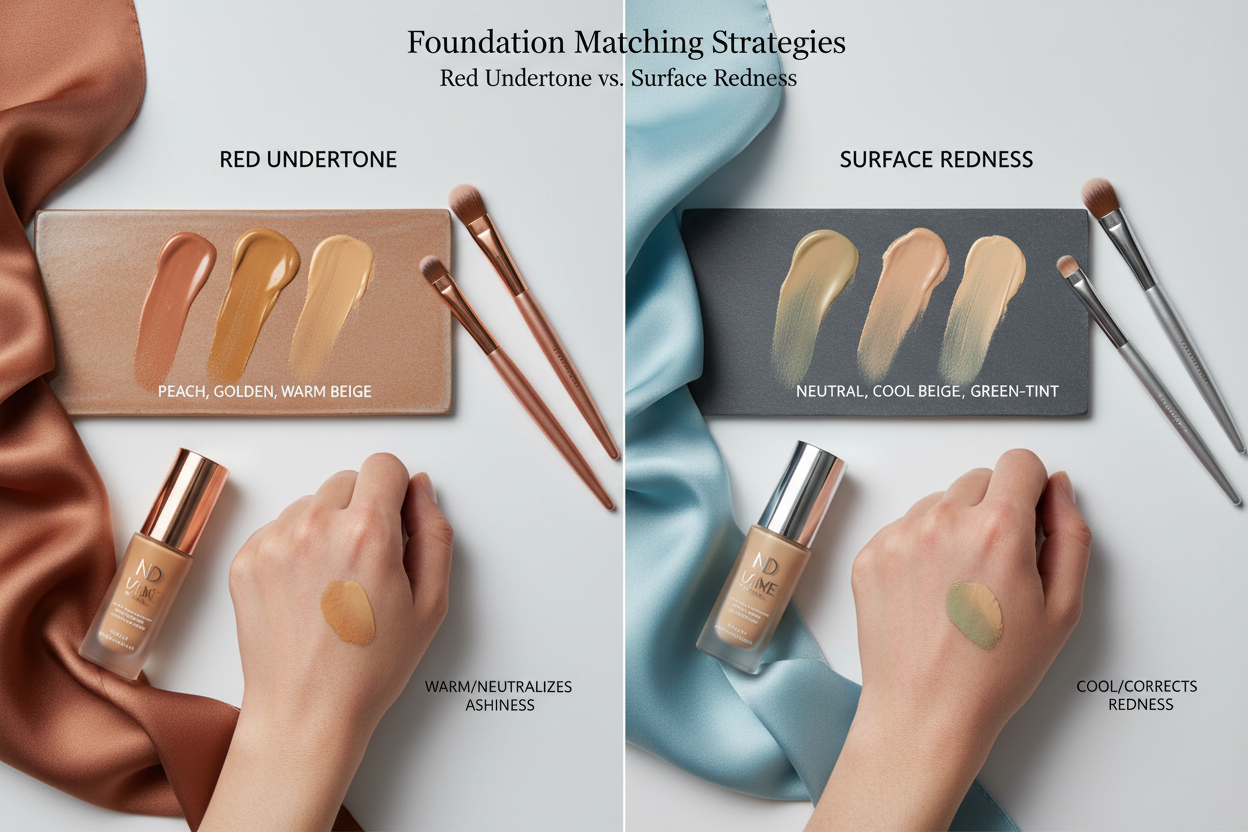
Path 1: True warm or red undertone (no significant surface redness)
Your skin has a genuine golden, peachy, or rosy-warm cast at the pigment level. You need:
- Foundations with golden, peachy, or warm-neutral bases — look for descriptors like "warm," "golden," "beige-W," or "sand"
- Blush shades in peach, coral, or warm rose
- Stay away from foundations labeled "cool," "pink," or "rosy" — they'll read chalky or ashy against your warmth
Path 2: Cool or neutral undertone with surface redness
Your true undertone is cool or neutral, but active redness makes your skin read warmer than it actually is. You need:
- A green color-correcting primer applied to red areas before foundation — green sits opposite red on the color wheel and cancels it out
- A neutral or cool-leaning foundation that matches your actual undertone once the redness is neutralized
- Skip warm or golden foundations here — they don't fix redness, they compound the warm appearance the redness is already creating, and you'll end up looking orange or muddy
Path 3: True warm undertone and surface redness simultaneously
This is the one that trips people up most — and it genuinely does happen. Your undertone is warm, and you have redness sitting on top. You need:
- A green color corrector applied selectively to areas with active redness (cheeks, nose, chin) — not all over, because you want the warmth of your undertone to come through everywhere else
- A warm-undertone foundation layered on top once the redness is addressed
- This is what professional makeup artists do: cancel the surface redness, then build the foundation over your actual undertone. The two corrections work together when you do them in order
The principle across all three paths: color correction handles the surface; foundation shade handles the undertone. They're separate decisions.
When to See a Dermatologist vs. Use a Color-Analysis Tool
Not all redness belongs in the makeup aisle.
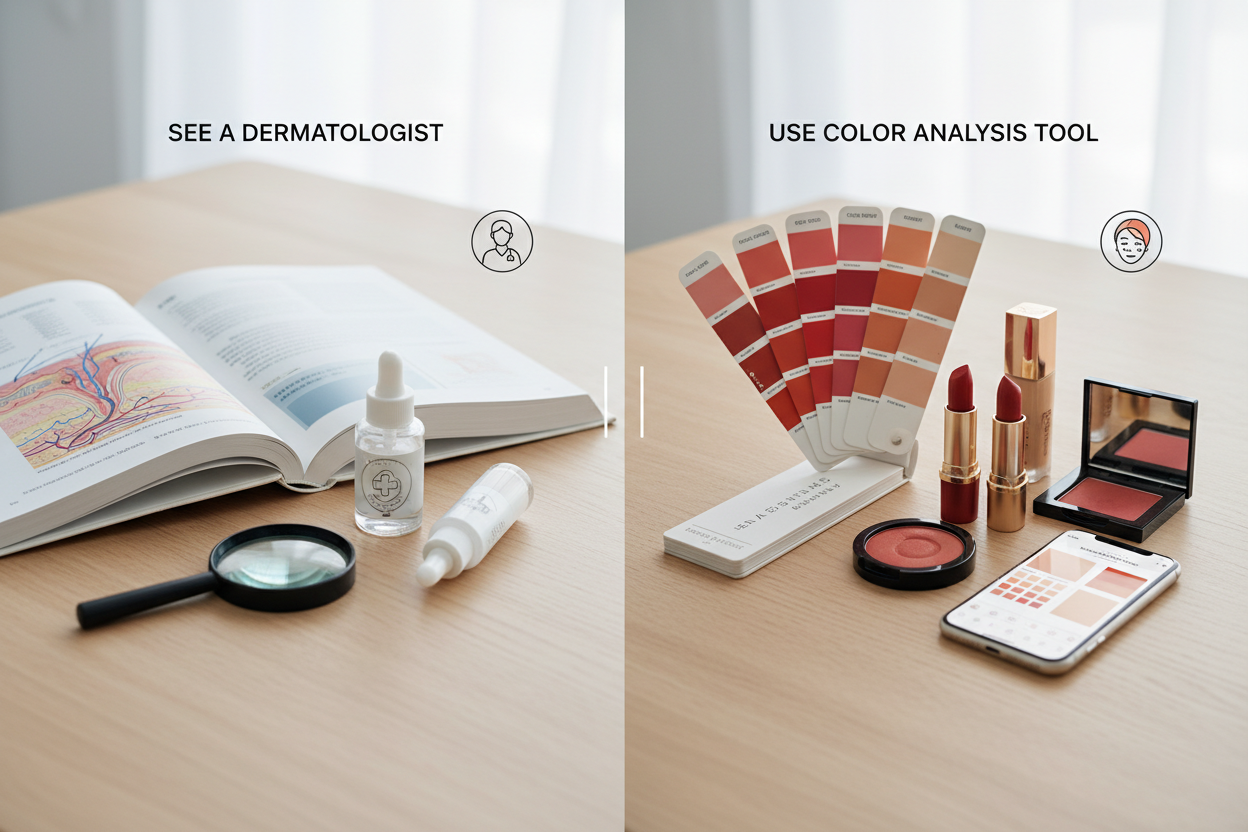
See a dermatologist if:
- Your redness is there every day regardless of what triggers it
- It's getting worse or spreading to new areas
- You have burning, stinging, visible broken capillaries, or texture changes
- You suspect rosacea — a diagnosable condition that responds to topical and oral treatments as well as laser therapy
- Redness appeared after starting a new medication or skincare ingredient
As Dr. Sam Ellis puts it, skin redness is a category that "can be improved" — and improved here is a medical word, pointing toward intervention rather than a cosmetic workaround.
Use a color-analysis tool if:
- Your skin is calm and stable right now, with no active redness or irritation
- Your redness is mild, occasional, and predictable (post-exercise flush, for example)
- You've already addressed chronic redness with a dermatologist and want to refine your foundation match
- You're simply unsure whether your skin runs warm, cool, or neutral — and no skin condition is currently skewing the read
The clearest rule of thumb: if the redness is a question your mirror keeps asking, ask a dermatologist first. If the redness is stable and the question is about shade harmony, that's where color analysis starts.
The Vein Test Failure Mode: Why Redness Turns Blue Veins Pink
The wrist vein test is the most repeated piece of undertone advice online — and it works, when conditions are right. The failure mode is specific enough to be worth understanding.
Veins at the inner wrist are visible through a thin layer of skin. Blue or purple means cool undertone; green means warm. The test works because vein color indirectly reflects the underlying blood vessel structure, which connects to your overall undertone.
Here's the problem surface redness creates: redness in the skin's capillaries acts as a color filter. When the outermost layer is flushed or inflamed, it casts a reddish-pink tint over everything visible through it — including the veins below. A blue vein seen through slightly reddened skin stops looking purely blue. It reads blue-purple at best, warm-neutral or pinkish at worst. The test says neutral or warm when the underlying truth may be cool.
This isn't a flaw in the test — it's a flaw in the conditions. The fix isn't to ditch the vein test entirely; it's to move it somewhere surface redness is less likely to interfere, which is what the protocol below covers.
The Inner-Arm Protocol: A Redness-Resistant Testing Zone
The inner upper arm — the soft skin on the underside between your elbow and armpit — is the most reliable alternative testing zone for anyone with surface redness concerns. A few reasons it works so well:
- Minimal sun exposure: This area is almost always covered, so it hasn't built up the UV-related capillary damage and hyperpigmentation that shows up on the face, décolletage, and outer forearms
- Low trigger exposure: Heat, wind, and environmental irritants mainly affect exposed skin — the inner upper arm stays largely shielded
- Readable veins: The veins here are typically visible without the interference of active surface redness, giving you a cleaner undertone signal
- Consistent baseline: Because it's rarely exposed, this zone holds a stable color that better reflects your actual undertone — without the daily variation you get from trigger-exposed skin
To use this zone:
- Test in natural daylight — indirect light near a window works well; avoid indoor artificial lighting, which distorts color perception
- Make sure the area has no makeup, fake tan, or skincare products on it
- Look at vein color (blue-purple means cool, green means warm, a mix means neutral), then hold a white piece of paper next to your skin to check for any color cast
- Cross-reference with the jewelry test: rest gold and then silver jewelry against the inner arm and compare in natural light
This approach applies the same principle as standard undertone testing — no products that alter appearance — but extends it to the variable most people miss: the redness itself.
People Also Ask
Can rosacea make you look like you have a warm undertone when you don't?
Yes — and it's one of the most common misreads in foundation shopping. Rosacea causes persistent redness on the cheeks, nose, and chin. That redness adds a rosy cast to the whole face, which can visually mimic a warm or red undertone during standard tests like the white paper test or the jewelry test.
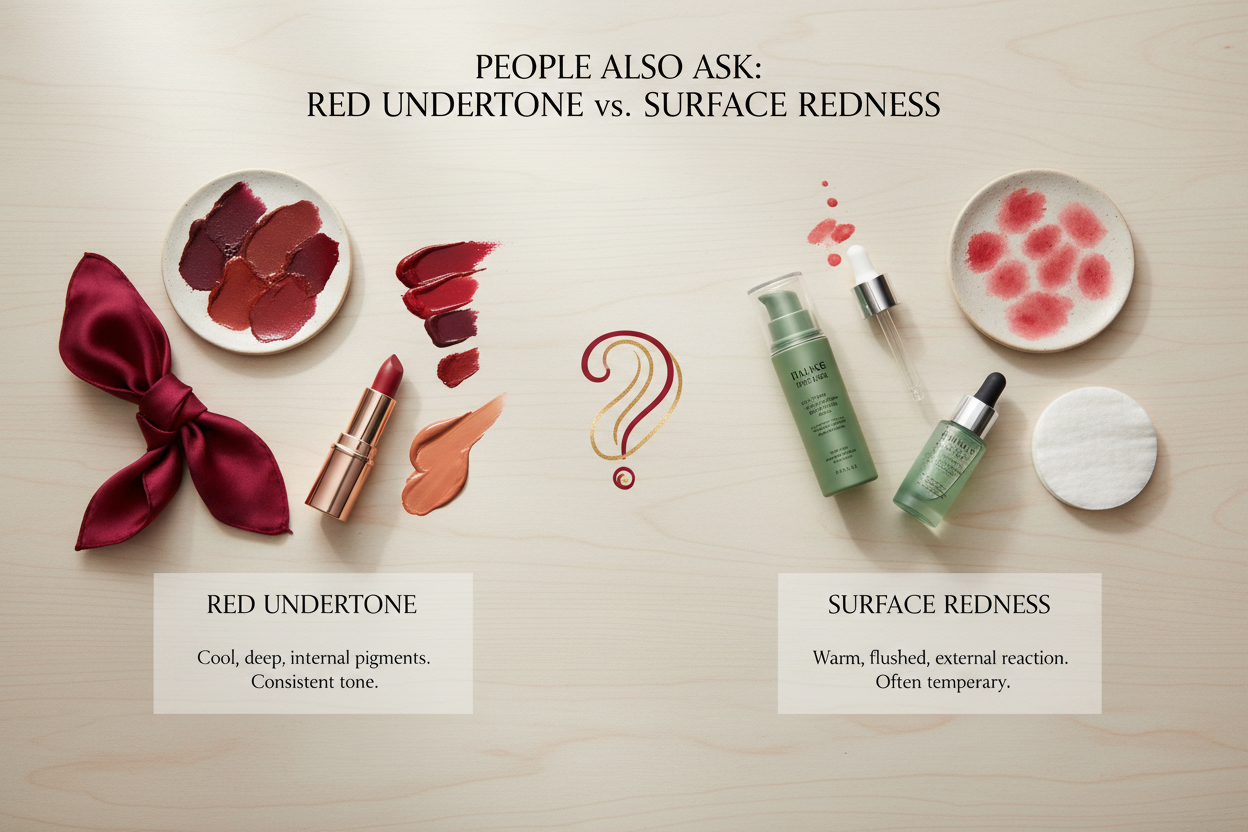
Your true undertone comes from pigment deep in the skin, not from capillary inflammation at the surface. Someone with rosacea and a genuinely cool undertone will still look best in cool-leaning foundations once the surface redness is color-corrected — even if their skin reads warm to the naked eye. If you have rosacea and have always struggled to find a flattering foundation, the problem may not be the shade depth. You may have been matching to the rosacea instead of to your actual undertone.
How do I tell if my skin is red because of undertone or because of redness?
Ask yourself one question: does it change?
Undertone doesn't. It looks the same in the morning and at night, after a run, after a glass of wine, in summer heat and winter cold. Surface redness does shift — it comes and goes with temperature, stress, diet, and other triggers.
A useful test: look at your inner upper arm. That skin gets minimal sun and isn't prone to flushing. If it has a warm, peachy, or golden tone, that's your undertone. If the redness you're worried about is mainly on your cheeks and nose, and it flares up and then settles down, that's something happening at the surface.
You can also try a cold compress. Hold it against your face for a few minutes. If the redness fades, it was caused by dilated capillaries — surface stuff. Whatever's still visible underneath is closer to your actual undertone.
Should I use a green color corrector if I have a warm undertone?
Only if you also have surface redness. These are two separate decisions.
A green color corrector cancels redness at the surface — it neutralizes red wavelengths so your foundation sits evenly on top. It has nothing to do with your undertone. If your undertone is warm, you still choose a warm foundation; you just apply the green corrector to red-affected areas first.
If you have a warm undertone and no significant surface redness, a green corrector isn't necessary and may actually flatten the natural warmth your skin is supposed to have.
The rule: green corrector fixes surface redness. Foundation undertone matches your undertone. They work on different layers and do different things.
Does surface redness go away or is it permanent like undertone?
Surface redness runs the full spectrum from temporary to chronic — but even chronic redness can improve, which makes it genuinely different from undertone.
- Temporary redness from exercise, heat, or mild irritation clears up on its own within minutes to hours.
- Redness from broken or dilated capillaries caused by sun damage or repeated flushing sticks around longer, but laser treatments and targeted topical skincare can often reduce it.
- Rosacea-related redness is chronic, but it responds to treatment. Topical medications, oral therapies, and laser procedures can bring it down significantly over time.
Undertone is different. It isn't a condition — it doesn't improve, worsen, or respond to anything, because there's nothing wrong with it. It's just a fixed characteristic of your skin's pigmentation. That distinction matters practically: if redness is what's sending you to a dermatologist, that's the right call. Your undertone will still be there, unchanged, once the redness is handled.
Can I do an undertone test if my skin is currently red or irritated?
You can, but the results won't be reliable if you test zones affected by the redness. Short answer: wait if you can, and move the test if you can't.
Undertone tests need a clean baseline — no products, no reactions, nothing else competing for color signal. Active redness does exactly that. It adds a warm cast that can push a cool or neutral result the wrong direction.
If your skin is acutely irritated — sunburned, reacting to a new product, or in a rosacea flare — the safest move is to wait it out. If you need an answer sooner, test on your inner upper arm instead. It's shielded from most triggers and gives a cleaner read than your face or outer forearms. Run at least two tests there (vein check plus white paper comparison) and see if they agree before settling on a result.
FAQ
What is the difference between a red undertone and surface redness in skin?
A red undertone is a fixed characteristic of your skin at the pigment level. It sits beneath the surface and stays consistent regardless of how you feel, what you eat, or whether you just ran a mile. It belongs to the warm family alongside peachy and golden hues.
Surface redness is different. It's a reactive condition caused by dilated capillaries, inflammation, sun damage, rosacea, or irritation. It lives at the top layer of skin and fluctuates with triggers.
The short version: undertone doesn't change. Surface redness can — and often does.
Can surface redness from rosacea change my foundation undertone match?
Rosacea doesn't change your actual undertone, but it does mess with how you perceive it. The persistent redness across your cheeks, nose, and chin adds a warm visual noise that can make a cool or neutral undertone read as warm during standard tests.
The practical problem: people with rosacea often end up buying foundations matched to their rosacea rather than their skin. The coverage goes on and it still looks wrong. Color-correcting the redness first, or checking your undertone at the inner arm instead, gives you a much cleaner read.
How do I find my true undertone if I have chronic redness or rosacea?
Test away from affected skin. The inner upper arm is your most reliable spot — minimal sun exposure, rarely involved in rosacea flares, and it doesn't flush the way your face does.
Run at least two tests and cross-reference:
- Vein check on the inner wrist or upper arm: blue-purple suggests cool, green suggests warm, a mix suggests neutral.
- White paper test against the inner arm: does your skin read pink-rosy (cool), golden-yellow (warm), or neither (neutral)?
- Jewelry test: hold silver and gold near the inner arm rather than the face for a cleaner read.
Consistent results across multiple tests in a low-redness area will tell you more than any single test done on your face.
Should I treat my skin redness before doing an undertone test?
Ideally, yes — or at least wait for a low-redness moment. Undertone tests read your skin's baseline pigment, and active redness adds a competing color layer that skews results warm.
If you're in a rosacea flare or dealing with fresh irritation, hold off on face-based testing until things calm down. If you need an answer now, test on your inner upper arm instead — redness is usually much less of a factor there.
Does a green color-correcting primer mean I have a cool undertone?
No — these are unrelated decisions. A green color corrector cancels red wavelengths at the skin's surface before you apply foundation. It targets surface redness, not undertone.
You can have a warm undertone and still benefit from a green corrector if you have rosacea or chronic facial redness. Apply the corrector to red-affected areas, then layer a warm-leaning foundation on top. The two products do different jobs at different layers.
Can I have both a warm red undertone and surface redness at the same time?
Yes. Undertone and surface redness are independent — they come from different sources and sit at different levels of the skin. Someone with a warm, reddish undertone from their natural pigment can absolutely also have rosacea or broken capillaries adding redness at the surface.
The tricky part is calibration: the warm foundation is right for your undertone, but you may still need a targeted color corrector for the surface redness. The two solutions work together rather than canceling each other out.
Which undertone tests are least affected by surface redness?
The most reliable tests are the ones that move away from facial redness or work from indirect signals:
- Inner upper arm vein test — checks a low-exposure zone largely unaffected by rosacea or facial flushing.
- White paper test on the inner arm — compares baseline skin pigment away from trigger zones.
- Jewelry test against the inner arm or neck — avoids the cheeks and nose where chronic redness tends to concentrate.
- Sun-tanning pattern question — warm undertones tend to tan easily and rarely burn; cool undertones burn more readily. This one is entirely unaffected by surface redness because it's a historical pattern, not a real-time skin observation.
Cross-referencing two or more of these gives you the most reliable read of your true undertone. If you want a structured way to work through each variable, start your color analysis here.