Personal Hair Color Analysis
 Reviewed by Alexandra Gilmore
A trend photo cannot tell you whether its hair color will support your own skin, eyes, natural hair, and contrast. Analyze those features together to narrow warm, cool, and neutral options, then choose a shade and depth that look intentional on you rather than impressive only on the reference.

Choosing a hair color based on a trend photo or a friend's recommendation is a gamble. What looks stunning on someone else can wash out your complexion, clash with your undertone, or simply feel "off" without you being able to articulate why. Personal hair color analysis removes that guesswork by mapping your individual coloring — skin tone, undertone, eye color, and natural hair shade — to the specific hues most likely to make you look radiant.
💫 Discover Your Complete Color Palette
One feature rarely explains every color that works for you. Compare your undertone, depth, clarity, and contrast as a complete palette, then use the results to test clothing, makeup, and hair colors more consistently.
Find My Color Palette →The process draws on the same principles professional colorists use during an in-person consultation. By evaluating how your unique combination of features interacts with warm, cool, and neutral tones, a structured analysis narrows an overwhelming palette of options down to a focused set of shades that genuinely work for you.
What you'll learn in this guide:
- Why generic hair color advice misses the mark for most people
- The core inputs every accurate color analysis evaluates
- How AI-powered photo tools replicate a colorist's eye
- How to translate your results into a concrete conversation with your stylist
- How to maintain your matched color at home
Whether you're considering a subtle refresh or a dramatic transformation, understanding your personal color profile is the difference between a result you love and one you spend months growing out.
Why Generic Hair Color Advice Fails Most People
Scroll through any social media platform and you'll find endless hair color trends — honey balayage, espresso brown, platinum blonde, strawberry copper. The problem isn't the trends themselves. It's that they're presented as universal solutions, ignoring the single most important variable in any color decision: the person wearing it.
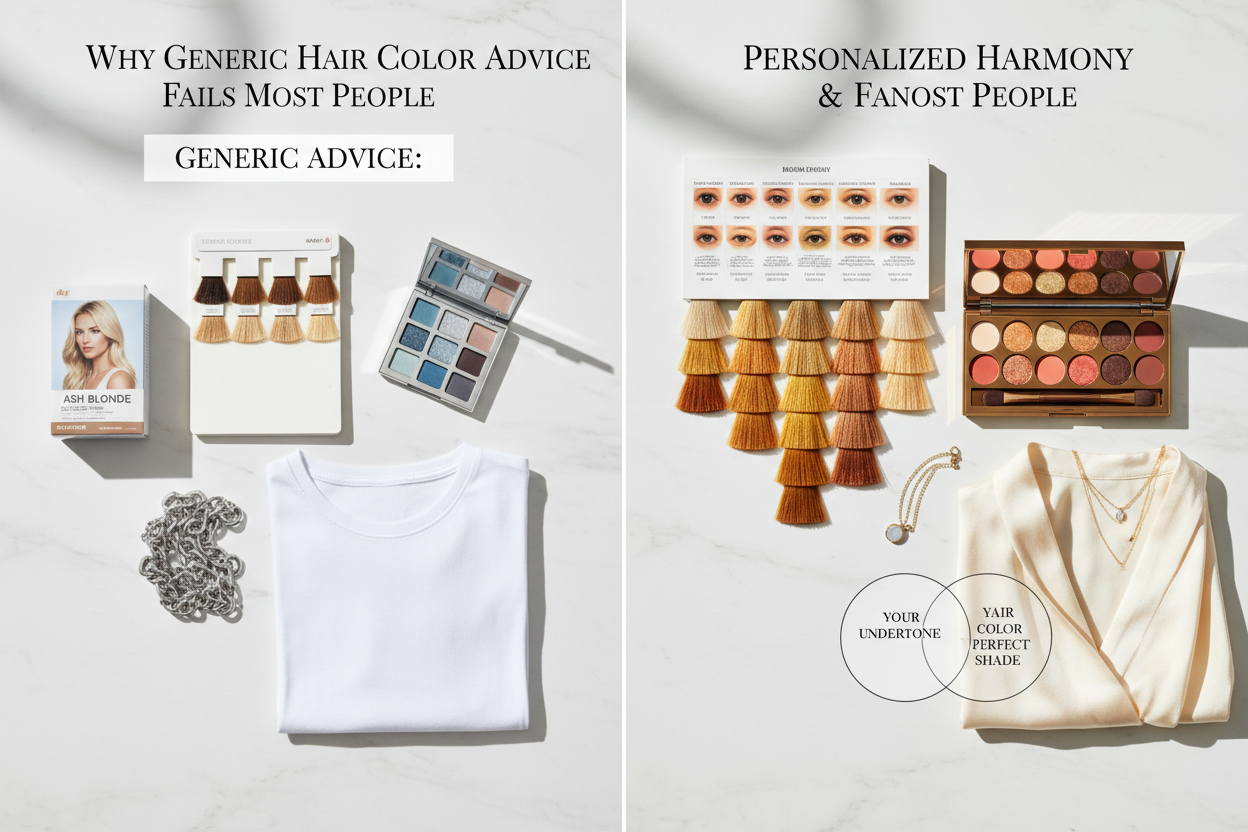
When a shade is chosen based on what's popular rather than what's compatible with your specific coloring, the results are predictable in the wrong way. Warm golden tones can turn sallow against certain skin undertones. Ash shades that photograph beautifully on one complexion can look dull or harsh on another. A color that earns compliments on your colleague may make you look tired by Friday afternoon.
Three variables determine whether a hair color will actually flatter you:
- Skin tone and undertone — the overall depth and warm, cool, or neutral cast of your complexion
- Natural hair shade — your baseline pigment, which affects how color deposits and reflects light
- Eye color — the contrasting or harmonizing element that ties the full picture together
Generic advice ignores these entirely, or collapses them into something like "if you have fair skin, try this." Personal hair color analysis treats each variable as a distinct, measurable factor and matches shade recommendations to the combination — not just one piece of it.
If you've ever walked out of a salon feeling like something was slightly off even though you couldn't say what, there's a good chance the color chosen didn't account for all three. A structured analysis exists to close that gap.
Ready to stop guessing? Find your colorist-approved match →
What Personal Hair Color Analysis Actually Measures
A personal hair color analysis isn't a mood board exercise or a personality quiz. It's a structured evaluation of how your natural features interact with specific color families. The goal is to find the most flattering hues for your skin tone, hair shade, and eye color — not to reimagine you as someone else.
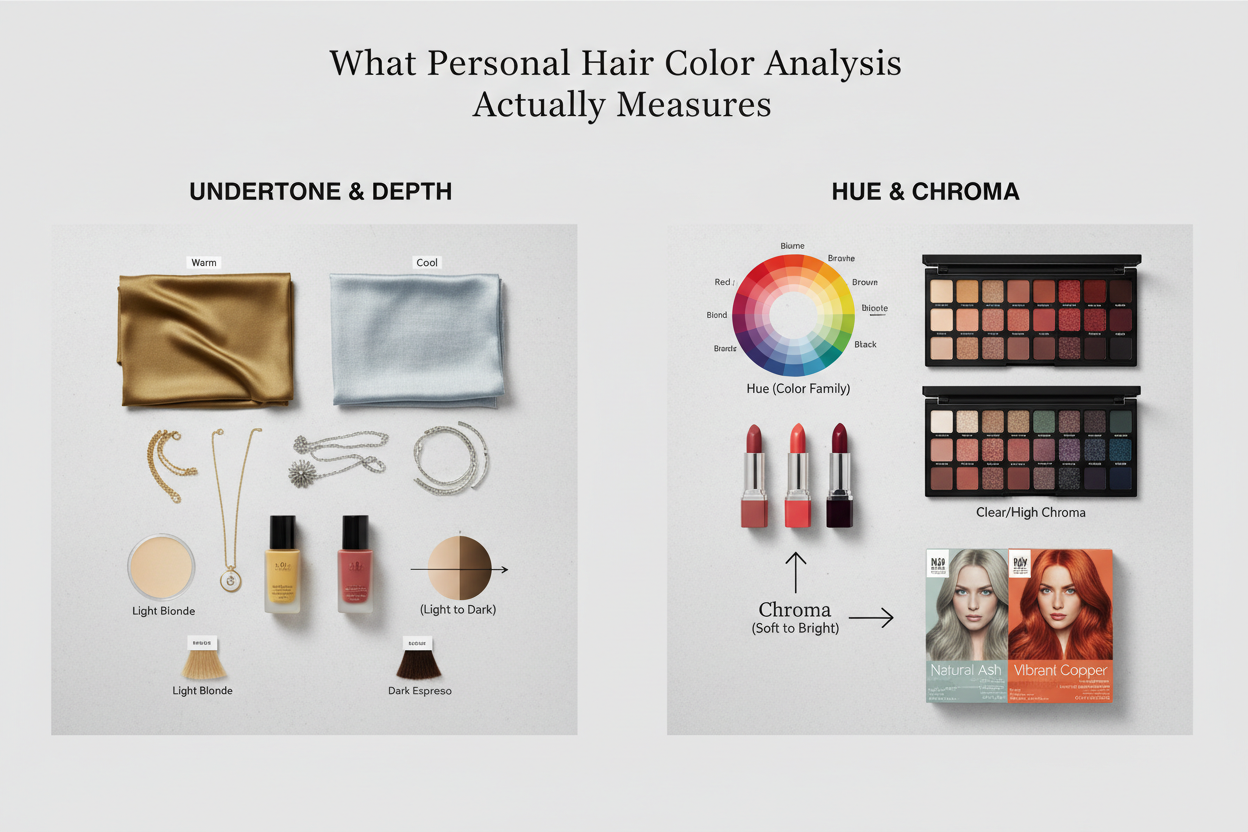
Knowing what each input actually measures helps you engage with the process more accurately and make sense of the results.
The Three Inputs Every Colorist Evaluates First
1. Skin tone and undertone
Skin tone refers to the surface depth of your complexion — fair, light, medium, tan, or deep. Undertone is the underlying hue beneath the surface, and it doesn't change with sun exposure or seasons. The three categories are:
- Warm — yellow, peachy, or golden cast; veins appear greenish
- Cool — pink, red, or bluish cast; veins appear blue or purple
- Neutral — a balance of warm and cool; veins appear blue-green
Undertone is the most decisive factor in shade compatibility. Warm undertones work well with golden blondes, rich coppers, caramel browns, and auburn reds. Cool undertones suit ash blondes, cool browns, burgundy, and blue-black. Neutral undertones have the widest range but still benefit from deliberate choices rather than guesswork.
2. Natural hair shade
Your natural hair pigment determines how color interacts with your strands. Lighter natural shades absorb and reflect color differently than darker ones. A colorist looks at not just the current depth (the Level 1–10 scale from black to lightest blonde) but also whether your natural tone runs warm or cool. Someone with naturally warm, golden-brown hair may need different tonal adjustments than someone with naturally ashy medium brown, even at the same level.
3. Eye color
Eye color acts as a harmony or contrast anchor. Deep brown eyes paired with a warm medium complexion create a different equation than light blue eyes against the same skin tone. A color analysis uses eye color to determine whether a shade should echo your natural palette for a soft, cohesive result, or introduce deliberate contrast for something more striking. Green and hazel eyes often carry their own undertones — amber, gold, or gray flecks — that a hair color choice can either amplify or mute.
Together, these three inputs produce a specific compatibility profile rather than a vague seasonal category, and that profile is what drives a useful recommendation.
How AI Photo Tools Replicate a Colorist Consultation
A professional colorist evaluates you in person under controlled lighting, comparing your features against years of trained pattern recognition. That kind of expertise has historically meant booking a salon appointment. AI photo analysis tools have changed that — a comparable assessment now takes about two minutes from your couch.
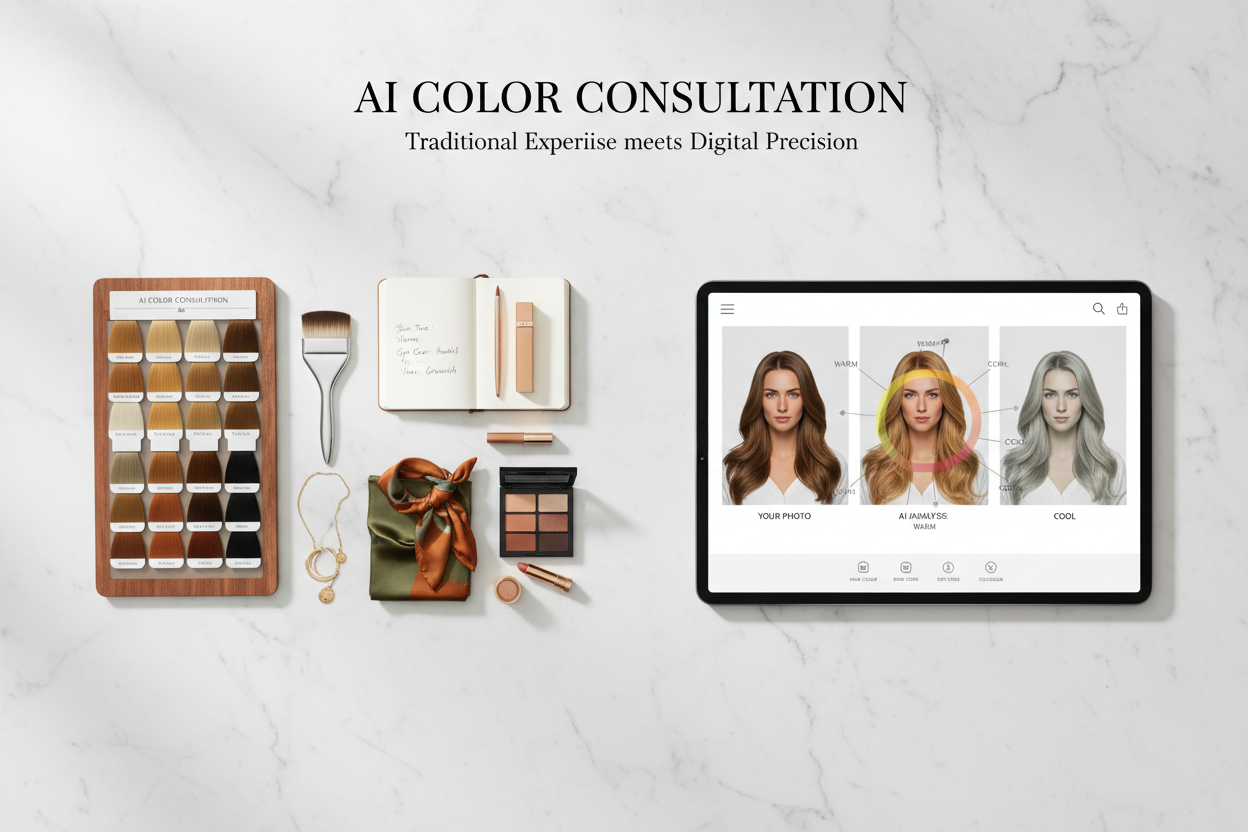
The accuracy depends on two things: the quality of the underlying color science, and the quality of the photo you submit. On the science side, the algorithm runs the same three-axis evaluation a colorist would — reading skin tone depth and undertone, assessing natural hair shade, factoring in eye color contrast — then cross-referencing those inputs against a database of known compatible shades. On the photo side, you control how much the tool has to work with.
What the Algorithm Reads in Your Photo
The tool is looking for subtle visual signals: the warmth or coolness of your skin's surface reflectance, the depth and tone of your hair at the root, the contrast ratio between your features. Each of these gets harder to read when image quality is poor.
To give the algorithm clean data:
- Use natural daylight. Stand near a window with indirect light. Overhead fluorescent lighting adds a yellow cast; direct sun creates harsh shadows. Both skew undertone readings.
- Skip filters and editing. Even subtle warmth or brightness adjustments alter the color values being measured. Submit an unedited photo.
- Shoot face-forward. Angled shots create lighting asymmetry and can obscure the jawline, which is often the clearest area for reading skin tone.
- Show your roots. If your hair is colored, exposing natural root growth gives the algorithm your actual baseline pigment rather than a processed shade.
- Go light on makeup if you can. Foundation alters the skin tone signal significantly. Bare or minimal coverage returns more accurate undertone readings.
The two-minute turnaround doesn't mean a trade-off in accuracy when these conditions are met. It just means the algorithm reads the visual answers directly instead of asking you questions.
Reading Your Results: Skin Tone, Undertone, and Shade Compatibility
When your analysis finishes, you'll get a profile with your undertone category, a recommended shade family or two, and usually a set of specific shades within those families. Knowing how to read this turns a recommendation into something you can actually use.
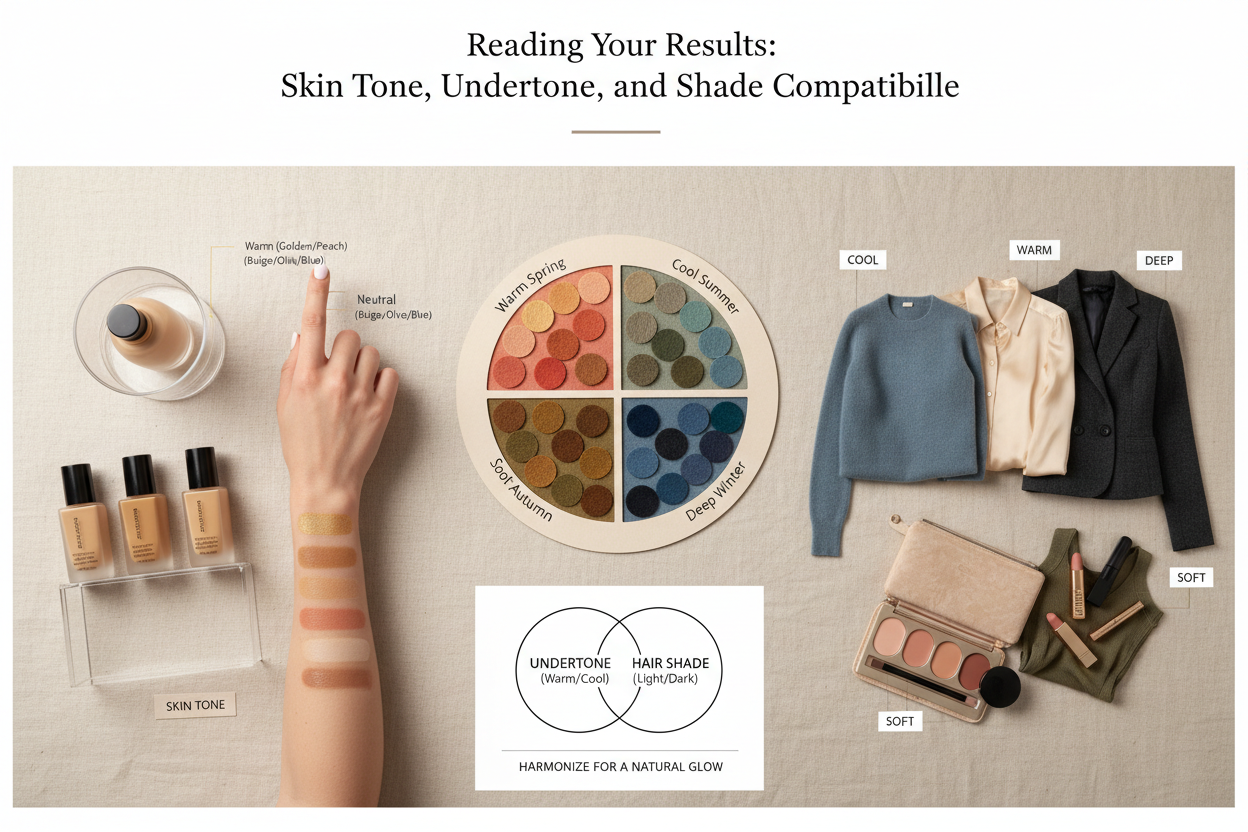
Undertone-to-shade mapping at a glance:
| Undertone | Flattering Shade Families | Shades to Approach Carefully |
|---|---|---|
| Warm | Golden blonde, copper, caramel, auburn, warm brown | Ash, cool platinum, blue-black |
| Cool | Ash blonde, platinum, cool brown, burgundy, blue-black | Golden, orange-based copper, warm auburn |
| Neutral | Most families with attention to depth | Extreme warm or extreme cool ends |
Your results may also include a depth recommendation — whether going lighter or darker than your current color will suit you better. Higher contrast between hair and skin reads as striking; lower contrast is softer and more blended. Neither is better; it comes down to the look you want.
If your profile flags a "caution" category — shades that won't technically clash but won't do your coloring any favors either — pay attention to that. Knowing what to skip is just as useful as knowing what works.
One thing worth keeping in mind: undertone compatibility is about the tone of a color, not just how light or dark it is. A deep brunette can run warm (chestnut, mahogany) or cool (espresso, cool mocha). Your undertone result tells you which version of your target shade to ask for — not just the shade name.
Know your undertone and ready to see your matches? Start your personal color analysis →
From Analysis to Salon: Using Your Color Profile with a Stylist
A color analysis result isn't just self-knowledge — it's a communication tool. Most salon disappointments come down to the gap between what a client imagines and what a stylist understands. Bringing a structured color profile to your appointment closes that gap before it opens.
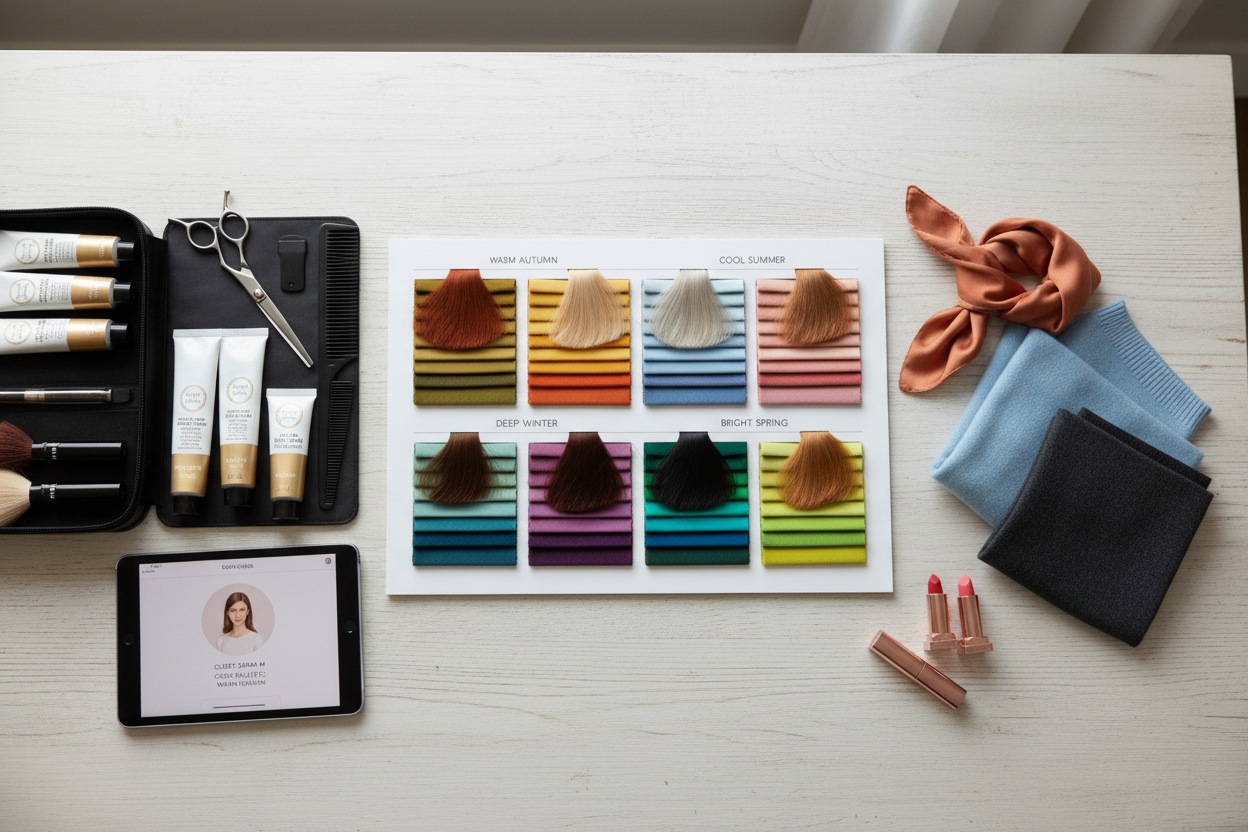
When you sit down with your colorist, your analysis gives you specific language to use:
- Lead with undertone. Instead of "I want something warm," say "My undertone is warm and my analysis recommended golden or caramel families." That immediately orients your colorist to your compatible range.
- Reference your depth recommendation. If the analysis suggested going one level lighter or staying at your current depth, say so. It signals that you've thought this through, not just scrolled through photos.
- Share shade families, not just photos. Inspiration photos are useful for finish and technique — balayage vs. single process, glossy vs. matte — but your color profile is more useful for ensuring the shade actually works with your complexion.
- Ask about tonal adjustments. Even within a compatible family, your colorist may suggest a small tweak — a touch more neutral to balance a pink complexion, for example. Your profile gives them a baseline to refine rather than a blank slate to guess from.
Some color analysis platforms include stylist search features that help you find someone already familiar with palette-driven consultations. Going in with your profile turns the appointment from a guessing game into a collaborative process — and usually means fewer correction rounds afterward.
Maintaining Your Matched Color: Products Aligned to Your Palette
Getting the right color match is only step one. What you do between salon visits determines how long it actually holds.
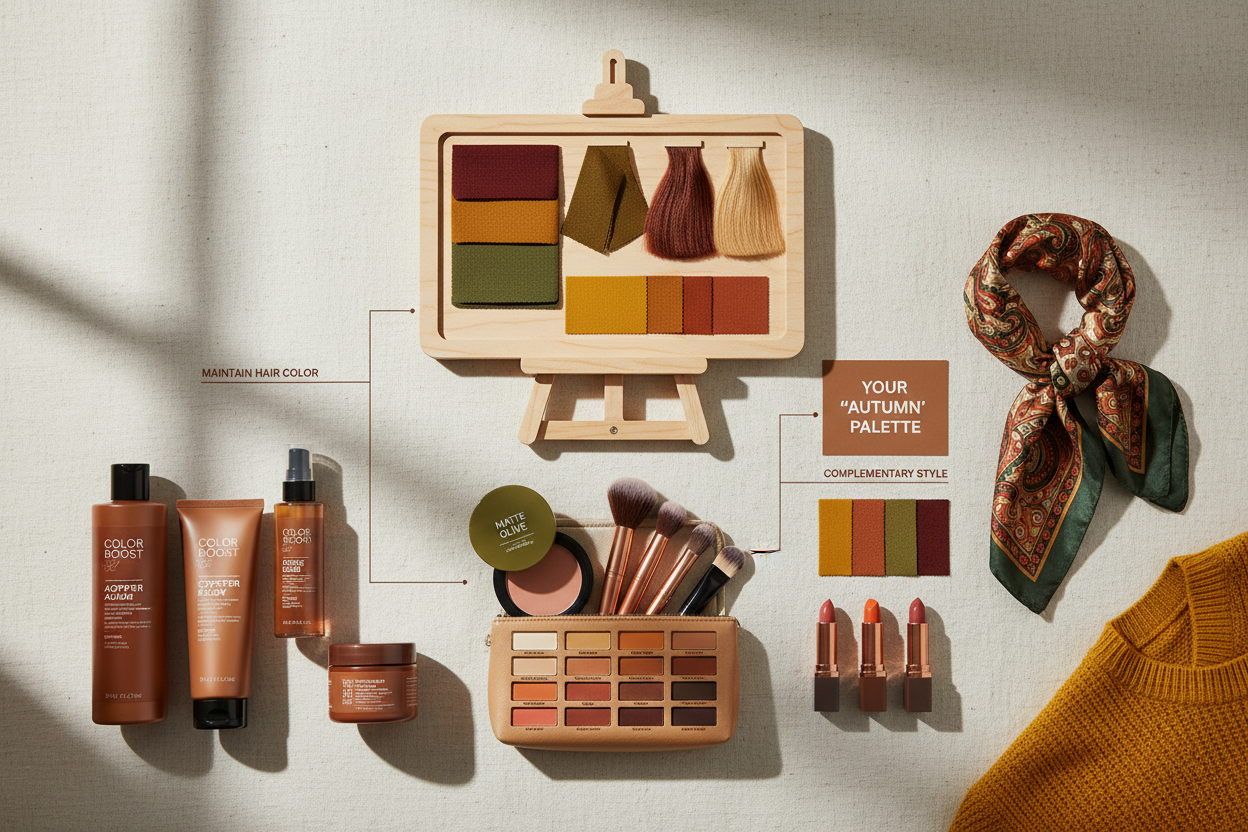
The products you use should be chosen for your specific shade family, not just your hair type. Generic recommendations ignore tonal needs. Your maintenance routine should follow the same logic as the analysis.
Key maintenance considerations by shade family:
- Cool and ashy shades (platinum, ash blonde, cool brown) tend to brass — gradually shifting toward yellow or orange from oxidation and mineral buildup. A purple or blue-toning shampoo or conditioner once or twice a week pulls it back.
- Warm shades (copper, auburn, golden blonde) can fade fast, especially with frequent washing. Color-depositing conditioners in matching warm tones help extend vibrancy between appointments.
- Deep brunettes and blacks need color-protecting formulas that preserve depth without stripping. Sulfate-free shampoos make a real difference here — sulfates accelerate fading.
Some brands build their product lines around this idea, pairing your chosen shade with a maintenance routine that includes the specific toning, depositing, or protecting products for that color family. Whether or not you use a structured system, the principle is the same: your at-home routine should reinforce the match, not work against it.
Timing matters too. Most professional color formulas need 48–72 hours before the first wash to fully set. A color-safe dry shampoo during that window helps, and washing with cool or lukewarm water rather than hot keeps the result closer to what you walked out with.
How to Get Your Personal Hair Color Analysis Today
Getting a personal hair color analysis is much easier than it used to be. What once meant booking a salon consultation — sometimes at extra cost, sometimes as a prerequisite to seeing a colorist at all — now takes a few minutes through an online tool.
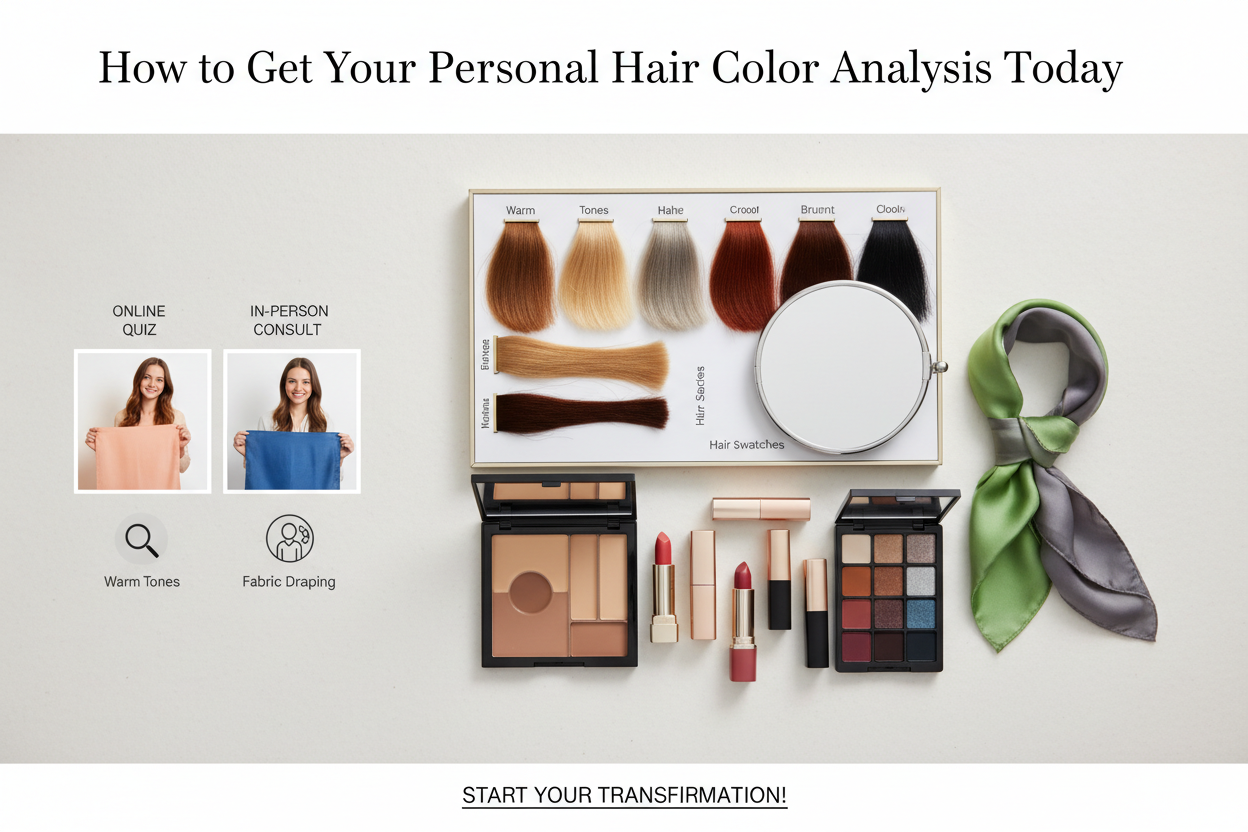
The basic sequence:
- Take or select a qualifying photo — natural light, no filters, roots visible if possible
- Complete a short intake — current hair color, any recent chemical treatments, what result you're after
- Receive your shade profile — undertone category, compatible shade families, specific recommendations, and shades to avoid
- Use the profile — at home to guide a color purchase, or at the salon as a briefing for your colorist
The intake adds context the photo can't show on its own. Whether you've had a keratin treatment that might affect how color deposits, or whether you're covering gray versus refreshing your natural tone — those details matter, and they're what a colorist would ask in person.
The whole thing takes about two minutes. What you get back is a color profile built around your actual features, not a trend or a generic recommendation.
People Also Ask
How do I find my perfect hair color based on skin tone?
Start by identifying your skin's undertone — the underlying warm, cool, or neutral cast that stays consistent regardless of tan or season. Warm undertones (yellow, peachy, golden) pair well with caramel, copper, auburn, and golden blonde shades. Cool undertones (pink, blue, or rosy) are complemented by ash blondes, cool browns, and burgundy. Neutral undertones have the broadest compatibility range.
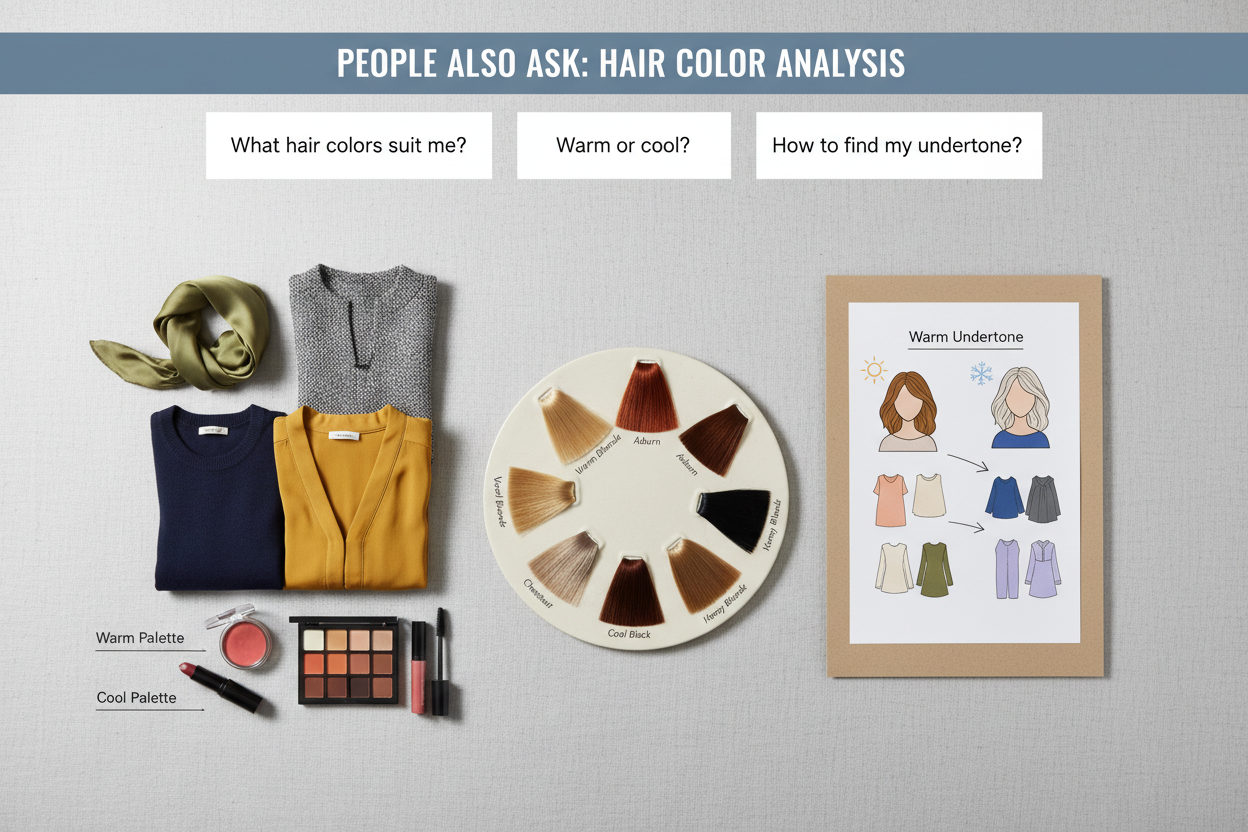
Once you know your undertone, factor in your natural hair depth and eye color. A structured personal hair color analysis takes all three inputs simultaneously and returns shade families specifically matched to your combination — which is more precise than skin tone alone.
What is a personal color analysis and how does it work for hair?
A personal color analysis evaluates how your natural features — skin tone, undertone, natural hair shade, and eye color — interact with specific color families. Instead of assigning you a broad seasonal label, it produces a compatibility profile: which hair colors will genuinely flatter your coloring and which ones are likely to clash or wash you out.
The process works by reading your three core inputs against a framework of known tone combinations. The goal is to find shades that work with your features rather than against them — whether that happens in a salon or through an AI-powered photo tool.
Can an AI tool accurately match hair color to my complexion?
Yes, when the photo conditions are right. AI tools run the same three-axis evaluation a colorist would — detecting skin undertone, reading natural hair depth, and assessing eye color contrast — then cross-referencing those signals against a database of compatible shade combinations.
Accuracy depends heavily on photo quality. Natural daylight, no filters, a face-forward angle, and visible roots at the hairline give the algorithm the clearest possible data. Overhead artificial lighting, heavy makeup, or edited images can skew undertone readings and reduce precision. Under the right conditions, the analysis takes roughly two minutes.
How is hair color analysis different from seasonal color analysis?
Seasonal color analysis (Spring, Summer, Autumn, Winter) categorizes your entire natural palette — skin, hair, and eyes — into one of four seasonal types and uses that to guide clothing, makeup, and hair choices across the board. It's a useful starting point, but it works in broad strokes.
Personal hair color analysis is more granular than seasonal color analysis. It focuses specifically on hair, evaluating not just your seasonal category but the precise undertone and depth combination that will make a particular shade work for your specific coloring. The difference between warm espresso brown and cool espresso brown matters here. The output is actionable shade-level guidance rather than a broad palette category, which is why it's more useful when you're standing in front of a color swatch or explaining what you want to a stylist.
What information do I need before getting a hair color analysis?
Most analysis tools and colorists ask for a short set of inputs:
- A current photo — ideally taken in natural light, unfiltered, showing your face and natural roots if your hair is currently colored
- Your natural or current hair shade — the depth and any warm or cool character you've noticed
- Recent chemical history — highlights, bleach, keratin treatments, or permanent color, since these affect how new color deposits
- Your goal — covering gray, refreshing your natural tone, going lighter or darker, or making a significant change each call for a different approach
Some tools also ask about eye color separately if it isn't clearly visible in the photo. Having this ready means the analysis can move quickly and return a more accurate result, whether you're doing it online or in person.
FAQ
What does a personal hair color analysis include?
A personal hair color analysis looks at three things: your skin undertone, natural hair depth, and eye color. From those, it figures out which shade families will actually flatter you rather than fight your coloring. You get:
- A primary undertone reading (warm, cool, or neutral)
- A recommended depth range — how light or dark works for you
- Specific shade families that complement your combination
- Shades that are likely to clash or wash you out
Some tools also factor in your color history — previous bleaching, highlights, or permanent treatments — since existing pigment affects how new color deposits and behaves.
How accurate are AI-based hair color analysis tools compared to an in-person colorist?
Under good photo conditions, AI tools run the same three-axis evaluation a colorist would — reading undertone, depth, and contrast, then cross-referencing compatible shades — and typically return a match in about two minutes. The logic is the same as a salon consultation.
The main variable is photo quality. Natural daylight, no filters, visible roots, and a straight-on angle give the algorithm the clearest read. Poor lighting or filtered images can throw off undertone detection. An in-person colorist can adjust for those things on the fly, which gives them an edge in tricky cases. For most people, though, an AI analysis with decent photos gets you pretty close.
Can I do a hair color analysis at home using just a photo?
Yes. Most tools that offer this only need a photo — no appointment, no in-person visit. The algorithm reads your skin undertone, hair depth, and eye color from the image and returns shade recommendations.
For the most accurate results:
- Take the photo in natural daylight, not overhead artificial light
- Skip filters or editing — they alter undertone signals
- Show your natural roots if your hair is currently colored
- Face the camera directly so skin and hairline are clearly visible
With those conditions met, the analysis takes a couple of minutes and gives you something concrete to bring to a stylist or use to narrow down at-home options.
How does skin undertone affect which hair colors look best on me?
Undertone is the most important factor in hair color compatibility. It's the underlying warm, cool, or neutral cast in your skin that stays consistent regardless of tan, season, or lighting.
- Warm undertones (golden, peachy, yellow) work well with caramel, copper, auburn, honey blonde, and golden browns
- Cool undertones (pink, rosy, bluish) suit ash blondes, cool espresso browns, and blue-based reds like burgundy
- Neutral undertones have the broadest range and can pull off both warm and cool shades, though the extreme ends of either spectrum can still look off
A mismatch — say, a strongly warm copper on a deeply cool complexion — tends to look muddy or sallow. Getting the undertone right first narrows things down considerably and makes every other decision easier.
Will my recommended hair color change as I age or my skin tone shifts?
Yes, over time. Skin tone shifts with age, sun exposure, hormonal changes, and health. Any meaningful change to your undertone or depth naturally updates which hair colors will flatter you most. Many people find their undertone stays relatively stable, but the depth and vibrancy that suit them best can change. Very deep shades that once looked beautiful can turn harsh as skin loses pigment with age — softer, slightly warmer versions of the same tone tend to work better.
It's worth revisiting your analysis whenever you notice a significant change in your skin, after a major health event, or every few years as a general check. Running an updated photo through an AI tool is a quick way to see whether your current color profile still fits.
How do I use my color analysis results when talking to my stylist?
Your analysis gives you a vocabulary your stylist can actually use. Instead of bringing in a photo of someone else's hair and hoping it translates, you can walk in and say something specific:
- Your undertone category and the shade families that work with it
- The recommended depth range (level 4–6, level 7–9, etc.)
- Any shades flagged as unflattering for your coloring
- Your actual goal — gray coverage, a refresh, lift, or a full transformation
Share the written results if the tool provides them. A good stylist will use that profile to dial in the formula — adjusting warmth, tone, and technique — rather than applying a generic version of the color. It moves the conversation from "I want to go brunette" to "I want a cool-leaning medium brown in this depth range because my undertone is cool." That second version gives the stylist what they need to get it right without guessing.
Is personal hair color analysis different from a general seasonal palette analysis?
They're related but work at different levels of specificity. Seasonal color analysis puts you in a broad category — Spring, Summer, Autumn, or Winter — based on the overall warmth, coolness, and contrast of your natural coloring. That category can point you toward hair color in general terms, but it's built to cover your whole personal palette, including clothing and makeup.
Personal hair color analysis goes deeper. It focuses only on hair, using your undertone, depth, and eye color contrast to identify not just a seasonal category but specific shade-level recommendations — warm espresso versus cool espresso, golden blonde versus ash blonde. The results are directly useful at the salon or beauty counter rather than giving you a broad style archetype. If you want to know which exact shade to put on your hair, a dedicated hair color analysis gives you a more precise answer than a seasonal palette alone.
Ready to find out which shades actually suit your coloring? Take the personal hair color analysis quiz and get your matched shade profile in minutes.