Pale Olive Skin Tone Description
 Reviewed by Alexandra Gilmore
Pale olive skin is light in depth but carries a muted green, yellow, or gray cast that often confuses foundation labels and undertone tests. Learn which visual clues are dependable, how it differs from pink or peach fair skin, and which daylight comparisons can confirm the description.

Pale olive skin is one of the most misunderstood complexion types in beauty and skincare. It sits at an unusual intersection: light in depth, yet carrying an undertone that reads green, yellow, or muted gray rather than the pink or peachy tones most people associate with fair skin. The result is a complexion that regularly confuses foundation algorithms, stumps makeup artists, and—as even professionally trained beauty creators have admitted—can take years for the person wearing it to correctly identify.
💫 Discover Your Complete Color Palette
One feature rarely explains every color that works for you. Compare your undertone, depth, clarity, and contrast as a complete palette, then use the results to test clothing, makeup, and hair colors more consistently.
Find My Color Palette →This guide gives you a precise, source-grounded description of pale olive skin so you can finally put a name to what you see in the mirror.
What you'll learn here:
- The difference between skin depth (how light or dark your skin is) and skin undertone (the hue beneath the surface)—and why pale olive sits at a specific, defined point on both scales
- The visual characteristics that distinguish pale olive skin from fair neutral, fair warm, and medium olive complexions
- Why pale olive skin is genuinely difficult to classify, even for professionals, and what makes it unique among light skin tones
- Practical tools—from at-home vein checks to seasonal observation—that help you confirm whether pale olive is an accurate description for your skin
- How understanding your pale olive undertone affects foundation matching, color analysis, and skincare product selection
According to skincare research, knowing your precise skin tone is one of the most important factors in choosing products and makeup that actually work for you. For pale olive skin in particular, that knowledge is harder to arrive at—but the payoff in accurate color matching and routine-building is significant.
What 'Pale Olive' Actually Means: Depth vs. Undertone
"Pale olive" is two separate descriptors pressed into one phrase. Conflating them is the root cause of most misidentification.
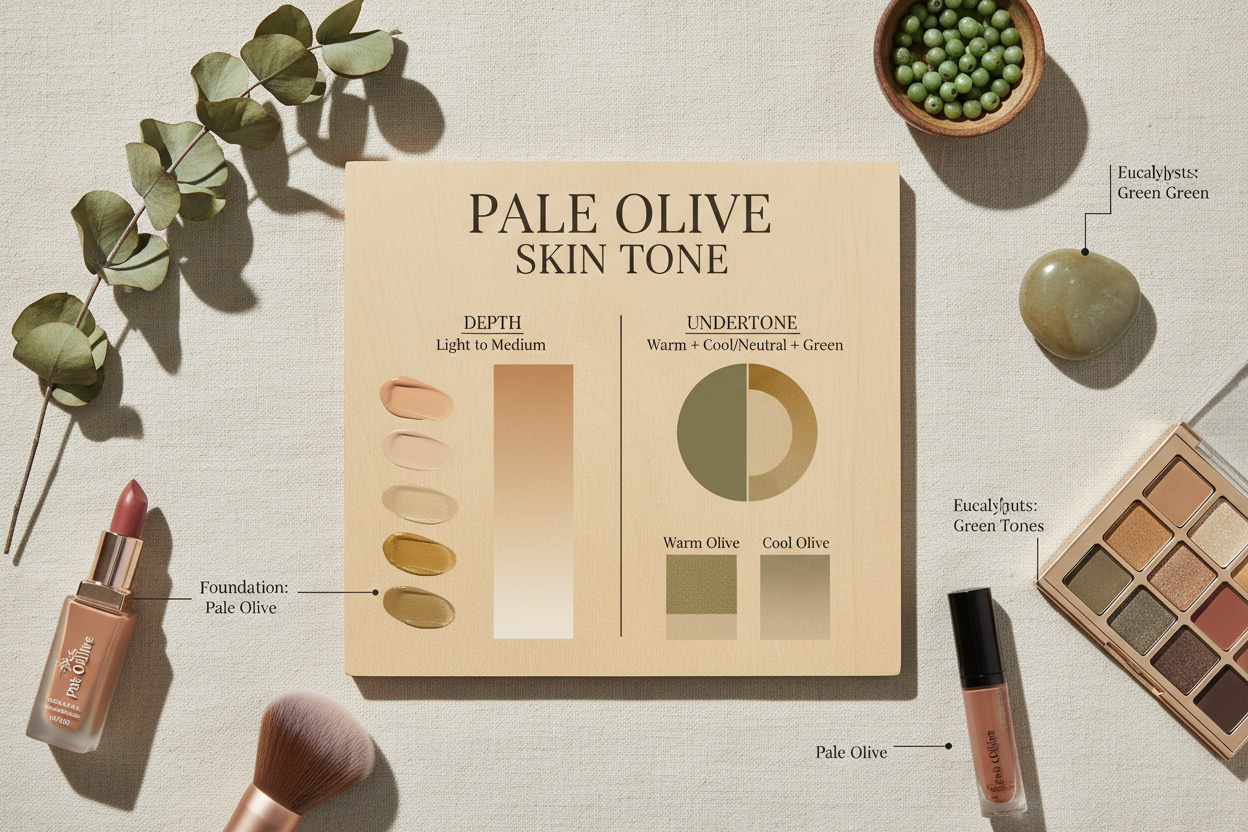
Pale refers to skin depth—where your complexion falls on a light-to-dark scale. On the Fitzpatrick scale, pale olive sits in the Type II–III range: light enough to show redness and sun sensitivity, but not the porcelain tone associated with purely fair skin. Depth is what you observe when you compare your arm to someone else's in daylight.
Olive refers to undertone—the hue beneath the surface. The Oxford English Dictionary traces the word "olive" describing a skin quality to at least the 17th century, where it meant a light tan or brownish cast. In modern undertone language, that translates to a muted, greenish-yellow or greenish-neutral hue sitting beneath a relatively light complexion.
The critical point: being pale doesn't determine your undertone, and having an olive undertone doesn't require a medium or tan complexion. Pale olive skin is light in depth and carries a greenish-neutral undertone. Neither descriptor cancels the other.
| Descriptor | What It Measures | Pale Olive Value |
|---|---|---|
| Depth | Light vs. dark on the skin scale | Light (Fitzpatrick II–III) |
| Undertone | Hue beneath the surface | Greenish-neutral to muted warm |
Get the split wrong and every product match downstream goes with it. If you want a personalized confirmation, take the color analysis quiz to find your exact undertone placement.
Why Pale Olive Is So Hard to Identify—Even for Professionals
Pale olive is genuinely one of the hardest undertones to read. This isn't an exaggeration: beauty professionals with formal training and years of experience have publicly acknowledged spending nearly a decade working on their own complexion before correctly identifying their undertone as olive rather than neutral or warm.
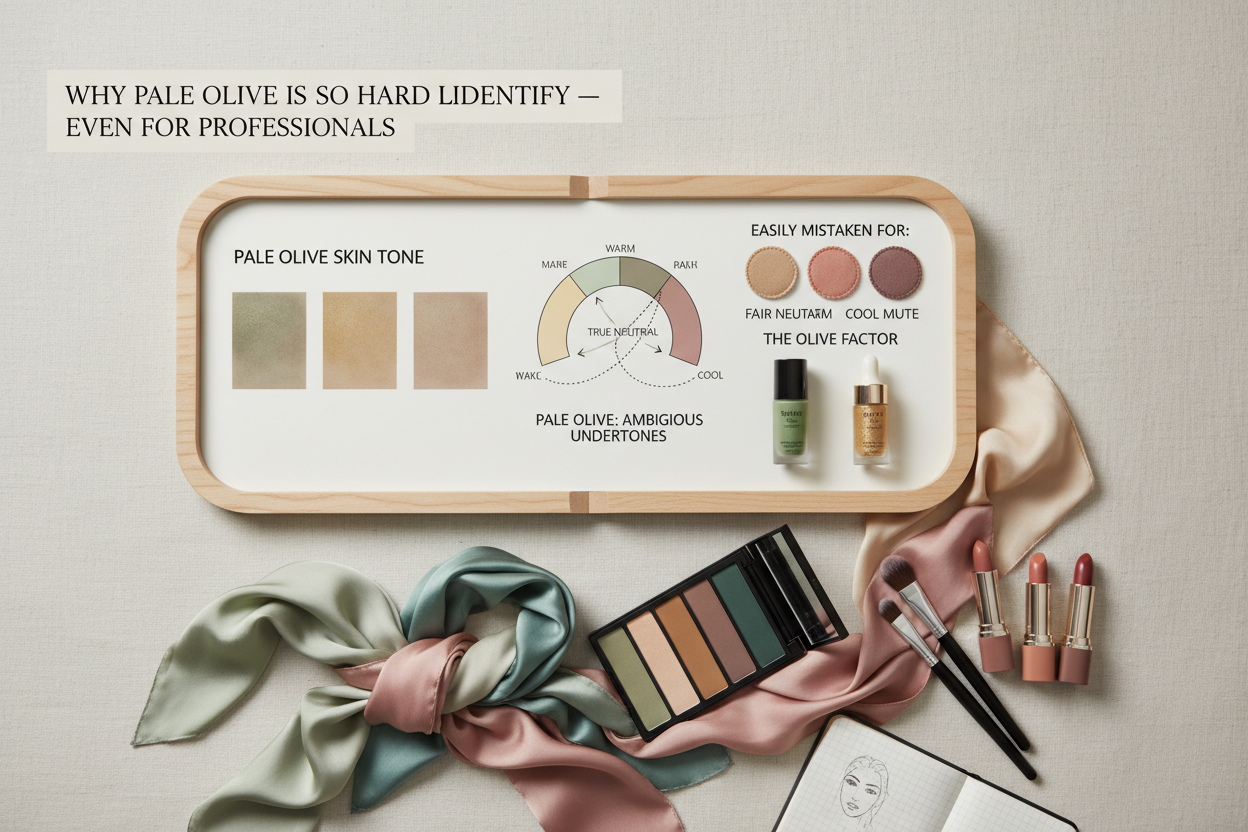
Several factors make it so elusive:
- The greenish cast is subtle at pale depths. On deeper olive skin, the muted green-yellow is easier to spot. On a light complexion, it can disappear entirely in certain lighting or show up only in specific areas—the under-eye hollows, the inner wrist.
- Artificial lighting suppresses it. Fluorescent and warm interior lighting tends to flatten the greenish quality, making pale olive look straightforwardly neutral or even slightly pink. Natural, indirect daylight is the only reliable condition for reading it accurately.
- It reads as multiple things depending on context. Against a white background, pale olive can look slightly gray or cool. Against ivory or cream, it reads warm. Neither is fully accurate, which is exactly what makes it olive rather than definitively one or the other.
- Standard undertone tests are designed for clearer warm/cool distinctions. The vein, jewelry, and fabric tests were built around pink-versus-golden contrasts. Pale olive sits in a greenish-neutral middle ground that these tests often fail to resolve.
The result: regularly mismatched foundations, confused shade-match tools, and a lot of time cycling through products labeled "neutral" or "warm" without ever quite landing on the right one.
Key Visual Characteristics of Pale Olive Skin
In natural, indirect daylight, pale olive skin has a recognizable set of visual qualities. No single characteristic is definitive on its own—look for a pattern across several.
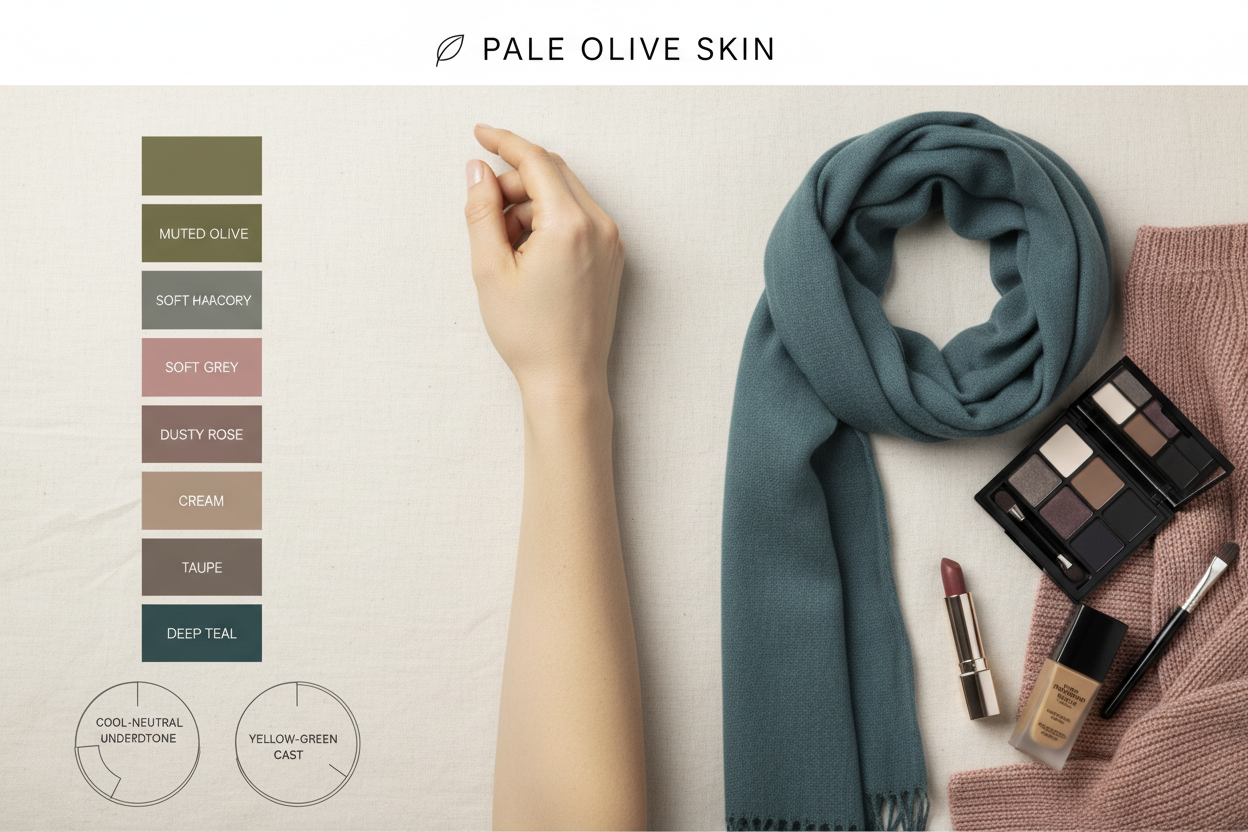
Overall appearance:
- Light in depth, but without the bright pink or rosy quality common in fair cool skin
- A subtle muted quality, as though the skin's surface has been slightly desaturated compared to a clearly warm or clearly pink complexion
- A faint greenish or greenish-yellow cast, most visible in the under-eye area, the sides of the nose, and the inner wrist
Specific areas to observe:
- Under-eye area: May show a slightly olive or grayish-green shadow rather than a purely purple or brown one
- Inner wrist: The skin here often shows the undertone more clearly than the face; look for a quiet golden-green cast rather than a peachy or pink one
- Jaw and neck: The transition between face and neck often reveals the true undertone, particularly if foundation oxidizes or shifts on the face
What pale olive skin typically does not look like:
- No visible pink flush at rest
- No warm gold glow the way a clearly warm or peachy complexion has
- No ashy gray quality that cool-neutral skin can take on with the wrong products
The Vein Test and Other At-Home Checks
These checks work best in natural light near a window, with no makeup or heavy moisturizer on the skin.
1. The inner-wrist vein check Look at the veins on the inside of your wrist:
- Predominantly blue → cool undertone
- Predominantly green → warm undertone
- Blue-green, neither clearly one nor the other → olive or neutral-warm undertone
For pale olive skin, the blue-green reading is the most common outcome. If you cannot decide whether your veins look blue or green, that ambiguity is itself a signal.
2. The white paper test Hold a plain white sheet of paper next to your bare face in natural light.
- If your skin looks pink or rosy against it → cool lean
- If your skin looks yellow or peachy → warm lean
- If your skin looks slightly yellow-green, gray, or just muted → olive undertone
3. The jewelry test Try on silver and gold jewelry against your bare wrist.
- Silver more flattering → cool undertone
- Gold more flattering → warm undertone
- Both look reasonable but neither is dramatically better, or gold looks slightly more harmonious despite not being "glowing" → olive or neutral-warm
4. The sun observation check How does your skin respond to sun exposure? Pale olive skin tends to tan fairly easily for how light it is, and rarely burns badly before color develops. If your light skin tans faster than you'd expect and the result reads golden-olive rather than golden-pink, that fits an olive undertone.
None of these checks is conclusive on its own. Mixed results are normal for pale olive skin. The undertone is specifically defined by how hard it is to categorize.
Pale Olive vs. Similar Skin Tones: How to Tell the Difference
Pale olive sits in a middle ground, which means it gets confused with several adjacent complexion types. Here's how to tell them apart.
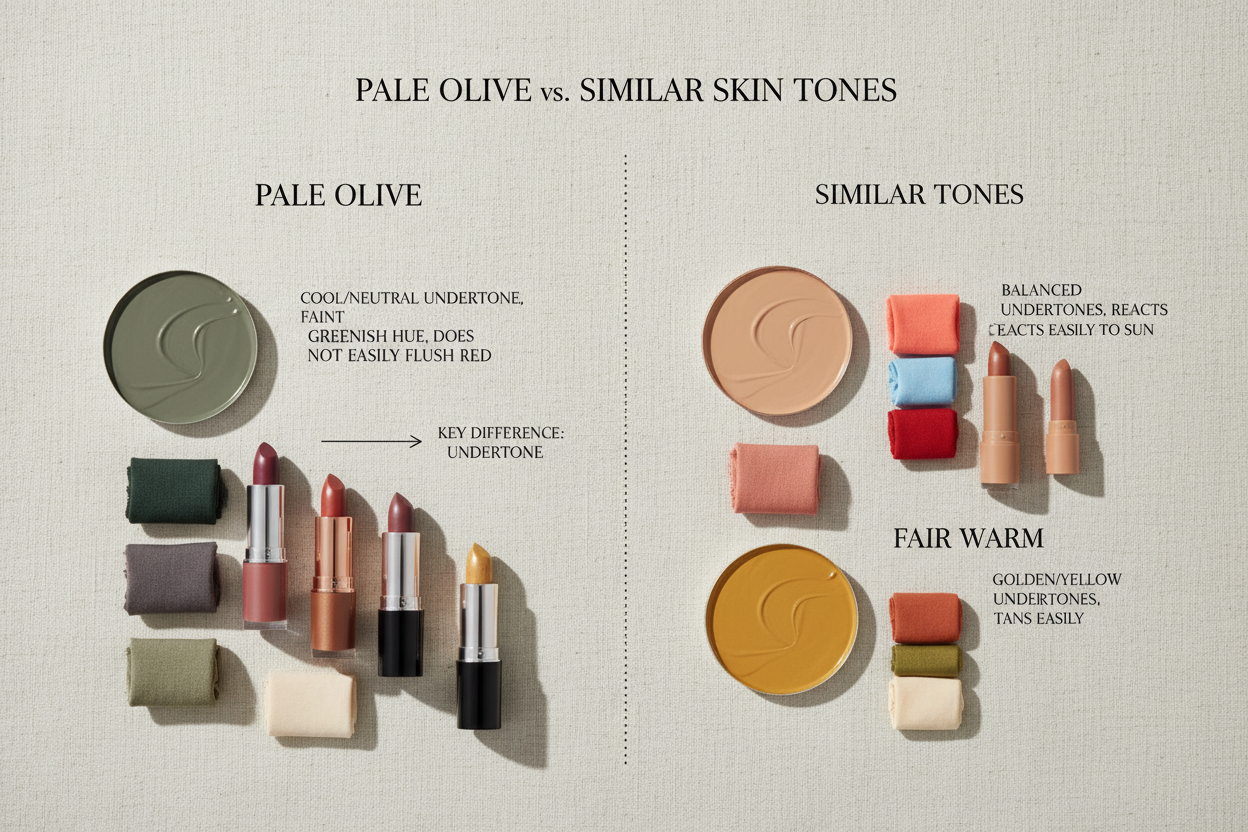
Pale olive vs. fair cool (pink-neutral)
- Fair cool skin has a visible pink or rosy quality, especially across the cheeks and nose
- Pale olive has no natural flush — the resting complexion looks muted or slightly yellowish-green
- Fair cool veins read blue; pale olive veins read blue-green
- The question to ask: does your bare skin look flushed or flat? Olive reads flat
Pale olive vs. fair warm (peachy-golden)
- Fair warm skin has a clear yellow or peachy saturation — the warmth is noticeable
- Pale olive is less saturated; the warmth gets partially canceled out by the greenish quality
- Fair warm skin tends to glow in golden light; pale olive can look slightly dull or gray in the same conditions
- The question to ask: does gold jewelry make your skin glow, or does it just look okay? Olive gets okayed rather than lit up
Pale olive vs. fair neutral
- Fair neutral skin balances pink and yellow without a greenish modifier
- Pale olive has a greenish quality that fair neutral lacks — that's the clearest distinguishing factor
- Both can trip up the vein test, but pale olive often shows a muted, slightly gray cast in the white paper test that neutral skin doesn't
- The question to ask: against white paper, does your skin look balanced or faintly greenish? Neutral looks balanced; olive looks slightly off
Pale olive vs. light-medium olive
- The undertone character is the same — the difference is purely depth
- Light-medium olive sits higher on the Fitzpatrick scale (Type III–IV) and the olive cast is easier to spot without close observation
- Pale olive is lighter but carries the same muted greenish undertone at lower intensity
The Role of Geographic and Genetic Background in Olive Skin
Olive skin shows up across a wide range of geographic and ethnic backgrounds. The term was used in 17th-century English to describe complexions observed in Mediterranean populations, and contemporary references to olive skin often use women from regions like Orihuela in southern Spain as visual anchors.
Pale olive skin appears — without being exclusive to — people with ancestry from:
- Mediterranean regions: Southern Spain, Italy, Greece, Portugal
- Middle Eastern backgrounds: Lebanese, Turkish, Persian, Israeli heritage
- East and Southeast Asian backgrounds: where light skin may carry a yellow-green rather than peachy cast
- Latin American heritage: particularly among those with mixed Indigenous and European ancestry
- Eastern European backgrounds: some Polish, Russian, and Balkan complexions carry a subtle olive quality beneath fair depth
Pale olive shows up across very different genetic backgrounds—it's not a default skin type for any one ethnicity. The muted greenish-neutral quality is a biological undertone characteristic, not a cultural category. Identifying it accurately means looking at the skin itself, not making assumptions based on someone's heritage.
Start your color analysis to confirm your undertone regardless of your heritage.
How Pale Olive Skin Responds to Sun, Seasons, and Lighting
Pale olive skin has behavioral patterns that can help confirm identification—and that directly affect which products work best across the year.
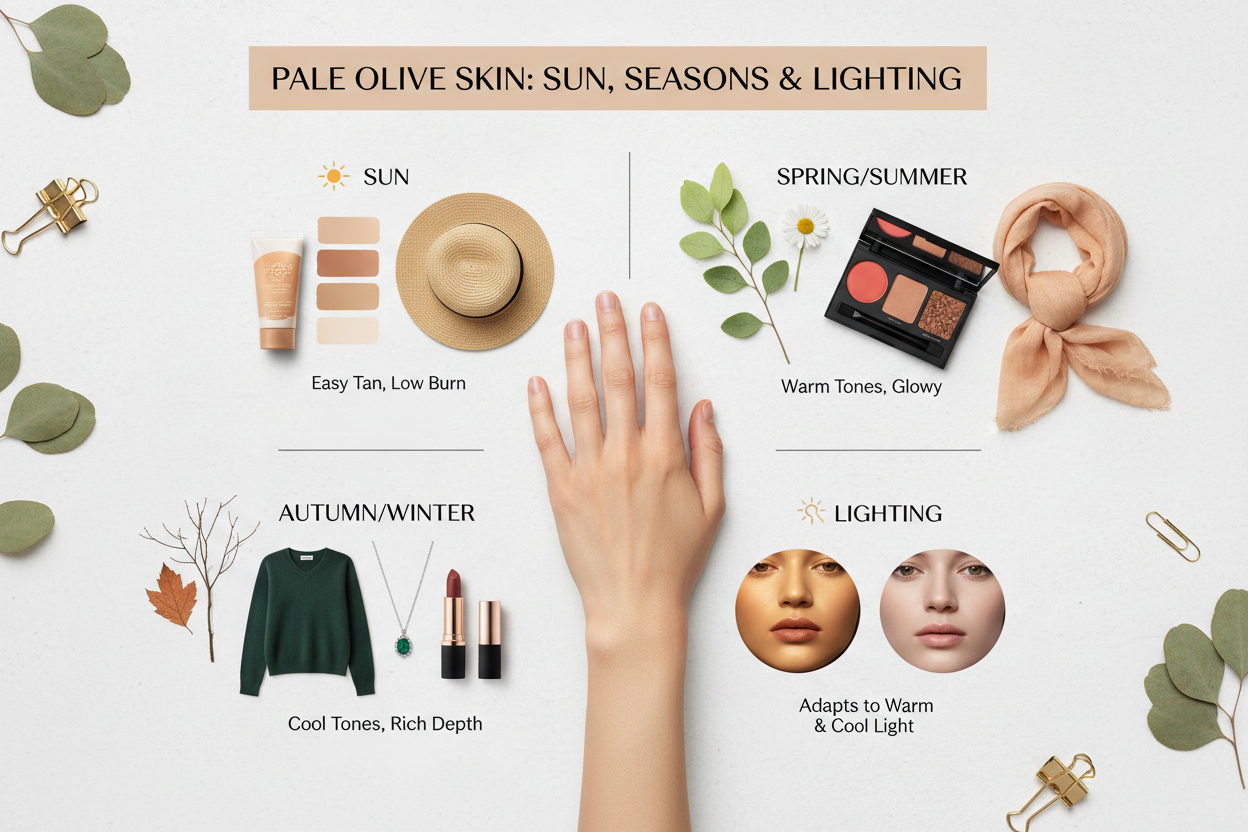
Sun response: Pale olive skin often tans more readily than its light depth would suggest. It can burn with prolonged unprotected exposure, but it typically develops a tan first, and that tan reads golden-olive or golden-brown rather than pink-red. If you tan faster than other light-skinned people around you, and your tan has no pink quality to it, that's consistent with olive pigmentation.
Seasonal shifts:
- In summer, the olive cast can become more visible as light tanning deepens the muted warmth in the skin
- In winter, pale olive skin can look noticeably grayer or more sallow, and cool-toned artificial lighting makes this worse
- Foundation that works in summer may read too dark or too warm in winter, and the reverse is just as common
- The greenish quality under the eyes often becomes more pronounced in winter
Lighting effects:
- Natural, indirect daylight is the most accurate environment for reading pale olive undertone
- Warm indoor lighting (incandescent, amber) suppresses the greenish cast and makes olive skin look warm or peachy
- Fluorescent or cool lighting can exaggerate the gray quality and make pale olive look cool or ashy
- Flash photography often bleaches out undertone entirely, leaving pale olive looking flat white or neutral
The practical upshot: if your foundation looks right at home but wrong in daylight (or vice versa), lighting is probably masking your undertone.
Foundation, Concealer, and Color Matching for Pale Olive Skin
Getting undertone identification right matters because it directly shapes which products will actually work on your face.
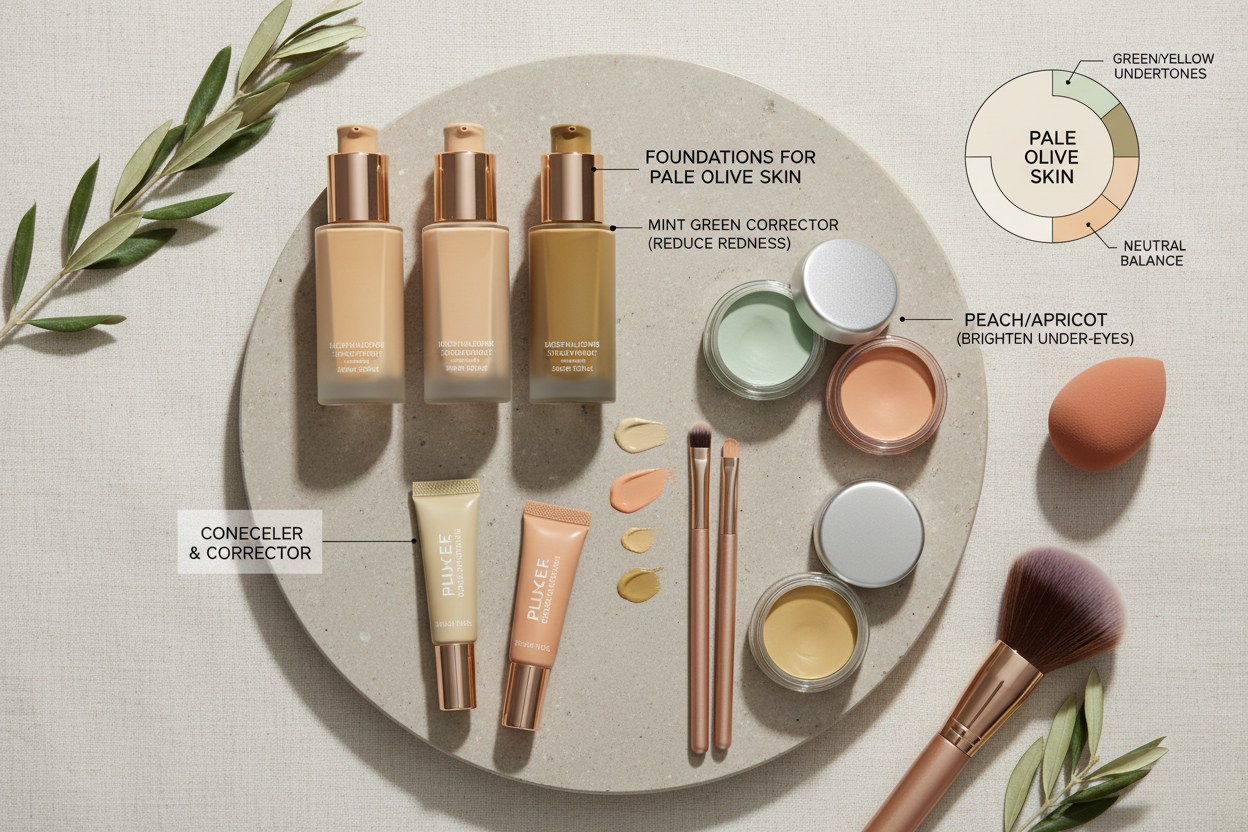
Foundation:
Pale olive skin tends to clash with two common foundation categories:
- Purely pink-based foundations go ashy, gray, or ghostly—the cool-pink tone fights the greenish-olive quality
- Purely yellow-based warm foundations can pull orange or brassy, especially as they oxidize
What tends to work:
- Shades described as neutral-warm, neutral-olive, or beige with green undertone correction
- Foundations in the ivory to light beige depth range with a yellow-green or olive modifier—not peach, not pink
- Brands with dedicated olive shades (sometimes labeled "O" or "olive") rather than generic warm or neutral options
Oxidation risk: Olive skin tends to make foundations with high yellow or orange pigment go visibly orange over time—the skin's greenish quality interacts chemically with warm-heavy formulas. Test on your jaw and check after 30 minutes before committing.
Concealer:
- Under-eye concealer works best with a peach or salmon undertone to offset the olive-gray shadow—not pink or lavender, which will deepen the muted cast
- Skip pure yellow concealers under the eyes; they tend to highlight the olive tone rather than neutralize it
Setting and finish:
- Pale olive skin usually looks better with a natural to satin finish—heavy matte formulas can push the gray-sallow quality forward
- Warm-neutral or translucent-beige setting powders work better than anything with pink or lavender brighteners
Blush and bronzer:
- Peach, terracotta, and warm mauve blushes sit well against olive skin
- Highly pink or cool-toned blushes tend to clash with the greenish base
- A muted, warm-toned bronzer adds depth without conflicting with the undertone
Finding Your Exact Pale Olive Undertone with a Color Analysis
Standard at-home undertone checks often struggle with pale olive skin—not because you're doing them wrong, but because the tests weren't built for it. The greenish-neutral quality of olive sits squarely in the gap between warm and cool, and most methods are only designed to tell those two apart.
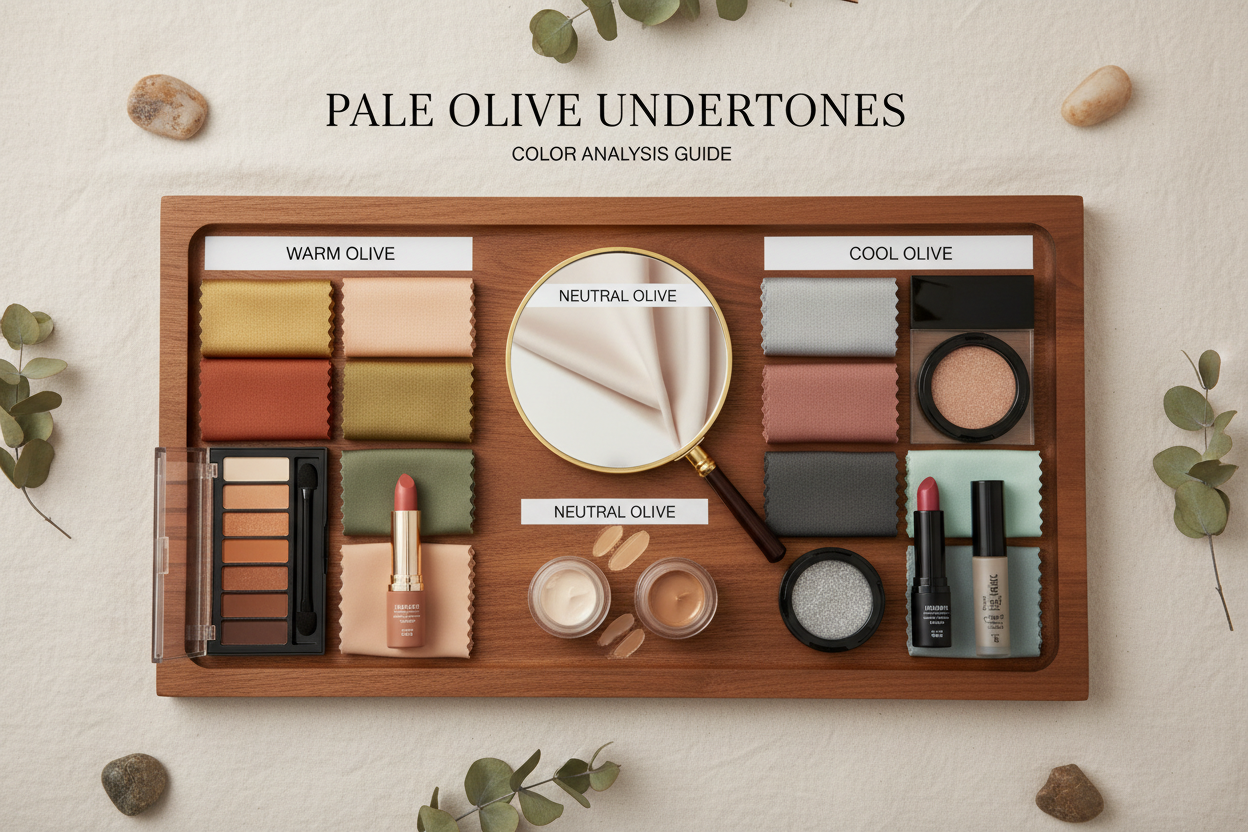
Makeup artists with formal training have described spending years misreading their own olive undertone, cycling through warm and cool products without landing anywhere useful. If that sounds familiar, it's a sign the tools weren't suited to the job, not that you missed something obvious.
A structured color analysis works around these limitations in a few concrete ways: it looks at multiple signals together rather than relying on any single check, it treats depth and undertone as related rather than independent, and it gives you specific guidance—shade range, undertone family, product categories—instead of a broad warm/cool label. It also eliminates the lighting-dependent variability that makes self-assessment so inconsistent.
If you want to move from "I think I might have pale olive skin" to something you can actually use, a systematic analysis is the most direct route.
People Also Ask
What does pale olive skin tone look like?
Pale olive skin is light in depth—roughly Fitzpatrick Types II–III—but carries a muted, greenish-neutral undertone beneath the surface. In natural daylight it looks slightly desaturated compared to clearly warm or pink complexions, without much visible flush at rest. The greenish cast tends to show up most in the under-eye area and the inner wrist. It doesn't have the warm gold of fair peachy skin, or the rosiness of fair cool skin. It reads quiet, faintly greenish or yellowish-green, especially in the right light.
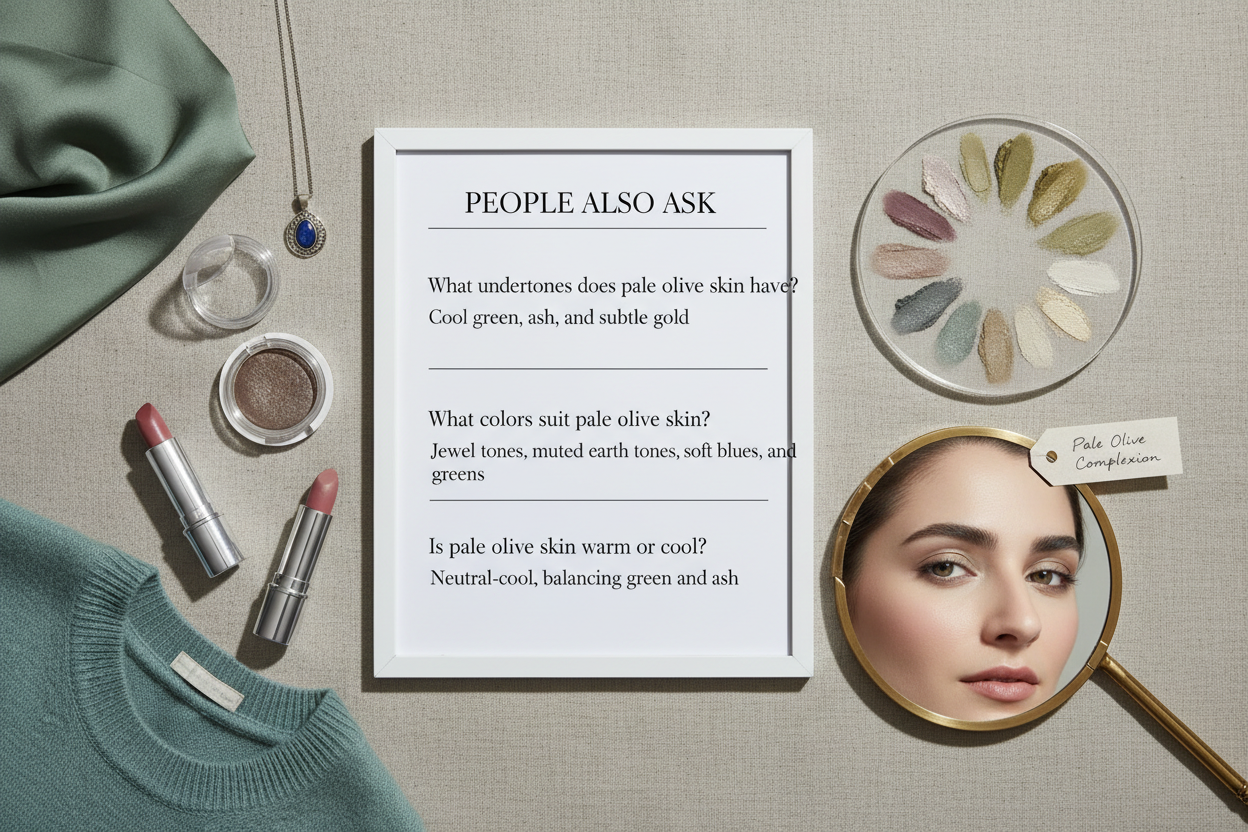
Is olive skin tone warm or cool?
Neither, really. Olive sits in a greenish-neutral category that doesn't map cleanly onto the warm/cool spectrum. The greenish quality partially cancels both the pink end of cool undertones and the golden end of warm undertones, which is why standard warm/cool tests often come back mixed or ambiguous for olive skin. Some olive complexions lean slightly warm (yellow-green), others slightly cool (gray-green), but the defining characteristic is that muted middle ground—not a clear landing on either side.
How do I know if I have an olive undertone?
A few observations together can point to olive undertone:
- Vein check: Veins on the inner wrist look blue-green rather than clearly blue or clearly green
- White paper test: Bare skin looks faintly greenish, yellowish-green, or slightly gray against white paper in natural light—not pink or warmly golden
- Jewelry test: Neither silver nor gold is dramatically flattering; gold is passable but doesn't make skin glow
- Foundation behavior: Pink-based shades look ashy; purely warm shades oxidize orange; neither feels quite right
- Undertone ambiguity: Standard warm/cool tests consistently return mixed or inconclusive readings
If several of these patterns sound familiar, olive undertone is likely. A single test on its own isn't conclusive for this undertone type.
What is the difference between pale skin and olive skin?
These two terms describe different things and can apply to the same person at the same time.
- Pale describes skin depth—how light the complexion is on a light-to-dark scale
- Olive describes undertone—the hue that lives beneath the surface
Someone can be pale (light depth) and olive (greenish-neutral undertone) simultaneously. Olive skin isn't inherently dark—the underlying pigment characteristic can show up at much lighter depths, even if olive undertones are commonly associated with medium or tan complexions. "Olive" is not a synonym for "medium-toned."
Can you have pale skin with an olive undertone?
Yes—this is exactly what "pale olive" means. Skin depth and undertone are independent characteristics. A light complexion can carry a greenish-neutral undertone just as it can carry a cool pink or warm peachy one. The olive quality is simply less visible at lighter depths, which is part of why pale olive skin is so frequently misidentified. The greenish cast tends to appear most clearly in specific areas (under-eye hollows, inner wrist) and in natural, indirect daylight rather than artificial indoor lighting.
What foundation shade works best for pale olive skin?
For pale olive skin, look for foundations that are light in depth (ivory to light beige), neutral-warm or neutral-olive in undertone rather than pink or strongly peachy, and labeled with an olive or yellow-green modifier when available. Some brands use "O" in their shade codes for this.
Two things to avoid: pink-based neutrals, which read ashy or gray against the olive undertone, and strongly yellow-warm shades, which tend to oxidize orange over time.
The easiest way to test a candidate shade: apply it to your jaw and check after 30 minutes in daylight. If it has shifted orange or looks visibly gray or pink, the undertone is off. A well-matched foundation should disappear into your skin rather than pulling in either direction.
FAQ
What exactly is a pale olive skin tone?
Pale olive skin has two separate characteristics: a light depth (toward the lighter end of the spectrum, roughly Fitzpatrick Types II–III) and an olive undertone (a muted, greenish-neutral hue under the skin's surface). The word "olive" has been used for this undertone since at least the 17th century. Depth and undertone are independent, so someone can be light-skinned and olive-toned at the same time—one doesn't cancel out the other.
Is pale olive skin considered warm, cool, or neutral?
Pale olive skin doesn't fit neatly into warm or cool. The defining characteristic is a greenish-neutral undertone that partially mutes both the rosy quality of cool skin and the golden quality of warm skin. Some people lean slightly yellow-green, others gray-green, but neither reads as a clean match for either standard category. That's why conventional undertone tests often give people with pale olive skin mixed or inconclusive results.
Why does my pale skin look greenish or yellow in some lighting?
The short answer: your undertone is showing. Pale skin has less pigment to compete with the olive undertone underneath, so it surfaces visibly—especially in natural, indirect light. You'll usually notice it most around the under-eye area and inner wrist.
Indoor lighting tends to flatten or shift the cast, so the same complexion can look neutral under fluorescents and greenish by a window. That inconsistency is a big part of why pale olive skin gets misread so often.
How is pale olive skin different from fair neutral skin?
Both sit at similar depths, but they behave differently with color.
Fair neutral skin has roughly equal pink and yellow undertones, which makes it adaptable. Most shades work without obvious clashing, whether they lean cool or warm.
Pale olive skin has a greenish-neutral undertone that isn't just a mix of pink and yellow — it reads slightly desaturated. That distinction has real consequences: pink-based products can look ashy, and strongly warm-yellow ones tend to oxidize orange. Fair neutral skin rarely runs into either problem. The sweet spot for pale olive is just narrower.
What foundation undertone should I choose for pale olive skin?
For pale olive skin, you're generally looking at ivory to light beige depths with a neutral-to-warm undertone — but specifically one with a yellow-green or olive quality rather than peach or gold. Some brands flag this with an "O" in their shade codes, or a "Y" that reads slightly greenish rather than warm-golden.
A few things to watch out for:
- Pink-based shades tend to go gray or ashy on olive skin
- Strongly peachy or orange-based shades often oxidize and pull even more orange after an hour of wear
The most reliable test: apply the shade to your jaw and check it after 30 minutes in natural daylight. If it's disappeared into your skin, you've found your match. If it reads pink, gray, or orange, move on.
Can pale olive skin tan easily despite being light?
Yes. Olive skin tends to tan more easily and burn less than other fair skin types at the same depth—that's actually one of the things that sets it apart. The melanin that creates the greenish-neutral undertone also drives a stronger tanning response. Individual results still vary, though, and lighter olive skin can absolutely burn, so sunscreen isn't optional.
How do I confirm my undertone if I think I have pale olive skin?
No single test is conclusive for olive undertone. The most reliable approach combines several observations:
- Vein check: Veins on the inner wrist appear blue-green rather than clearly blue or clearly green
- White paper test: In natural daylight against a white sheet, bare skin reads faintly greenish, yellowish-green, or slightly gray—not pink or peachy
- Jewelry test: Neither gold nor silver looks obviously right; gold is acceptable but doesn't make skin glow the way it does on warm undertones
- Foundation history: Pink-based shades look ashy; warm-yellow shades turn orange; no standard undertone category fits quite right
If several of these match your experience, pale olive is a strong possibility. Because this undertone consistently confuses standard tests, a structured color analysis can give you more precise confirmation—take the color analysis quiz to get a personalized undertone reading based on your specific complexion.
To compare this result with another established color-analysis guide, continue with the companion article “Fair Olive Skin Color Guide”, which keeps the two closely related questions distinct.