Low Contrast Face Colors
 Reviewed by Alexandra Gilmore
When skin, hair, eyes, brows, and lips sit close together in value, bold color can arrive before the face does. Identify your actual light-to-dark range, then repeat it with blended outfits, softened prints, makeup, and hair choices that preserve definition without forcing dramatic contrast.

Your face tells a story in tones. The relationship between your skin, hair, and eye colors — how similar or different they are from one another — creates what makeup artists and color analysts call your facial contrast level. If those three elements sit close together on the value scale, you have a low contrast face.
💫 Discover Your Complete Color Palette
One feature rarely explains every color that works for you. Compare your undertone, depth, clarity, and contrast as a complete palette, then use the results to test clothing, makeup, and hair colors more consistently.
Find My Color Palette →Understanding where you land on the contrast spectrum matters because it directly shapes which colors work with your features and which ones overpower them. The same bold lip that looks electric on a high contrast face can read as jarring on someone with naturally soft, blended coloring — and a barely-there look that flatters a low contrast face may simply disappear on someone with stronger natural definition.
This guide focuses specifically on the low contrast face: what it means in color analysis terms, how to identify it, and how to choose face colors and makeup that genuinely complement your natural palette rather than fight it. By the end, you will be able to:
- Recognize the characteristics of a low contrast face across different skin depths
- Understand why certain makeup shades and application techniques work better for your coloring
- Avoid the common mistakes that accidentally add harsh contrast where it doesn't belong
- Choose lip, eye, and face colors that stay true to your natural tonal range
Whether you are new to color analysis or refining what you already know, reading your contrast level is one of the most practical tools you can apply to everyday makeup decisions.
What 'Low Contrast Face' Actually Means in Color Analysis
Facial contrast isn't about how light or dark your complexion is in absolute terms. It's about the ratio — the degree of difference in value and depth among three elements: your skin tone, your hair color, and your eye color. When those three sit close together on the tonal scale, blending into a harmonious but low-differentiation whole, you have a low contrast face.
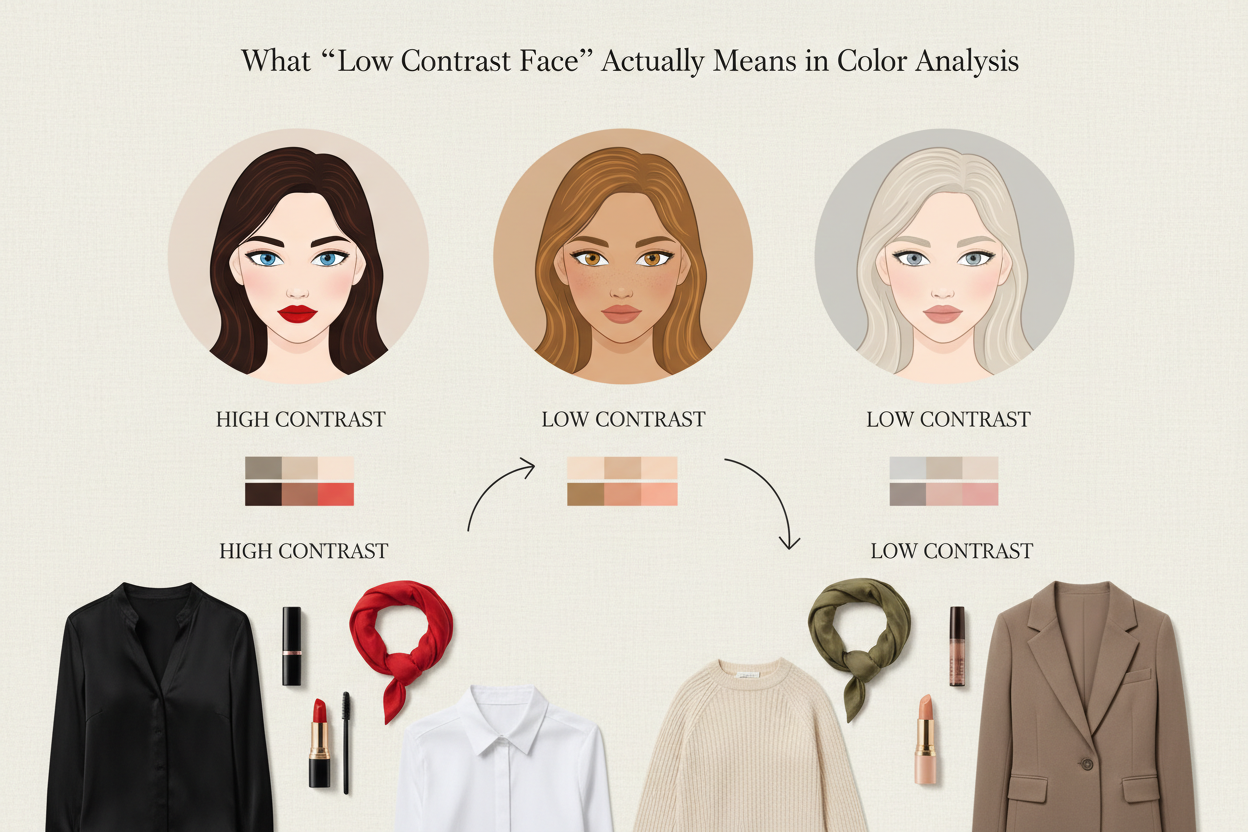
The practical result is that your features don't immediately stand out from each other. Hair doesn't sharply frame the face. Eyes don't pop against skin. Everything reads as part of a unified, softly blended palette. This isn't a flaw — it's a structural characteristic with its own distinct beauty logic.
Color analysis turns this observation into a workable system. The contrast filter concept — which has racked up millions of views online — asks a simple question: what does it actually mean to be high contrast versus low contrast, and what does that tell you about which colors to wear? The answer starts with how your features relate to each other, not just what their individual shades happen to be.
Ready to find out where you land? Take the contrast quiz →
How Contrast Theory Connects to Your Face Colors
Contrast theory in makeup isn't new. It comes from color analysis — the practice of mapping relationships between a person's natural coloring and the colors most likely to work with it.
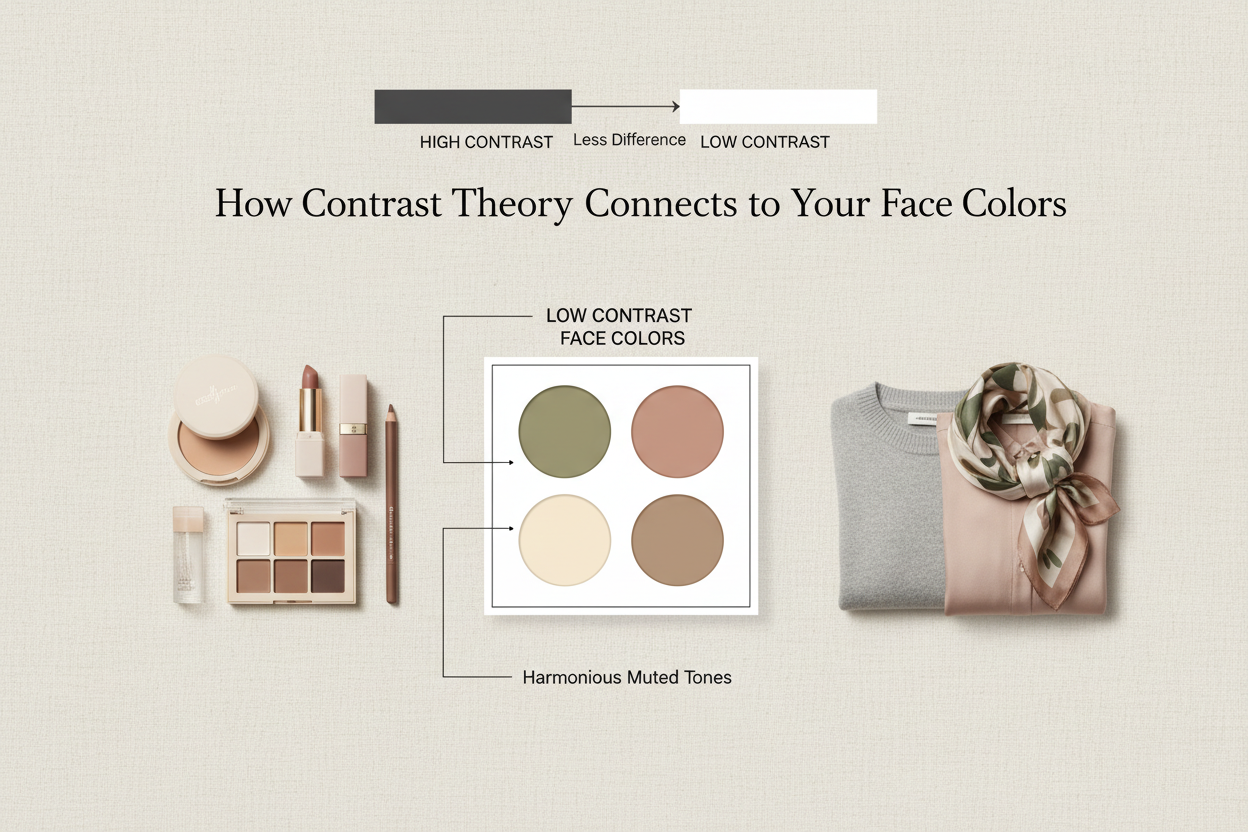
The underlying mechanism is value. In color terms, value means how light or dark a hue is, independent of its actual color. When your skin, hair, and eyes sit at similar values, your contrast is low. When they diverge sharply — very dark hair against very fair skin, or light eyes against a deep complexion — contrast is high.
This is the same principle behind contouring. Contouring uses shadow and highlight to introduce artificial depth, to create the illusion of contrast where none naturally exists. For a low contrast face, that's worth sitting with: if you have to manufacture visual drama, your natural features probably don't produce it on their own. That's not a gap to fill. It's a starting point for a different approach.
The goal for a low contrast face is alignment — choosing colors that work with the softness already there rather than imposing drama that fights it.
The Three Contrast Levels: Where Does Low Contrast Sit?
Most color analysis frameworks recognize three contrast levels:
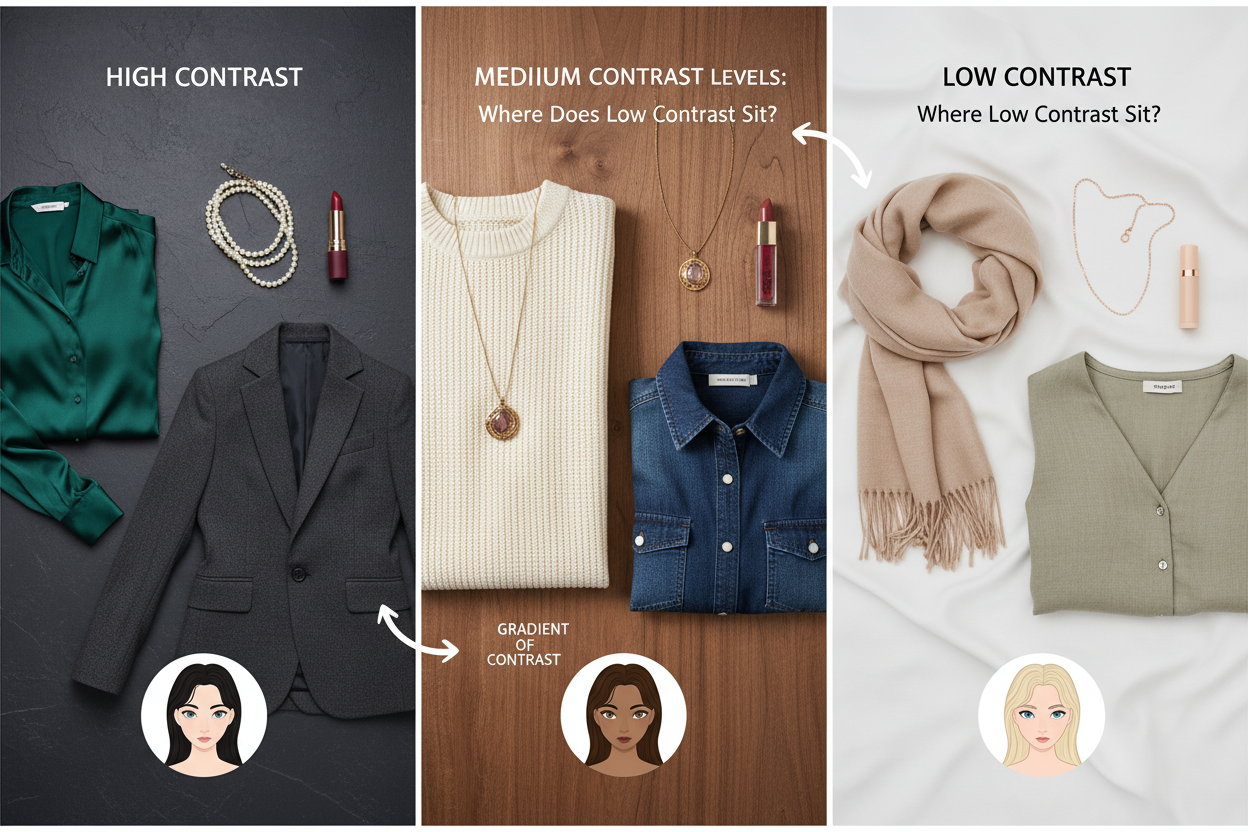
| Level | What it looks like |
|---|---|
| High contrast | Strong, clear differentiation between skin, hair, and eyes — e.g., very dark hair, pale skin, and vivid or very light eyes |
| Medium contrast | Moderate difference between features — some visual definition, but not sharply polarized values |
| Low contrast | Minimal difference in value across skin, hair, and eyes — features blend into a soft, unified tone |
Low contrast sits at the gentle end of this spectrum. It doesn't mean your features are invisible — it means the transitions between them are smooth rather than abrupt.
You can rule out high contrast if your features don't create an immediate, noticeable frame — if nobody comments on a striking hair-and-skin combination, or your eyes don't stand out dramatically against your complexion. You can rule out medium contrast if there's almost no step change between your hair, skin, and eye tones at all. If your overall impression is soft, blended, or natural, low contrast is probably where you belong.
Common Low Contrast Face Color Combinations
Low contrast isn't exclusive to fair or light complexions. It shows up across the full range of skin depths. What defines it is the similarity in value between features — not how light or dark any single one of them happens to be.
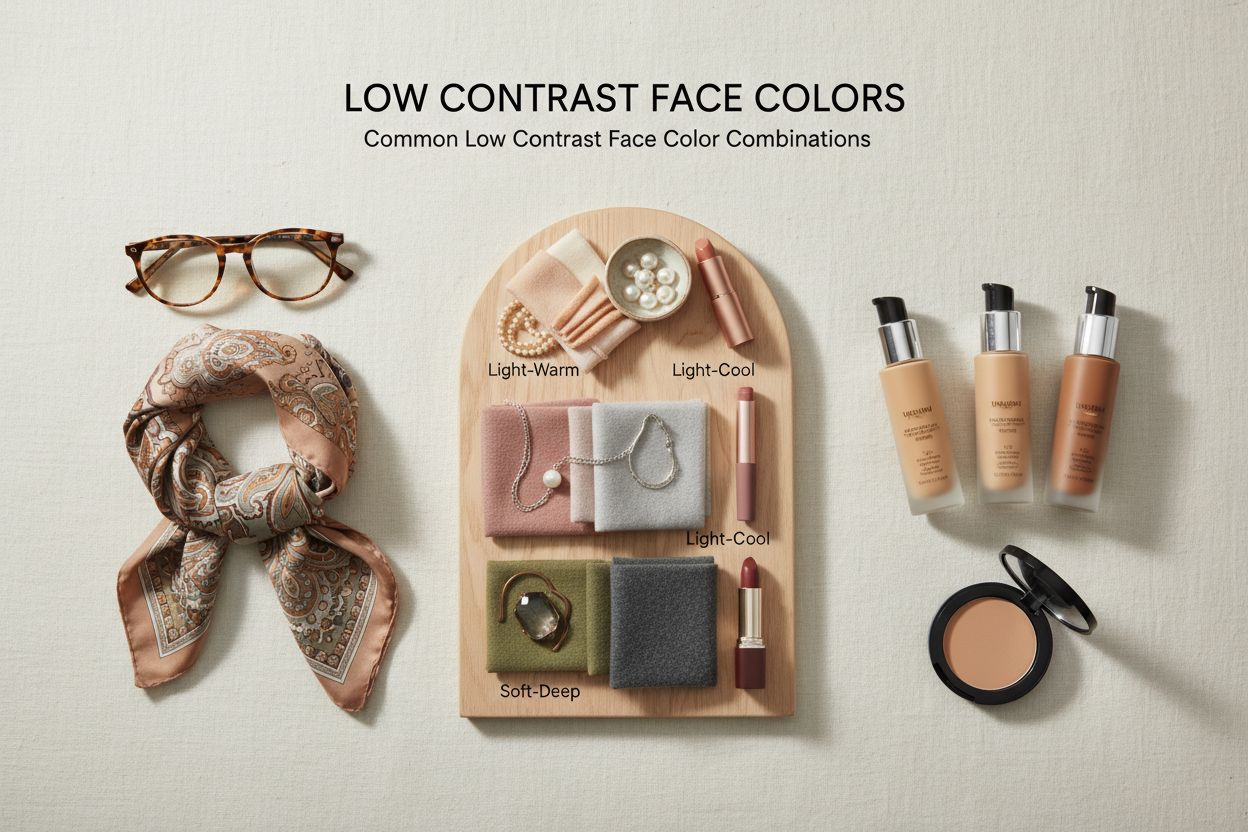
Low Contrast Across Different Skin Depths
Light skin depth examples:
- Ash blonde hair + light blue or grey eyes + fair, cool-toned skin
- Golden blonde hair + hazel eyes + light warm-toned skin
- Light golden brown hair + soft green eyes + ivory or light beige skin
Medium skin depth examples:
- Warm medium brown hair + warm brown eyes + medium olive or golden skin
- Auburn hair + amber or medium brown eyes + light-medium warm skin
- Soft chestnut hair + brown eyes + neutral medium skin
Deep skin depth examples:
- Deep brown or black hair + very dark brown eyes + deep brown or ebony skin
- Soft black hair + dark brown eyes + deep warm or neutral skin
- Dark warm brown hair + dark brown eyes + rich medium-deep skin
In each case, no single feature dramatically outpaces the others in lightness or darkness. A person with deep skin, dark eyes, and dark hair has low contrast for exactly the same structural reason as someone with fair skin, light eyes, and blonde hair — the values sit close together across all three zones.
This matters for makeup selection more than most guides acknowledge. When low contrast gets treated as a pale-skin thing, a lot of people never find advice that actually fits their coloring.
Not sure which combination describes you? Start the contrast quiz → to identify your level in a few steps.
Makeup Principles That Complement Low Contrast Features
The core idea is simple: use color to reveal your features, not fight them. When makeup stays within your natural tonal range, it looks effortless because it's working with what your face already does.
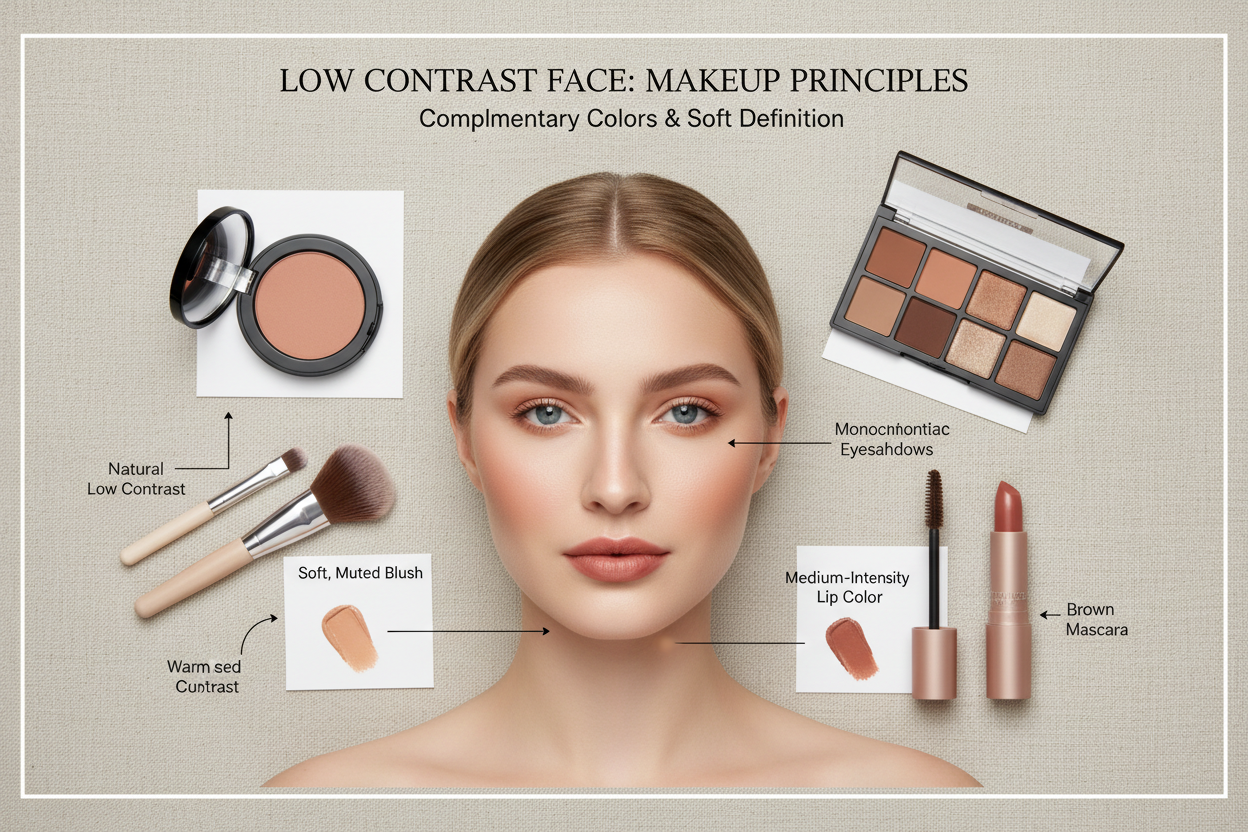
In practice, that comes down to a few habits:
Stay within your natural value range. This doesn't mean everything has to be neutral or boring. It means your makeup depth shouldn't dramatically exceed your feature depth. If your hair and eyes read as medium-value, your makeup should too — not stark and dark, not bleached out.
Prefer soft definition over sharp lines. Precise cat eyes, heavy contour, stark lip liner — these import contrast that isn't naturally there. Softly blended shadow, smudged liner, diffused edges: these look cohesive. Hard edges don't.
Use tone-matching as your baseline. A lip color one or two shades deeper or warmer than your natural lip creates polish without visual disruption. Same with brows — filling them in to match your natural color keeps the face harmonious. Going darker usually doesn't.
Let texture do the work. Shimmer, satin, and light-reflecting finishes add dimension without adding contrast. A glossy lid or a dewy highlight reads as interesting without pushing the value extremes.
Mistakes That Accidentally Add Unwanted Contrast
Contrast theory works in reverse just as well as it does in the positive direction. The same techniques that help high contrast faces lean into their drama can look harsh or dissonant on a low contrast face.
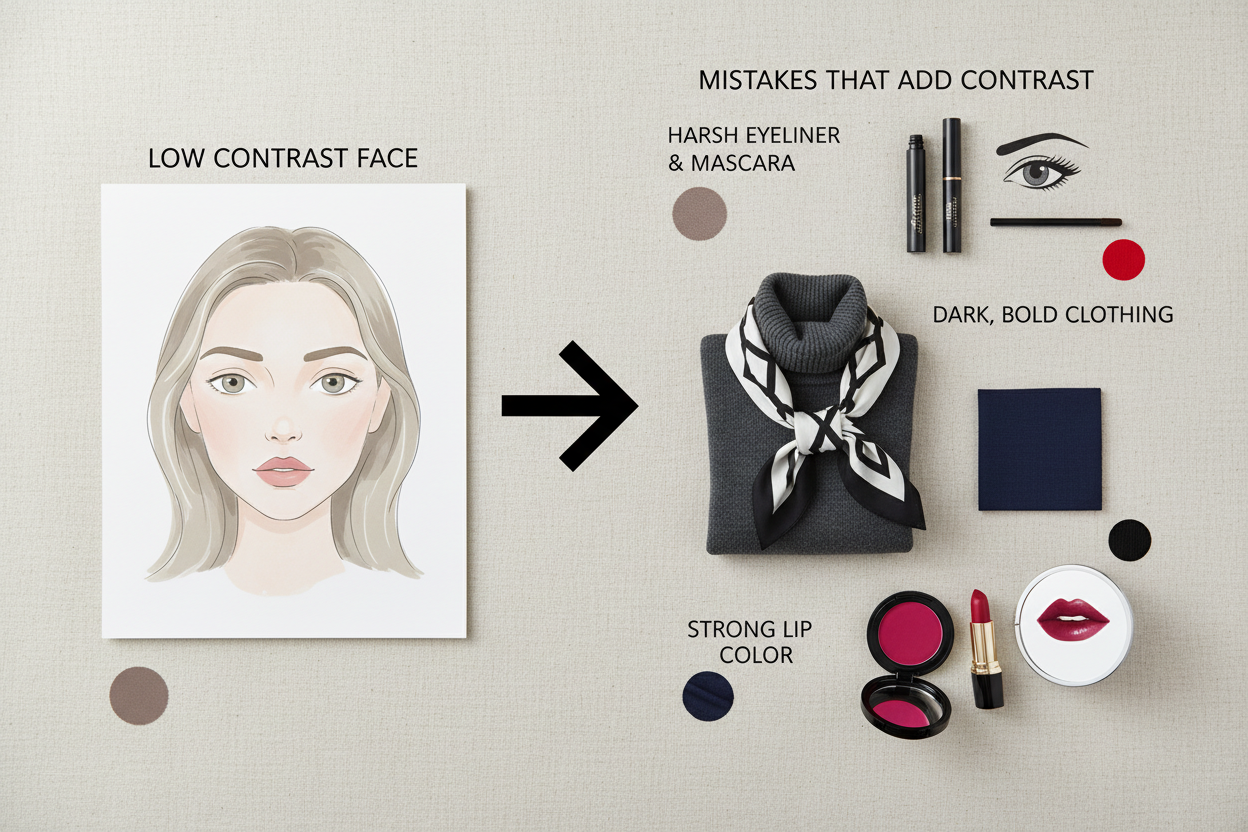
Watch out for these specific pitfalls:
- Jet-black eyeliner on the waterline or tight-line — creates an abrupt dark edge that fights soft, blended coloring
- Very dark or overly defined brows — brows significantly darker than the natural hair color import a high contrast element that pulls attention away from overall harmony
- Deep, cool-toned lip colors on warm low contrast faces — a stark plum or true red on a golden-toned face introduces a value and temperature jump that disrupts natural softness
- Heavy contouring with deep, matte powders — contouring is designed to create the illusion of contrast; applying it heavily to a low contrast face works against the face's natural tonal unity
- Sharp highlight-and-shadow combinations — extreme strobing and contouring together introduce a theatrical value range that low contrast features can't anchor
None of these choices are universally wrong — they work well for other contrast profiles. On a low contrast face, they tend to make the makeup look like it's wearing the person rather than enhancing them.
How to Confirm Your Contrast Level Before Choosing Colors
Self-assessment is a practical starting point. The most reliable method is a simple grayscale check:
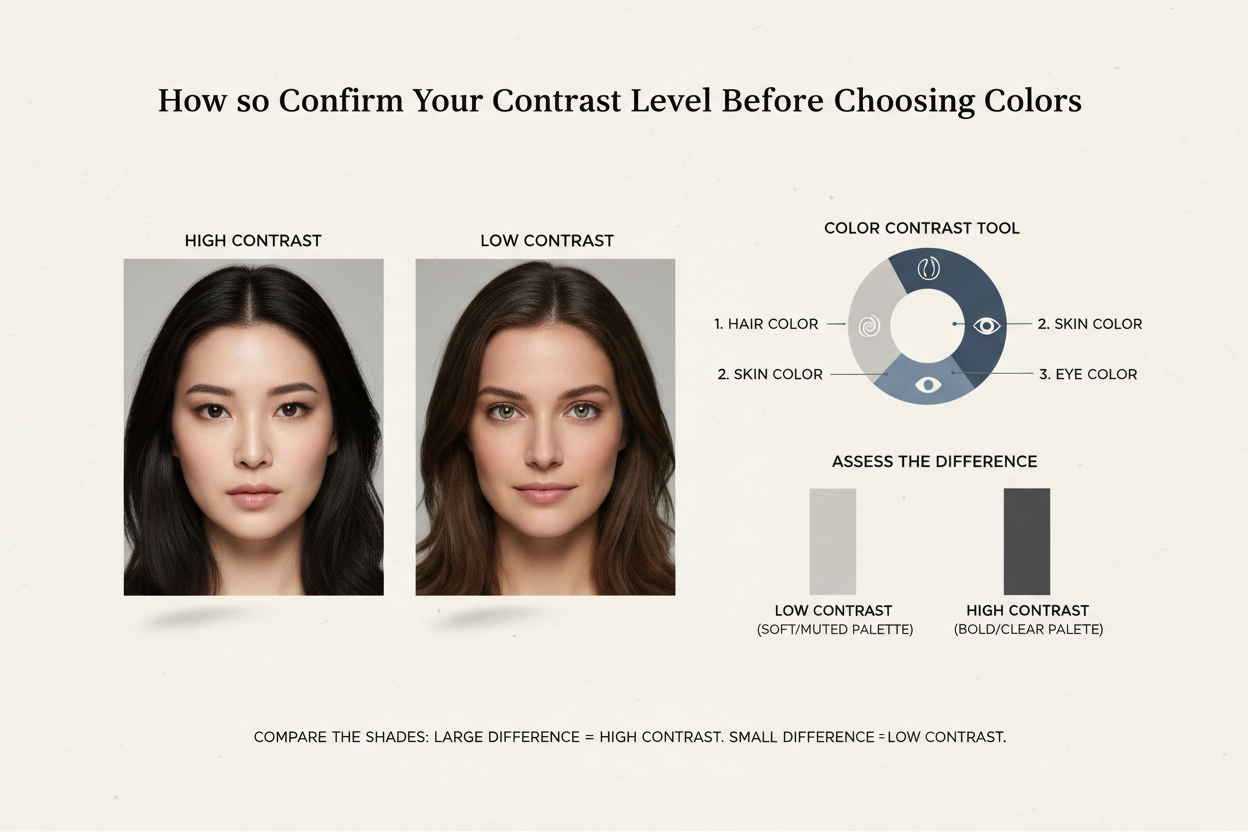
- Take a photo of your face in natural light, no makeup, with your natural hair visible (or a recent photo if you know your base color)
- Convert the photo to black and white using your phone's editing tools
- In grayscale, look at the difference in shade between your hair, skin, and eyes
If the three zones collapse toward a similar grey value — if it's hard to separate hair from face, or eyes from the surrounding skin — you're looking at low contrast. If there's a dramatic jump between zones (very dark hair against very pale skin, for example), you're likely medium or high contrast.
You can also try a quick squint test: look at yourself in the mirror and squint until your vision softens. If your features seem to dissolve into each other rather than sharpen up, low contrast is a strong candidate.
A structured quiz takes this further by accounting for undertone, eye shape, and seasonal color type — things the grayscale test won't catch on its own.
Choosing Lip and Eye Colors That Stay Within Your Contrast Range
The two makeup zones with the highest visual impact are lips and eyes. Getting these right does most of the work for a low contrast face.
For lips:
- Choose shades within two or three steps of your natural lip tone — nudes, peachy-pinks, warm roses, soft mauves, or berry tones depending on your undertone
- Avoid shades that are dramatically darker or more saturated than anything else on your face
- Glossy and satin finishes tend to work better than matte at very deep pigment levels, because they scatter light rather than sitting as a flat block of color against the face
- If you want to wear a bold lip, keep eyes minimal — this moves contrast around rather than piling it up
For eyes:
- Match eyeshadow depth to your natural iris depth — if your eyes are a medium warm brown, warm taupe and bronze shadows stay in range; if your eyes are soft grey-green, dusty mauves and soft khakis sit well
- Use liner in brown, grey, or a deep version of your eye color rather than black, particularly close to the waterline
- Brown-black mascara reads as definition without pushing to a value extreme the way blue-black can
- Blended, diffused eyeshadow edges keep the eye look consistent with the soft transitions that already exist in low contrast features
Both zones respond to the same principle: echo what's already there, then refine and elevate rather than replace.
People Also Ask
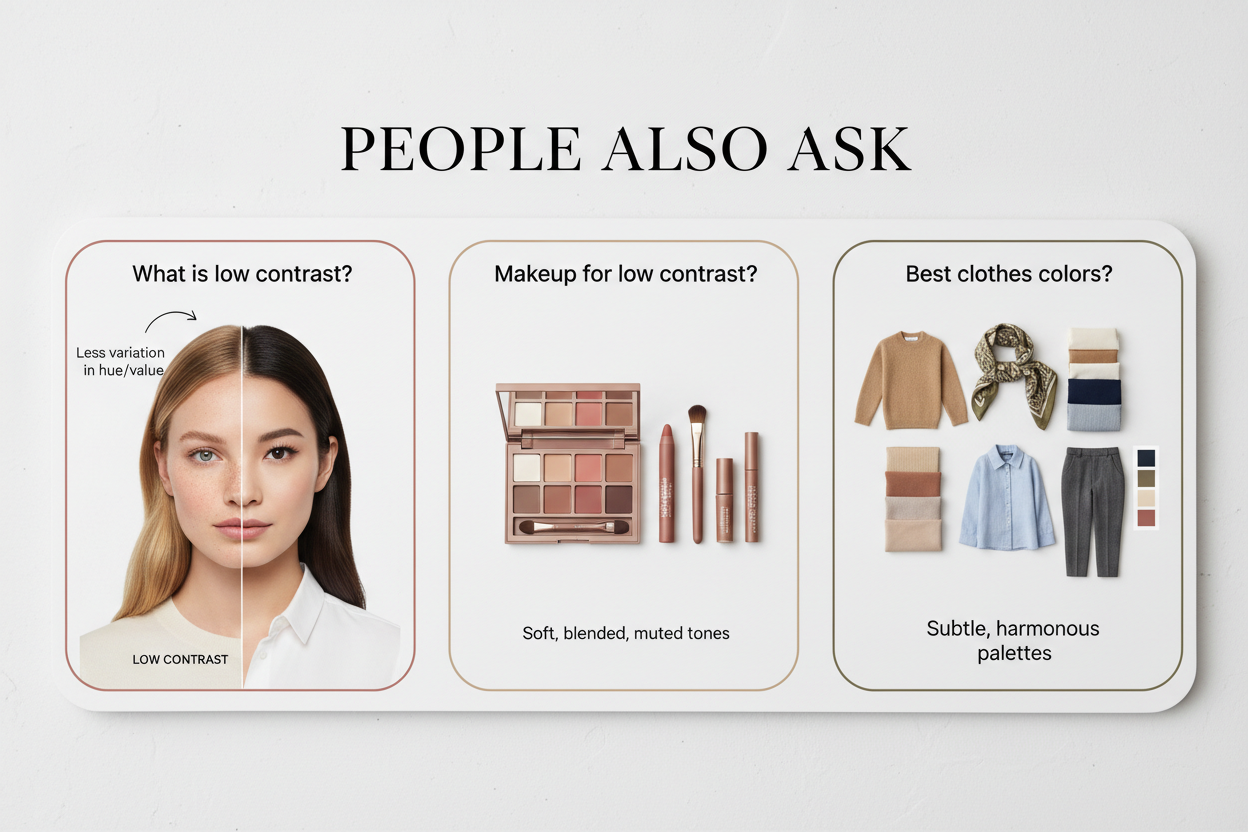
What does it mean to have a low contrast face?
A low contrast face is one where your skin, hair, and eyes sit close together in tone. No single feature stands out dramatically against the others — they blend into a unified whole rather than creating sharp distinctions. Your hair doesn't strongly frame your face, and your eyes don't jump out against your skin. This is a structural characteristic from color analysis, not a flaw or a sign of dull coloring. It just means your palette works within a narrower value range, which calls for different makeup and color choices than a high contrast face.
How do I know if I am low, medium, or high contrast?
The easiest place to start is a grayscale check. Take a photo in natural light with no makeup and your natural hair visible, then convert it to black and white. Look at whether the three zones — hair, skin, and eyes — all land near the same grey value, or whether there are clear steps between them.
- Low contrast: The zones are hard to tell apart — everything reads as a similar grey tone
- Medium contrast: There's a visible step between zones, but nothing sharply polarized
- High contrast: Strong, obvious separation — very dark hair against pale skin, or vivid eyes against a deep complexion
You can also try the squint test: soften your gaze in the mirror until your vision blurs slightly. If your features seem to dissolve into each other rather than sharpen into distinct zones, you're probably low contrast. A color analysis quiz can take it further by factoring in undertone and seasonal color type alongside pure value.
What makeup colors suit a low contrast face?
Makeup for a low contrast face works best when it stays within your existing tonal range rather than importing new depth. Some practical guidelines:
- Lips: One to three shades from your natural lip tone — nudes, peachy pinks, warm roses, soft mauves, or berry tones depending on your undertone — look polished without disrupting the overall balance
- Eyes: Eyeshadow that matches your natural iris depth; warm taupe and bronze for warm brown eyes, dusty mauve and soft khaki for cool grey-green eyes
- Liner: Brown, grey, or a deep version of your eye color rather than stark black, especially on the waterline
- Brows: Filled in to match your natural brow color, not dramatically darker
- Finish: Satin, shimmer, and gloss add dimension without pulling in harsh value contrasts
The basic idea is to stay within your natural contrast range and use texture and warmth to add interest, rather than forcing depth differences that aren't already there.
Is low contrast the same as having a soft or muted coloring?
They overlap a lot, but they're not the same thing. Low contrast refers to the relationship between your skin, hair, and eye values — specifically, how similar those values are to each other. Soft or muted coloring, in seasonal color analysis, refers to saturation — how much grey or neutral is mixed into your overall palette, rather than how your features compare in depth.
Most people with soft or muted seasonal types also have low contrast, because lower saturation tends to come with closer tonal values across features. But you can have low contrast with relatively clear, bright individual colors, and muted coloring can occasionally read as medium contrast if the hair and skin are far enough apart in depth. Contrast level and color season both describe your natural coloring, just from different angles.
Can a person with dark skin have a low contrast face?
Yes — and this is one of the most important points to understand about contrast. Low contrast is not about the absolute lightness of your complexion. It is about the ratio of values between skin, hair, and eyes. A person with deep brown skin, very dark brown eyes, and deep brown or black hair has low contrast for exactly the same structural reason as a person with fair skin, soft blue eyes, and blonde hair: all three features sit close together in tonal value, with no single zone creating a sharp visual break from the others.
Treating low contrast as a fair-skin phenomenon is a common misreading of the concept, and it means many people with medium or deep complexions never find color guidance that accurately reflects their features. The grayscale check works equally well across all skin depths — what you are looking for is not lightness, but closeness of value between the three zones.
FAQ
What is the difference between low contrast and high contrast in color analysis?
Contrast level in color analysis refers to how much tonal difference there is between three facial zones: skin, hair, and eyes. On a high contrast face, those zones are clearly separated in value — very dark hair against a pale complexion, say, or deeply pigmented eyes against light skin. The difference between zones is obvious and visually striking. On a low contrast face, those same zones sit close together in depth, so features tend to blend into each other rather than stand apart.
Neither is better. They're just descriptions of how light and dark values relate across the face. Where it matters practically is in how each responds to color. High contrast faces can carry bold, polarized makeup without looking imbalanced. Low contrast faces tend to look most harmonious when makeup stays within a narrower value range — sharp extremes can overpower features that weren't structured to anchor them.
How do I test whether my face is low contrast?
The most reliable self-test is a grayscale conversion. Take a photo in natural light, no makeup, with your natural hair visible, then convert it to black and white. You're looking at whether your hair, skin, and eyes land at similar grey values or read as clearly distinct tones.
- Similar grey values across all three zones: points toward low contrast
- Noticeable steps between zones, but not extreme: likely medium contrast
- Strong, obvious separation between zones: points toward high contrast
There's also the squint test: soften your gaze in a mirror until your vision blurs. If your features dissolve into one unified tone rather than separating into distinct zones, low contrast is a real possibility. That said, lighting and personal interpretation vary enough that a structured color analysis tool, one that accounts for undertone and seasonal type alongside value, will get you further than a quick mirror check.
Does low contrast mean I should avoid bold makeup entirely?
Not entirely — but how you build a bold look matters. A deeply pigmented lip or a dramatic eye can work on a low contrast face when it's the only point of emphasis and everything else stays quiet. The problem comes from stacking: dark liner plus deep shadow plus vivid lip can overwhelm features that aren't built to carry that much intensity at once.
The more useful reframe is that bold means something different depending on your natural contrast level. Rich texture — glossy lips, shimmer on the lids, a luminous base — reads as elevated without importing extreme value contrast. A plum lip in a warm berry tone makes a statement without the harsh visual break that stark black liner across the entire eye would create. Working within your natural contrast range doesn't mean playing it small. It means choosing the kind of impact that actually suits your face.
Can my contrast level change with age or hair color changes?
Yes, and these are two of the most common reasons a contrast level shifts. Hair is the zone most likely to change over time, and it has a significant effect on overall facial contrast:
- Natural greying or lightening typically moves a face from medium or high contrast toward low, because the value gap between hair and skin narrows
- Artificially darkening hair can push a naturally low contrast face toward medium or high contrast, at least temporarily
- Skin changes with age — including uneven pigment softening — can reduce the apparent depth of the skin zone and nudge contrast lower
This is why contrast-based makeup guidance may need revisiting at different life stages. Someone who wore warm medium-depth lip shades at thirty may find at fifty that slightly lighter, softer tones feel more balanced — not because their taste changed, but because their face changed. If you've had significant hair changes, it's worth re-evaluating rather than assuming a previous assessment still holds.
What hair colors are most common in low contrast faces?
Low contrast tends to cluster around hair shades that stay tonally close to the complexion rather than creating strong visual separation. Common examples include:
- Warm blonde to light golden brown on fair to light skin
- Soft ash brown or mousy brown on light to medium skin
- Medium warm brown on medium olive or tan skin
- Deep brown to soft black on medium-deep to deep skin tones, particularly when the eyes are similarly deep
The specific hair color matters less than how much value distance it creates from the skin. Someone with medium brown hair and medium olive skin can still read as low contrast even though neither element looks particularly light or dark on its own. It's always the ratio between zones — not the absolute depth of any single zone — that places a face in the low contrast category.
Is low contrast face the same as a soft or muted color season?
Related, but not identical. Low contrast describes the structure of your face — specifically, how your three facial zones compare in tonal value. Soft or muted, as seasonal color analysis uses those terms, describes saturation: how much grey is mixed into your natural coloring rather than pure, vivid pigment.
The two qualities often show up together. Lower saturation in individual features tends to coincide with closer values across them. Soft Summer and Soft Autumn are both seasonal types where muted saturation and low contrast commonly appear in the same person. But the overlap isn't total:
- Someone can have low contrast with relatively clear, distinct feature colors
- Someone with muted coloring can still show medium contrast if their hair and skin differ enough in depth
Contrast level and color season are two separate layers of analysis. Keeping them separate gives you a more accurate read of how colors will behave on your face than treating them as the same thing.
Which makeup mistakes make a low contrast face look washed out?
Most of the common errors share the same root cause: introducing value extremes the face's natural contrast can't anchor, or not providing enough definition to keep features visible in the first place.
- Too-light foundation or concealer with no warmth or dimension flattens the face and removes what little tonal variation it has
- Stark or frosty lip colors that pull the lip zone lighter than the surrounding skin, erasing the mouth rather than defining it
- Skipping brow definition, which removes a key structural anchor on a face where features already tend to blend together
- Heavy matte black liner all the way around the eye, which creates a visual weight the face isn't built to balance and often makes features look smaller, not more defined
- Matching all makeup tones to skin with no shift in depth, leaving a single-note look where no feature reads clearly
- Piling on multiple bold elements at once, which overwhelms rather than lifts
The fix is rarely more intensity. It's placing slightly deeper or more defined tones at the right points — using texture and warmth to add life while staying within the tonal range your face already works in.