Deep Winter Olive Skin
 Reviewed by Alexandra Gilmore
Olive skin can belong to Deep Winter even when its green-yellow cast appears warm at first glance. Learn how cool dominance, strong depth, and higher contrast can sit over an olive base, then test black, jewel tones, icy accents, and blue-based shades against earthy Deep Autumn alternatives.

Olive skin confuses even experienced color analysts — and deep winter olive skin takes that confusion to another level entirely.
💫 Discover Your Complete Color Palette
One feature rarely explains every color that works for you. Compare your undertone, depth, clarity, and contrast as a complete palette, then use the results to test clothing, makeup, and hair colors more consistently.
Find My Color Palette →Here is why: olive complexions carry an inherent yellow-green undertone that reads as warm. Yet deep winter is a cool, high-contrast season. Put those two descriptions side by side and most people assume they cannot coexist. That assumption leads to mistyping, frustrating wardrobe experiments, and color palettes that sit unworn in a Pinterest board.
The truth is more interesting. Deep winter olive skin does not sit cleanly on either side of the warm-cool divide. It occupies a specific zone where cool dominant undertones layer over a muted olive base, creating a complexion that needs colors calibrated to both realities at once — not one or the other.
Getting this wrong has real consequences:
- Too warm a palette (think autumn's burnt oranges and caramels) pulls out the sallow, muddy quality in olive skin rather than its depth and richness.
- Too icy a winter palette (pale lavenders, powder blues) strips contrast away and leaves the complexion looking flat.
- Generic "winter" advice that ignores the olive undertone produces the same washed-out result.
This guide is built around the specific intersection of deep winter and olive skin. By the end, you will know exactly which colors amplify this complexion's natural drama, which ones to cut from your wardrobe, and how to identify whether deep winter is genuinely your season or whether a neighboring palette — soft autumn or dark autumn — is the better fit. The guidance draws on color analyst frameworks and the practical reality that olive skin is, as one source notes, one of the most nuanced complexion types to navigate in a seasonal context.
If you have been told you are "probably autumn" because of your olive tone, or "definitely winter" because of your dark features, and neither answer has ever felt quite right — this is the guide written for you.
What Makes Deep Winter Olive Skin Uniquely Complex
Most seasonal color systems were built around clean undertone categories — warm or cool, bright or muted. Olive skin doesn't fit that framework, and deep winter olive skin makes the tension worse.
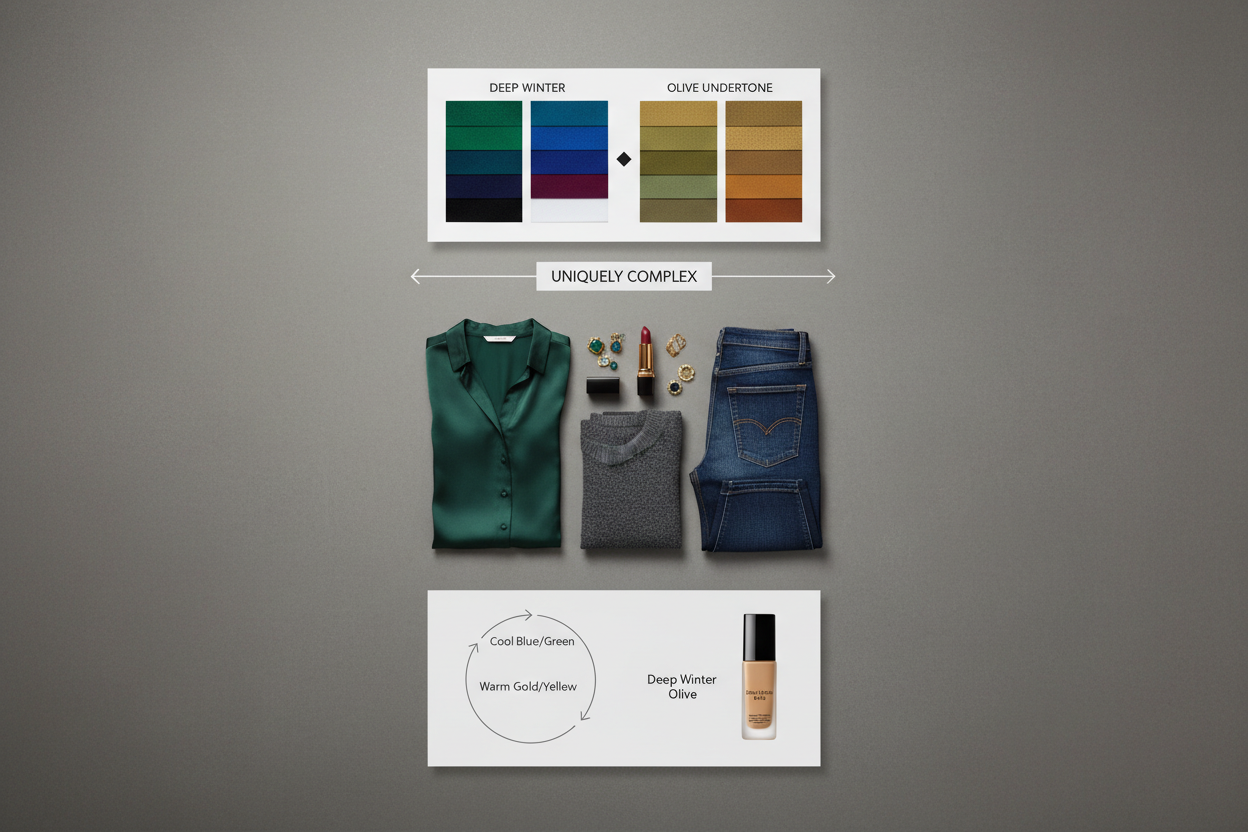
The core problem is that olive complexions carry a yellow-green pigment layer that reads warm at the surface. Deep winter, on the other hand, is built on cool, dark, high-contrast coloring. When an analyst sees someone with olive skin and dark features, that warm surface reading tends to pull the diagnosis toward autumn — usually dark autumn or soft autumn — even when the actual undertone is cool.
That misclassification matters in practice. Autumn palettes lean heavily on earthy warmth: terracottas, warm browns, golden mustards. On deep winter olive skin, those colors bring out the sallow, muddy quality of the undertone instead of its richness. The complexion ends up looking tired rather than deep.
Deep winter olive exists as a real category because olive skin is not the same as warm skin. The yellow-green cast can sit on top of a cool or neutral-cool base. When it does, the seasonal prescription shifts completely. Colors have to work with both the olive depth and the cool axis at the same time — not defaulting to autumn's warmth, but not reaching for icy winter pastels either, which tend to flatten the complexion's natural contrast.
That two-axis problem is why olive skin is one of the harder complexion types to classify accurately in a seasonal system. Getting it right means looking past the surface to read the undertone underneath — which a basic warm-or-cool test consistently misses.
7 Signs You Actually Have a Deep Winter Olive Palette
Not every olive complexion belongs in deep winter. These seven markers help distinguish a genuine deep winter olive type from neighboring seasons.
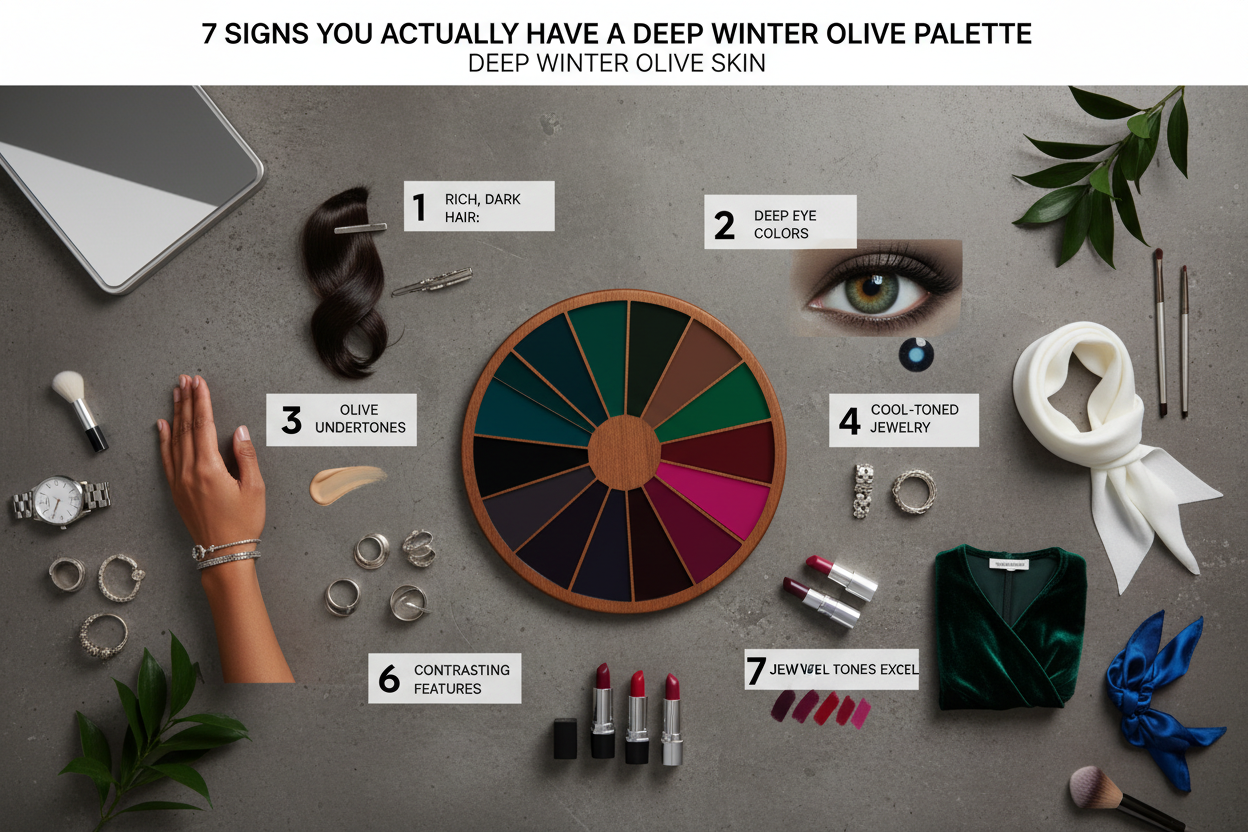
1. Your natural coloring is high contrast overall. Hair, eyes, and skin create a noticeable dark-to-light contrast — not a blended, low-key look. Deep winter needs this level of drama. Soft autumn and soft summer do not.
2. Your skin tone is medium to deep, not light. Deep winter olive tends to sit in the medium-deep to deep range. Lighter olive tones with the same contrast profile often point toward true winter instead.
3. Your hair is naturally very dark — near-black, dark brown, or dark espresso. Hair that reads as rich auburn or warm chestnut at a distance suggests autumn rather than winter. Deep winter hair absorbs light rather than throwing warmth back at you.
4. Your eyes are dark — deep brown, near-black, or very dark hazel. Eye color in deep winter olive rarely reads as light or bright. The depth in the eyes matches the depth in the skin and hair.
5. Cool colors read more sophisticated on you than warm ones. Hold cool jewel tones — deep emerald, sapphire, plum — near your face and your skin looks cleaner, more defined. Warm earth tones do the opposite: they flatten things out or muddy your complexion.
6. Warm palettes make you look tired, not glowing. Autumn's signature colors — burnt orange, camel, warm olive green — tend to make your face recede rather than lift. If this happens consistently, it's a reliable sign you've been mistyped as autumn.
7. Icy pastels wash you out rather than brightening you. True bright winter's pale icy tones leave deep winter olive skin looking ashy or dull. Your complexion needs depth, not lightness. If the icy stuff falls flat but cool and deep works, deep winter is the more likely fit.
Is Your Olive Skin Warm, Cool, or Neutral? How to Tell
The warm-cool question is the single most important diagnostic step for olive skin — and it's the one most people skip or get wrong.
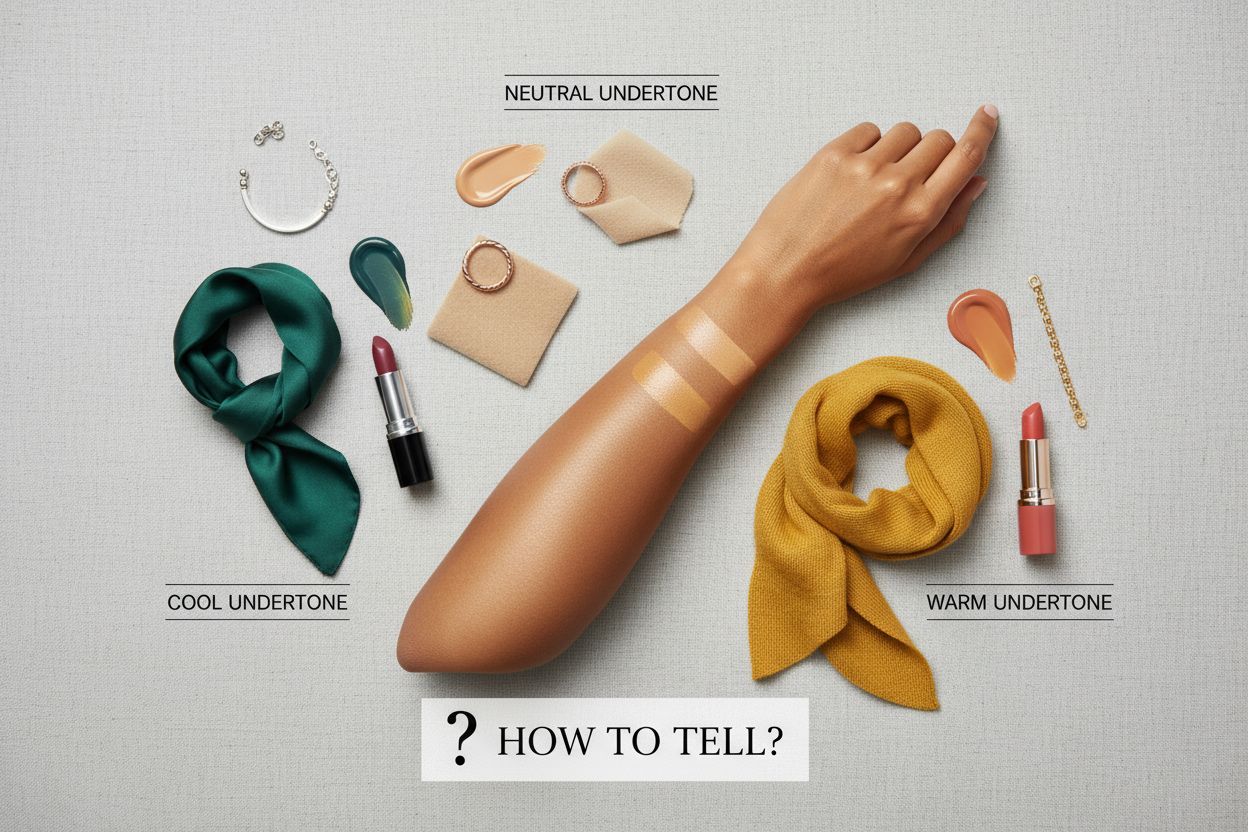
Color analysts Sarah and Lucinda, who specialize in olive skin classification, are direct about this: figuring out whether olive skin reads warm, cool, or neutral takes more than a quick look. The olive cast itself isn't the signal. What sits beneath it is.
Self-test 1: The vein check Look at the veins on the inside of your wrist in natural daylight, not artificial light. Blue or purple veins point to a cool undertone. Green veins point to warm. A mix — or difficulty reading a clear color at all — suggests neutral-cool, which is common in deep winter olive.
Self-test 2: The jewelry test Hold silver and gold jewelry against bare skin without makeup. Silver near the face should make your skin look clearer and your eyes brighter if you're cool-dominant. Gold should either blend into the skin or create a muddled look. If gold looks equally good or better, dark autumn may be a closer fit than deep winter.
Self-test 3: The white versus off-white test Place a pure cool white fabric next to your face, then swap it for a warm cream or ivory. Cool white looking sharp and clean suggests a cool undertone. If it reads harsh or a bit grey, you may be neutral-cool — still potentially deep winter, but possibly sitting closer to the neutral-cool zone that separates deep winter from true winter.
Self-test 4: Warm versus cool clothing from a distance Have someone photograph you in a warm-toned top and a cool-toned top under the same light. In the warm version, does your skin look yellowish or flat? In the cool version, does it look defined? The camera tends to catch what the eye talks itself out of seeing.
One thing worth keeping in mind: olive skin can carry a cool undertone while still appearing warm on the surface. These tests are designed to get underneath that surface read to the structural undertone below.
The Deep Winter Olive Color Formula: What to Wear
The prescription for deep winter olive skin comes down to one principle: cool-dominant, high-depth colors that bridge the warm-cool axis without killing contrast. Avoid the icy end of winter and the earthy end of autumn. Build your wardrobe in the zone between — deep, cool-leaning, and richly saturated.
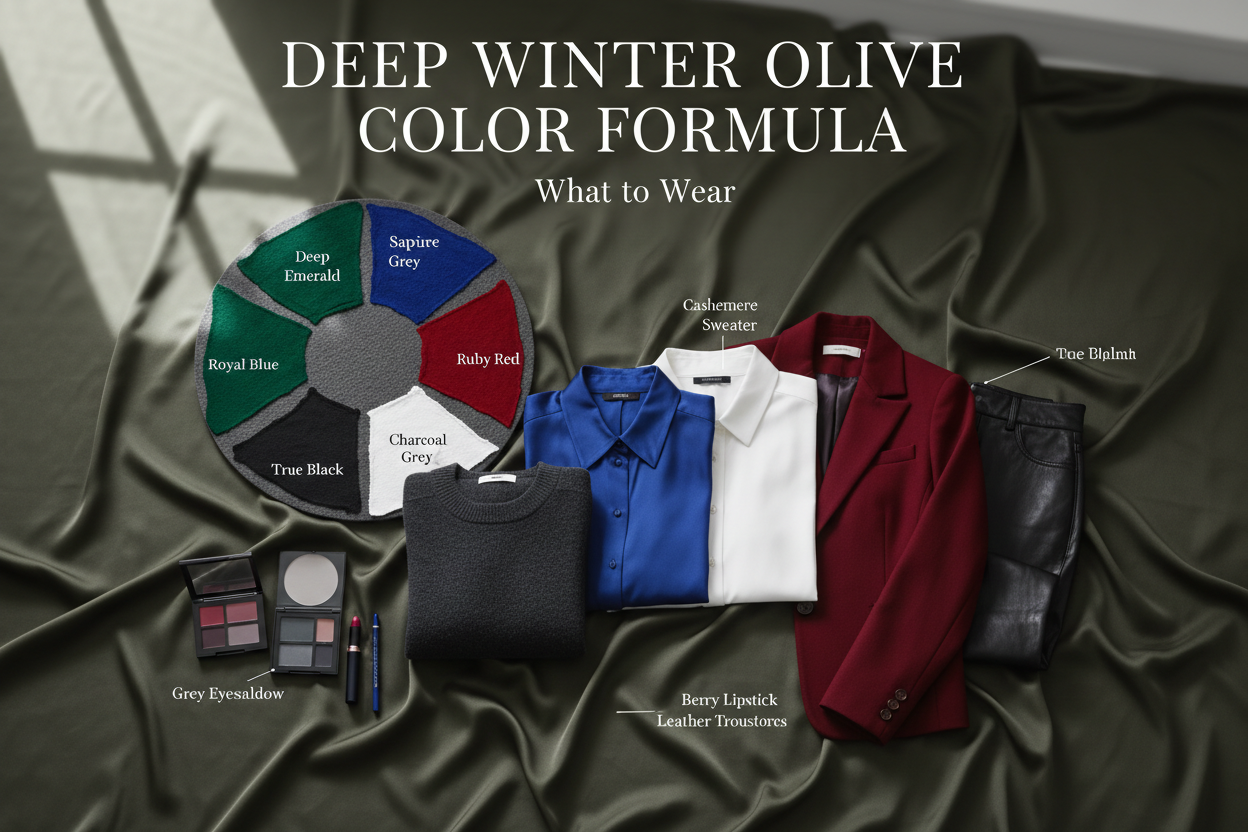
Three layers:
- Foundation neutrals that hold depth without pulling warm or cold
- Statement jewel tones that activate olive's natural richness
- Accent colors that add dimension without muddying the palette
Neutrals That Work: Charcoal, Espresso, and Cool Taupe
Neutrals matter most because you wear them constantly. For deep winter olive, temperature is everything.
Charcoal is the most reliable neutral here. Cool grey depth without the starkness of black — it mirrors the season's cool axis while holding up against olive's natural depth. Trousers, blazers, knit pieces, all of it works.
Espresso brown is the palette's warm-leaning neutral, and it earns its place because it's a dark, cool-adjacent warm rather than a honey or caramel. The depth keeps it inside deep winter's range. It works particularly well as a contrast layer against cooler pieces.
Cool taupe — greyed and slightly ashy, not beige-leaning — threads the warm-cool axis in a way that suits olive. The key test: if it reads beige or sandy, it's running too warm and will pull out the sallow quality in olive skin. If it reads grey-mauve or grey-brown, it's sitting in the right place.
Warm beiges, camel, and tan are caution tones. They work on dark autumn olive but tend to flatten deep winter olive by pulling too warm.
Accent Colors: Jewel Tones That Amplify Olive's Richness
This is where deep winter olive really performs. Cool saturation and high depth play directly to what this complexion does naturally — absorbing and reflecting rich color.
Emerald green is probably the most powerful accent in this palette. The cool green resonates with the green cast in olive skin rather than fighting it, and the depth of the shade holds the winter contrast requirement. Bright greens and lime shades — warm and high-key — don't produce the same effect.
Burgundy and deep plum are the palette's red-adjacent family. They replace orange-reds (which belong to autumn) with cool berry-based reds that work with olive's undertone instead of against it. They also give you strong contrast against the neutrals above.
Sapphire blue brings cool brightness without icing out. Unlike pale blue, which drains olive depth, sapphire carries enough weight to hold the palette's contrast requirement while giving you a vivid cool accent.
Deep teal sits at the intersection of blue and green, and it works unusually well for this complexion — it picks up both the cool undertone of winter and the muted green cast of olive skin at the same time.
Saturation matters as much as hue. Deep winter olive skin needs colors that are rich and fully saturated, not muted or pastel. Dusty versions of these jewel tones — dusty teal, muted sage, faded plum — read more soft summer or soft autumn, and they lose the contrast depth that makes the palette work. When you're choosing pieces, go for the fully saturated, clear version of each color, not the washed-out one.
Colors to Avoid If You Have Deep Winter Olive Skin
Knowing what not to wear is as useful as knowing what to wear. For deep winter olive skin, problem colors fall into two categories: colors that over-warm the complexion and colors that over-cool it.
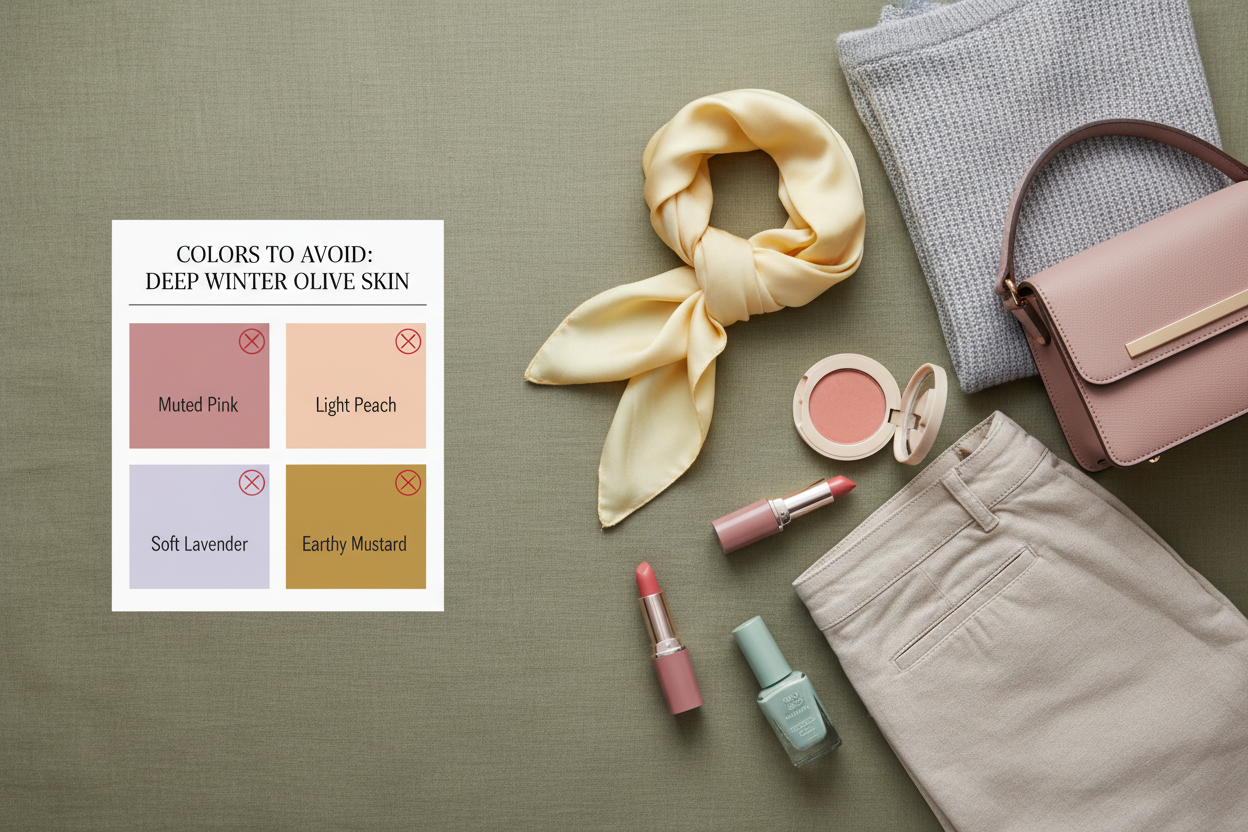
Over-warming colors to avoid:
- Camel and tan — Pull the yellow-green cast forward, creating a sallow rather than luminous effect
- Warm rust and terracotta — Autumn's signature palette; they flatten the cool depth in this complexion
- Golden yellow and mustard — Amplify the olive cast in an unflattering direction
- Warm olive green — Counterintuitively, the color closest in name to the skin tone is rarely the right choice; warm olive activates the muddiest quality of the undertone
- Peach and coral — Clash with the cool axis; read as orange against olive's green base
Over-cooling colors to avoid:
- Icy pastels (pale lavender, powder blue, soft pink) — Designed for bright winter or summer types; they strip contrast from deep winter olive, leaving the complexion looking washed out and greyish
- Pure cool white as a primary color — Too stark in large amounts; works as an accent but not as a dominant tone
- Pale grey or silver-toned neutrals — Lighter versions of grey pull the coolness too far and create an ashy effect against olive skin
Middle-ground colors that frequently mislead:
- Warm brown — Works for dark autumn but reads as muddy on deep winter olive
- Bright true red — Depends heavily on the red's specific temperature; blue-reds work, orange-reds do not; this one requires testing before committing
How to Apply the Deep Winter Olive Palette in Real Outfits
Theory is one thing. Actually getting dressed is another. Here are three scenarios that translate the formula into real wardrobe decisions.
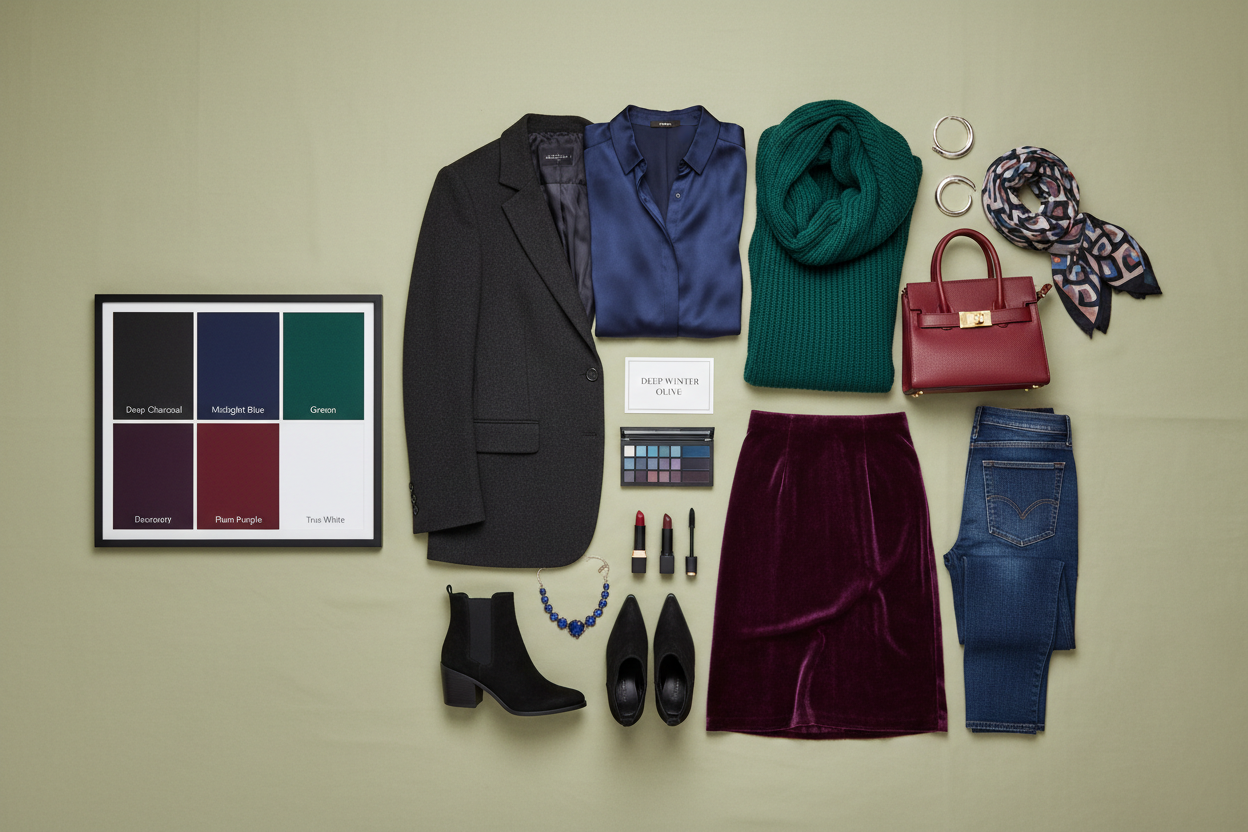
Scenario 1: The everyday neutral base Start with charcoal or espresso as your foundation — charcoal trousers, a dark espresso knit, cool taupe. Layer a cool white, deep navy, or another deep neutral on top. This works for most professional and casual situations without needing a jewel tone every day.
Scenario 2: The statement color moment Pick one jewel tone as the focal piece — a sapphire blazer, an emerald sweater, a deep plum blouse — and ground it with charcoal or espresso underneath. The jewel tone does the work; the neutral keeps it from getting loud. Don't pair two jewel tones unless one is dark enough to read as near-neutral.
Scenario 3: The monochromatic deep winter look Build an all-dark, tonal outfit using two values of the same family: deep charcoal with a lighter cool grey, or espresso with a dark teal accent. Monochromatic dressing plays up the high-contrast quality that deep winter olive skin carries naturally. It also sidesteps the guesswork of mixing warm and cool tones.
A note on pattern: Patterns follow the same temperature rules as solids. Geometric prints in deep cool tones work well. Patterns that bring in warm tones — florals with peach and yellow, paisley with orange accents — reintroduce the same over-warming problem the palette is trying to solve.
Find Your Exact Deep Winter Olive Season With a Color Analysis
Self-assessment has real limits — and the warm-cool diagnostic challenge specific to olive skin is exactly where those limits show up.
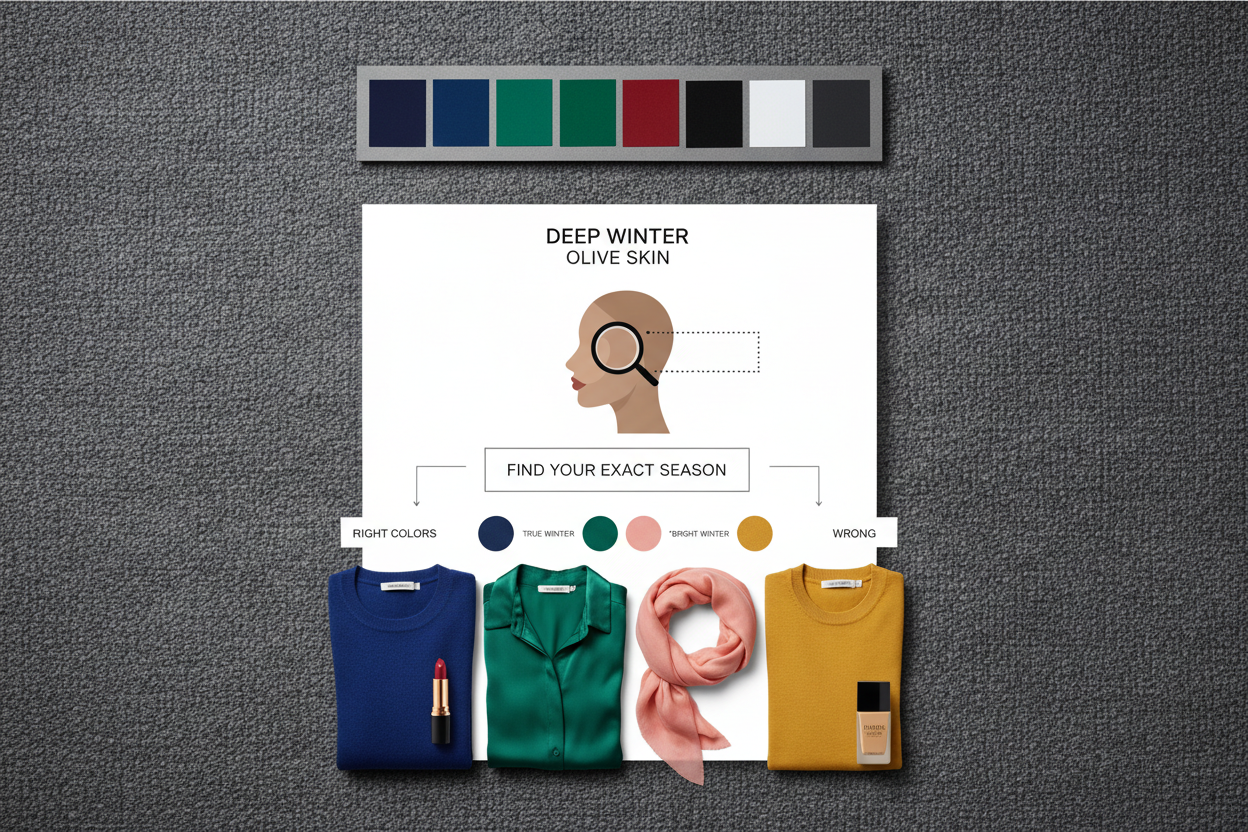
The self-tests in this guide help narrow the field. But a few things resist home testing:
- Lighting conditions shift how undertones read, making vein and jewelry tests unreliable outside neutral light
- Adjacent season confusion — especially between deep winter and dark autumn — needs side-by-side color draping to resolve
- Neutral-cool versus warm-neutral is a fine distinction that changes the palette recommendation in ways a self-test can't calibrate
- Depth level within deep winter varies: some deep winter olive types sit closer to true winter, others toward dark autumn's border, and that position matters for which colors actually work
A professional color analysis — or a well-structured digital tool calibrated for olive skin — gives you the draping comparison that makes these distinctions visible in a way mirrors and articles can't.
The goal at this stage isn't to replace that process. It's to arrive at it informed. Understanding the warm-cool tension in deep winter olive skin means that when you do get a color analysis, you'll know which questions to ask and how to interpret what you see — rather than accepting a default autumn placement just because of your olive tone.
People Also Ask
What colors should deep winter olive skin avoid?
Two groups consistently underperform on deep winter olive skin.
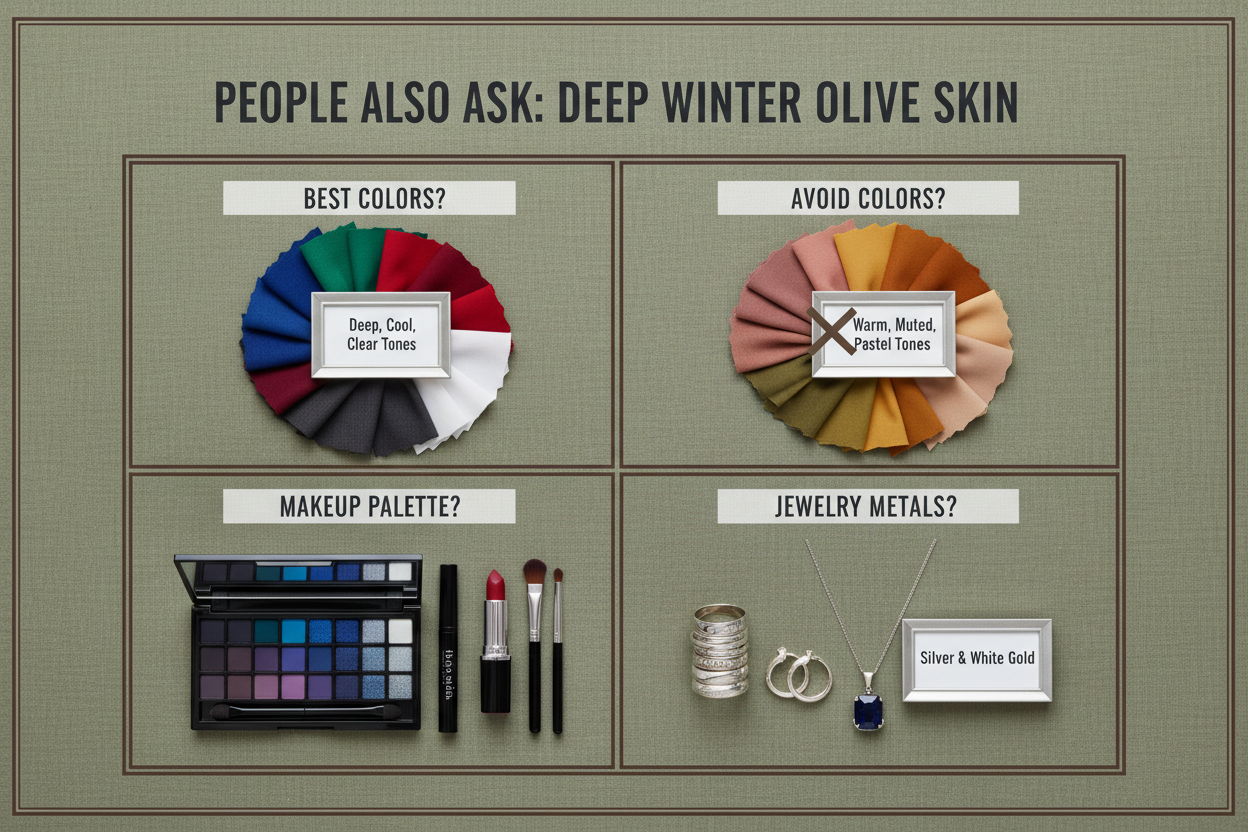
Too warm:
- Camel, tan, and warm beige pull the yellow-green cast toward sallow
- Terracotta, rust, and burnt orange flatten the cool depth this complexion needs
- Mustard and golden yellow amplify the olive cast in the wrong direction
- Peach and coral clash with olive's green base, reading orange against it
Too cool:
- Icy pastels — pale lavender, powder blue, soft pink — strip contrast and leave skin looking ashy
- Light cool grey in large amounts pushes too far and washes everything out
- Warm white or cream as a dominant color veers either too warm or too stark depending on its cast
The easiest test: hold the color near your face in natural light. If your skin looks flatter or more yellow, skip it. If it looks clearer and more defined, keep it.
Is olive skin warm or cool for color analysis?
Olive skin is neither strictly warm nor strictly cool — and that's what makes it tricky to type seasonally.
The visible surface reads warm. That yellow-green pigment layer consistently pulls color analysts toward autumn. But what sits beneath it can be cool, neutral-cool, or warm, and those aren't the same thing.
Analysts who specialize in olive skin point out that the green cast isn't the undertone signal. A person with olive skin can have a genuinely cool or neutral-cool foundation, which puts them in winter or a neutral-leaning cool season — even when the surface looks warm.
The practical upshot: olive skin needs to be tested against cool and warm colors, not typed by appearance. If cool jewel tones clarify the face and warm earth tones muddy it, the undertone is cool. Doesn't matter how warm the skin looks at first glance.
What is the difference between deep winter and dark autumn for olive skin?
These two seasons share high depth and dark feature coloring, which is why olive-skinned individuals are frequently mistyped between them. The meaningful differences are:
| Feature | Deep Winter Olive | Dark Autumn Olive |
|---|---|---|
| Undertone | Cool to neutral-cool | Warm to neutral-warm |
| Best neutrals | Charcoal, espresso, cool taupe | Rich brown, warm camel, chocolate |
| Best accent colors | Deep jewel tones, blue-reds, emerald | Earth tones, terracotta, warm rust |
| Problem colors | Mustard, camel, warm olive | Icy pastels, pure cool white |
| Jewelry preference | Silver or white gold reads better | Gold reads better |
| Warm clothing effect | Flattens or muddy the complexion | Adds warmth and glow |
The quickest way to tell them apart is holding warm versus cool fabric against your bare face. Cool tones tend to clear up deep winter olive skin; warm tones make dark autumn olive skin look more alive. If you keep getting mixed results from self-tests, professional color draping is the most reliable way to settle it.
Can olive skin be a true winter season?
Yes. Olive skin can genuinely fit a winter season — deep winter, true winter, and sometimes the neutral-cool edge of dark winter — as long as the undertone beneath the surface olive cast is cool or neutral-cool.
The common misconception is that olive automatically means warm, which automatically means autumn. That logic mistakes surface appearance for undertone. Olive skin with dark features and a cool structural foundation belongs in winter. Put it in autumn and you get exactly the wrong result: warm earthy colors that bring out the muddiest quality of the complexion instead of its natural richness.
True winter and deep winter are the most common placements for olive skin within the winter category. True winter tends to suit olive types with higher overall contrast and a cooler, crisper undertone. Deep winter works better when the coloring is very dark and the undertone reads neutral-cool rather than purely cool. If the tests above give you consistent but slightly ambiguous results, that distinction is worth looking into.
What makeup colors work best for deep winter olive skin?
Makeup follows the same temperature rules as clothing. The most effective choices stay cool-to-neutral-cool and maintain enough depth to honor the complexion's contrast.
Foundation and concealer: Reach for formulas labeled neutral-cool or olive-correcting. Purely warm or golden foundations tend to push the complexion sallow; purely pink ones can go ashy. A neutral-cool base with a slight olive correction is the sweet spot.
Lip color:
- Deep berry, wine, and blue-red shades are the strongest performers
- Cool-toned red (blue-based) rather than orange-based red
- A deeper, cool dusty rose can work as an everyday option
- Avoid coral, peach, warm orange-red, and brick shades
Eye color:
- Deep plum, charcoal, and navy liner and shadow define without adding warmth
- Emerald or teal liner works as an accent — it echoes the same olive-flattering effect those jewel tones have in clothing
- Warm bronze and copper shadows introduce unwanted warmth and tend to muddy the look
Blush: Cool berry-rose and deep mauve shades work better than peach or warm coral. Blush is where warm tones most visibly fight olive's cool undertone — a warm-toned blush on a cool olive complexion often reads as an orange cast against green.
Highlighter: Silver and cool champagne highlighters work with the cool axis. Gold and bronze bring back the over-warming problem.
FAQ
What exactly is deep winter olive skin and how is it different from other olive complexions?
Deep winter olive skin has olive's characteristic yellow-green cast on the surface, but a cool or neutral-cool undertone beneath it — combined with naturally deep, high-contrast features (dark hair, dark eyes, or both).
What separates it from other olive complexions:
- Warm olive (autumn range): The undertone beneath the green cast is warm, so earth tones and golden hues work well. On deep winter olive skin, those same colors fall flat or read muddy.
- Soft or muted olive (soft autumn/soft summer): Lower contrast and softer features define this type. Deep winter olive has noticeably more depth and drama.
- True winter olive: Slightly cooler and crisper than deep winter. The deep winter version sits at the warm edge of winter — neutral-cool rather than strictly cool.
The combination of an olive surface, cool-to-neutral-cool foundation, and high depth makes this one of the harder complexions to type accurately. A lot of analysts stop at the warm surface and reach the wrong conclusion.
How do I know if I'm deep winter versus soft autumn if I have olive skin?
The most reliable test is holding warm versus cool colors directly against your bare face in natural light and watching what happens.
Soft autumn signals:
- Warm camel, terracotta, and golden earth tones clarify your complexion and reduce any uneven cast
- Cool jewel tones make your face look sallow or dull
- Your overall coloring has a softness to it — features blend rather than contrast sharply
- Gold jewelry looks noticeably more harmonious than silver
Deep winter signals:
- Cool jewel tones (deep emerald, sapphire, burgundy) sharpen and define your face
- Warm earth tones flatten the complexion or create a yellowish cast
- Your features have significant contrast — hair and eyes read distinctly darker than skin
- Silver or white gold reads cleaner against your skin than yellow gold
If both seem to partially work, test depth next. Deep winter needs very dark, saturated colors. Soft autumn is served by medium-depth muted shades. If soft, dusty hues wash you out but deep rich ones make you look vivid, you're probably leaning deep winter.
Can olive skin tones wear black, or is it too harsh for the complexion?
Black works well on deep winter olive skin — and for this complexion type, it's actually one of the stronger neutral choices.
The "black is too harsh" concern applies more to low-contrast complexions, where a very dark color can overwhelm the face. Deep winter olive already has naturally high contrast, so the skin holds its own against dark tones. Black works with that contrast rather than against it.
A few practical notes:
- Black near the face (necklines, collars) tends to look clean and defined on deep winter olive
- Keep the overall palette proportional to the complexion's depth — black pairs better with other deep or saturated tones than with pale or washed-out pieces
- Skip warm-toned accessories with black; that combination can push the olive cast toward sallow
What hair colors are most common in deep winter olive individuals?
Deep winter olive individuals almost always have naturally dark hair — this depth of hair coloring is part of what creates the high-contrast quality that characterizes the season. Common natural hair colors include:
- Near-black or true black — the most frequent
- Very dark espresso brown — reads almost black in most lighting
- Dark cool brown — a deep brown with ash or neutral undertones rather than red-warm ones
Hair with strong warm or auburn undertones (warm chestnut, golden brown, red-brown) is less typical for this placement and may signal a shift toward dark autumn instead.
For color-treated hair: cool-toned dark shades — cool espresso, blue-black, and ash-dark brown — stay consistent with the palette. Warm highlights like golden blonde or copper tend to conflict with the cool foundation of this season, even when the effect looks flattering in isolation.
Are there specific metals — gold versus silver — that work better for deep winter olive skin?
Silver, white gold, and platinum tend to work better for deep winter olive skin. The logic follows the same cool-to-neutral-cool reasoning as the clothing palette.
- Silver and white gold echo the cool side of the undertone, creating clean contrast against the skin instead of competing with its warmer surface
- Yellow gold adds warmth that can reinforce a sallow quality in the complexion rather than balancing it out
- Rose gold sits somewhere in between and can work in some deep winter olive cases, especially those leaning neutral-cool — though it's less reliable than silver
That doesn't mean yellow gold is off-limits. One gold piece against an otherwise cool outfit can read as a deliberate accent. The problem shows up when gold dominates the whole look and pulls everything warm.
For gemstones, deep cool-toned stones — sapphire, amethyst, deep emerald, garnet — fit the jewel-tone principle that runs through this palette.
Why do some winter palette colors wash out olive skin instead of enhancing it?
Not every winter color works equally well for the deep winter subseason, and olive skin has a narrower effective range within winter's broader spectrum.
Common culprits:
- Icy pastels: True winter and bright winter include light, icy shades like pale lavender, ice pink, and powder blue. These colors need very high contrast and a cool, bright undertone to work. Deep winter olive skin has the depth but not the crisp brightness those shades demand — the result looks ashy or dull.
- Cool colors without enough depth: A color can be technically cool in temperature but too light or soft to give deep winter olive skin the contrast it needs. The complexion's depth requires depth in return.
- Bright, saturated cool tones without warmth adjustment: Some winter brights — electric blue, vivid fuchsia — work on high-contrast cool complexions but look jarring on olive skin, which needs the cool tone to carry some richness rather than pure saturation.
The fix is staying within the deep winter range specifically: colors that are cool or neutral-cool and dark or richly saturated, rather than borrowing freely from the broader winter category. Depth is what makes winter colors functional on olive skin.
Do deep winter olive skin tones change seasonally with sun exposure, and does that affect the palette?
Olive skin tans, and for many people in this category the complexion deepens noticeably in summer. The practical question is whether this changes the color season — and the answer is generally no, though it can shift what works within the palette.
The underlying cool-to-neutral-cool undertone doesn't change with a tan. Seasonal placement is determined by that fixed undertone, not by surface depth at any given moment.
What does shift is the overall depth of the complexion. A deeper summer tan means the darker, more saturated end of the deep winter palette may feel even more harmonious than usual, while medium-depth colors that worked well in winter can lose some of their impact against the darker background.
One thing worth watching: a tan can make warm-toned colors look temporarily more flattering by adding contrast. This is a surface effect, not an undertone shift. If camel looks appealing in August, it's more likely the temporary depth of the tan creating a false positive than any genuine change in your season.
The palette itself stays the same year-round. Adjusting the depth of specific color choices up or down with the season is fine-tuning, not re-typing. If your results have always felt ambiguous, a professional color analysis — ideally done in your natural winter coloring — can settle it with draping rather than guesswork.