
Deep Summer Color Palette: Myth or Valid Type?
 Reviewed by Alexandra Gilmore
Deep Summer is accepted in some extended systems and rejected as contradictory in others, so the name needs translation before it becomes useful. Compare cool, muted, medium-deep colors with Soft Summer, Soft Autumn, and Winter neighbors, then let fabric response decide whether the concept fits.

Search for "deep summer color palette" and you'll find two camps: color analysts who treat it as a well-defined seasonal sub-type complete with curated swatches, and skeptics who argue that pairing the word deep with summer is a contradiction in terms. If you've been told you might be a Deep Summer — or if you've landed here after bouncing between Soft Summer and Soft Autumn with no clear answer — this article is for you.
💫 Explore Seasonal Color Analysis
Use the distinctions in this article to narrow the possibilities, then compare the seasonal system as a whole. Seeing the neighboring palettes together makes the result easier to test in real clothing and daylight.
Learn Seasonal Analysis →Here's what makes this particular type genuinely confusing:
- Summer, as a season, is defined by muted, faded, and blended tones — the landscape drained of its earlier vibrancy by the heat of the sun.
- Deep, as a color quality, implies richness, darkness, and intensity — qualities most people associate with Autumn or Winter, not Summer.
- The result is a type that sits at a real intersection of those two worlds, and one that a surprising number of people are misidentified out of, usually into Soft Autumn.
Commercially, the type is treated as fully real: ready-made Deep Summer palettes featuring 48 or more colors are actively sold and used as shopping references. Analytically, experienced practitioners consistently field the same question — "Why am I not a Soft Summer or Soft Autumn?" — and point to a handful of concrete physical markers, starting with natural hair color, as the fastest way to resolve it.
This article works through the evidence systematically. You'll find out what Summer actually means as a color season, how Deep Summer fits (or doesn't) inside both the classic four-season and the expanded twelve-season frameworks, how it differs from its nearest neighbors, which specific colors belong in the palette, and how to figure out whether this type genuinely applies to you.
Why 'Deep Summer' Sounds Like a Contradiction
The skepticism makes sense. Summer, as a color season, is defined by softness, muting, and restraint. Deep implies weight, richness, substance. Put them together and it reads like two opposing design briefs stapled into one.
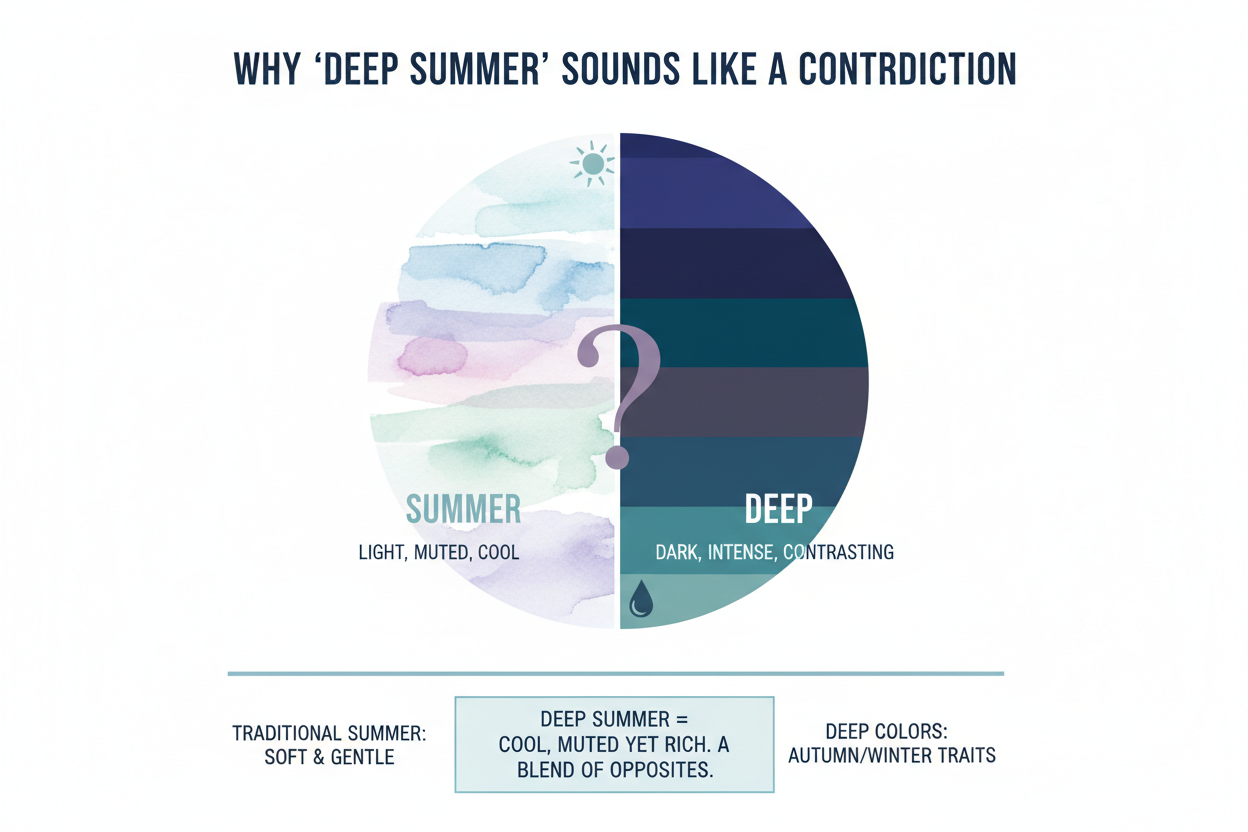
That tension is worth sitting with, because it's exactly where most misidentifications happen.
The short answer is that the contradiction is only apparent. Summer's defining characteristic isn't lightness — it's muting and cool undertone. A color can be cool-leaning and deep. Charcoal, plum, steel blue: all cool colors with real pigment weight. The confusion comes from quietly substituting "summer" with "pale" or "delicate," which isn't what the framework actually says.
Separate those two ideas and the Deep Summer type becomes internally consistent — and recognizable.
Not sure where you land? Take the color analysis quiz →
What the Summer Season Actually Means for Color
Seasonal color analysis borrows its logic from nature. In Summer, extended heat changes the visible landscape: colors that were bright and saturated in Spring become faded, blended, and muted. The greens soften. Shadows flatten. Everything looks slightly dusted.
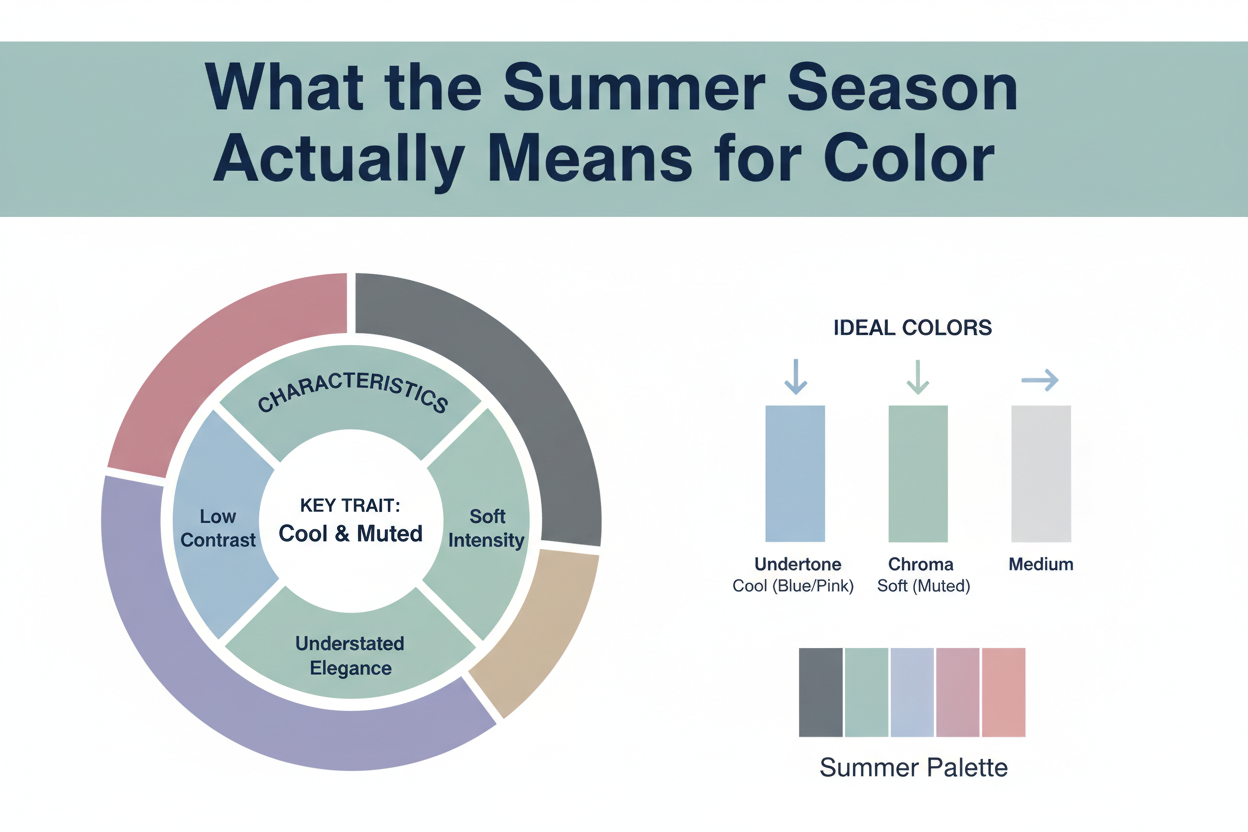
That quality — reduced saturation, cool or neutral-cool undertone, a blended rather than punchy character — is the defining thread across all Summer types. It has nothing to do with depth or lightness specifically.
What this means in practice:
- Summer colors are never highly saturated. Vivid, clear primaries look out of place regardless of whether a shade is light or dark.
- Summer colors carry a cool or neutral-cool undertone. Warm golden or orange-based shades conflict with the season's base quality.
- Summer colors look blended. There's a softness to the way hues relate — dusty rather than crisp, hazy rather than sharp.
A very deep shade can carry all three of those qualities. That's the foundation on which Deep Summer rests.
How Deep Summer Fits Inside the Four-Season System
Classic seasonal color analysis divides coloring into four types: Spring, Summer, Autumn, Winter. Extended frameworks split each of those four into three sub-types, giving twelve types total. Deep Summer is one of those twelve — it sits at the boundary between Summer and Winter.
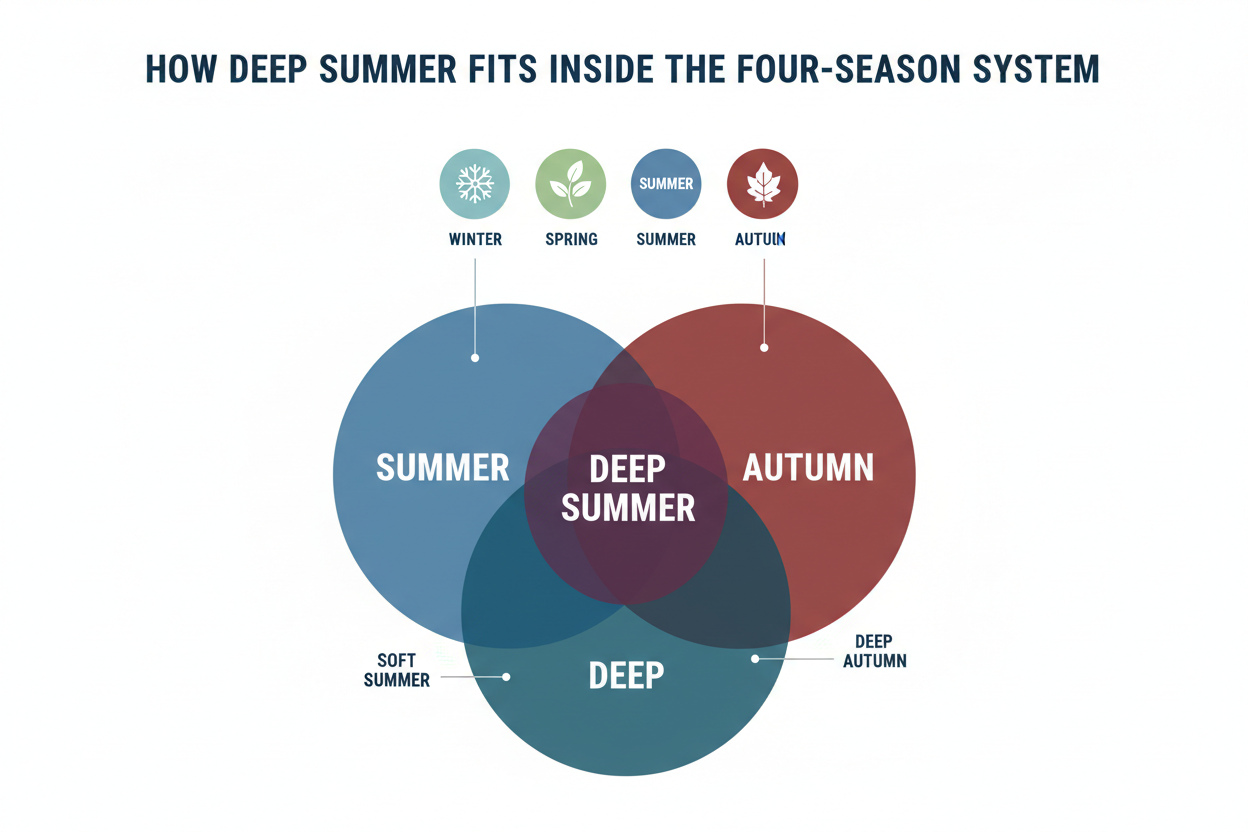
This is a recognized analytical category, not an invented niche. Color season sub-types are a structured continuation of the original four-season logic, not a departure from it.
Here's a simplified breakdown of where Deep Summer lands:
| Quality | Summer (core) | Deep Summer | Deep Winter |
|---|---|---|---|
| Undertone | Cool | Cool to neutral-cool | Cool |
| Saturation | Low | Low–medium | Medium–high |
| Depth | Light to medium | Medium to deep | Deep |
| Overall effect | Soft, hazy | Rich but muted | Bold, high-contrast |
Deep Summer takes Summer's muting and cool undertone, then adds Winter's depth. The result is a palette that handles darker, richer shades without losing the characteristic softness.
Deep Summer vs. Soft Summer and Soft Autumn: The Confusion Explained
Most people get stuck here, and it's worth being direct: the Soft Summer / Soft Autumn / Deep Summer triangle is one of the most frequently misidentified areas in seasonal color analysis.
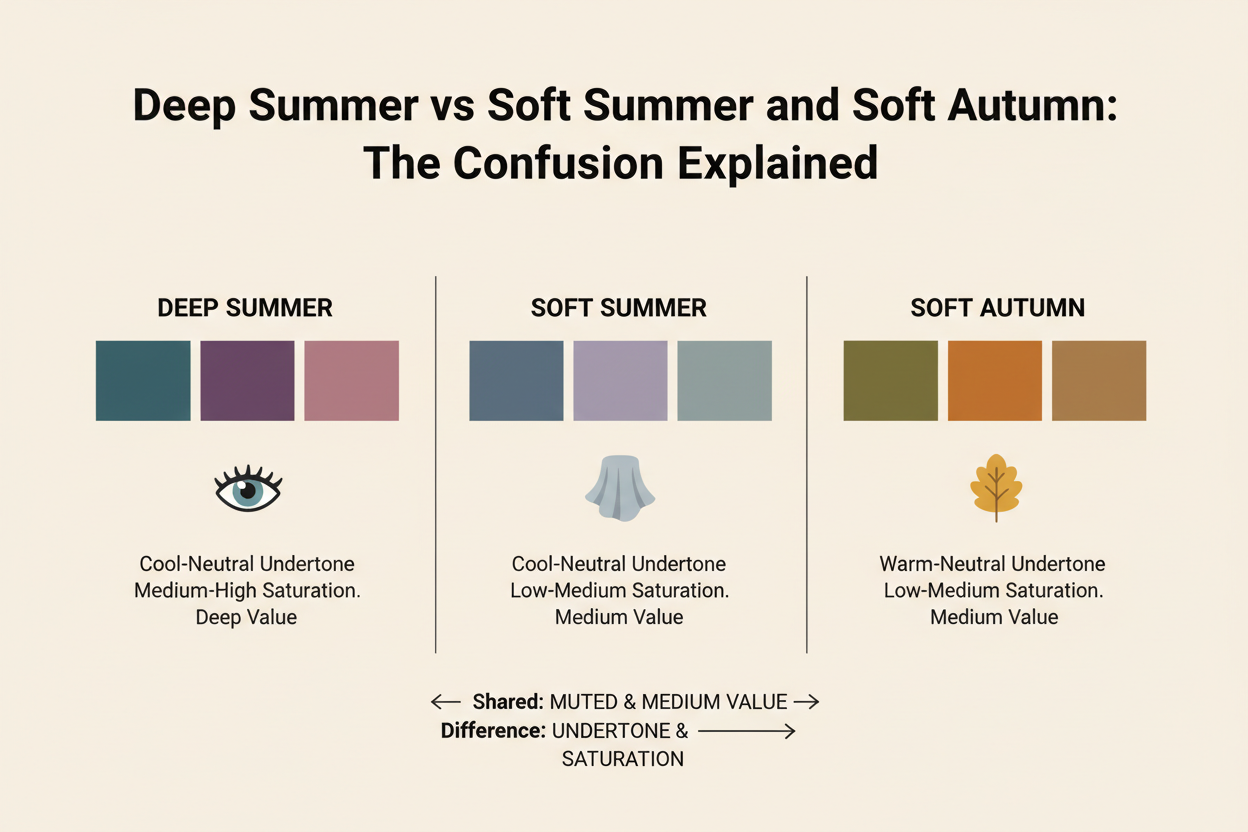
All three types share muting as a key quality. Soft Summer, Soft Autumn, and Deep Summer can all look washed out in high-saturation colors, which creates surface-level similarity in what doesn't work. The real differences show up in depth and undertone.
The fastest single diagnostic? Natural hair color.
Color analysts consistently point to this as the quickest way to cut through the confusion:
- Soft Summer tends to have naturally light-to-medium hair — ash blonde, light brown, or mousy brown with cool or neutral tones.
- Soft Autumn tends toward medium-to-warm brown hair, often with a slight golden or reddish quality even if the overall effect looks muted.
- Deep Summer tends to have naturally dark hair — deep brown to near-black — with a noticeably cool or neutral-cool cast rather than warm redness or golden highlights.
Hair color matters because it reflects the actual depth and undertone of a person's overall coloring. If someone is asking "am I Soft Summer or Soft Autumn?" but has dark, cool-toned hair, they're probably neither — and that one observation can redirect the whole analysis.
Beyond hair, the distinguishing markers break down like this:
| Marker | Soft Summer | Soft Autumn | Deep Summer |
|---|---|---|---|
| Overall depth | Light to medium | Medium | Medium to deep |
| Undertone | Cool | Warm | Cool to neutral-cool |
| What works | Dusty pastels, cool muted shades | Muted warm tones, earthy shades | Deep cool shades, muted richness |
| What fails | Anything warm or bright | Cool or bright shades | Warm shades, very pale colors |
Still unsure which type fits your coloring? Start the quiz to find out →
The Deep Summer Color Palette: What Colors Actually Belong Here
Commercially, Deep Summer is treated as a well-defined reference set — curated palettes of 48 colors are actively produced as shopping guides, organized to help wearers match colors in real stores.
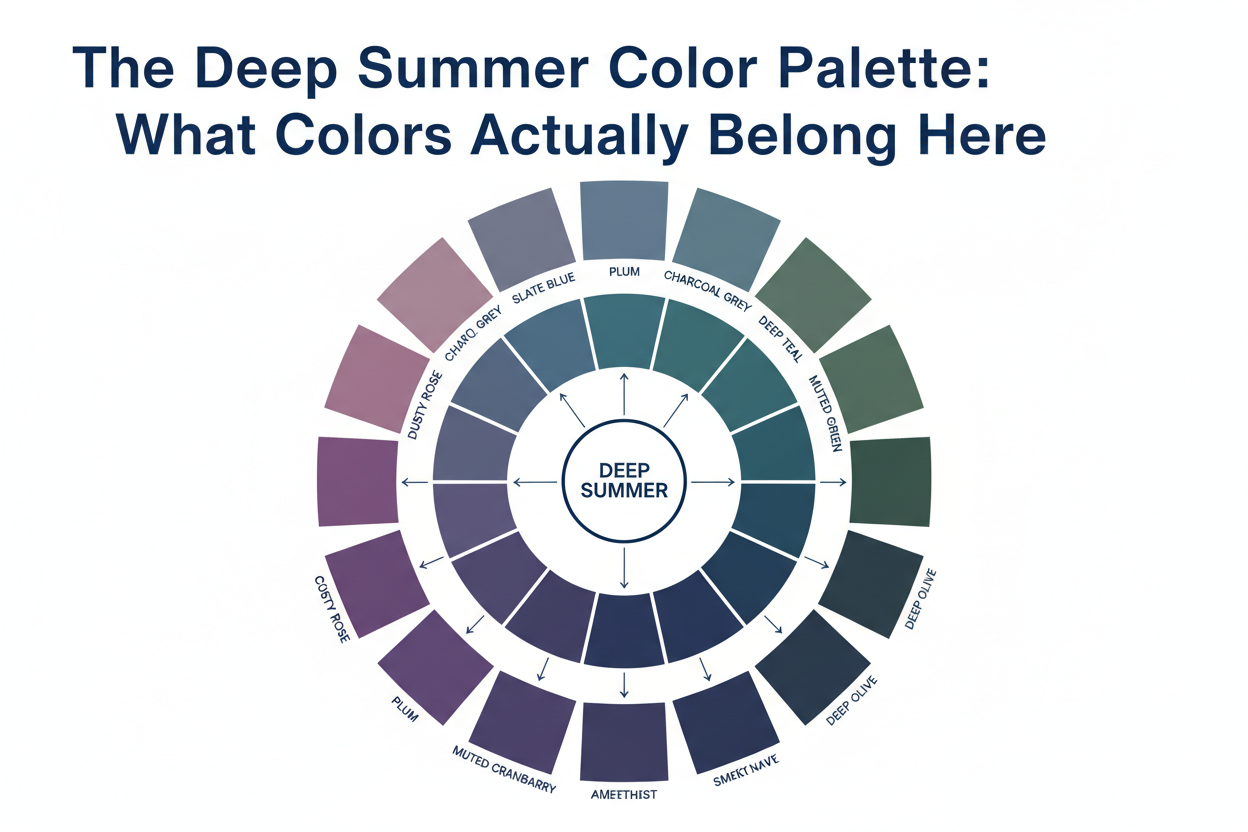
Three qualities define the palette, and they work together:
- Cool or neutral-cool undertone throughout. No golden, peach, or warm-rust shades.
- Muted rather than saturated. Colors are complex and blended, not vivid or punchy.
- Enough depth to avoid looking washed out. This is where Deep Summer parts ways from Soft Summer.
Key color families in a coherent Deep Summer palette:
- Deep berries and plums — cool, dark, and muted enough to avoid reading as jewel-toned
- Dusty roses and mauve — pink with grey or cool shadow added, nothing peachy or warm
- Blue-greys and slate — cool mid-depth neutrals that stand in for the stark black and white of Winter
- Smoky navies and deep teals — cool dark shades that carry depth without warmth
- Soft burgundy and wine — red shifted cool and darkened, not the warm brick-red of Autumn
- Charcoal and deep taupe — neutral darks that lean cool rather than warm brown
What's absent is just as telling: no camel, no warm gold, no coral, no clear or icy pastels, and no stark black-and-white contrast.
How to Wear the Deep Summer Palette in Practice
The palette's logic becomes clearest in actual clothing combinations. Take plum layered over dusty rose — a cool, deep hue paired with a muted, grayed pink. Both colors share the season's cool undertone and soft quality, so they work together without competing. That combination produces the quiet richness that defines Deep Summer styling.
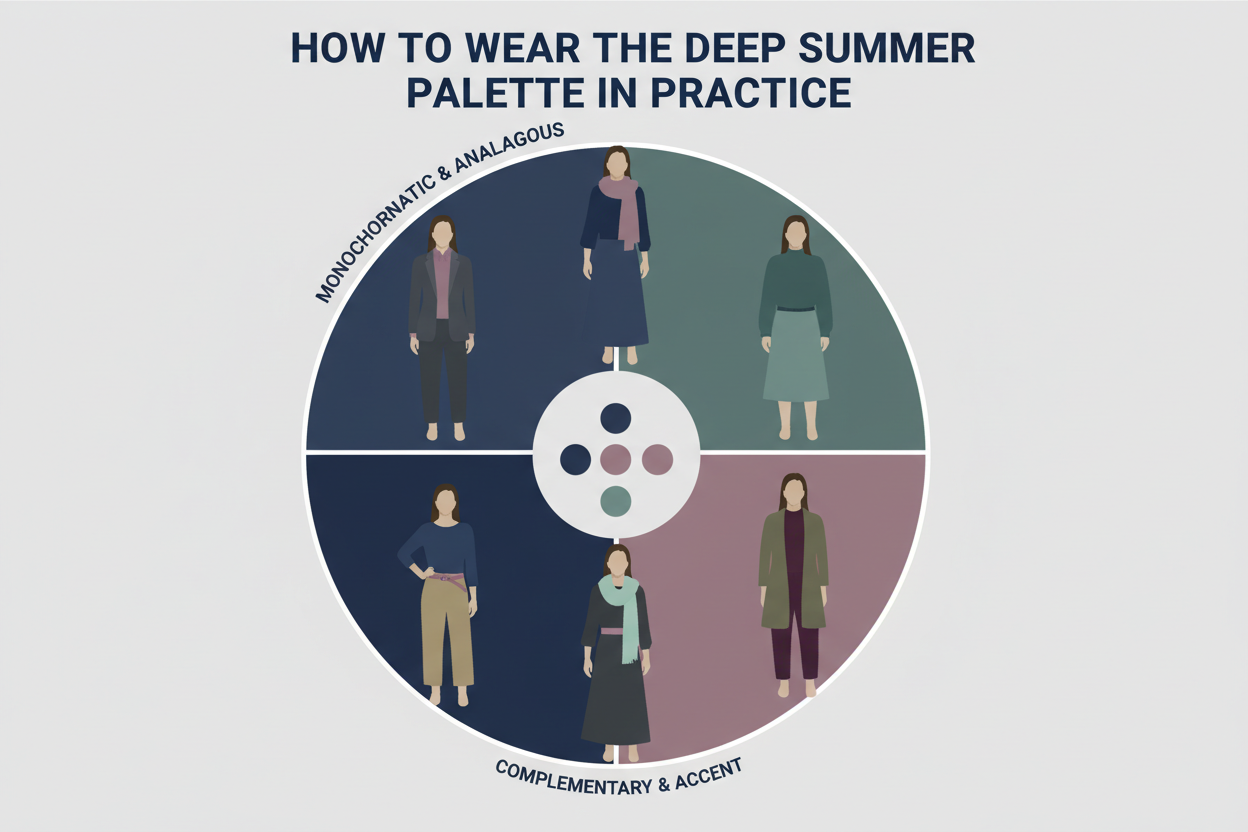
Some practical starting points:
Tops and outerwear Go for cool-muted shades with depth: plum, dusty rose, mauve, smoky navy, slate grey. These sit near the face where undertone contrast matters most.
Bottoms and base pieces Deep charcoal, cool taupe, and slate navy work as neutrals here the way black and bright white do for Winter types — they anchor an outfit without the harshness of stark contrast.
Avoiding common mistakes
- Bright white bleaches out Deep Summer coloring. Soft white or light grey are better near the face.
- Camel and warm tan introduce yellow-warmth that fights the season's cool base.
- Saturated jewel tones — electric blue, vivid emerald — look heavy and overpowering. The problem is the saturation, not the depth.
Pattern and texture guidance Patterns that work best have cool, muted color combinations with medium contrast. Sharp black-and-white graphic prints are too high contrast; warm earthy patterns are too warm. The overall impression should read as blended and sophisticated, not bold or rustic.
How to Tell If You're Actually a Deep Summer
Self-identification in seasonal color analysis is harder than most guides let on, because the physical signals interact with each other and with the context you're viewing them in. Some markers are more reliable than others, though.
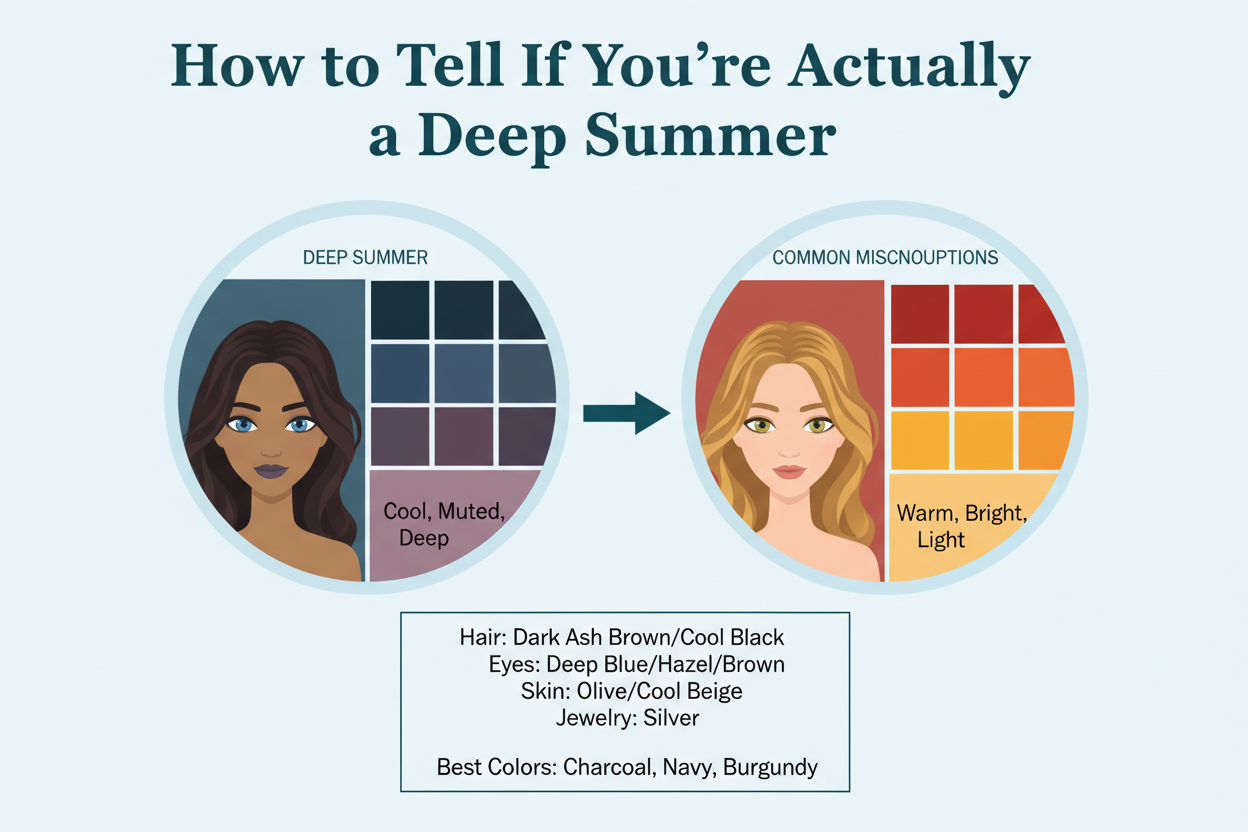
Start with overall depth. Deep Summer is a medium-to-deep type. If your natural coloring reads as very light — pale skin, light hair, light eyes together — Deep Summer probably isn't it.
Check your skin's undertone. Cool or neutral-cool is what you're looking for. Pink or rosy undertones, or a neutral that reads slightly blue rather than olive or golden, point toward Summer rather than Autumn.
Notice what high contrast does to your face. If stark black next to your skin reads as harsh or aging, but the same depth in a softer shade — charcoal, plum, deep cool navy — looks refined and intentional, that's Summer muting working on a deeper base.
Watch what muted warm colors do. Put on a warm caramel or terracotta. If something looks slightly off — your complexion reads muddy, your face less defined — that undertone conflict is a useful signal.
The Role of Natural Hair Color in Telling These Types Apart
Natural hair color — before any coloring, highlighting, or lightening — carries concentrated information about both undertone and depth. It's one of the fastest signals available when separating Deep Summer from adjacent types.
Deep Summer natural hair is typically dark: medium-dark to very dark brown, often reading close to black in low light. It lacks the warm redness or golden quality that characterizes Autumn types. Under neutral or cool light it can look slightly ashy.
Compare this to:
- Soft Autumn: warm brown hair, often with visible redness or gold even if the overall effect appears muted
- Soft Summer: light to medium brown or ash blonde — distinctly lighter in overall depth
- Deep Winter: also dark hair, but often with a very cool, almost blue-black quality, usually paired with higher skin contrast
If someone has been coloring their hair for years this cue gets harder to use, but photos from childhood or early adulthood can often recover it.
Why Plum, Berry, and Dusty Rose Work When Bright Colors Don't
These three color families show up consistently in Deep Summer palettes because they satisfy all three of the type's key requirements at once.
Plum is dark and cool-toned — it carries the depth Deep Summer coloring needs to avoid looking washed out, while its blue-red base aligns with the season's cool undertone. It's muted enough to sidestep the sharp intensity of a jewel tone.
Berry works similarly: a cool red-purple that's been slightly desaturated. It reads rich rather than vivid. On Deep Summer coloring it looks intentional and polished; on a warmer type it can look heavy and fight the skin's undertone.
Dusty rose follows the same logic at a lighter depth: a pink with grey or cool shadow mixed in, which strips out the warmth of coral or salmon. It works near the face without creating harshness because its muting matches the season's overall quality.
Bright versions of these colors — vivid fuchsia, clear cherry red, warm bubble-gum pink — tend to overwhelm Deep Summer coloring or read as clashing. Not because the hue family is wrong, but because the saturation no longer matches. The palette isn't about avoiding intensity; it's about finding depth and richness inside muted, cool-leaning territory.
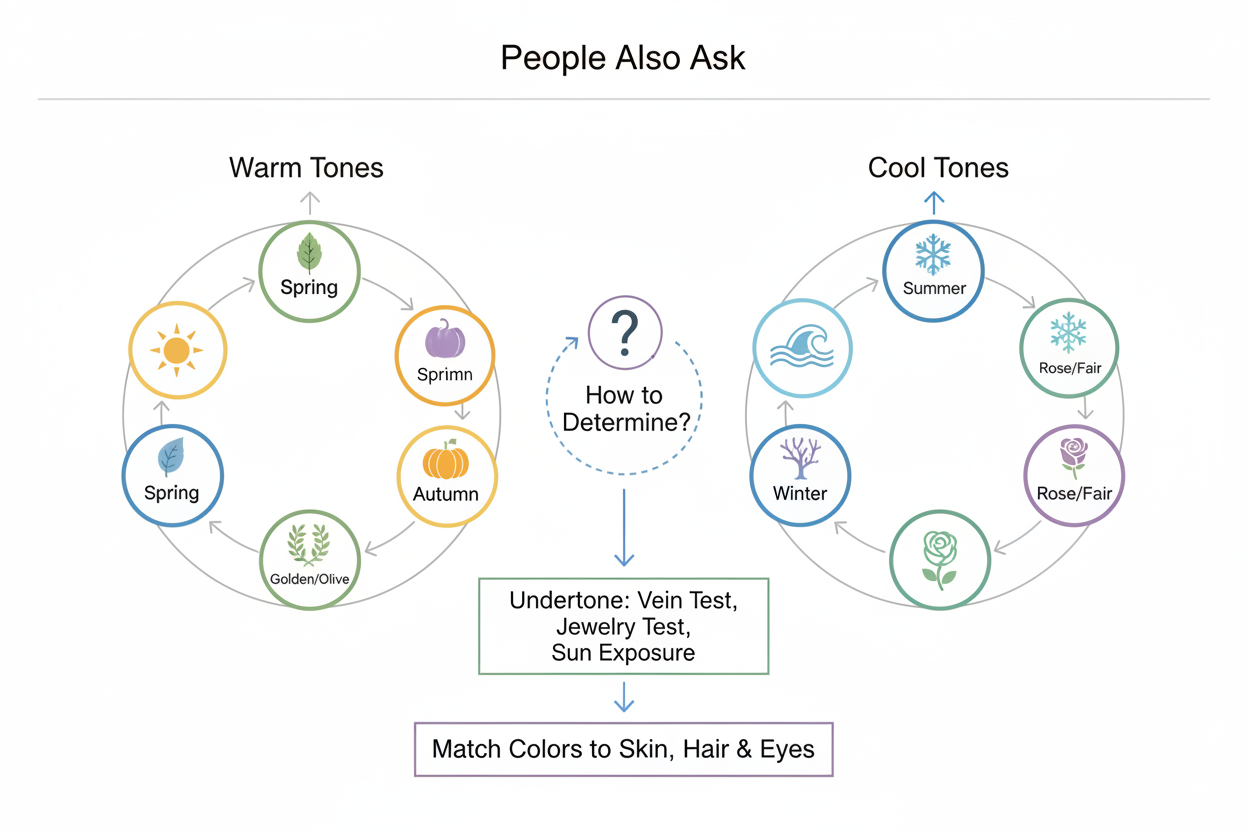
People Also Ask
What is the deep summer color palette?
The deep summer color palette is a set of colors suited to people whose natural coloring combines cool or neutral-cool undertones with medium-to-deep overall depth. It sits at the boundary between the Summer and Winter seasons in extended seasonal color analysis frameworks.
Its defining qualities:
- Cool or neutral-cool undertones throughout — no warm gold, camel, or peach shades
- Muted rather than saturated — colors read as blended and complex, not vivid
- Enough depth to avoid looking washed out — this is what separates it from Soft Summer
Color families in this range include deep plum, dusty rose, smoky navy, mauve, cool burgundy, slate grey, and blue-toned charcoal. Most commercial versions present around 48 colors as a shopping reference for matching clothing and accessories.
Is deep summer a real color season or a made-up sub-type?
It's a recognized sub-type within the extended twelve-season color analysis framework. The twelve-season system expands the original four-season logic by dividing each core season into three sub-types based on which adjacent season's qualities show up in a person's coloring.
Deep Summer sits at the Summer–Winter boundary. It keeps Summer's characteristic muting and cool undertone, but picks up Winter's depth. That combination is internally consistent and analytically distinct from both Soft Summer (lighter, more delicate) and Deep Winter (higher contrast, more saturated).
"Deep" and "summer" can sound like opposites, but that's a misreading of what Summer actually means in this system — it's defined by muting and cool undertone, not by lightness.
What is the difference between deep summer and soft summer?
Both types share the Summer season's cool undertone and muted quality, but they differ significantly in depth and in how much color weight the person can carry.
| Feature | Soft Summer | Deep Summer |
|---|---|---|
| Overall depth | Light to medium | Medium to deep |
| Natural hair color | Ash blonde to light-medium brown | Dark brown to near-black |
| Best neutrals | Soft grey, cool taupe | Charcoal, slate, deep navy |
| Color weight | Low — pale and dusty shades | Medium-high — richer, darker shades |
| What fails | Warmth, brightness, high contrast | Warmth, brightness, and overly pale shades |
The clearest practical difference: Soft Summer coloring gets overwhelmed by depth and darkness, while Deep Summer can carry those richer shades—and actually needs them to avoid looking washed out.
How do I know if I am a deep summer or a soft autumn?
This is one of the most common mix-ups in seasonal color analysis. Both types share a muted quality, which means vivid or highly saturated colors look off on both — so the overlap is real.
The fastest single check is natural hair color:
- Deep Summer hair is dark brown to near-black with a cool or ashy quality — no visible warmth, redness, or golden highlights
- Soft Autumn hair is warm-toned medium brown, often with subtle redness or gold even if the overall impression looks muted
Beyond hair, test your undertone response:
- Hold a warm caramel or terracotta near your face. If your complexion looks muddy or undefined, warm undertone is working against your skin — that's a signal toward Summer, not Autumn.
- Hold a cool dusty rose or slate near your face. If it looks clarifying and clean, the cool-muted quality is working with your coloring.
One note worth adding: if you're trying to decide between Soft Summer and Soft Autumn but your hair is dark and noticeably cool-toned, you may be neither. Deep, cool hair points toward Deep Summer instead.
What colors should a deep summer avoid?
Deep Summer coloring runs into trouble with three things: warmth, high saturation, and stark contrast on the lighter end.
Colors and qualities to avoid:
- Warm shades — camel, terracotta, warm orange, golden yellow, coral, peach. These bring in yellow or orange-based warmth that clashes with the season's cool undertone and can make skin look muddy.
- Highly saturated or bright colors — vivid fuchsia, electric blue, clear cherry red, bright emerald. The saturation is too intense for a muted season; they tend to overpower rather than complement.
- Stark black and bright white together — the sharp contrast reads as harsh rather than polished. Deep charcoal and soft white do the same job without the abruptness.
- Clear or icy pastels — they lack the depth that Deep Summer coloring needs and tend to wash everything out.
The short version: avoid both ends of the saturation scale, and stay on the cool side of every neutral.
FAQ
What makes deep summer different from other summer sub-types?
The Summer season has three sub-types in the extended twelve-season framework: True Summer, Soft Summer, and Deep Summer. All three share cool or neutral-cool undertones and a muted quality — vivid, saturated colors look out of place on all of them. The differences come down to depth.
- True Summer sits at the balanced center — not especially light or dark, with moderate contrast
- Soft Summer leans lighter and more delicate; the overall impression is pale and hazy
- Deep Summer leans darker, pulling influence from the Winter season; it carries medium-to-deep overall depth
In practice, Soft Summer coloring gets overwhelmed by dark, heavy shades — while Deep Summer actually needs that weight. Pale, wispy colors that look ethereal on a Soft Summer will look washed out on a Deep Summer.
Can a deep summer wear black, or is it too harsh?
Pure black is usually too high-contrast for Deep Summer. The season keeps Summer's muted quality, so sharp contrast tends to look harsh near the face rather than polished.
Better options:
- Deep charcoal — similar visual weight to black, but less abrupt
- Smoky navy or cool dark brown — add depth while staying in the cool-muted range
- Black away from the face — in shoes or a bag, it causes far fewer problems than it does at the neckline
The issue isn't darkness. Deep Summer coloring can handle depth. The problem is the stark contrast of pure black against skin. Slightly softened or muted darks fix that.
What is the difference between deep summer and deep winter?
Both seasons share depth and a cool or neutral undertone. They sit next to each other in the seasonal system, on either side of the Summer–Winter boundary. The key difference is saturation and contrast level.
| Feature | Deep Summer | Deep Winter |
|---|---|---|
| Saturation | Muted and blended | Higher, more vivid |
| Contrast | Medium | High |
| Color quality | Smoky, dusty, complex | Clear, sharp, bold |
| What fails | Warmth and high saturation | Warmth and washed-out muted shades |
In practice: a rich jewel-toned emerald looks striking on a Deep Winter and overpowering on a Deep Summer. A smoky plum reads sophisticated on a Deep Summer and slightly dull on a Deep Winter. That muting factor is what separates them.
Why do deep summers often get mistyped as soft autumn?
The confusion makes sense. Both Soft Autumn and Deep Summer reject vivid, saturated colors, and both can look wrong in stark, high-contrast combinations. That shared quality of "muted works, bright doesn't" leads a lot of people to land in the wrong season.
The reliable differentiator is undertone. Soft Autumn has a warm or neutral-warm base — its muting comes with golden, peachy, or reddish tones. Deep Summer has a cool or neutral-cool base — its muting comes with ashy, bluish, or grey-inflected tones.
A quick diagnostic: hold a warm terracotta or camel next to your face. On a Soft Autumn, it typically clarifies and flatters. On a Deep Summer, it tends to make the complexion look muddy or undefined. The reverse test applies too — try a cool dusty rose or slate grey and see which one your face reaches toward.
Does natural hair color reliably indicate a deep summer season?
Hair color is a useful first signal, but not definitive on its own. Full seasonal typing requires reading undertone and overall contrast across skin, hair, and eyes together.
That said, hair color is one of the most frequently cited clues for distinguishing Deep Summer from its neighbors. People who aren't sure whether they're a Soft Summer or Soft Autumn, but have distinctly dark, cool-toned or ashy hair, often get pointed toward Deep Summer instead. Dark hair with no visible warmth, redness, or golden highlights fits a summer-influenced season better than an autumn one.
Hair color gets less reliable when it has shifted significantly from childhood, or when color treatments make the natural shade hard to assess. In those cases, how skin responds to color swatches becomes the more stable test.
What neutral colors work best for the deep summer palette?
Good Deep Summer neutrals share two qualities: cool or neutral-cool undertones, and enough depth to hold their own against the season's overall richness.
Strong choices:
- Charcoal and slate grey — versatile anchors that replace stark black
- Smoky or navy-tinted dark blue — reads as a neutral here without the harshness of pure black
- Mauve and cool taupe — sit somewhere between neutral and accent
- Dusty or blue-toned white — works where bright white would look jarring
Avoid neutrals with warm undertones. Camel, warm beige, ivory with a yellow cast, and tan all introduce warmth that fights the season's cool base.
Can someone with light hair be a deep summer?
Rarely. But hair alone doesn't determine depth in seasonal color analysis — it's the combination of skin tone, eye color, and hair read together.
Deep Summer coloring tends toward medium-to-dark hair because dark hair usually anchors the overall depth. Light blonde hair with pale skin almost always points to a lower-depth type — Soft Summer or True Summer are far more likely.
That said, light hair alongside notably deep, cool-toned eyes and a medium-depth complexion could still push someone toward the deeper end of the Summer range. If you're not sure where you land, hold pale dusty shades and richer cool-muted shades up side by side — your reaction to each is the most direct test. Or take the quiz for a guided read on your specific combination.
To test this Summer result from another useful angle, continue with the companion article “Exploring the Deep Summer Color Palette: A Complete Guide”, which keeps the two closely related questions distinct.