Dark Skin Warm vs Cool Undertone
 Reviewed by Alexandra Gilmore
Two equally deep complexions may need completely different foundation bases and clothing colors because depth and undertone are separate. Compare warm, cool, and neutral signals with methods suited to dark skin, then carry the result into makeup, jewelry, hair color, and wardrobe decisions.

If you have a deep complexion, pinpointing your dark skin undertone can feel surprisingly elusive—yet it may be one of the most useful things you learn about your appearance. Your surface skin tone (how light or dark you appear) and your undertone (the subtle hue beneath that surface) are two separate qualities, and confusing them leads to mismatched foundations, unflattering clothing colors, and accessories that fight your natural coloring rather than complement it.
💫 Discover Your Complete Color Palette
One feature rarely explains every color that works for you. Compare your undertone, depth, clarity, and contrast as a complete palette, then use the results to test clothing, makeup, and hair colors more consistently.
Find My Color Palette →The good news: finding the right foundation for dark skin is no longer the frustrating search it once was—but only when you know which undertone you're shopping for. The same logic extends far beyond makeup. Color theory connects your undertone to the clothing shades, jewelry metals, and hair colors that make your complexion glow.
Here's what this guide will give you:
- A clear explanation of how warm and cool undertones actually appear on deep skin
- Reliable at-home tests that work even when standard methods fall short for darker complexions
- Practical color guidance for makeup, clothing, and accessories based on your specific undertone
- Answers to the most common questions people with dark skin have about undertone identification
Whether your skin is a rich espresso, a deep mahogany, or a dark golden brown, your undertone is working quietly beneath the surface—shaping which colors feel "off" and which ones make you look like your best self. By the end of this guide, you'll know exactly how to read it.
Skin Tone vs Undertone: Why Dark Skin Makes the Distinction Even More Important
Skin tone is the depth you see in the mirror—light, medium, deep, or anywhere between. Undertone is something else: the persistent hue sitting beneath the surface, unaffected by sun, seasons, or how much sleep you got. Both together determine how any color—a dress, a lipstick, a foundation—actually looks on you.
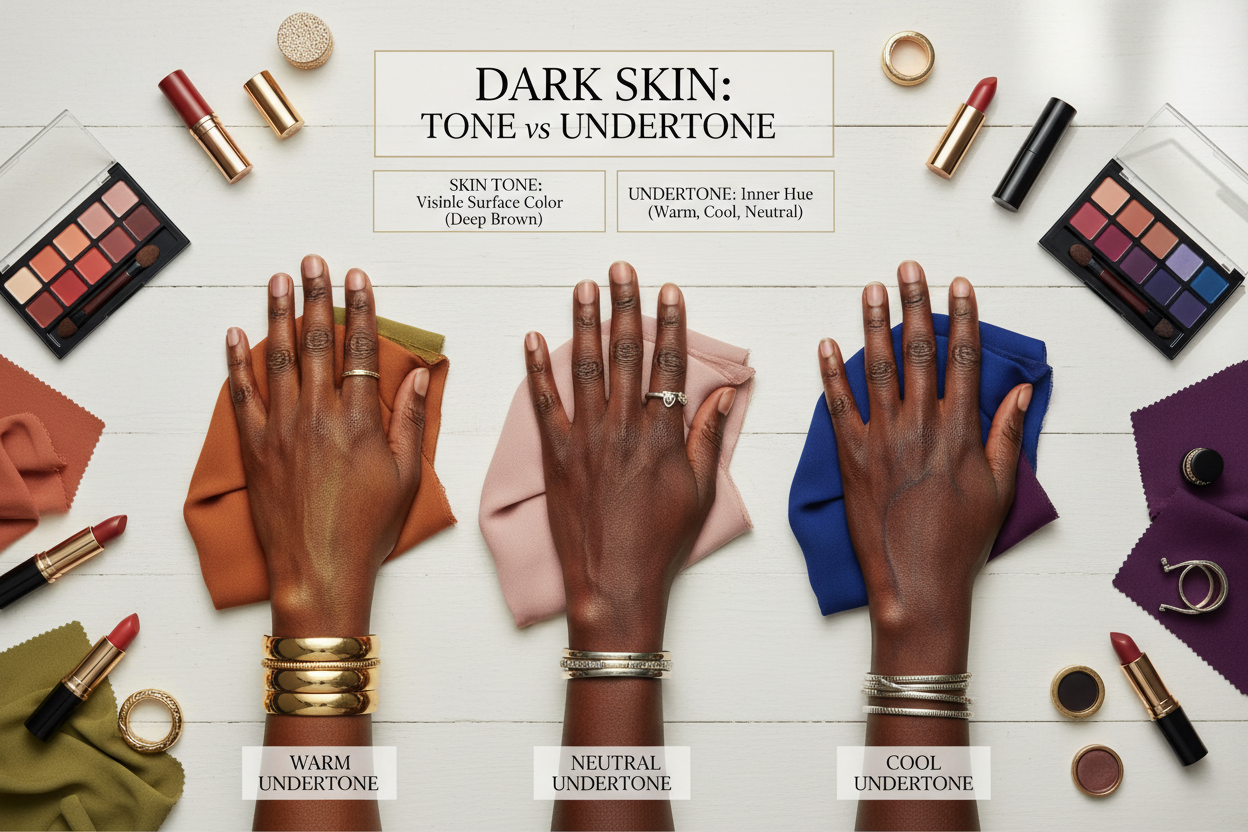
For people with deep complexions, the difference between these two things matters more than most beauty advice lets on. Surface darkness can absorb or mask the underlying hue, so undertone is often harder to read than it is on lighter skin. That's not a minor detail. A foundation chosen by depth alone can leave skin looking ashy, orange, or flat. A clothing color picked on instinct rather than matched to undertone can dull a rich complexion instead of letting it do what it does.
The common mistake is treating depth as the whole story. A very dark skin tone can have a warm, cool, or neutral undertone. The surface tells you almost nothing about which one you have. Getting that distinction right is what every color decision builds on.
What Warm Undertones Look Like on Dark Skin
On deep complexions, warm undertones show up through specific visual cues. They're not always obvious at first, but once you know what to look for, they're consistent.
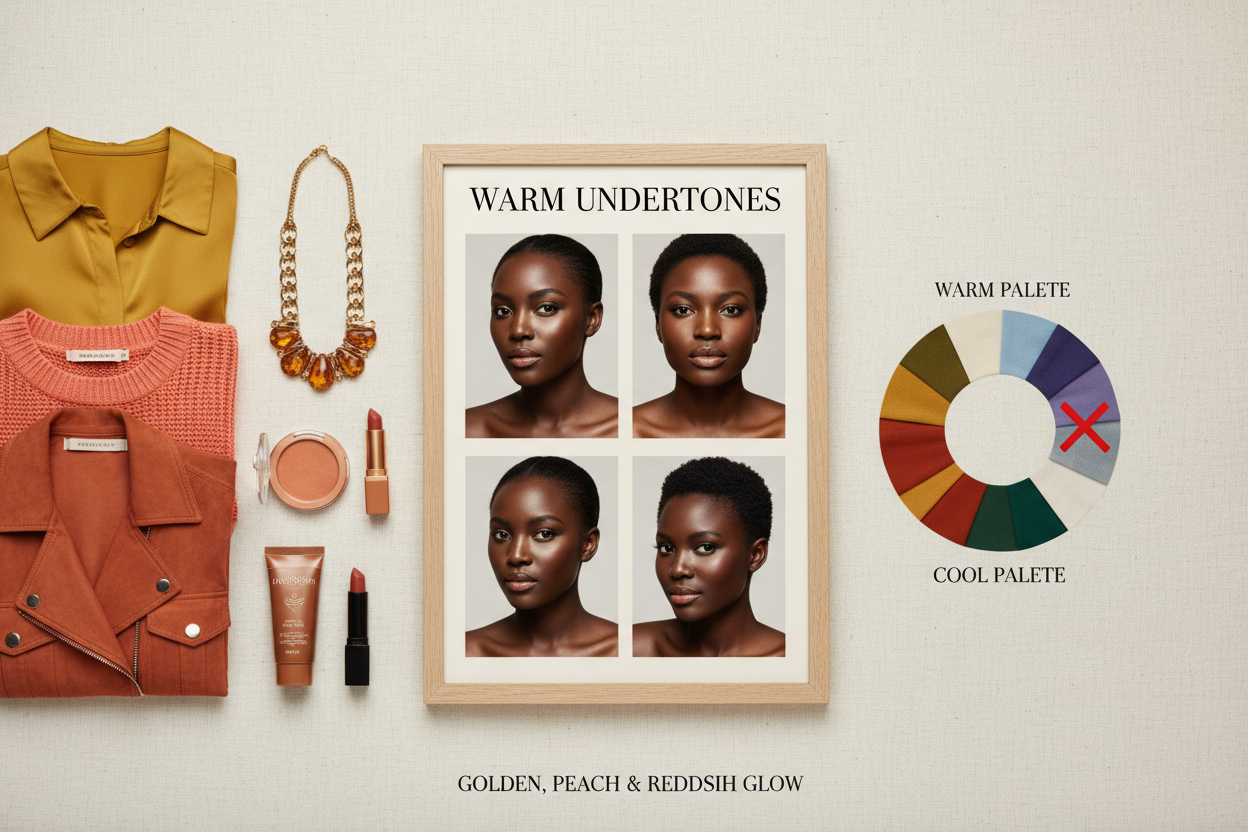
Common signals of a warm undertone on dark skin:
- A golden or bronze cast, most noticeable in natural daylight
- Peachy or honey-tinged highlights on the cheeks, forehead, and nose bridge
- Skin that reads yellow-based rather than blue or red-based when held against a white background
- A caramel or amber warmth in the mid-tones
- Skin that tans deeper and richer with sun exposure, rather than turning ashy or gray
Warm undertones on dark skin cover a wide range—golden-brown and bronze to deep mahogany with amber flecks. The common thread is that yellow and orange pigments are doing more work beneath the surface than red or blue ones.
One practical note: warm undertones in deep skin are sometimes easier to spot on the inner wrist or décolletage, where the skin is slightly less affected by external pigmentation changes.
What Cool Undertones Look Like on Dark Skin
Cool undertones on deep complexions are frequently misread—or missed entirely. The visual cues often look like something else entirely, which is most of the problem.
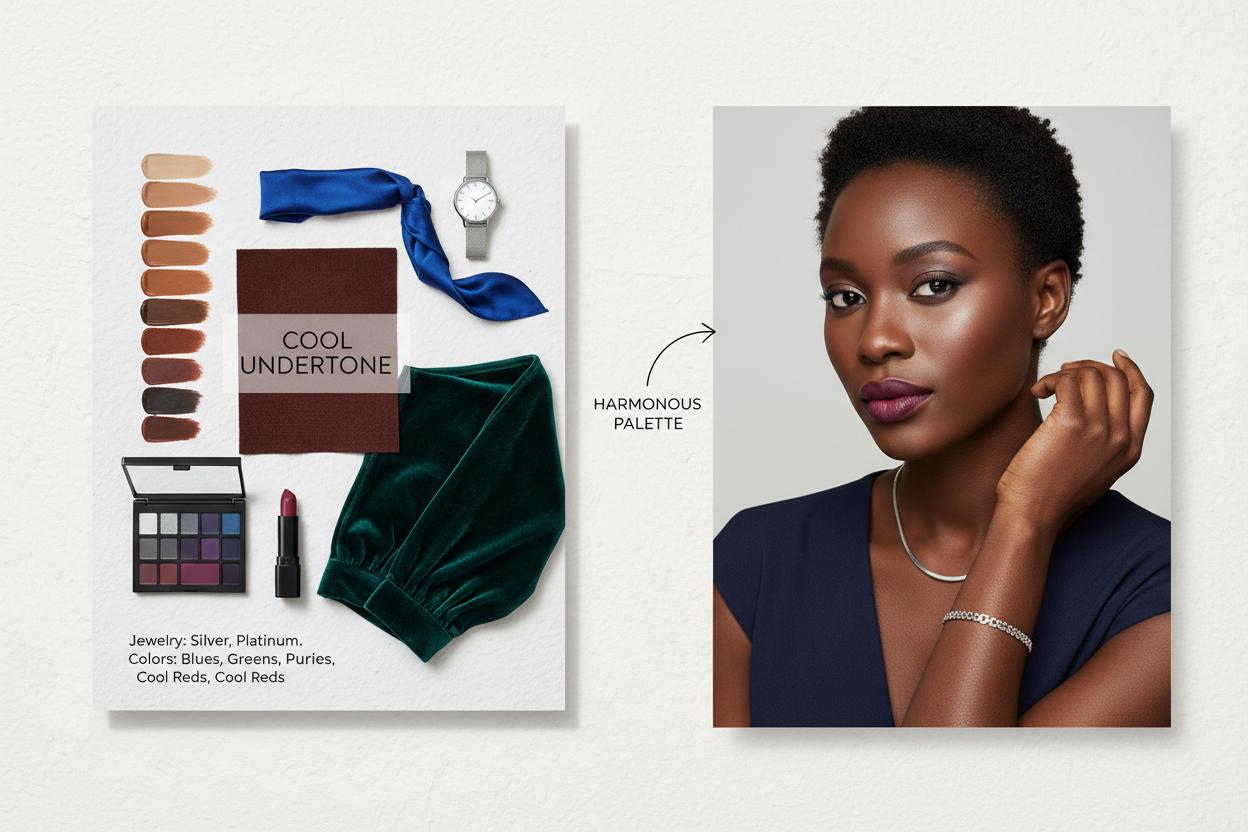
Common signals of a cool undertone on dark skin:
- An ashy or grayish cast, especially around the forehead, jawline, and cheekbones—probably the most recognizable cool-undertone marker in dark skin, and constantly mistaken for dryness or poor skincare
- Blue or reddish-purple hints in the skin's mid-tones, particularly on the cheeks
- Skin that reads berry or plum-based rather than golden in natural light
- A cool, almost blue-black depth in the darkest areas
- Skin that looks flat or washed out under warm-toned or orange-based light
The ashy signal is worth pausing on. A lot of people with cool undertones spend years chasing a hydration fix for something that was never a moisture problem—it's an undertone mismatch, either in their skincare or their foundation. That reframe matters more than it sounds.
Cool undertones on dark skin show up across a wide range: deep blue-blacks and ebony tones with visible purple hints, dark complexions with a clearly red or burgundy base.
The Most Reliable At-Home Tests for Identifying Your Dark Skin Undertone
Standard undertone tests were largely developed with lighter skin in mind, and several work less reliably on deeper complexions. Here's an honest breakdown of which methods hold up—and how to adapt them.
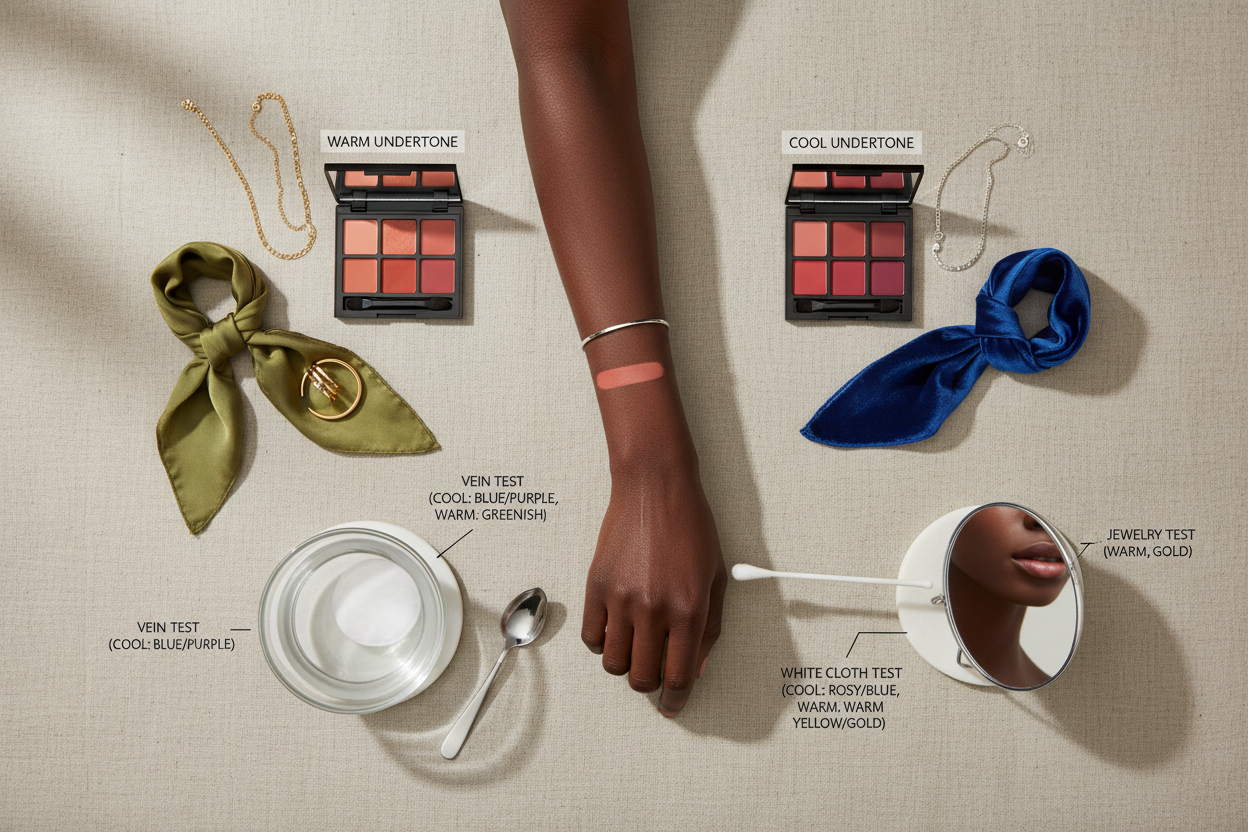
The Vein Test
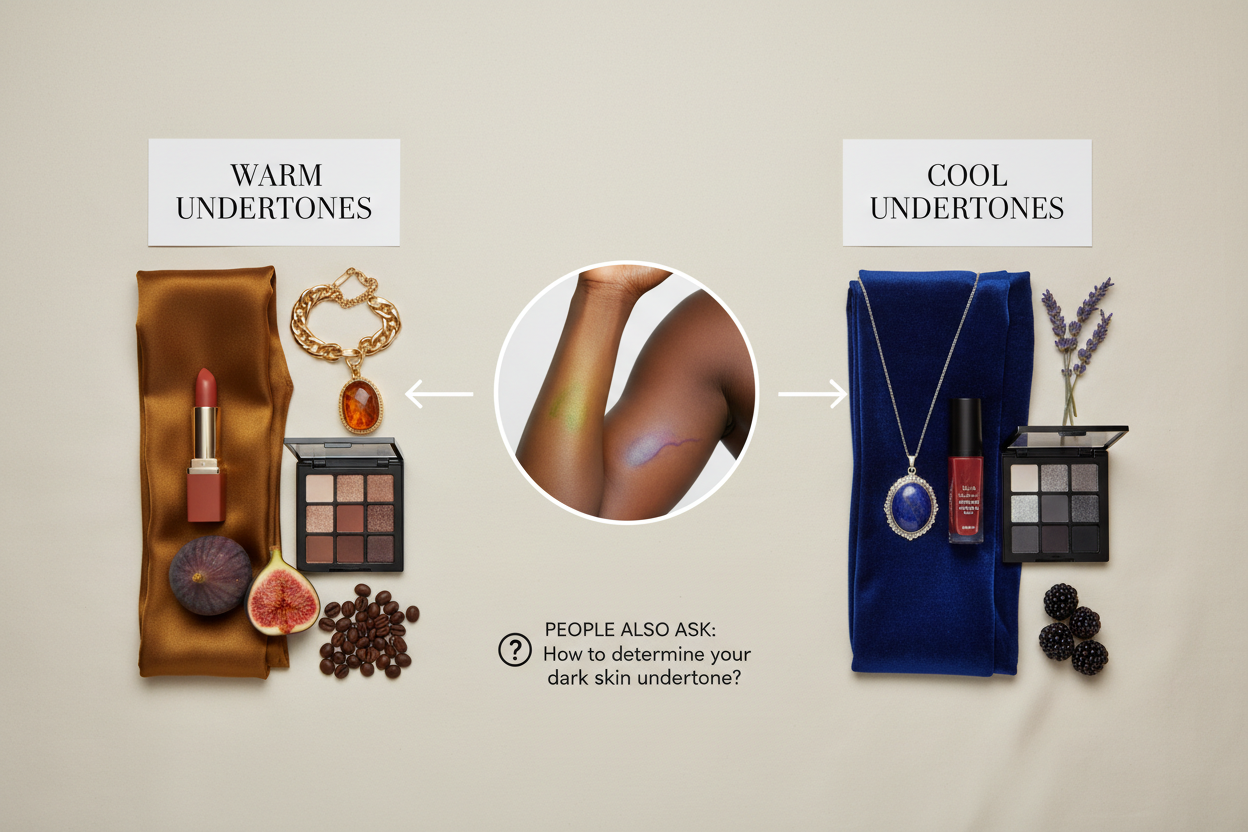
Hold your inner wrist under natural light (not fluorescent or warm artificial light) and look at the color of the veins beneath your skin.
- Blue or purple veins suggest cool undertones
- Green-tinged veins suggest warm undertones
- A mix of both suggests neutral undertones
Limitation for dark skin: On very deep complexions, veins can be difficult or impossible to read clearly. If you can't make out a definite color, skip this test rather than guessing—a bad read here sends you in the wrong direction entirely. Move to the jewelry or white paper test instead.
The White Paper Test
Hold a plain white sheet of paper against your bare face in natural daylight.
- If your skin looks yellowish or golden next to the white, you likely have a warm undertone
- If it looks pinkish, bluish, or grayish, you likely have a cool undertone
- If neither reading is strong, you're probably neutral
This test works reasonably well for dark skin because the stark contrast of white paper makes undertone hues more visible than they appear on their own. Use natural window light, not a phone flashlight or overhead bulb.
The Sun Reaction Test
Think about how your skin responds to extended sun exposure:
- Does it deepen to a rich, warm brown or bronze? That points toward a warm undertone.
- Does it burn more easily, or take on an ashy, grayish tone instead of a warm tan? That points toward cool.
It's not a precise method, but it's a useful corroborating data point.
The Jewelry Test (see dedicated section below)
The Jewelry Test: Gold vs Silver on Deep Complexions
This is consistently the most accessible and reliable method for identifying your dark skin undertone, especially when vein visibility is limited.
How to do it:
- Remove all makeup (or at minimum, clear your face of any products with color or shimmer).
- Hold a piece of gold jewelry—a chain, bracelet, or earring—against your bare skin in natural light.
- Then hold a piece of silver jewelry in the same spot.
- Observe which metal makes your skin look more alive and luminous, and which makes it look flatter or duller.
Reading the results:
- Gold looks better: warm undertone. Gold's yellow base harmonizes with the golden and bronze pigments already present in warm dark skin.
- Silver looks better: cool undertone. Silver's cool, blue-white quality complements the blue, red, and purple undertone pigments in cool dark skin.
- Both look equally good, or you genuinely can't choose: neutral undertone.
One extra note: If you own rose gold jewelry, it falls between the two. If rose gold consistently looks the most flattering on you, you're probably neutral—or close to it.
The jewelry test works well for deep complexions because you're not trying to spot a subtle hue shift in your skin. You're watching how a strong external color either sits well with your tone or fights it. That contrast shows up clearly even on the deepest skin.
How Your Undertone Should Guide Color Choices in Clothing and Makeup
Color theory connects your undertone to the world of color around you—in your wardrobe, your makeup, and your accessories. The logic is simple: colors that share your undertone's base will harmonize with your complexion, while colors that conflict with it can make your skin look dull, sallow, or uneven.
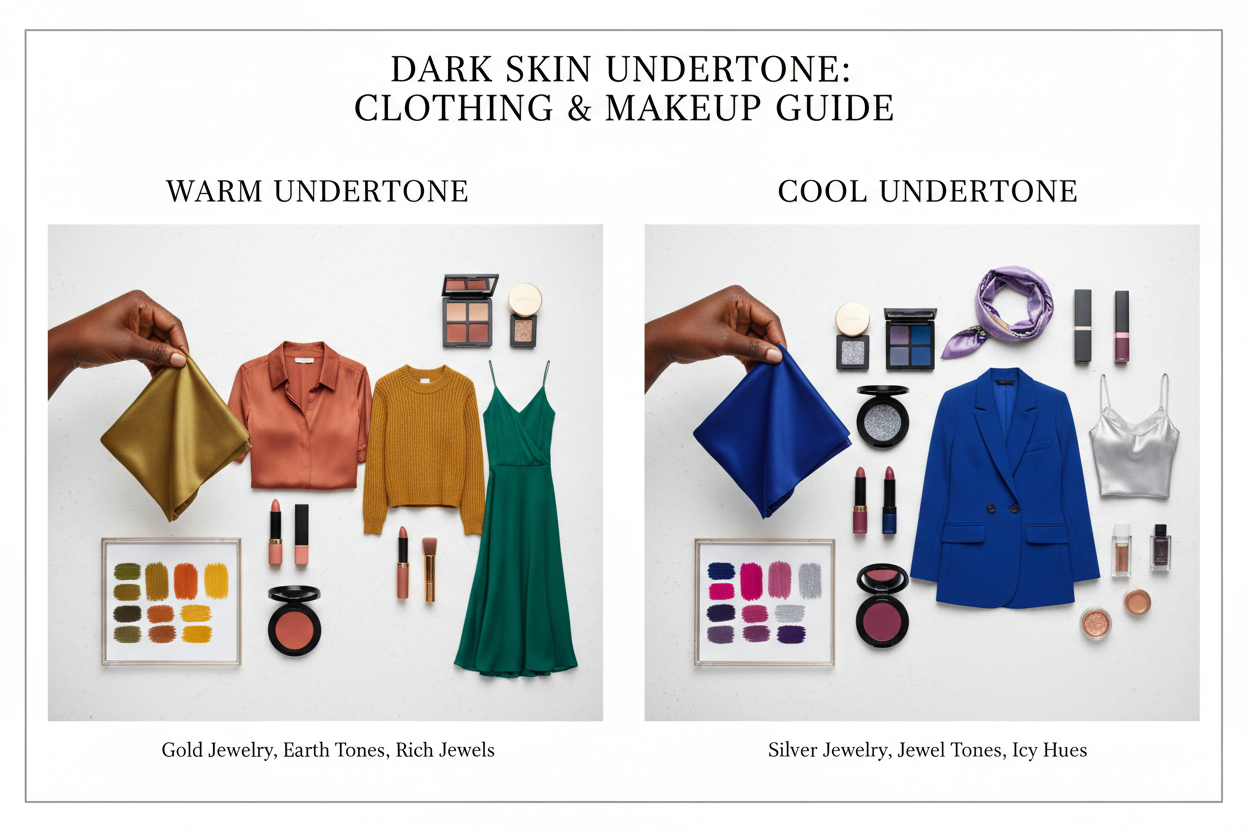
The range of foundations and makeup shades for dark skin has expanded a lot in recent years, which means knowing your undertone now gives you real options instead of forcing you to settle for whatever came closest. The challenge has shifted from scarcity to selection—and undertone knowledge is what makes that selection feel less overwhelming.
For warm dark undertones:
Clothing:
- Earth tones—terracotta, rust, camel, olive, warm brown, and deep gold—will feel natural and effortless
- Rich jewel tones like burnt orange, deep amber, and warm burgundy are particularly striking
- Avoid colors with strong blue or gray bases (icy lavender, silver-gray, cool fuchsia) as they tend to neutralize warmth rather than enhance it
Makeup:
- Eyeshadows in copper, bronze, warm taupe, terracotta, and burnt sienna complement warm dark skin beautifully
- Lip shades in warm brick reds, deep peaches, cinnamon, and brown-based nudes create cohesion
- Blush tones with peachy, golden, or warm coral bases work better than cool pinks or berries
For cool dark undertones:
Clothing:
- Cool jewel tones—sapphire blue, emerald, deep plum, rich teal, and true red—are exceptionally flattering
- Cool neutrals like charcoal, navy, and true white tend to look cleaner and sharper than warm-based neutrals
- Avoid warm-heavy tones like mustard yellow, orange, and camel—they can amplify any ashy cast
Makeup:
- Eyeshadows in cool plum, deep berry, charcoal, navy, and silver work with rather than against the undertone
- Lip shades in blue-red, deep berry, cool wine, and cool-based nudes with pink or rose hints are particularly harmonious
- Blush with cool pink or cool berry bases complements rather than conflicts
On product labels, look for:
- Warm foundations: descriptors like "golden," "caramel," "amber," "yellow-based," or "honey"
- Cool foundations: descriptors like "rose," "pink," "red-based," "blue-based," or "espresso with cool undertone"
- Neutral foundations: often labeled "neutral," "balanced," or formulated to work across undertone ranges
Foundation Undertone Matching for Dark Skin: Warm, Cool, and Neutral Shades
Getting your undertone wrong in foundation is the most immediately visible mistake—and the one most likely to cause that frustrating gray or orange cast. The good news is that the shade range for deep complexions is broader now than it has ever been. The hard part is knowing how to navigate it.
Match foundation to both depth and undertone. A shade that matches your darkness but not your undertone will betray itself within an hour of wear—either by oxidizing orange (common in warm skin paired with a neutral-cool formula) or by sitting ashy and flat (common in cool skin paired with a warm-yellow formula).
For warm dark skin: Look for foundations explicitly labeled with yellow, golden, or amber undertone descriptors. In deep ranges, these are often named with warm words—"espresso with golden undertone," "chestnut," "deep amber," "mahogany warm." Test on your jawline, not your wrist, and check in natural light after 20–30 minutes to see whether the shade oxidizes.
For cool dark skin: Look for foundations labeled with rose, red, or neutral-cool descriptors. Words like "deep with red undertone," "espresso cool," or "deep rose" signal the right direction. Be cautious of formulas described as "natural" or "medium-neutral" in deep ranges—they tend to skew warm and read ashy against cool dark skin.
For neutral dark skin: Neutral formulas in deep ranges are more widely available now and labeled as such. They blend neither strongly yellow nor strongly pink, which helps if you find that both warm and cool foundations never feel quite right.
Practical testing tips:
- Always test on the jawline, where the foundation needs to blend with both your face and neck
- Check in natural daylight, not store lighting
- Wait at least 20 minutes before deciding—that's when undertone mismatches typically show up through oxidation
- If a foundation disappears into your skin and your face and neck look continuous, the undertone match is right
Common Mistakes People with Dark Skin Make When Guessing Their Undertone
Even with good intentions, certain assumptions consistently lead people with deep complexions to the wrong undertone conclusion. Recognizing these errors in advance prevents a lot of trial and error.
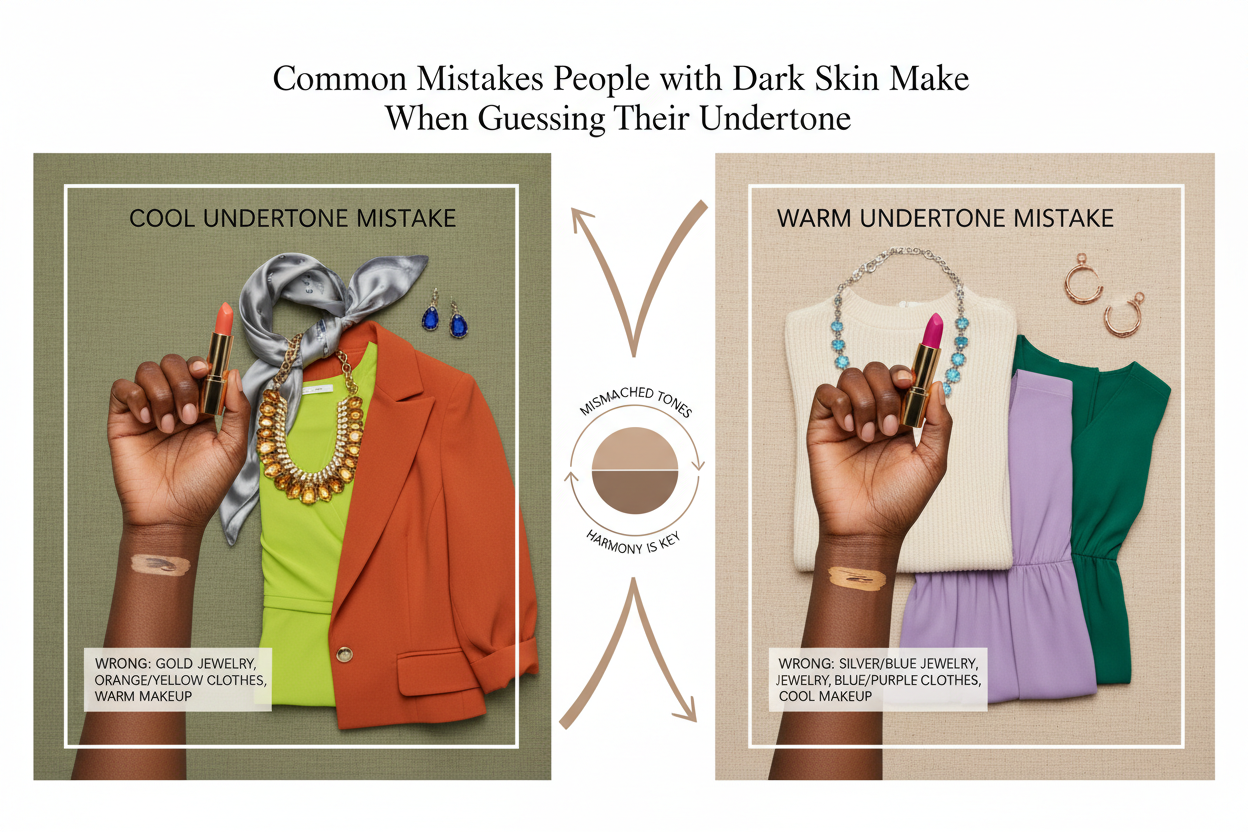
Mistake 1: Assuming all dark skin has warm undertones This is the most widespread error, and it's actively reinforced by marketing that defaults to warm-based formulas in deep shade ranges. Many people with deep complexions have genuinely cool or neutral undertones. Treating warm as the default leads to foundations that oxidize orange and clothing choices that flatten rather than flatter.
Mistake 2: Relying solely on the vein test On deep skin, veins are often not clearly visible enough to read accurately. Making a definitive undertone call based on a vein color you can barely see is worse than using no test at all. If the vein test isn't giving you a clean, clear reading, treat it as inconclusive and try the jewelry or white paper test instead.
Mistake 3: Confusing surface darkness with undertone A very deep, rich complexion says nothing definitive about its undertone. Ebony skin can be warm, cool, or neutral. Deep golden-brown skin can be warm, cool, or neutral. Depth and undertone are independent of each other.
Mistake 4: Misreading ashy skin as a skincare issue An ashy or grayish cast is one of the most reliable visual markers of a cool undertone in dark skin, but it gets blamed on dehydration, dead skin buildup, or poor moisturizing. If the ashiness persists regardless of your skincare routine, it's most likely an undertone signal, not a skin health problem.
Mistake 5: Testing in artificial light Indoor lighting, whether warm incandescent bulbs or cool fluorescent strips, distorts undertone readings in any self-test. Always conduct vein, paper, and jewelry tests in natural daylight, preferably near a window.
Mistake 6: Using only one test No single at-home test is perfectly reliable for dark skin. Use two or three methods and look for where the results converge. If the jewelry test and the white paper test both point to warm, that agreement means something. If different tests give you conflicting signals, neutral undertone is worth considering.
Still Unsure? Take the Color Analysis Quiz to Confirm Your Undertone
At-home tests are a reasonable starting point, but they have real limits—especially for deep complexions, where visual cues can be ambiguous, tests can conflict, and the standard guidance wasn't originally designed with dark skin in mind.
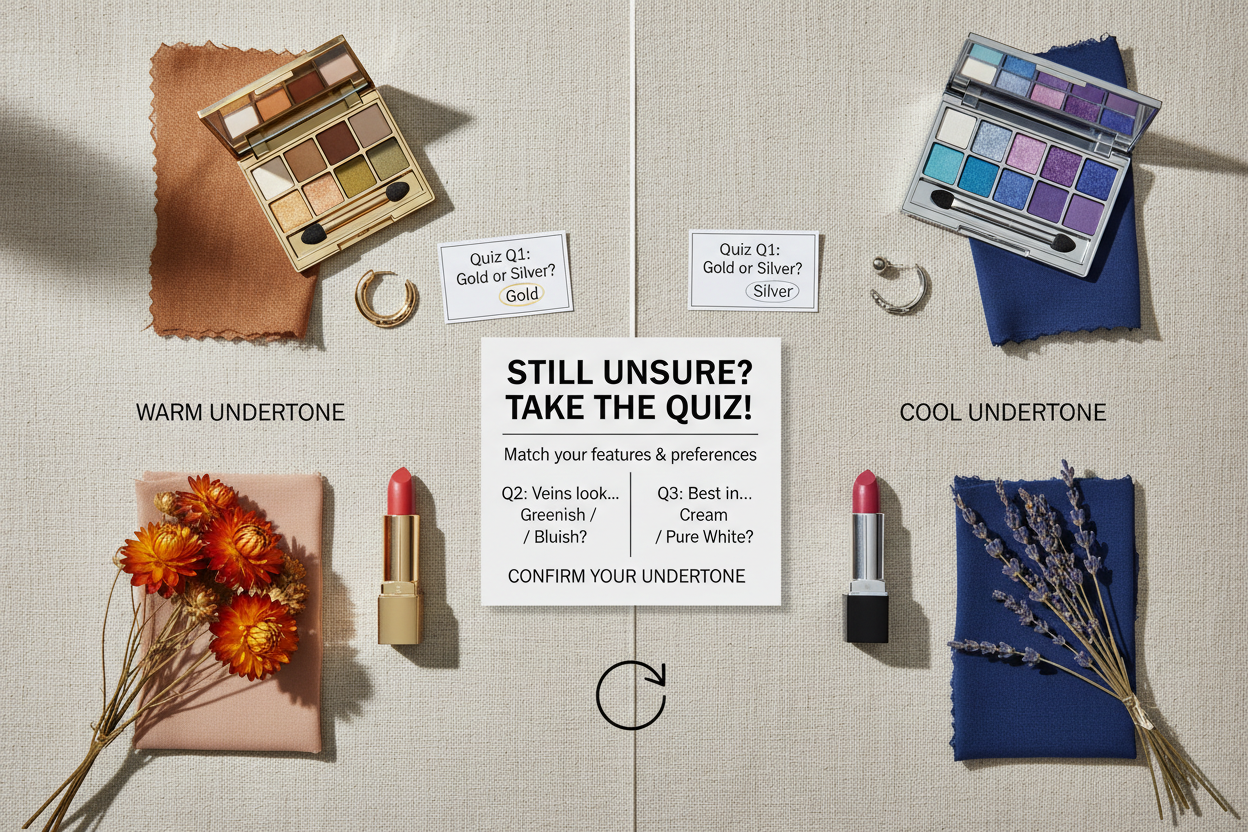
Self-assessment works when the signals are clear and consistent. When they're not—when the vein test is inconclusive, when gold and silver both look fine, when you've tried multiple foundations and none feel right—that's not a failure on your part. The signals are genuinely subtle.
A color analysis tool looks at multiple variables together: skin depth, undertone signals, hair color, eye color, and how you respond to different color families. That combination is more reliable than any single at-home test, and it gives you color guidance you can actually use.
If you've worked through the tests here and still aren't sure about your undertone, the quiz at color-analysis.app is worth trying.
People Also Ask
How do I know if I have a warm or cool undertone with dark skin?
The most reliable approach is to combine two or three at-home tests and look for where the results agree. Start with the jewelry test: hold gold jewelry against bare skin in natural light, then switch to silver, and notice which metal makes your complexion look more luminous. Gold flattering your skin points to warm; silver points to cool. Follow up with the white paper test—hold a plain white sheet beside your face in daylight and notice whether your skin reads yellowish-golden (warm) or grayish-pinkish-bluish (cool). If a single test feels ambiguous, using two methods almost always clarifies the answer. Avoid either test under artificial lighting, which distorts undertone readings.
What undertone do most dark-skinned people have?
No single undertone defines dark skin. Deep complexions come in all three categories—warm, cool, and neutral—and none is more common or more correct than the others. The idea that all dark skin is warm-toned is one of the beauty industry's most stubborn myths, and it's a big reason so many deep-shade foundations have historically pulled yellow-orange. A significant number of people with very deep complexions actually have cool or neutral undertones. Skin depth and undertone are separate things; knowing one tells you nothing reliable about the other.
Can dark skin have cool undertones?
Yes. Cool undertones show up across the full range of skin depths, including the deepest complexions. On dark skin, they often look like:
- An ashy or grayish cast, especially around the forehead, jawline, and cheekbones
- Blue, red, or purple-tinged mid-tones, most visible in natural daylight
- A berry or plum base that becomes noticeable against a white background
- Veins on the inner wrist that read distinctly blue or purple
That ashy appearance gets misread as a skincare or hydration problem fairly often. If it sticks around despite a consistent routine, it's almost certainly an undertone characteristic rather than a skin health issue.
What colors look best on dark skin with warm undertones?
Warm dark undertones tend to look best with colors that share the same yellow-orange-red base.
Clothing and accessories:
- Earth tones: terracotta, rust, camel, warm brown, deep gold, olive
- Rich warm jewel tones: burnt orange, deep amber, warm burgundy, cognac
- Metallics: gold, bronze, copper
Makeup:
- Eyeshadows in copper, bronze, warm taupe, terracotta, and burnt sienna
- Lip colors in warm brick reds, cinnamon, brown-based nudes, and deep peachy corals
- Blush in peachy, golden coral, or warm rose tones
Colors to use cautiously: Strong cool tones—icy lavender, silver-gray, cool fuchsia, anything with a distinctly blue or purple base—can work against warmth rather than with it. Worth testing before committing.
Is the vein test accurate for dark skin undertones?
It can be, but it has real limitations on deep complexions. The vein test reads the color visible through the skin on your inner wrist—blue or purple suggests cool undertones, green suggests warm. On very dark skin, the depth of pigmentation can make veins hard or impossible to see clearly. If you can make out a definite color, the reading is valid. If it's ambiguous, guessing does more harm than good and can throw off your whole undertone assessment.
Treat it as one data point, not a definitive answer. If the reading isn't clean, skip it and try the jewelry test or white paper test instead—both tend to be easier to read on deep complexions.
What is the difference between skin tone and undertone for dark complexions?
These two terms describe completely different things, and mixing them up causes most undertone-related color mistakes:
- Skin tone (also called surface tone or depth) is the visible lightness or darkness of your skin — fair, medium, deep, rich, and so on. It shifts with sun exposure, seasons, and age.
- Undertone is the persistent underlying hue — warm (yellow, golden, orange), cool (blue, red, pink, purple), or neutral (a balance of both) — that sits beneath the surface and does not change with sun exposure or environmental factors.
For people with dark complexions, this distinction matters more than it does for lighter skin because high surface pigmentation can visually absorb or mask the undertone, making it harder to read at a glance. A deep skin tone tells you almost nothing about whether the undertone is warm, cool, or neutral. Getting it right is what determines whether a foundation oxidizes cleanly, whether a clothing color makes your complexion glow, and whether a lip shade feels cohesive or slightly off.
FAQ
Can dark skin have both warm and cool undertones at the same time?
Yes—this is called a neutral undertone, and it exists across all skin depths, including very dark complexions. A neutral undertone means your skin carries roughly equal amounts of warm and cool hues rather than one clearly dominating the other. In practice, this means:
- Neither gold nor silver jewelry looks obviously better than the other
- Foundation shades described as "neutral" or "balanced" tend to blend most seamlessly
- Both warm and cool color palettes can work, though the strongest versions of either extreme may feel slightly off
Neutral undertones are not a fallback category for uncertain results—they're a genuine undertone family. If you consistently find that undertone tests give you mixed signals across multiple methods, neutral is likely your actual answer rather than an inconclusive one.
Why does the vein test sometimes not work for dark skin?
The vein test works by reading color through the skin on your inner wrist — blue or purple means cool undertones, green means warm. On deeper complexions, higher concentrations of melanin absorb or obscure that color, so the veins just look dark regardless of what they actually are.
When you can't clearly read the vein color, guessing introduces error into your undertone assessment. The test is worth trying in strong natural light, but if the result isn't obvious, skip it. The jewelry test and white paper test are more reliable here because they respond to light reflected off your skin's surface rather than requiring you to see through it.
What foundation undertone should I choose for deep warm skin?
For deep skin with warm undertones, look for foundations described as warm, golden, or caramel within the deep shade range. A few things to check:
- Shade names like honey, bronze, caramel, chestnut, or amber usually signal warm undertones
- In the bottle or pan, the formula should look yellow-golden, not pink, red, or gray
- Swatched on the jawline in natural daylight, a good match disappears into the skin rather than pulling orange or ashy
Avoid foundations with cool or neutral descriptors like rose, porcelain, or sand — these tend to read ashy or grayish on warm dark skin. Also worth watching: foundations that oxidize (shift more orange after application). Some warm-leaning formulas pull too orange on very deep skin, so patch-testing on the jaw before committing saves a lot of frustration.
Shade ranges have expanded a lot, but matching undertone within the deep range still matters just as much as matching depth.
Do warm and cool undertones affect which hair colors look best on dark skin?
Yes. Undertone shapes how hair color reads against your complexion, the same way it affects clothing and makeup choices.
For warm dark undertones:
- Warm hair colors tend to harmonize naturally: deep auburn, honey brown, warm black-brown, chestnut, golden highlights
- Heavily cool-toned colors—jet black with a blue tint, ash brown, platinum—can feel stark rather than complementary
For cool dark undertones:
- Blue-black, cool espresso, burgundy with a plum base, and ash-toned browns tend to feel cohesive
- Warm golden or orange-based highlights may clash, creating an unbalanced look
Hair color has more variables than clothing or makeup, though. Lighting, skin depth, eye color, and personal style all play into it. Undertone is a useful starting point, not a rule.
How is undertone different from skin tone for people with dark complexions?
These two things describe entirely separate characteristics, and mixing them up causes most color-matching errors:
| Skin Tone | Undertone | |
|---|---|---|
| What it is | The visible depth or lightness of your skin | The underlying hue beneath the surface |
| Range | Fair → light → medium → deep → rich | Warm, cool, or neutral |
| Does it change? | Yes—with sun, seasons, age | No—it stays consistent throughout life |
| What it tells you | How much surface pigment you have | Which color families harmonize with your complexion |
For people with dark complexions, getting this distinction right matters more than it does for lighter skin. High surface pigmentation can visually mask or absorb undertone, which makes it much harder to read at a glance. Someone with a deep skin tone could have a warm, cool, or neutral undertone—the depth of the complexion doesn't tell you which. That's what determines whether a foundation oxidizes cleanly, whether a clothing color makes skin look luminous, or whether a lip color feels right rather than slightly off.
What colors should people with dark cool undertones avoid?
People with dark cool undertones generally find that colors with a strong yellow, orange, or gold base work against rather than with their natural undertones. Colors worth approaching with caution:
- Warm earth tones in their most saturated forms: rust, terracotta, mustard, camel
- Warm-based browns and nudes in makeup, which can make skin look sallow or flat
- Gold and bronze metallics, which tend to sit more naturally on warm undertones
- Orange-family colors, particularly at high saturation
That said, none of these are hard rules. Personal style, contrast preferences, and the specific saturation of a color all play a role. If a warm color is making a look feel slightly off and you can't pinpoint why, undertone mismatch is usually the culprit — not shade or depth.
Colors that tend to work well for cool dark undertones: jewel tones with a blue or purple base (sapphire, amethyst, emerald), cool reds and berry shades, silver and platinum metallics, and rich cool neutrals like charcoal and navy.
Is it possible to have a neutral undertone with very dark skin?
Yes. Neutral undertones aren't limited to medium or light complexions—they show up across the full range of skin depths, including the deepest tones. On very dark skin, a neutral undertone just means the warm and cool elements are balanced rather than one pulling ahead of the other.
In practical terms, people with deep neutral undertones often notice:
- Both warm and cool foundation shades pull slightly off, while true neutral formulas blend most cleanly
- They have more flexibility with clothing colors, since neither warm nor cool palettes clash dramatically
- Standard undertone tests like the jewelry or vein test give inconsistent results—which is itself a useful signal pointing toward neutral
If you've run through multiple at-home tests and kept landing somewhere between warm and cool, a neutral undertone is probably the right answer. A color analysis quiz can help confirm it by cross-referencing several factors at once instead of betting everything on one method.