Cool Summer Hair Colors and Highlights
 Reviewed by Alexandra Gilmore
Not every ash blonde or cool brown belongs in Cool Summer; some are too dark, stark, or metallic for the season's softness. Choose base colors and highlight techniques that remain muted and blended, then avoid golden, copper, or high-contrast effects that can make the skin look dull.

If you belong to the Cool Summer color season, choosing the wrong hair color can quietly dull your complexion — while choosing the right one makes your skin look clearer, more luminous, and effortlessly put together. The challenge is that "cool" covers a wide range, and not every ash or blonde shade lands in Cool Summer territory.
💫 Discover Your Complete Color Palette
One feature rarely explains every color that works for you. Compare your undertone, depth, clarity, and contrast as a complete palette, then use the results to test clothing, makeup, and hair colors more consistently.
Find My Color Palette →This guide covers everything you need to navigate the best hair colors for the cool summer palette: the natural shades that already belong to this season, which highlight techniques flatter it most, the warm tones to avoid, and how to tell whether you're a Cool Summer rather than a Cool Winter or True Summer.
Here's what makes Cool Summer hair color distinctive from the start:
- The palette is light, muted, and consistently cool-toned. Natural Cool Summer hair spans from light ashy blonde through dirty blonde to medium cool brown — never golden, never warm.
- Softness is the through line. Whatever specific shade sits on a Cool Summer's head, it shares a muted, low-saturation quality that harmonizes with the season's equally soft skin and eye tones.
- Individual variation matters. Cool Summer is not a rigid mold. Because everyone's features are unique, you may lean slightly lighter or slightly deeper within the spectrum — and your ideal shade should reflect that nuance rather than a one-size formula.
- The "true cool" distinction is real. Cool Summers sit alongside Cool Winters as the two seasons with genuinely cool (blue- and ash-based) undertones, which is why the same highlight technique that works beautifully on one can look harsh or flat on the other.
By the time you finish reading, you'll know exactly which shades and techniques serve a Cool Summer complexion, which ones to skip, and how to keep color looking fresh without drifting warm or brassy.
What Makes a Hair Color 'Cool Summer'?
A hair color fits the "Cool Summer" label when it hits three qualities at once: cool (no warm, golden, or brassy undertones), muted (softened saturation rather than vivid or high-contrast), and light to medium in depth. Lose any one of those and you've stepped outside the palette.
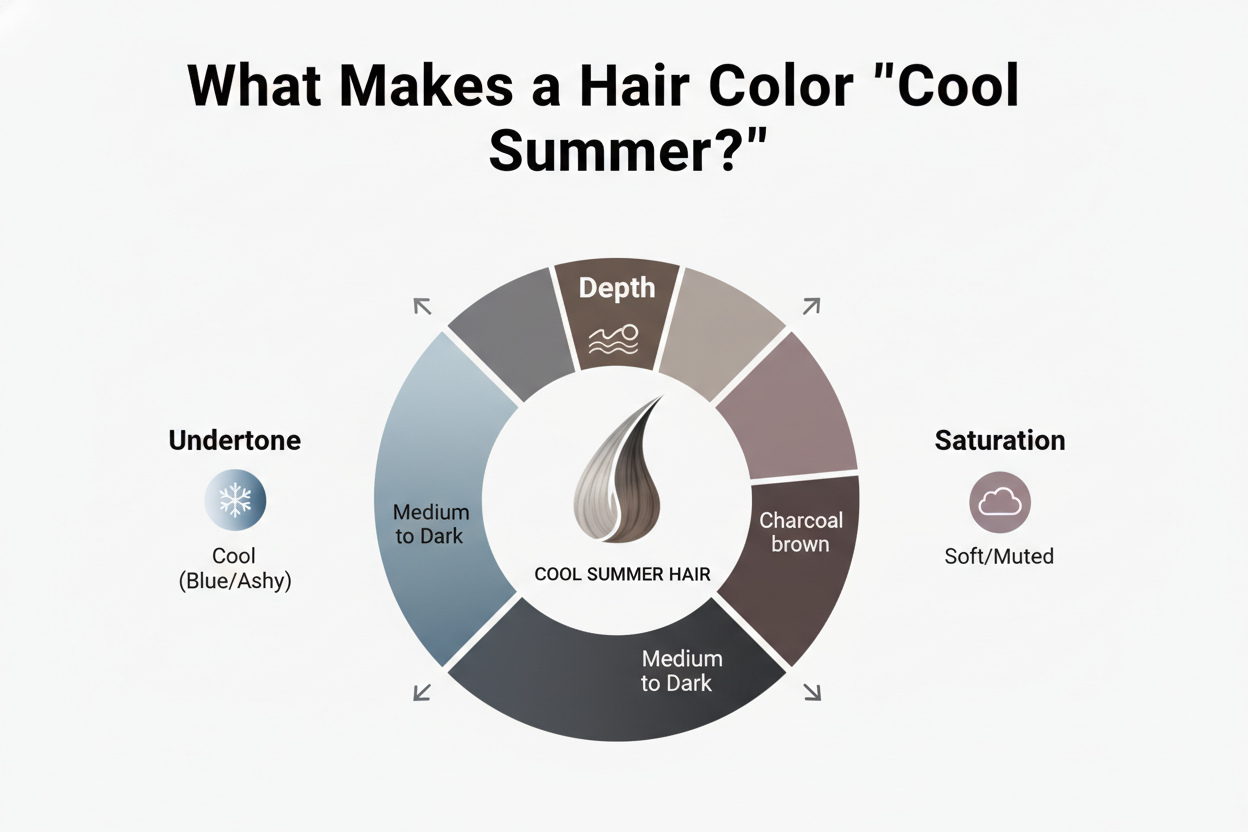
One color expert describes the Cool Summer season as an English country garden where "everything is soft and blended with delicate washes of colour." That image is a useful gut check: if a shade reads bold, warm, or sharply contrasted, it doesn't belong in the garden.
In practice, this means:
- Cool undertones are non-negotiable. Ash, slate, rose-beige, and blue-based tones belong here. Golden, caramel, copper, and honey do not.
- Muted saturation defines the palette. A Cool Summer shade should look blended into the hair, not deposited on top of it.
- Depth stays light to medium. Very dark or very stark shades push into Cool Winter territory (more on that below).
When all three conditions line up, the hair color works with a Cool Summer's equally soft skin and muted eyes — that effortlessly polished look the season tends to produce.
Not sure if Cool Summer is actually your season? Individual features vary, and the palette is a starting point rather than a verdict. Take the free color analysis quiz →
The Natural Hair Color Spectrum of Cool Summers
Cool Summer natural hair runs through a fairly specific corridor: light ashy blonde → dirty blonde → medium cool brown. Every shade in that range shares the same basic quality — soft, muted, and cool. Never golden, never red-shifted, never dark enough to read as near-black.
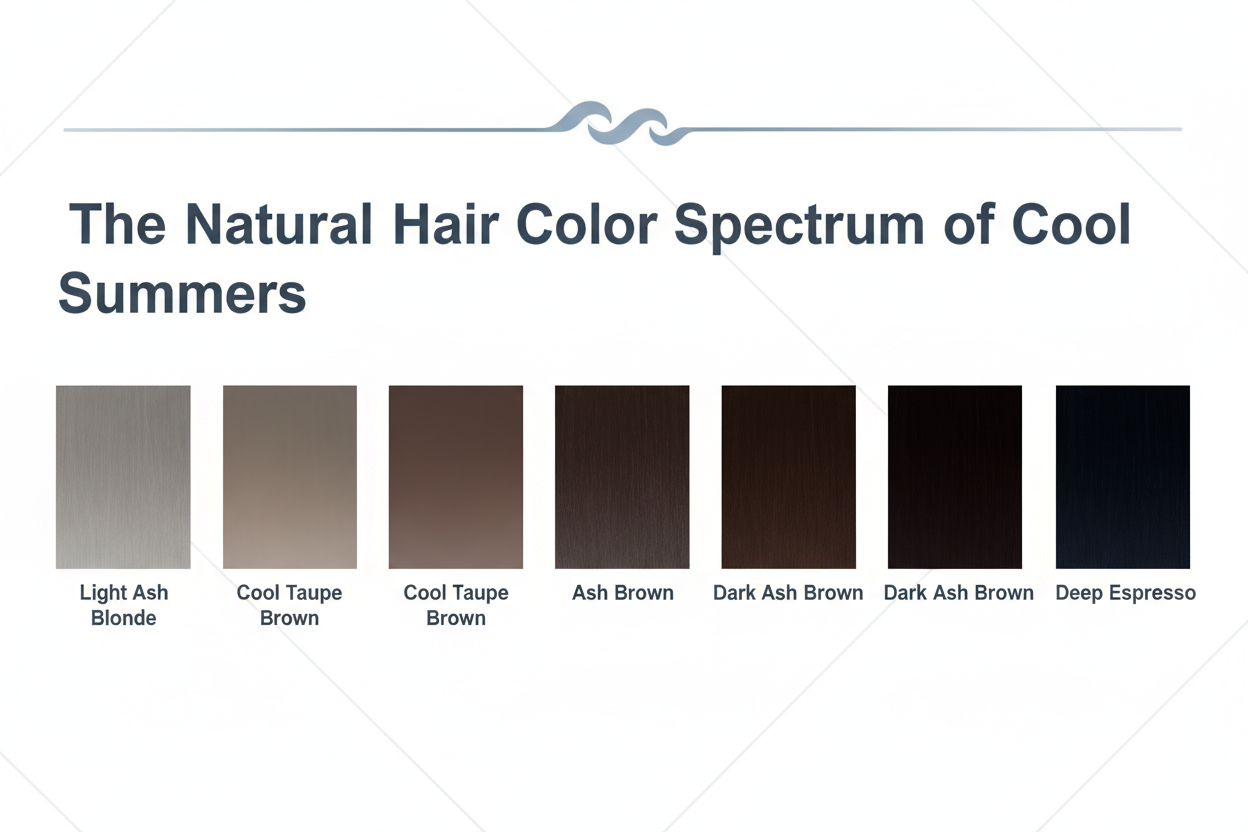
Knowing where you fall on that spectrum helps you make better color decisions, whether you're staying close to your natural base or adjusting it.
Ashy blonde vs. dirty blonde: understanding the Cool Summer blonde range
Both ashy blonde and dirty blonde belong in the Cool Summer palette — but they're not the same shade, and that difference matters when you're picking a color formula.
| Ashy blonde | Dirty blonde | |
|---|---|---|
| Tone | Pale, silvery, or platinum-cool | Beige-cool with a faint grey-green depth |
| Saturation | Very low — almost neutral | Low — slightly richer but still muted |
| Risk zone | Can pull too icy if overdone | Can drift warm if the formula isn't careful |
| Best for | Lighter Cool Summers with fair skin | Cool Summers with light-medium skin |
The thing that matters for both: no gold. If your "dirty blonde" starts reading as honey or caramel, it has left Cool Summer territory. A true Cool Summer dirty blonde looks more like cooled wheat than sun-warmed straw.
Best Highlight Techniques for Cool Summer Hair
The overriding principle for Cool Summer highlights is low contrast and cool tone throughout. The "English country garden" visual framework is a reliable guide here — delicate washes of colour, softly blended, never harsh or abrupt.
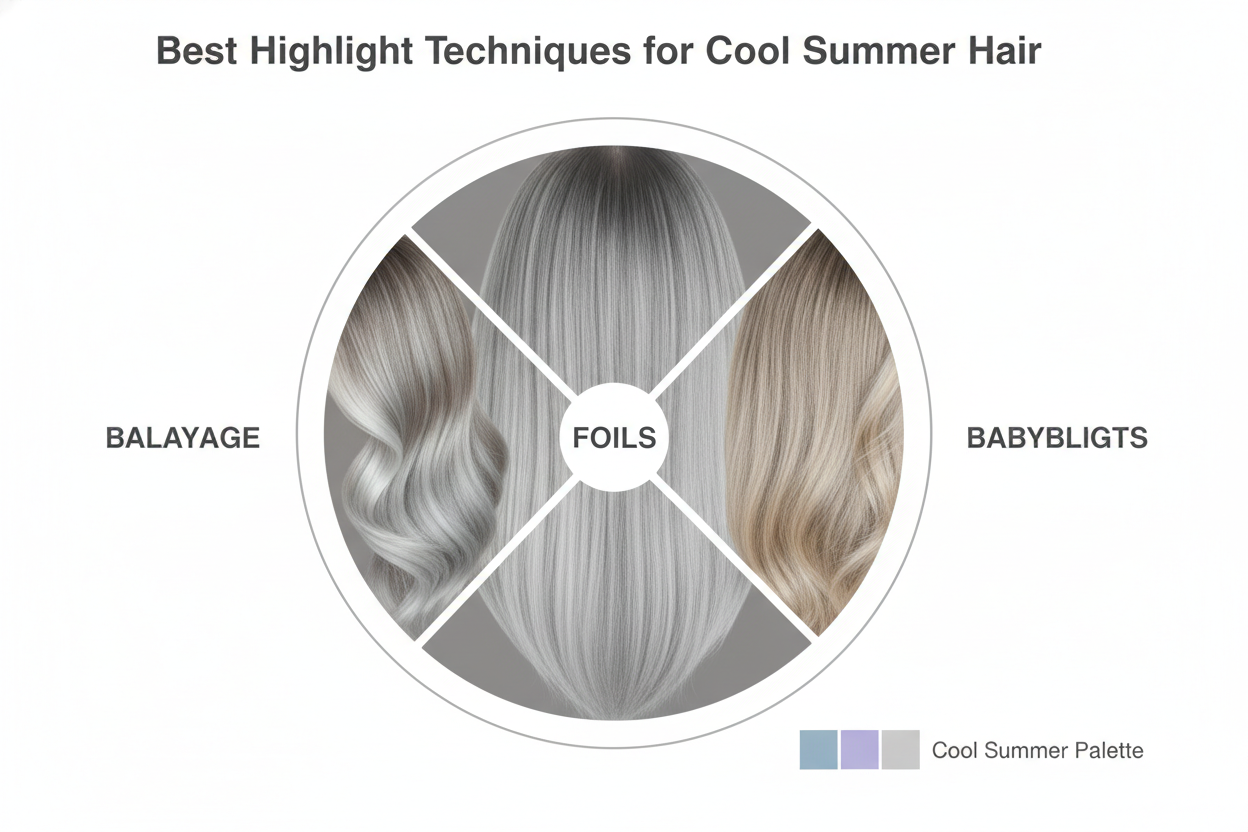
Low-Contrast vs. High-Contrast Highlights: Why Cool Summers Need Soft Blending
High-contrast techniques — bold balayage, chunky face-framing, strongly separated panel highlights — work against the muted, gentle quality that defines the Cool Summer palette. A stark contrast between dark root and bright highlight introduces drama that belongs to Cool Winter, not Cool Summer.
Techniques that work well:
- Fine babylights — micro-thin sections woven throughout create a barely-there shimmer that reads as natural
- Tonal glossing — an all-over cool-toned gloss adds luminosity without adding contrast
- Soft, seamless balayage in ash or cool-beige tones, painted lightly so the transition stays gradual
- Shadow root kept close in depth to the mid-lengths, which prevents a sharp line of demarcation
Techniques to approach with caution:
- Heavy balayage with strong root-to-tip contrast
- Chunky foil highlights that create visible blocks of color
- Any formula containing gold, honey, or warm beige developers
The goal is hair that looks like it caught more light, not hair that looks colored. Softness and blending are the standard — not saturation or contrast.
Hair Colors to Avoid If You're a Cool Summer
The Cool Summer palette is built on being light, muted, and gentle. That means the shades to avoid tend to share one or more of three qualities: they're warm, bright, or high-contrast — the opposite of everything the palette is.
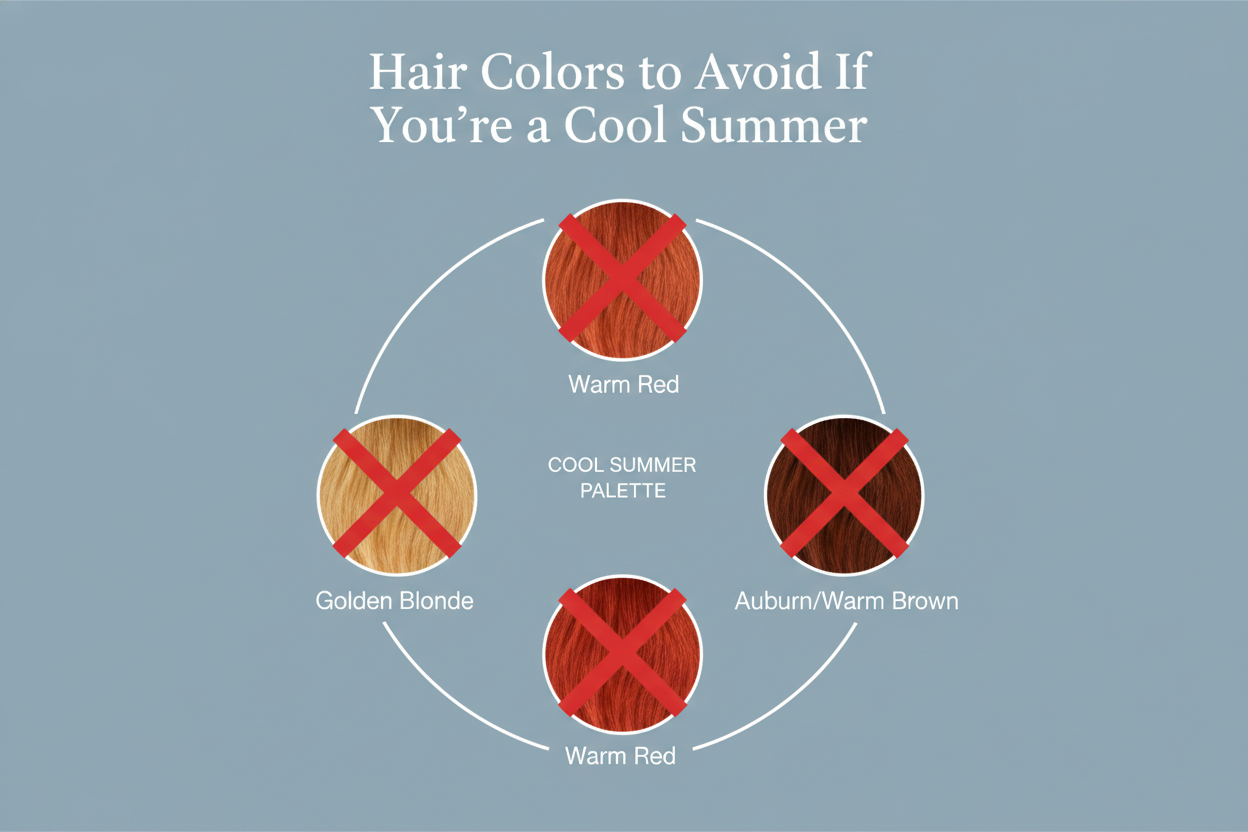
Avoid these categories:
- Golden and honey blondes — the warmth pulls against cool undertones and casts yellow or orange near the face
- Caramel and butterscotch tones — too warm and too saturated
- Copper and auburn shades — any red shift puts you outside the cool spectrum
- Warm or chocolate brown — brown with red or gold undertones will clash with cool skin
- Platinum ice blonde — cool in tone, but the starkness creates high contrast that belongs to Cool Winter, not Cool Summer
- Jet black or near-black — the depth reads as dramatic, which is a Winter quality
A quick gut-check: if a shade sounds warm, it's probably wrong. If it sounds saturated and bold, same answer. Cool Summer rewards restraint. The right shade usually feels like it's holding back a little.
Worried you might be choosing the wrong shade? Getting your season confirmed before your next appointment saves you from a costly correction. Start your color analysis here →
How to Tell If You're Actually a Cool Summer (Not Cool Winter or True Summer)
Cool Summer, Cool Winter, and True Summer are the three seasonal categories people mix up most often — and honestly, the confusion makes sense because all three share cool undertones. What separates them is contrast level and saturation.
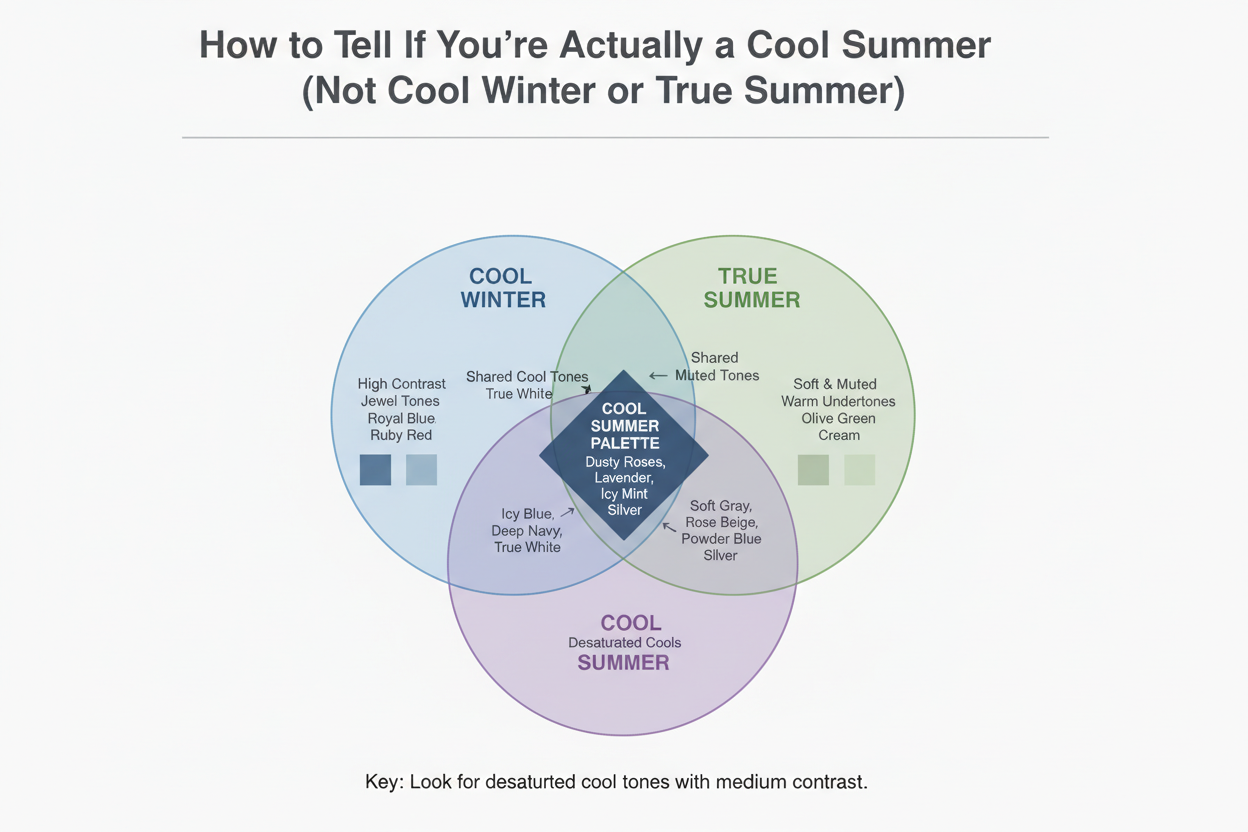
| Cool Summer | True Summer | Cool Winter | |
|---|---|---|---|
| Undertone | Cool/neutral-cool | Cool | Cool/neutral-cool |
| Contrast | Low to medium | Low | High |
| Palette depth | Light to medium | Light to medium | Medium to deep |
| Hair quality | Soft, muted, cool | Soft, muted, cool | Richer, deeper cool |
| Wrong shade risk | Goes washed out with warmth; harsh with high contrast | Similar to Cool Summer | Can handle more depth and contrast |
In practice:
- Cool colors suit you, but very dark or stark shades make you look severe? That points to Cool Summer over Cool Winter.
- High contrast looks polished rather than harsh on you, and you can wear slightly deeper cool tones? You may lean Cool Winter.
- Your palette reads almost identical to Cool Summer but with a bit less blue in it? You might be True Summer.
These aren't just technical distinctions — they matter when you're choosing hair color formulas or deciding how much highlight contrast to add. Get it right and the color lifts your complexion. Get it wrong and it just looks approximately correct.
Maintaining Cool Summer Hair Color: Keeping Tones Muted and Ash-Forward
Cool Summer has one consistent enemy: warmth. Ash and cool tones oxidize over time, drifting toward gold or brass — especially in lighter shades. Staying ahead of that drift is what keeps the palette looking right between salon visits.
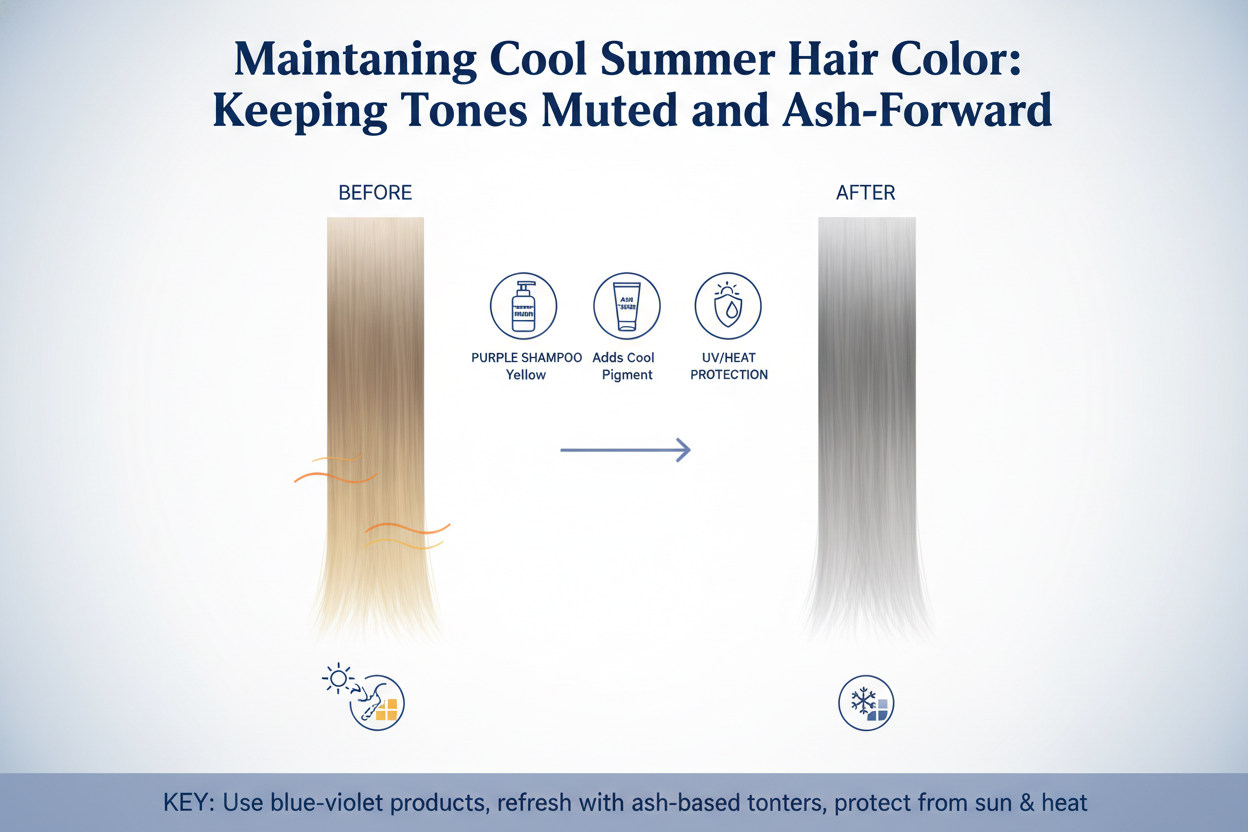
Key maintenance strategies:
- Purple or violet shampoo 1–2 times per week — deposits cool pigment to neutralize yellow and brassy buildup in blonde and light-brown tones
- Cool-toned toning gloss every 4–6 weeks — refreshes the ash without a full color appointment; ask your colorist for a clear or ash-based gloss
- Blue shampoo for medium cool brown — blue pigment counteracts the orange and copper oxidation that shows up in mid-depth brunette shades
- Limit heat styling where you can — repeated heat exposure speeds up oxidation and dulls the soft quality the palette depends on
- Clarifying shampoo occasionally — clears mineral and product buildup that can make the tone look muddy or warm
The goal isn't to freeze the shade in place. It's to stop the slow creep toward warmth that pulls it out of the Cool Summer range. Think of it as keeping the softness and coolness intact — not matching a specific swatch.
Find Your Exact Cool Summer Shade with a Personalized Color Analysis
One expert calls Cool Summer "one of the prettiest colour palettes of the four seasons" — but it's also one of the trickier ones to pin down. The spectrum runs from ashy blonde to medium cool brown, and where you land depends on your specific mix of skin undertone, eye colour, and natural contrast.
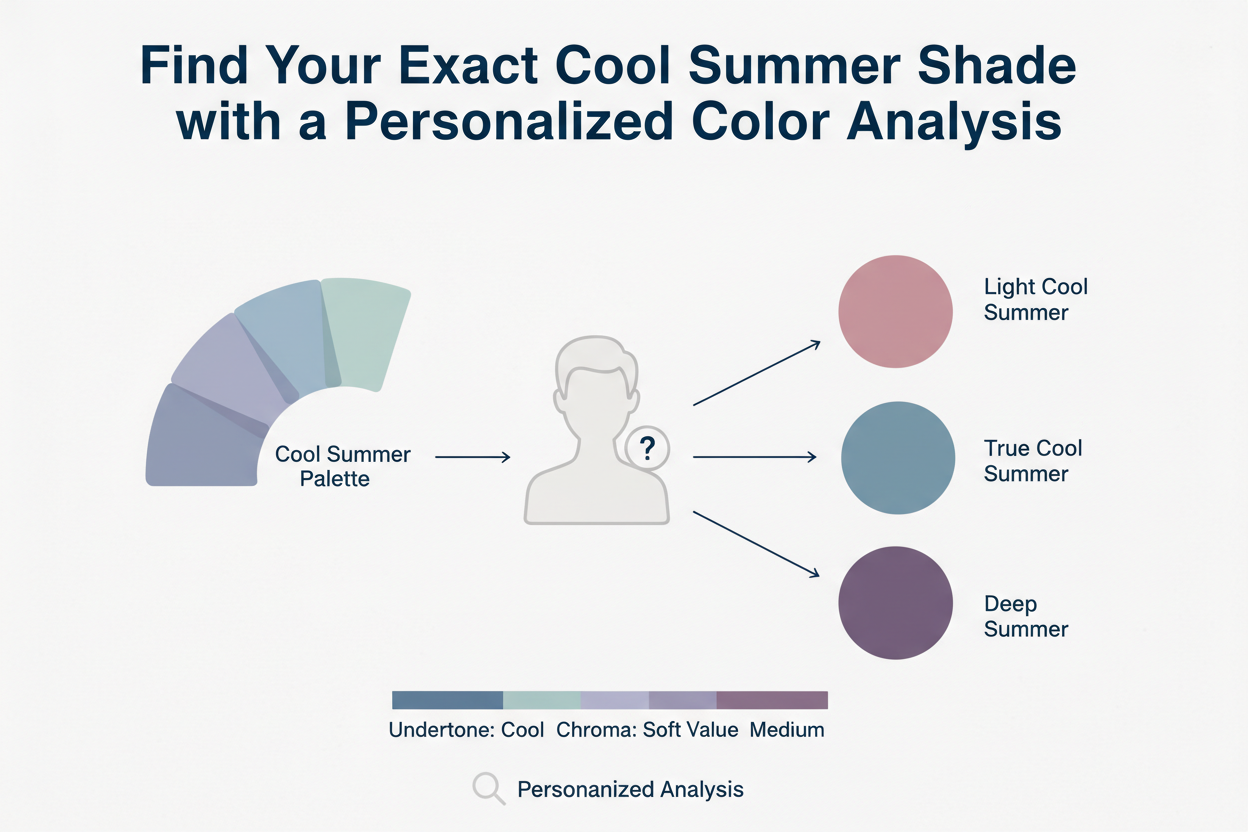
Palette descriptions give you a framework, not an answer. As one color stylist puts it: you're unique, and you may not fit neatly into one palette. These are starting points, not conclusions.
That variation is also why misidentification is so common. Summer types are surprisingly prevalent — research from one European colour community found a majority of surveyed women fell into a summer category — which means a lot of people are navigating this palette, with a wide range of features between them.
A personalized color analysis closes that gap. It tells you not just whether you're a Cool Summer, but where on the spectrum your coloring sits, and which specific shades, highlight approaches, and maintenance strategies actually work for you.
People Also Ask
What hair colors are best for cool summer skin tone?
Cool summer skin tones work best with hair colors that share the same qualities as the season itself: cool undertones, muted saturation, and light-to-medium depth. A few strong options:
- Ashy blonde — pale and silvery, with no golden shift
- Dirty blonde — a cooled, beige-leaning blonde that reads like cooled wheat rather than warm honey
- Medium cool brown — a softened, ash-inflected brunette without red or gold undertones
What ties these together is a soft, muted, cool appearance. Warm, vivid, or deeply saturated shades pull the palette in the wrong direction and tend to cast unflattering warmth near the face.
Can cool summers go blonde?
Yes — blonde is actually one of the most natural choices within the Cool Summer palette. The natural hair color range for this season runs from light ashy blonde through dirty blonde, so lightening toward blonde works with the palette rather than against it.
The catch: the blonde has to stay cool. Ashy, silvery, and cool-beige formulas belong here. Golden, honey, or warm blonde formulas don't — even a subtle warm shift can undermine the soft harmony this palette depends on. Purple toning shampoo and regular cool-toned gloss treatments help maintain the right tone between salon visits.
What is the difference between cool summer and cool winter hair color?
Both Cool Summer and Cool Winter have cool undertones, which is why they get confused. The difference is depth and contrast:
| Cool Summer | Cool Winter | |
|---|---|---|
| Depth | Light to medium | Medium to deep |
| Contrast | Low to medium | High |
| Overall effect | Soft, muted, gentle | Richer, bolder, more striking |
In practice, Cool Summer colors are softer and less dramatic — ashy blonde, muted cool brown. Cool Winter colors can carry more depth and saturation, and high-contrast styling looks polished rather than harsh on this type. If very dark or stark shades make you look severe, you're more likely a Cool Summer.
Should cool summers avoid warm highlights?
Yes. Warm highlights — golden blonde, honey, caramel, copper — sit outside the Cool Summer palette and tend to clash with its cool, muted complexion. Near the face, warm tones can make skin look sallow or introduce a yellow or orange cast.
High-contrast placements are also a problem, not just warm tones. Heavy balayage with a strong root-to-tip contrast or chunky foil panels bring a level of drama that belongs to Winter palettes, not Summer. The goal is soft, seamlessly blended highlights in ash or cool-beige formulas — color that looks like the hair caught more light, not like it was dramatically colored.
What does a cool summer hair color look like?
A Cool Summer hair color looks soft, muted, and quietly luminous — never bold, warm, or sharply contrasted. Think English country garden: delicate, blended, gentle washes of color rather than anything vivid or dramatic.
In practice, that might mean:
- Fine ashy highlights woven through a light brown base, catching the light without obvious contrast
- A cool dirty blonde that reads beige in low light and softly luminous in sunlight
- A medium cool brown with a slight ashy or slate quality, free of any red or gold warmth
The overall impression is hair that harmonizes with the person wearing it — it enhances without overpowering, and looks like it belongs there rather than being applied on top.
FAQ
What is the natural hair color range for Cool Summer types?
Cool Summer natural hair runs from light ashy blonde through dirty blonde to medium cool brown. Every shade in this range shares the same quality: a muted, cool, ash-inflected tone with no golden or red warmth. Even the darker end reads soft and understated rather than rich or saturated.
Can a Cool Summer dye their hair a warm or golden shade?
Generally, no. The Cool Summer palette is built on cool undertones and low saturation. Warm or golden shades — honey blonde, caramel, copper, golden brown — introduce exactly the warmth the palette lacks by design, and that warmth tends to bounce yellow or orange tones onto the face. The further a shade drifts from cool and muted, the more it works against a Cool Summer complexion rather than with it.
What is the difference between a Cool Summer and a True Summer in terms of hair color?
Both types share cool undertones and muted saturation, so their hair palettes overlap considerably. The main distinction is depth and lightness:
- True Summer sits closer to the center of the Summer family — softly cool with balanced depth
- Cool Summer leans slightly cooler and can handle a touch more contrast, sitting closer to the Winter side of the seasonal spectrum
In practice the differences are subtle. A True Summer might favor warmer-cool brunettes, while a Cool Summer gravitates toward ashy, silvery, or slate-leaning shades. Neither type suits warm or vivid color.
How do I keep my Cool Summer hair color from going brassy?
Brassiness is the main maintenance challenge for Cool Summers because oxidation and heat exposure naturally push color toward warmth. A few things that help:
- Use a purple or blue-violet toning shampoo once or twice a week to neutralize yellow and orange shifts
- Apply a cool-toned gloss or toner between color appointments to refresh ash tones
- Avoid excessive heat styling without heat protection, which accelerates warmth development
- Rinse with cool water rather than hot to help color molecules stay locked in
The goal is to keep the hair reading ash-forward at all times. The moment it tips warm, it moves outside the Cool Summer palette.
Are ash blonde highlights good for Cool Summer types?
Yes. Ash blonde highlights are among the most flattering choices for Cool Summers. They sit directly within the season's cool and muted requirements, and because ash blonde falls naturally within the Cool Summer hair range, well-placed highlights read as enhanced natural color rather than something applied.
The technique matters as much as the shade. Fine, softly blended highlights — sheer weaves or a gentle melt rather than bold panels — preserve the low-contrast, seamless look that suits this palette best.
How do I know if I am a Cool Summer or a Cool Winter?
Both seasons share cool undertones, which makes them easy to confuse. The clearest distinctions are depth and contrast:
| Cool Summer | Cool Winter | |
|---|---|---|
| Depth | Light to medium | Medium to deep |
| Contrast | Low to medium | High |
| Effect of stark shades | Looks harsh or draining | Looks polished and striking |
A practical self-test: hold a very dark, high-contrast look up to your face. If it feels overpowering or severe, you are likely a Cool Summer. If it enhances and energizes your complexion, Cool Winter is the stronger fit. Cool Summers are defined by softness — their best hair colors feel gentle and quiet, never dramatic.
Is dirty blonde a Cool Summer hair color?
Yes, dirty blonde falls squarely within the Cool Summer natural hair color spectrum. The term refers to a blonde that reads as cooled, beige-leaning wheat rather than warm golden honey — and that cool-beige quality is precisely what makes it compatible with this palette.
One caveat: not all dirty blondes are equal. A dirty blonde with visible warmth, golden flecks, or honey tones slides toward the warm side and no longer belongs to the Cool Summer palette. The version that works reads cool, slightly ashy, and softly muted in all lighting conditions. If you are unsure whether your current shade leans cool or warm, a personalized color analysis can confirm it.
Before finalizing a shade, compare this advice with the companion article “The Best Hair Colors for the Cool Summer Palette”, which keeps the two closely related questions distinct.