Best Colors for Dark Skin Female
 Reviewed by Alexandra Gilmore
Deep skin is not one undertone and cannot be served by the vague instruction to wear jewel tones. Separate depth from warm, cool, neutral, or olive direction, then choose specific clothing colors and contrast levels that enhance the complexion instead of relying on recommendations built around lighter skin.

Finding the colors that genuinely flatter your skin is advice most of us receive early and often—but for dark-skinned women, the standard guidance rarely goes deep enough.
💫 Discover Your Complete Color Palette
One feature rarely explains every color that works for you. Compare your undertone, depth, clarity, and contrast as a complete palette, then use the results to test clothing, makeup, and hair colors more consistently.
Find My Color Palette →The premise of color theory sounds straightforward: identify the hues that harmonize with your personal coloring—your skin tone, hair color, and eye color—and build your wardrobe around them. In practice, though, most color guides were written with lighter complexions as the default, leaving women with deep skin tones with vague recommendations like "jewel tones" or "bold colors" that don't account for the real variation within dark skin.
Here is what this guide does differently:
- It separates skin depth from undertone. Dark skin is not a single category. A deep complexion can carry warm golden undertones, cool reddish or ashy undertones, or a neutral mix—and each responds differently to the same color.
- It gives specific, actionable color choices organized by undertone, not just broad "dark skin" buckets.
- It addresses the colors worth approaching carefully—and explains exactly how to make them work rather than writing them off entirely.
- It covers how your hair color and eye color interact with clothing colors to create a complete picture.
Whether you are shopping for a wardrobe staple, planning an outfit for a special occasion, or simply trying to understand why certain colors photograph beautifully on you while others fall flat, this guide gives you a practical, tone-by-tone framework rooted in color theory—adapted specifically for deep complexions.
Why Undertone—Not Just Skin Depth—Determines Your Best Colors
Two women can share the same rich, deep complexion and look completely different in the same shade of burgundy—one radiant, one washed out. The reason is almost never skin depth. It's undertone.
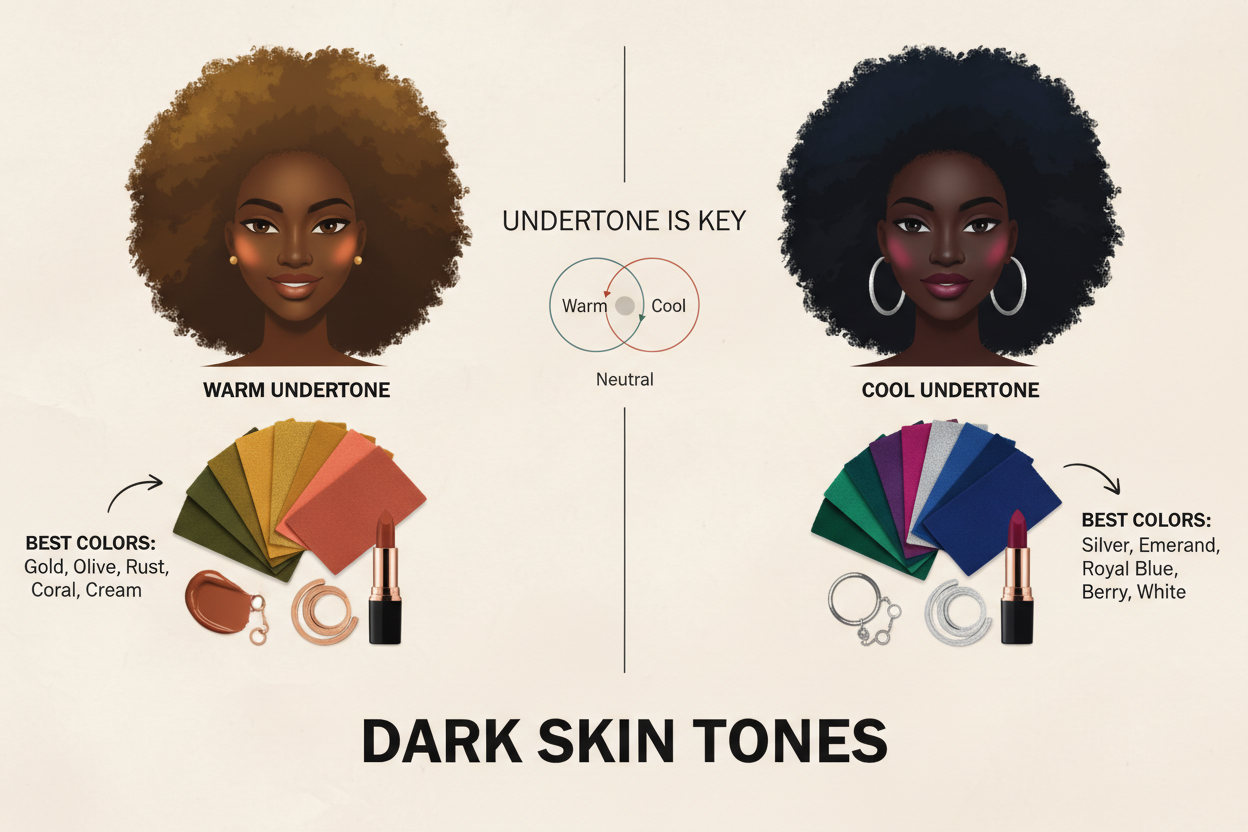
Undertone is the subtle hue that lives beneath the surface of your skin. It doesn't change when you tan or when the light shifts. For dark-skinned women, undertones fall into three families:
- Warm – golden, orange, or yellow-based; common in mahogany, caramel-brown, and deep golden complexions
- Cool – red, pink, or blue-based; common in ebony, blue-black, and deep reddish-brown complexions
- Neutral – a balanced mix of warm and cool, without a strong lean in either direction
The basic principle: colors that share or complement your skin's undertone family will harmonize with your face. Colors that fight it create dullness or an ashy cast. Once you know your undertone, choosing flattering colors stops being guesswork.
This matters more for dark-skinned women than most guides let on. Deep skin tones absorb more light, so low-contrast or poorly matched colors don't just look unflattering—they can disappear entirely. Getting undertone right isn't a small refinement. It's the foundation.
Not sure of your undertone yet? A personalized color analysis can confirm it in minutes. Take the quiz →
How to Identify Your Undertone as a Dark-Skinned Woman
Why Standard Undertone Tests Are Less Reliable on Deep Skin—and What to Do Instead
If you've tried the standard undertone tests and walked away more confused than when you started, you're not imagining things. Most of these tests were developed and calibrated on lighter complexions. The classic "look at your veins" instruction assumes you'll see a clear green-versus-purple distinction, but on deep skin the melanin concentration makes veins look uniformly dark—often dark green or dark blue regardless of undertone. The result is ambiguous at best and misleading at worst.
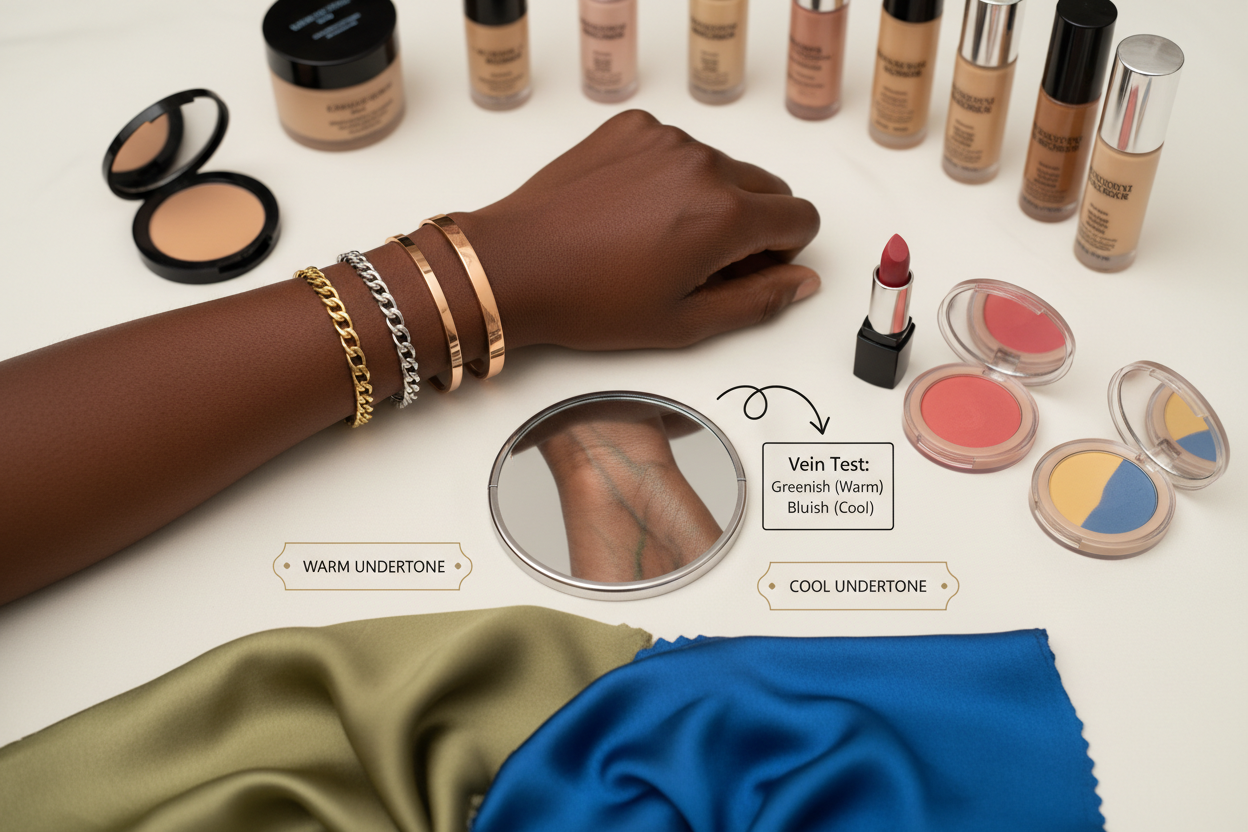
Here are three adapted methods that work more reliably on deep skin:
1. The Inner Wrist Test—in Natural Daylight, Not Artificial Light Go outside or stand near a window with unfiltered natural light. Look at the skin on the inside of your wrist where it's thinnest. You're not looking for vein color alone—look at the overall tone of the skin itself. Does it have a yellowish, honey, or peachy quality? That points warm. Does it have a reddish, blue-gray, or ash quality? That points cool. Neither? Neutral.
2. The Jewelry Test on the Inner Arm Hold a piece of gold jewelry and a piece of silver jewelry against the inner side of your forearm—not your hand, where the skin tone often differs. The metal that makes your skin look more even, luminous, and alive is your match. Gold points warm, silver points cool. If both look equally good (or equally "meh"), lean neutral.
3. Your Sun Reaction Does your skin tan easily and deepen to a warm golden-brown in the sun? Warm undertone. Does it redden, ashen, or turn a deeper cool brown-gray? Cool undertone. This is a secondary cue, not a standalone test, but it's useful for confirmation.
If you're still uncertain after these three methods, a digital color analysis tool—which reads your coloring across multiple dimensions rather than a single data point—is the fastest way to get a confident answer.
Best Colors for Warm Undertones in Dark Skin
Warm undertones in deep skin create a naturally rich, luminous base. The colors that work with that warmth share the same earthy, sun-drenched character—and the combinations that really pop play warmth against depth.
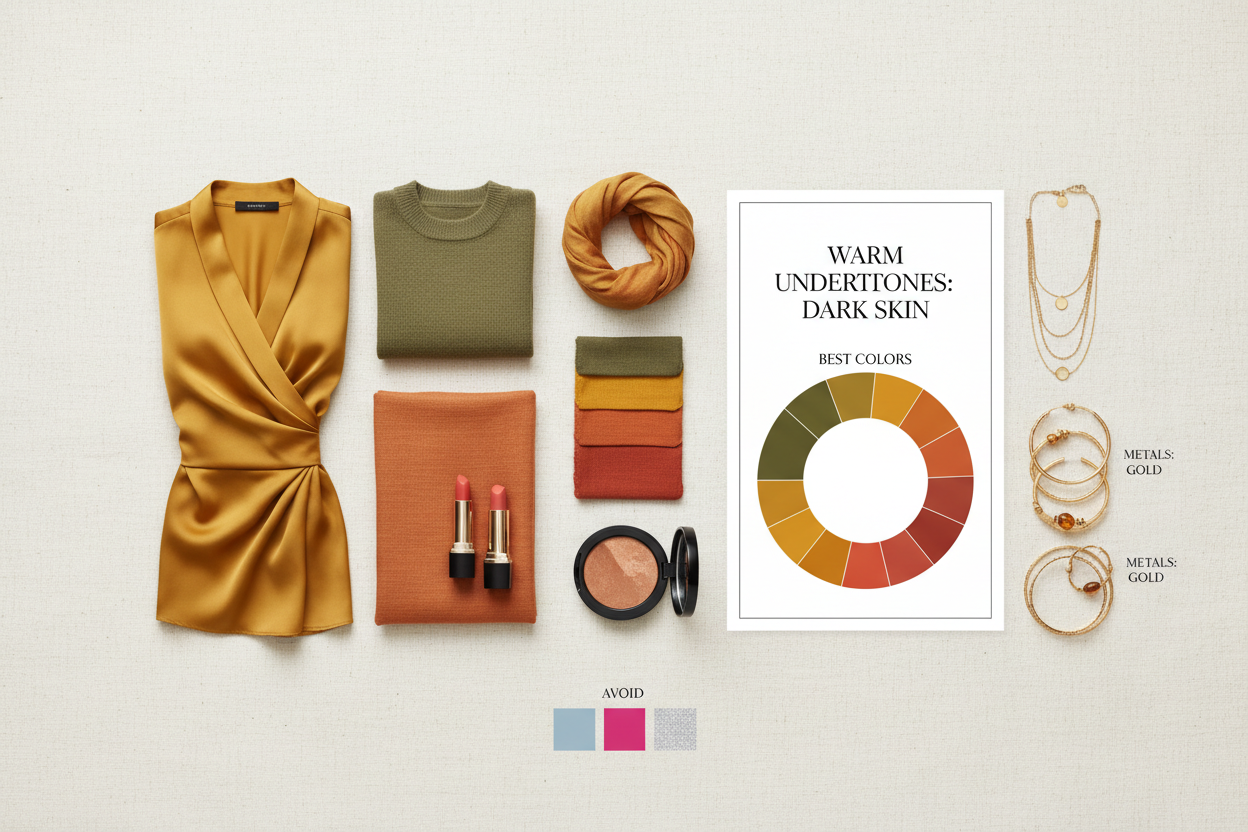
Highest-confidence colors for warm undertones:
- Terracotta and burnt orange – the orange family in clothing echoes the golden base of the skin without competing with it
- Rich camel and warm toffee brown – analogous to your skin's own warmth; creates a tonal, sophisticated effect
- Mustard and golden yellow – pulls the gold undertone forward dramatically; works in both natural and artificial light
- Warm red and tomato red – reds with orange in their base (as opposed to blue-base reds) work beautifully here
- Olive green and moss green – earth-adjacent greens with yellow undertones complement rather than clash
- Deep warm copper and bronze – in metallics, these are the clothing equivalent of the jewelry test
- Cream and warm white (not stark white) – a white with a slight yellow or ivory cast sits better against warm skin than cool, blue-toned whites
Colors to use with intention: Cool-base blues and stark whites aren't off the table, but pairing them with a warm-undertone anchor piece will keep the look balanced.
Warm-Undertone Color Combinations That Create Maximum Impact
Single-color advice only goes so far. Here's how to build combinations using two color theory principles: analogous harmony (colors that sit near each other on the color wheel) and complementary contrast (colors opposite each other):
| Combination Type | Example Pairing | Why It Works |
|---|---|---|
| Analogous warmth | Burnt orange top + deep chocolate brown trousers | Both hues share a warm, earth-tone family; unified and rich |
| Complementary contrast | Mustard yellow dress + warm burgundy accessories | Yellow and red-violet are near-complementary; high visual energy without clashing |
| Tonal depth | Terracotta blouse + camel trousers + gold jewelry | Three warm tones at different depths create dimension |
| Warm-neutral anchor | Olive green jacket + warm white tee + cognac boots | The neutral white balances the outfit while keeping the warm palette intact |
The principle: anchor a high-saturation warm color with a deeper or more muted warm neutral rather than cooling it down with gray or stark white.
Best Colors for Cool Undertones in Dark Skin
Cool undertones in deep skin—particularly in ebony and deep reddish-brown complexions—create a natural contrast base. The colors that work best lean into that contrast rather than softening it.
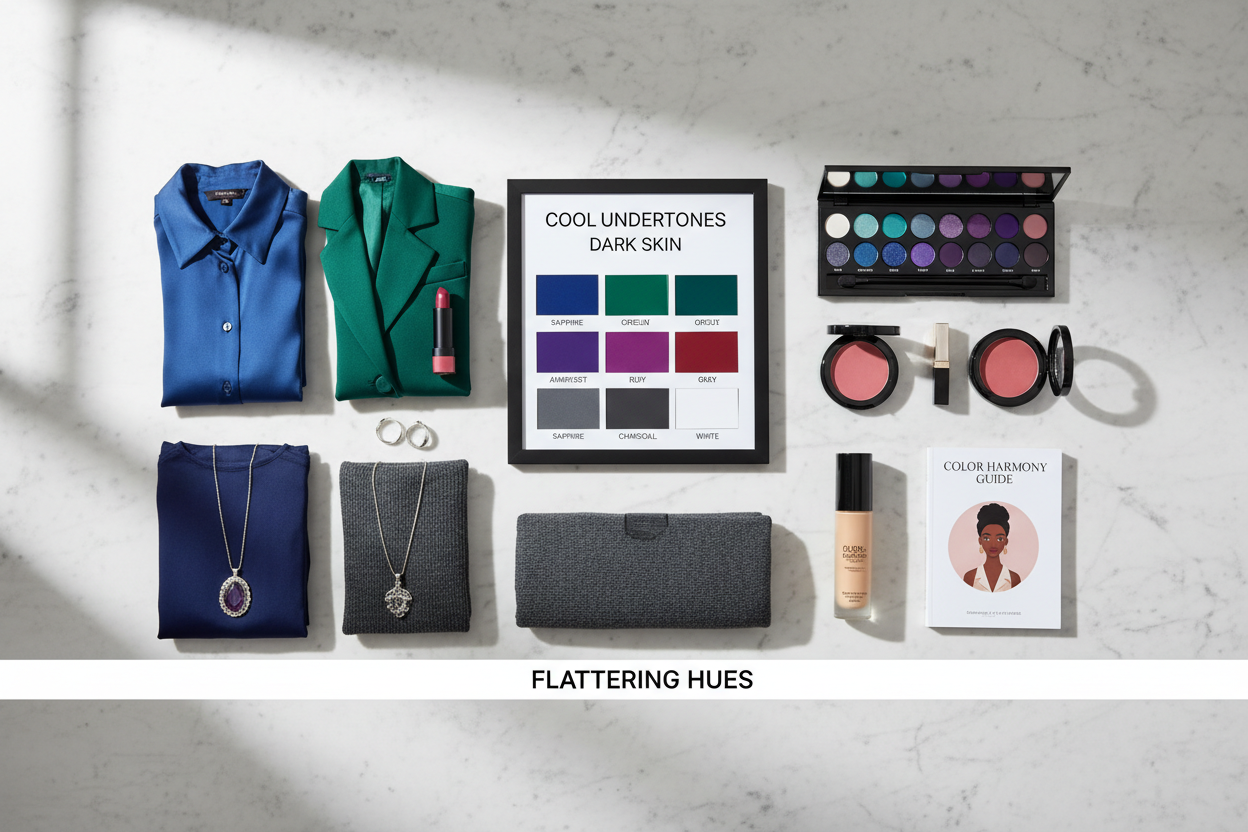
Highest-confidence colors for cool undertones:
- Sapphire blue – the cool depth of this jewel tone plays directly off your undertone
- Royal and cobalt blue – high-saturation blues with a cool base hit maximum luminosity
- Emerald green – cool, vivid, and complementary to the reddish depth common in cool-undertone dark skin
- Royal purple and deep violet – the red-blue mix in purple echoes what's already in your undertone
- True fuchsia and deep magenta – pink-based reds with a blue lean work where orange-reds often don't
- Slate and charcoal gray – cool neutrals that read clean without draining warmth you don't have to spare
- Icy pastels at high saturation – ice blue, lavender, pale lilac can work when they have genuine intensity; milky or washed-out versions tend to read ashy against deep cool skin
Want to confirm your cool undertone and get a custom palette? Start your color analysis →
Best Colors for Neutral Undertones in Dark Skin
Neutral undertones are genuinely the most flexible of the three groups—but that flexibility can feel like uncertainty if no one explains what it actually means. A neutral undertone doesn't mean "no undertone." It means your warm and cool elements are balanced enough that you can borrow from both palettes without much compromise.
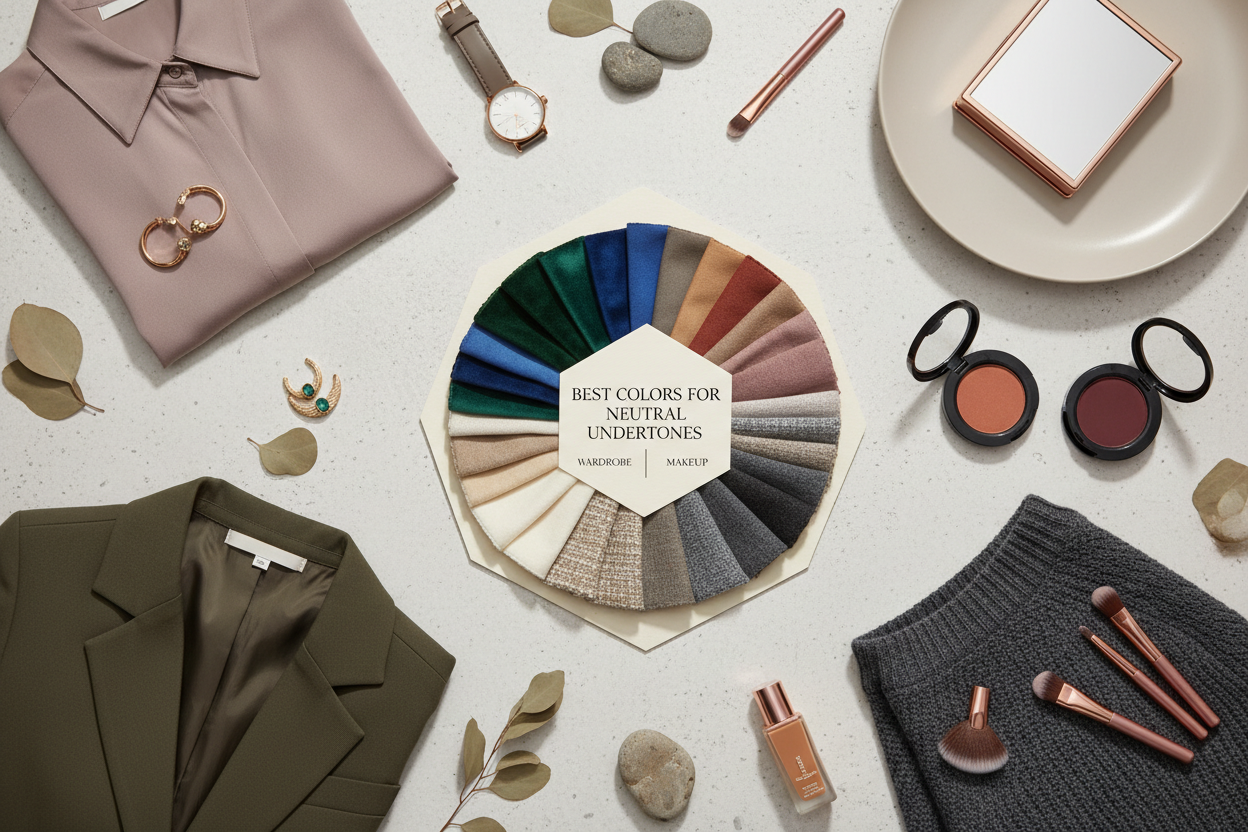
Colors that work with near-universal reliability for neutral dark skin:
- True red – not orange-red or blue-red; a balanced red sits at the meeting point of warm and cool and consistently flatters neutral undertones
- Classic navy – deep enough to provide contrast, neutral enough in temperature not to tip too warm or too cool
- Forest green – a medium-depth green with neither strong yellow nor strong blue is a reliable choice
- Balanced nude and medium brown – a nude that's genuinely close to your skin in depth (rather than a beige designed for lighter skin) creates clean, contemporary looks
- Burgundy and wine – these sit between warm and cool, which is exactly why they work here
- Cream and ivory – as with warm undertones, these outperform stark white, though neutral undertones handle pure white better than warm or cool extremes do
Your advantage: You can draw freely from both the warm and cool palettes above. The practical move is to notice which side of neutral you lean toward in different lighting—many people classified as "neutral" have a slight warm or cool preference—and use that as a secondary guide.
Colors to Approach with Caution—and How to Make Them Work
No colors are absolutely off-limits for dark skin, but some need more deliberate handling to avoid flattening or graying the complexion. Knowing why is more useful than a simple avoid list.
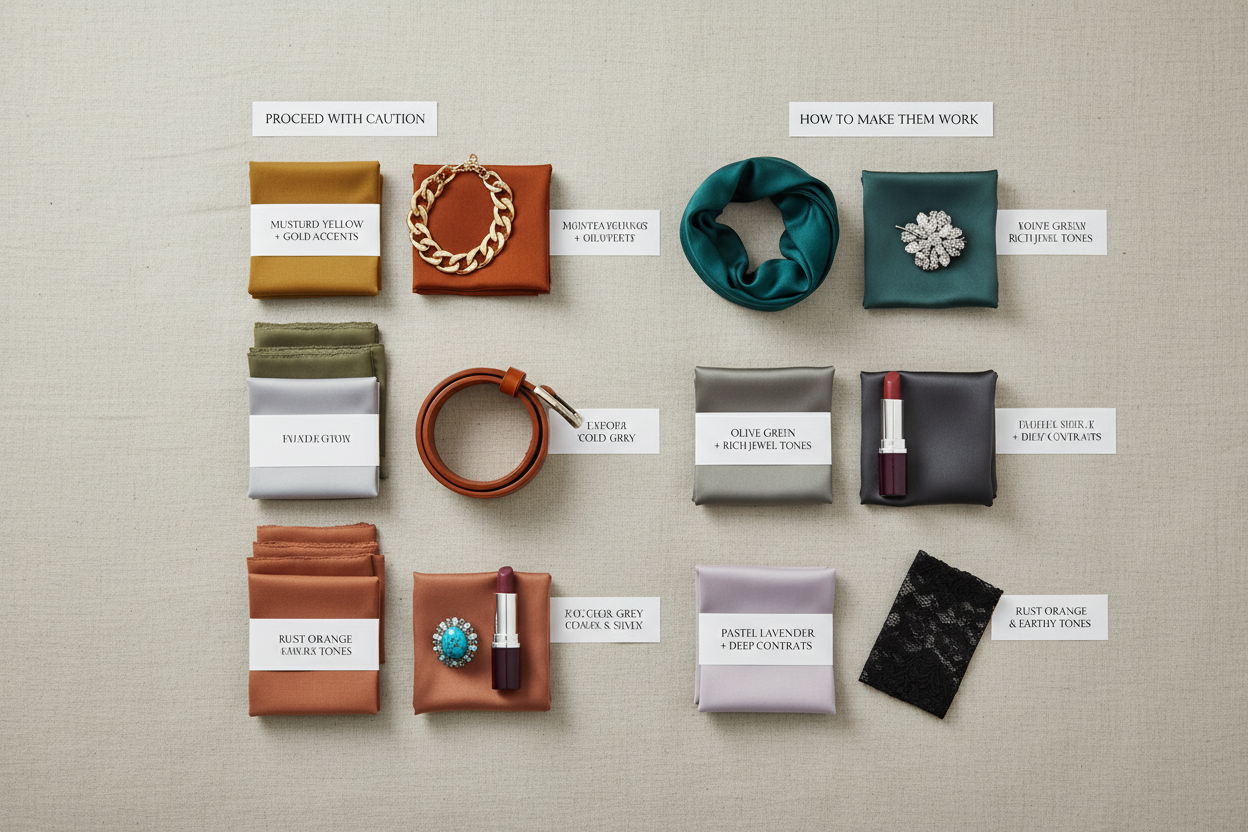
Muted, low-saturation neutrals (taupe, drab khaki, dusty mauve) The problem isn't the hue family—it's the saturation. Grayed-down colors have low contrast with deep skin, so both the color and the skin end up looking flat at the same time. Fix: Stay in the same hue family but go richer. A vivid plum instead of dusty mauve. A deep olive instead of drab khaki.
Washed-out or milky pastels Very pale, low-saturation pastels can read ashy or chalky against deep skin, especially with cool or neutral undertones. Fix: Look for pastels that still carry real color presence—ice blue, saturated lavender, pale coral with actual depth—rather than versions that look like they've been diluted.
Muddy browns and warm neutrals on cool undertones If you have a cool undertone, orange-leaning browns can bring out reddish or ashy qualities in your complexion in ways that don't flatter. Fix: Stick to cooler browns like dark espresso or charcoal-brown, or balance a warm brown with a cooler dominant piece.
Neon yellows and yellow-greens These fight with the skin's natural pigment depth in a way that reads chaotic rather than energetic. Fix: Anchor the yellow-green piece with a deep neutral—chocolate brown or black—to keep it from overwhelming the look.
The guiding principle: color theory is about adjustment, not elimination. Saturation, pairing, and undertone alignment are the actual tools.
Building a Complete Color Palette Around Your Dark Skin Tone
A wardrobe built on random color choices—even individually flattering ones—rarely comes together as a whole. A structured palette gives you a framework. Color theory backs this up: you get more mileage from a small set of intentional hues than from a broad collection of pieces that don't quite connect.
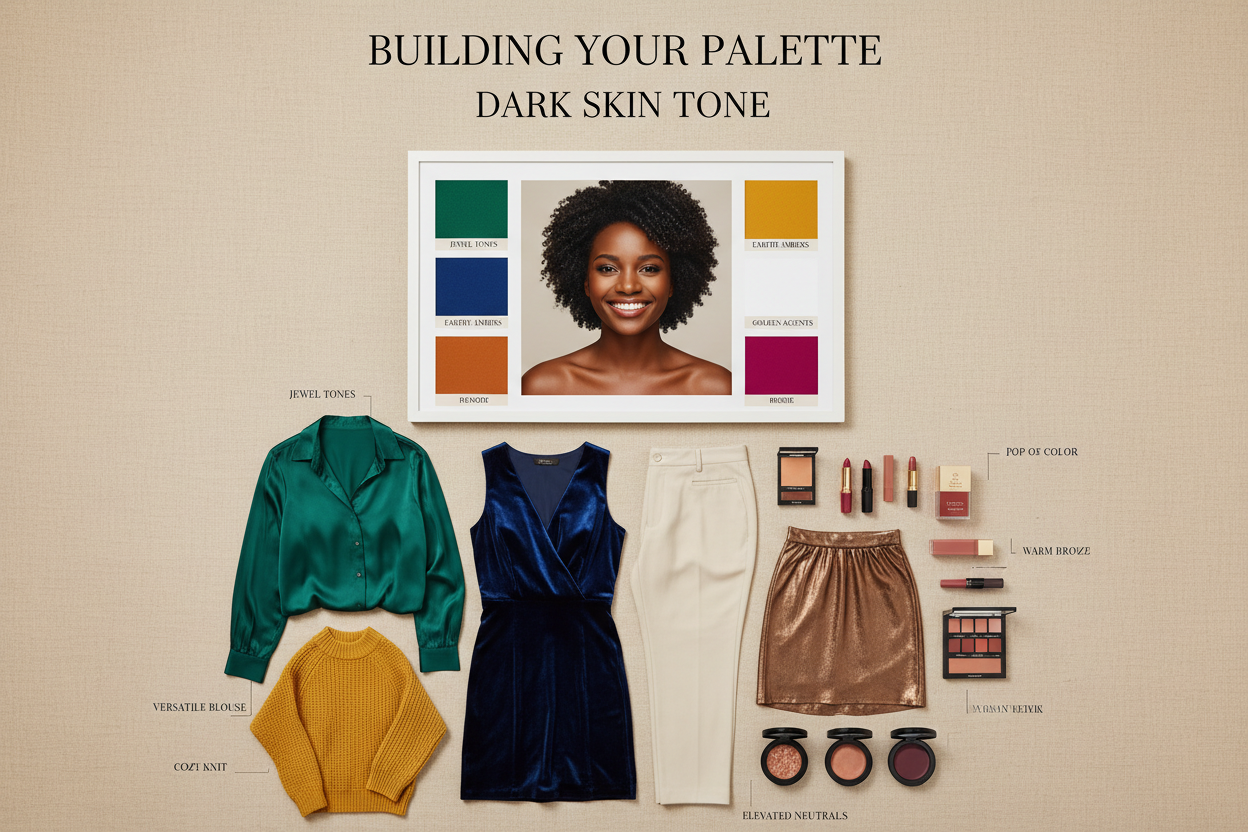
A practical four-part palette structure:
Hero color – Your highest-impact color, chosen from your undertone category. This goes in statement pieces: dresses, blazers, tops that lead the look. For warm undertones, think terracotta or burnt orange. For cool, sapphire or emerald. For neutral, true red or forest green.
Two supporting colors – Colors that work with your hero through analogous or complementary relationships. These show up in separates, layering pieces, and accessories. They give you flexibility without making outfits feel random.
One neutral anchor – A deep or balanced neutral that grounds everything. For warm undertones: camel, warm chocolate, or cognac. For cool: slate, charcoal, or deep navy. For neutral: classic navy or espresso brown.
A metal accent – Gold for warm undertones, silver or white gold for cool, either for neutral. Jewelry, hardware, and shoe details in the right metal finish an outfit in a way that purely clothing-based advice tends to miss.
When building outfits from this palette:
- Lead with the hero color in the largest piece
- Use one supporting color in a secondary piece or layering item
- Ground with the neutral anchor
- Add the metal accent to finish
Your specific undertone category determines which hues fill each slot—that's the color theory principle the whole framework rests on.
Seasonal Color Analysis and Dark Skin: What the System Gets Right and Wrong
You may have come across seasonal color analysis—the idea that personal coloring maps onto archetypes like Deep Autumn, Deep Winter, Soft Summer, and so on. For dark-skinned women, the most common placements are Deep Autumn (warm undertone, high contrast) and Deep Winter (cool undertone, very high contrast), with some women falling into adjacent seasons.
What the system gets right:
- It correctly identifies that depth and contrast matter alongside undertone, not just one or the other
- The Deep Autumn and Deep Winter palettes suit many dark-skinned women well—rich, saturated colors rather than muted or light ones
- It gives you a vocabulary for understanding why certain colors work, which is genuinely useful
Where it requires adaptation:
- Seasonal analysis was developed primarily with lighter-skinned European complexions in mind; some seasonal palettes contain colors that were defined partly by how they appear on fair skin
- The system can become overly prescriptive—"you are a Deep Winter, therefore avoid all warm colors"—in ways that do not account for the full range of personal preferences and individual variation within dark skin
- Eye color and hair color, which factor heavily into seasonal assignments, look different on dark skin and require adjusted interpretation
The practical takeaway: Seasonal analysis is a useful starting map, not a final destination. Use it to find a cluster of colors worth trying, then filter those recommendations through your specific undertone and test them against your actual skin, hair, and eyes. The undertone-based framework in this article is more immediately applicable because it focuses on what actually matters for deep complexions.
People Also Ask
What colors look best on dark skin women?
Colors that consistently flatter dark skin tend to be rich and saturated rather than muted or washed out. Jewel tones—sapphire, emerald, royal purple—work across most undertones. Beyond that, the best choices depend on your specific undertone:
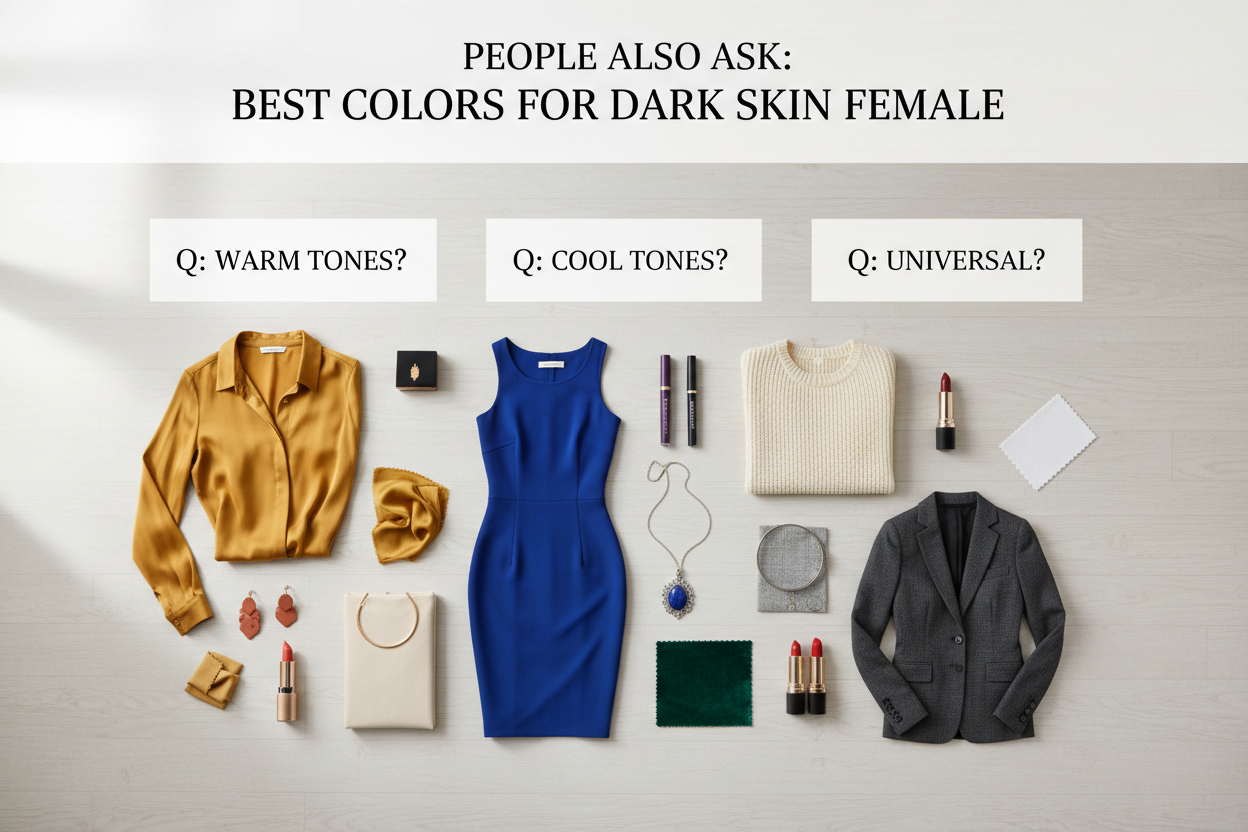
- Warm undertones: terracotta, burnt orange, mustard yellow, warm red, olive green
- Cool undertones: cobalt blue, emerald green, deep violet, fuchsia, slate gray
- Neutral undertones: true red, classic navy, forest green, burgundy
The through-line is saturation. Deep skin tones do better with colors that have real presence than with pale or grayed-down versions.
How do I find my undertone if I have dark skin?
Standard undertone tests—especially the vein test—are less reliable on deep skin because high melanin makes veins look uniformly dark. A few approaches that work better:
- The inner wrist test in natural daylight: Look at the skin itself, not the veins. A yellowish or honey quality suggests warm; a reddish or ash-gray quality suggests cool.
- The jewelry test: Hold gold and silver against your inner forearm. Whichever makes your skin look more luminous indicates your undertone—gold for warm, silver for cool, both working equally for neutral.
- Your sun reaction: Skin that deepens to a warm golden-brown in sun leans warm; skin that reddens or turns a cool gray-brown leans cool.
If you're still not sure after trying these, a digital color analysis tool that looks at multiple dimensions of your coloring at once tends to give a more definitive answer.
What colors should dark-skinned women avoid?
No colors are truly off-limits, but some shades need more careful handling:
- Low-saturation, muted neutrals (dusty taupe, drab khaki, washed-out mauve) can look flat against deep skin because there's not enough contrast. The fix is usually the same hue at a higher saturation.
- Milky or faded pastels tend to read ashy on deep complexions. Pastels with real intensity—ice blue, saturated lavender—work much better than the pale, chalky versions.
- Very warm, orange-leaning browns can be unflattering on cool undertones, where they sometimes bring out unwanted ashiness. Cooler browns like espresso or charcoal-brown are a safer bet.
The short version: it's not about avoiding specific colors, it's about avoiding low saturation and undertone mismatches.
Do jewel tones work for all dark skin undertones?
Most jewel tones work well on dark skin because their high saturation creates a strong visual presence—but which ones look best still depends on your undertone:
- Warm undertones tend to do well with jewel tones that have warm bases: deep amber, rich topaz, warm emerald, deep gold
- Cool undertones get the most out of cooler options: sapphire, amethyst, cool emerald, deep ruby with a blue base
- Neutral undertones can pull from both groups and generally work with the full jewel-tone spectrum
No jewel tone is universally off-limits for dark skin, but matching the temperature of the tone to your undertone makes a noticeable difference.
What is the best neutral color for dark skin?
The most reliable neutral depends on undertone, but a few options work well across deep complexions:
- Deep navy is about as close to a universal neutral as exists for dark skin—cool enough for cool undertones, deep enough that it won't wash out warm ones
- Warm chocolate brown works well for warm and neutral undertones and provides rich contrast
- Espresso or charcoal are solid cool-side neutrals that anchor an outfit without dulling the complexion
One thing worth knowing: stark, blue-toned white tends to underperform as a neutral on dark skin. Cream, ivory, or warm white is a more flattering everyday choice for warm and neutral undertones, while cool undertones can pull off a cleaner, brighter white more easily.
Can dark-skinned women wear pastels?
Yes, but saturation matters. The pale, milky versions you see everywhere in fashion can look ashy or chalky against deep skin. The versions that actually work have real color behind them:
- Ice blue rather than faded sky blue
- Saturated lavender rather than washed-out lilac
- Pale coral with some depth rather than a barely-there blush
Pairing a pastel with something darker—chocolate brown, navy, or black—helps ground the look so the pastel isn't fighting the richness of the skin. Warm undertones generally do better with peachy, buttery, and mint-leaning pastels; cool undertones with lavender, pale blue, and pink-based ones.
FAQ
What is the single most universally flattering color for dark skin females?
No single color flatters every dark-skinned woman equally. Undertone variation means the same hue reads differently on different complexions. That said, deep jewel tones—particularly rich emerald green and sapphire blue—come closest. Their high saturation creates strong visual presence without washing out a deep complexion, and their mid-temperature hues work for both warm and cool undertones.
If you had to pick one shade, true cobalt or royal blue has the widest cross-undertone performance. It carries enough cool depth for cool undertones and enough vibrancy to illuminate warm ones.
How does hair color affect which clothing colors look best on dark skin?
Hair color is one of three anchors in your personal color profile—alongside skin tone and eye color—and it does shape which clothing colors feel harmonious. The point is that your overall palette should work as a system, not just serve your skin tone in isolation.
In practice:
- Deep blue-black or jet hair adds cool contrast at the top of the frame. Cool-toned clothing—cobalt, deep violet, slate—tends to feel intentional rather than accidental.
- Dark brown with warm highlights (chestnut, auburn) pulls the overall palette warmer. Terracotta, mustard, and warm red clothing echo that warmth well.
- Colored or chemically lightened hair introduces a new variable. If you've added warm copper tones, treat that the same way you'd treat any other warm undertone signal when choosing clothing colors.
The short version: look at skin tone, hair, and eyes together rather than optimizing for one and ignoring the others.
Is there a difference in color recommendations for dark skin with warm versus cool undertones?
Yes. Undertone is arguably more influential than skin depth when it comes to which shades actually work. Two women with the same deep complexion but different undertones can look completely different in the same garment.
Warm undertones (golden, honey, amber qualities in the skin):
- Do well in earthy, sun-warmed hues: burnt orange, terracotta, mustard yellow, olive, warm red
- Rich golds and warm browns tend to be natural allies
- Cool-leaning colors like icy grays or blue-toned whites can read as ashy
Cool undertones (reddish, bluish, or gray-ash qualities in the skin):
- Tend to shine in colors with blue or violet bases: cobalt, deep violet, fuchsia, emerald, cool berry
- Silver tones and true blacks are usually flattering
- Very warm, orange-leaning shades can emphasize an unwanted grayness
Neutral undertones can draw from both groups, which makes them the most flexible. High-saturation versions of any color still tend to outperform muted ones regardless of undertone.
Can dark-skinned women wear white, and which shades of white work best?
Yes, but the specific shade matters. Not all whites look the same against deep skin.
- Warm white, ivory, and cream work well across most dark skin tones, especially for warm and neutral undertones. They create contrast without the harshness that stark white can bring.
- Bright, pure white tends to suit cool undertones better, where it reads as crisp and high-contrast rather than draining.
- Blue-toned or stark white can emphasize ashiness in cool undertones if the pairing isn't managed carefully—though a cool-undertone wearer usually carries it better than a warm-undertone one.
General rule: warm or neutral undertones, go for cream or ivory before reaching for the brightest white. Cool undertones, you have more flexibility across the range.
What makeup colors complement dark skin with a cool undertone?
Cool undertones in dark skin tend to have a blue, reddish, or slightly gray-ash quality. Shades that work with that base — or create contrast against it — tend to perform best.
Lips:
- Deep berry, plum, cool raspberry, blue-red, and wine tones are consistently flattering
- True reds with a blue base rather than an orange one
Eyes:
- Jewel-toned shadows — deep violet, sapphire, cool bronze with gray in it — bring out the richness of cool-toned deep skin
- Charcoal and cool slate liner over warm brown
Foundation and highlight:
- Foundations with pink or neutral undertones rather than strongly golden formulas
- Highlighters with a pearl or silver sheen rather than warm gold, which can read muddy against a cool base
Blush:
- Cool berry, dusty rose, and plum-side blushes tend to sit more naturally than warm peach or copper
How do I use color theory to build an outfit palette around my dark skin tone?
Color theory gives you a practical framework for building outfits that feel cohesive rather than accidentally thrown together. Here's how it works in practice:
Identify your personal color anchors. Figure out your skin undertone (warm, cool, or neutral), your natural hair color, and your eye color. These three things form the foundation of your most flattering palette.
Pick a dominant hue that works with your undertone. Start here—a rich jewel tone, a warm earthy shade, or a cool deep hue depending on what you found in step one. High saturation tends to read better on dark skin than muted or washed-out versions of the same color.
Build around it using color relationships:
- Complementary pairing (colors opposite on the wheel) creates strong visual contrast—cobalt blue against warm orange, for instance
- Analogous pairing (neighboring colors) creates harmony—forest green with teal and navy
- Neutral anchoring grounds bolder choices—navy, espresso brown, or charcoal paired with a single vibrant hue
One thing that's easy to get wrong: neutrals need to be deep enough to actually provide contrast against a rich complexion. Very light, low-saturation neutrals tend to flatten rather than anchor.
Does eye color matter when choosing the best colors for dark skin females?
Eye color is part of your overall color picture, and while skin undertone and depth usually matter more, it can still nudge your palette in useful directions.
- Very dark brown or near-black eyes are common among dark-skinned women and don't really restrict your options. Deep, saturated colors tend to work well across the board.
- Medium warm brown eyes with golden or amber flecks look especially good with warm, earthy tones that echo those highlights—burnt orange, olive, rich caramel.
- Dark eyes with cool undertones (the kind that look almost black with a blue or gray depth) tend to pair well with the same cool jewel tones that suit cool-undertone skin—deep violet, cobalt, cool emerald.
- Hazel or lighter eyes are less common on deeply pigmented skin, but when they appear they create real contrast. Warm amber clothing tones can make those eyes pop noticeably.
The short version: eye color rarely overrules undertone, but when you're deciding between two options that both look good, the shade that echoes or complements your eye color will pull everything together more cleanly.
Not sure how your skin undertone, hair color, and eye color interact? Take the color analysis quiz and get a read on all three at once.
To compare this result with a neighboring skin-tone question, use the companion article “Dark Skin Tone Palette Guide”, which keeps the two closely related questions distinct.